Ritual contexts in the Maya Lowlands are often recognized archaeologically as distinct from nonritual contexts in that they can include increased quantities of a diverse suite of materials assembled as patterned deposits. For excavators, these contexts can be difficult to interpret, particularly when they are the accumulation of multiple episodes of deposition. The difficulty is compounded when those deposits include materials otherwise considered refuse or ordinary objects. It then becomes necessary to take into account “how action is ritualized relative to practice in general” (Swenson Reference Swenson2015:330). In this article, we consider deposits of flaked stone—identified by excavators in the Maya Lowlands as ritual deposits—as acts of ritualization in which the action of ritual itself is considered, first and foremost, not as a symbolic statement but as a discursive practice (Barad Reference Barad2007).
Understanding ritual this way allows for the consideration of how materials can be recontextualized, with their meaning and efficacy shifting from one context to the next. In this case, it enables the consideration of just how lithic “dumps,” typical of the everyday discarding of debris, can be repurposed and transformed into an effective and powerful protective layer for select deceased individuals.
For some individuals, particularly those who were transformed into ancestral spirits, a prolonged funeral event could include a series of actions even after burial of the body. Often, the stages in the funeral cycle leave clear material traces that are recoverable archaeologically, as was the case when excavators working in a prominent temple structure in Caracol's “A-Group” encountered 7,599 pieces of chert and 6,774 pieces of obsidian layered in “lenses” above the tomb designated SDC12A-2 (Chase and Chase Reference Chase and Chase1987:15). The chert debitage associated with this tomb located in Structure A3 was not a haphazardly created dump, but rather was a concentrated and patterned layer of materials, a clear example of a more or less intentionally structured deposition (Joyce Reference Joyce, Mills and Walker2008; Joyce and Pollard Reference Joyce, Pollard, Hicks and Beaudry2010). This event included materials with a history of procurement, manufacture, and use that created a chain of relations between people, things, and places. In analyzing the sequence of actions carried out in the burial of a single individual in the city of Caracol during the Classic period, we also consider the crafters whose signatures reside in the materials included in the event as part of their bundled characteristics (Keane Reference Keane2003).
In this article, we present a technological analysis of the flaked stone debitage found layered above a tomb identified as SDC12A-2 in Caracol's Structure A3 and compare the results to the flaked stone found in residential groups engaged in flaked stone production; we then argue that the similarities in the assemblages of both contexts provide evidence suggesting that crafters in the city of Caracol were periodically called on to provide flaked stone for the funerary events of the royal elite. Inclusion of the flaked stone debris produced by crafters, we claim, connected those communities to the burial event and linked them to a prominent ceremonial space.
After presenting the technological analysis of flaked stone and describing the entire burial context, we conclude with a discussion that considers the practice of layering itself as a ritualized act. From this perspective, the layering of flaked stone is similar to other reported ritualized acts but uses different materials, including plaster, textiles, and clay. Finally, we suggest that, by using a practice-based approach to ritual studies, which understands that relationships with materials can shift from one context to the next, additional archaeological examples may be recognized as similar to those described here.
Ritualized “Lithic Dumps” in the Classic Period Maya Lowlands
There have been multiple recorded cases in which large collections of flaked stone were found deposited above tombs in the Maya Lowlands (Chase and Chase Reference Chase and Chase1987:15, Reference Chase and Chase1996:71–75; Hall Reference Hall1989; Hruby and Rich Reference Hruby, Rich, Navarro-Farr and Rich2014; Johnson Reference Johnson2016; Moholy-Nagy Reference Moholy-Nagy1997; Pendergast Reference Pendergast1981, Reference Pendergast and Braswell2003; Trachman Reference Trachman1999). These contexts tend to be some of the most materially rich burials and are found in some of the largest elite or temple structures. All are dated to the Classic period (AD 250–900). A stratigraphic analysis of mortuary events associated with these lithic “dumps” suggests they were deposited after the grave was closed, thereby sealing the body and all offerings below.
The sites with known flaked stone deposits above burials are located primarily in the Petén region of Guatemala and Belize. The deposits include the various stages of core reduction and shaped tools typical of the materials found in flaked stone workshops (Hirth Reference Hirth and Hirth2009). At Río Azul, multiple tombs were sealed with layers of chert debitage, mostly from biface production, as well as whole bifacial tools, and were associated with elaborately painted chambers in some of the site's most focal architecture (Hall Reference Hall1989). Similarly, the collection of flaked stone debitage found above tombs at El Perú Waká was primarily made up of materials related to the production of chert bifacial tools (Hruby and Rich Reference Hruby, Rich, Navarro-Farr and Rich2014) and obsidian blades and cores (McCormick et al. Reference McCormick, Hruby, Navarro-Farr, Rich, Eppich and Hruby2021). Taschek and Ball (Reference Taschek, Ball and Kerr1992:492) reported more than 295,000 obsidian pieces, including blades, cores and flakes, and 45,000 pieces of chert “percussion products” from a single burial context at Buena Vista del Cayo in Belize.
At Tikal, the quantities of lithic debitage sealing select Classic period elite tombs were described as “a ton of esoterically distributed flint, perhaps a quarter ton of obsidian may not be far off the mark” (Coe Reference Coe1990:607). Moholy-Nagy's later assessment estimated that more than 100,000 pieces of chert and 220,000 pieces of obsidian were recovered from above-tomb contexts (Reference Moholy-Nagy1997:298). She also explained that the material found outside of tomb entries included “no used artifacts, and only small quantities of little sherds, the kind of rubbish that would be picked up by sweeping, were included in the debitage layers” (Moholy-Nagy Reference Moholy-Nagy1997:304). Her observations suggest that this material was coming directly from crafters in Tikal, as if swept from residential workshop areas and carried to the tombs in basket loads.
Although the majority of these reported concentrated lithic dumps, including the one analyzed here, were made up of flaked stone materials and little else, Tomb F8/1 at Altun Ha, Belize, was sealed with more than 8,000 pieces of chert debitage, along with a host of other materials such as jade ornaments, shell, flaked green obsidian figural forms, and points typical of Teotihuacan (Pendergast Reference Pendergast and Braswell2003). However, as reported, these materials were found in a “jumble” in a matrix that included “core in the upper part of the crypt”; although the “original positions of the objects could not be ascertained,” Pendergast argued, “the dispersion of artifacts throughout the core demonstrates beyond any reasonable doubt that the offering was part of closing ceremonies for the burial” (Reference Pendergast1990:266). In that example, however, there may also be a possibility of multiple episodes of deposition, because there was “no evidence of the crypt roof” that would have clearly separated those materials included inside the grave from those layered above the grave (Pendergast Reference Pendergast1990:263).
The flaked stone layered above the Altun Ha tomb was explicitly described as an offering, yet when considering these contexts at Tikal, Moholy-Nagy (Reference Moholy-Nagy1997:306) suggests, “The accumulations of chert and obsidian debitage placed with chamber burials, as well as with other kinds of special deposits, may well have been regarded as a kind of offering.” Yet chert and obsidian debitage was still production waste that needed to be disposed of, and the construction of monumental architecture and closing and burying tombs provided opportunities for that disposal (Moholy-Nagy Reference Moholy-Nagy2020). These designations—as events of offering or as opportunities for waste disposal—highlight the problems that arise when sharp distinctions are made between symbolic belief and mundane behavior. In the following sections we consider the case of Caracol and the inclusion of flaked stone in the core of structures housing elaborate burials. We argue that the deposition of large quantities of flaked stone, as associated with a ritualized event, transformed the materials from trash to a protective layer for the ancestral dead. In addition, as fragmented things, the materials carry with them a chain of relations including the communities of crafters who have left their signatures, which are identifiable through technological analysis conducted in this study.
Caracol, Belize
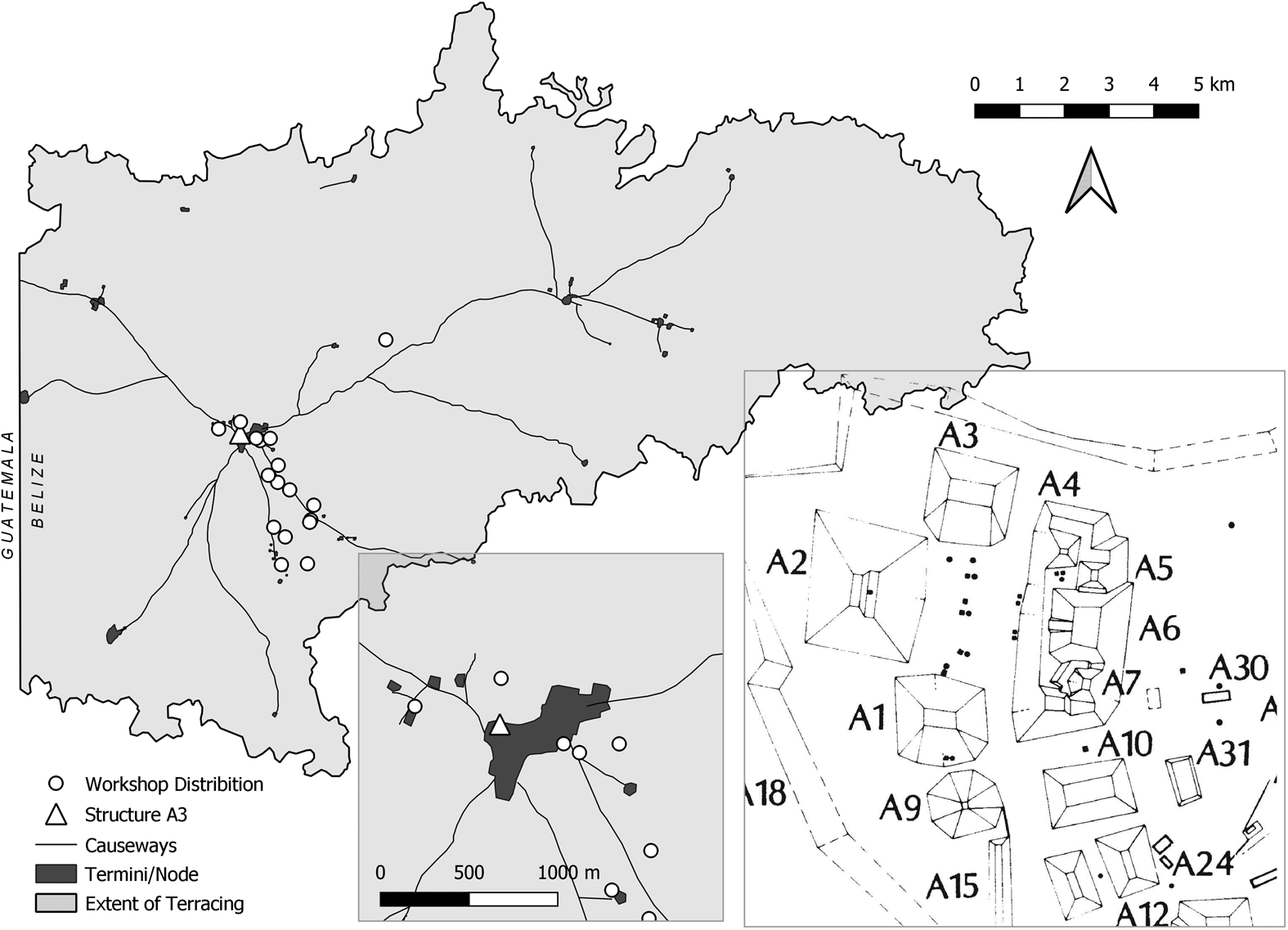
The Classic period Maya city of Caracol, Belize, was constructed on a large karstic plateau and is connected to the geology of the Petén, near the borders of what is today Belize and Guatemala. At the height of its occupation around AD 650, the city encompassed nearly 200 km2 and was home to more than 100,000 people occupying some 9,000 residential groups (Chase and Chase Reference Chase, Chase, Freidel, Chase, Dowd and Murdock2017a). The population was sustained through a landscape of terraced agriculture, multiple causeways linking the residential areas to the site's core, and a number of possible marketplaces (D. Chase and A. Chase Reference Chase and Chase2014). Beginning as a series of independent settlements during the Middle Preclassic period, by the Late Preclassic period (ca. AD 15), the initiation of a ceremonial group (herein referred to as the “A-Group”) served to unify a growing population (Chase and Chase Reference Chase and Chase2006). The A-Group would serve as the city's primary public ceremonial space throughout the Classic period (Chase and Chase Reference Chase, Chase, Freidel, Chase, Dowd and Murdock2017a). After completion of the long, linear platform and its temple structures on the eastern side of the plaza, the construction of tall pyramidal structures continued throughout the Classic period, eventually enclosing the plaza on all four sides (Figure 1). During the Late Classic period, a separate tripartite temple complex, located to the northeast of the A-Group, was completed to a height of more than 40 m tall. This structure, called Caana, or “sky place,” by archaeologists, was an administrative and ceremonial complex occupied by the ruling elite; together with smaller pyramidal structures it is collectively known as the “B-Group” (Chase and Chase Reference Chase and Chase2017b). It is primarily within these two groups that individuals of the royal house were buried throughout the Classic period; in both groups, collections of flaked stone debitage were found associated with their graves (Chase and Chase Reference Chase and Chase1987; Johnson Reference Johnson2016; Pope Reference Pope, Chase and Chase1994).
Overview of site with inset of Caracol's epicenter and a second inset showing the configuration of the A-Group and the location of Structure A3 (after Chase and Chase Reference Chase and Chase1987, Reference Chase and Chase2016).

Whereas the veneration of the royal ancestral dead occurred in Caracol's largest temple structures of the A- and the B-Groups, mortuary rituals for the rest of the population generally took place in smaller household mausoleums situated on the eastern side of a four-sided plaza group (Chase and Chase Reference Chase, Chase, Fitzsimmons and Shimada2011). Archaeological investigations of both the epicentral “downtown” area and the surrounding residential groups reveal the extent to which the population of Caracol was integrated by a set of shared ritual practices, made possible by the complex network of causeways and marketplaces that enabled interaction. Among the goods that may have been made available through markets were mass-produced pots with modeled faces and small, shallow bowls, also known as “face caches” and “finger bowls” (Chase and Chase Reference Chase and Chase2013). Both face caches and finger bowls (so called because they are often found with human phalanges inside of them) were some of the most commonly offered goods in household mausoleums. The solidification of a “Caracol identity” appears to have occurred by the Late Classic period with nearly 60% of the population estimated to have practiced the eastern mausoleum tradition, many of which included offerings of face caches and finger bowls (Chase and Chase Reference Chase and Chase2004). The network of causeways and markets also connected communities of lithic crafters to the greater population, as is evident through the relatively even distribution of crafting-intensive households throughout the city (Figure 1). Based on the excavation of more than 150 residential groups and the major ceremonial groups in the core of the city, it has become clear that varied quantities of flaked stone (both tools and debitage) were often included in funerary and veneration-related events for both the royal line and the rest of the population (Johnson Reference Johnson2016:283–337). Although numerous funerary contexts throughout the city included flaked stone, a select few contained quantities exceeding thousands. In the following sections, we discuss one of the largest collections of flaked stone recovered from a burial context in Caracol, which was inside the major ceremonial temple, Structure A3.
The Funerary Event in Structure A3
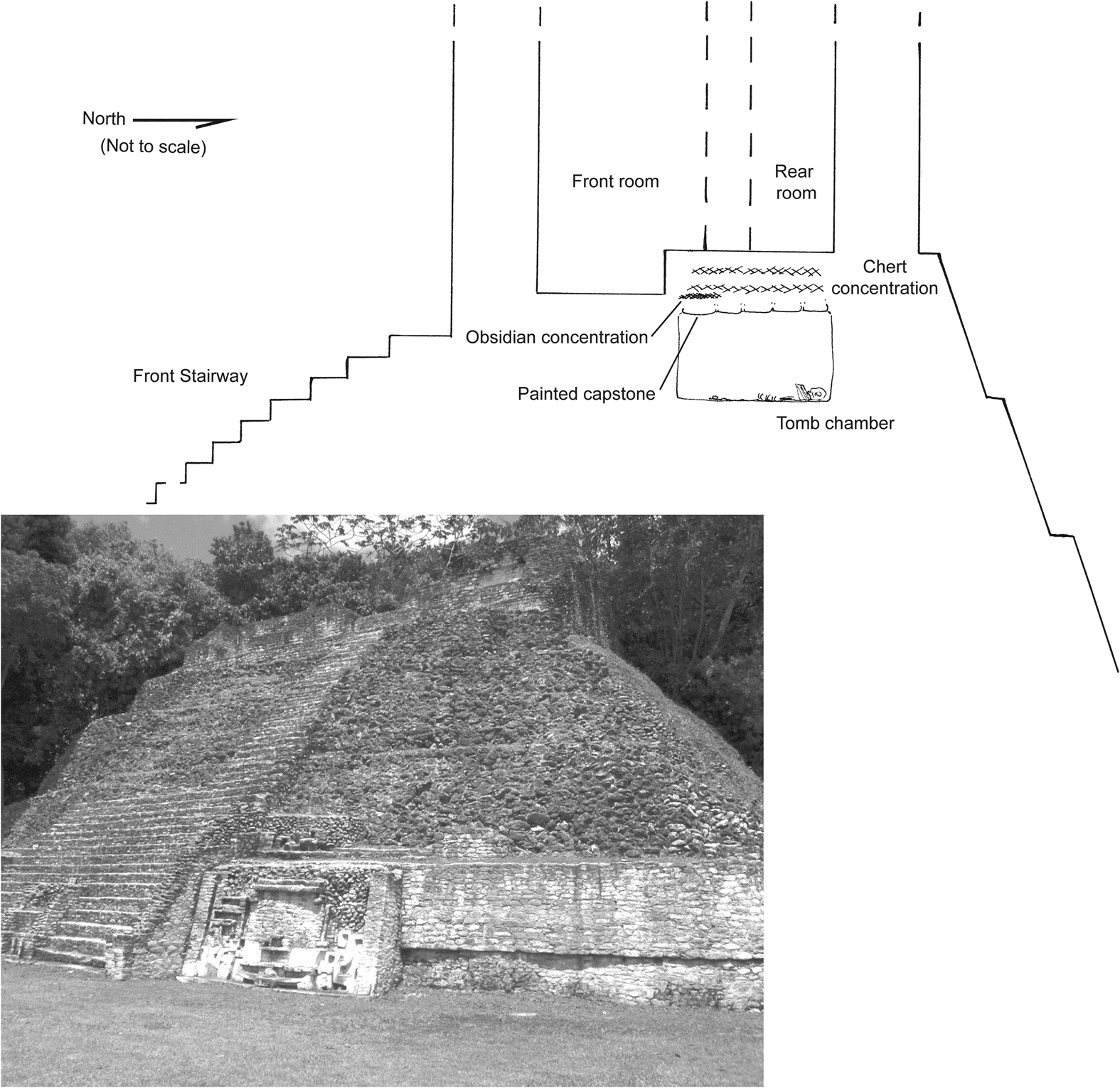
The structure known as A3, which was 16 m tall, was constructed on the north side of the A-Group plaza during the Late Classic period. It was elaborately decorated with stucco designs and painted red, as evident through the fragments of modeled stucco and red paint recovered in excavations (Chase and Chase Reference Chase and Chase1987). On the summit of the structure were two parallel, linear rooms with a single entryway separating them. The front room had three entrances facing out to the main plaza. A tomb was constructed directly below the interior doorway separating the two rooms (see Chase and Chase [Reference Chase and Chase1987] for a complete description of the excavations).
The Structure A3 tomb (designated Special Deposit C12A-2 or SDC12A-2) was constructed for a single adult individual. The state of preservation made the identification of a specific sex or age difficult. Included in the grave were 13 black-throated bobwhite birds, placed at the individual's feet (Morton Reference Morton, Chase and Chase1987:108). Ceramic cylinders and bowls were placed around the head and torso of the individual, some of which were identified by Arlen Chase as “Cohune Red, Benque Viejo Polychrome and a Red-on-Orange type and dated to the Late Classic period” (Chase and Chase Reference Chase and Chase1987:17). The tomb was then closed with a series of capstones. The southernmost capstone was painted with a calendar round date and the Caracol emblem glyph, suggesting the tomb was closed during AD 695 and that the deceased individual was an important member of the Caracol polity. Once the capstones were in place, those present for the funeral event then layered chert debitage, blades, and drills across the length of the grave and obsidian debitage and blades above the painted capstone (Figure 2).
Reconstructed stratigraphic section showing the location of the A3 tomb in association with the front and back rooms, with inset of black-and-white photograph of A3 taken at plaza level. Photograph courtesy of Lisa Johnson.

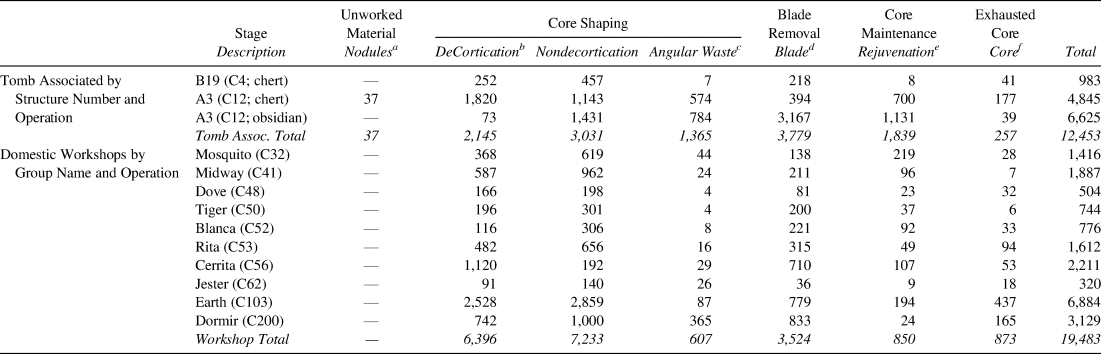
The area above the tomb was excavated as multiple “lots” or spatial units designated as C12A/45 on the eastern side and C12A/47 on the western side of the excavation. C12A/49 was assigned to an area directly below these two lots to remove the last of the matrix and lithic debris and clear the capstones (Table 1). Once funeral attendants sealed the grave, it signaled the completion of one stage in the funerary cycle, with the body of the dead removed from the world of the living (Weiss-Krejci Reference Weiss-Krejci, Colas, LeFort and Persson2006). Archaeologically recovered traces overlying the grave suggest the cycle was not complete and that the living continued to visit the grave as the deceased underwent the transformation into a royal ancestral spirit.
Structure A3 Excavation Units and Associated Flaked Stone Assemblages from above Capstones of Vaulted Tomb, Special Deposit C12A-2 (SDC12A-2).

A feature described by the excavators as a bench (but which may have also served as an altar) was constructed to cover the tomb in the central doorway and provide a space for continued interaction with the dead below. A geometric design was incised on the surface of the plastered bench feature. The pattern of the design is identical to those reported in other Classic period Lowland Maya sites, which archaeologists have often described as “patolli” boards, after a Postclassic Aztec game involving a board with a similar series of squares patterned in a cruciform shape (Becker Reference Becker1999).
The rear floor was burned: dates recovered from the burnt floor indicated that these actions were carried out shortly after the burial of the individual below, suggesting that the liminal phase between biological death and the transformation into ancestral spirit was relatively short (Chase and Chase Reference Chase, Chase, Cecil and Pugh2009). Veneration most likely occurred while the individual remained in living memory. It is unclear when the altar and the floor would have been incised, but after Structure A3 had largely fallen out of use, a set of incensarios was placed on an axis to the back room (Chase and Chase Reference Chase and Chase1987:9, Reference Chase and Chase2020:79), indicating the continued importance of this location.
Flaked Stone and a Community of Crafting at Caracol
The thousands of fragments and drill tools included in the elaborate funerary event were most likely provided by the surrounding households engaged in intensive lithic crafting. The flaked stone industry of Caracol has been investigated through multiple studies of chert and one study of the obsidian (Johnson Reference Johnson2014, Reference Johnson2016; Johnson et al. Reference Johnson, Carpenter, Chase and Chase2015; Pope Reference Pope1996). To date, analyses have shown very little intensive effort to make bifaces; much of the domestic flaked stone reduction was focused on producing blades. The residential groups involved in flaked stone tool production were spatially distributed across the city and do not appear to have been managed or controlled by a ruling elite in the city center, suggesting independent specialization. Furthermore, reduction practices appear to be highly standardized for the production of small, robust chert blades likely used as contingent tools in the multicrafting process to create crafted objects of shell, slate, or other materials (Johnson Reference Johnson2008; Pope Reference Pope1996). These materials, both flaked stone and other debris from crafting, are typically recovered from secondary contexts such as structure construction fill within trench excavations. The residential groups with elevated numbers of flaked stone debitage and finished tools are outliers. Arguably, these select households likely produced the flaked stone debris and included it in construction fill during episodes of expansion, rather than collecting debris from other, more distant places.
Chert Blade Production at Caracol
Although access to flaked stone was relatively unrestricted, with chert and obsidian tools found in nearly every residential group that has been excavated to date, a much smaller number of residential groups was found to have flaked stone pieces from the production process (Johnson Reference Johnson2016). Evidence of intensive domestic lithic production is indicated by the recovery of complete or nearly complete reduction sequences. In addition, percussors (e.g., hammerstones, anvils, antler tines) and used chert blade tools (e.g., drills) are also found. At least 11 crafting-intensive residential groups (i.e., workshops) had evidence of discrete dumping episodes (Johnson Reference Johnson2008, Reference Johnson2014; Johnson et al. Reference Johnson, Carpenter, Chase and Chase2015; Pope Reference Pope1996:Table 2). These are secondary deposits of refuse likely collected from cleaning episodes of the household plaza spaces. As of 2019, 17 residential groups with evidence of intensive lithic reduction have been documented (Figure 1). Pope (Reference Pope1996) describes nine of these and demonstrates that they are domestic workshops with complete reduction sequences (Table 2). These particular residences are unusual because they have notably high frequencies of chert flaked stone counts relative to other domestic groups of similar size where similar excavation methods were used. They are evenly dispersed across the city, along causeways and in areas that would have had pathways to provision markets with tools intended for nonproducing households. The craftspeople in these domestic lithic workshops also appear to have used their tools to modify shell and slate, because excavators often found the debitage from those activities along with the flaked stone material (Pope Reference Pope1996:72).
Summary of Analyzed Flaked Stone Counts by Reduction Stage for Associated Above-Tomb Contexts and Previously Analyzed Domestic Chert Flaked Stone Workshops.

aNodules were not counted by Pope Reference Pope1996.
bIncludes primary and secondary (Pope Reference Pope1996).
cIncludes shatter and blocky fragments (Pope Reference Pope1996).
dIncludes used and unused drills, complete and fragments.
eIncludes “trimmed flakes” and “ridge flakes” (Pope Reference Pope, Chase and Chase1994:153–154, Reference Pope1996:64–66, Figure 3a–f), also referred to as core tops, core platforms, or core tablets.
fIncludes complete and fragments.
Of the two groups that underwent intensive study, in which all matrix was screened using a ¼- and ⅛-inch mesh, investigations at the “Dormir” group, a small low-lying residential complex with three structures, yielded 3,129 chert artifacts from a narrow excavation trench: approximately 451 chert artifacts per cubic meter (A. Chase and D. Chase Reference Chase and Chase2014; Johnson et al. Reference Johnson, Carpenter, Chase and Chase2015). Included in this assemblage were unworked nodules, core shaping debitage, core maintenance debris, exhausted cores, and used and unused blade tools. When that assemblage was compared to the collection found above the tomb in Structure A3, it was clear that many of the same stages of production were represented (see Table 2).
In these workshops, fist-sized chert nodules that occur within the local karstic bedrock were split or sectioned and reduced unidirectionally, bidirectionally, or multidirectionally to remove small chert blades. Chert blades were then shaped into a drill-like form. Chert blade tools were typically used in shell crafting or for domestic activities for which drilling or incising was needed (Johnson Reference Johnson2008; Johnson et al. Reference Johnson, Carpenter, Chase and Chase2015). Some of these tools were recovered alongside shell and slate fragments (Pope Reference Pope1996:134). Use-wear studies on a sample of chert blade-like tools indicated a drilling action or repeated back-and-forth movements, perhaps like burins (Pope Reference Pope, Chase and Chase1994, Reference Pope1996). More recent macroscopic analysis with a 20–40× magnification hand lens shows distal striations and tip rounding. Other tools appear to have no use-wear, suggesting discarded tool preforms or those that have some flaw in form or structure. Similar tools have been found in residential groups at Tikal and Xunantunich as well (Braswell Reference Braswell, LeCount and Yaeger2010; Puleston Reference Puleston1969). Importantly, these tools are short blades with lateral retouch and some bulbar thinning, indicating that they could have been backed or hafted. Furthermore, distal features on some of the tools show resharpening by removal of a single pressure flake from a distal/lateral margin. This pressure flake removal effectively removes the dulled bit. The production, forming, and maintenance of these small, yet thick and robust, chert tools were highly standardized as in obsidian blade production (Johnson Reference Johnson2008).
Obsidian Blade Production at Caracol
Identifying the residential groups engaged in obsidian tool production at Caracol is much more difficult, although some can be suggested based on such criteria as relative counts and the presence of percussion debitage to shape and rejuvenate blade cores. However, evidence for obsidian workshops could have been effectively erased, because most obsidian material—both tools and debitage alike—were often included in ceremonial offerings and mortuary events, with only small quantities found discarded (Johnson Reference Johnson2016). Although the materials recovered from residential chert workshops are typically found in the construction fill, similar to what Moholy-Nagy (Reference Moholy-Nagy1997) describes at Tikal, obsidian reduction for the production of blades is inferred through analysis of both ritual and domestic contexts, rather than redeposits of primary workshop debris. The tomb context in Structure A3 is one such example. Other tomb contexts include those from Structures L3 and A34 (see Johnson Reference Johnson2016:Table 7-13). Like chert blade production, obsidian reduction strategies included a variety of methods to shape cores, remove blades, and maintain cores through rejuvenation techniques. As discussed more fully in Johnson and colleagues’ study (Reference Johnson, Carpenter, Chase and Chase2015), there were similarities between chert blade tool production and obsidian production with similar debitage, including narrow blade cores, core tablets, and overshots, and similar rejuvenation techniques.
Caracol was a major obsidian consumer on par with similarly sized sites in the Petén and northern Belize. The results of geochemical sourcing using handheld portable XRF and technical analysis indicate that obsidian from the El Chayal source in Guatemala made up the majority of imported material. It arrived as roughed-out macrocores with most or all cortical surfaces removed (Johnson Reference Johnson2016). Obsidian from other geological sources, such as Pachuca in Central Mexico, likely arrived as finished tools rather than in large cores. Although obsidian was certainly less ubiquitous than chert, and required a great deal more effort to procure, it was an unrestricted resource. Distributional data of blades in particular show that it was available for all residential groups that have been excavated (Johnson Reference Johnson2016).
Analysis of the Flaked Stone from the A3 Mortuary Context
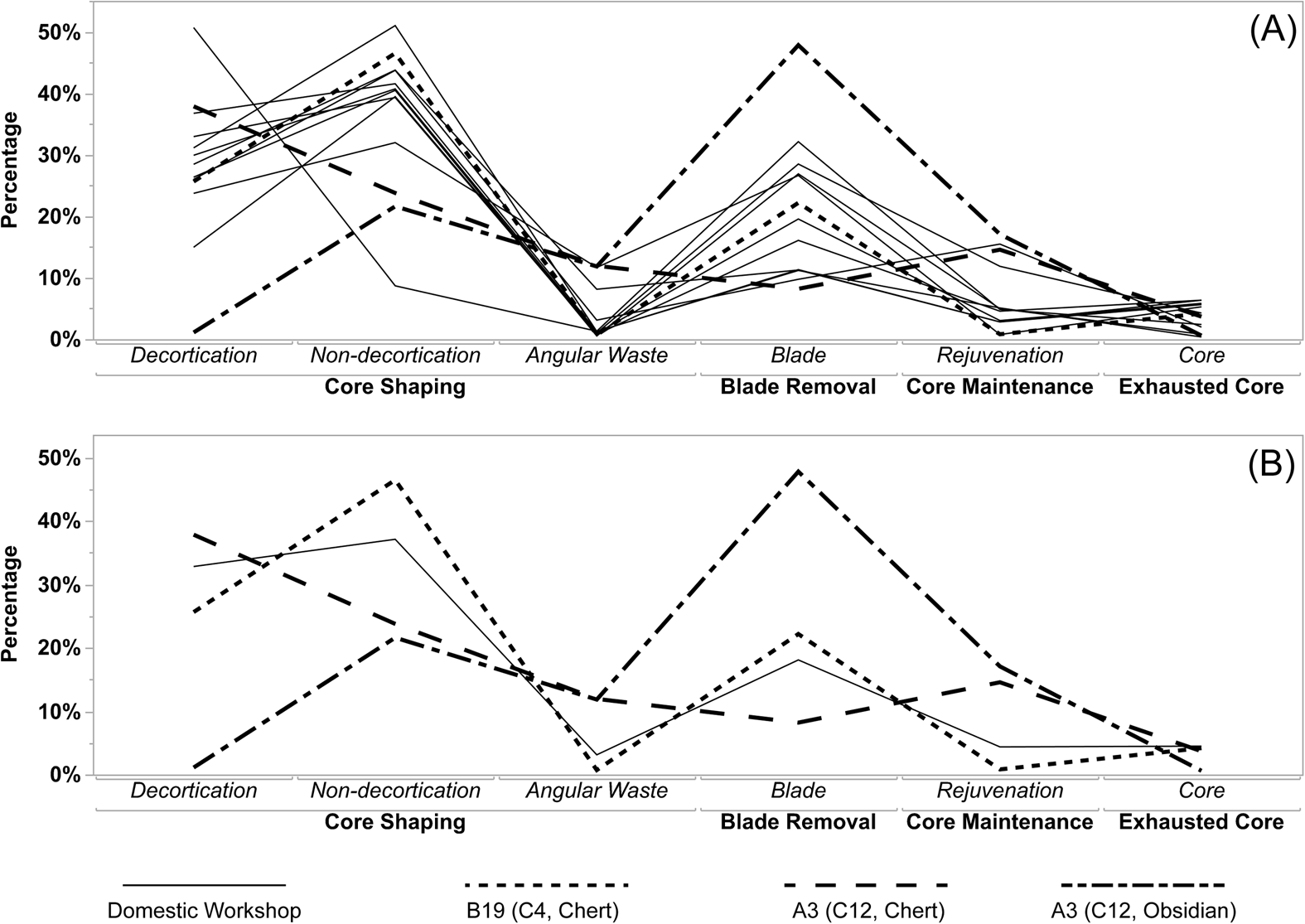
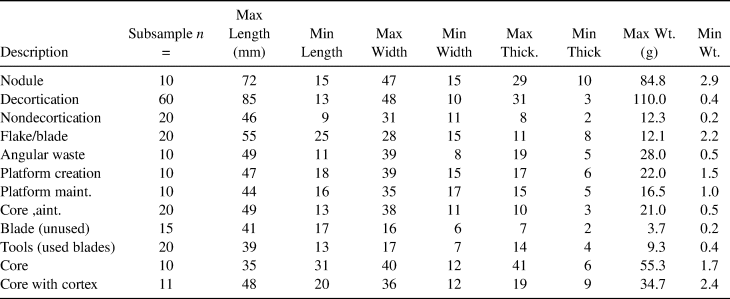
After reviewing the typical inventory of flaked stone found in crafting-intensive residential groups, we now turn to the collection of flaked stone found above the tomb in Caracol's ceremonial A-Group. We considered the results of analyses carried out on collections of flaked stone from Caracol's surrounding residential groups when we conducted a re-inventory and updated analysis of the obsidian from Structure A3. We observed in the corresponding catalog records that there was an abundant amount of chert from many of the same excavated areas above SDC12A-2. Analysis of chert materials followed earlier analytical schema to test for the presence of blade production (Johnson et al. Reference Johnson, Carpenter, Chase and Chase2015; Pope Reference Pope1996). The analysis was moderately expeditious and was conducted in the Caracol Archaeology Project field laboratory during the last days of the 2015 field season. Because the assemblage had already been provisionally sorted, an updated analysis reported already grouped artifact types by major attributes (e.g., the presence of cortex, cores, blades, and so on). Time did not allow for a comprehensive attribute analysis of each artifact type or determination of the presence of refits; however, a sample was measured, and major attributes were noted (Table 3). Notably, refits related to core maintenance and platform rejuvenation were reported for the obsidian materials from this context (Johnson Reference Johnson2016). It was readily apparent that the reduction sequence present in the chert assemblage was indicative of blade production, rather than bifacial tools. It included nodules of unworked materials identical to those found within the local karstic bedrock forming the geological foundations of Caracol. The collection of chert and obsidian that was procured for the burial event included core shaping debris, pieces that are rarely found in typical household contexts but are more closely aligned with the kinds of pieces found in crafting-intensive residential workshops (Figure 3).
(A) Percentages of reduction stage by context (see Table 2); (B) percentages of reduction stage by context with workshops aggregated. Note similarity in reduction stage percentages by material type relative to context.

Morphometric Data of a Sample of Chert Artifacts from Structure A3 Investigations.

Based on the raw nodules that we found, we argue that chert was procured locally, most likely while quarrying bedrock for architectural constructions and cutting away the hillsides to build terraces. As such, we expected to have a proportion of nodules and/or tested cobbles. Tested cobbles have one or more provisional flake removals to determine the internal quality of the rock; they are included with nodules in morphometric data (Table 3). Next, the assemblage included decortication flakes and blades ranging from 12 to 85 mm in length. There were many more decortication pieces of chert than obsidian (see Figure 3 and Table 2), which suggests, as we have said, that obsidian was most likely arriving at Caracol as semi-prepared cores with most of the cortex removed, in contrast to chert that was local and had to be trimmed of cortical material. These debitage data show that nodules were split or otherwise sectioned, thus creating a relatively flat platform for further lateral shaping by removing cortical material. Decortication debitage has the largest overall measurements, and nodules may have exceeded 100 mm on one axis. Core shaping was typically unidirectional or bidirectional; as a result, most percussion debitage includes flakes, flakes/blades, blades, and radially shaped cores. The flake/blade (or miscellaneous flakes/blades) category is applied to those mostly incomplete pieces of debitage that lack proximal or distal margins.
A morphometric analysis of a subsample found that core shaping percussion debitage did not exceed 60 mm in length (24–54 mm), further suggesting that the available raw material was particularly small in size. The percentages of macrocore shaping pieces and percussion flakes from the deposit were similar for both chert and obsidian. There were substantially more cortical pieces of chert than obsidian ones. However, although the percentages by reduction stage may vary across chert and obsidian, the stages are the same. Figure 3 illustrates the similarity in overall percentages between the technological reduction stages present in the chert from SDC12A-2 and the domestic workshops, further reinforcing the claim that chert blade production debris is coming directly from flaked stone crafters.
Although the technological stages discussed here are primarily for blade production pieces, the obsidian reduction profile percentages are akin to those percentages reported for other Maya obsidian workshops and are similar to the obsidian found in mortuary contexts (Johnson Reference Johnson2016:331–334, Figures 7-8 and 7-10, Tables 7-15 and 7-17). Outside of the tomb context, there is no evidence of lithic crafting having occurred in the ceremonial A-Group.
Chert blade removal took place in a radial or semi-radial fashion much like obsidian blade removal. Chert blades are not necessarily long (17–41 mm), likely because of the overall size of cores (~50 mm). Classification of chert blades required the expedient identification of macroscopic use-wear, which determined that both used and unused tools are present in the assemblage. Used tools have distal wear from drilling or incising. Table 3 summarizes the morphometrics of a subsample of blades, including blade tools. These data show that chert blades are relatively short and thick when compared to obsidian blades (41 mm × 16 mm wide × 7 mm thick and 61 mm × 11 mm × 3 mm, respectively [Johnson Reference Johnson2016:183, Table 5-8]). Yet many flaked stone blades lacked eraillure scars and faceted platforms, indicating pressure removal or perhaps very controlled indirect percussion (Andrefsky Reference Andrefsky2005).
In addition, a number of production errors were evident. One prominent error was the application of insufficient force or at an incorrect angle to remove chert and obsidian blades, causing hinge, step, and overshot features (i.e., plunging pieces). Many chert blades were still usable with hinge terminations, because significant trimming was done to the distal and lateral margins (Johnson Reference Johnson2008). The chert blades found at Caracol are not thin and long like obsidian blades, but rather are short, narrow, and thick in cross section, making them a robust tool form. Because of production errors and particularly when blade cores became smaller, pressure or percussion platforms needed to be rejuvenated to widen, flatten, or otherwise refine the platforms. This was done through sectioning both chert and obsidian cores; thus, core platform maintenance or rejuvenation debitage is often multifaceted and flat. The quantity of platform creation pieces was higher for obsidian, most likely due to the increased effort to maximize the number of blades that could be removed from the imported material. Chert was found locally within the limestone and was readily available, and so there are a greater number of chert cores with hinge scars that were discarded rather than rejuvenated.
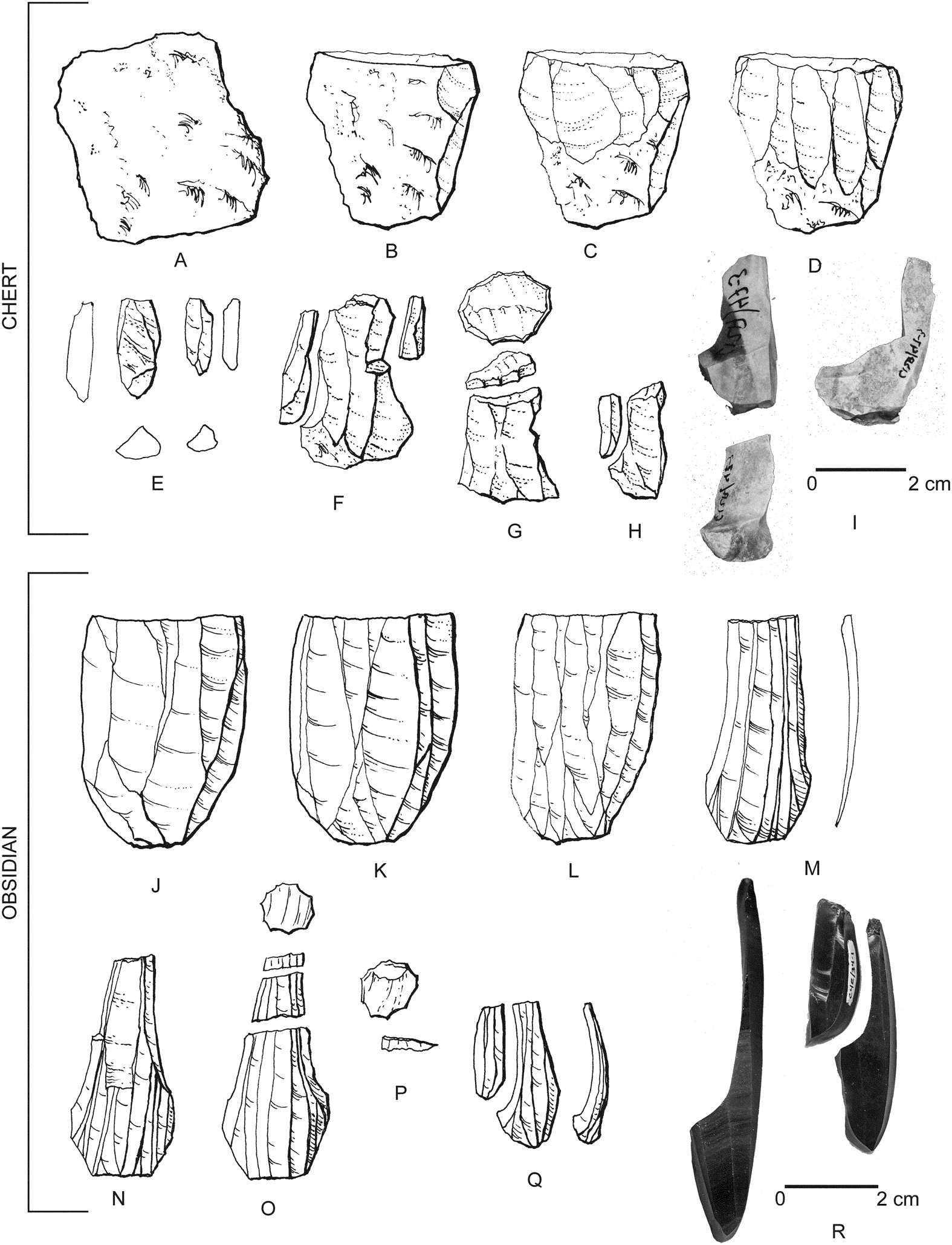
When chert cores are present, they are typically exhausted. Because the material is small overall, some chert cores were exhausted after just a few blades were removed. Although the techniques to shape the core were similar to the techniques used to work obsidian, the resulting pieces vary and are not always uniform (Figure 4). This is most likely due to the porosity in the material, inclusions, overall size, hardness, and other challenging characteristics of the material. Obsidian cores make up less of the tomb assemblage overall. The contextual analysis of obsidian cores at Caracol has determined that most were curated at workshops and reshaped (by notching, splitting, and the like) and then included in offerings in the numerous residential shrine caches throughout residential sectors of the city (Johnson Reference Johnson2016:307, Table 7-9). However, the most elaborate flaked stone offerings, those that included entire sequences of flaked stone production, were seemingly reserved for some of the most prominent funerary events.
Illustration of obsidian and chert reduction sequences by dominant stage. Chert: (A–D), reduction of chert nodules and core shaping; (E) example of chert drills with cross sections; (F), reduction errors (hinge and step fracturing); (G) core maintenance through sectioning or removing core tablets; (H) final stages of core reduction; (I) plunging pieces. Obsidian: (J–M), macrocore to reduction of polyhedral blade core with blade cross section; (N) blade production errors; (O) core maintenance (i.e., rejuvenation); (P), core sections/platform preparation pieces; (Q–R), plunging pieces/exhausted core. Note: Line drawings A–H and J–Q are not to scale.

In the other major public space of Caracol, the B-Group, a similar, yet smaller, assemblage of chert and obsidian was associated with the tomb of a royal woman on the summit of Caana. As with the individual buried within A3, the woman's grave included a date. The date on the tomb wall indicated she was buried in AD 634, roughly one generation or 60 years earlier than the funerary event in the A-Group (Chase and Chase Reference Chase, Chase and Houston1998:308). A later deposit placed above the locus of her chamber contained a number of chert drills (n = 180) and 567 chert artifacts consisting of debitage and cores (13). Cursory sorting and analysis of this material showed that, of the collection, 180 chert drills, weighing 218.2 g, exhibit bilateral retouching similar to that recorded from crafting residences. Additionally, the other chert pieces included 515 flakes (717.5 g) of various types and 42 cores (738.9 g). Although the cores and debitage are not yet separated into types, their association with such a large number of chert drills suggests the presence of blade-core shaping debitage, cortical and noncortical, and small to medium-sized exhausted blade cores weighing an average of 17.5 g. The stages present in this context, like the A3 tomb collection, are nearly identical to those recovered from residential groups engaged in flaked stone production (Figure 3).
Discussion: The Practice and Materiality of Sealing Graves
Within a ritualized event, places and things are experienced differently, a feature of ritual that archaeologist Edward Swenson (Reference Swenson2015:331) has described as a “material re-framing.” These mortuary contexts demonstrate the fluidity of materiality and meaning from one context to the next. Meaning-making is an active and ongoing process. Meaning is not static and inherent in materials but instead emerges through material engagement (Barad Reference Barad2007). Viewed this way, flaked stone fragments are not symbols but can take on symbolic meaning when positioned in certain configurations of people, spaces, materials, and, in this case, ancestral spirits. Materials often exhibit assorted qualities simultaneously, as “bundled” and difficult to disentangle (Keane Reference Keane and Miller2005). Flaked stone may be black, gray, sharp, smooth, and light in weight all at once. Along with and inspired by those material qualities are the varied meanings that emerge when humans interact with those materials. Meaning-making does not only include the abstract and symbolic but also may include indexical references through relationships between people and things and a history of movement from one moment to the next (Joyce Reference Joyce, Renfrew and Morley2007; Joyce and Gillespie Reference Joyce and Gillespie2015).
Flaked stone debris was not produced by just anyone but by a highly skilled community of lithic crafters, whose signatures remained on the pieces included in the funerary event. It is for this reason that archaeologists analyzing these kinds of contexts may describe flaked stone layered above a tomb as a symbolic reference to cosmological layering or “lightning and celestial fire” while also discussing the crafting process that led to their production (Hall Reference Hall1989:308; Hruby and Rich Reference Hruby, Rich, Navarro-Farr and Rich2014; McCormick et al. Reference McCormick, Hruby, Navarro-Farr, Rich, Eppich and Hruby2021).
A series of actions were needed to contend with the dead body and its spiritual transformation and rebirth (Fitzsimmons Reference Fitzsimmons2010; Scherer Reference Scherer2015; Weiss-Krejci Reference Weiss-Krejci, Colas, LeFort and Persson2006). Those actions included preparing and dressing the body, placing offerings, and sealing the grave. The entire transformation process did not end with the burial of the body but continued with periodic visitation and veneration by the living.
In considering the ritualized practice of “wrapping or sealing,” there are numerous examples in which the body of the deceased was bundled and the grave itself with the body and all the grave goods was encased and sealed with materials. The use of flaked stone was just one way in which the act was carried out. In other cases, loose white marl (Duncan Reference Duncan and Wrobel2014) or clay and textiles were used. Such was the case with tomb B-4/7 at Altun Ha where “virtually the entire crypt appears to have been draped in cloth” (Pendergast Reference Pendergast1982:65–68). For some Maya burial events, the grave diggers took additional steps to carefully layer materials in patterns reminiscent of the Maya cosmos, including in vertical layering and horizontal cruciform shapes. In the mausoleum of a politically connected household at Palenque, an elaborate cruciform-shaped crypt was sealed with four alternating layers of limestone slabs and thick layers of wet, white plaster (Johnson Reference Johnson2018). At Río Azul, Tombs 1 and 19 in the major structure of C1, as well as Tomb 23 in Structure C1C, were sealed with chert debitage scattered in alternating layers of white plaster and cut limestone slabs (Hall Reference Hall1989). Above Tomb 19 in particular, “lime mortar was used and chert debitage was laid in four distinct layers” (Hall Reference Hall1989:168; emphasis added). At Buena Vista, after the burial was covered in a thick layer of obsidian and chert debitage, “a wet plaster matrix was poured onto the entire mass” (Taschek and Ball Reference Taschek, Ball and Kerr1992:494). In addition to vertical layering, some Maya chose particular patterns in the colors of materials to seal the tomb. Becker noted that some chultun burials at Tikal were “filled with alternating dark and light levels of earth, suggesting purposeful deposition” (Reference Becker1999:76). The diversity in practice and materiality surrounding the sealing of Maya graves in the Lowland region demonstrates the bundled qualities of materials, particularly in a ritualized event.
In many cases, the grave would be a site of repeated visitation, which resulted in additional material traces and ritual deposits. The altar feature above the tomb in Caracol's Structure A3 provided a space for continued interaction with the deceased below. Two sets of geometric designs were incised on the plaster surface of the bench/altar (Chase and Chase Reference Chase and Chase1987:12). Similar incised designs have been noted for ceremonial contexts in other Lowland Maya centers: they are typically described as the “patolli” design by excavators, a Nahua term adopted from elsewhere (Becker Reference Becker1999). The patolli design, typically a cruciform four-track board with 52 square spaces, has been associated with the Mesoamerican calendar and may have been used in the practice of divination (Edmonson Reference Edmonson and Nash1967; Voorhies Reference Voorhies2013). In the Maya area, the design may vary but almost always includes multiple square spaces situated within a larger quadrangular pattern. At Tikal, a patolli “game board” was incised on a burnt stucco patch sealing a ritual deposit (Becker Reference Becker1999:65). At Palenque, a geometric design was incised onto the plaster floor inside the Temple of the Inscriptions above the tomb of Pakal (Ruz Lhuiller Reference Ruz Lhuiller1951). The association of the design with graves and nearby tombs and altars in the Maya Lowlands during the Classic period may very well have been used as a means to communicate directly with ancestral spirits.
Conclusion
The analysis of flaked stone tied to its context of recovery continues to contribute to anthropological interpretations of archaeological investigations. Our study generated an interpretation that is multidimensional. First, technological analysis of chert from Caracol continues to build on earlier analysis, confirming the sharing of technological strategies to reduce obsidian and chert. These analyses demonstrate that a separation of crafting communities based on material alone obscures the identification of a much larger crafting community. The crafting community of Caracol shared knowledge of core reduction and maintenance strategies to produce blade tools, which were essential contingent tools for crafting other objects in multicrafting industries (see Hirth Reference Hirth and Hirth2009; Shimada Reference Shimada2007). Although the current data from Caracol do not include a clearly identifiable obsidian workshop, the integrated road network and multiple marketplace locales are significant physical manifestations of established communication links far beyond household neighbors.
Second, the analysis of this context as an elaborate event, within a series of events to complete a funerary cycle, has shifted the focus from isolated collections of artifacts to a social practice integrating diverse materials. Analytical categories that we, as archaeologists, follow can unintentionally overlook shared material practices by refusing to cross material boundaries—with plaster considered separately from flaked stone, and chert considered separately from obsidian. A concern for material practice and the relationships that emerge from distinct configurations of people, things, and ancestral spirits in space suggests that the archaeologically investigated contexts described here were of a similar material framework. Reconfigured in other contexts, those same materials may have slipped from awareness as mundane trash (Moholy-Nagy Reference Moholy-Nagy1997), yet these mortuary events initiated a “material re-framing” (Swenson Reference Swenson2015:330), as the flaked stone was experienced differently, bringing about new meanings.
Furthermore, the materiality of Maya funerary practices can vary from one event to the next, across elite and non-elite. Ritualized dumping of flaked stone above human burials may be much easier to identify when it includes thousands of pieces of debitage, but as some have noted, smaller residential mortuary events may only include hundreds of pieces of flaked stone or perhaps fewer still. The practice of layering stone and white plaster, or “marl,” above graves appears to have been carried out to varied degrees not only among the ruling classes but also in in smaller residential mortuary events. At Tikal, Becker (Reference Becker1999:30) has noted multiple residential burials with “white powder” or “white powdery gravel” spread over the grave and, in other cases, “160 flint flakes spread on the barely mounded earth over the orifice, with more flints and several obsidian pieces taken directly from the shaft, 80% of them unused” (Reference Becker1999:97).
At Caracol, there are very few recorded mortuary contexts with large quantities of flaked stone debris, and all of these are highly prominent and elaborate graves. In addition to the A3 tomb context, a slightly smaller but similar collection of chert blade production debitage and a number of chert drills were deposited above the tomb of a prominent woman on the summit of Caana. Smaller households may not have commanded the collection of entire workshops to seal the graves of their ancestral dead, but in recognizing the contexts discussed in this article as traces of a shared material practice, more examples may be identified in non-elite contexts. Among ahau and laborer, there was a similar understanding of body and soul, death and ancestral rebirth. With an increasing interest in the materiality of ritual and a push for a relational approach in which all materials from those contexts are considered equally important to understanding the nature of the event, more examples of the ritualized deposition of flaked stone in mortuary events may be recognized.
Acknowledgments
Primary excavation data were provided by the Caracol Archaeological Project. We would also like to thank Arlen and Diane Chase for their comments and insight during our analysis. Special thanks to Arianna Campiani for her assistance with translations and to Maureen Carpenter, Marc Marino, Rachel Kangas, and Angelica Costa for help with the analysis.
Data Availability Statement
The excavated materials discussed in this article are housed in the storage facility of the Caracol Archaeological Project, Caracol, Belize. Additional photographs of artifacts are available upon request from the authors.