Introduction
Depression is a relapsing and recurring illness. Beyond suffering and compromised quality of life (Charney et al. Reference Charney, Reynolds, Lewis, Lebowitz, Sunderland, Alexopoulos, Blazer, Katz, Meyers, Arean, Borson, Brown, Bruce, Callahan, Charlson, Conwell, Cuthbert, Devanand, Gibson, Gottlieb, Krishnan, Laden, Lyketsos, Mulsant, Niederehe, Olin, Oslin, Pearson, Persky, Pollock, Raetzman, Reynolds, Salzman, Schulz, Schwenk, Scolnick, Unutzer, Weissman and Young2003; Kessler et al. Reference Kessler, Akiskal, Ames, Birnbaum, Greenberg, Hirschfeld, Jin, Merikangas, Simon and Wang2006), prolonged depression in late life increases medical burden and mortality both in medically ill and medically healthy persons (Bruce et al. Reference Bruce, Leaf, Rozal, Florio and Hoff1994; Steffens et al. Reference Steffens, Levy, Wagner, McQuoid, Krishnan and Carroll2002). Disability conferred by late-life depression increases dependency needs, care costs and family disruption, and often leads to institutionalization (Alexopoulos et al. Reference Alexopoulos, Buckwalter, Olin, Martinez, Wainscott and Krishnan2002).
Attainment of remission is viewed as the optimal outcome of acute antidepressant treatment (Nierenberg & Wright, Reference Nierenberg and Wright1999; Thase & Ninan, Reference Thase and Ninan2002; Anderson et al. Reference Anderson, Ferrier, Baldwin, Cowen, Howard, Lewis, Matthews, McAllister-Williams, Peveler, Scott and Tylee2008) in both young and older adults. Remission, defined as an almost asymptomatic state, is considered a stable clinical state with a low risk for relapse and recurrence (Frank et al. Reference Frank, Prien, Jarrett, Keller, Kupfer, Lavori, Rush and Weissman1991; Rush et al. Reference Rush, Kraemer, Sackeim, Fava, Trivedi, Frank, Ninan, Thase, Gelenberg, Kupfer, Regier, Rosenbaum, Ray and Schatzberg2006; Fava et al. Reference Fava, Ruini and Belaise2007). Patients who improve but fail to achieve remission have significant functional impairment, compromised quality of life and high utilization of health-care services (Miller et al. Reference Miller, Keitner, Schatzberg, Klein, Thase, Rush, Markowitz, Schlager, Kornstein, Davis, Harrison and Keller1998; Simon et al. Reference Simon, Khandker, Ichikawa and Operskalski2006). Although remission is desirable, remission rates in mixed-age samples of patients with major depression treated with first-line antidepressant treatment are 30–35% and decline significantly with successive treatment failures (Nelson, Reference Nelson2006). Remission may be even more difficult to achieve and sustain in depressed older patients (Reynolds et al. Reference Reynolds, Frank, Kupfer, Thase, Perel, Mazumdar and Houck1996; Mueller et al. Reference Mueller, Kohn, Leventhal, Leon, Solomon, Coryell, Endicott, Alexopoulos and Keller2004).
Several definitions of remission have been proposed. Most definitions specify two conditions: attainment of an almost asymptomatic state over a predetermined period of time, usually 1–2 weeks (Frank et al. Reference Frank, Prien, Jarrett, Keller, Kupfer, Lavori, Rush and Weissman1991; Rush et al. Reference Rush, Kraemer, Sackeim, Fava, Trivedi, Frank, Ninan, Thase, Gelenberg, Kupfer, Regier, Rosenbaum, Ray and Schatzberg2006). Inherent in these definitions is the assumption that, once remission is achieved, patients would continue to have favorable long-term outcomes (Thase & Simons, Reference Thase and Simons1992; Paykel et al. Reference Paykel, Ramana, Cooper, Hayhurst, Kerr and Barocka1995; Rush et al. Reference Rush, Kraemer, Sackeim, Fava, Trivedi, Frank, Ninan, Thase, Gelenberg, Kupfer, Regier, Rosenbaum, Ray and Schatzberg2006). Empirical studies support this point of view in young adults and in those with late-life depression because depressed patients who achieve remission have a lower relapse rate than those who improve but remain symptomatic (Ramana et al. Reference Ramana, Paykel, Cooper, Hayhurst, Saxty and Surtees1995; Van Londen et al. Reference Van Londen, Molenaar, Goekoop, Zwinderman and Rooijmans1998; Rush et al. Reference Rush, Kraemer, Sackeim, Fava, Trivedi, Frank, Ninan, Thase, Gelenberg, Kupfer, Regier, Rosenbaum, Ray and Schatzberg2006). However, patients who remain asymptomatic for the short period of time required to satisfy the definition of remission may still experience subsyndromal symptoms after remission.
Achievement of remission is often followed by development of subsyndromal depressive symptoms affecting up to 50% of patients (Nelson, Reference Nelson2006; Rush, Reference Rush2007). In some cases, subsyndromal depressive symptoms are self-limited, but in others they may evolve into a recurrence of depression. This study focuses on the prognostic significance of subsyndromal depressive symptoms during the 6 months following remission of late-life depression, the period during which if a full-blown depressive episode occurs it would be classified as a relapse (Riso et al. Reference Riso, Thase, Howland, Friedman, Simons and Tu1997; Nierenberg & Wright, Reference Nierenberg and Wright1999). It is hypothesized that long duration of subsyndromal symptoms during the 6 months following attainment of remission is a predictor of recurrence.
Method
Subjects
The subjects were out-patients and in-patients of a psychiatric university hospital consecutively recruited for an uncontrolled treatment study of geriatric depression. None of the subjects were recruited through advertisement. Inclusion criteria were: (1) age ⩾60 years, (2) diagnosis of unipolar major depressive disorder (MDD) according to DSM-IV; (3) a Longitudinal Follow-up Examination (LIFE) Psychiatric Status Rating Scale (PSR) score ⩾5 (5 = definite criteria for MDD/without prominent psychotic symptoms or extreme impairment; Keller et al. Reference Keller, Lavori, Friedman, Nielsen, Endicott, McDonald-Scott and Andreasen1987); (4) the presence of an informant who had knowledge of the patient's history and had enough contact so that they could observe behavioral changes within 1 week; and (5) residence at a distance within 45 min from the psychiatric university hospital. All participants received uncontrolled treatment for depression. After a complete description of the study, subjects signed written informed consent approved by the Weill Cornell Medical College Institutional Review Board.
Exclusion criteria were: (1) a history of psychiatric illness (except personality disorder) other than unipolar depressive disorder diagnosed prior to the onset of the first depressive episode; (2) severe acute medical illness, that is metastatic cancer, decompensated cardiac, liver or renal failure, major surgery, stroke, or myocardial infarction 6 months prior to study entry; (3) spinocerebellar degeneration, Huntington's chorea, Parkinson's disease, or multi-infarct dementia; (4) moderate to severe dementia as evidenced by a Mini-Mental State Examination (MMSE; Folstein et al. Reference Folstein, Folstein and McHugh1975) score <20; and (5) severe behavioral disability defined as complete impairment in performance of the activities of daily living domain of the Philadelphia Multilevel Assessment Instrument (MAI; Lawton et al. Reference Lawton, Moss, Fulcomer and Kleban1982). These criteria resulted in a group of older patients with unipolar major depression but without a major medical illness, moderate or severe dementia, or severe disability.
Systematic assessment
At baseline, diagnostic assessment was based on the SCID-R. Depression severity was assessed with the LIFE PSR (Keller et al. Reference Keller, Lavori, Friedman, Nielsen, Endicott, McDonald-Scott and Andreasen1987). Cognitive impairment was measured with the MMSE (Folstein et al. Reference Folstein, Folstein and McHugh1975) and Mattis Dementia Rating Scale (DRS; Mattis, Reference Mattis1989). Medical burden was quantified using the total score (except for the psychiatric domain) of the Cumulative Illness Rating Scale, Modified Version for Geriatrics (CIRS-G; Miller et al. Reference Miller, Paradis, Houck, Mazumdar, Stack, Rifai, Mulsant and Reynolds1992). CIRS-G information was obtained from the medical history and physical examination, and from the available laboratory test results. Disability was assessed with the Instrumental Activities of Daily Living (IADL) subscale of the Philadelphia MAI; this subscale provides information about the participant's ability to perform nine IADLs (Lawton et al. Reference Lawton, Moss, Fulcomer and Kleban1982).
After the baseline evaluation, the patients and informants (when necessary) had in-person evaluations every 6 months and telephone evaluations 3 months after each in-person session. An extra in-person evaluation was conducted when the participant first met criteria for remission and for recurrence. If the participants were unable to come to the hospital, research assistants visited them at their homes. During follow-up evaluations, depressive symptoms were assessed with the PSR. The PSR assessed the presence and severity of depressive symptoms each week during the 6 months prior to each research assessment. In the PSR, memory prompts and detailed questioning are used to improve the accuracy of information. When patients are unable to offer information and when discrepancies are detected, raters interview individuals who have frequent contact with the patients and/or contact the patients' physicians to obtain additional information. Thus the PSR uses an information gathering process similar to that of a clinical examination. The PSR classifies the status of depression on a scale of 1 to 6. PSR score 1 refers to an ‘asymptomatic status/returned to usual self’ status without any residual symptoms of MDD. PSR score 2 refers to ‘residual/mild depressive symptoms’ with the presence of one or more symptoms of no more than mild degree. PSR score 3 refers to ‘subsyndromal symptoms/moderate symptoms’ with no more than moderate impairment in functioning. PSR score 4 refers to ‘major symptoms’ with major impairment in functioning but does not meet full criteria of MDD. PSR score 5 refers to ‘definite criteria for MDD/without prominent psychotic symptoms or extreme impairment’. Finally, PSR score 6 refers to ‘definite criteria for MDD/with psychotic symptoms or extreme impairment’ (Keller et al. Reference Keller, Lavori, Friedman, Nielsen, Endicott, McDonald-Scott and Andreasen1987; Judd et al. Reference Judd, Akiskal, Maser, Zeller, Endicott, Coryell, Paulus, Kunovac, Leon, Mueller, Rice and Keller1998). Cognitive impairment (MMSE, DRS), medical burden (CIRS-G) and disability (IADL domain of MAI) were assessed at two time points: at baseline when the MDD diagnosis was made; and when they first met criteria for remission.
Intensity of antidepressant drug (AD) treatment was classified with the Composite Antidepressant Score – Revised (CAD; Alexopoulos et al. Reference Alexopoulos, Meyers, Young, Kakuma, Feder, Einhorn and Rosendahl1996). CAD orders intensity of AD treatment on a scale of 0–4, with 0 = no medication; 1 corresponds to treatment with daily doses of buproprion <100 mg, nortriptyline <30 mg, setraline <25 mg, paroxetine, fluoxetine or citalopram <10 mg, venlafaxine <50 mg or escitalopram <5 mg; 2 corresponds to buproprion 100–199 mg, nortriptyline 30–49 mg, setraline 25–49 mg, paroxetine, fluoxetine or citalopram 10–19 mg, venlafaxine 50–75 mg or escitalopram 5–10 mg; 3 corresponds to buproprion 200–300 mg, nortriptyline 50–80 mg, sertraline 50–100 mg, paroxetine, fluoxetine or citalopram 20–30 mg, venlafaxine 76–150 mg or escitalopram 10–15 mg; and 4 corresponds to buproprion >300 mg, nortriptyline >80 mg, setraline >100 mg, paroxetine, fluoxetine or citalopram >30 mg, venlafaxine >150 mg, or escitalopram >15 mg. The investigators had no control over treatment with antidepressants. The antidepressants were prescribed by community-based physicians responsible for the patients' clinical care.
Definitions of remission, duration of subsyndromal symptoms, and recurrence
In this study, remission was defined as a PSR score of ⩽2 for 3 consecutive weeks, without the presence of depressed mood or lack of interest or pleasure, after an episode of MDD. This definition is consistent (a) with studies of late-life depression (Bhalla et al. Reference Bhalla, Butters, Mulsant, Begley, Zmuda, Schoderbek, Pollock, Reynolds and Becker2006; Rutherford et al. Reference Rutherford, Sneed, Miyazaki, Eisenstadt, Devanand, Sackeim and Roose2007; Alexopoulos et al. Reference Alexopoulos, Reynolds, Bruce, Katz, Raue, Mulsant, Oslin and Ten Have2009; Taylor et al. Reference Taylor, McQuoid, Ashley-Koch, MacFall, Bridgers, Krishnan and Steffens2011), in which the required duration for remission has been 1–3 consecutive weeks of a specific cut-off score; and (b) with the recommendations from the American College of Neuropsychopharmacology (ACNP) Task Force on Remission and Response (Fava et al. Reference Fava, Ruini and Belaise2007). Relapse was defined as a PSR score ⩾5 during the first 6 months after remission. The duration of subsyndromal symptoms after remission (‘duration subsyndromal symptoms’) was calculated by the number of weeks of PSR scores of 3 or 4 in the first 6 months following remission in subjects who did not meet criteria for relapse. Recurrence was defined as a PSR score ⩾5 occurring between 6 months and 2½ years (last research observation since baseline) after remission.
Statistical analysis
Bivariate analyses using χ2 and Mann–Whitney–Wilcoxon tests compared (a) subjects who had a relapse in the first 6 months after remission with those who remained relapse-free and (b) subjects who had a recurrence of depression with subjects who remained well. Then, Cox proportional hazards survival analyses were performed to explore the association of ‘duration subsyndromal symptoms’ during the risk period for relapse (in the first 6 months following remission) with time to recurrence. Any participant who did not have a recurrence was considered censored. To examine whether the effect of ‘duration subsyndromal symptoms’ on time to recurrence remained significant in the presence of confounding variables, we created a final Cox proportional hazards regression model including variables that were associated with time to recurrence (using Cox proportional hazards models and p < 0.15). The hazard rates of each predictor were tested for proportionality with a Cox model including the variable and its interaction with [log(time to recurrence) – 5.69]. The constant 5.69 is the average of the logarithms of the survival times. For the final Cox regression model, we used backward elimination with p = 0.05 as the criterion for removing an explanatory variable from the model. All analyses were performed with SAS 9.1 (SAS Institute Inc., USA) and S-Plus 7.0 (TIBCO Software Inc., USA).
Results
A total of 317 older out-patients (n = 191) and in-patients (n = 126) who met DSM-IV criteria for MDD entered this study. Of these, 242 achieved remission after receiving uncontrolled antidepressant treatment, 42 did not remit and 33 were lost to follow-up or had incomplete data to determine remission. There were no significant differences between those who were lost to follow-up or had incomplete data (n = 33) versus the rest (n = 284) on age, entry status (in-patient versus out-patient), and years of education. However, patients who were lost to follow-up or had incomplete data comprised a significantly higher percentage of males than the remaining 284 patients (males: 15.45% v. 7.22%, χ2 = 5.47, df = 1, p = 0.019).
Among the subjects who achieved remission (n = 242), 57 were lost to follow-up or had incomplete data in the first 6 months after remission. This report focuses on the 185 subjects who remained in remission for 6 months and had follow-up data for up to 2.5 years thereafter. The subjects who were lost to follow-up or had incomplete data were older by an average of 4.37 years than the 185 subjects with follow-up data (Mann–Whitney: z = 3.08, p = 0.0021). Furthermore, a higher percentage of in-patients were lost to follow-up or had incomplete data compared to subjects with follow-up (50.88% v. 31.35%, χ2 = 7.22, df = 1, p = 0.0072). There were no significant differences on gender and years of education between the two groups.
Relapse and subsyndromal symptoms
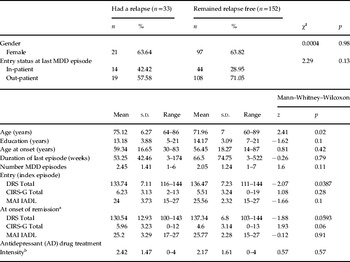
Despite the stringent definition of remission requiring 3 weeks of an almost asymptomatic state, 17.8% (33/185) of remitted subjects experienced a relapse during the 6 months following remission. Subjects who relapsed were older and more cognitively impaired at entry than those who remained relapse free (Table 1).
Demographic and clinical characteristics on 185 older subjects with major depression followed for 6 months after remission

MDD, Major depression disorder; DRS, Mattis Dementia Rating Scale; CIRS-G, Cumulative Illness Rating Scale – Geriatric Version; MAI IADL, Philadelphia Multilevel Assessment Instrument – Instrumental Activities of Daily Living subscale; s.d., standard deviation.
a When remission was first identified.
b Composite Antidepressant Score (CAD) in last month before relapse or in the sixth month.
Even among participants who remained relapse free within 6 months after remission (n = 152), a high number developed clinically significant depressive symptomatology. Specifically, only 57.24% (87/152) were asymptomatic or had mild residual depressive symptoms (PSR scores of 1 and 2) during the 6-month period following remission whereas 42.76% (65/152) of relapse-free subjects developed subsyndromal symptoms (PSR scores of 3 or 4). In this last group (n = 65), 47.69% (31/65) of subsyndromal symptoms lasted up to 4 weeks, 38.46% (25/65) lasted 4–8 weeks, and 13.85% (9/65) lasted longer than 8 weeks.
Recurrence
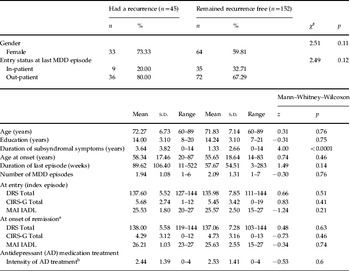
Further analysis focused on the 152 depressed elderly subjects who achieved remission and remained relapse free for 6 months. Of the 152 subjects, 108 were out-patients and 44 were in-patients. Most depressed subjects had a recurrent disorder (Table 2). Their average age at onset was in midlife. On average, their index episode was of moderate severity. They had significant medical burden, mild or no cognitive impairment, and some impairment in IADL.
Demographic and clinical characteristics on 152 older subjects with major depression who remained in remission past the risk period for relapse and were followed for 2 years

MDD, Major depression disorder; DRS, Mattis Dementia Rating Scale; CIRS-G, Cumulative Illness Rating Scale – Geriatric Version; MAI IADL, Philadelphia Multilevel Assessment Instrument – Instrumental Activities of Daily Living subscale; s.d., standard deviation.
a When remission was first identified.
b Composite Antidepressant Score (CAD) in last month before relapse or in the sixth month.
Of the 152 subjects who remained in remission of depression past the relapse risk period (6 months), 45 had a recurrence (PSR score ⩾5) during the ensuing 2 years (2.5 years since remission). After taking into consideration censored participants, the estimated recurrence rate derived from the Cox proportional hazards model during the 2 years of follow-up was 37.6% [95% confidence interval (CI) 29.2–47.6]. Bivariate comparisons between subjects who suffered a recurrence and those who remained well showed no significant difference in any demographic or clinical variables. The only exception was that subjects who suffered a recurrence had a longer duration of subsyndromal symptoms in the 6 months following remission of depression than subjects who remained well throughout the follow-up period (Table 2).
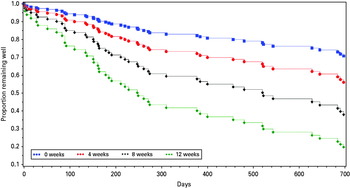
The duration of subsyndromal symptoms was significantly associated with time to recurrence [Wald χ2 = 18.28, p < 0.0001, hazard ratio (HR) 1.16, 95% CI 1.08–1.24]; the higher the number of weekly PSR scores of 3 or 4 in the first 6 months after remission, the shorter the time to recurrence. Specifically, participants with 4, 8 and 12 weeks of PSR score 3 or 4 in the first 6 months after remission had 45, 66 and 86% recurrence rates respectively (Fig. 1).
Duration of subsyndromal symptoms in the first 6 months following remission and recurrence rates in the ensuing 2 years. The survival curves are of time to recurrence of elderly depressed patients who experience 0, 4, 8 and 12 weeks of subsyndromal symptoms during the first 6 months following remission. The survival curves start 6 months after remission (0 days) and end 2 years later. Calculations were by the Cox proportional hazards model: ‘duration subsyndromal symptoms’ was associated with time to recurrence. Proportional hazards likelihood ratio for the overall model: χ2 = 13.74, df = 1, p < 0.0002; for ‘duration subsyndromal symptoms’: χ2 = 18.28, df = 1, p < 0.0001.

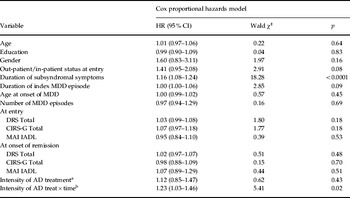
Further analyses examined whether the relationship between subsyndromal symptom duration and recurrence remained significant in the presence of potential confounding variables. To this end, exploratory univariate analyses were conducted using the Cox proportional hazards model to identify demographic and clinical variables related to time to recurrence with a p value ⩽0.15 (Table 3). These variables were included in a multivariate Cox proportional hazards model.
Bivariate relationships of demographic and clinical variables to time to recurrence in 152 older subjects with major depression who remained in remission past the risk period for relapse

HR, Hazard ratio; CI, confidence interval; MDD, major depression disorder; DRS, Mattis Dementia Rating Scale; CIRS-G, Cumulative Illness Rating Scale – Geriatric Version; MAI IADL, Philadelphia Multilevel Assessment Instrument – Instrumental Activities of Daily Living subscale; AD, antidepressant.
a Composite Antidepressant Score (CAD) in last month before recurrence or before last follow-up.
b Time = log(time to recurrence) – 5.69; the constant 5.69 is the average of the logarithms of the survival times. The HR of intensity of AD treatment scores was not proportional over time as shown by the significant intensity of AD treat × time interaction.
The final Cox predictive model of recurrence was constructed after use of backward elimination in which variables with p > 0.05 were removed. The resultant model consisted of ‘duration subsyndromal symptoms’ (Wald χ2 = 18.72, p < 0.0001, HR 1.17, 95% CI 1.09–1.25), intensity of AD treatment (Wald χ2 = 0.64, p = 0.42, HR 1.12, 95% CI 0.85–1.48) and intensity of AD treatment × time (Wald χ2 = 5.78, p = 0.016, HR 1.24, 95% CI 1.04–1.49).
To further ensure that our continuous measure of intensity of antidepressant treatment (CAD scores ranging from 0 to 4) adequately captured the role of treatment, we used a categorical definition of antidepressant treatment (adequate versus inadequate) and repeated the above analysis. According to this definition, ‘adequate’ was characterized as treatment with CAD intensity ⩾3 and ‘inadequate’ was treatment with a CAD intensity <3. In a Cox proportional hazard model including adequate antidepressant treatment, duration of subsyndromal symptoms and the interaction of adequate antidepressant treatment × time, the results were similar to the previous final model: ‘duration of subsyndromal symptoms’ (Wald χ2 = 18.69, p < 0.0001, HR 1.17, 95% CI 1.09–1.25), adequacy of AD treatment (Wald χ2 = 0.51, p = 0.47, HR 1.35, 95% CI 0.60–3.05), and adequacy of AD treatment × time (Wald χ2 = 6.01, p = 0.014, HR 2.23, 95% CI 1.17–4.23).
The significant interaction of adequacy of antidepressant treatment with time indicates that the relationship of treatment to recurrence was not the same over time. Specifically, during the first 4 months of follow-up, patients with adequate antidepressant treatment were five times less likely to recur than patients with inadequate antidepressant treatment (Wald χ2 = 7.82, p = 0.0052, HR 5.37, 95% CI 1.65–17.46). However, adequacy of antidepressant treatment after the first 4 months of follow-up was not significantly associated with reduced recurrence rates (i.e. after 10 months following remission) (Wald χ2 = 1.50, p = 0.23, HR 0.52, 95% CI 0.23–1.40).
Discussion
The principal finding of this study is that subsyndromal symptoms in the first 6 months after remission are common and predict subsequent recurrence of late-life depression; the longer the duration of subsyndromal symptoms, the shorter the time to recurrence and the higher the recurrence rates. Older patients who experience subsyndromal symptoms for 0, 4, 8 and 12 weeks during the 6 months after remission have an estimated recurrence rate of 28, 45, 66 and 86% respectively during the ensuing 2 years. The relationship of subsyndromal symptoms to recurrence is independent of the intensity of antidepressant drug treatment during the month preceding recurrence.
To our knowledge, this is the first study to demonstrate that increased duration of subsyndromal symptoms occurring soon (6 months) after remission is associated with increased risk for recurrence of late-life depression. Nonetheless, this observation is consistent with findings from controlled and uncontrolled treatment studies suggesting that subsyndromal symptoms forecast poor long-term outcomes in elderly and in younger patients (Frank & Levenson, Reference Frank, Kupfer, Levenson and Manning1990; Thase & Simons, Reference Thase and Simons1992; Paykel et al. Reference Paykel, Ramana, Cooper, Hayhurst, Kerr and Barocka1995; Ramana et al. Reference Ramana, Paykel, Cooper, Hayhurst, Saxty and Surtees1995; Judd et al. Reference Judd, Akiskal, Maser, Zeller, Endicott, Coryell, Paulus, Kunovac, Leon, Mueller, Rice and Keller1998; Van Londen et al. Reference Van Londen, Molenaar, Goekoop, Zwinderman and Rooijmans1998; Taylor et al. Reference Taylor, Reynolds, Frank, Cornes, Miller, Stack, Begley, Mazumdar, Dew and Kupfer1999; Karp et al. Reference Karp, Buysse, Houck, Cherry, Kupfer and Frank2004; Dombrovski et al. Reference Dombrovski, Mulsant, Houck, Mazumdar, Lenze, Andreescu, Cyranowski and Reynolds2007). With one exception (Frank & Levenson, Reference Frank, Kupfer, Levenson and Manning1990), studies of adults have documented that subsyndromal symptoms at the point of remission or during the continuation and maintenance treatment phases were associated with high recurrence rates during the next 2 years (Ramana et al. Reference Ramana, Paykel, Cooper, Hayhurst, Saxty and Surtees1995; Judd et al. Reference Judd, Akiskal, Maser, Zeller, Endicott, Coryell, Paulus, Kunovac, Leon, Mueller, Rice and Keller1998; Karp et al. Reference Karp, Buysse, Houck, Cherry, Kupfer and Frank2004). In late life, subsyndromal depressive symptoms occurring prior to or during the maintenance treatment phase predicted subsequent recurrence of major depression (Taylor et al. Reference Taylor, Reynolds, Frank, Cornes, Miller, Stack, Begley, Mazumdar, Dew and Kupfer1999; Dombrovski et al. Reference Dombrovski, Mulsant, Houck, Mazumdar, Lenze, Andreescu, Cyranowski and Reynolds2007). Finally, the importance of subsyndromal symptoms is also highlighted by research demonstrating that treating subsyndromal depression symptoms may prevent major depression in late life (van't Veer-Tazelaar et al. Reference van't Veer-Tazelaar, van Marwijk, van Oppen, van Hout, van der Horst, Cuijpers, Smit and Beekman2009).
This study's findings need to be viewed in the context of its limitations. These include the lack of controlled treatment and the absence of a control group. Although uncontrolled treatment may be a limitation, the treatment offered to the subjects of this study was of low to medium intensity (Tables 1 and 2), and, although a control group is desirable, the lack of randomization reduced the subject selection bias inherent in randomized treatment studies. Another limitation may be the retrospective assessment of depressive symptoms at 6-month intervals with a telephone assessment in between. Although direct assessment of depressive symptoms at more frequent intervals is desirable, the LIFE and PSR used by this study are instruments validated by the National Institute of Mental Health (NIMH) Collaborative Study of Depression (Keller et al. Reference Keller, Lavori, Friedman, Nielsen, Endicott, McDonald-Scott and Andreasen1987), and have been used in studies with mixed-age (Keller et al. Reference Keller, Lavori, Mueller, Endicott, Coryell, Hirschfeld and Shea1992; Judd et al. Reference Judd, Akiskal, Maser, Zeller, Endicott, Coryell, Paulus, Kunovac, Leon, Mueller, Rice and Keller1998) and elderly depressed patients (Hinrichsen, Reference Hinrichsen1992). Finally, the MMSE cut-off of 20 may have allowed inclusion of individuals with cognitive impairment or early-stage dementia. A wide range of cognitive impairment coexists with depression in older adults and increases with age (Arve et al. Reference Arve, Tilvis, Lehtonen, Valvanne and Sairanen1999). A more stringent MMSE cut-off score would have resulted in a sample of younger, cognitively intact and relatively healthy participants and may not have accurately captured important clinical aspects of an older population, differentiating them from younger adults.
Several clinical characteristics have been associated with poor outcomes of late-life depression. Cognitive dysfunction (Story et al. Reference Story, Potter, Attix, Welsh-Bohmer and Steffens2008), impairment in some executive functions (Alexopoulos et al. Reference Alexopoulos, Kiosses, Heo, Murphy, Shanmugham and Gunning-Dixon2005; Sneed et al. Reference Sneed, Roose, Keilp, Krishnan, Alexopoulos and Sackeim2007) and psychomotor slowing (Butters et al. Reference Butters, Whyte, Nebes, Begley, Dew, Mulsant, Zmuda, Bhalla, Meltzer, Pollock, Reynolds and Becker2004) have each been associated with slow and/or poor response to antidepressant treatment. Medical burden has also been shown to predict poor long-term outcomes of late-life depression in some studies (Cui et al. Reference Cui, Lyness, Tang, Tu and Conwell2008). Finally, disability has a reciprocal relationship with depressive symptoms and worsens the long-term prognosis of late-life depression (Alexopoulos et al. Reference Alexopoulos, Buckwalter, Olin, Martinez, Wainscott and Krishnan2002). In this study, however, cognitive impairment, medical burden and disability assessed at entry, when the subjects were symptomatic, and at the beginning of remission (Table 3) had weak associations with recurrence of depression that did not reach statistical significance. However, cognitive impairment and medical burden were associated with relapse in the first 6 months after remission (Table 1). Consequently, the group of the recurrence analyses was enriched with patients with low cognitive impairment and medical burden as many of those with greater cognitive impairment and medical burden had already relapsed. Nevertheless, further investigation of the association of medical co-morbidity and cognitive impairment with recurrence rates is warranted.
The adequacy of AD treatment during the first 4 months of follow-up predicted low recurrence rates. However, later on, adequacy of drug treatment did not significantly influence recurrence rates. Because a high number of recurrences occurred during the first 4 months of follow-up, the group with longer follow-up might have been depleted from patients at high risk for recurrence. This observation may account, at least in part, for the lack of a significant relationship between treatment adequacy after the first 4 months of follow-up and recurrence of depression.
The findings of this study have methodological and clinical implications. On a methodological level, long-term outcome studies of geriatric depression may include information on subsyndromal states occurring soon after the attainment of remission because of their prognostic value. In this study, focusing only on remission as an almost asymptomatic state over 3 weeks predicted an average recurrence rate of 37.6% over 2 years. However, the occurrence and duration of subsyndromal depressive symptoms following remission increased the prediction of recurrence. For example, a patient without any subsyndromal symptoms after remission had a 28% chance of recurrence within 2 years. By contrast, the probability of recurrence of a patient with subsyndromal depressive symptoms lasting 12 weeks was 86%.
On a clinical level, although remission is a desirable outcome, it is not a permanent state; thus attention should be paid to subsyndromal depressive symptoms developing after remission. Vigilant follow-up should aim to identify depressive symptoms after remission of late-life depression and treatment plans should aim to shorten their duration. Although suppressing subsyndromal symptoms may reduce suffering and disability, studies are needed to establish whether recurrence rates are reduced. The possibility remains that subsyndromal symptoms are an index of a ‘virulent’ disorder whose outcomes may change little with symptom suppression.
In conclusion, this study finds that a large percentage of depressed older patients develop subsyndromal depressive symptoms after remission of major depression. The duration of subsyndromal symptoms after remission is proportionately associated with recurrence of depression in the ensuing 2 years. Although the mechanisms relating subsyndromal symptoms to recurrence are unclear, it is prudent to remain clinically vigilant during the first few months after remission of late-life depression.
Acknowledgements
This work was supported by NIMH grants R01 MH042819 (Longitudinal study of late-life depression; PI: G.S.A.), P30 MH085943 (Cornell ACISR in late-life depression; PI: G.S.A.), K23 MH074659 (Treating depressed, cognitively impaired elders; PI: D.N.K.) and R01 MH091045 (Home-delivered intervention for depressed, cognitively impaired elders; PI: D.N.K.).
Declaration of Interest
Dr Kiosses received grant support from the National Alliance for Research on Depression and Schizophrenia (NARSAD), the Mental Health Initiative Foundation, and the Alzheimer's Association. Dr Alexopoulos received grant support from Forest; served as a consultant to Lilly; and has been a member of speakers and bureaus sponsored by Astra Zeneca, Forest, Merck, Avanir and Lundbeck and a stockholder of Johnson & Johnson. Dr Alexopoulos had full access to all of the data in the study and takes responsibility for the integrity of the data and the accuracy of the data analysis.