“Nye be tsofa,” - hate has no medicine (Ga aphorism).Footnote 1
In Accra, the capital city of Ghana, many people believe that malicious spirits can manifest themselves in both physical and spiritual ways. Incidents of theft are often assumed to be caused by spiteful jealousy. Violent acts can be understood to be the result of hateful feelings. Witchcraft, curses, juju, and sorcery are alleged to be expressions of malevolence and anger. And as the saying goes, there is no cure for such malice. But at a shrine compound near the site of the first Ga settlement in the city, the followers of Nae, the goddess of the sea, are taking measures to cool the fires of hatred and to offer comfort to those victimized by malicious acts. Using a judicial process of litigation, pacification, and purification, the jury of the Nae We Shrine Tribunal sits in daily judgement of both secular and supernatural crimes, challenging the old adage that hate has no medicine.
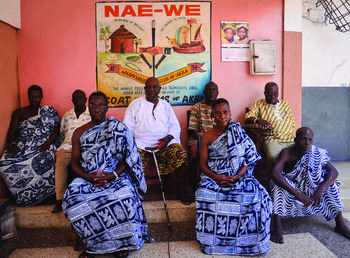
The Jury of the Nae We Shrine Tribunal. The Elders of Nae We take their places, ready to hear the next case. There is no priest present because this photograph was taken after Numo Tete III died in 2008. During the interregnum, the head of family, Numo Tumomli Yartey took on the role as the leader of the jury. The new priest, Numo Akwaa Mensah III, was installed by the elders in 2013. Behind the jury is the “Coat of Arms of Akra,” hearkening back to a time in 1734 when Priest Nii Boi Tono was acknowledged by Jan Pranger of the Dutch West India Company as the chief of Accra. Since then, the power to sign treaties and distribute land has been gradually secularized and placed in the hands of the Ga chiefs. Nevertheless, the spiritual leaders of the city assert their role as arbiters of justice and social peace in Accra. Back from left to right: Tete Mensah, Daniel Oko Yarlai Yartey, Head of Family Numo Tumomlin Yartey, Secretary Joseph Nii Yarboi Amugi. Front from left to right: Tete Tawiah, Okyeame Borquaye, Tete Annan Jonathan.

The Nae We Shrine Tribunal is one of hundreds of customary courts that deal with social and spiritual conflicts in Ghana. Though these courts are not registered with the Ministry of Justice, they have achieved normative recognition within the Ghanaian Constitution as institutions equipped to handle “the rules of law which by custom are applicable” (Government of Ghana 1992:133). In Ghana, as in most other countries in Africa, customary law governs the lives of the majority of residents, in particular those who are either illiterate or unable to afford participation in the formal legal system (Ubink & van Rooij Reference Ubink, Rooij, Ubink and McInerney2011). In village settings as well as in the larger urban areas, most of these courts are run by chiefs, who mediate conflicts over property, land, and succession. Shrines, on the other hand, tend to deal with supernatural criminalities, which are regarded by most Ghanaians as parallel in significance to other sorts of legal misconduct. The Nae We Shrine Tribunal combines both realms. It is a venue for witchcraft trials, which makes it an important community center for spiritual justice, as well as a court for civil and criminal cases that do not easily fit into nearby chiefly or government systems. Furthermore, it can seamlessly manage hybrid cases that mix the secular and the supernatural. Other shrines in Accra have courts too, but they are rarely active, whereas Nae We has a revered history as a leading family house in the city, a legacy that has elevated the shrine and its goddess to paramount status. Additionally, the Tribunal has fortified its reputation by maintaining a meticulous system of record keeping that provides a level of transparency that no other customary court in Ghana can offer.
The Nae We Shrine Tribunal is situated within the neighborhood of Ussher Town, in the heart of the capital city of Ghana. Established by Ga settlers in the seventeenth century, Ussher Town (known locally as Ga Mashie) is steeped in history. It is home to the oldest chiefly, king making, and shrine houses in the city, as well as the durbar grounds of the annual Ga harvest celebrations. But it is also one of the least developed and most overcrowded quarters of Accra, a city of approximately four million people (Government of Ghana 2018). In keeping with its surroundings, the home of the goddess is not an imposing edifice. There is no sign on the street to indicate its presence, and the compound itself isn’t much bigger than a family home. The sanctum within the shrine is also rather small, taking up only one room. Even its library is innocuous, a set of shelves filled with old ledgers, their pages overflowing with handwriting and their covers worn at the edges. Nevertheless, Nae We is a storeroom for an immense archive of court dockets, reference materials that document the struggle against crimes of hatred in Accra. For scholars, the details within these records open a window to a legal system that operates according to indigenous protocols, procedures, and notions of justice.
This article is the first published account of a multi-year project to digitize thirty years of handwritten records, generously supported by the priest and elders of Nae We. In practice, this has involved carefully handling every page of dozens of worn out volumes, along with hundreds of letters and thousands of scraps of paper. Some of the records were retrieved from the depths of old cocoa bags, dragged to the shrine from an offsite location. The secretary and priest were eager to preserve these records for posterity, so they offered us an improvised studio in a small room in the shrine compound, where we spent hundreds of hours photographing trial records and documents. After six years of work we had indexed over twelve thousand digital photos. The original ledgers remain on the shelves at the Nae We office, but digital copies are now available to the priest and elders as precedents of past court decisions.
It is exceedingly rare to find documents of historical significance at a priestly court in Africa. As far as we can gauge, the documents at Nae We are the only extant, indigenously-generated, written accounts from a traditional priestly court in Africa today. They contain trenchant examples of human contestation within the densely populated center of Accra, where people often endure physical, financial, and spiritual insecurity. When business transactions and close relationships fall apart, Nae We serves as a refuge for those seeking recompense. And when malicious supernatural powers bear down on the residents of Accra, they can defend themselves with the help of the goddess Nae. The judges at Nae We even consider hybrid cases that intertwine the secular and the supernatural. So firmly grounded are these documents in local notions of legal reasoning, they offer evidence of the “organic African jurisprudence” that Jean and John Comaroff have encouraged scholars to seek out for decades (Reference Comaroff and Comaroff2004:199).
This article will outline the historical and contemporary role of the Nae We Shrine Tribunal in Accra, situating it within the context of contemporary literature on witchcraft and traditional courts in Africa. It will also describe the trial process as an expression of daily life in Accra and explain why the court has gone unnoticed by international human rights advocates. The Nae We Shrine Tribunal is a unique venue for procedural justice, one that has survived the secularization of Ga politics, the colonial suppression of traditional courts, the threats posed by charismatic Christianity, and the ire of human rights activists. It is a dramatic expression of vernacular jurisprudence that continues to serve the legal and spiritual needs of the inhabitants of a rapidly changing African metropolis.
The history of the Nae We Shrine Tribunal
The elders of Nae We assert that their ancestors have held court at the shrine since the founding of Accra in 1677, a plausible claim, given that Ga deities have always been regarded as brokers of justice. According to the documentary record, the house of Nae has been active since at least 1743, when its titular head, the Nae wulomo (a male elder who leads the Nae kinship group and fills the office of priest of the sea goddess), was recognized by Europeans as the leader of the ruling clan house of Accra. The crest of Nae, emblazoned on the wall of the compound, serves as a symbol of the goddess’s legacy. The image illustrates a handshake between Nii Boi Tono of Nae We and Jan Pranger of the Dutch West India Company, acknowledging the priest as an early “king of Akra.” As the ancestral and spiritual leader of the House of Nae, the priest had the right to collect duties on imports and exports and play a role in brokering justice in the city. As the elders of Nae like to point out, the earliest priests of Accra played a dual role as chiefs as well as priests, an argument sustained by the foundational history of Accra written by Carl Christian Reindorf in 1895 (115).
However, as Accra grew, other priestly houses and chiefly houses contested the authority of Nae. The warden of the goddess of the lagoon, Korle Wulomo, and the keeper of the shrine of the war god, Sakuomo Wulomo, have always asserted their right to share in the distribution of religious power in the city. They also claim to have conducted their own tribunals in Accra from time immemorial (Interview, Sakumo Wulomo, Accra, Nov 17, 2002; Interview, Korle Wulomo, Accra, Dec 6, 2002). Additionally, a steady influx of immigrant newcomers from around the Gold Coast challenged the supremacy of Nae We by bringing their own chiefly and godly systems of justice to the city (Reindorf Reference Reindorf1895). But by far the biggest test of Nae’s role as arbiter of justice began in 1853, when the British colonial government sought to usurp the legal supremacy of customary courts by establishing the Supreme Court of the Gold Coast. British governors placed legal power in the hands of a colonial magistrate, claiming that Ga tribunals did not follow the protocol of habeas corpus or adhere to rules of evidence. When Accra became the capital of the Gold Coast in 1877, the British went a step further, by declaring that all “native” courts would fall under the jurisdiction of the Supreme Court’s Chief Justice (Kimble Reference Kimble1963). The rise of colonial political, economic, and cultural power in the city, along with the rapid spread of Christianity and Islam, further diminished traditional authority. By the end of the nineteenth century, the Nae We Shrine Tribunal had disappeared from official colonial records.
But the elders at Nae We maintain that the Tribunal has never ceased operation and has never abrogated the right to try criminal cases, even for capital offenses. Their assertions are supported by Carl Christian Reindorf (Reference Reindorf1895), who referenced a specific instance in the late eighteenth century when the acting priest of Nae We presided over a case of homicide. No verdict was reached because the accused committed suicide during the trial, but the priest demonstrated his judicial power nonetheless. There is also evidence that the Nae We Shrine Tribunal was operating in the 1920s and 30s, as anthropologist Margaret Field (Reference Field1937) noted that the paramount shrines of the Ga people operated both as places of worship and as public courts. In fact, Field claimed that the shrines of Accra were treated as higher courts, where appeals from chiefly courts could be brought. Thus, despite its disappearance from the colonial records, it seems the Tribunal never stopped its work as a court of justice. However, it did encounter increasing competition, particularly in the arena of property disputes and criminal trials. Chiefly courts rose to prominence in the nineteenth century as arbiters in conflicts over land ownership, while at the same time colonial magistrates asserted authority over criminal cases as early as the 1880s (Parker Reference Parker2000:85; Kimble Reference Kimble1963:129). As in other parts of Africa (Hogg Reference Hogg, Carpenter and Lawrance2018:55; Mann & Roberts Reference Mann and Roberts1991), justice in Accra began to operate according to a tier of legalities, with colonial courts at the top handling a small number of major criminal cases, the chiefly tribunals in the middle managing a slightly larger file of political and land disputes, and courts such as the Nae We Shrine Tribunal at the bottom dealing with the vast majority of less serious offenses.
In the early twentieth century, the colonial government placed further pressure on indigenous systems of justice on the Gold Coast by suppressing dozens of “anti-witchcraft” shrines (Allman & Parker Reference Allman and Parker2005; Gray Reference Gray2005). Oddly, Nae We never seemed to warrant attention by officials in Accra. Some legal scholars have suggested that the British operated according to an unwritten “repugnancy” test, which treated customary law as a necessary component of colonial rule, provided it did not offend the morals of the colonial ruling classes (Griffith Reference Griffith1887; Mann & Roberts Reference Mann and Roberts1991; Ibhawoh Reference Ibhawoh2014). Though the priest and elders of Nae We today might disagree, the former elders of Nae We probably avoided colonial surveillance by simply abandoning modes of discipline and violence to which the British colonists claimed exclusive rights (such as imprisonment, corporal punishment, or executions). This would have been a prudent decision, allowing the continuity of the shrine while at the same time maintaining political stability. Though the colonial governments of British Africa publicly declared their commitment to “law and order” as part of their civilizing mission, administrators on the ground seemed willing to let shrines such as Nae operate autonomously, provided they did not commit egregious disruptions to the moral expectations of colonial rule (Hynd Reference Hynd2012; Colebourne Reference Colebourne, Godfrey and Dunstall2005).
Ghana’s independence did not dramatically alter the relationship between shrine and state. Like the colonial laws before them, Ghanaian laws enshrined the individual rights of persons, ensuring that traditional institutions would only be censured if they perpetuated customs repugnant to human dignity. What did disappear was the imminent threat of repression based on British notions of morality. In fact, after 1957, dignitaries began to celebrate the role of shrines such as Nae We, visiting them in order to garner political support. Shrine secretary Joseph Nii Yarboi Amugi has stated firmly that every president since Kwame Nkrumah has been welcomed to the shrine, affirming the role of traditional justice within the scope of national politics (Interview, Accra, May 17, 2012). A particularly vocal supporter in the 1980s was Flight Lieutenant-turned-President Jerry John Rawlings, who famously called for a “return to the shrines” in 1979 (Daily Graphic 1980). Other leaders followed, including John Kufour of the right-leaning National Patriotic Party, a leader with a very different political background from Rawlings, who visited more than once in the 2000s.
Hybrid vernacular justice: beyond “witchcraft trials”
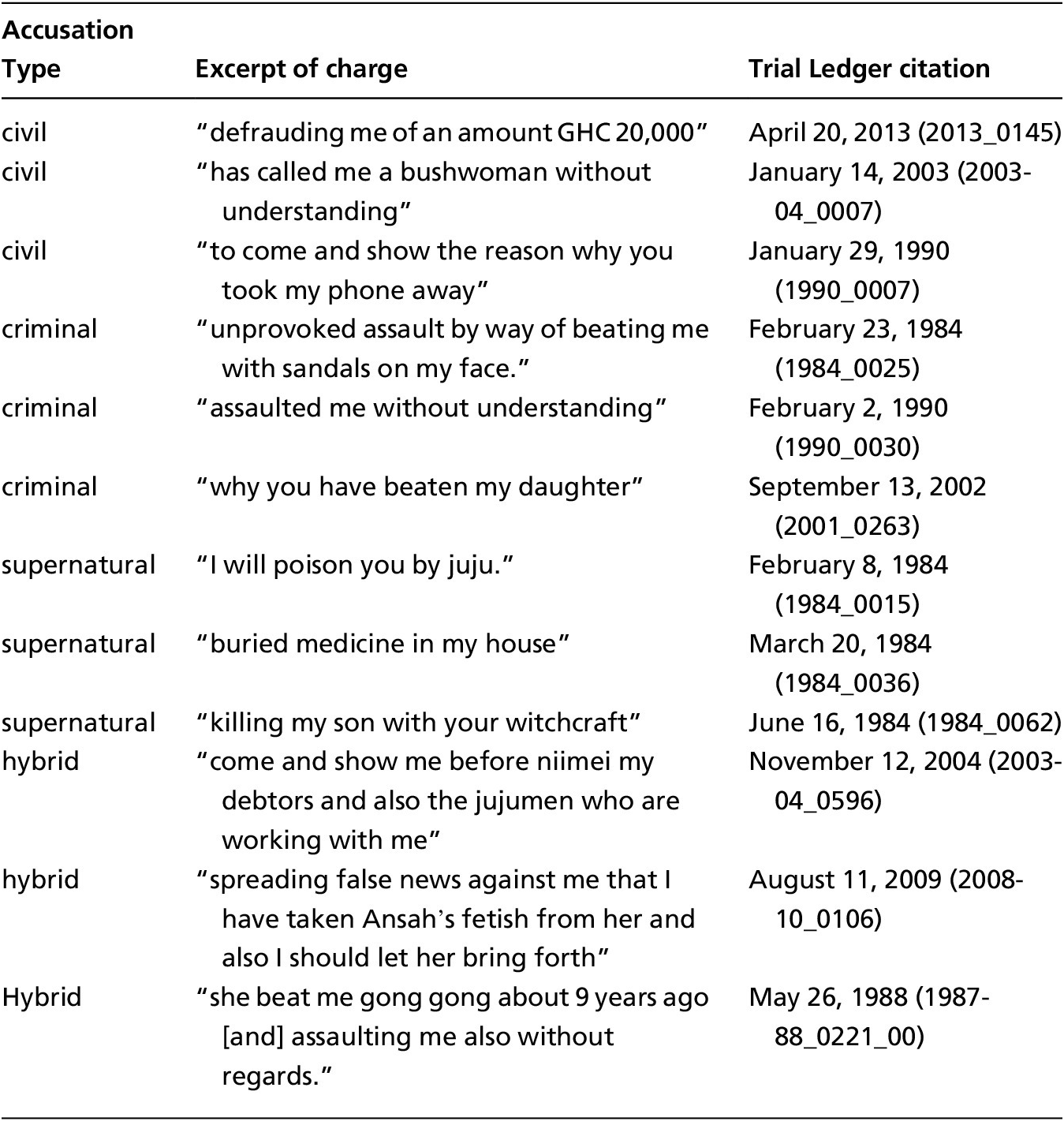
When we first heard about the Nae We Shrine Tribunal, we were told it was a place for “witchcraft trials.” In the Ghanaian context, we understood this to specifically mean that people were being accused of using malicious spirits to harm their neighbors and kin, and that they were being arrested and brought to trial, just as they are in some parts of Northern Ghana (Adinkrah Reference Adinkrah2017; Richter et al. Reference Richter, Flowers and Bongmba2017). Indeed, we were astounded when we finally saw so many accusations of “witchcraft” on the pages of the court dockets(see Table 1). Though written in English, this term appeared to be a direct translation of the Ga term for witchcraft, ayekpemo. Not only were accusations of witchcraft prevalent, but countless other charges of spiritual malfeasance leapt off the pages, including “curse” (or lomo, a malicious oath that leads to physical misfortune or injury), “sorcery” (or su, meaning to bewitch or poison someone), “put into fetish” (meaning to make someone beholden to a local spirit or god, with dire consequences if they do not repent), and “juju” (something similar to fetish though less specific in its attachment to a named local spirit). With all this evidence of vernacular jurisprudence at hand, it seemed we had found the quintessential African “witchcraft” court, a system of justice founded upon local understandings of occult criminality.
Examples of Accusations at the Nae We Shrine Tribunal. We have categorized accusations as civil, criminal, supernatural, or hybrid, but the charges written in the court docket can change as the trial proceeds. Passionate exchanges between litigants can lead to charges of curses, sorcery, juju, witchcraft, and even confessions of spiritual malfeasance. The charge listed in the court docket serves mostly as a guide to the jury about what to expect from the trial, but the decision rendered may include new charges and countercharges.

However, after all of the court dockets had been examined, it became clear that the majority of the trials at the Nae We Shrine Tribunal actually involve petty conflicts over property, minor assaults, or claims of defamation, with no supernatural referent. This means that even though the court is widely known as a “witchcraft court,” it would be wrong to prioritize witchcraft as the cultural practice that defines jurisprudence at Nae We. Starting with Edward Evan Evans-Pritchard (Reference Evans-Pritchard1937) over eighty years ago, Western scholars have tended to treat witchcraft as an idiom that offers insight into social cleavages, class divisions, gender conflict, and economic change (Gluckman Reference Gluckman1968; Lewis Reference Lewis and Douglas1970; Marwick Reference Marwick1972). But even if occult offenses such as witchcraft are an everyday part of life in Ghana, we are not comfortable with an analytical strategy that prioritizes witchcraft as a guiding cultural element in the study of vernacular jurisprudence. To privilege witchcraft as the “indispensable background” to other beliefs (Evans-Pritchard Reference Evans-Pritchard1937:21), the cause of “practically any misfortune” (Crawford Reference Crawford1967:94) or as an ultimate “metaphysical” answer (Gluckman Reference Gluckman1963 [2004]:142), would essentialize the judicial world of Nae We as a site of religious performance. This is because the court records demonstrate that justice at Nae We has neither a secular nor a spiritual starting point; rather, it is a place of l’arrangement, where political power and spiritual power intertwine without one defining characteristic (De Boeck Reference De Boeck, Werbner and Ranger1996:99; MacGaffey Reference MacGaffey2000:16).
There are other reasons why the Nae We Shrine Tribunal is difficult to fit into the current scholarly discussion on witchcraft and vernacular jurisprudence. One is that it operates at arm’s length from both Ga tribunals and the Ghanaian judiciary. Though Nae We is a founding house of the Accra polity, it cannot be understood as part of a coordinated “tribal” judiciary. Some of the disputes brought to Nae We might end up at the nearby Ussher Town chief’s palace (only a few blocks away), but few of these would be suitable for a chiefly tribunal where issues of land, property, and succession are preeminent. Nor does Nae We operate as an appendage to the nearby government circuit court at James Town (also only a few blocks away). Cases from Nae We might be entirely reconceived within formal language to make them appropriate for the state judiciary by, for example, secularizing an accusation of witchcraft into an accusation of defamation, but the registrar at James Town has unequivocally stated that his court does not deal with any supernatural crimes, nor is it likely to entertain any such cases in the future (Interview, Simon Panfo, Accra, May 17, 2012). In other African countries that have enacted laws against supernatural offenses, witchcraft trials are starting to crop up regularly in government courts. John and Jean Comaroff’s (Reference Comaroff and Comaroff2004) analysis of trials involving witchcraft accusations in South Africa has inspired a new literature about the sorts of “cultural justice” emerging in government courts in Africa (Fisiy Reference Fisiy1998:143; Harnischfeger Reference Harnischfeger2000:99; Luongo Reference Luongo2008:35). Adam Ashforth’s most recent article in the African Studies Review (Reference Ashforth2015) offers a lively account of the way that magistrates in Malawi have brought down decisions in cases of witchcraft as a means of dissipating the hatred that such cases reveal. This may be the case in other parts of Ghana, but not in central Accra.
Another thing that distinguishes the Nae We Shrine Tribunal is the fastidious manner with which priest and elders tend to their records and protocols. Such procedural thoroughness has led people to believe that the court is a recent invention, perhaps a type of restorative or alternative justice that developed during the postcolonial period. Indeed, it is understandable that newcomers to the shrine might take away this impression because some of the formal elements of procedural justice at Nae We appear to be directly borrowed from international judicial protocols (such as the positions of bailiff and secretary, the use of case numbers, the positioning of plaintiff versus defendant, and the imposition of fines for contempt of court). One might even be led to think that these components hearken back to the colonial judicial system, but there is simply no evidence that British nor Ghanaian-trained jurists have ever been involved in structuring the process of justice at Nae We. The shrine elders are adamant on this point. They state unequivocally that the Tribunal has never been directed by Ga chiefs, British colonial officers, or government bureaucrats. The duteous nature of record keeping and the shrine’s unfailing adherence to protocol should not be mistaken as a facsimile of Western “due process.” Rather, it is a logical result of years of hard work and sound management by the priest and elders.
Nevertheless, it does remain a puzzle that extant court dockets date back only to 1984. Scholars of Ghanaian history will note that this is the same year that the Provisional National Defence Council (PNDC) initiated the revolutionary Public Tribunals Board. At the time, the Chairman of the PNDC, Jerry John Rawlings, hoped that systems of traditional justice would soon overthrow the imposed “Westminster model” (Daily Graphic 1980). But shrine secretary Amugi has stated firmly that records have always been kept at the shrine, and that those written prior to 1984 have only been temporarily misplaced (much to his frustration). Amugi denied any links to the PNDC or any other political party and noted that the shrine has never dealt with national issues such as rent controls, price ceilings, or government corruption (Interview, Accra, May 17, 2012). Rather, the court at Nae We has consistently focused on local disputes, making it vernacular in the sense that it responds to local cues about justice and punishment, rather than national or international regimes of law. This bottom-up approach to jurisprudence does not neatly fit into the current literature on systems of justice that have emerged as responses to social dislocation, political crisis, or military conflict (Gocking Reference Gocking2000; Fenrich et al. Reference Fenrich, Galizzi and Higgins2011; Ngarambe Reference Ngarambe2015).
It is also difficult to fit the Nae We Shrine Tribunal into the historiography of shrines in Ghana, in particular the literature on witchcraft panics in the Gold Coast and Ghana. The biography of the sea goddess differs sharply from deities such as Tongo, Aberiwa, and Tigari, mobile spirits who have traveled around West Africa as weapons against outbreaks of witchcraft (Allman & Parker Reference Allman and Parker2005). No one has ever “bought” Nae to fight supernatural crimes elsewhere. Indeed, Nae has never left Accra, maintaining her residence in Ussher Town for centuries. Moreover, our analysis of the Nae We records offers no evidence of significant statistical changes in the rates of curse, sorcery, and witchcraft accusations over time. Rather, there is something consistent, even banal, about the spiritual crimes that appear as regular occurrences in approximately half of the trials. In fact, the trial records offer no evidence of a correlation between witchcraft activity and crisis in the body politic. The impression one gets when reading the Nae We documents is that witchcraft accusations are simply an element of daily life in Accra, and therefore a normative component of procedural justice at the Nae We Shrine Tribunal.
The court at Nae We also fails to reflect what scholars have called the “modernity” of witchcraft (Geschiere Reference Geschiere2000; Sanders Reference Sanders2000:127). One might expect to find accusations within the Nae We documents that reflect changing working conditions, income disparity, or the impact of new technologies, but these things are notably absent from the records. There are no dramatic accounts of changes in labor relations akin to ekong, the type of witchcraft that turns people into zombies to work on invisible plantations, as reported by Peter Geschiere and Cyprian Fisiy in Cameroon (Reference Geschiere and Fisiy1994). Nor are any new deities of modernity, such as Mami Wata, present in the trial records (Drewal & Houlberg Reference Drewal and Houlberg2008). The technology of modern witchcraft is also missing, as there are no accounts of airplanes, landing strips, or other expressions of the mobility found in witchcraft accusations from other parts of Africa (Geschiere Reference Geschiere2013). While accusations of infertility are common at trials at Nae We, they never contain expressions of a supernaturally gendered impotence like the twenty-first century phenomena of the stolen penises that has hit many African countries (Bavier Reference Bavier2008). Nor can we find anything about bodily or blood medicines as we might in the muti murders and albino killings of Southern and East Africa (CNN 2002; Bryceson et al. Reference Bryceson2010). Instead of seeing new occult criminalities that demand new types of postcolonial due process, a core repertoire of stereotypical accusations repeat themselves at Nae We, via phrases such as “he buried juju in my house,” “she called me a witch,” “he threatened to kill me,” “they put me into fetish,” and so on. So rote are these allegations that they cannot support any assertion that the trials at Nae We are expressions of modernity, critiques of capitalism, or a reflection of a new occult economy.
Most strikingly, the records from Nae We fail to support an axiom of contemporary witchcraft studies, which holds that witch attacks most often occur within kinship groups and the household (Fisiy Reference Fisiy1998:143; Geschiere Reference Geschiere2000). There is a Ga saying that holds that there is a witch in every house (Shia fee shia, aye eye jeme), and popular discourse about witches usually takes on a kin-versus-kin dimension. One of the greatest fears of Ghanaians is to be betrayed by a brother, sister, mother, father, or spouse who is revealed to be a witch. Yet family feuds rarely appear in the Nae We trial records. Rather, the litigants at the shrine come from local networks of commerce in the bustling, crowded neighborhoods of Accra. The contestations between market women, fishermen, and petty traders do occasionally show deep levels of intimacy, but they rarely demonstrate the frictions that occur within bonds of kinship. Though kinship witchcraft battles may be ongoing in Accra, it is not possible to argue that the Nae We tribunal exists as a functional check on such disputes.
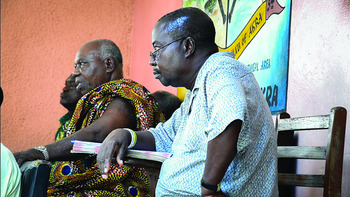
The Shrine Secretary. Joseph Nii Yarboi Amugi sits in judgment, his hand poised over the pages of the newest docket, ready to capture what transpires during the trial. Mr. Amugi worked in Europe, the Middle East, and East Asia during the 1980s then returned home to take up the role of record keeper at Nae We; he takes notes at trials and handles all correspondence and financial matters at Nae We.

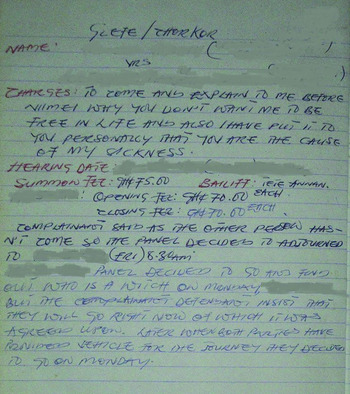
An Example Case at Nae We. A spirit medium has charged a woman with a type of witchcraft leading to sickness and misfortune. The charge reads: “… explain to me before [the priest of Nae] why you don’t want me to be free in life and [why] you are the cause of my sickness.” After some delays, the plaintiff and defendant appeared in court, and during a heated discussion involving friends, family, and onlookers, charged and countercharged one another with witchcraft. Unable to settle the case, the elders of Nae We asked the litigants to visit a witch finding ritualist. Neither party could agree who would pay for transportation or purifications fees, so the case remained unresolved. Nevertheless, the Tribunal collected fees of GHC215 (USD115). (Note: names and dates have been blurred to protect the privacy of the participants).

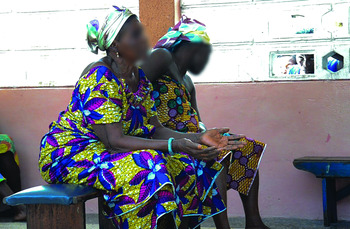
A Defendant at Nae We. An elderly woman pleads in her defense at the Nae We Shrine Tribunal. She has been charged with causing the sickness of the plaintiff and has been called a witch. Alongside the defendant sits the plaintiff. A crowd of family members and friends are seated behind the litigants, and outside a growing congregation of onlookers peers through windows. This particular case was heated and noisy, with the audience shouting and jostling inside and outside the shrine compound. A lengthy cross-examination by the elders proved inconclusive, and it was agreed that the litigants should be sent to a witch-finding ritualist. The elders of the shrine arranged transportation to the home of ritualist, but neither party showed up, and the case petered out. (Note: faces have been blurred to protect the privacy of the participants).

The banality of vernacular justice at Nae We
A case at the Nae We Shrine Tribunal commences when a plaintiff brings an accusation before the court. It is officially registered in the court docket, given a sequential number, and named after the location of the crime. The defendant is then summoned by the shrine secretary, usually via a phone call. If the defendant does not answer, the plaintiff must pay a cash “summons fee” to cover the cost of remanding the defendant. Once the fee is paid, the shrine bailiff seeks out the defendant, traveling to their residence with a suitcase containing a broom representing the authority of the goddess. According to the elders of the shrine, the accused always recognizes the gravity of the charges when the broom is laid before them and will agree to plead their case before the priest.
Beyond delivering a summons, the court system at the Nae Shrine has no legal authority to force someone to attend a trial. Even the secretary has admitted that, in rare instances, accused persons have simply refused to come to court, but he argues that the vast majority will always come because they fear the spiritual wrath of Nae. The goddess is understood to be overseeing the trials held at her family home and is said to be able to make anyone who resists her bidding suffer misfortune, fall sick, go insane, or even die. Nevertheless, some people still refuse her call. In stubborn cases, when an accused person refuses to show for an important trial, the secretary of Nae We can petition the Ghana Police Service for an arresting permit, on the grounds that the priest has authority to do so as a traditional religious leader. According to the Ghanaian Constitution, “No person or authority shall raise any police service except by or under the authority of an Act of Parliament” (1992), which means that police are not legally required to comply with a petition made by a traditional religious leader. However, the shrine records show that jurors at Nae We often do issue an “arrest permit” to apprehend an individual for a trial. To pay for this permit, the secretary charges the plaintiff an “arresting fee,” part of which is passed on to the police when they bring the defendant to the shrine (Interview, Accra, May 17, 2012). Though technically unconstitutional, this seems to be a regular practice at Nae We.
The priest and elders of the Nae We Shrine Tribunal state that they will hear any and all cases brought before them, which means they hear a wide variety of suits. Many of the accusations found in the records are akin to English common law offences such as defamation, harassment, trespassing, robbery, burglary, assault, and sexual assault. Others are specific to Ga notions of spiritual wrongdoing, including accusations of juju, cursing, sorcery and, of course, witchcraft. Many of these cases are mixed together, especially when accusations fly during the trials; however, there do appear to be contemporary limits to what can be heard at Nae We. Accusations of murder might be leveled during a case but only with reference to a supernatural cause. High crimes related to the state are also absent from Nae We, even those involving disputes over chiefly succession. Thus, it does seem that the judicial dominance established during the colonial era remains in place, now in the form of National authority over criminal matters.
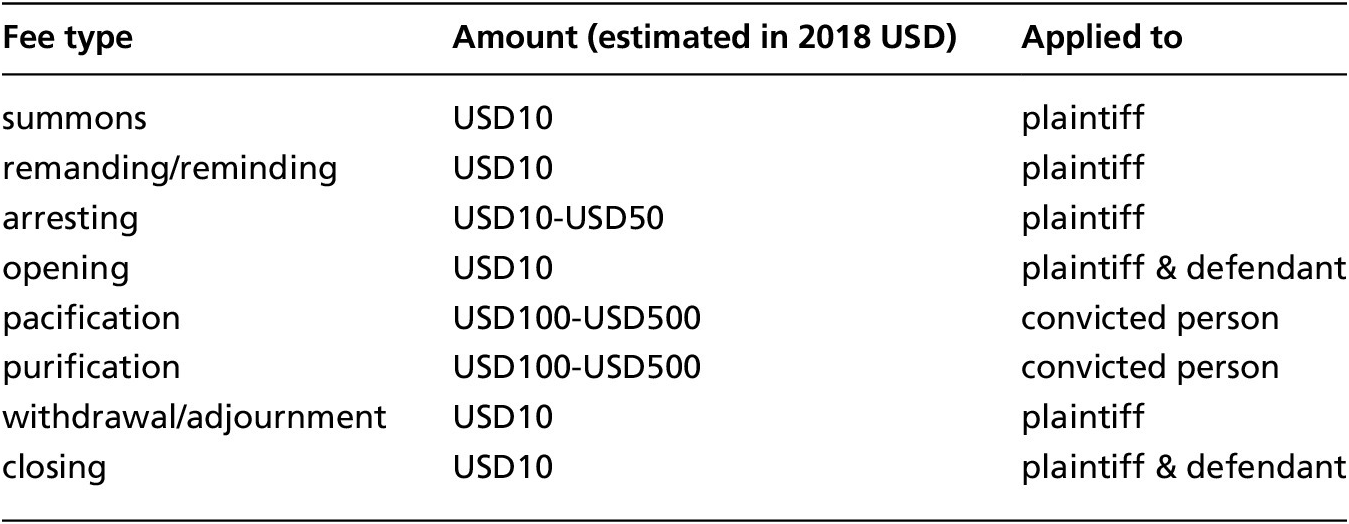
There is a case at Nae We about every second day. On the morning of a trial, the secretary writes the case number and location of the crime on a chalkboard in the corner of the courtyard, and the elders slowly assemble on the benches, waiting for the plaintiff and the defendant to show up. The number of elders who form the jury differs from case to case but is typically between seven and twelve. Most of the time, both of the litigants arrive on time and the trial proceeds, but as in many other courts, people sometimes arrive late or fail to show up. No matter what the situation, the secretary makes notes, and the bailiff is tasked with retrieving fees to cover the expenses of booking time at the court. Should either of the parties fail to attend a hearing, the court officials charge them a “remanding/reminding fee” as a form of punishment, an amount that is paid in cash directly to the shrine. As happens in other courts, the trials at Nae We sometimes fizzle out. Often litigants will arrive and announce that they have dropped the charges. Sometimes litigants will agree to cash payments to privately end a dispute. Other times, cases are continuously adjourned until they peter out without resolution. Still other cases suffer delays due to weather, traffic, or family crises, and end without resolution. But if a trial is ended prematurely or if the elders see that their time is being wasted, the litigants are required to pay “withdrawal/adjournment” fees similar in amount to remanding fees (see Table 2).
List of fees at Nae We. If litigation moves smoothly at the Nae We Tribunal, the fees are modest, but if charges of pacification and purification are levied, the financial burden to a convicted person can be substantial. The elders at Nae We argue that their fees are simply a means of ensuring the continuing financial viability of the Tribunal.

When a case does go to trial, the litigants seat themselves in front of the jury, on separate benches. They are asked to provide an “opening fee” to the shrine coffers, in the form of cash and gifts. The litigants then stand and present their cases and are cross-examined by the priest and elders. No legal counsel is allowed at Nae We, but litigants may bring one close friend or relative to offer a supporting statement. They can also invite their friends and family to sit in the gallery, which is comprised of about four rows of benches behind the litigants. The courtroom is often crowded with supporters sitting on the benches, standing behind the benches, and assembled outside the windows of the courtyard, but only the litigants and their one associate may speak or respond to questions. Any member of the jury can ask questions, and the exchanges between the litigants and the jurors is often heated. The crowd also shouts and responds to what they hear, but if they are deemed to be disturbing the proceedings, young men deputized by the priest as security officers will see that they are removed from the premises.
Once the hearing is completed, the priest and his jury retreat to the sanctuary of the shrine to seek guidance from the goddess of the sea, while the litigants remain in the courtyard. Deliberations are brief, usually taking less than an hour. When the jury reappears, they take their seats, and the priest announces the decision in favor of either the plaintiff or the defendant. In some cases, both parties will be found at fault. Guilty parties are required to pay “pacification fees” to the goddess Nae in the form of palm wine, akpeteshie (local gin), schnapps, soft drinks, cloth, foodstuffs, livestock, or cash. Like all payments, pacification items are first given to the secretary, and then divided between the shrine and the victorious litigant, depending on the decision of the jury. However, the priest always states that the pacification fee should be understood primarily as a means of making amends to the goddess for the wrongs done by the people under her watch, and only secondarily as a reward to the aggrieved party.
If a litigant is found guilty of a supernatural crime, such as sorcery or witchcraft, they may need to be spiritually purified. This work is beyond the purview of the priest of Nae, who is a divine figure but who does not have the gift to be able to see into the spirit world where the malicious forces that caused the crime were committed. Therefore, he must enlist the help of spirit mediums, known in Ga as woyei (f) or wontsemei (m), experts who are able to gauge the nature of a supernatural injury and cleanse the spirits of the guilty parties. There are dozens of professional spiritualists affiliated with Nae We. They visit the shrine regularly to let the priest know that they can do the work of divining and cleansing, and they congregate en masse at the shrine compound during the rituals of the annual Homowo harvest celebrations. The secretary of Nae will select a spiritualist and send the accused to visit them at their private shrine compound, wherever it may be in the city of Accra. Only the litigants and the members of the jury will be present at the divining session, which may involve the slaughter of livestock, drinking of ritual potions, the performance of dances, the display of sacred objects, or the repetition of incantations. The purpose of the ordeal is to cool the spirits that are causing the accused to commit hateful acts. If the accused is found guilty or confesses, they must cover any costs related to the purification ritual. If the accused is deemed not guilty, the plaintiff must cover those costs. Once the purification ritual is complete, the litigants return to Nae We to officially end the trial, each paying a “closing fee” so that the case will be recorded as complete in the tribunal docket.
By outsourcing divination rituals to associated ritualists, the Nae We Shrine Tribunal avoids association with the material culture and ritualistic elements of witchfinding and confession extraction. The shrine elders were not always so detached from this process. In the past, an exposed witch might be punished with a fine, public humiliation, or even a beating at the hands of a priest (Field Reference Field1937). As the shrine elders like to point out, in the olden times those excused of spiritual malfeasance were sometimes beaten to death. But while corporal punishment or even execution might have been part of witchcraft trials in the past, the elders of Nae take pains to point out that there have been no forms of physical abuse used at the shrine in recent memory, and that their goal is not to punish but rather to cleanse the accused, in order to reestablish social harmony. Though they admit that the process of divination at affiliated shrines can at times violate a person’s dignity, they assert that the accused never suffers any bodily harm. Of course, they make these claims having recused themselves from the process, leaving it in the hands of spiritualists without any certified professional body to oversee their work.
If a case is quickly heard and quickly judged, justice at Nae We can cost less than USD50. This is a hefty sum in a city with an average daily wage of USD5 per day (Fink et al. Reference Fink, Weeks and Hill2012), but it is manageable with the help of friends and family. However, as with other courts, litigation at Nae We can be quite expensive if it drags on. In particular, cases involving the divination of spiritual crimes can be expensive, sometimes reaching as high as several hundred U.S. dollars. Nevertheless, purification fees should not be regarded as a windfall for the shrine. The goods collected are understood as sustenance for the deity, and a substantial amount is passed on to the spiritualists handling the cases. Though protracted cases bring in larger fees, they also involve several days of mustering the people and resources needed to conduct divination rituals. The priest and the elders may also suffer financial loss during a prolonged case if litigants cannot afford to pay for rituals. Rather than regarding the cost of a trial as a form of spiritual extortion, it may be better to think of the fees at Nae We as a reflection of the efforts by the priest and the elders to keep the court on a solid financial footing, afford a sense of decorum for the shrine, and encourage litigants to take the proceedings seriously.
Statistically, over 60 percent of the trials at Nae We do not involve any sort of supernatural crime. In fact, the average cases heard at Nae We are similar to the sorts of cases that might be brought before a daytime courtroom reality television show in the United States—unpaid rent, damage to property, debts owed, infidelity, or slander. However, it is always possible that a minor civil charge can be elevated into a criminal charge or a spiritual accusation. For instance, someone might accuse another person of theft and then, at the trial, claim to have been physically assaulted or allege that their business was spiritually cursed to fail. Outright spiritual wrongdoings make up about 40 percent of the charges at Nae We, and they are usually related to curses, sorcery, and witchcraft. Most of these cases are solved with relative ease by dealing with them as defamation suits, but many do result in lengthy purification rituals. Nevertheless, those cases that are sent for divination follow precedent and protocol. Nae We is not an improvised witch finding movement. Rather, the elders see themselves as defenders of the rights of residents of Accra to live free from spiritual persecution. The goal of the priest and elders is to resolve disagreements in an orderly, and hopefully amicable, fashion. Failing that, they rely on interpreters of the other world of occult forces to cool the fires of hatred and restore social harmony.
The Future of the Nae We Shrine Tribunal: the challenge of the “anti-anti-witchcraft crowd” and Charismatic Christianity
The Nae We Shrine Tribunal handles a wide variety of charges. Some of these involve charges of witchcraft, but the priest and elders do not prioritize their role as a witchfinders. Rather, they regard judging cases of spiritual malfeasance as just part of the daily work at the shrine. Yet the mere presence of charges relating to witchcraft and sorcery makes it necessary to situate the Tribunal within a conversation about witchcraft in Ghana. The public follows cases of witchcraft in the print media through tabloids such as The Mirror and People & Places, and on radio via call-in shows such as etuo mu wo sum (it is dark inside the barrel of a gun). Witchcraft is also a regular topic of religious sermons on television, as pastors call on people to pray for deliverance from the “evil machinations of witches” (Adinkrah Reference Adinkrah2017). Videos of supposed witches and wizards caught in the streets of Accra sometimes go viral on YouTube, Facebook, and WhatsApp, and belief in witchcraft is reinforced through interpretations of the Bible and the Quran, through proverbs, and through popular Ghanaian music. While there are many skeptics, most people in Accra make decisions based on the assumption that they will have to contend with supernatural forces in all facets of their lives. This includes expressions of fear about being cursed, struck by juju, or put into fetish, but the paramount concern is with bewitchment, and witchcraft often stands in as an umbrella term for the larger category of supernatural crimes. Like many other Africans, the majority of people in Ghana truly do live within what Adam Ashforth has called a “world with witches” (Reference Ashforth2015).
At the same time, Ghana is being caught up in an international movement to halt the violent persecution of witches. International organizations such as Action Aid and UNICEF argue that witchcraft persecution is a form of violence against the weakest members of society, and have noted that children without parents and elderly women with mental illnesses bear the brunt of accusations (Kwatra Reference Kwatra2012; Cimpric Reference Cimpric2010). By citing case after case of human rights violations, they hope that international pressure will encourage the Ghanaian government to halt witch hunting, but for now it continues unabated, especially by independent Christian pastors who believe they have the gift of seeing into the invisible world of witches. In particular, Ghanaian activists are targeting prayer camps that have been converted to witch camps, rural outposts where families forcibly relocated their loved ones to deliver them from mental illness believed to be caused by bewitchment (Ofori-Atta et al. Reference Ofori-Atta, Attafuah, Jack, Baning and Rosenheck2018). Undercover investigative reporter Anas Aremeyaw Anas has documented cases wherein members of a radical Christian church accused a young boy of witchcraft, tied him to a tree and beat him. Anas claims that every year in Ghana, hundreds of children are murdered by family members who believe that their bodies are possessed by evil spirits (Mullins Reference Mullins2015). Activists also exposed the horrific murder of an elderly woman in Tema, a Ga-speaking suburb, whose death made international news when an evangelical pastor tortured her into confessing she was a witch, doused her with kerosene, and set her alight (Smith Reference Smith2010). Other elderly persons have narrowly escaped death by mobs after being accused of witchcraft (Gold Coast Journal 2015). Yet none of this activism has had an impact on the daily work at the Nae We Shrine Tribunal.
The absence of any activist challenge to the Nae We Shrine Tribunal is striking. Campaigns to end the persecution of witches in Africa, the “anti-anti-witchcraft” crowd as Adam Ashforth (Reference Ashforth2015) sardonically calls them, have focused on heinous crimes such as necklacing in South Africa (Ball Reference Ball1994), witch hunts in East Africa (Hari Reference Hari2009), and the infamous witch camps of Northern Ghana (Richter et al. Reference Richter, Flowers and Bongmba2017), but none of trials at Nae We have caught their attention. This may be because, on an average day, the Nae We court will never hear a word uttered about witches, sorcery, or curses because most cases are about petty crimes and misdemeanors. It might also be because the punishments meted out by the Tribunal are aimed at social healing rather than vengeance, as is the tradition at major shrines for paramount deities in Ghana (McCaskie Reference McCaskie2006; Nukpe Reference Nukpe2007). Just as it did in the colonial era, the trial process at Nae We continues to pass a sort of unwritten repugnancy test because it does not involve exile, imprisonment, corporal punishment, or capital punishment. The state, it appears, has never been at odds with Tribunals such as the one held at Nae We, and there is no echo here of what Comaroff and Comaroff have described as the “challenge of Culture to the sovereignty of the state” (Reference Comaroff and Comaroff2004:189).
In fact, Nae We faces a greater challenge from the charismatic Christian movement than from activists or the state. For the past few decades, the rituals of the harvest festival of Homowo, a key part of the traditional religious calendar of the Ga people, have been challenged by churches around Accra. In particular, megachurches such as Lighthouse International have organized resistance to the annual “ban on drumming and noisemaking,” which occurs during the harvest months of May and June in Accra (see van Dijk Reference van Dijk2001:31). Exuberant gospel choirs and bands have disrupted traditional Ga rituals on purpose, often resulting in violence. In 1998, a mob of Ga youth led by traditional priests attacked the Lighthouse International headquarters, tearing down walls around the church and confiscating instruments. A subsequent human rights commission upheld the rights of Charismatic churches to make noise during Homowo, which has led to ongoing bursts of conflict (de Witte Reference de Witte2008:304–5). Charismatic Christian dogma portrays Nae as a minion of Satan and regards the followers of the traditional gods as pagans or devil worshippers (Ghana Web 2017). Yet as fierce as these conflicts may be, and as difficult as it is for a traditional shrine to survive in an era of Christian fundamentalism, these conflicts have had no impact on the Nae We Shrine Tribunal. As the priest and elders proudly declare, no political or religious disturbance has ever disrupted the daily operations of the court.
Conclusion
The Nae We Shrine Tribunal has a deep legacy as a culturally-competent arena for procedural justice. Despite changes to the political structure of the Ga state, incursions made during the colonial era, the mobilization of “anti-anti-witchcraft” activists, and challenges posed by Christian churches, the Tribunal has survived intact. As an independent judicial body, it is inimitably positioned to help people guard their cultural notions of dignity, self-respect, and spiritual wellbeing. Operating outside the purview of chiefly and state rule, it is a space where disputes involving hatred and jealousy can be aired, discussed, and resolved, using traditional methods of purification and pacification, as well as well-reasoned secular decision-making. The Nae We Tribunal is much more than a witchcraft court; it is law from below, a vernacular legal approach that responds to indigenous concepts of fairness, respect, and spiritual equilibrium.
There are many other traditional courts in Ghana, but the Nae We Shrine Tribunal has endured through the centuries by virtue of its decorum, recordkeeping, and flexibility. In the future, the court may face legitimate challenges from human rights organizations, based on the willingness of its jury to offer social healing and spiritual security to its litigants without regard for international regimes of human rights. It may also endure increasing threats from fundamentalist Christians, who, in their fervor to remake Ghana as a Christian republic, seek to dismantle the traditional religions of the country, along with their traditional court systems. But, for now, it remains a form of jurisprudence that is embedded within local culture, and it continues to offer a path to social reconciliation for the people of Accra.
Acknowledgments
The authors would like to thank the priest and elders of Nae We in Accra for allowing access to their court and records. Without their assistance and candour, this article would not have been possible. We also want to express gratitude for the generous financial support offered by the British Library’s Endangered Archives Programme, and by the Research Office at Mount Saint Vincent University.