Discourses of sustainability have largely emerged from advanced capitalist societies representing middle-class, tertiary-educated urban perspectives (Castro, Reference Castro2004; Middlemiss, Reference Middlemiss2014; Plumwood, Reference Plumwood2002), despite recognition that inclusivity of the whole community is needed in creating solutions to problems of unsustainability (Berlach & Chambers, Reference Berlach and Chambers2011; Fischer & Black, Reference Fischer and Black1995; Gough, Reference Gough2014). This article explores the ways that people perceived as disengaged from dominant sustainability discourses understand underpinning concepts of sustainability in their lives. This is not a new concern, and some sustainability scholars (Middlemiss, Reference Middlemiss2014; Plumwood, Reference Plumwood2002) have expressed unease that discourses of sustainability are exclusionary. Indeed, as this article discusses, people in very different social fields engage in, and/or disengage from, sustainability discourses in different ways, but in many cases have the same concerns (as those expressed in sustainability discourses) regarding the future, or interest in future generations, or in non-human value (Kelly & Coggan, Reference Kelly and Coggan2007; Macnaghten & Urry, Reference Macnaghten and Urry1998).
The origins of sustainability discourses lie in the 20th century and include the deeply destabilising effects of the world wars; of social movements, including the introduction of Eastern spiritualities into Western societies; and the environmental awareness of the 1950s and 1960s that was brought to life in the United States by activists like Aldo Leopold (Reference Leopold1949) and later by Rachel Carson (Reference Carson2002) in their affectively engaged scientific observations. Two important waves of predominantly environmental but also social concerns have contributed to the dominant sustainability discourses in modern societies (for a thorough review see Beasy, Reference Beasy2018; Gough, Reference Gough and Davies2018; Jepson, Reference Jepson2018). These are, namely, discourses that critique continued economic growth and discourses that promote technological efficiencies that support models of economic growth aligned with the Brundtland Commission’s description of sustainable development.
Discourses of sustainability have been critiqued for privileging Western scientific knowledge by delegitimising certain people from participating through the prerequisite knowledge required to speak into them (Davison, Reference Davison, Willis, McKenzie and Harris2009; Redclift & Springett, Reference Redclift and Springett2015). Others argue that sustainability discourses have emerged out of fields of power, such as politics or business, that imperceptibly advance the interests of these fields, as shown through national reports and policy agenda-setting regarding questions of sustainability and sustainable development (Dryzek, Reference Dryzek1997; Macnaghten & Urry, Reference Macnaghten and Urry1998).
Dominant discourses of sustainability rely heavily on solutions driven by experts and governmental policy or reform. Yet, in this approach, lay populations are generally afforded little agency — by which I mean little capacity to think independently and make their own choices. Arguably, they are acted upon and controlled by government policies within and through these discourses, with little opportunity to speak to and contribute to them (Dryzek, Reference Dryzek1997, Reference Dryzek2013; Fischer & Black, Reference Fischer and Black1995). Pfeifer (Reference Pfeifer2011) suggests that sustainable development discourses have contributed to deficit or malign constructions of people that recognise and label poor people as perpetrators of environmental degradation and discredit local forms of knowledge (Castro, Reference Castro2004; Jepson, Reference Jepson2018).
More recent accounts, such as ‘Rewilding’ (Root-Bernstein, Gooden, & Boyes, Reference Root-Bernstein, Gooden and Boyes2018) and ‘Recoverable Earth’ (Jepson, Reference Jepson2018) narratives, use discourse to centralise place-based, grass-roots and transformative solutions to environmental problems. Jepson (Reference Jepson2018, p. 28) notes:
the Recoverable Earth narrative offers a way out of this depressing situation by suggesting that rather than beating ourselves up for the harm we have inflicted on our planet, we can work with the forces of nature and within the constraints of society to recover the biosphere and through this find new meaning and purpose in our lives.
Feminist scholars also offer new ways of moving forward through drawing together feminist political economy and environmental justice approaches (Gottschlich & Bellina, Reference Gottschlich and Bellina2017). Others are offering nuanced interpretations of how gender may influence sustainability consciousness (Olsson & Gericke, Reference Olsson and Gericke2017), or consider the political implications of sustainability (Baek, Reference Baek and Baek2018) and the ways language can be used to better direct efforts in the critique of economic growth (Krüger, Reference Krüger2019).
At the same time, corporate environmentalism and discourses of sustainable development continue to exist and encourage individuals to exhibit agency through consumer choice (Australian Government, n.d.). Faith is devoted in the natural processes of the market to coordinate the improvement of the economy using environmental criteria relating to eco-consumption practices, driven by consumers as well as voluntary systems of businesses (Dreyer et al., Reference Dreyer, Botha, Van der Merwe, Le Roux and Ellis2016). Considerable research is now invested in promoting green consumption and individual agency to affect global change, which is evidenced by the numerous books, journals and green living guides published in recent years (a Google search for ‘2016 green living books’ returns 41,300,000 results). And much research investigates the experiences of people who conform with practices advocated in the discourses, such as mothers living ‘light green’, making ethical food choices, navigating transport options, and making eco-design decisions (Buckley, Reference Buckley2013; Edwards, Reference Edwards2013; Knibb & Taylor, Reference Knibb and Taylor2017). Yet, market-based solutions are not immune from criticism.
Dryzek (Reference Dryzek1997) critiques the viability of consumerist approaches, given their abilities to ‘reach’ such a wide audience, as well as relying on individuals to ‘change’. This critique echoes concerns from Slavoj Žižek (continental philosopher and self-identified political radical) who suggests that the social structures limit an individual’s ability to act on and ‘do’ what is advocated for in these discourses (such as markets limiting the viability of eco-alternative products; Stephenson, Reference Stephenson2010; Žižek, 2009). Žižek (Reference Žižek2009) questions the fundamental effectiveness of such an approach anyway. He argues that discourses like eco-consumption are attempts to ‘divert’ public attention from the broader structural changes that are required to effectively address problems of unsustainability (Stephenson, Reference Stephenson2010).
Similarly, Dryzek (Reference Dryzek1997) and other authors (Castro, Reference Castro2004; Fischer & Black, Reference Fischer and Black1995) critique sustainability discourses for the assumptions made about people’s subjectivities (which include someone’s values, judgments, expectations, opinions) and their ordinary lives. Expressed in discourses of sustainability are particular preconceived ideas about the audiences with which they seek to engage. How people are constructed in discourses of sustainability has implications for how people perceived themselves to be reflected in these discourses. This leads me to wonder, what assumptions do discourses of sustainability make about people and their ordinary lives? It seems that how people are constructed in discourses influences how ‘people’ relate to them. Can particular people see themselves reflected in what is being said? And, if so, how do they see themselves reflected?
Conrad (Reference Conrad2012) terms this phenomenon ‘the resonance ability of the frames presented’ (p. 1). Sustainability literature suggests that if people cannot identify or connect with a discourse, then there is less likelihood of engagement with it (Conrad, Reference Conrad2012; Hajer & Versteeg, Reference Hajer and Versteeg2005). Critical questions should be asked of how people are experiencing discourses of sustainability. For instance, are the assumptions (such as people as consumers and individuals; e.g., see Spaargaren & Mol, Reference Spaargaren and Mol2008) representative of the people to or about whom these discourses speak? And, what representations of more ‘marginalised’ people are implicit or explicit in sustainability discourse? As noted by Ott (Reference Ott, Ott and Thapa2003) in ‘The Case for Strong Sustainability’, ‘sustainability means that present and future persons have the same right to find, on the average, equal opportunities for realising their concepts of a good human life’ (p. 60). In this way, sustainability is discursively positioned as constituting what it means to live and aspire towards a good life, noting that this is subjective and contestable. This article reports on research that explored how meanings and experiences associated with a good life were diverse and reflected people’s social contexts. The study was located in an advanced capitalist context, situated in Tasmania.
Locating the study
Tasmania is positioned at 41° south of the equator and is the only island state of Australia. Historically, Tasmania has been a global leader in environmental politics and the birthplace of the world’s first Green’s Party, The United Tasmania Group, formed in response to the flooding of Lake Pedder (Beresford, Reference Beresford2015). With this rich political history rooted in environmental debates, the Tasmanian body politic has become polarised about ‘environmental’ matters. Tasmania’s social and political environment makes the state a rich area for research on competing conceptualisations of sustainability, since the state’s population encompasses a diverse spectrum of people who hold potentially contrasting values and beliefs (Stratford, Armstrong, & Jaskolski, Reference Stratford, Armstrong and Jaskolski2003). This study includes people who identify as neutral in environmental debates, as well as a range of people who identified personal passion about environmental issues (either for or against). A study that includes people from a range of social locations provides a rich source of contrast for exploring how sustainability may be constructed.
Methodology
Hermeneutic methodology is a qualitative research approach that assumes there are multiple subjective ways that experiences and social phenomena can be understood. It values discursive (e.g., conversation) practices and the process of interpretation that occurs in making sense of human interactions. At the same time, hermeneutics understands that it is the situatedness of human action in relation to some wider whole that gives action meaning (Abercrombie, Hill, & Turner, Reference Abercrombie, Hill and Turner2000). To explore this diversity, I draw upon Bourdieu’s concept of habitus to describe the internalised dispositions of thought and action that generate ‘meaningful practices and meaning-giving perceptions’ (Reference Bourdieu1984, p. 170). With his concept of habitus, Bourdieu promotes inquiry into interactions that occur between people and fields in the social world.
Habitus is dynamic and adaptive, embodying past experiences while adapting to the necessities of the field in the present moment. A person’s habitus is not only made of past experience but also of present exposure and present-moment decision making, as well as formulating future intentions. The concept of habitus presents personhood as a shifting positioned body in social space. Habitus is employed in this project through analysing interpretations and practices of concepts of sustainability in a way that is open to the complexity of interactions and experience. Exploring ‘the experience of social agents and … the objective structures which make this experience possible’ (Bourdieu, Reference Bourdieu1988, p. 72) is the intention of this research project, with a specific focus on experiences related to concepts of sustainability. I ask a key question: How are questions of sustainability navigated and how does this vary with social location?
I purposively chose participants from diverse social locations because I assume that a person’s location in social space is a way to include a diversity of perspectives. Bourdieu lends support for this assumption when he says,
… there will be different or even antagonistic points of view [among participants in different contexts], since points of view depend on the point from which they are taken, since the vision that every agent has of space depends on his or her position in that space. (Reference Bourdieu1977, p. 130)
At the same time, Bourdieu (Reference Bourdieu1977, p. 128) reminds researchers that ‘social groups’ on paper risk simplified and unified interpretations of characteristics. I assume here that social locations (group identities) do not determine or infer who a person is; rather, the aim of recruiting from a range of social contexts was to investigate, represent and reflect the complexity and diversity of ways in which sustainability might be interpreted across social locations.
Focus groups and semistructured interviews were employed as methods in the doctoral study that data in this article is drawn from. Questions from the focus group included: ‘What are likely to be some of the most important issues facing Tasmania in 2025? What are likely to be the most important issues in the world in the second half of this century? What will life be like in your town/suburb/region in 2100?’ Questions from the semistructured interview included: ‘What is our role in the climate change/global warming? What are some of the significant or defining moments that you can recall in your life so far?’
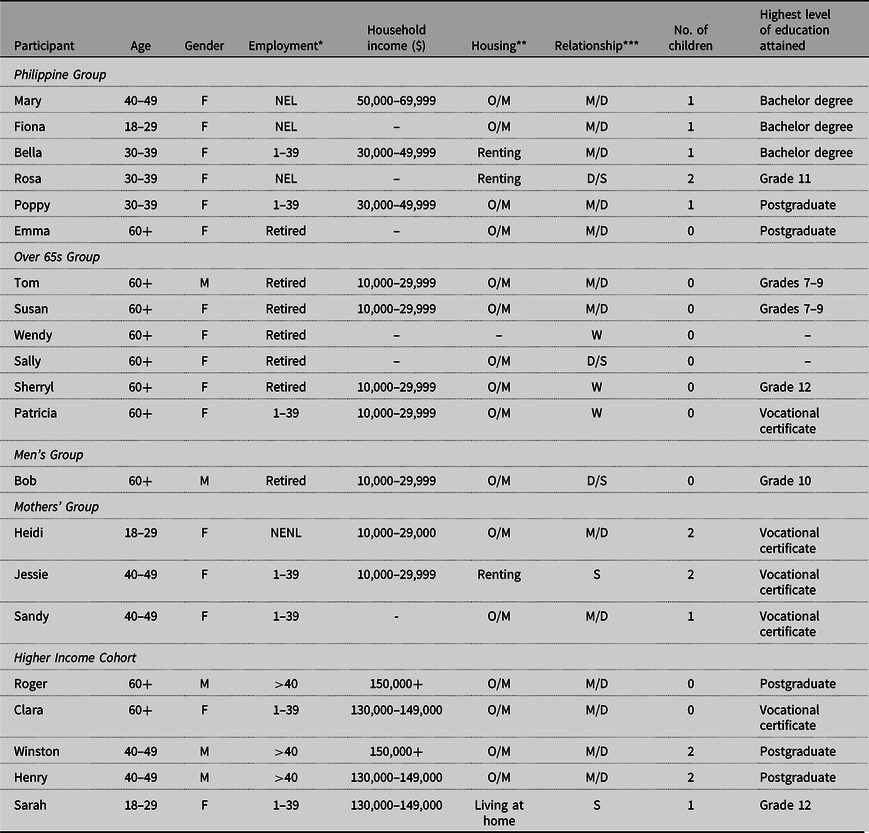
Following Moules, the research study was not guided by the need to include a set number of participants; rather, ‘hermeneutic research is not validated by numbers, but by the completeness of examining the topic under study and the fullness and depth to which the interpretation extends understanding’ (Reference Moules2002, p. 14). I worked to include a sample size that was conducive to acquiring a new and richly textured understanding of experience (Crouch & McKenzie, Reference Crouch and McKenzie2006). The context of the participant groups can be found in Beasy (Reference Beasy2018), while demographic information that was supplied by participants is included in Table 1.
Participant Demographic Information

Note: *Employment: NEL = Not employed, looking for work; 1–39 = Employed, working 1–39 hrs per week; NENL = Not employed, NOT looking for work; >40 = Employed, working more than 40 hrs per week. **Housing: O/M = owned or mortgage. ***Relationship: M/D = Married or de facto; D/S = Divorced or separated; W = Widowed; S = Single.
While participants share some characteristics, whether through demographic indicators or social networks, each member has distinct and different lives. Therefore, as I proceed forward, I do so in recognition of the complexity of the participants’ lives and of the stories shared with me relayed in this paper.
Findings and Discussion
Participants in this research spoke of family, social connectedness, happiness, achievement and health as important in constituting what was worthy of sustaining into the future. Family was expressed as a central importance in experiences of a good life. Social connectedness was found to contribute towards a good life. Happiness and material/immaterial complexities were found in experiences and constitutions. Personal achievement, in the broadest sense, was identified as important for a good life. Health and the importance of being healthy was also expressed by participants as necessary for pursuing a good life.
Family
Social research literature has established that across a wide variety of social and cultural contexts, a sense of belonging to family contributes towards people’s ideas of a good life (Hurka, Reference Hurka1993; Maslow, Reference Maslow, Chalmers and Manfred1958). Similarly, participants identified spending time with family as central to their experience of a good life. This is not to say that participants had a common understanding of family or family belonging.
The concept of family has received substantial scholarly attention over the past couple of decades, reflecting varied interpretations and troubling imagined traditional ideals (Collins, Reference Collins1998; Seymour & Walsh, Reference Seymour and Walsh2013). These traditional ideals centre on nuclear constructions of family (heterosexual couples with children), place of residence and co-habitation (Bourdieu, Reference Bourdieu1996). As noted by Bourdieu (Reference Bourdieu1996), ‘… one has to cease to regard the family as an immediate datum of social reality and see it rather as an instrument of construction of that reality’ (p. 22). Collins (Reference Collins1998) similarly notes, ‘the power of this traditional family ideal lies in its dual function as an ideological construction and as a fundamental principle of social organization’ (p. 63). Participants’ descriptions of what family looks like were powerful in shaping how they came to think about what was important to sustain into the future.
Traditional understandings of family were present in participant ideas. For example, Heidi alludes to her conceptions when she says: ‘seeing that my children … are still together as siblings … I guess you have it in your head to grow old with your partner … that old nice sort of thing’. Participant constitutions of family were reminiscent of the ideals and structures of the traditional family (Bourdieu, Reference Bourdieu1996), including nuclear constructions, parent-child relations and also proximity. However, the interplay of these ideas was dependent on how participants structured their own lives and aspirations for the future. For example, Philippine Group participants indicated that they belonged to an extended family group, one that ranged across generations and diverse kin relations, in addition to nuclear parent-child relations. Family is the heart of habitus for participants in the Philippine Group and traverses complex and distant geographies.
Sharing time with family
Spending time with family was important for most participants to having a ‘good life’. Winston from the Higher Income Cohort suggests this when he says, ‘I enjoy spending time with my kids and grandkids’, and Rosa from the Philippine Group, who notes the importance of spending time with her son. However, participants largely associated family time with romanticised understandings of quality time. Emphasis was placed not just on the amount of time spent with family, but on the quality of this time. When I asked Paul from the Men’s Group what the activities are that he wants to do if freed from his daily obligations of work, he responded with ‘spending more time with [his] kids’. Rosa similarly remarked, ‘I know it’s important quality time when I am home. But it would be nice if I was just at home and spent time with him.’
While spending time with family was important to participants, family was also a connection to a meaningful past. In the Mothers’ Group, Jessie discusses the values she tries to instil in her children, which prompts her to think back nostalgically to her childhood and how values were embodied then. Family was found across the groups to sustain a sense of historicity and locatedness. This accords with Daly (Reference Daly2001), who argues that family time is often valued nostalgically for memories of the past and wanting to honour traditional understandings of family. The habitus ensures the active presence of past experiences that form the schemes of perception, thought and actions (Bourdieu, Reference Bourdieu1990b). In the case of spending time with family, certain activities are equated to quality time related to the previous social and cultural exposures of habitus.
Ideas of what constitutes family varied most prominently with cultural background. Yet, how time with family was conceived and prioritised appeared to be strongly influenced by economic capital. Daly (Reference Daly2001) notes that ‘Family time is not only a descriptive term that offers a perspective on some aspect of family togetherness, it is a prescriptive term that directs families to act in certain ways’ (p. 284). For the Higher Income Cohort, this involved negotiating work commitments at the expense of time with family in the present and spending more time with family later in life. Participants of the Higher Income Cohort spoke with a surety about their futures that would enable this. In the Philippine Group, there was less surety about forward planning and more emphasis on the negotiation between work and family in the present.
The continued negotiation in allocating time for family and work was embodied differently across the groups. The practice of spending time with family was mediated by the necessity of participating in paid work and was particularly prominent in the Philippine Group. When asked what money could provide, Rosa explained wanting to stay home with her son, but was unable to because of needing to work: ‘If we have money, we can survive.’ Rosa demonstrated throughout her interview a constant tension between work and childcare and how she is an unwilling participant in social structures. At the same time, she demonstrated how economic growth acts as a governing ideal when she suggests that more money is the answer.
The Higher Income Cohort expressed a tension between work and family differently. The conditions of the fields in which these participants were located, enabled planned and strategised activities (Bourdieu, Reference Bourdieu1984, p. 44). Participants in the Higher Income Cohort took for granted a wider array of choice making. For example, Winston remarked: ‘[I’m] a very big advocate for strategy … if you generally have a strategy on where you might like to head, it will form like buffers in the bowling alley.’ While similar work and family life tensions were discussed, the Higher Income Cohort expressed an acceptance of the present conditions and belief in strategies that would ease these tensions in the future.
Within the Mothers’ Group, Jessie reminisced about her own childhood experience of family and how she uses these moments to influence the choices she makes for her family in the present. Daly (Reference Daly2001) suggests people often try to recreate the experiences of the past, highlighting the weight of past experiences in influencing dispositions of habitus. Jessie suggested that it was doing everything together as a huge family that comprised the most memorable and positive experiences in her childhood:
I guess for us we were lucky in a way because we come from a huge family. Like my mum is one of 11 children so all our growing up we grew up with grandma, aunties, uncles, cousins, we were never, like, bored, we didn’t ever have to, we did everything together as this huge, like huge family.
In this quote, Jessie gives a sense that family is meaningfully enacted through proximity: we did everything together. In the Mothers’ Group, the practice of doing together as a family was a mutually intelligible and legitimated practice (Bourdieu, Reference Bourdieu1984). Family was a taken-for-granted aspect of daily existence, incorporated into the everyday world of participants.
Participant interpretations of family were, in many ways, set in tension with the individualistic assumptions present in sustainability discourses. Many neoliberal sustainability discourses present solutions to complex sustainability problems through individual consumption practices. An internet search reveals many advertising campaigns and websites pitching solar panels ‘to save the family money’ (Google search, November 2017). Yet, as Middlemiss (Reference Middlemiss2014, p. 939) notes, ‘individualisation is not as widespread in people’s daily lives, or as universal experience’, as theorists often suggest.
In support of this critique, participants’ interpretations of family pushed back against these constructions and represented deeply held connections to kin that are maintained, for example, through the passing down of values, nostalgia and sharing of space. Interpretations of family were complex and contextually located in the social and cultural contexts of habitus. Where a participant is located socially mattered in how family was interpreted and subsequently practised in the everyday world. The field informed understandings of what is meant by family, which generated meaningful practices that expressed the logics of the field. An example of this came from Jessie when she spoke of how she wanted to pass on the values she grew up with in her childhood. Jessie is reproducing the cultural practices that are familiar to her experiences and social locatedness. Social position was something that influenced the scope and scale of what people saw as possible for themselves, as well as an embodied set of dispositions.
Social connectedness
Participants spoke of connectedness to people and places in their constructions of a good life. Participants’ sense of connectedness was influenced by their relations with people including (but not specific to) family members, and to spaces and/or facilities where people were able to meet. Research has shown that people who perceive themselves to have an inadequate level of social connection are less happy and have increased health risks (Cacioppo & Patrick, Reference Cacioppo and Patrick2008; Putnam, Reference Putnam2001). Additionally, socio-cultural (e.g., the combined social and cultural factors) integration and personal relationships were found to contribute towards a sense of connectedness (Haller & Hadler, Reference Haller and Hadler2006; Putnam, Reference Putnam2001). I found interconnections between participants’ experiences in physical spaces and with their sense of social connectedness. For instance, Tom exemplified how mobility in physical spaces is important to his experiences of social connectedness when he said: ‘Social connection, I think you’ve got to have a social, no good being tied up in one place. I think it’s important.’ The act of moving between places to enable social connections is valued in and of itself. At the same time, spending time in places promoted a sense of belonging to that place more broadly and amplified the general sense of being socially connected.
Place-based connections
Participants’ experiences of being in the world were largely influenced by the spaces and places that they inhabited. For the most part, the physical world was conceptualised to exist external to the human world. However, there were socially located differences in conceptions of how humans were positioned in relation to the physical world. I interpreted a complex relationship between expressions of environmental and social connectedness. Some participants saw the environment as something external to their everyday worlds, yet connected meaningfully to their social interactions and sense of social connectedness.
Detailed by Hidalgo and Hernández (Reference Hidalgo and Hernández2001), a number of interpretations of connection to place exist, as well as terms that speak to place-based connection. Common across scholarly works is the idea that place connectedness represents the link between spaces and people and the embodiment of this connection (Cresswell, Reference Cresswell2014), similar to the views expressed by participants.
For example, Mary enjoys going down to the local oval with her husband and son after work. She said: ‘With my little family here, we normally just go the oval at the university when the weather is alright for football … my husband said that with him he wants this to engage in the sports thing.’ While she talked fondly of the oval itself, she enjoys spending time there because she can watch her husband interact playfully with their son. The oval provides the necessary space for the ball sports that her husband enjoys.
Similarly, for the groups participating in the study from the Neighbourhood House, the house itself was seen as a place of value. For the Philippine Group, the Neighbourhood House provided a space that they could go to and talk with others who share similar experiences. For the Over 65s Group, the Neighbourhood House provides a reason to leave home. Patricia illustrated this when she said: ‘When I come up here, I really enjoy coming up here. I don’t go anywhere much else now … I suppose it’s just talking to other people. It’s just people that you don’t see except when you are here.’
In this quote, Patricia suggests that although the place is of value to her, the opportunity for social connection the place enables is the reason for its value. Hidalgo and Hernandez (Reference Hidalgo and Hernández2001) propose that often places are significant for the social connections afforded.
In conversation with participants, it was the interconnectedness and complexity in relationships between environments and people that came to the fore. Participant stories of place connectedness were reflective of the activities and necessities of their everyday world, such as Sandy, who spoke about the supermarket, or Winston, who spoke about visiting Hobart every week but only recently feeling ‘a part of the community’. The places that participants connected to were socially situated within the cultural practices of their social location (Bourdieu, Reference Bourdieu1990a).
Happiness
Happiness was a prominent theme brought into conversations by participants. As noted by Frey and Stutzer (Reference Frey and Stutzer2010, p. viii), ‘there is probably no other goal in life that commands such a high degree of consensus’. Happiness was not explicitly mentioned in interviews; however, participants referred to happiness in conversations about what is important for a good life and also in discussions about other people’s quality of life. Happiness is precisely the kind of empty signifier that has life breathed into it in a particular habitus. My research shows that it does not mean anything on its own; it has to be imagined and enacted and will look different depending on someone’s social location and context.
Participants’ understanding and experience of happiness was complex and was found to extend beyond simply material or emotional accounts. Many of the participants shared thoughts and feelings that reflected happiness as a state of being, influenced by place and context. Rosa talked of how she experiences happiness differently in Australia than in her native country: ‘the happiness is different compared here, because you have a lot of family over there, cousins and aunties’. Rosa suggests that happiness has a fluid meaning, which when practised can be experienced differently according to social and cultural conditions.
Patricia from the Over 65s Group referred to her own happiness after reflecting on her life experiences. Patricia consciously decides about whether or not she is happy. She put it this way: ‘… and I suppose there are people worse off, but I can’t say there would be anyone any much better. I’m happy, you know, I’ve got plenty of food and kids are all happy. So no, I’m quite happy.’ She uses comparison with other people as a way of making meaning from her own situation; then noting that there are elements in life, such as food and happy children that, if satisfied, are indicators in their own right, of happiness. Patricia’s comments here represents perspectives held by many of the older participants.
The period of time that Patricia and others in the Over 65s Group grew up in offers some context for understanding why happiness is conceived in particular ways. Patricia and others in this cohort were born shortly after the Great Depression in Australia. It was a time of heavy unemployment and scant resources, when thriftiness and social cohesion were valued (Australian Government, 2015). People struggled to meet basic needs, and happiness was found through satisfying them. Patricia’s habitus seems to reflect the cultural practices and the social norms of her childhood. Habitus is cemented in past experiences and is most strongly constructed during childhood (Bourdieu, Reference Bourdieu1977). While Patricia’s habitus retains a capacity for responsiveness, this is shadowed by the histories, habits and boundaries of her past that are so internalised in self-awareness as to be invisible.
In contrast, an example that highlights agency came from Heidi, a younger participant, when she reflected on her everyday world compared with others: ‘Even if someone is richer or healthier, that they’re still equal because they still have to go through life and challenges and just because they have everything does not mean their life is not as happy as mine is.’
This observation suggests that Heidi conceives of happiness independent to the social and cultural conditionings of habitus. Happiness was achieved primarily by participants’ internal dialogue and was relatively unaltered by external conditionings.
Similarly, although somewhat different to Heidi, Patricia demonstrated her interpretation of happiness when she said:
I’m happy enough, you know. As long as I’ve got my licence, I can come up here and go to the shop and do a few things, that’s it. Well it’s no good of wanting to do things you can’t do. You would be very miserable, wouldn’t you? I don’t think you can do that; you’ve got to take it as it comes. It’s not much good of me wanting to fly.
In this comment, Patricia begins to explore the complexity in achieving happiness. She suggests that the agency of an individual is important to determine what should constitute happiness. At the same time, she insists that access to material items, such as a car licence, is important. She concludes by saying that the licence is valuable for what it provides in the pursuit of happiness — accessible, convenient transportation. The following section explores entanglements of material and experiential elements in understandings and feelings of happiness.
Experiences of the everyday — material complexity
In many cases, happiness was identified by participants as something achieved in experiences. Experiences that contribute to happiness included connecting with family, spending time with other people, and participation in place-based activities. Some research purports that experiences bring greater happiness than material possessions (Frey & Stutzer, Reference Frey and Stutzer2010). However, what was evident in many of the conversations with participants was the complexity and connectedness of experiences to the material. Experiences were facilitated for many participants by an ability to meet basic needs, such as accommodation and paying bills (Maslow, Reference Maslow, Chalmers and Manfred1958).
Bourdieu (Reference Bourdieu1984) thought about the meeting of basic needs through his conceptualisations of ‘necessity’. Bourdieu described distance from necessity as a means of thinking about how people prioritise and give time and energy to particular activities. Evident in both Bourdieu’s theories is the assumption that the further away individuals and collectives are from ‘necessity’ or basic needs, the greater the capacity for social and cultural advancements (Bourdieu, Reference Bourdieu1984). However, Bourdieu’s interpretation acknowledges the positioning of the individual and their perception of what is a necessity in their life. Many of the participants suggested that they were driven by necessities in their lives, although the determination of what was necessary was dependent on the perspectives and values of the individuals. Rosa noted that more money would make her life easier and better because at present she ‘can’t stay home with [her son]’. More money would enable her ‘to have all [her] family together in one place … If we have money, we can survive’. There was a desperation for Rosa in getting to a financial position that would enable the family to be reunified. At the same time, Rosa made the point that ‘not everything you can get from money’. So, while she acknowledged the need for money, Rosa too acknowledged that money in itself does not buy happiness; rather, it buys access to it.
The conditional freedoms available within a habitus become evident in participants’ elaborations of getting to happiness. Some aspects of habitus are driven by physical requirements of the body to satisfy hunger and the need for shelter. Yet, when these conditions are met, Bourdieu (Reference Bourdieu1984) suggests the habitus becomes the enactment of a conditional freedom that pursues ‘higher order’ experience. Bourdieu (Reference Bourdieu1984) conceptualised this more esoteric, ‘cultured’ pursuit as a marker of distance from necessity.
For Sarah from the Higher Income Cohort, material possessions were not recognised as important, but money to fulfil basic needs were considered an obvious necessity. There was some conflict and unresolved understanding for Sarah in the relationship between happiness and money; for example, when she said: ‘I guess, you can still be happy if you are living on the street with some money, but you have certain experiences that you are not going to have.’ Sarah’s comment suggests that she values economic capital and that within her social fields, economic capital is a measure of a good life. Yet, she recognises the value of experiences as an independent measure and enabler of happiness, never identifying that it is her economic position that gives her access to these experiences. Sarah’s comments are particularly interesting because of how she is socially located. Sarah lives with her parents, who she perceives as being wealthy. Sarah’s habitus is situated in middle-class conditions that provide some insights into her conflicted perception of money.
Material possessions, including money, were more readily pursued as a means of enhancing happiness in the Higher Income Cohort, as exemplified by Winston and his interest in sailing, and Sarah, when she expressed her ideas of money enabling more experiences. Social contexts, such as the Mothers’ Group and the Philippine Group, appeared to influence how happiness was expressed, suggesting that happiness was experienced through meeting basic material needs. Participants articulated interconnections between the material and the experiential, and connected these ideas with attaining happiness.
Achievement
The theme of achievement was also a marker of a good life, with socially located meanings. Achievement has been identified in the literature as a driving force of modernist understandings of progress (McClelland, Reference McClelland1987). A sense of achievement and the act of pursuing goals is reported to render life meaningful in realising ‘a good life’ (Tiberius, Reference Tiberius2005). Similarly, Bourdieu linked aspiration (a close relative of achievement) to happiness when he responded to the question in an interview: ‘What should one do to be happy?’ with ‘One must do what little one can to change things … to escape the laws, the necessities, the determinisms’ (Sokwe, 2013). Here, Bourdieu seems to imply that aspirations are inevitable and inevitably social. Sarah, in response to the question ‘What does having a fulfilling or good quality life mean to you?’, emphasises the importance of achievement when she responds with ‘Having, like, a sense of achievement’.
Participants’ perceptions of what is achievable and what counts towards achievement were constructed through socially constituted understandings of progress and progression. Evident across the social contexts was an understanding of how life progressed — childhood, career/family and then retirement. While there were varied interpretations on how each of these phases would be carried out (discussed below), understandings of these life stages reflected powerful cultural narratives. For example, participants equated retirement as a time of rest and relaxation: Fiona said, ‘Hopefully, Tim is not working anymore, just resting, retired so we can enjoy life.’ Similarly, Roy makes the same point when he said, ‘If you want to retire early … you want to sit back and enjoy some of that life.’ These ideas reflect wider social discourses present within participants’ everyday worlds.
The Australian Dream is an example of a cultural narrative denoting the dominant ideas of what kinds of aspirations Australians should have (Haebich, Reference Haebich2008). Aligned with Bourdieu’s conceptions of doxa, the Australian Dream is a discursive example of the social conditions that produce habitus. Morris claims that ‘the Australian Dream powerfully underlines the fundamental role that affordable, adequate and secure housing plays in creating a foundation for a decent, fulfilling life in retirement’ (emphasis in original; Johnson, Reference Johnson2016). In the Mothers’ Group, Sandy expressed her concern about ‘how much [her daughter has] gotta do now just to buy [her] own place’. Property ownership is a marker of the Australian Dream that receives much attention because for many people, such as Sandy’s daughter, property ownership is desired but difficult to achieve (Cowan, Reference Cowan2017; Denniss, Reference Denniss2017). In the men’s focus group, there was a rich discussion about superannuation and the negotiations that need to happen at the time of retirement. Participants’ assumptions about how people retired and what they did reflected practices sold as the Australian Dream (Hamilton & Denniss, 2015). For instance, Mike spoke of a friend deciding on whether to sell a beach shack in order to accrue additional superannuation, even though ‘the idea was [for the shack to be] a place for him and his wife to take off to on the weekend’. Participants’ discussions of life paths tacitly reproduced these dominant projections of life choices and life event ordering.
However, achievement within significant life stages was interpreted among participants differently between the social groups. This was evident in examples shared in the interview concerning what achievement looked like to participants in their lives. For example, in the Higher Income Cohort, Sarah linked her sense of achievement strongly to her career aspirations. When asked, ‘What does having a sense of achievement look like in her life?’, Sarah said:
like for me … that my career is going will take over, well, not take over, but that’s what I am set out to do for the next 10, 20 years and knowing that I love and am passionate about that … Knowing that I’m going to go through like baby pilot through to hopefully the top and having some kind of proud moment that I have achieved it.
Winston, also from the Higher Income Cohort, spoke of strategising in order to reach a particular point in his life that would afford him the time to do the things he wanted to do. Achievement in the Higher Income Cohort was more prominently conceived as something that would occur in the future through the realisation of an imagined future.
Bourdieu (Reference Bourdieu1984) proposed that social distinction is positively correlated by a socially achieved distance from necessity. Necessities are defined as those activities on which survival depends — working, family, food, shelter. Activities that related to necessity were absent from constitutions of achievement in the Higher Income Cohort. For example, Winston disregards basic necessities as achievements when he talks of time: ‘I’ve got enough time to do the essential things I want to do, but I haven’t got enough time to do the luxurious things that I would like to do. So must haves, you’ve got to achieve those.’ Winston refers to such things as sleep and earning money as must haves, or items of necessity. Winston demonstrates his pursuit of a life of ease and his social position as being relatively free of urgency. This pursuit tends to induce an active distance from necessity and opens up possibilities for imagining futures and for forward planning (Bourdieu, Reference Bourdieu1984).
Necessities are socially located
However, the ways in which achievement is constituted varied with participants’ social locations. In Distinction (Reference Bourdieu1984), Bourdieu stated that it is more than economic capital that informs habitus. He offered examples of how people with similar earnings have ‘different’ consumption patterns, demonstrated through choices in food, leisure and art. Examples are given to illustrate that habitus is a perceptual scheme that structures the perceptions of everyday existence around social class practices and perceptions, well exemplified in the common expression: ‘That’s not for the likes of us’ (Bourdieu, Reference Bourdieu1984, p. 380). Bourdieu contended that taste (or preference and choice making) is reliant on the social and historical conditions of habitus; for example, when a working-class person becomes more successful in business and ‘doesn’t know how to spend the money’ (Bourdieu, Reference Bourdieu1984, p. 374). Since the release of Distinction, scholars such as Margaret Archer contend that Bourdieu’s work does not recognise morals or values influencing individuals’ decision and choice making. In this sense, they argue that Bourdieu denies individual diversity within social class groups (Archer, Reference Archer1996). While I suggest that there were similarities in what was regarded as valid and sensible aspirations within the social groups, there remains diversity and difference for each individual of the group and their unique perspectives (Elder-Vass, Reference Elder‐Vass2007).
Aspirations from the Higher Income Cohort, such as Sarah’s (for a high-profile career) and Winston’s (for a life of luxury), seemed different to the aspirations from the individuals in other groups in the study. For instance, Paul from the Men’s Group described his feelings of achievement from raising a family: ‘To bring four children in and see them grow and now see the grandchildren grow. So that was my main achievement.” Paul spoke of the material constraints and temporal urgencies in which his aspirations have been funnelled — the ups and downs in caring for a sick wife, raising children, experiencing difficulties and periods of time of lack of employment. His aspirations are grounded in these socially and historically situated conditions. Paul enjoys and finds achievement in tending to the needs that arise from these conditions; he has a taste for the necessities of his life (Bourdieu, Reference Bourdieu1984). He values and enjoys his achievements because they are achievements of his everyday world, and is it from his experiences that he makes sense of what achievement is.
Mary from the Philippine Group spoke of the aspirations she has for her children and links her sense of achievement strongly to seeing her children succeed. Bourdieu stated ‘the habitus is a virtue made of necessity’ (Reference Bourdieu1984, p. 372). Yet, what determines necessity is influenced by the social and cultural influences of its production. To do well in school is valued highly in Philippine culture because of a belief in the opportunities schooling can provide for the recipient (Bernardo, Reference Bernardo2003). While achievements are largely regarded as an individual activity, there are expectations within Mary’s Philippine community that ascribe education as a necessity. These ideas influence her own interpretations of what is recognised as necessity and also as achievement.
Health
Participants described good health as an important precursor in striving for and having ‘a good life’. Health is often noted as an element important to a good life (Allardt, Reference Allardt, Nussbaum and Sen1993; Hurka, Reference Hurka1993) This was exemplified by Sarah from the Higher Income Cohort when she said: ‘… being well, they all come first before anything else. And the career is another thing separate from all of that. I can only have the career if all the other things are OK, like the health thing is under control.’
Health was discussed by participants as a functional and necessary consideration in daily life. The quality of an individual’s health was thought to influence the possible attainment of a good life. Health was not discussed as an independent component of a good life; rather, good health was seen to improve experiences, such as the themes discussed above. Many participants spoke of basic needs (such as health) as necessary for attaining psychological and self-fulfilling needs that directly contributed to a good life.
The presence of illness in social connections or through personal experiences only served to reinforce the importance of good health. When asked what would make life better or easier, Paul responded with:
I suppose the only thing I can say to make my life easier or better is mine and my wife’s health. Because of my wife’s medical condition, we went to Victoria for 23 days and what we did in those 23 days we would normally do in a week but because of her health you’ve gotta extend the time in holidays and think about how you do it.
The significance of knowing others with ill health was further demonstrated by Patricia when she said, ‘You sort of think when these ones got this and that. Cancer and leukaemia and all that. No good. I’ve had nothing to affect me. Even with the grandchildren. We’ve been awfully lucky.’ Discussions of maintaining good health were not prominent in conversations until ill health was experienced, suggesting the importance of direct experience in acknowledging or realising the significance of something.
In addition, conceptions and experiences of health seemed to be largely shaped by age. This corresponds with Bourdieu’s (Reference Bourdieu1990b) description of habitus as inscribed in bodies by similar histories. The deterioration of the body occurs similarly over the course of the life, which varies with an array of socially, culturally, economically and biologically determined conditions (World Health Organization, 2016).
Younger participants referred more often to mental health and the importance of a healthy mind and positive attitude, such as Sarah, who noted: ‘I need to work on not stressing myself out. Like sometimes I can be quite overdramatic. And then the stress builds up in my mind and then the health thing.’ Or Heidi, when she reflected on constantly checking Facebook: ‘I think I have to be [self-disciplined], otherwise I would run amuck in my head.’ Media over recent decades has increasingly presented information on the importance of mental wellness. Understandings of what health is (which now includes mental wellbeing) and the responsibility that individuals have to maintain health has changed in the same period (Kline, Reference Kline2006). Media and emerging health discourses on mental health, wellness, self-care, mindfulness, therapeutic culture and medications, among others, form components of the social conditions that influence everyday perceptions; in this instance, what constitutes good health. Sarah and Heidi reflected their understandings of health through this socially and historically situated perspective, while older participants tended to discuss physical health. They suggested that health became more of a priority with age because experiences of ill health were more frequent, either directly or through friends and family.
Summary and Conclusion
Discourses of sustainability evoke particular imaginaries relating to what it is to be sustainable and to live sustainably. Implications from this research for sustainability education relate to the ways in which sustainability is conceived and developed as a key concept in education contexts. This research provides some insights into nuanced approaches educators could use to engage students of all ages, including drawing on their already established connections to sustainability and everyday experiences. This research was premised on the idea that these discourses are located in particular socio-cultural contexts that may not be applicable or relevant to other social locations. The research explored interpretations and encounters of sustainability from people beyond the urban, tertiary-educated middle class where sustainability discourses have originated, and found that participants were predominantly disengaged from these ideas and related discussions about sustainability. Problems of unsustainability that are articulated in sustainability discourses tended not to reflect the issues that participants brought into conversation, particularly those whose lives are fashioned with/within a working-class habitus. Instead, participants connected with issues that implicated their immediate social and ecological relationships in some way.
Participants’ interpretations of what is important to sustain through understandings of a good life trouble assumptions embedded in discourses of sustainability, and highlight the multiple subjectivities of interpreting and living what it means to live a good life. Concepts of sustainability encountered in each of the different social contexts, represented by the groups I worked with, were performed in ways that reflect and respond to available economic, cultural and social capital.
This article offers an account of sustainability that understands the aspiration for sustainability as a central, constitutive element of habitus, identity and possibility underlying social actions. This is important information for sustainability educators because it shows that we are all in some way connected to principles and practices of sustainability.
By exploring encounters of sustainability in diverse social contexts, this research extends understandings of the importance of situated knowledges in experiences of sustainability (Macnaghten & Urry, Reference Macnaghten and Urry1998; Middlemiss, Reference Middlemiss2014). This presents opportunities for sustainability advocates to establish nuanced understandings of how to engage with diverse subjectivities in meaningful ways; in this sense, extending understanding in sustainability scholarship and education practice about the ‘nature’ of subjectivity and how we, as sustainability scholars and sustainability educators, can be responsive to difference in future conversations and education contexts.
Kim Beasy works at the University of Tasmania in the School of Education, teaching and researching contemporary issues that underpin questions of equity and sustainability. She recently completed her PhD, which explored interpretations of sustainability across diverse social contexts. Kim is involved with a number of projects, including Sustainability Skills Cafes, effects of diversity on group decision making for sustainable outcomes, LGBTIQ+ inclusive teaching practices, postgraduate experiences, and effectiveness of preservice teacher training in studies of equity and diversity. Kim is Chair of Education for Sustainability (EfS) Tasmania, a network of stakeholders invested in collaborating together to promote EfS across the state.