INTRODUCTION
“Intellectual disability” is a general term, describing an impairment of intelligence and social functioning (World Health Organization, 1992). There is a lack of clarity and agreement about the definition of intelligence and social functioning, and as a result different countries may use different synonyms in place of “intellectual disability.” These terms include “mental retardation,” “congenital developmental disabilities,” and “learning disabilities.” Although the population of people with intellectual disabilities is relatively small, comprising ~1% of the population, its needs demand high priority in healthcare services. This is because many people with intellectual disabilities need support throughout their lives and have longer and more intense involvement with services than the vast majority of citizens (Department of Health, 2001; Rees et al., Reference Rees, Cullen, Kavanagh, Stevens, Raftery and Mant2004). Services for people with intellectual disabilities were originally developed for children and young adults and they focused on enabling clients to lead full and active lives. Because of improvements in health and social care, people with intellectual disabilities are now living longer and, as a result, are developing conditions such as cancer. However, there has been very little research on how matters of communication of diagnosis and prognosis are handled for people with intellectual disabilities with life-limiting illnesses. Indeed, Todd (Reference Todd2002) has suggested that “the bereavement experiences of people with intellectual disabilities provide the only palpable point in the research literature where death makes some form of appearance.”
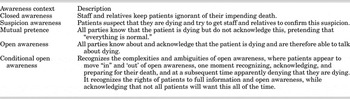
Brown et al. (Reference Brown, Burns and Flynn2002) provided some insights when they interviewed the carers of 21 deceased people with intellectual disabilities. They found that several participants revealed conversations in which the person made it clear that they suspected that they were dying, and displayed a certain readiness to have it openly acknowledged. Despite this, they observed that carers felt ill-equipped to manage such conversations and tended not to engage in open communication. More recently, Tuffrey-Wijne et al. (Reference Tuffrey-Wijne, Hogg and Curfs2007) supported this initial work by finding that people with intellectual disabilities are protected from even the most basic of cancer information. The relative lack of research in the area stands in stark contrast to the considerable debate that has taken place about communication and awareness within the general population since the 1960s. Glaser and Strauss (Reference Glaser and Strauss1965) were instrumental in beginning the exploration of this area, when they identified four types of “awareness context”: closed, suspicion, mutual pretence, and open awareness. Table 1 details types of awareness contexts. Their work led to an ideological shift and a preference for openness in discussion with the dying. Field and Copp (Reference Field and Copp1999) later developed the additional concept of “conditional open awareness.” The changing demographics of the population of people with intellectual disabilities means that there is now an urgent need to consider how issues of communication about illness, death, and dying are handled in this population.
Awareness contexts

This qualitative study formed part of a project that aimed to describe the current provision of palliative care to people with intellectual disabilities in one Health Service Executive Area in Ireland and to conduct a corporate assessment of the population's palliative care needs. In this article we report on findings from focus groups that explored how caregivers handled issues of communication about death and dying with people with intellectual disabilities.
METHOD
Local research ethics approval was obtained. The sample was drawn from the population of one Health Service Executive area in Ireland. It is a predominantly urban area and has a population of 486,000 people with 2,826 people registered as having an intellectual disability. The area is served by three major intellectual disability organizations and one specialist palliative care service. Ninety-one staff members participated in 16 focus groups. Participants were purposively sampled to reflect diversity in occupation, workplace, and level of experience in the provision of palliative care to people with intellectual disabilities. A topic guide was used to structure the interviews. Interviews were of 40–70 minutes' duration.
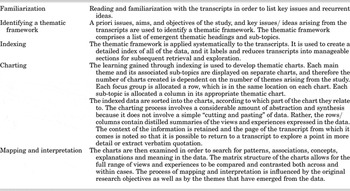
Interviews were tape-recorded, transcribed, made anonymous, and then analyzed using “Framework,” a content analysis method developed at the National Centre for Social Research for use with qualitative research data (Ritchie & Spencer, Reference Ritchie, Spencer, Bryman and Burgess1993). Framework uses a thematic approach to classify and interpret data. The approach treats every transcript in a systematic way within a common analytical framework, and the validity and reliability of findings are enhanced by the consistent and transparent method of analysis employed. Framework analysis involves five distinct, athough interconnected, stages (Table 2).
The Five Stages of Framework Analysis

RESULTS
Participants
The sample for the focus group discussions comprised 91 staff from the following professions: nurses, doctors, social workers, psychologists, physiotherapists, occupational therapists, complementary therapists, pastoral care providers, social care staff, management, and household staff. Seventy-nine participants were female and 12 were male. Participants came from a diverse range of work settings including community group homes, residential centers, psychiatric hospitals, activity centers, sheltered work centers, general hospitals, and hospices.
Experience of Palliative Care Staff in Communicating about Life-Limiting Illness, Death, and Dying with People with Intellectual Disabilities
Palliative care staff viewed communication as a core part of their practice and were confident of their abilities when dealing with members of the general population. However, they were challenged by the fact that they felt that the provision of care to people with intellectual disabilities was different and often more difficult. Participants recognized that many people with intellectual disabilities have communication impairments, and therefore the participants felt that this was one of the most significant difficulties facing this population. Participants considered the issue to be most problematic when communicating with people with severe and profound disabilities, but admitted to anxiety even when communicating with people with mild disabilities, because they were unsure what information would be understood or how it would be processed and dealt with. One participant explained:
You don't know what they… how they have… computed, interpreted what you have said to them and what effect it's having on them. And that would have… that would apply to quite a number of situations (Focus group 4; FP3: 462–5).
Staff relied on the carers of the person with intellectual disabilities to bridge communication gaps and to remedy their perceived shortcomings. However, palliative care staff were commonly over-reliant on carers to meet communication needs. They frequently did not engage in direct communication with the person with an intellectual disability, and instead engaged in a three-way communication process involving patient, carer, and staff. This could sometimes lead to carers controlling the flow of information to the person with an intellectual disability and assuming the sole responsibility for decision making, as is demonstrated in the following excerpt:
R6: Because… its a learning disability but its… you can't really tell until you interact with him, I think. Like if he was sitting there, you wouldn't really know.
Other Respondent: Mmmm (nods agreement)
R6: You know, he has no obvious learning disability, but I'd say he's always had it all his life. But he was always protected, and I know that [his sibling] was always there for him.
Interviewer: And you said, “In some ways, it would be collusion in any other circumstance”?
R6: It would yes, Because we would speak directly to the patient, or ask the patient's advice. But in regards to that patient we don't, really, because we don't know whether he'd be able to understand. Which I suppose is kind of presumptious really. (Focus group 1; R6: 247–57)
A small number of staff who had greater experience in caring for people with intellectual disabilites recognized the potential difficulties that could result from an over-reliance on carers. They challenged the assertion that palliative care staff should rely on carers to meet all communication needs:
I suppose I've learnt in learning disability, so I would go to the patient first, as I would for every patient. I'd read the notes or whatever, but I'd try and establish for myself what I could, or try and communicate (Focus group 3; R2: 641–4).
Experience of Intellectual Disability Staff in Communicating about Life-Limiting Illness, Death, and Dying with People with Intellectual Disabilities
Although intellectual disability staff were generally confident of their communication skills, they were unused to talking about end-of-life issues with service users or their families. They commented that they found it complex and challenging to speak of these issues, and revealed feelings of uncertainty while speaking of their experiences:
But when it comes to speaking about death to them, we're not familiar with it. We're familiar with nursing them and everything else, but to sit down and discuss with them, even when they want to talk about it, I even find it hard.(Focus group 7; R2: 339–43)
Awareness of Illness, Death, and Dying
Participants varied significantly in their opinions about whether people with intellectual disabilities are capable of recognizing that they are unwell or dying. All agreed that the population is a heterogeneous one, and that a person's cognitive and emotional abilities, together with their life experiences, should be considered when judging the person's awareness of their condition. However, in practice, staff did not appear to have an agreed-upon way of assessing this, and different team members could have quite different opinions about a person's level of insight. There was a general consensus that people with milder difficulties quite often indicated some awareness of their condition, either directly in conversation or indirectly by mood or behavior changes. However, there was marked uncertainty as to whether people with more severe or profound disabilities were aware of the development of a life-limiting condition, such as cancer. Participants felt that people with more severe disabilities often experienced a significant level of chronic ill-health, and were unsure, therefore whether these people had the cognitive or emotional abilities to differentiate between cancer and chronic ill-health.
Influence of Relatives on the Process of Communication
Participants felt that relatives had a very influential role on the process of communication about illness, death, and dying, and that this added a further layer of complexity to the issue. Both intellectual disability and palliative care staff spoke of relatives acting as gatekeepers and deciding what information would be provided to the person with a disability. Participants recounted experiences in which difficulties had arisen because relatives had not wanted to speak to the person with the intellectual disability about the serious nature of their condition. One participant spoke of the dilemma in the following way:
When you're caring for someone towards the end of life, there's that whole thing over should these people be told, and if there's family involvement do the family want them to be told? Do they have a knowledge themselves? And if the family don't want them to be told, and they're asking you the question it's very, very difficult (Focus group 11; R1: 10–14).
Managing Issues of Communication
Even when service users demonstrated some awareness of their condition, the majority of staff from the intellectual disability services admitted to feeling that they lacked the knowledge, skills, or confidence to enter into open communication with the client about their illness. Staff said they responded to cues by either changing the subject entirely or by attempting to reassure the patient without really addressing the issue, as illustrated in this quote:
R4: I'm thinking of one person in particular now, and she was… she was very aware, and crying, crying… She didn't know what it was, but she just felt it in herself, that there was something seriously wrong. And asked that, and has said that “Am I very sick?” Has said that, “Am I very sick?”'
I: And how would you respond to that?
R4: Well, you wouldn't really say that “You aren't” but you'd say that “You are going to get better, we're going to get everything done for you, we'll see what happens.”' (Focus group 14: 117–127)
Staff described the reasons why they adopted these approaches rather than engaging in open communication. They were very concerned about the possible effects on the individual with the intellectual disability and did not want them to be frightened:
FP1: We found some days now when we had to leave her in bed, say she wasn't really able to get up, she was scared in the dormitory on her own. She'd start to cry. She prefers to be out with everybody. You know, we kind of… even when we're giving her her tablets we'd say “This is for your sore arm,” “This is for your sore leg” and that kind of thing. She'd feel better and that's the kind of level we'd…you know…deal with it…. I think to a certain extent, yes, she would understand but I think it wouldn't be good for her because I think it would maybe scare her because she has the understanding of it. (Focus group 9; FP1:1145–1147; 1150–2)
Importantly, many staff spoke of their lack of knowledge and skills in the area. They did not feel that their training adequately prepared them for these encounters, and they were fearful of causing additional harm to the individual by engaging in such conversations in an inappropriate manner. Some participants thought that the person might “give in” if they knew of a diagnosis of a life-limiting illness, and felt that ignorance of their condition might help them to “fight” it better. Others were concerned that they might frighten the person or provoke an uncontrollable emotional response. Staff also spoke of a sense of isolation when dealing with the issue; they were concerned that if they engaged in discussion of the topic then other team members would feel they had done the wrong thing.
Only one group from the intellectual disability services seemed to adopt a consistently proactive approach to communication. In this unit there was a high degree of support for facilitating open communication, while at the same time respecting the wishes of individuals who did not wish to engage in conversation about end-of-life issues. The staff from this unit emphasized the importance of recognizing the probable course of an illness, anticipating probable problems, and actively engaging with patients and families to develop a trusting and honest relationship. They felt that this approach was one that had worked well, and ensured that service users and families got the best care possible:
R1: Well we, from the very beginning, we kind of develop that relationship [with patients and families], because we know what's going to come, we try to prepare for it.
R2: From when they come in.
I: So you work towards it actively?
R2: We work with them from the word “Go.” (Focus group 8; R1 & R2: 599–607)
It was not clear why this unit adopted such an approach, whereas others did not. It may have been related to their relatively greater level of experience in caring for people with intellectual disabilities toward the end of life, and to the fact that staff had found greater success in engaging in open communication rather than in continuing with deception. One participant described the effects of failing to engage in open communication:
R1: We did have two incidents where families said, “No, we don't want them to know.” And the families' wishes were respected, as opposed to the clients'. And that was again where clients came from community houses, and [had diagnoses of advanced cancer], and some of it was the social workers and the staff involved weren't able to see what kind of problems were going to develop. And the clients weren't told.
I: And how did you find that worked out?
R1: Well…it was kind of a disaster… (Focus group 8; R1: 640–9)
Managing Collusion
Collusion, in the medical context, happens when a patient's family acts with healthcare professionals to conceal a serious or life-limiting illness from the patient. Palliative care staff commonly encounter collusion in the general population, and are skilled in ensuring that the best outcome for patient and family is achieved. However participants commented that management of the issue was more difficult when it involved dealing with people with intellectual disabilities. In keeping with their usual practice, staff adopted a cautious approach to truth-telling when a family stated that information should be withheld from a person with intellectual disabilities. They tried to develop a trusting relationship with the patient in order to make a better judgement of the risk–benefit ratio involved. They also tried to develop a trusting relationship with the family and to explore the possible consequences of collusion with them. Finally, they created an environment in which patients had the opportunity to ask questions if they wanted to. Palliative care staff considered the extent to which patients asked questions to be an important factor that influenced whether they directly challenged collusion and engaged in open communication with the patient. Indeed, staff appeared to require quite solid evidence of intent on the part of the patient before the staff member disclosed any information that was contrary to the wishes of the family.
Despite the fact that this approach generally led to satisfactory outcomes for patients from the general population, it appeared that it was less successful when dealing with people with intellectual disabilities and their families. Participants found it more difficult to develop the fundamentally important relationship of trust, and people with intellectual disabilities appeared less likely to ask questions and initiate conversation than did members of the general population. These challenges are illustrated in the following excerpt in which staff recounted a situation in which they had suspected that part of the patient's distress was caused by fear and lack of understanding of what was happening to her, but in which the patient's relatives were clear that they did not want the issue explored further:
R4: I think sometimes for somebody in a family in the general public, there are more inklings that they have an idea. You get more openings, you know, asking more questions. This lady didn't ask questions, you just had a feeling yourself…
R2: … If say, you have somebody normally, say in the community, and if there is collusion, but if the patient keeps asking questions, then you feel that it's right [to answer the person's questions]. But for this lady, she didn't do any of that, you know'.
R4: We don't have the right then, to go in. And she mightn't be able to understand it. And it might be that the family were right, that they knew her better. (Focus group 2; R2 & R4: 234–6 & 251–6)
Future Practice
The majority of participants did not appear to hold absolute opinions that talking to people with intellectual disabilities about illness, death, and dying was “wrong.” Rather, they were most influenced by concerns about their lack of skills and experience in the area, and the resultant probability that they would cause harm by engaging in open conversations. As might be expected, staff from the units that had cared more frequently with service users toward the end of life were more aware of the potential negative consequences associated with closed communication. Staff from other units did not recognize these issues as clearly and some considered that it might be possible to simply reassure service users or distract them from pursuing conversations about death or dying. However, as the conversations in the focus groups unfolded and the collective knowledge of the participants was shared, it became apparent that this was often not achieved and that service users continued to express anxieties about their conditions if their concerns were not addressed.
It was clear that participants were strongly committed to acting in the best interests of their service users, and there was a growing awareness among them that they might not have handled particular cases in the best way possible. Indeed, following discussion participants often asked the interviewer for an opinion in an attempt to seek some resolution on the issue:
What's the right thing to do like? I mean… a person does say to you "Am I dying?"… A person who is affected with a disability and yet would understand… that if you did say "Yes"… that she would understand it. What do you do? What is the right thing to do? (Focus group 11; R2: 532–6).
Staff were keen to develop their understanding of and skills in the area, and felt that partnerships working between palliative care and intellectual disability services offered a potential solution to the difficulties that they were experiencing.
DISCUSSION
The findings of this study support the observations that have been made to date on the fact that people with intellectual disabilities are rarely involved in open discussion of life-limiting illnesses such as cancer. They add to existing knowledge by detailing the opinions and practices of a broad range of stakeholders and by focusing on discussion of death and dying. Despite the general societal move toward conditional open awareness, participants in this study rarely discussed death and dying with people with intellectual disabilities who had life-limiting illnesses. Only one unit spoke openly of death and dying to service users in a consistent manner. It appeared that staff and families in the remainder of the organizations operated most commonly in closed awareness environments with people with moderate, severe, or profound disabilities, and in suspicious awareness environments with people with mild-to-moderate disabilities. Despite volunteering evidence that people with mild-to- moderate disabilities developed some awareness of their deteriorating condition on a frequent basis, staff attempted to steer conversations away from discussion of death by using strategies of distraction or reassurance that the person “would be fine.”
Problems around truth telling are not unique to people with intellectual disabilities because it is a natural instinct for carers to try and protect their loved ones from the knowledge that an illness is incurable. However, carers tend to be particularly concerned about the effects information will have on the person with intellectual disabilities, and often argue that the person “won't understand” or that “the truth is too upsetting” (Tuffrey-Wijne, Reference Tuffrey-Wijne2002). It is recognized within the literature that the pressure to maintain “a conspiracy of silence” can be intense and family patterns of behavior can result in the person with intellectual disabilities being “overprotected.” However, the observation that so few open conversations are held with people with intellectual disabilities who are facing their own death is one that is concerning. Despite the challenging nature of the topic, there is no reason to believe that people with intellectual disabilities have less need for information about illness, death, and dying than the rest of the population or that the arguments promoted by professionals, researchers, and ethicists in favor of conditional open awareness are any the less valid for people with intellectual disabilities.
Impairments of communication pose major challenges for both people with intellectual disabilities and their carers, and both palliative care and intellectual disability staff drew attention to this issue. This finding is congruent with the findings of previous studies that have cited communication difficulties as among the most significant barriers to the general provision of healthcare to people with intellectual disabilities (Lennox et al., Reference Lennox, Diggens and Ugoni1997). Palliative care staff tended to rely on carers to bridge communication gaps but commonly became over-reliant on the carers and did not engage directly with the person with intellectual disabilities. Although carers assume an important role as mediators in communication between healthcare professionals and people with intellectual disabilities, little has been written to date of their influence on this process. There is a need to better understand the fundamental communication issues involved in conversations with people with intellectual disabilities about end-of-life care issues in order to improve the quality of palliative care given to this population. Family members were clearly viewed by participants as having an important and influential role in this process, which points to the particular need to involve them in such work.
CONCLUSIONS AND IMPLICATIONS
Despite their anxieties about engaging in open communication with people with intellectual disabilities about death and dying, all participants were committed to ensuring that service users received optimal care at the end of life. Discussion within the focus groups led to some participants reflecting on their usual practice and wondering whether there was greater scope for engaging in open communication with service users. Although preparation for loss and change is not an easy option, it is one that can lead to increased emotional growth, self-awareness, and empowerment for the individual concerned (Leick & Davidson-Neilson, Reference Leick and Davidson-Neilson1991) and this forms part of the rationale for offering the opportunity for conditional open communication to people with intellectual disabilities. Recent research has led to recognition of the universality of the experiences of loss and bereavement and to a growing understanding of the significance of these issues in the lives of people with intellectual disabilities (Dodd et al., Reference Dodd, Dowling and Hollins2005). In the light of findings from this study, we should consider the issue of communication with people with intellectual disabilities who are facing death and dying in order to ensure similar advances in knowledge and understanding. We cannot be confident of the quality of palliative care provided to people with intellectual disabilities until we are certain that palliative care and intellectual disabilities staff possess the necessary knowledge, skills, and confidence to make decisions about, and engage in, appropriate communication with people with intellectual disabilities about end-of-life care issues.
ACKNOWLEDGMENT
This work was supported by a Research Fellowship from the Health Research Board, Ireland (grant number HSR 2005/09).