Introduction
Kawasaki disease is an acute self-limited febrile illness, Reference Jone, Tremoulet and Choueiter1 first reported as an acute febrile mucocutaneous lymph-node syndrome by Tomisaku Kawasaki in 1967. Reference Kawasaki2 It mainly affects children under 5 years old, causing coronary artery dilatation or aneurysm. It is the most common cause of acquired cardiac disorders in children. Approximately 25% of patients with Kawasaki disease who do not receive appropriate treatment develop coronary artery lesions, such as coronary arterial aneurysms. Reference Jone, Tremoulet and Choueiter1,Reference Seki and Minami3
Atherosclerosis is a chronic inflammatory vascular disease characterised by the gradual buildup of fatty deposits, or fibrous plaques, within the inner lining of arteries, known as the vascular intima. Reference Kong, Cui, Huang, Zhang, Guo and Han4 It is associated with numerous well-known risk factors, such as hypercholesterolaemia, hypertension, diabetes, and smoking. Reference Fan and Watanabe5 Through the continuous inflammatory response between these risk factors and the arterial wall cells, as well as the lipid deposition in the intima of the blood vessels, it leads to gradual luminal narrowing and compromised vascular compliance. Reference Fan and Watanabe5 Such pathological alterations substantially increase the risk to acute thrombotic events.
Cardiovascular disease is the leading cause of mortality globally, with nearly 20 million deaths each year. 6 Atherosclerosis, along with its complications such as myocardial infarction and stroke, significantly contributing to morbidity and mortality worldwide, thereby imposing a substantial public health burden, Reference Xing and Lin7 among which coronary atherosclerosis being the main contributor. Reference Zaman, Wasfy and Kapil8 Coronary atherosclerosis develops over the life course, with early atherosclerotic lesions already detectable in individuals as early as childhood and adolescence. Reference Zaman, Wasfy and Kapil8 The chronic nature of this disease means that lesion formation typically advances insidiously over decades, with subtle changes in arterial function preceding the onset of clinical manifestation. Accordingly, it is particularly important to identify the early risk of cardiovascular diseases and prevent the development of diseases in advance.
A meta-analysis showed that the level of carotid intima-media thickness (95% confidence interval: 0.01, 0.03; P = 0.005) and high-sensitivity C-reactive protein (95% confidence interval: 0.00, 0.10; P = 0.03) were significantly higher in patients after Kawasaki disease than controls, indicating that endothelial dysfunction and inflammatory processes may exist in patients with a history of Kawasaki disease and increase the risk of atherosclerosis. Reference Zeng, Chen, Zhang and Ji9 However, the development and pathogenesis of atherosclerosis are significantly influenced by lifestyle, particularly high-fat and high-cholesterol diet. Reference Vesnina, Prosekov, Atuchin, Minina and Ponasenko10 Due to the influence of these confounding factors, it is impossible to determine the potential causal relationship between Kawasaki disease and coronary artery atherosclerosis. Mendelian randomisation is an analytical method for investigating causality. It utilises genetic variation as a surrogate marker for the risk factor and is not influenced by two significant sources of error: conventional confounding variables and reverse causation. Reference Stensrud11,Reference de Haan, Siegerink and van Hylckama Vlieg12 Kawasaki disease is an acute self-limiting systemic vasculitis of unknown cause, mainly involves coronary arteries. Associations of Kawasaki disease with other atherosclerosis, including cerebral atherosclerosis, peripheral atherosclerosis, atherosclerosis, excluding cerebral, coronary, and peripheral artery disease were not reported at present. In this study, we explore the potential relationship.
Materials and methods
Our Mendelian randomisation study report follows the Strengthening the Reporting of Observational Studies in Epidemiology. Reference Skrivankova, Richmond and Woolf13 The data used in this study were publicly available, and the published data that had previously obtained relevant ethical approval and participant consent. Consequently, obtaining additional ethical approval or participant consent was unnecessary.
Study design
We performed a bidirectional two-sample Mendelian randomisation analysis to investigate the potential causal relationship between Kawasaki disease and atherosclerosis. The bidirectional design comprised two distinct analytical directions.
(1) Forward Mendelian randomization analysis: With Kawasaki disease as the exposure and each atherosclerosis-related phenotype as the outcome, we assessed whether genetic predisposition to Kawasaki disease was associated with an increased risk of atherosclerosis. Four clinical atherosclerotic disease outcomes were evaluated, including coronary atherosclerosis, cerebral atherosclerosis, peripheral atherosclerosis, ATHSCLE. In addition, three non-invasive surrogate markers of subclinical atherosclerosis were examined: brachial–ankle pulse wave velocity, carotid intima-media thickness, and pulse wave arterial stiffness index.
(2) Reverse Mendelian randomisation analysis: To test for the presence of reverse causality, we performed a complementary analysis with coronary atherosclerosis as the exposure and Kawasaki disease as the outcome. This analysis examined whether genetic liability to coronary atherosclerosis could influence the risk of Kawasaki disease, which would indicate a reverse causal pathway rather than (or in addition to) the hypothesised forward direction.
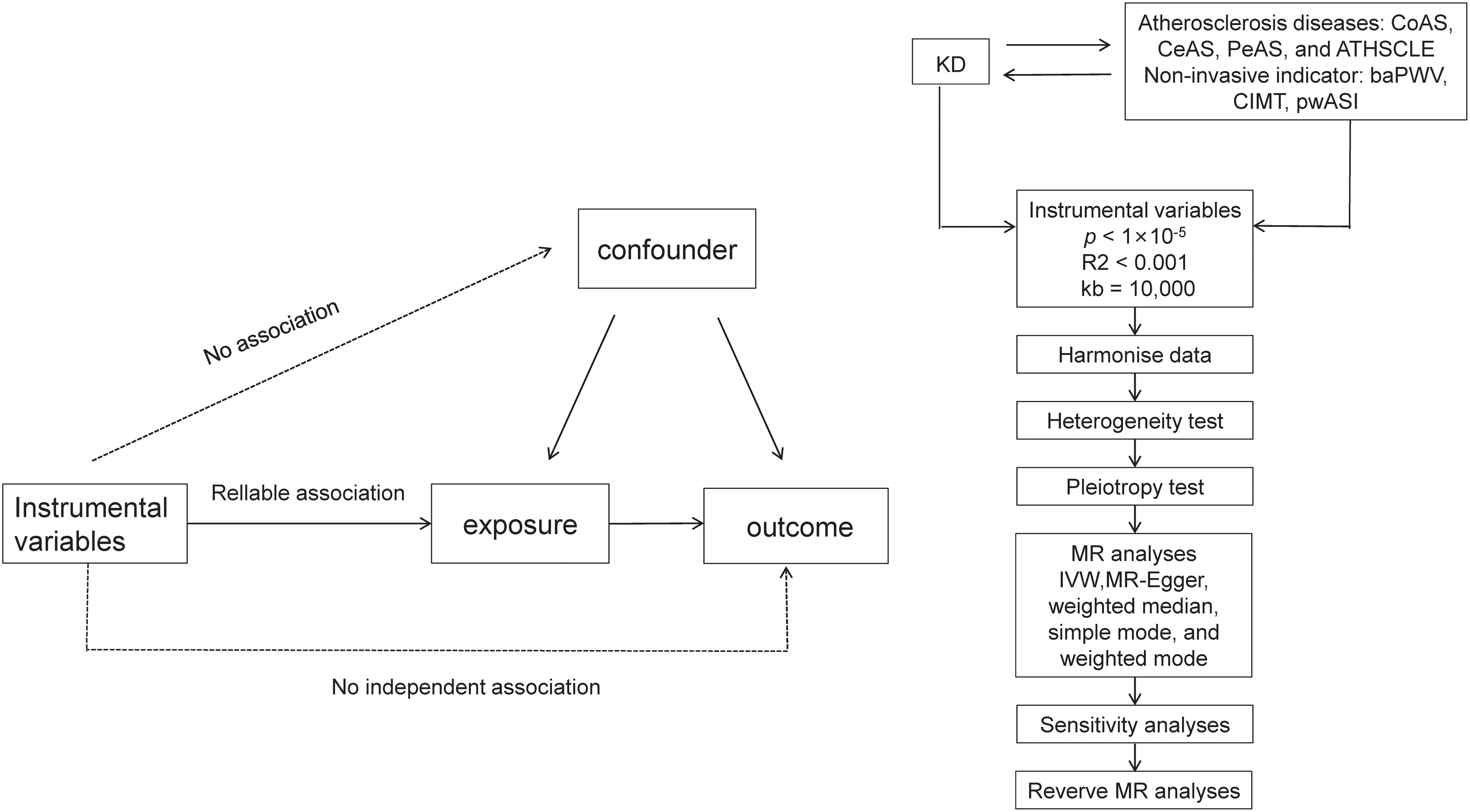
The Mendelian randomisation framework rests on three core instrumental variable assumptions: (1) the genetic variants are robustly associated with the exposure (relevance assumption); (2) the genetic variants are not associated with confounders of the exposure–outcome relationship (independence assumption); and (3) the genetic variants influence the outcome exclusively through the exposure (exclusion restriction assumption). A schematic overview of the study design is presented in Figure 1.
Mendelian randomization concept and assumptions. KD = Kawasaki disease; CoAS = coronary atherosclerosis; CeAS = cerebral atherosclerosis; PeAS = peripheral atherosclerosis; ATHSCLE = atherosclerosis, excluding cerebral, coronary andperipheral artery disease; baPWV = brachial–ankle pulse wave velocity; CIMT = carotid intima media thickness; pwASI = pulsewave arterial stiffness index; MR = Mendelian randomization; IVW = inverse variance weighted.

Data sources for Kawasaki disease
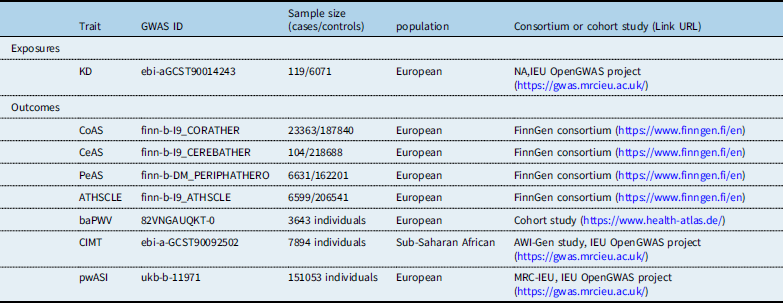
The Kawasaki disease dataset was extracted from publicly available GWAS summary dataset from the IEU Open GWAS project repository (https://gwas.mrcieu.ac.uk/, code: ebi-aGCST90014243). The study included 119 cases and 6071 controls of European origin (Table 1). Reference Buda, Chyb and Smorczewska-Kiljan14 The diagnosis of Kawasaki disease was established according to the American Heart Association criteria. The control group is based on Polish donors recruited within the research project TESTOPLEK between 2010 and 2012 and is registered as the POPULOUS collection at the Biobank Lab of The Department of Molecular Biophysics, University of Lodz, Poland, which is currently registered in Directory (v. 4.0) of BBMRI-ERIC consortium under bbmri-eric: ID: PL_BLUL: collection: POPULOUS_BLUL registration number (https://directory.bbmri-eric.eu/). Further information regarding the study design and data control procedures can be found in previous reports. Reference Buda, Chyb and Smorczewska-Kiljan14
Data sources used for the two-sample Mendelian randomization analysis

Table 1. Long description
A table with two main sections: Exposures and Outcomes. The table has five columns: Trait, GWAS ID, Sample size (cases/controls), population, and Consortium or cohort study (Link URL). The Exposures section includes one row with data for Kawasaki disease (KD) with a sample size of 119 cases and 6071 controls from a European population, sourced from the IEU OpenGWAS project. The Outcomes section includes six rows with data for various conditions such as Coronary Artery Aneurysm (CoAS), Cerebral Artery Stenosis (CeAS), Peripheral Artery Stenosis (PeAS), Atherosclerotic Large Artery Stroke (ATHSCLE), brachial-ankle pulse wave velocity (baPWV), and pulse wave velocity of the aorta and systemic arteries index (pwASI). Each row lists the trait, GWAS ID, sample size, population, and the consortium or cohort study with a link URL. The sample sizes and populations vary across the outcomes.
Data sources for atherosclerosis
GWAS summary statistics for ATHSCLE (6599 cases and 206,541 controls), coronary atherosclerosis (23,363 cases and 187,840 controls), cerebral atherosclerosis (104 cases and 218,688 controls), and peripheral atherosclerosis (6631 cases and 162,201 controls) were obtained from the FinnGen project. Reference Kurki, Karjalainen and Palta15 The project began in 2017 with the goal to collect genotype data from 500,000 Finnish individuals and combine this with data from health registers. The brachial-ankle pulse wave velocity summary statistics were derived from the LIFE-Adult cohort (N = 6734). Reference Rode, Teren and Wirkner16 Pulse wave analysis was performed using the oscillometry-based Vicorder device (Vicorder, Skidmore medical, Bristol, UK). Summary statistics of pulse wave arterial stiffness index (Genome-wide Association Studies (GWAS) ID: ukb-b-11971) were obtained from the United Kingdom Biobank (N = 151,053). Reference Palmer17 Summary statistics of carotid intima-media thickness were derived form a cross-sectional study that investigated populations from six sub-Saharan African sites as part of the Africa Wits-INDEPTH Partnership for Genomic Studies cohort (N = 7894). Reference Boua, Brandenburg and Choudhury18 A detailed description of the data sources had been summarised in Table 1.
Instrumental variables selection
To identify the instrumental variables, we executed a series of rigorous quality controls. Firstl, we extracted single nucleotide polymorphisms robustly associated with the exposures (Kawasaki disease). Since only one single nucleotide polymorphism passed the genome-wide significance threshold (P < 5 × 10⁻⁸), we decided to relax threshold (P < 1 × 10⁻⁵) to obtain the required number of instrumental variables and generate more comprehensive results. Second, we applied a threshold of R
2 < 0.001 and a window size of 10,000 kb to remove the potential influence of linkage disequilibrium. Third, we used GWAS Catalog (https://www.ebi.ac.uk/gwas/) to further remove the effects of confounding factors, and single nucleotide polymorphisms associated with confounding factors such as obesity, hypertension, and smoking were excluded from our analysis. Finally, to quantify the strength of instrumental variables, we employed the F-statistics, which is calculated as F= , where R 2 is the proportion of inter-individual variance explained by the instrument, n represents the sample size, and k is the number of single nucleotide polymorphisms. Only single nucleotide polymorphisms with F-statistics exceeding 10 were considered, to minimise the potential weak instrument bias.
Statistical analysis
In this study, various approaches, such as inverse variance-weighted, Mendelian randomization-Egger, weighted median, simple mode, and weighted mode, were employed to investigate the potential causal link between Kawasaki disease and atherosclerosis. Effect estimates were evaluated using inverse variance-weighted method as primary method, and four supplementary Mendelian randomisation methods as sensitivity analysis. The inverse variance-weighted method is regarded as an ideal estimator under optimal conditions, provided that all genetic variants are valid instrumental variables. Reference Burgess, Small and Thompson19 The Mendelian randomisation-Egger method can assess and adjust the effect of horizontal pleiotropy of selected genetic variants. Reference Bowden, Davey Smith and Burgess20 Furthermore, the weighted median method can provide valid estimates even if up to half of information comes from invalid genetic variants. Reference Bowden, Davey Smith, Haycock and Burgess21
The effect of heterogeneity was assessed using Cochran’s Q statistic of both the inverse variance-weighted and Mendelian randomisation-Egger. A P-value exceeding 0.05 in this test generally implies no significant heterogeneity across the selected instrumental variables, suggesting that the influence of heterogeneity on the estimation of causal effects can be disregarded. The presence of horizontal pleiotropy was evaluated through the Mendelian randomisation-Egger intercept and the Mendelian randomisation Pleiotropy Residual Sum and Outlier global test. If the P-value of the Mendelian randomization-Egger test is greater than 0.05, this would indicate a negligible potential for genetic pleiotropy to bias the causal inference, thereby permitting us to disregard its confounding influence. Furthermore, the Mendelian randomization-PRESSO method was employed to identify potential outliers. If an outlier single nucleotide polymorphism was detected (P < 0.05), the causal effects were re-estimated using the remaining single nucleotide polymorphisms after excluding the outliers. Finally, a leave-one-out analysis was performed as a sensitivity check, where each single nucleotide polymorphism associated with the exposure was sequentially removed, and the inverse variance-weighted analysis was repeated to calculate the combined effect of the remaining single nucleotide polymorphisms, thereby assessing the influence of each individual single nucleotide polymorphism on the outcome.
All statistical analyses were performed by utilising the “TwoSampleMR” package in R software (version 4.0.3, R Foundation for Statistical Computing, Vienna, Austria).
Results
Selection of single nucleotide polymorphisms
After the pre-established strict quality criteria filtering, the study ultimately included 8 single nucleotide polymorphisms as instrumental variables associated with Kawasaki disease for Mendelian randomisation analysis. The range of F-statistics for the selected single nucleotide polymorphisms was between 17.594 and 24.170, indicating that the estimated coefficients are unlikely to be biased by weak instrumental variables. For detailed information regarding these single nucleotide polymorphisms, refer to Table S1.
Mendelian randomisation analysis
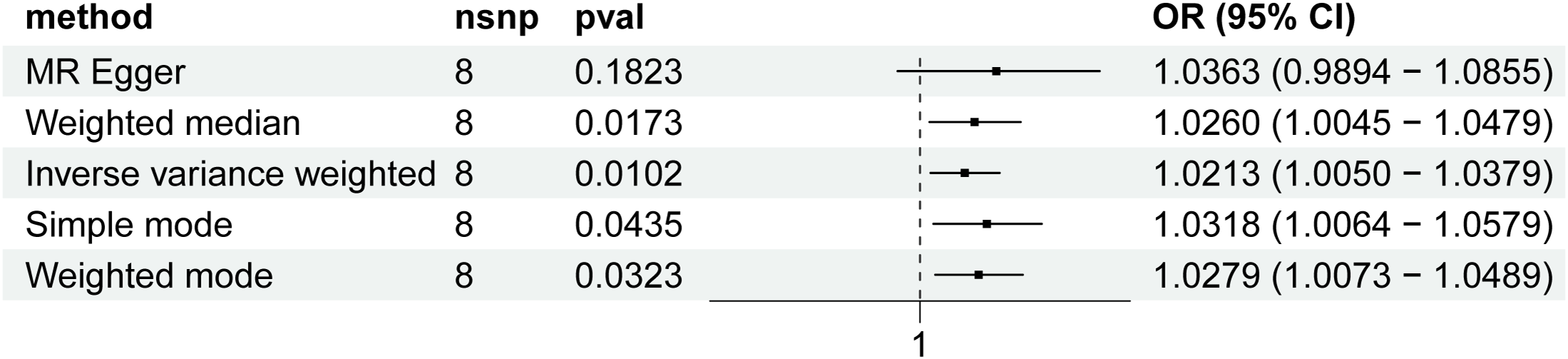
Inverse variance-weighted, Mendelian randomisation-Egger, weighted median, weighted mode, and simple mode analyses were performed to evaluate the causal relationship between Kawasaki disease and atherosclerosis. The inverse variance-weighted results suggested that a higher genetic predisposition to Kawasaki disease may contribute to the development of coronary atherosclerosis (odds ratio = 1.0213; 95% confidence interval = 1.0050 to 1.0379; P = 0.01) (Figure 2). Furthermore, the weighted median, simple mode, and weighted mode methods produced results consistent with those of the inverse variance-weighted method (weighted median: odds ratio = 1.0260, 95%confidence interval = 1.0053 to 1.0471, P = 0.014; simple mode: odds ratio = 1.0318, 95% confidence interval = 1.0085 to 1.0557, P = 0.03; weighted mode: odds ratio = 1.0279, 95% confidence interval = 1.0086 to 1.0476, P = 0.025) (Figure 2).
Forest plots of MR estimates of genetic association between Kawasaki disease and coronary atherosclerosis. IVW = inverse variance weighting; CI = confidence interval; OR = odds ratio; MR = Mendelian randomization.

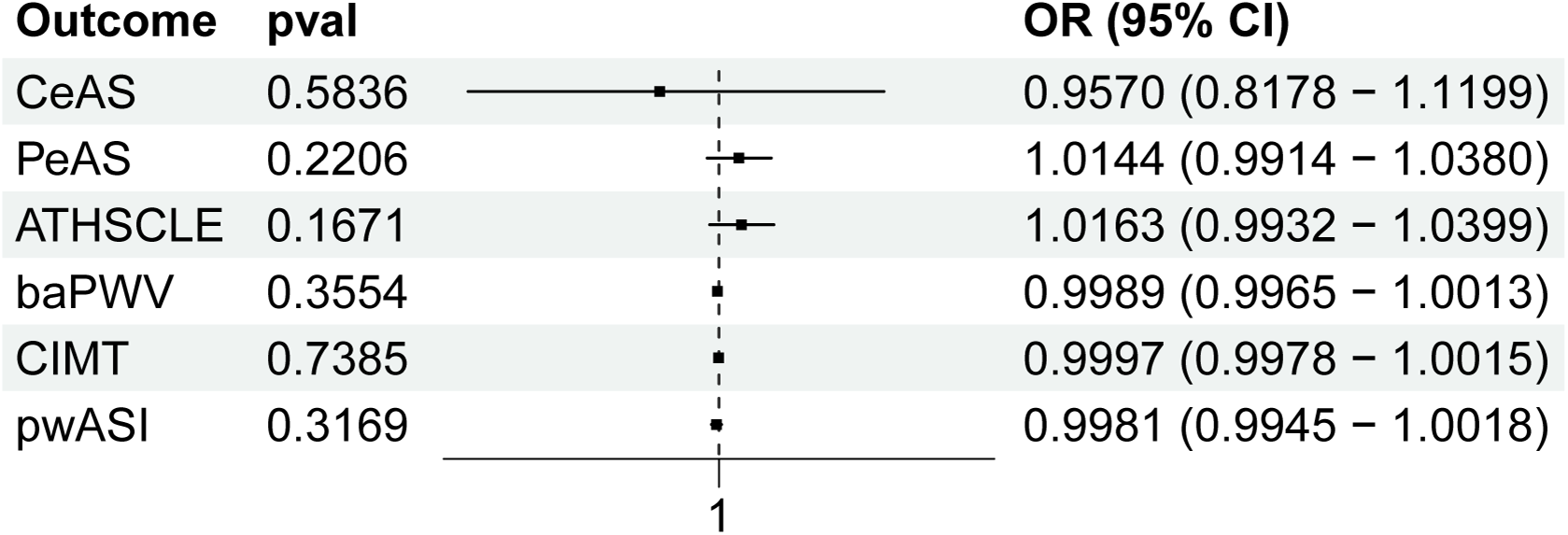
Although the association estimates of Mendelian randomisation-Egger were not statistically significant (P = 0.18), its direction was positive, consistent with the other analyses (Figure 2, Figure S1). The inverse variance-weighted results suggested that no causal relationship between Kawasaki disease and cerebral atherosclerosis (odds ratio = 0.9570; 95% confidence interval = 0.8178 to 1.1199; P = 0.58), peripheral atherosclerosis (odds ratio = 1.0144; 95% confidence interval = 0.9914 to 1.0380; P = 0.22), atherosclerosis, excluding cerebral, coronary and peripheral artery disease (odds ratio = 1.0163; 95% confidence interval = 0.9932 to 1.0399; P = 0.17), brachial–ankle pulse wave velocity (odds ratio = 0.9989; 95% confidence interval = 0.9965 to 1.0013; P = 0.36), carotid intima media thickness (odds ratio = 0.9997; 95% confidence interval = 0.9978 to 1.0015; P = 0.74), and pulse wave arterial stiffness index(odds ratio = 0.9981; 95% confidence interval = 0.9945 to 1.0018; P = 0.32) (Figure 3).
Forest plots of MR estimates of genetic association between Kawasaki disease and atherosclerosis. CI = confidence interval; OR = odds ratio; MR = Mendelian randomisation; CeAS = cerebral atherosclerosis; PeAS = peripheral atherosclerosis; ATHSCLE = atherosclerosis, excluding cerebral, coronary and peripheral artery disease; baPWV = brachial–ankle pulse wave velocity; CIMT = carotid intima media thickness; pwASI = pulse wave arterial stiffness index.

Pleiotropy, heterogeneity, and sensitivity evaluation
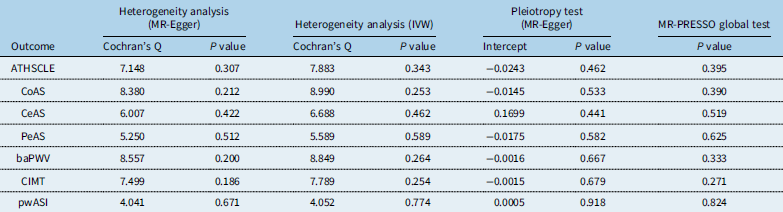
The Cochran’s Q statistic of Mendelian randomisation-Egger and inverse variance-weighted methods were conducted, and the results showed that heterogeneity did not exist among the selected instrumental variables (Table 2). Horizontal pleiotropy was assessed using the Mendelian randomisation-Egger intercept test, and no evidence of pleiotropic bias was observed among the genetic variants used in this study (Table 2). The results of the Mendelian randomisation-PRESSO global test also appeared to be no horizontal pleiotropy, and the results of the Mendelian randomisation-PRESSO outlier test manifested that there were no outliers that need to be removed (Table 2). Finally, additional leave-one-out sensitivity analyses were performed to examine the potential impact of single single nucleotide polymorphisms on the robustness of the causal estimates, and the results showed that the causal effect did not significantly fluctuate with any single single nucleotide polymorphism leave-out (Figure S2).
The pleiotropy test by MR-Egger intercept and MR-PRESSO and heterogeneity tests by MR-Egger and inverse variance weighted

Table 2. Long description
A table with 8 rows and 7 columns comparing heterogeneity and pleiotropy analysis results for various outcomes. The columns are labeled Outcome, Heterogeneity analysis (MR-Egger) Cochran’s Q, Heterogeneity analysis (MR-Egger) P value, Heterogeneity analysis (IVW) Cochran’s Q, Heterogeneity analysis (IVW) P value, Pleiotropy test (MR-Egger) Intercept, Pleiotropy test (MR-Egger) P value, and MR-PRESSO global test P value. The rows list different outcomes: ATHSCLE, CoAS, CeAS, PeAS, baPWW, CIMT, and pwASI. Each row provides values for Cochran’s Q and P values for MR-Egger and IVW heterogeneity analyses, as well as intercept and P values for the pleiotropy test and MR-PRESSO global test P value.
Reverse Mendelian randomisation analysis
To confirm the absence of reverse causality, we conducted reverse Mendelian randomisation analysis treating coronary atherosclerosis as the exposure and Kawasaki disease as an outcome in turn. The inverse variance-weighted results indicated no genetically determined association between coronary atherosclerosis and Kawasaki disease (odds ratio = 0.8783; 95% confidence interval = 0.2732 to 2.8234; P = 0.83), and the Mendelian randomisation-Egger, weighted median, simple mode, and weighted mode methods also produced results consistent with those of the inverse variance-weighted method (Figure S3).The heterogeneity test revealed no evidence of heterogeneity among the instrumental variables (Mendelian randomisation-Egger: Q = 3.1092, P = 0.375; inverse variance-weighted: Q = 4.2529, P = 0.373). The Egger-intercept (P = 0.371) and the Mendelian randomisation-PRESSO global test (P = 0.468) indicated no evidence of horizontal pleiotropy. The leave-one-out analysis demonstrated that the Mendelian randomisation results were robust and not driven by any single instrumental variables (Figure S4).
4. Discussion
This study represents the first application of bidirectional two-sample Mendelian randomisation to investigate the relationship between Kawasaki disease and atherosclerosis, it provides consistent evidence that elevated genetic susceptibility to Kawasaki disease may contribute to the onset and progression of coronary atherosclerosis (inverse variance-weighted: odds ratio = 1.0213; 95% confidence interval = 1.0050 to 1.0379; P = 0.01), and this finding was consistently supported by the weighted median, weighted mode, and simple mode estimators. In contrast, no genetic associations were observed for cerebral atherosclerosis, peripheral atherosclerosis, or atherosclerosis excluding coronary, cerebral, and peripheral artery disease, nor for the subclinical vascular markers brachial-ankle pulse wave velocity, carotid intima-media thickness, and pulse wave arterial stiffness index. Recent years have seen a growing application of Mendelian randomisation to disentangle the complex inflammatory and metabolic underpinnings of Kawasaki disease. For instance, Niu et al. performed a bidirectional Mendelian randomisation analysis linking circulating interleukin-2 and interleukin-8 with Kawasaki disease susceptibility, Reference Niu, Pan, Wang, Zhang, Lin and Zhang22 while a separate Mendelian randomisation study investigated childhood-specific plasma lipid species in relation to Kawasaki disease risk. Reference Zhen, Zhang and Guo23 The present study extends this emerging literature by providing, for the first time, genetic evidence that Kawasaki disease itself—rather than shared inflammatory or lipid-related confounders—may contribute to the long-term development of coronary atherosclerosis, and by revealing the striking coronary-specificity of this risk.
The selective vulnerability of the coronary arteries in Kawasaki disease can be understood through an integrated anatomical, haemodynamic, and inflammatory perspective. Anatomically, the coronary arteries possess a unique intimal structure that undergoes age-dependent multilayering and fragmentation of the internal elastic lamina from infancy onward, rendering them particularly susceptible to inflammatory injury. Reference Guerri-Guttenberg, Castilla, Cao, Azzato, Ambrosio and Milei24 Haemodynamically, the coronary circulation is exposed to high-pressure pulsatile aortic flow, and the proximal segments of the right and left coronary arteries—where Kawasaki disease-related vasculitis predominates—are subjected to turbulent shear stress, a well-established driver of endothelial activation. Reference Sato, Hanna and Mori25,Reference Siasos, Tsigkou and Coskun26 During the acute phase of Kawasaki disease, inflammatory infiltrates, composed largely of monocytes and macrophages, localise preferentially to these epicardial coronary segments, triggering a cascade of immune mediators that progressively disrupt the internal elastic lamina and promote intimal hyperplasia. Reference Giryes and McGonagle27,Reference Zeng, Zhang, Ko and Chen28 In contrast, the cerebral and peripheral arterial beds are exposed to lower pressure regimes and different flow dynamics, and they are not the primary targets of Kawasaki disease-associated inflammatory infiltration, which may explain the absence of detectable genetic associations with cerebral, peripheral, or systemic atherosclerosis in our study.
The genetic findings of the present study align with and extend a growing body of experimental and observational evidence. Motoji et al. established a Kawasaki disease-like vasculitis model of atherosclerosis in ApoE-/- mice using the Candida albicans water-soluble fraction. Using this atherosclerotic murine model, the authors demonstrated that Candida albicans water-soluble fraction-induced vasculitis significantly accelerates atherosclerotic progression. Reference Motoji, Fukazawa and Matsui29 A subsequent systematic review further supported an elevated risk of early-onset atherosclerosis among individuals with a history of Kawasaki disease Reference Lee, Lin and Widdifield30. In addition, Shiono Y et al. reported persistent pathological alterations in systemic arteries long after the acute phase of Kawasaki disease, with more advanced atherosclerotic features observed in vessels complicated by persistent coronary arterial aneurysms, compared to those with regressed coronary arterial aneurysms or no coronary arterial aneurysms at all. Reference Shiono, Takahata and Ino31 Collectively, these findings imply that Kawasaki disease may confer an increased risk of atherosclerosis in later adulthood. Nevertheless, these observational studies are inherently susceptible to confounding by environmental exposures, lifestyle choices, and dietary habits, such as high-fat intake, which may bias the results. The present study employed Mendelian randomisation to effectively circumvent confounding bias and reverse causation, thereby establishing from a genetic perspective that genetic susceptibility to Kawasaki disease confers an increased risk of coronary atherosclerosis. In contrast, no genetic predisposition was found for cerebral atherosclerosis, peripheral atherosclerosis, or ATHSCLE.
At the molecular level, the biological plausibility of this causal relationship is further supported by shared pathogenic pathways. Observational studies have indicated that endothelial dysfunction and inflammatory processes are crucial elements in the pathogenesis of Kawasaki disease, both of which also represent established risk factors for the initiation and progression of atherosclerosis. Reference Kumrah, Goyal, Rawat and Singh32 Acute-phase Kawasaki disease is characterised by a profound inflammatory infiltrate targeting the coronary endothelium, resulting in persistent endothelial dysfunction and intimal remodeling Reference Qiu, Zhang, Li, Hua and Zhang33 that extend well beyond clinical convalescence. Reference Yu, Wu and Song34 This persistent vasculitic process drives vascular cellular senescence and sustained endothelial impairment, establishing a prolonged proinflammatory microenvironment that facilitates the development of premature atherosclerosis in young adults. Reference Motoji, Fukazawa and Matsui29 Furthermore, genetic variants linked to Kawasaki disease are predominantly enriched in biological processes associated with vascular inflammation and immune regulation, including pathways involving matrix metalloproteinases, T-cell activation, and interleukin-1 signaling. Reference Chen35,Reference Noval Rivas and Arditi36 These dysregulated pathways drive acute Kawasaki disease vasculitis, and sustained endothelial damage may precipitate premature atherosclerosis, the subclinical onset of which can occur within the first decade of life. Reference Candelino, Tagi and Chiarelli37 Targeting these specific molecular pathways may therefore provide novel therapeutic strategies for long-term cardiovascular protection in Kawasaki disease survivors.
The absence of causal associations between genetic predisposition to Kawasaki disease and subclinical markers of arterial stiffness (brachial-ankle pulse wave velocity, pulse wave arterial stiffness index, carotid intima-media thickness) merits attention. These non-invasive measures are well-established predictors of cardiovascular risk in the general population, Reference Sang, Lv, Dang, Cheng and Zhang38–Reference Nezu, Hosomi, Aoki and Matsumoto40 and observational studies have suggested that certain parameters, such as carotid intima-media thickness, may be increased in Kawasaki disease survivors Reference Zeng, Chen, Zhang and Ji9. These null results could be attributable to insufficient power to detect subclinical non-coronary changes, owing to the modest Kawasaki disease sample size and the relatively young cohorts from which the phenotypes were drawn. Moreover, the carotid intima-media thickness dataset was sourced from a cross-sectional study of sub-Saharan African populations (N = 7894). Notably, carotid intima-media thickness levels and their associations with cardiovascular risk factors exhibit ethnic variation, with adjusted mean carotid intima-media thickness values being lowest in African populations among various ethnic groups, Reference Nonterah41 suggesting that the baseline characteristics of subclinical atherosclerosis in this population may differ from those in other ancestries. It is also possible that the vascular impact of Kawasaki disease is genuinely confined to the coronary arteries, as suggested by the strong anatomical and haemodynamic specificity discussed above. Consequently, these null results the current negative results should not be regarded as conclusive evidence for ruling out the causal relationship between Kawasaki disease and non-coronary atherosclerosis. Future studies with larger-scale, multi-ethnic genome-wide Kawasaki disease samples and extended follow-up durations will be required to resolve these possibilities definitively.
Several methodological considerations warrant cautious interpretation of our findings. The exposure dataset comprised merely 119 cases against 6071 controls, a modest case count that inevitably curtails precision in instrument discovery and effect estimation. Foremost is the relaxed instrument selection threshold (P < 1 × 10⁻⁵) necessitated by the paucity of genome-wide significant loci for Kawasaki disease. While this pragmatic strategy has precedent in Mendelian randomisation studies of low-heritability exposures, Reference Burgess42 we took precautionary measures: all F-statistics exceeded 10, and neither Mendelian randomisation-Egger intercept nor Mendelian randomisation-PRESSO indicated pleiotropy. Reassuringly, weighted median and mode-based estimates aligned with the inverse variance-weighted result, supporting its robustness, together with the absence of heterogeneity (Cochran’s Q P > 0.05) and the confirmation from leave-one-out analysis, considerably strengthens the plausibility of a genuine causal effect of genetic predisposition to Kawasaki disease on coronary atherosclerosis, despite the relaxed single nucleotide polymorphism selection threshold. In the reverse-direction analysis, genetic liability to coronary atherosclerosis exhibited no association with Kawasaki disease status. Nevertheless, power remains limited, particularly for reverse and non-coronary analyses, given the modest Kawasaki disease case count. Validation in larger, multi-ancestry cohorts is warranted.
From a translational perspective, identifying Kawasaki disease as a potential genetically risk factor for coronary atherosclerosis offers several avenues for precision medicine. For instance, polygenic risk scores that incorporate Kawasaki disease‑associated variants could be developed. These scores might help stratify long‑term cardiovascular risk among Kawasaki disease survivors and potentially pinpoint those at highest risk. These individuals could benefit most from more intensive preventive measures. Another direction involves drug‑target Mendelian randomisation. By focusing on genetic variants within or near genes that encode druggable proteins, researchers could prioritise specific molecular targets. Candidates such as components of the interleukin‑1 or matrix metalloproteinase pathways are of particular interest for therapeutic development aimed at reducing long‑term coronary risk in this population. Finally, integrating genetic data with detailed clinical phenotyping will be essential. This includes information on coronary aneurysm status and acute‑phase treatment history, ideally within prospective, multi‑ethnic cohort studies. Only then can genetic insights be translated into actionable clinical strategies.
Several limitations should be considered when interpreting these findings. The instrumental variables were derived exclusively from a European-ancestry GWAS, which may limit the generalisability of our conclusions to non-European populations. Although the exposure and outcome GWAS were drawn from nominally independent cohorts, the possibility of minimal sample overlap cannot be entirely excluded. We were unable to distinguish Kawasaki disease patients with versus without coronary artery aneurysms, a distinction that may materially alter long-term risk estimates. The outcome data relied on clinical diagnosis codes and subclinical markers rather than overt, adjudicated clinical endpoints, which may introduce outcome misclassification. Finally, our Mendelian randomisation framework captures only the lifelong effect of genetically predicted Kawasaki disease susceptibility; the actual vascular health trajectory of an individual with a history of Kawasaki disease is additionally shaped by acute disease severity, residual coronary damage, intravenous immunoglobulin treatment, and modifiable lifestyle factors, all of which require dedicated prospective investigation.
Conclusion
Our study suggests that Kawasaki disease could be an independent risk factor for coronary atherosclerosis, a finding that warrants further investigation regarding its clinical and public health implications. A childhood history of Kawasaki disease, even when mild, may be considered as a potential cardiovascular risk marker and could eventually inform risk-enhancing strategies in primary prevention. Although the present Mendelian randomisation analysis is constrained by the modest size of the available Kawasaki disease GWAS and thus provides hypothesis-generating rather than definitive evidence, it strongly supports the need for larger replication studies. Importantly, it highlights that Kawasaki disease survivors may benefit from long-term coronary surveillance. If confirmed, these insights could lead to targeted prevention and reduce premature cardiovascular disease in this population.
Supplementary material
The supplementary material for this article can be found at https://doi.org/10.1017/S1047951126124111
Data availability statement
All GWAS summary statistics used in this study are publicly available from the IEU Open GWAS Project repository (https://gwas.mrcieu.ac.uk/, accession codes: ebi-a-GCST90014243 for Kawasaki disease; and additional codes for each atherosclerosis phenotype used). The FinnGen cohort data are available at https://www.finngen.fi/en. The UK Biobank data (ID: ukb-b-11971) are available at https://www.nealelab.is/uk-biobank. The LIFE-Adult and African Wits-INDEPTH Partnership datasets are available from the original publications cited in Table 1.
Acknowledgements
The authors appreciate the IEU Open GWAS project repository for providing the Kawasaki disease GWAS summary dataset and FinnGen project for providing atherosclerosis GWAS summary statistics.
Financial support
This research received no specific grant from any funding agency, commercial, or not-for-profit sectors.
Competing interests
The authors declare no competing interest.
Ethical standard
The data used in this study were publicly available and the published data that had previously obtained relevant ethical approval and participant consent. Consequently, obtaining additional ethical approval or participant consent was unnecessary.