Introduction
There are many reports in the literature of foreign bodies in the pharynx and the tracheobronchial tree; however, lodging of a foreign body in the larynx is a rare event, accounting for less than 4 per cent of all foreign bodies.Reference Zaytoun, Rouadi and Baki 1 , Reference Cohen, Lewis, Herbest and Geller 2 Migration through the mucosa into the paraglottic space is even rarer still. A review of the literature revealed only one case report of migration of an ingested foreign body into the paraglottic space.Reference Lupo, Leuin and Kelley 3
This paper discusses a case of an ingested foreign body in an adult, in which the foreign body migrated into the paraglottic space and ultimately required multiple surgical procedures for complete removal.
Case report
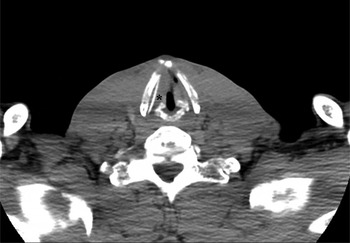
A 68-year-old man presented to the emergency department with persistent odynophagia 4 days after ingesting a fish bone. A computed tomography scan revealed a 2.5 cm linear foreign body embedded in the larynx within the right paraglottic space (Figure 1). The patient underwent direct laryngoscopy. However, the foreign body could not be visualised.
Axial computed tomography image of patient on initial presentation. Note fish bone in right paraglottic space (asterisk).

Transcervical exploration of the right paraglottic space was performed using a posterolateral approach. This approach was modified from the approach commonly used for arytenoid adduction. The larynx was approached lateral to the strap muscles, and the pharyngeal constrictors were detached from the posterior border of the thyroid cartilage. The pyriform sinus mucosa was dissected off the thyroid cartilage, thereby allowing access to the paraglottic space. After an extensive search, the surgery was aborted without successfully identifying the foreign body.
A repeat computed tomography scan showed the foreign body in the same location. Four days later, the patient underwent repeated direct laryngoscopy, which again did not reveal a foreign body in the endolarynx. A repeat transcervical exploration of the right paraglottic space was performed using the same techniques described above, and the foreign body was successfully identified and removed.
The patient was discharged home without any complications. He had mild laryngeal and pharyngeal oedema that resolved after one month. He had no swallowing difficulties and his voice was normal.
Discussion
Ingested foreign bodies are one of the most common reasons for otolaryngological emergency consultation. The vast majority of cases can be managed with endoscopic removal. However, in some cases foreign bodies can become lodged in areas that are difficult to access endoscopically. More invasive means may be required to remove such foreign bodies, including transcervical approaches or even thoracotomy if they enter the tracheobronchial tree.Reference Marks, Marsh and Dudgeon 4 , Reference Fraga, Neto, Seitz and Schopf 5 Migration of foreign bodies into the paraglottic space is a rare event that is likely to necessitate using a more invasive procedure for removal.Reference Lupo, Leuin and Kelley 3
We presented a case of an ingested fish bone that migrated into the paraglottic space. It is difficult to predict the route that a foreign body might take in tissue as it may not necessarily follow fascial planes.Reference Norfolk and Gray 6 In our case, it is unclear exactly how the fish bone migrated into the paraglottic space. One possible route of entry is through the anterior wall of the pyriform sinus. The fish bone may have become lodged in the pyriform sinus in an anterior–posterior orientation. Subsequent contraction of the pharyngeal constrictors may have then propelled the fish bone anteriorly into the paraglottic space. The lack of an intraluminal portion of the foreign body made an endoscopic approach problematic.
-
• Migration of ingested foreign bodies into the paraglottic space is rare
-
• Paraglottic space foreign bodies are not likely to be amenable to endoscopic removal
-
• Management may require a transcervical approach for removal
-
• The posterolateral approach to the paraglottic space is a useful alternative to laryngofissure for removal of paraglottic space foreign bodies
Lupo et al. reported a case of paraglottic migration of an ingested bony fragment after maxillofacial trauma.Reference Lupo, Leuin and Kelley 3 The patient presented with a laryngeal abscess and airway compromise. Similar to our case, an initial endoscopic attempt at removal was not successful. The foreign body was subsequently retrieved after performing a laryngofissure. The patient required a tracheostomy, but was eventually decannulated. We described an alternate approach for paraglottic space exploration. Our patient underwent a posterolateral approach to the paraglottic space, which is a modification of the approach used for arytenoid adduction. This less morbid approach may be better suited for smaller foreign bodies, such as fish bones; our patient did not require a tracheostomy.
Management of sharp foreign bodies in the head and neck is controversial. Some individuals advocate early intervention, while others suggest observation if the patient is asymptomatic.Reference Williams, Eisele and Wyatt 7 There is a paucity of literature on embedded laryngeal foreign bodies, but the potential for airway compromise and infectious complications suggests that observation may not be a prudent choice. In our case, the patient presented with a foreign body in the paraglottic space and was symptomatic until it was removed.
In conclusion, paraglottic space foreign bodies are rare and are difficult to manage endoscopically. Transcervical exploration should be considered for cases in which attempts at endoscopic removal fail. A posterolateral approach to the paraglottic space may be more beneficial in some cases because it avoids some of the complications associated with laryngofissure.