Introduction
The influence of economic factors on biological living conditions has been widely documented. Steckel (Reference Steckel1979, Reference Steckel, Gallman and Wallis1992, Reference Steckel1995, Reference Steckel2008) emphasized that four biological measures can be used to describe human well-being: life expectancy, morbidity, state of skeletal remains and height. Height is regarded as one of the indicators of environmental stress at population level, being an excellent barometer of standard of living of populations (Tanner, Reference Tanner1978, Reference Tanner1981; Susanne et al., Reference Susanne, Bodzsar, Bielicki, Hauspie, Hulanicka, Lepage, Rebato and Vercauteren2001; Sanna, Reference Sanna2002; Carson, Reference Carson2005, Reference Carson2009, Reference Carson2010, Reference Carson2011; Nowak & Piontek, Reference Nowak and Piontek2008; Bodenhorn, Reference Bodenhorn2010a, Reference Bodenhornb; Nowak et al., Reference Nowak2011).
Since the 19th century changes over time in height in the fast-developing countries of Western Europe and the United States have been observed. Improvement in socioeconomic status, and therefore standard of living, has been attributed to the processes of industrialization and modernization. Among many factors contributing to an upward trend in height, the most important are likely to be nutrition and health status. The effects of other factors contributing to the increase of height in human populations, including wealth, health care, family income and education level, have also been described (Komlos, Reference Komlos1985, Reference Komlos1987, Reference Komlos2010; Steckel, Reference Steckel, Gallman and Wallis1992, Reference Steckel1995; Komlos & Baten, Reference Komlos and Baten2004; Komlos & Baur, Reference Komlos and Baur2004; Carson, Reference Carson2005, Reference Carson2009, Reference Carson2010; Nowak & Piontek, Reference Nowak and Piontek2008; Bodenhorn, Reference Bodenhorn2010a, Reference Bodenhornb; Nowak et al., Reference Nowak, Piontek and Zadarko-Domaradzka2011).
The relationship between height and living conditions has been the subject of many studies including populations from contemporary Poland (Bielicki et al., Reference Bielicki, Szczotka, Górny and Charzewski1981; Bielicki & Welon, Reference Bielicki and Welon1982; Bielicki, Reference Bielicki, Falkner and Tanner1986; Hulanicka et al., Reference Hulanicka, Brajczewski, Jedlińska, Sławińska and Waliszko1990; Bielicki & Hulanicka, Reference Bielicki, Hulanicka, Bodzsar and Susanne1998; Kołodziej & Kozieł, Reference Kołodziej and Kozieł2002), other areas of Europe and the United States (Susanne et al., Reference Susanne, Bodzsar, Bielicki, Hauspie, Hulanicka, Lepage, Rebato and Vercauteren2001; Sanna, Reference Sanna2002; Komlos & Baur, Reference Komlos and Baur2004; Malina et al., Reference Malina, Peňa Reyes, Tan, Buschang, Little and Koziel2004; Komlos, Reference Komlos2010; Nowak et al., Reference Nowak, Piontek and Zadarko-Domaradzka2011; Gupta et al., Reference Gupta, Deding and Lausten2013; Mora, Reference Mora2013), as well as historical populations (Nicholas & Steckel, Reference Nicholas and Steckel1991; Carson, Reference Carson2005, Reference Carson2009, Reference Carson2010, Reference Carson2011; Kopczyński, Reference Kopczyński2005, Reference Kopczyński2006, Reference Kopczyński2007, Reference Kopczyński2011; Nowak & Piontek, Reference Nowak and Piontek2008; Bodenhorn, Reference Bodenhorn2010a, Reference Bodenhornb; Barten & Blum, Reference Baten and Blum2012). Wurm (Reference Wurm1985) included changes over time in height in Germany in the 19th and 20th centuries. Changes in population height were also recorded in rural areas of Ukraine from the 19th and early 20th centuries (Nowak & Piontek, Reference Nowak and Piontek2008). Carson (Reference Carson2005, Reference Carson2009, Reference Carson2010, Reference Carson2011) and Bodenhorn (Reference Bodenhorn2010a, Reference Bodenhornb), using 19th-century US prison records and data on heights on New York legislators, confirmed the positive relationship between social and environmental factors and growth. Baten & Blum (Reference Baten and Blum2012) investigated height trends from around the world during the 19th century and the beginning of the 20th century, and found that migration movements influenced trends in body height in Old and New World populations. Secular changes in height and leg length in the child, adolescent and young adult populations, associated with improvement in health, nutritional and living conditions, were shown in a rural, agrarian Zapotec-speaking community in Oaxaca from 1978 and 2000 (Malina et al., Reference Malina, Peňa Reyes, Tan, Buschang, Little and Koziel2004). Secular trends in height of 14-year-old boys from Wrocław (Poland) in the 1980s and the 1990s and their relationship with social gradients were shown by Kołodziej & Kozieł (Reference Kołodziej and Kozieł2002).
The pioneering studies for populations in Poland were conducted in the late 19th century and the beginning of the 20th century (Zakrzewski, Reference Zakrzewski1891; Olechnowicz, Reference Olechnowicz1897; Bochenek, Reference Bochenek1904, Reference Bochenek1906; Rutkowski, Reference Rutkowski1906, Reference Rutkowski1914; Maciesza, Reference Maciesza1914; Talko-Hryncewicz, Reference Talko-Hryncewicz1914). While these studies investigated height, they did not report on the association between height and economic factors affecting the respective study populations. Recent research has focused on differences in stature of conscripts from the Polish territories belonging to the Prussian sector (Nowak, Reference Nowak2011) and to the Kingdom of Poland (Kopczyński, Reference Kopczyński2005, Reference Kopczyński2006, Reference Kopczyński2007, Reference Kopczyński2011). This is despite the regions of Poland (guberniyas) experiencing considerably different economic circumstances. In light of the scarcity of research in this field of physical anthropology in the Kingdom of Poland, the aim of this investigation was to briefly summarize the economic circumstances across the regions of the Kingdom of Poland and then examine the relationship between these region-specific economic circumstances and height of their inhabitants during the late 19th and early 20th centuries.
Historical background
In 1772 the territory of the Polish state was split between the three neighbouring powers: Russia, the Kingdom of Prussia and Austria. As a result of this first partition, Prussia took over the region called Royal Prussia (without Gdańsk) and Kuyavia (Polish: Kujawy). After the second partition in 1793, Greater Poland (Polish: Wielkopolska) with the capital city of Poznań, Western Masovia (Polish: Mazowsze) with the city of Płock, and the cities of Gdańsk and Toruń were incorporated into the administrative boundaries of Prussia. Two years later Prussia expanded their territory to include Masovia, Podlasie and Suwałki. The partitioning states seized jointly over 733,000 square kilometres of the area of the then Poland, with Russia taking 82% of its land, Austria 11% and Prussia 7%. In 1807 Poland gained a semblance of independence in the form of the Duchy of Warsaw, which was renamed the Kingdom of Poland in 1815, formally tied with Russia through the personal union. After 1918 the Polish state regained most of Greater Poland and Gdańsk Pomerania, but without Gdańsk, which by the decision of the world powers was granted the status of a Free City. In 1918 Poland also acquired some lands, which earlier had been incorporated into the Kingdom of Prussia: Upper Silesia, a part of Masuria, Warmia and Lower Silesia (Lord, Reference Lord1973; Cegielski & Kądziela, Reference Cegielski and Kądziela1990).
The Polish territories belonging to Prussia, Russia and Austria showed differences in the rate of economic development. Per capita income in the Prussian sector was higher than in the borderland provinces of the Kingdom of Poland (the Russian sector) and in the area known as Galicia (the Austrian sector). At the beginning of the 20th century, in the Prussian-ruled territories per capita income amounted to 113 dollars per year, in comparison to 63 and 38 dollars in the Kingdom of Poland and Galicia, respectively (Chwalba, Reference Chwalba2000). Some differences were also observed within the partitioned regions. Thus, in Prussian-owned Greater Poland the annual income per capita amounted to 563 marks in Gdańsk, 567 marks in Pomerania and 603 marks in Upper Silesia (Chwalba, Reference Chwalba2000).
The liquidation of feudalism in agriculture in the Polish lands stimulated the development of other sectors of the economy. This process was not equal in the partitioned regions. The pace of change was dependent on the level of economic development of the partitioning powers, which stimulated or inhibited the economy of these regions. The highest dynamics of change and the highest growth rate in the mid-19th century were noted in the German lands followed by the Austrian lands, with the slowest growth occurring in the territory ruled by Russia, where the remnants of feudalism were still observed until the end of the 19th century. In the second half of the 19th century, the Prussian sector (with the exception of Upper Silesia) became a source of cheap labour and agricultural facilities for industrializing central and western Germany. The Kingdom of Poland, despite many development barriers, became one of the most important industrial centres of Russia. In Galicia, the economic situation improved by virtue of oil production, but this region was still poorly industrialized in comparison to the other Polish territories (Chwalba, Reference Chwalba2000), with agriculture being the basis of the Galician economy. As many as 768 per 1000 Galician residents were dependent on the agricultural economy during the years 1897 to 1907, while in the Kingdom of Poland this figure was lower at 566 per 1000 residents; 260 per 1000 were employed in industry (Chwalba, Reference Chwalba2000). In the Duchy of Poznań, 540, 234 and 87 residents per 1000 were employed in agriculture, industry and trade respectively (Chwalba, Reference Chwalba2000).
The development of industry and the concentration of capital led to the transformation of many industrial plants across the Polish territories. In the Kingdom of Poland, in the years 1884 to 1913 the number of factories increased from 44 to 148. Similarly, the number of factory workers increased from 45,000 to 202,000. In Gdańsk Pomerania and Greater Poland, in the years 1882–1907 the number of factories employing over 50 people grew from 125 to 436, and the number of factory workers from 20,000 to over 61,000 (Łukasiewicz, Reference Łukasiewicz1988).
The Prussian sector's rapid and dynamic economic growth was also evident in the mechanization of agriculture and agricultural production. In the second half of the 19th century and at the beginning of 20th, the production of rye, wheat, barley and oats per person per year was highest in this region amounting to 653 kg per person in Greater Poland in comparison to 412 kg per person in Silesia and a mere 280 kg per person in Galicia. Similarly, the potato harvest was 1529 kg and 580 kg in Greater Poland and Galicia, respectively. Cattle production per 100 persons per year was 47.2 head in Greater Poland and 31.9 in Silesia, and pig production was 50.3 and 23.1 head, respectively (Łukasiewicz, Reference Łukasiewicz1988; Budnik & Liczbińska, Reference Budnik and Liczbińska2013).
Methods
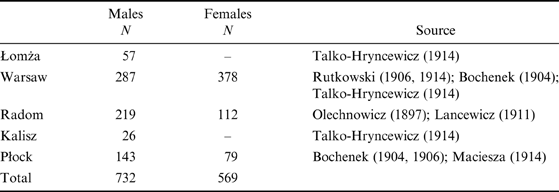
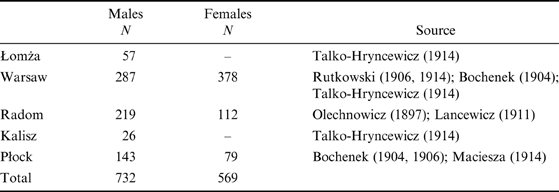
This investigation utilized data on height of adult inhabitants (male and female) from five guberniyas (provinces) of the Kingdom of Poland (Łomża, Warsaw, Radom, Kalisz and Płock) collected in the years 1897 to 1914. These data were published for individuals from this region in the late 19th and early 20th century in appendices to articles from Olechnowicz (Reference Olechnowicz1897), Bochenek (Reference Bochenek1904, Reference Bochenek1906), Talko-Hryncewicz (Reference Talko-Hryncewicz1914), Rutkowski (Reference Rutkowski1906, Reference Rutkowski1914), Lancewicz (Reference Lancewicz1911) and Maciesza (Reference Maciesza1914) (Table 1). The data did not include individual information about socioeconomic status of inhabitants. The study data were compiled and digitized, creating a new database (N=732 men and N=569 women). The mean ages of men and women were 33.7 and 32.0 years, respectively.
Number of individuals under study and the source of data, 1897–1914
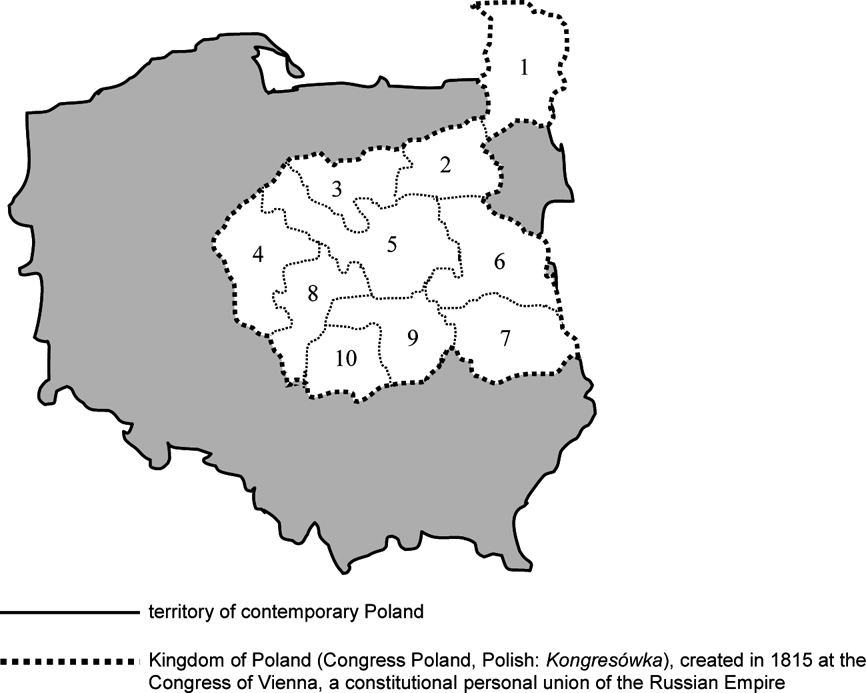
In this study an administrative division of the Kingdom of Poland from 1867 was adopted (Chwalba, Reference Chwalba2000), such that it consisted of ten guberniyas (provinces): Kalisz, Kielce, Lublin, Łomża, Piotrków, Płock, Radom, Siedlce, Suwałki and Warsaw (Fig. 1).
Territory of contemporary Poland compared with the Kingdom of Poland. The guberniyas of the Kingdom of Poland are: (1) Suwałki, (2) Łomża, (3) Płock, (4) Kalisz, (5) Warsaw, (6) Siedlce, (7) Lublin, (8) Piotrków, (9) Radom, (10) Kielce.

Mean height and standard deviation for cohorts born between 1840 and 1890 were calculated. Differences in average height of male and female inhabitants across the five guberniyas represented in the data set were examined using ANOVA and the Fisher's LSD (Least Significant Difference) test of multiple comparisons. Calculations were performed using the package of STATISTICA (STATISTICA, 2011).
Results
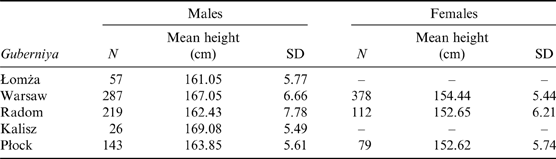
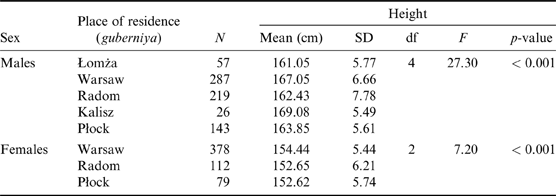
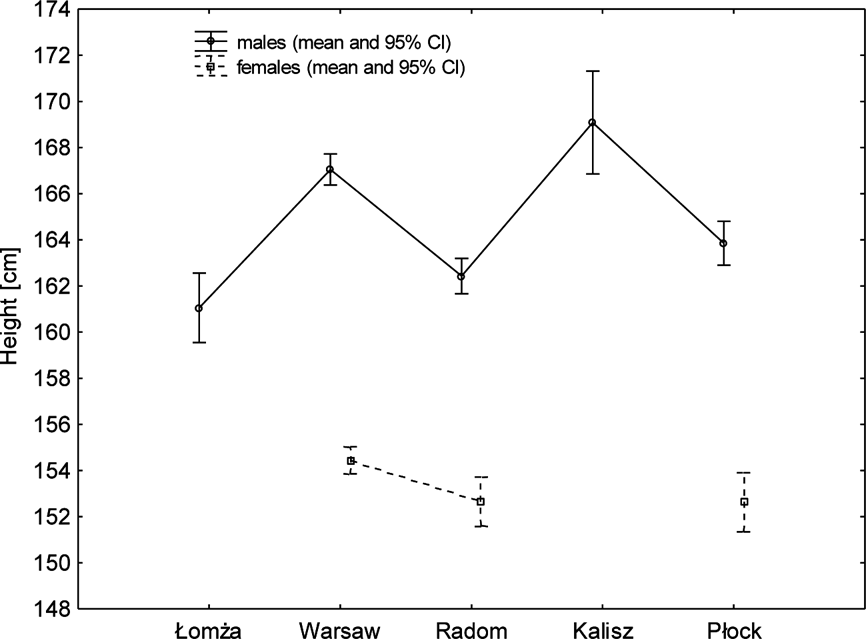
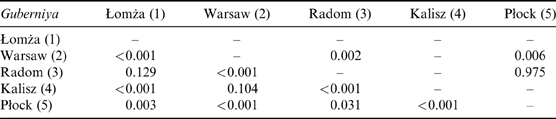
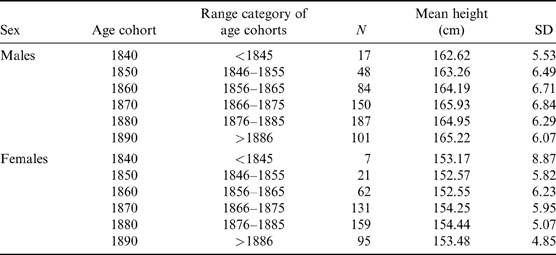
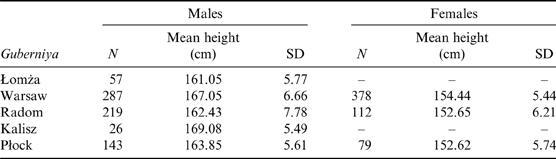
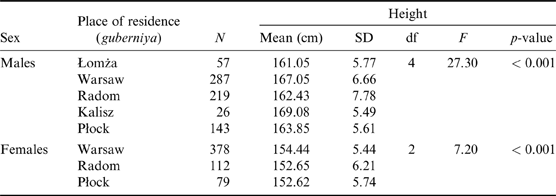
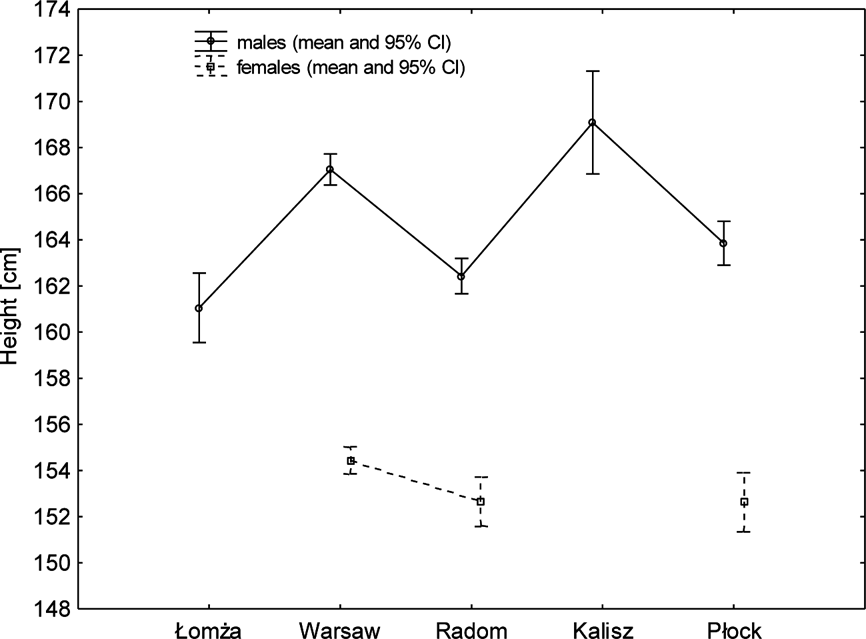
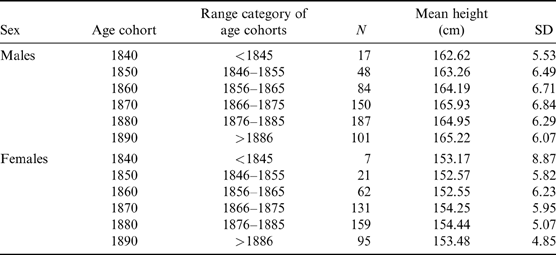
The mean values of height and standard deviation for men and women across the five represented guberniyas are presented in Table 2. The tallest men came from the Kalisz and Warsaw guberniyas (169 and 167 cm, respectively), while the shortest came from the Łomża, Radom and Płock guberniyas (161 cm, 162 cm and 163 respectively). The same was true in the case of women: the highest, measuring 154 cm, lived in the Warsaw guberniya (no data for the Kalisz guberniya) and the shortest in the Płock and Radom guberniyas (152 cm in both) (Table 2). The ANOVA analysis confirmed that mean height for both sexes differed significantly by place of residence (guberniya) (Table 3 and Fig. 2). Table 4 shows the differences in mean height using the multiple comparison Fisher's test. It shows that the height of individuals differed significantly between the guberniyas for both sexes. Moreover, an analysis of birth cohorts born between 1840 and 1890 demonstrates the increase in mean height over time (Table 5). The difference between the earlier male cohorts (1840) and the later ones (1890) amounted to nearly 3 cm.
Average height and standard deviation for men and women from the Kingdom of Poland, 1897–1914
Differences in average height of men and women from the Kingdom of Poland, 1897–1914 (ANOVA)
Mean height and 95% confidence intervals (CI) in the guberniyas of the Kingdom of Poland.
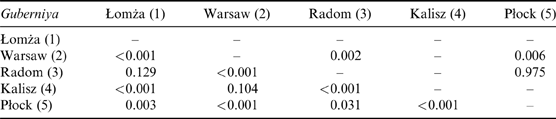
Differences in mean height of men and women from the Kingdom of Poland using Fisher's LSD test, 1897–1914 (lower triangle for males and upper one for females)
Mean height and standard deviation (SD) of birth cohorts from the Kingdom of Poland, 1897–1814
Discussion
As was mentioned earlier in this paper, the Polish lands under Russian rule were not equal to the territories belonging to the Prussian sector in terms of socioeconomic development and standard of living (Łukasiewicz, Reference Łukasiewicz1988; Kopczyński, Reference Kopczyński2006; Nowak, Reference Nowak2011). This translated into differences in height of individuals from the two regions. Previous studies have shown that the height of conscripts from the Kingdom of Poland and from the Prussian sector differed significantly in favour of the latter: the conscripts from the Kingdom of Poland were shorter than those from the Prussian sector by an average of 4 cm (Nowak, Reference Nowak2011).
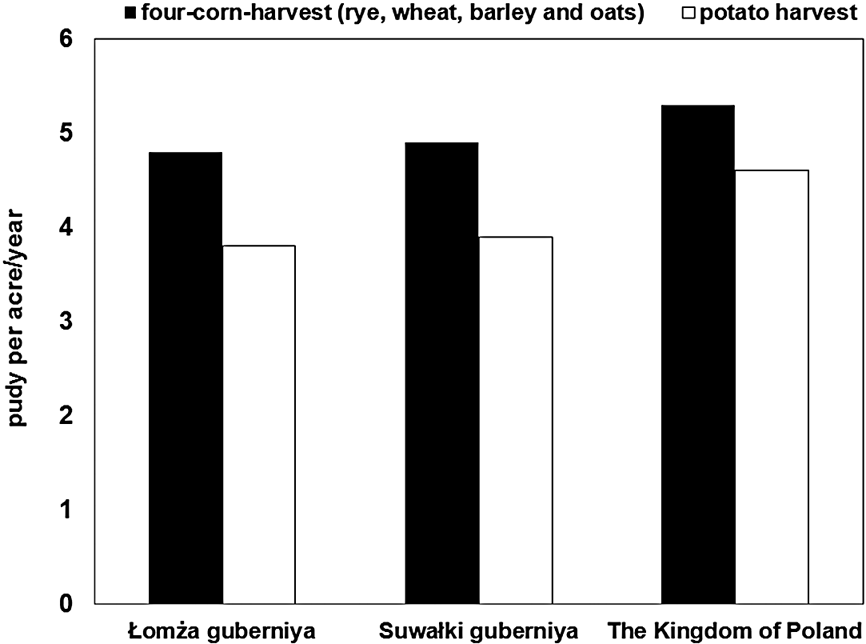
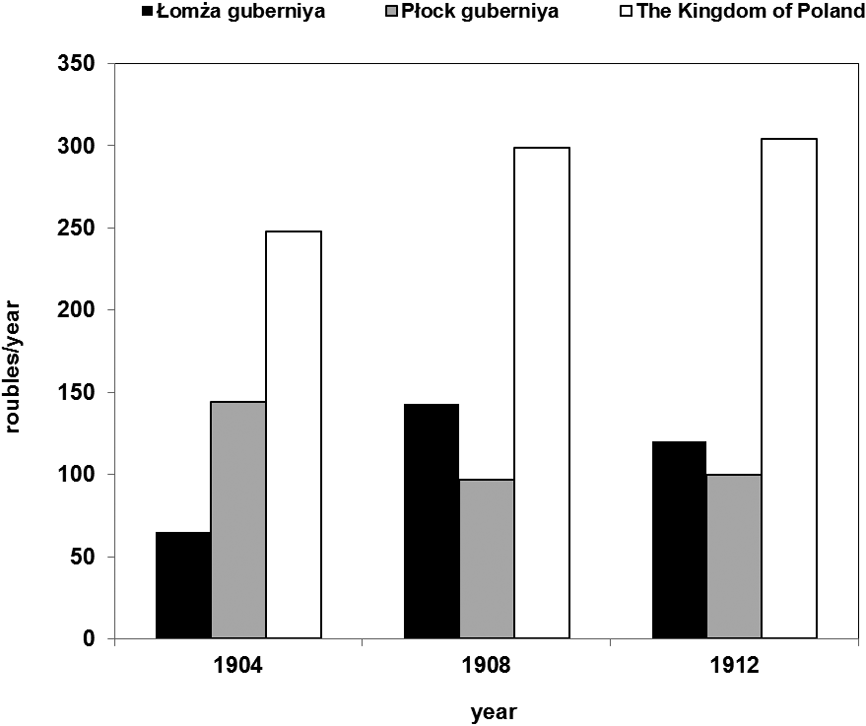
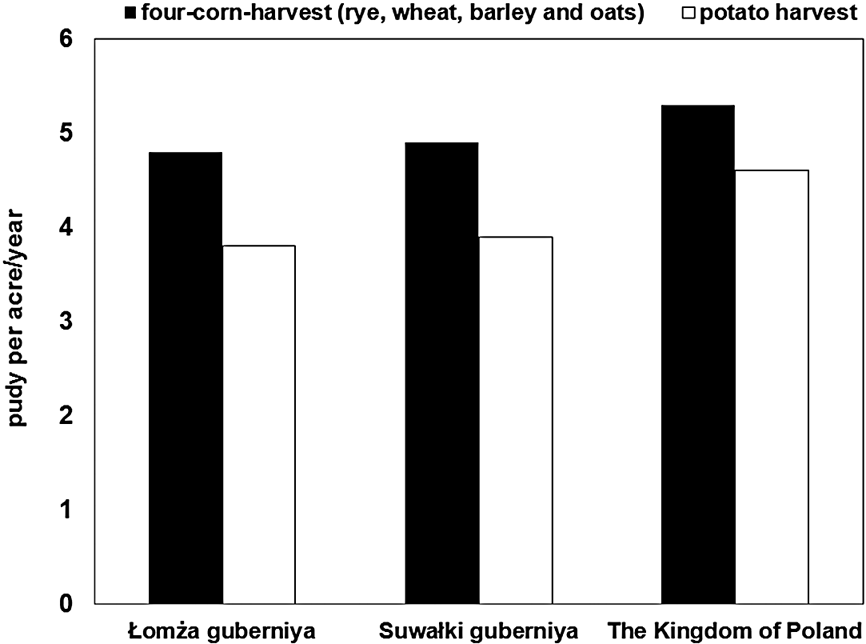
Although the territories of the Kingdom of Poland belonged to the poor and neglected areas of historical Poland, some differences in the level of economic development and wealth status were noted, which were reflected in the differences in the height of individuals in the various guberniyas of the Kingdom of Poland. The most neglected, economically backward and the poorest were the regions in the north-east part of the Kingdom of Poland, encompassing the Łomża and Płock guberniyas, and the southern region. These areas were not included in the process of industrialization, and agriculture was characterized by domination of three-field fallow, and very low harvest and livestock production (Kaczyńska, Reference Kaczyńska1974; Dobroński, Reference Dobroński1979; Kopczyński, Reference Kopczyński2005, Reference Kopczyński2006, Reference Kopczyński2007). As many as 65% of the population of the north-east areas of the Kingdom lived off non-profit agriculture (Łukasiewicz, Reference Łukasiewicz1988). In the Łomża gubreniya the harvest index was the lowest. In the years 1901–1906 the harvest index, calculated as the difference between the sowing and harvesting in pudy per acre (the pud was introduced to Russia as a unit of weight by the tsarist regulations in 1835, and to the Kingdom of Poland in 1849; Fenna, Reference Fenna2004) was below the average calculated for the whole Kingdom of Poland. In the Łomża and Suwałki guberniyas the potato harvest index was at a level of 3.8 and 3.9 pudy per acre, respectively, while in the whole Kingdom of Poland it was 4 pudy per acre (Kaczyńska, Reference Kaczyńska1974; Fig. 3). The same was true with regard to the four-corn-harvest index, which in the Łomża guberniya was below 5 pudy per acre, while in the whole Kingdom of Poland it was over 5 pudy per acre (authors' calculations based on Kaczyńska, Reference Kaczyńska1974; Fig. 3). Industry in the north-east lands was underdeveloped and industrial plants were scattered. In the Łomża guberniya in 1870 there were four workers per industrial plant. This state of affairs persisted until the end of the 19th century: in 1897 the number of workers per industrial plant increased to only thirteen persons (Kaczyńska, Reference Kaczyńska1974). The workers' wages here were far lower than the annual average of the Kingdom of Poland (authors' calculations based on Kaczyńska, Reference Kaczyńska1974; Fig. 4).
Four-corn-harvest index and potato-harvest index (in pudy per acre) in the Kingdom of Poland, 1901–1906. After Kaczyńska (Reference Kaczyńska1974).
The annual average salary (in roubles) of industrial workers in the Kingdom of Poland. After Kaczyńska (Reference Kaczyńska1974).

In the fast industrializing central guberniyas, such as the Warsaw one, a reverse phenomenon was observed. Only 35% of inhabitants of the central part of the Kingdom of Poland lived from agriculture. In the 1880s, the Warsaw industrial district hired more than 20% of the workers of the whole Kingdom of Poland. In Warsaw, the leather industry concentrated more than 70% of workers employed in this industry in the whole Kingdom of Poland (Łukasiewicz, Reference Łukasiewicz1988). It is not surprising that the poorest regions of the Kingdom of Poland are characterized by the shortest height of individuals, while the more affluent central provinces of the Kingdom of Poland (the Warsaw and Kalisz guberniyas) had the tallest ones. The difference in the average male height between more affluent and poor regions was 6–8 cm in favour of the former, and in the case of women it was about 2 cm on average in favour of the former. Despite regional differences in height in the territory of the Kingdom of Poland, a gradual increase of stature of birth cohorts was noted. This situation was linked with the gradual improvement in the economy over the period under study.
A similar conclusion was reached by Kopczyński (Reference Kopczyński2006), examining secular trends in the height of the conscripts from the Kingdom of Poland. Kopczyński found that in the Płock and Łomża guberniyas the increase in average height did not occur or was very weak, and noted that the difference in the level of advancement in agriculture and industry between the north-east regions of the Kingdom of Poland vs its central parts remained almost till the end of the first decade of the 20th century (Kopczyński, Reference Kopczyński2005, Reference Kopczyński2006). With regard to the central guberniyas of the Kingdom, such as the Kalisz and Warsaw ones, Kopczyński (Reference Kopczyński2006) also noted differences in body height between farmers and agricultural workers in favour of the former. In the north-east part of the Kingdom of Poland such differences were not observed, which according to Kopczyński (Reference Kopczyński2006) was associated with a low standard of living in both agricultural occupational groups.
Historians and historical demographers have shown that the Polish lands under Russian rule were the poor and neglected areas of historical Poland. It is well-known and well-documented that in the guberniyas of the Kingdom of Poland the levels of economic development were unequal. This paper shows that differences in height in the guberniyas of the Polish Kingdom coincide with their economic diversity. Therefore the study confirms that differences in economic status, and thus in the standard and the quality of life, are reflected in biological variables, including height.