INTRODUCTION
The bigeye thresher Alopias superciliosus (Lowe, 1839) is a pelagic subtropical species with a circumtropical distribution (Froese & Pauly, Reference Froese and Pauly2008), listed among the Mediterranean ichthyofauna (Quignard & Tomasini, Reference Quignard and Tomasini2000). Its occurrence in the Mediterranean was unknown until the beginning of the 1980s (Hureau & Monod, Reference Hureau and Monod1973; Quéro, 1984), when it was recorded for the first time in the Ionian Sea (Gruber & Compagno, Reference Gruber and Compagno1981). Furthermore, the species has been reported from the western Mediterranean (Compagno, Reference Compagno1984, Reference Compagno2002; Bauchot, Reference Bauchot and Fischer1987; Notarbartolo di Sciara & Bianchi, Reference Notarbartolo di Sciara and Bianchi1998; Serena, Reference Serena2005), and, more recently, it has been listed also among the fish of the eastern part of this basin (Golani et al., Reference Golani, Öztürk and Basusta2006), where it was recorded from Israeli waters (Golani, Reference Golani1996, Reference Golani2004). The first occurrence of the bigeye thresher in the Aegean waters has been mentioned by Megalofonou et al. (Reference Megalofonou, Damalas and Yannopoulos2005), after surveys carried out during 1998–2001. Successively, the species has been recorded from Gökova Bay (south-eastern Aegean Sea) and the northern Sea of Marmara (Kabasakal & Karhan, Reference Kabasakal and Karhan2007).
However, since 1952, specimens of Alopias superciliosus captured in the Dodecanese waters (south-eastern Aegean Sea, eastern Mediterranean) have been deposited at the collection of the Hydrobiological Station of Rhodes (HSR) of the Hellenic Centre for Marine Research and one of them is still exhibited to the public. More information on these interesting old samples, already listed in Corsini-Foka (Reference Corsini-Foka2009), is here reported, because they probably represent, on the basis of available data, the first record of the species for the whole Mediterranean Sea.
REMARKS
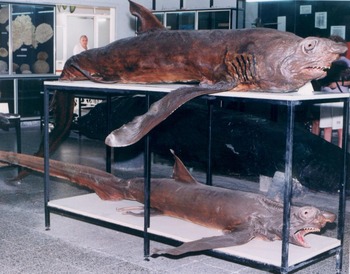
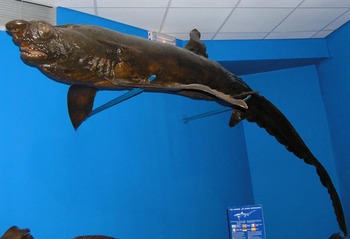
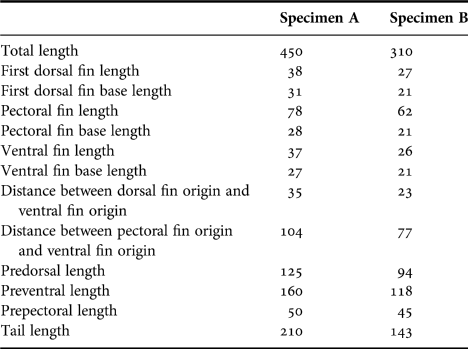
The two embalmed specimens of Alopias superciliosus are males of an approximate total length of 450 cm (Specimen A) and 310 cm (Specimen B) respectively (Table 1). The characteristic deep horizontal groove on each side of nape, the very large eyes with expanded orbit onto the head's dorsal surface and the position of the first dorsal fin base, closer to pelvic bases than to the pectoral, are easily distinguishable on the preserved specimens (Figures 1 & 2), according to the species identification keys of Compagno (Reference Compagno1984), Quéro (Reference Quéro and Whitehead1984) and Bauchot (Reference Bauchot and Fischer1987) (see also Tortonese, Reference Tortonese1937–1938). In Specimen A, 16 rows of teeth in the upper jaw and 19 in the lower are visible, while in Specimen B they are 24 and 22 respectively. After examination of the HSR documentation, the only captures of Alopias specimens reported in the archives are back in the 1950s: one specimen was caught in the area of Leros Island on 6 August 1952 and another three in the area of Archangelos, eastern coast of Rhodes Island, on 7 July 1954. In the past, the two sharks were erroneously identified as Alopias vulpinus (Alopias vulpes), commonly named ‘alòpekes’ (αλώπɛκες) and exhibited as ‘sharks’ (καρχαρίɛς). No data on fishing method, depth of capture or description of fresh specimens are available, but the two specimens were already exhibited in the small HSR museum during the 1950s (Figure 3A, B). Consequently, the specimens conserved today are two of the above mentioned samples, captured more than fifty years ago in the Dodecanese waters.
Two preserved males of Alopias superciliosus (Specimen A above, Specimen B below) at the Hydrobiological Station of Rhodes collection. (Photograph: HSR archive, 1992.)

The largest Alopias superciliosus (Specimen A) in the collection today of the Hydrobiological Station of Rhodes. (Photograph: A. Sioulas.)

Alopias superciliosus at the Hydrobiological Station of Rhodes collection during the 1950s. (Photographs: A. Pachos.)

Approximate morphometric measurements (cm) of the two embalmed Alopias superciliosus male specimens from the south-eastern Aegean Sea.

CONCLUSIONS
As mentioned above, the two old embalmed specimens of the bigeye thresher described here from the Dodecanese waters were misidentified as Alopias vulpinus for a long time. The related old archive and photographic documentation testify that A. superciliosus has occurred in the south-eastern Aegean Sea since the 1950s, taking the first record of its occurrence in the whole Mediterranean Sea back by about thirty years, according to the updated records listed in Clo' et al. (Reference Clo', Bonfil and De Sabata2008).
The species Alopias superciliosus has been listed among the non-indigenous questionable fish in the Mediterranean, due to insufficient data and uncertain origin (Zenetos et al., Reference Zenetos, Çinar, Pancucci-Papdopoulou, Harmelin, Furnari, Andaloro, Bellou, Streftaris and Zibrowius2005) and a probable introduction via the Gibraltar Strait requires verification (Zenetos et al., Reference Zenetos, Meriç, Verlaque, Galli, Boudouresque, Giangrande, Çinar and Bilecenoğlu2008).
Previous reviews of available data and recent captures in the central and eastern Mediterranean Sea (Kabasakal & Karhan, Reference Kabasakal and Karhan2007; Clo' et al., Reference Clo', Bonfil and De Sabata2008), combined with the present note, may add further support to the statement that the bigeye thresher shark is probably an uncommon or rarely captured and reported inhabitant of the Mediterranean, as assessed by Cavanagh & Gibson (Reference Cavanagh and Gibson2007).