INTRODUCTION
Cereal yields in the rain-fed semi-arid tropical agro-ecosystems of sub-Saharan Africa are low, typically less than 1 tha−1, mainly due to poor crop management rather than low physical potential (Stockholm International Water Institute (SIWI), 2001). Among the sub-optimal farmer practices in the region is nutrient management (Giller et al., Reference Giller, Rowe, de Ridder and van Keulen2006). Fertiliser use in sub-Saharan African agriculture is the lowest in the world (Rockström, Reference Rockström2000) with many countries in southern Africa using less than 8.5 kg ha−1 (Twomlow et al., Reference Twomlow, Steyn, du Preez, Pearson, Unger and Payne2006a). Surveys carried out by Rusike et al. (Reference Rusike, Dimes and Twomlow2003) in semi-arid southern Zimbabwe indicated that less than 5% of farmers commonly used fertilisers at recommended rates. The main reason cited by farmers for low use of fertilisers in semi-arid areas is the high risk of crop failure as a result of droughts and dry spells. As fertiliser is the most costly cash input used by tropical smallholder farmers in southern Africa (Twomlow et al., Reference Twomlow, Rohrbach, Rusike, Mupangwa, Dimes and Ncube2006b), with fertilisers in Africa costing six times as much as those in Europe, North America or Asia (Sanchez, Reference Sanchez2002), most farmers in dry areas are unable to invest in fertilisers.
The result of the low use of fertiliser is depletion of soil fertility that along with the concomitant problems of weeds, pests and diseases is believed to be the major biophysical cause of low per capita food production in Africa (Sanchez, Reference Sanchez2002). To reverse the trend of nutrient depletion, there is a need to develop fertiliser-use technologies tailored to smallholders’ climatic and socioeconomic conditions. One such strategy is the micro-dosing technology that is being promoted by the International Crops Research Institute for the Semi-Arid Tropics (ICRISAT) in low potential areas of the Sahel (Tabo et al., Reference Tabo, Bationo, Gerard, Ndjeunga, Marchal, Amadou, Annou, Sogodogo, Taonda, Hassane, Maimouna, Diallo, Koala, Bationo, Waswa, Kihara and Kimetu2007) and southern Africa (Twomlow et al., Reference Twomlow, Rohrbach, Dimes, Rusike, Mupangwa, Ncube, Hove, Moyo, Mashingaidze and Maphosa2010). According to Carberry et al. (Reference Carberry, Gladwin, Twomlow, Delve and Probert2004), farmers in environments of low and erratic rainfall are better off applying lower rates of Nitrogen (N) fertiliser on more fields than concentrating a limited supply on one field at the current fertiliser recommendation rates. The micro-dosing rate currently promoted in semi-arid Zimbabwe is 17 kg N ha−1, which is about 34% of the recommended rate of 50 kg N ha−1 for these areas. Results from a scaling out program of micro-dosing on farmers’ fields in Zimbabwe showed that smallholder farmers increased their yields from as little as 750 kg ha−1 to more than 1400 kg ha−1 by applying as little as 10 kg N ha−1 (Twomlow et al., Reference Twomlow, Rohrbach, Dimes, Rusike, Mupangwa, Ncube, Hove, Moyo, Mashingaidze and Maphosa2010). Thus, micro-dosing may be a useful strategy to familiarize farmers with N fertiliser use and increase cereal production.
Although application of N fertilisers often leads to crop yield increase, results from studies under smallholder conditions show that fertiliser-use efficiency is quite low. Mushayi et al. (Reference Mushayi, Waddington and Chiduza1998) report that on farmer-managed fields 3.6 kg maize (Zea mays L.) grain kg−1 applied N was produced compared with 12.4 kg maize grain kg−1 applied N on researcher-managed plots. The low Agronomic Nitrogen Use Efficiency (ANUE) on smallholder farms can be attributed to poor management of N resources due to lack of information on fertiliser use and sub-optimal crop management practices. Poor timing of field operations, management of pests and diseases as well as other nutrient deficiencies contribute to low ANUE on farmer's fields (Mushayi et al., Reference Mushayi, Waddington and Chiduza1998). Furthermore, soils in the smallholder farming sector of Zimbabwe are predominantly sandy, and a number of studies suggest that leaching of N fertilisers is a serious risk, especially when applied at recommended rates (Chikowo et al., Reference Chikowo, Mapfumo, Nyamugafata and Giller2003; Nyamangara, Reference Nyamangara, Bationo, Waswa, Kihara and Kimetu2007; Nyamangara et al., Reference Nyamangara, Bergström, Piha and Giller2003).
Thus, the micro-dosing recommendation of spot application of N fertiliser to a well-managed cereal plant between 4 and 6 weeks after crop emergence (WACE) does make application of N fertiliser more economical for the farmers (Twomlow et al., Reference Twomlow, Rohrbach, Dimes, Rusike, Mupangwa, Ncube, Hove, Moyo, Mashingaidze and Maphosa2010) and is likely to improve ANUE. In environments where water is limiting, improved management practices, such as fertiliser application and conservation tillage, often result in ‘more crop per drop of rainwater’ leading to high rainwater productivity and crop yields (Rockström et al., Reference Rockström, Barron, Fox, Kijne, Barker and Molden2003). According to Rockström et al. (Reference Rockström, Kaumbutho, Mwalley, Nzabi, Temesgen, Mawenya, Barron, Mutua and Damgaard-Larsen2008) and Steiner and Rockström (Reference Steiner and Rockström2003), maximum crop yields in drought prone areas can only be obtained by combining soil fertility management with water harvesting techniques. Conservation tillage practices (e.g. planting basin) that include precision application of both basal and top dress fertilisers are currently being promoted in smallholder agriculture by a number of development and agriculture research organizations in Zimbabwe (Twomlow et al., Reference Twomlow, Hove, Mupangwa, Masikati, Mashingaidze, Humphreys and Bayot2009).
However, since the majority of smallholder households are labour-constrained (Steiner and Twomlow, Reference Steiner and Twomlow2003), the benefits of micro-dosing are unlikely to be realized to a large extent. This is because the current micro-dosing practice has been reported by practitioners to be very time-consuming and laborious (ICRISAT Unpublished Field Visit Reports). Farmers in Zimbabwe are currently using the commonly available Crowne bottle caps to apply N fertiliser micro-dose at a rate of one Crowne bottle cap shared between three maize plants. This equates to 12,400 caps ha−1 for a maize crop planted at a spacing of 30 × 90 cm (Twomlow et al., Reference Twomlow, Rohrbach, Dimes, Rusike, Mupangwa, Ncube, Hove, Moyo, Mashingaidze and Maphosa2010). However, labour bottlenecks develop at the recommended time of N application as farmers have other tasks such as planting of late crops and weeding early planted crops (Makanganise et al., Reference Makanganise, Mabasa, Jasi and Gatsi2001). Consequently weeding and/or application of N fertiliser are delayed leading to decreased crop productivity. One solution devised for this problem by ICRISAT in collaboration with Agri-Seeds Service, Zimbabwe was to formulate an N fertiliser tablet that was the equivalent of prill AN contained in one-third of a Crowne bottle cap. In the production process, a pharmaceutical binding agent was used to improve the handling characteristics of the tablet. The perceived advantage of using a tablet over the bottle cap is that less time is spent dividing cap into three portions, it is easier to spot place and could eventually be mechanized. However, for these N tablets to be useful to farmers, these should be at least as productive as the prill N fertiliser, easy to handle and resistant to damage during transportation.
The objectives of this study were to determine some of the physical and chemical properties of the tableted N compared with the prill formulation; and to quantify agronomic response of maize grown under two tillage practices (conventional and basins) in farmer-managed trials to micro-dosing with two AN formulations. No attempt was made to assess labour issues associated with micro-dosing, as access to the farmers during the cropping season was restricted due to political disturbances.
MATERIALS AND METHOD
Physical and chemical properties of ammonium nitrate tablets
Physical stability
A simple integrity test of the tablets was carried out to mimic transport from factory to retailer and finally to the farmer. Bags containing 50 tablets were dropped 10 times from height of 1 m and 2 m, and the numbers of broken tablets were counted.
Percentage N
Since tablets use a binding agent, it was expected that the total N content would be lower than the equivalent weight of pure prilled AN. Therefore, both AN forms were also analysed (n = 5) for total N content using distillation and titration (Kjeldahl method) (Association of Official Analytical Chemists (AOAC), 1990).
Solubility
Since the tablets use a pharmaceutical binding agent, it was hypothesized that the rate at which AN will dissolve could be different from the prilled form. This dissolution time could affect the release of N from the tablets to the root zone of the crop, and even reduce potential leaching. In the laboratory, solubility of the two formulations of AN fertiliser was tested in distilled water. The test in distilled water used Erlenmeyer flasks filled with 50 mL water. An equal amount (mass) of each AN type was left in the flask, and the time taken to dissolve was recorded (n = 5). In the field, prilled and tablet forms of AN were either surface-applied (n = 5) or incorporated into soil to a depth of about 1 cm (n = 5). Soil was either slightly moist (dry soil) from previous rains or thoroughly wetted to simulate significant rain shower (20 mm equivalent, wet soil). The time taken for complete dissolution of tablets and prill was determined visually and recorded.
Simple leaching tests
In order to check if the tablet formulation had the potential to reduce the quantity of N leached compared with prill, a series of simple laboratory-based leaching tests were undertaken for a range of antecedent soil conditions in response to different rainfall events. For these tests a nutrient-poor coarse grained sandy soil from ICRISAT's Lucydale site in southern Zimbabwe (see Ncube et al., Reference Ncube, Twomlow, van Wijk, Dimes and Giller2007 for a description of this soil) was air-dried and sieved through a 2-mm sieve, prior to being packed into plastic columns (0.2-m diameter × 0.2-m height) to a bulk density of 1.5 t m−3. Muslin cloth was stretched across the base of each column, and the column was then placed on a 0.2-m diameter filter funnel packed with glass wool. A beaker was placed at the base of the filter funnel to collect drainage water.
At the start of each experimental run, the columns were wetted up from the base until free water appeared on the soil surface, and then allowed to drain freely. Once drainage water had ceased flowing from the base of the column, the fertiliser treatments were applied. The treatments were as follows: fertilisation (zero fertilisation – control, 1.4-g prilled fertiliser, a single fertiliser tablet); size of simulated rainfall event (10, 20, 30, 40 and 50 mm); antecedent soil conditions (number of days simulated rainfall occurred after application of fertiliser – 0, 1, 2, 4 and 8 days). The simulated rainfall events size and days between rainfall events were determined from rainfall analyses undertaken by Mupangwa (Reference Mupangwa2009) for Matopos Research Station. Each treatment combination was replicated thrice (n = 3).
Once the experimental event commenced, the total volume of leachate was recorded for each column and its NO3–N was determined using Anderson and Ingram's (Reference Anderson and Ingram1993) colorimetric method, and the total milligram of NO3–N was calculated for each treatment combination. Once all the treatment combinations had been completed, the background NO3–N leached from the control columns was subtracted from the quantities of NO3–N leached from the fertilised columns and analyses of variance were undertaken.
Agronomic trials
Study site
On-farm trials were conducted in Masvingo (19°64'S, 310°49'E) and Chivi (19°93'S, 310°09'E) districts of Masvingo Province, Zimbabwe. Zimbabwe is divided into five agro-ecological regions, also known as Natural Regions I–V. Natural Regions I and II receive the highest rainfall (at least 750 mm per annum) and are suitable for intensive farming. Natural Region III receives moderate rainfall (650–800 mm per annum) and Natural Regions IV and V have fairly low annual rainfall (450–650 mm per annum) and are suitable for extensive farming (adapted from Vincent and Thomas, Reference Vincent and Thomas1960).
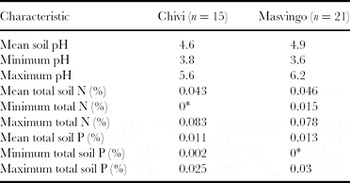
The communal areas of Masvingo district are mainly under Natural Region IV, although the area around Great Zimbabwe and Lake Mutirikwi receives heavy but irregular rainfall and comprises 7% of the district that is classified as Natural region III (Balarin, Reference Balarin1982). Trials in this study were sited in both Natural Regions III and IV. The rainfall season in Masvingo Province is unimodal, starting from October and ending in March (Hagmann, Reference Hagmann, Twomlow, Ellis-Jones, Hagmann and Loos1995). The 45-year (1953–1998) average rainfall for Masvingo district is 582 mm with a range of 143 to 1037 (Mugabe et al., Reference Mugabe, Hodnett, Senzanje and Gonah2004). Chivi, classified as Natural Region V, is one of the driest districts in Masvingo Province. The crop-growing season is characterized by low and highly inconsistent rainfall with an average rainfall of 544 mm for the period of 1914–1988 with a range of 143–1123 mm (Mugabe et al., Reference Mugabe, Hodnett, Senzanje and Gonah2004). Soils in both Masvingo and Chivi districts are fersiallitic types (Nyamapfene, Reference Nyamapfene1991), predominantly sandy loam in Masvingo and sandy in Chivi. The soils are of inherently low fertility (Table 1). Despite low rainfall and marginal soils, the smallholder farmers in the districts practice rain-fed crop production. The major crops grown are maize, sorghum, (Sorghum bicolor (L.) Moench), pearl millet (Pennisetum glaucum (L.) R.Br.) and groundnut (Arachis hypogaea L.) mainly for home consumption (Mugabe et al., Reference Mugabe, Hodnett and Senzanje2003). Similar to smallholder cropping practices described by Ncube et al. (Reference Ncube, Twomlow, Dimes, van Wijk and Giller2009) in Tsholotsho district some 200 km to the west.
Summary of soil analysis results for the top 0.15 m from Nitrogen tablet micro-dosing trial plots collected from Chivi and Masvingo districts of Masvingo Province, Zimbabwe in 2006.

*Outside detection limit of the spectrophotometer available.
Farmer selection and experimental layout
In each district a meeting was held between various farmer groups participating in the Protracted Relief Programme and the Non-Governmental Organizations (NGOs), CARE and The Zishivane Water Project. Objectives of the experiment were explained to farmers and volunteers were invited in these meetings. Given logistical limitations and availability of tablets, the number of farmers in each district who could host a trial was limited to 20. Consequently, in each meeting, once a list of volunteers had been obtained, a random sub-sample of 20 was selected with the help of communities.
The trials were superimposed on the paired plot design used to promote micro-dosing and conservation agriculture (CA) under the Protracted Relief Program in Zimbabwe (Twomlow et al., Reference Twomlow, Rohrbach, Rusike, Mupangwa, Dimes and Ncube2006b). Each farmer had two main tillage (conventional farmer tillage and planting basin) plots whose sizes were between 10 × 50 m and 20 × 50 m located adjacent to each other on the same field. Each main tillage plot was divided into three equal sub-plots for N fertiliser application. One of the sub-plots in each tillage plot received no AN fertiliser and will be served as a control plot. The remaining sub-plots received either the prilled or tableted AN formulations. To avoid confusion by host farmers, the AN fertiliser top dressing rate of 28 kg N ha−1 recommended by the Zimbabwean Conservation Task Force (Twomlow et al., Reference Twomlow, Urolov, Oldrieve and Jenrich2008) for the planting basins was used on the conventionally tilled plots rather than the micro-dosing rate of 17 kg N ha−1, which is promoted by Twomlow et al. (Reference Twomlow, Rohrbach, Dimes, Rusike, Mupangwa, Ncube, Hove, Moyo, Mashingaidze and Maphosa2010).
In the conventional farmer tillage practice an ox-drawn mouldboard plough was used to till land when the host farmed had considered enough rainfall had fallen to wet the soil. The management of basal fertiliser (manure and Compound D) was decided by the individual farmer as no basal fertiliser was distributed under relief programs. In the case where manure was applied, it was collected from cattle kraal and heaped in field during the dry season (from August). The manure was spread across the field and incorporated at ploughing. Compound D (7:14:7 NPK) was applied at planting as per agricultural extension (AGRITEX) recommendations if applied. Maize (SC 403) seeds were dribbled behind the plough in every third furrow and covered with the next pass of the plough. Inter-row distance was approximately 90 cm with planting stations 30 cm apart. Timings of AN (34.5% N) application were determined by the farmer, but were typically between 4 and 6 WACE. Farmers spot applied half a Crowne bottle cap of prill AN per plant to give an application rate of 28 kg N ha−1. For the AN tablet formulation, one and a half tablets were applied per maize plant to give an application rate that was equivalent to that applied in prill AN. Farmers placed one tablet per maize plant with another tablet placed halfway between two plants in the same row. Weeding was as per farmer practice. Crop was harvested at physiological maturity and grain dried to 12.5% moisture content. This plot will hereafter be referred to as the flat tillage plot.
Management of the adjacent plot with planting basins followed recommendations of the Zimbabwe Conservation Agriculture Taskforce (Twomlow et al., Reference Twomlow, Urolov, Oldrieve and Jenrich2008). Land preparation was done in the dry season after removal of any weeds from the field. Hoes were used to dig a permanent grid of planting basins at a spacing of 90 × 60 cm having basin dimensions of 15 × 15 × 15 cm. Cattle kraal manure was applied after basin preparation at a rate of a handful of manure per basin. A typical adult handful of manure weighs about 0.09 kg, thus approximately 2 ton of manure was spot applied into planting basins. If the host farmers had Compound D available, they were free to apply capful of it per basin in the dry season and covered with a layer of soil. Three maize seeds were planted per basin and thinned to two plants at two weeks after crop emergence to achieve population of 37,037 plants ha−1. Planting took place after the basins had been filled with rainwater and subsequently drained. Farmers applied AN fertiliser between 4 and 6 WACE. On the first sub-plot a Crowne Agent bottle cap of prill AN was applied to each planting basin. On the second sub-plot, each planting basin received three AN tablets, while the third sub-plot received no AN fertiliser. Weed and field management was decided by the farmers. Under the conservation agriculture guidelines for Zimbabwe (Twomlow et al., Reference Twomlow, Urolov, Oldrieve and Jenrich2008), fields were supposed to be kept weed-free. Crop was harvested at physiological maturity and grain-dried to 12.5% moisture content. This plot will hereafter be referred to as the basin tillage plot.
Data analysis
Each farmer received a standard catch rainfall gauge and record book in which daily rainfall and all operations undertaken on each plot were recorded. Harvesting was carried out in each gross sub-plot that varied between 160 m2 and 320 m2 depending on the size of the field that the farmers had chosen to establish the trial. After shelling, maize grain yield per sub-plot was measured and recorded. In 2006 at harvesting, six soil samples were collected from the inter-row area of each tillage main plot using an auger to a depth of 0.15 m. Since the plots were located side by side, the samples from each tillage plot were mixed to form one composite sample, which was analysed for pH, total N and phosphorus (P).
As there were differences in basal fertilisation management between the flat and basin tillage practices, the data from the tillage plots were analysed separately and no direct comparisons of the flat and basin tillage were performed.
ANUE and rainwater productivity (WPrain) were calculated as follows:
ANUE = (Grain yield with applied nutrients (kg ha−1)) – Grain yield for control (kg ha−1))/N applied (kg ha−1);
WPrain (kg ha−1 mm−1) = Grain yield (kg ha−1)/Seasonal rainfall (mm).
The data were analysed using GenStat Release 9.1 (Lawes Agricultural Trust, 2007) and a General ANOVA model was used to generate treatment means. The treatment and interaction standard error of deviation (s.e.d.) were used to separate treatment means at the 5% level of significance.
RESULTS AND DISCUSSION
Physical and chemical properties of AN tablets versus prill
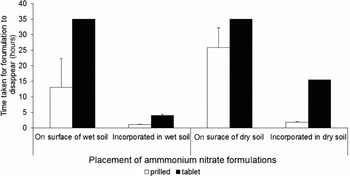
Drop tests showed a tablet breakage of 3.6% when dropped from a height of 1 m and 7% when dropped from 2 m. This suggests that the tablet formulation can maintain its integrity even under fairly rough handling. This is important for communal farmers, as fertilisers are not often available in local retail shops and farmers have to travel to nearest towns by buses and open trucks to purchase fertilisers. The tableted AN formulation has about 1.3% less N than the prill form (Table 2) by weight due to pharmaceutical binding agent. So, in effect both AN formulations contain about 17 kg of N per 50 kg of AN. However, preliminary tests showed that the solubility of the tableted AN differs from that of prill AN when placed in water and on or in the soil (Table 2 and Figure 1). Prill AN dissolves four times faster than tableted AN when placed in water and the same trend is observed when prill AN is either placed on or incorporated in the soil. Incorporation of fertiliser in soil and application on moist soil increases the rate of dissolution of both prill and tableted AN (Figure 1).
Mean nitrogen percentage and dissolution time in distilled water of prill and tablet AN formulations used in the study (N = 5).

The effect of soil moisture and placement of fertiliser on the average time taken for AN tablet versus the prill formulation to visible disappear under different field conditions. (N = 5). Bars represent standard error.

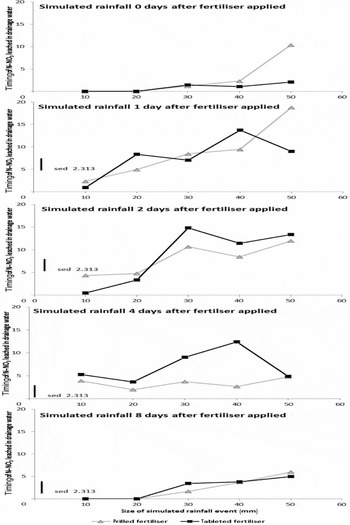
These differences in dissolution rate influenced leaching patterns observed for the two fertiliser formulations as shown in Figure 2, with total rainfall amount and antecedent soil conditions having a major influence on the amount of NO3–N leached from different treatments. When antecedent soil conditions were wet (Figure 2 – rainfall 0 days and 1 day after fertiliser application), the two fertiliser formulations behaved in a similar manner until the 50-mm simulated rainfall event when significantly (p = 0.042) more N–NO3 was leached from the soil columns treated with the prilled fertiliser. For 0 days after application of fertiliser, 10.3 mg of N–NO3 was leached from the prilled AN columns compared with only 2 mg from the tableted AN columns – a five-fold difference. For 1 day after planting, 18.8 mg of N–NO3 was leached from the prilled AN columns compared with only 9 mg from the tableted AN columns – a two-fold difference. These results suggest that as the size of storm increases within the first 24 h of fertiliser application, the reduced solubility of the tableted AN (Table 2, Figure 1) reduces considerably the rate of leaching. In real terms though, the 18.8 mg of N–NO3 leached following the 50-mm simulated rainfall event from the prilled AN columns (Figure 2, rainfall 1 day after application of fertiliser) is less than 2% of the total quantity of prilled AN applied and may be considered negligible. It was only when rainfall was applied four days after the fertiliser was added to the columns (Figure 2, rainfall four days after application of fertiliser) that more N–NO3 was lost from the tableted AN columns, but not significantly so. This may be due to the fact that the prilled AN had dissolved into the soil and had been absorbed into the soil matrix. By the time eight days had elapsed (Figure 2, rainfall eight days after application of fertiliser), the leaching patterns for the two formulations were not different, with losses increasing with increasing rainfall – although negligible in real terms. These results, although laboratory-based, do challenge the commonly held belief that the yellowing observed in many cereal crops following heavy rainfall events are due to leaching.
Average quantities of N–NO3 (mg) leached from columns (0.2 × 0.2 m) of sandy soil treated with either prilled AN or tableted AN following five different simulated rainfall events (10, 20, 30, 40 and 50 mm) occurring 0, 1, 2, 4 and 8 days after the application of the fertiliser (N = 3). (p = 0.042 for the three-way interaction with an s.e.d. of 2.313).

The behaviour patterns observed for both prilled and tableted AN (Figures 1 and 2) appear to qualify the current extension recommendations of only surface applying N fertilisers after rainfall so as to save time spent on applying and incorporating fertilisers during a period of peak labour demand.
On-farm trials
Rainfall
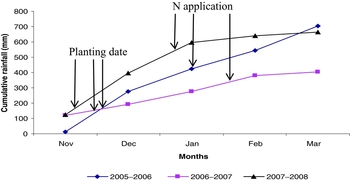
Rainfall varied in distribution and amount in the three years of the study (Figure 3). The rainfall season started late in 2005–2006 with November receiving the lowest rains. The total rainfall of 703 mm was above the yearly average for the two districts, which ranged from 550 to 600 mm. The highest rainfall was received in December with the rains more or less uniformly distributed across last three months. Although the 2006–2007 rainy season started early, it received the lowest rainfall of the three seasons in this study with a total of 403 mm (Figure 3). This season was declared a drought year due to severe dry spells and low rainfall (Food and Agriculture Organization (FAO), 2007). The third cropping season was characterized by high rainfall between November and December (Figure 3). However, the following months had low rainfall resulting in poor distribution of 665 mm of rain received in this season. These differences in rainfall distribution among the seasons affected timing of field operations such as planting of maize and application of AN (Figure 3). Planting was done early when November received high rainfall as was the case in the 2007–2008 season. In all seasons, planting of maize in planting basins was carried about a week earlier than in flat plots. Application of AN followed the same trend as in planting (Figure 3).
Timing of planting and nitrogen fertilisation averaged across trial sites in Masvingo, for the three seasons of the study (2005–2008) in relation to average cumulative monthly rainfall distribution between November and March.

Resource use and productivity
Basal fertiliser management
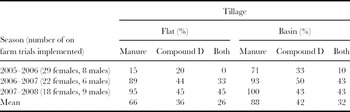
In the first year of the study, less than 20% of farmers applied a basal fertiliser on the flat plots and none of these combined manure and compound D (Table 3). According to Kamanga et al. (Reference Kamanga, Shamudzarira and Waddington2001), farmers in semi-arid areas base their decision to apply fertiliser on moisture status and their forecasts of the growing season. The 2005–2006 cropping season was characterized by low rainfall in November and early part of December (Figure 3) such that it is likely that farmers decided not to apply any fertiliser as a way of avoiding risk of losing fertiliser in the event of crop failure. In contrast, 71% of farmers applied manure in basins and 33% used inorganic basal fertiliser with about 10% of these farmers following the conservation agriculture recommendation of combining two basal fertilisers. The following seasons received high rainfall in November (Figure 3) and to take advantage of this, the number of farmers applying basal fertiliser in both tillage practices increased (Table 3). As farmers gained experience in use of fertiliser, more farmers were willing to apply both manure and compound D and were observed using some of the basin nutrient management practices on their ploughed fields.
Percentage of farmers that applied manure and/or Compound D fertiliser on farmer tillage practice and planting basin N tablet trials in Masvingo over the three seasons of the study.

Grain yield
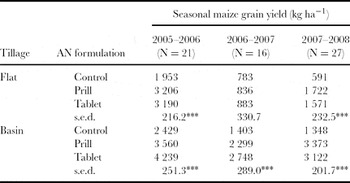
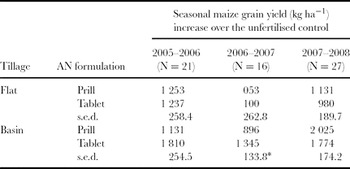
The application of 28 kg N ha−1 of either prill or tablet AN significantly (p < 0.001) increased maize grain yield by above 40% in all three seasons in basin tillage and in the 2005–2006 and 2007–2008 cropping seasons on the flat plot (Table 4). This is in agreement with the results obtained by Twomlow et al. (Reference Twomlow, Rohrbach, Dimes, Rusike, Mupangwa, Ncube, Hove, Moyo, Mashingaidze and Maphosa2010) from wide-scale testing of application of low amounts of N fertiliser (17 kg N ha−1) on farmers’ fields in dry areas of Zimbabwe. Cereal yield averaged for a broad spectrum of soil, farmer management and seasonal climate conditions increased from 1054 kg ha−1 for unfertilised controls to more than 1494 kg ha−1 for micro-dosed plots. Poor soil fertility is one of the main constraints to crop production in smallholder agriculture in southern Africa (Twomlow et al., Reference Twomlow, Steyn, du Preez, Pearson, Unger and Payne2006a). The soils in both Chivi and Masvingo are inherently poor in N (Table 1), and hence maize responded strongly to the addition of AN fertiliser resulting in high maize yields. The lack of significant response to micro-dosing on the flat plot during the 2006–2007 season was due to poor rainfall distribution (Figure 3), which resulted in low fertiliser use efficiency. Planting basins with their initial water harvesting properties and higher infiltration rates throughout the cropping season, as observed by Mupangwa (Reference Mupangwa2009) for a range of soil, probably improved N use efficiency resulting in the differences observed between control and micro-dosing treatments. However, it is not possible to make valid statistical comparisons between the flat plots and the planting basins because of preferential application of basal fertiliser that farmer chose to make on the basin plots in years 2 and 3 of the study (Table 3). The importance of additions of small quantities of N is underlined when the additional maize grain yield obtained by a household is calculated (Table 5). When it is considered that an adult consumes 150 kg of cereal per year (Ncube et al., Reference Ncube, Twomlow, Dimes, van Wijk and Giller2009), then micro-dosing in combination with basins resulted in increased household food security, as even in the driest year of the study at least 900 kg of additional maize grain was obtained (Table 5). This is in contrast to the flat plots that showed no significant yield increase to micro-dosing in the 2006–2007 dry season, possibly due to later planting dates and lack of basal soil fertility amendments.
The effect of applying small doses of prill and tablet AN (28 kg N ha−1) formulations on average maize grain yield (kg ha−1) in the flat and basin tillage systems compared with unfertilized controls in Masvingo over the three cropping seasons from 2005 to 2008 (N = number of on-farm trials successfully implemented and harvested each season).

Means in columns are significantly different at ***p < 0.001.
Additional maize grain yield (kg ha−1) obtained from applying small doses of prill and tablet AN (28 kg N ha−1) formulations from flat and basin tillage systems compared with unfertilised controls in Masvingo over the three cropping seasons from 2005 to 2008 (N = number of on-farm trials successfully implemented and harvested each season).

Means in columns are significantly different at *p < 0.05.
In flat plots, there was no significant difference in maize yield between the two AN formulations in all seasons (Table 4). However, maize grown in planting basins that received tablet AN significantly (p < 0.001) out yielded prill AN by 19% in the 2005–2006 season. The reason for this difference is, however, not clear. Based on the results of this study, if the cost of purchasing the two AN formulations is similar, then tablets may be the less time-consuming and more precise option for applying small quantities of AN fertiliser by smallholder farmers in both flat and basin tillage practices. However, further work is required to assess savings in labour that might be attributed to the use of tablets.
Agronomic nitrogen use efficiency (ANUE)
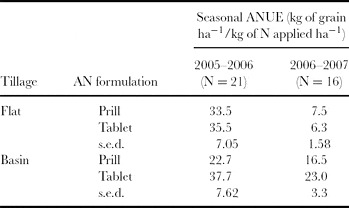
In the flat practice ANUE did not differ significantly between the two AN formulations during the 2005–2006 and 2006–2007 cropping seasons (Table 6). Agronomic N use efficiency was not calculated for the third season as farmers did not consistently collect data on soil fertility amendments due to the on-going national elections. In the first season ANUE was above 30 kg maize grain N kg applied ha−1. Kamanga et al. (Reference Kamanga, Shamudzarira and Waddington2001) measured ANUE values of up to 80 kg maize grain N kg applied ha−1 when below 20 kg N ha−1 was applied on sandy loams in Masvingo district in the 2000–2001 season. According to Mushayi et al. (Reference Mushayi, Waddington and Chiduza1998), low ANUE values on farmers’ fields were strongly related to other limiting nutrients such as P. Results from soil analysis show that some of the fields had low total soil P (Table 1), which may require application of potash. The low ANUE (below 10 kg maize grain N kg applied ha−1) obtained in 2006–2007 is probably due to low and erratic rains received during this season (Figure 3). Since N-use efficiency is usually a function of time of application (Kamanga et al., Reference Kamanga, Shamudzarira and Waddington2001), the delay in AN application in 2006–2007 (Figure 3) and low soil moisture probably resulted in low N uptake and utilization by the maize crop. The same trends as outlined above were observed in the planting basin (Table 6). However, the ANUE values in planting basins were generally higher than those observed in the flat, thereby pointing to improved N efficiency in this conservation tillage practice.
The effect of applying small doses of prill and tablet AN (28 kg N ha−1) formulations on ANUE (kg of grain ha−1/kg of N applied ha−1) in the flat and basin tillage systems in Masvingo over the two cropping seasons from 2005 to 2007 (N = number of on-farm trials successfully implemented and harvested in each season).

Rainwater productivity
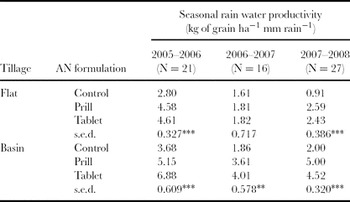
On the flat, applying small quantities of AN fertiliser significantly (p < 0.001) increased rainwater productivity in the first and last seasons of the study (Table 7). The same trend was observed in the drier 2006–2007 cropping season. There were no significant differences between prill and tablet AN formulations (Table 7). The values for rainwater productivity in this study are close to the range of 1.5–4 kg ha−1 mm−1 reported by Steiner and Rockström (Reference Steiner and Rockström2003) in ploughed fields in Tanzania. Addition of N fertiliser improves the efficiency of water use through increased development of leaf area and root system, which allows the crop to extract more water from sub-soil. In the planting basins, significantly ‘more crop per drop of water’ was obtained in all three seasons when 28 kg N ha−1 was applied in combination with the preferential application of available basal soil fertility amendments (Table 7). In all seasons, rainwater productivity values were above 3 kg ha−1 mm−1 where fertiliser was applied, including 2006–2007, which had low and erratic rainfall (Figure 3). These results suggest that managing soil fertility and water simultaneously leads to improved resource productivity and high yields. According to Rockström et al. (Reference Rockström, Barron, Fox, Kijne, Barker and Molden2003) results from field data in Kenya showed that the full benefits of water harvesting could be met through addressing soil fertility management. Thus, conservation agriculture techniques, such as planting basins, are one method of improving maize productivity in semi-arid smallholder agriculture.
Response of rain water productivity (WPrain) (kg of grain ha−1 mm of rain−1) to applying small doses of prill and tablet AN (28 kg N ha−1) formulations in the flat and basin tillage systems in Masvingo over the three cropping seasons from 2005 to 2008 compared with unfertilized controls (N = number of on-farm trials successfully implemented and harvested in each season).

Means in columns are significantly different at **p < 0.01 and ***p < 0.001.
As was observed with yield data in basins in the 2005–2006 season (Table 4), the tablet AN formulation was associated with a significantly (p < 0.001) higher rainwater productivity than prill AN (Table 7). Therefore, in this season maize plants grown under planting basins and receiving AN tablets were more effective at using the available soil water than plants that received prill AN and this translated to statistically higher maize grain yield. This trend was, however, not apparent in the subsequent seasons when the same dose of tablets was applied to the same basin.
CONCLUSION
AN tablets are a viable alternative to prill AN as a means of increasing cereal productivity in semi-arid area using the micro-dosing technology. Results from this study show that the tablets can maintain their integrity despite rough handling. However, some form of vibration tests maybe more indicative of the impacts of potential transport along rural roads. The N content in AN tablets (33.3 %) was comparable to that in prill AN (34.6%). However, the tablet formulation took twice as long to dissolve as prill AN when placed on a wet soil. Despite this difference in solubility, simple breakage through tests using leaching columns filled with a coarse granitic sandy soil, typical of the smallholder sector in Zimbabwe, suggest that less than 2% of the total AN applied was lost due to leaching in these nutrient-depleted soils after a 50 mm simulated rainfall event. Whether this laboratory observation can be directly translated to the field is open to questions, but the results do suggest that field studies are required to explore this behaviour further. Although less soluble than prill AN, there was no significant difference in grain yield between the two AN formulations as both significantly increased maize grain yield over the control. In fact in the first season, the tableted AN had significantly (p < 0.001) higher rainwater productivity and grain yield than prill AN. In addition, yield benefits to micro-dosing can be maximized by combining it with better water management techniques such as planting basins, as the host farmers chose to do in the second and third seasons. Hence, if AN tablets are available at a price comparable to prill AN, these can be a more precise method of micro-dosing cereal crops by smallholders.
Acknowledgements
The authors wish to thank farmers from Chivi and Masvingo districts for implementing the trials and the AREX staff and field staff of CARE International and Zvishavane Water Project for their invaluable contributions during the course of the research. The study was financed by a grant from the UK's Department for International Development and core funds from ICRISAT. The authors also wish to acknowledge the core support from Dr R. Kelly of Agri-Seeds Service, Zimbabwe who helped develop and produce AN tablets.