Asian Americans have received relatively little attention from political
scientists. Although a rapidly growing segment of the population, their
political behaviors, impacts on political institutions, and the policies
affecting them have been rarely studied in our discipline.1
In 2000, 3.6% of the U.S. population identified
themselves as belonging only to an Asian ethnic group, and 4.2%
identified themselves as Asian alone or Asian in combination with
one or more other racial groups (U.S. Bureau of Census 2002).
In recent years, the situation has been changing. The APSA Organized Section
on Race, Ethnicity, and Politics, founded in 1995, created an institutional
space devoted solely to the study of racial and ethnic minorities. The
establishment of the Asian Pacific American Caucus (APAC) in 2000 and the
APSA Committee on the Status of Asian Pacific Americans in the Profession in
2003 helped bring together political scientists and activists interested in
Asian Pacific American (hereafter APA)2
We
acknowledge that the term “Asian Pacific American” sometimes causes
controversies because it lumps together the two different groups of
Asian Americans and Pacific Islanders, often without full
understanding of the unique history of the latter. We use the term
just to refer to both Asian Americans and Pacific Islanders in fewer
words.
politics, and a recent
PS symposium
(September 2001) on APA politics is also a sign that political science
research on APAs is growing (Aoki and Nakanishi
2001).
In this article, we address the following questions: what research has
political science produced on APAs? To what extent has the research on APAs
spread among various subfields of political science? Has the amount of
research on APAs increased over the years, and if it has, with what factors
can we account for the trend? And, more generally, how much are political
science journals publishing research on racial and ethnic minorities in the
United States?
We investigate these questions by searching top political science journals
and APSA Annual Meeting programs from 1990 through 2003 and identifying
published articles and conference papers that dealt with APAs. The number of
journal articles tells us the extent to which studies on APAs are accepted
by the scholarly community; the number of conference papers gives an idea of
the volume of research on APAs that has not yet reached the level of journal
publication. Together, these data reveal the trend and status of research on
APAs.
Journal Article Selection Criteria
For the journal articles, we focus on the top 25 political science
journals in Garand and Giles's (2003)
rankings. From these 25, we excluded eight journals that are primarily
concerned with comparative politics and international relations or that
focused on narrow sub-fields.3
The
excluded journals are: World Politics, International
Organization, Comparative Politics, Comparative Political
Studies, International Studies Quarterly, International
Security, and Journal of Political Economy. In
our pilot study, we searched these journals and did not find any
APA articles.
Most of the remaining 17 were political
science journals, but we also had two from sociology, one from
economics, and two interdisciplinary journals. Seeking a greater
comparison between interdisciplinary and political science journals, we
added three interdisciplinary journals that ranked between 25 and
50—
Politics and Society (#33),
Annals of the American
Academy of Political and Social Science (#36), and
Urban
Affairs Research (#45)—giving us a total of 20 journals.
For these journals, we scanned all issues published from 1990 through
2003.4
For PS, we excluded
“The Teacher,” “The Profession,” and the “Association News”
sections, as well as letters to the editor and esymposia. For
the American Economic Review, we did not scan the March
issues, which contain only selected papers and proceedings of
the annual conference. For all journals, we did not scan
letters, regardless of how they were labeled (e.g., some
journals run letters under the heading “Comment”).
We
recorded the number of articles that dealt with APAs, as well as the
number of articles that dealt with African Americans, American Indians,
and Latinos.
5 An article was coded “APA”
if it includes an APA keyword in its title, or if its abstract
identified APAs as a primary focus. In cases where the abstract
was unclear, we reviewed the entire article, and coded the
article as “APA” if APAs were the primary subject of at least
one full paragraph, or if APAs were discussed in the text and
listed separately in at least two figures (tables, graphs,
etc.). We used a broad definition of “APA article,” including
some articles that others might not consider to be focused on
APAs. Given that, our numbers should be seen as a liberal
measure of the number of articles on APAs.
To examine trends beyond what is ascertainable from published articles,
we turned to APSA meeting programs. We read final programs of the APSA
meetings from 1990 through 2003 and identified papers that dealt with
Asian Americans.6
We did not use
preliminary programs in the June issue of PS because
many additions and changes are made in the final programs. We
thank Jennifer Richards and Lauren Chelf of APSA, Larry Bartels,
and Ichiro Sunada for giving us access to old final
programs.
We judged a paper as dealing with Asian
Americans if the title included the term “Asian American(s),” a specific
Asian American ethnic group name, or a phrase peculiar to Asian American
history (such as Japanese American internment).
7 For both the journal and the paper scan, we did not
count works as dealing with APAs if there was only a general
reference to racerelated issues, such as multiculturalism,
immigration, and affirmative action, but no explicit mention of
APAs. The paper scan was largely limited to a review of titles,
since we lacked access to most of the papers. It is sometimes
difficult to judge from the title whether a paper has
substantial discussions of Asian Americans, so the paper scan is
likely to produce an undercount. However, when questionable
cases arose, we tried to check the content by reading the papers
(if they were available); in some cases, we contacted
authors.
We searched Annual Meeting programs of all
sections except comparative and international politics. We searched only
panels and posters and excluded lectures, business meetings, and
receptions; we counted roundtables without papers only toward the number
of APA panels and not for the number of papers.
Trends in APA Scholarship
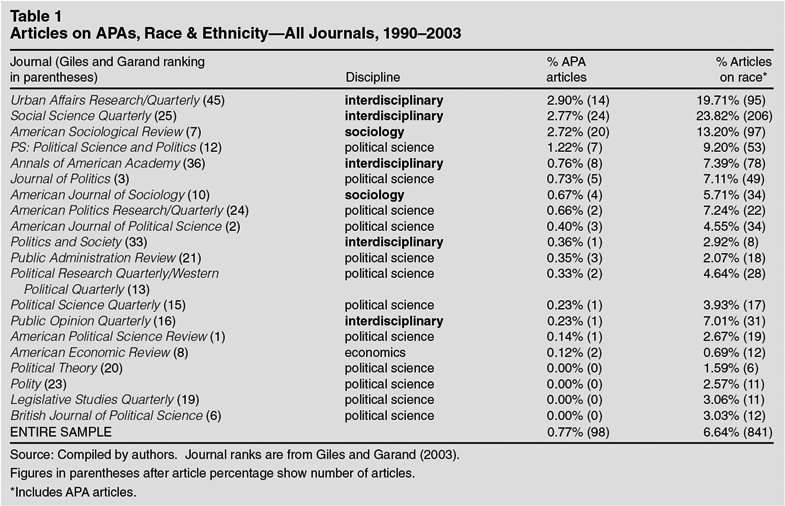
As Table 1 shows, articles on APAs are
relatively scarce, with no journal having more than 3% of its articles
dealing with APAs. Even this percentage is an overstatement of the
attention given to APAs, because a closer look of the 98 APA articles
shows that well over half focused on APAs and other minority groups
together, rather than APAs alone (breakdown not shown on the table;
available from authors). Because the total number of articles published
each year varies greatly by journal, Table 1
gives the percentage as well as the number of each journal's APA
articles.
When examining the pattern of journal publications, perhaps the most
interesting is the sizable gap between political science and other
social science journals. The three journals that ranked highest in the
number and percentage of APA articles (and the number and percentage of
race articles)—Urban Affairs Research, Social Science
Quarterly, and American Sociological Review—are all
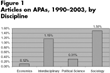
interdisciplinary or sociology journals. When we aggregate the numbers
by discipline (Figure 1), we see that the
interdisciplinary journals scanned contained considerably more articles
on APAs, and on race and ethnicity broadly, than the political science
journals.8
Although other sociology
journals contained considerably more articles on race and
ethnicity, we only fully scanned two, so we have to be cautious
in making generalizations about sociology journals.
Articles on APAs, 1990–2003, by Discipline
Table 1 also suggests that the concern made by
Ávalos (1991) more than a decade ago still
holds today: that young scholars studying race and ethnicity may
endanger tenure and promotion chances because top journals publish few
articles in these areas, while journals more likely to publish
literature on race and ethnicity are ranked lower by peers. The
APSR, flagship journal of the profession, published only
one article on Asian Americans, while the two journals that published
the most articles on race and ethnicity are ranked at number 25 or
lower.9
And the single APSR
article on APAs, about Congresswomen of color, included only a
very brief section on Representative Patsy Mink, a Japanese
American (Hawkesworth 2003).
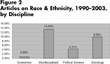
When we examine the number of all articles on race and ethnicity, we find
that interdisciplinary journals also had a far higher percentage of
articles than did political science journals (Figure
2), a pattern observed by Ávalos over a decade ago (Ávalos
1991).10
Because our definitions differed from those used by Ávalos,
our other figures are not comparable. However, our figures show
considerable increases in the number of race and ethnicity
articles in political science journals (for the 1990–2003
period, compared to Ávalos's findings for the 1964–1988 period),
while we do not find comparable increases for the sociology
journals.
Interdisciplinary journals' practice of
featuring symposia on race and ethnicity greatly increased their
numbers. The
Annals of the American Academy and
Social
Science Quarterly featured a substantial number of articles on
race and ethnicity this way.
11 For
example, see the June 1997 issue of Social Science
Quarterly and the March 2000 issue of the
Annals.
Not surprisingly, the political
science journal with the highest percentage of articles on race and
ethnicity (
PS) also publishes symposia; virtually all of the
PS articles on APAs were published in a 2001 symposium, and
a little over half of all the
PS articles on race and ethnicity
were published in symposia.
Articles on Race & Ethnicity, 1990–2003, by Discipline
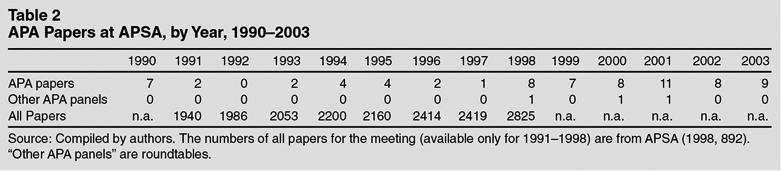
Table 2 shows the number of papers on APAs in
the final programs of the APSA meetings from 1990 to 2003. As was the
case with published articles on APAs, the number of papers that dealt
with APAs is very small (less than 1% of the entire papers presented
every year). With the exception of 1990 (in which two papers on the
Japanese American internment were presented, probably echoing Congress's
historic passage of the internment redress bill in 1988), there were
only four papers on APAs at most before 1998. There was a jump in the
number of APA papers in 1998, however, and at least seven papers have
been presented every year since.
Although most of the APA papers we identified had “Asian(s)” or “Asian
American(s)” in their title (rather than specific Asian ethnic group
names) this does not necessarily mean that all Asian ethnic groups
recognize a common identity. Scholars and activists often refer to a
bias in favor of East Asian ethnic groups (i.e., Japanese, Korean, and
Chinese Americans) in resources, recognition, and influence within the
Asian American scholarly and political community. The ethnic breakdown
of APA papers reflects that tendency; the East Asian ethnic groups were
the focus of APA papers at least three times; papers specifically
dealing with Vietnamese, Cambodian, and Native Hawaiians were presented
only once. What is most striking is that we have not yet seen a paper on
Filipino Americans and South Asians. Although Filipinos and South Asians
are the second and third largest ethnic groups in the U.S. populations
in the 2000 Census—1.9 million and 1.7 million, respectively (U.S.
Census 2002)—their political activities have
not received the scholarly attention that they deserve. This lack of
research may reflect their ambiguous and often marginalized positions
within the umbrella Asian American group. Yet Filipinos and South Asians
are making significant electoral and other political progress at the
local and state levels (Nakanishi and Lai 2003), if not on the national arena; this is one of the areas in
which future APA political research needs to address.
Expanding the Study of Overlooked Groups
Institutional change probably helps to explain the post-1998 increase in
APA papers at the APSA Annual Meeting that we saw in Table 2.12
One may question
if the increase of APA papers beginning in 1998 might reflect an
increase in the total number of papers presented at the meeting.
Although the PS discontinued recording the total number
of APSA papers in its annual meeting recap in the December issue
in 1999, the modest increase in total number of papers in 1998
(2,825) from 1997 (2,419) suggests that this is not a likely
factor.
In the latter half of the 1990s, the APSA
Organized Section on Race, Ethnicity, and Politics (REP) began to grow
and offer substantially more opportunities for papers on APAs. Asian
American politics specialists served as co-chairs of the REP program for
the 1998 and 1999 conferences. The former saw the first panel that was
entirely devoted to APA politics, while the latter helped bring together
scholars who then formed the Asian Pacific American Caucus (APAC), an
APSA Related Group. Since then, APAC has sponsored panels on APA
politics, often working closely with the REP section. Further fueling
the growth in APA studies was a new generation of scholars interested in
Asian American politics, and a desire to combat the on-going backlash
against Asian Americans in the wake of media reports on illegal campaign
contributions from Asian donors to the 1996 Clinton-Gore reelection
campaign.
In contrast, we have not discovered a clear upward trend in the number of
APA articles published in the 20 journals we searched.13
Although there were some one-time increases in the number of articles on
APAs (or articles on race, for that matter) when a symposium or
guest-edited issue was published, articles on APAs and other articles on
race are not evenly distributed across journals and years. Rather, as
seen above, articles are concentrated in particular journals. The same
tendency pointed out more than a decade ago by Ávalos (
1991) on race, gender, and ethnicity articles,
and by Kelly and Fisher (
1993, 548) on
articles on women, still continues today.
The continuing paucity of articles is probably in part due to factors
which change slowly. The interests of faculty help shape the research
interests of grad students and the choice of dissertations. Also
important is the existence—or lack thereof—of data sets that junior
faculty can use in their quest for publications and tenure. Survey data
on Asian Americans is relatively scarce, although the situation is
improving. The Pilot National Asian American Political Survey (PNAAPS),
the first multilingual, multicity survey of Asian Americans, is likely
to produce a surge of research the way that the Latino National
Political Survey did in the past decade.14
The PNAAPS principal investigator, Peite Lien, was also one
of the co-founders of the Asian Pacific American
Caucus.
In an encouraging sign, the APSR (which averaged just over one
article on race per year in our study) recently published a qualitative
and interpretative analysis of gender and race issues in Congress
(Hawkesworth 2003). However, unless leading
political science journals continue to give more space to studies of
race and gender in politics, scholars who study these issues may find
sociology and interdisciplinary journals more promising outlets for
their work.