Introduction
Public health is defined as helping people to stay healthy and protecting them from threats to their health (UK Government, 2013). In 2013, public health responsibilities in England were transferred from the National Health Service (NHS) and returned to local government, following the implementation of the 2012 Health and Social Care Act. In England, local government is run by elected councillors who are responsible for a range of services to deliver on local priorities. These services comprise a set of mandatory services such as library services, children’s services, housing benefit and welfare services; and other services that are discretionary such as sport and recreational services. Returning the responsibility of public health back to local government was done with the understanding that these authorities are in an ideal position to influence the social determinants of health (Lyons, Reference Lyons2007), and are best placed to achieve local population public health through collaboration with the NHS, public authorities such as the police and education providers, and public representatives (Marks et al., Reference Marks, Hunter, Scalabrini, Gray, McCafferty, Payne, Peckham, Salway and Thokala2015). At the time of the shift of public health responsibilities to local government, Public Health England was formed as a new executive agency of the Department of Health. Directors of Public Health within local authorities were allocated a ring-fenced public health budget and encouraged to prioritise cost-effective interventions and to target resources towards areas in most need (The King’s Fund, 2015). Activities were monitored using a Public Health Outcomes Framework grouped into four domains: improving wider determinants of health; health improvement; health protection; and health care public health and preventing premature mortality (Department of Health, 2012).
Since 2013, however, public health budgets have been drastically reduced in England and Wales (The King’s Fund, 2017) and year on year local authorities have faced increasing financial pressure. While economics as a discipline can offer support to demonstrate the potential returns of investment over different time horizons, there is little evidence of what, and how it is being used in practice. It is unclear if challenges to usage are because it is at a local level more generally (Eddama and Coast, Reference Eddama and Coast2009; Williams and Bryan, Reference Williams and Bryan2015a) or, if it is because of the unique features of public health coupled with the general paucity of economic evidence for public health interventions (Hill et al., Reference Hill, Vale, Hunter, Henderson and Oluboyede2017). The challenges of applying economic evaluation to public health interventions have been well documented and centre around difficulties of aligning long-term benefits with short-term investments; accounting for cross-sector costs and benefits; incorporating the wider well-being benefits from public health interventions; and including benefits that go beyond individuals such as carer and family effects (Weatherly et al., Reference Weatherly, Drummond, Claxton, Cookson, Ferguson, Godfrey, Rice, Sculpher and Sowden2009; Payne et al., Reference Payne, McAllister and Davies2012; Kelly et al., Reference Kelly, McDaid, Ludbrook and Powell2015).
The aim of this study was to undertake in-depth qualitative research within an English local government setting to better understand the decision-making roles within local government; how decision makers synthesise all types of evidence to inform resource allocation; how commissioning processes are structured; how economic evidence is accessed and interpreted; what types of economic evidence is used to inform resource allocation; and to elicit suggestions from the decision makers on how economics methods could better support decision making within this local context. This is important as although previous research has explored the use of economics within policy development and implementation, this has tended to be at a national level or within a health care context, rather than within a local government setting (Eddama and Coast, Reference Eddama and Coast2009; Williams and Bryan, Reference Williams and Bryan2015a).
Methods
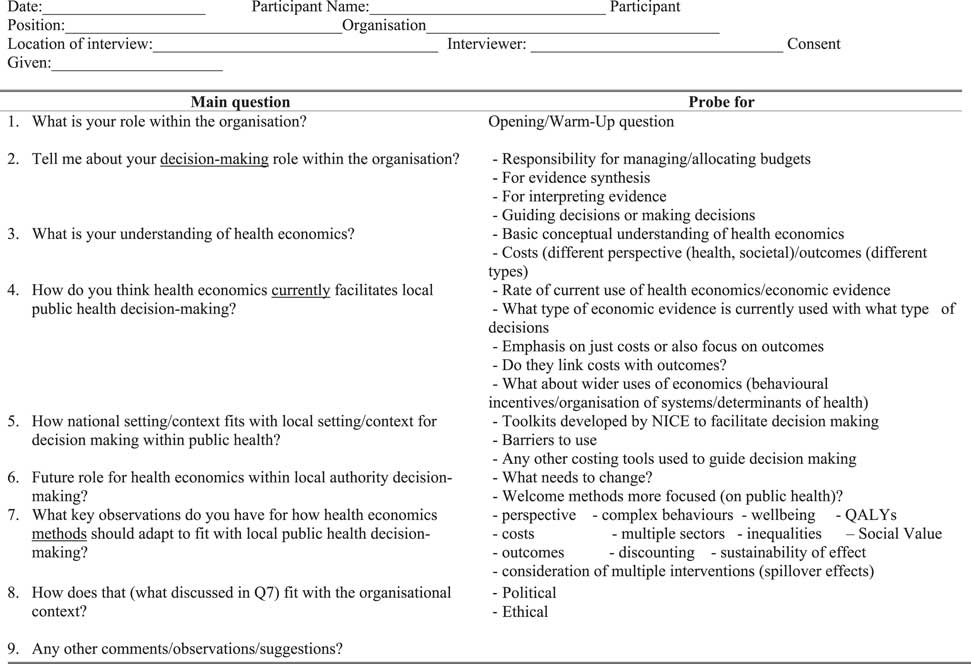
The study design included both observational (non-participant and participant) and in-depth interviews which enabled an element of triangulation since it allowed the research team to observe participant behaviour within routine meetings, and to cross-reference that with reported behaviour within the interviews. To begin, all meetings were observed using non-participant observation to obtain an initial understanding of how decisions are made; to identify key participants to be interviewed; and, to gain insight into the culture of the organisation to help inform the topic guide for the interview stage. Senior council officers advised on the most appropriate meetings to observe for this purpose and over the course of the study, the two main researchers (E.F. and K.B.) observed 18 hours of meetings which comprised the executive management meeting; senior public health officers meetings; the cabinet members brief; and the health and well-being board meetings. Permission to audio-record the meetings was not provided, so field notes were taken that were then used to inform the subsequent interview topic guide (Figure 1).
Topic guide.

Following the non-participant observations, the two interviewers (E.F. and K.B.) conducted the face-to-face in-depth interviews. An initial sample of 12 informants was identified from the non-participant meeting observations, and then a ‘snowballing’ sampling approach applied to identify other ‘suitable’ local decision makers within the organisation. Suitability was defined as someone who had a substantial decision-making role with respect to budget allocation. Effort was made to ensure a spectrum of decision-making roles were included comprising public health, finance, legal and commissioning officers; and elected members. Participants were approached via an email invitation. The interviews were transcribed and analysed using a constant comparative method whereby themes were identified to look for agreements and patterns in the interview data (Coast, Reference Coast2017). Detailed descriptive accounts were generated analysing the interviews in bundles of three before combining them together to form one overall descriptive account. Initial themes were identified which were refined and added to as new themes emerged. One interviewer (E.F.) led the data analysis by generating the descriptive accounts that were then read by the second interviewer (K.B.) who checked the interpretation of the quotes and added any further themes. Any disagreements were resolved by discussion. After the interviews had started, E.F. co-located between the University and the local government offices, spending 1 day a week working with the public health team, essentially acting as a participant observer. This structure of working meant that as the interviews progressed, the themes explored were influenced by the previous non-participant observations, the themes from previous interviews, and also participant observation from the interviewer being immersed in the organisation and being exposed to the working practices of the public health team.
All themes are illustrated by quotations from the informants. Ethical approval was granted from the University of Birmingham Science, Technology, Engineering and Mathematics Ethical Review Committee (ERN_15-1671 and ERN_15-0997). All analyses were conducted using Microsoft Word Version 16.
Results
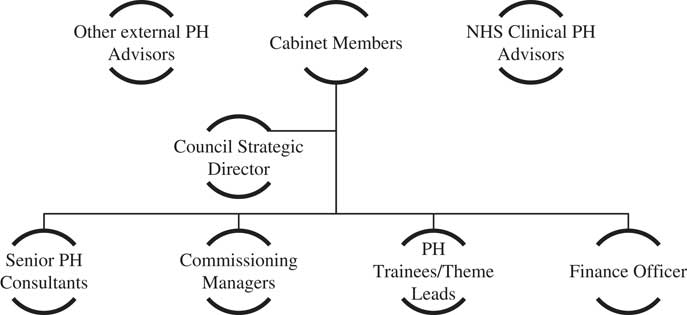
Eighteen informants were interviewed representing different decision-making roles across the organisation. Figure 2 represents these roles, and Table 1 illustrates how the informants were spread across these roles.
Participant characteristics.

Participant characteristics

All interviews were audio-recorded and conducted within the workplace of the informant. The interviews lasted from between 45 minutes and 1 hour. For each direct quotation, the ID number is provided.
Across the observations and interviews, a number of themes emerged. A clear commonality across all informants was the emphasis of public health on the positive narrative that is about achieving wellbeing, rather than avoiding ill-health: ‘it’s not negative, it’s about being happy, it’s about smiling, it’s about having conversations, it’s not about ill-health’ (ID18). The informants described the following key responsibilities of a public health officer: (1) Engagement, (2) Priority setting, (3) Commissioning and (4) Evidence-based decision making, each are discussed in turn below.
Engagement
The informants talked about engagement at multiple levels, such as engaging with other Council officers: ‘you obviously have to work very closely with your council and your council portfolio to make sure that they’re engaged…’ (ID16); and with engaging with the public: ‘we do lots of work with the communities…to ensure that the citizens have a voice…’ (ID4), as well as engaging with other key stakeholders, such as the NHS: ‘…to provide public health expertise to NHS commissioning which is basically CCG’s’ (ID6).
A few informants considered their role to be about influencing decisions (rather than making them). And that this influencing role was operationalised through a number of channels such as contact with the elected members; through conversation with health care decision makers, and with senior Council officers: ‘it’s quite often influencing decisions, rather than necessarily making them’ (ID7).
Priority setting
Many of the informants described their strategy for setting priorities. Several different themes emerged during these conversations with consideration of both financial and non-financial metrics.
There appeared to be consensus among the informants that the methods used for priority setting were unrefined, and that with whatever method that was used, the attention was always on services and conditions that cost the most money: ‘So it’s [prioritisation] pretty ad hoc I’d say, the focus was on things, things that cost a lot of public money’ (ID12).
Initially, the financial considerations were described as the key factor when setting priorities: ‘…the financial model’s probably most to the fore…’ (ID10). But, as the conversation progressed, this statement was ‘softened’ and it emerged that other factors were also important: ‘…I think we’ve gotta have informed local population approaches that look at how you respond, predict and manage higher risk…’ (ID10).
As the conversations progressed, and other metrics (non-financial) for priority setting were revealed, the informants discussed how evidence was used, and modelled, to inform on these priorities. It was acknowledged by the informants that there was a lack of strategic focus with just looking at the finances, and there was recognition that there was a need to link cost with outcomes: ‘but ultimately the financial model is just the representation of what you’re trying to do in pound notes, isn’t it? It’s just numbers. It needs a plan’ (ID10). ‘They need to know which ones [investments] will get the best outcomes that they want’ (ID12).
Only one informant talked about using a formal prioritisation toolkit, referred to as the Portsmouth prioritisation tool, a formal scorecard designed to compare services against an agreed set of factors that are often weighted (Primary Care Trust Network, 2008): ‘in our original operational plan, we had a look at the Portsmouth model of erm…prioritisation’ (ID11). However, it later emerged that this had not been successful: ‘we signed off a version of the Portsmouth prioritisation tool…I have to say we never really used it properly’ (ID11).
Commissioning
All informants with a commissioning role revealed that processes had recently changed to place more focus on efficiency. It transpired that there had been a shift in responsibility for commissioning within the Council, with a movement away from the public health team to within the newly developed ‘Commissioning Centre for Excellence’: ‘…12 members of the Public Health team have gone over to our commissioning side and, …that is a really good Public Health influence in there’ (ID14). The purpose of this Centre was to ensure that commissioning was conducted in an ‘evidence-based way’ ‘…it’s basically doing things in a, a rather decent way, so evidence-based’ (ID14).
Although Council priorities were set outside this commissioning process, when discussing the approach to commissioning, the informants referred to these priorities. This gave a sense that it was the commissioning process that put a focus on these priorities because of the need to achieve efficiency within scarce budgets, and therefore the need to prioritise services. One such priority that emerged was that commissioning was about meeting diverse population need: ‘…we are becoming much more efficient but also understanding much more clearly what it is that people need – what the need is within our populations for this approach’ (ID15). There was recognition that previous processes had not been as efficient as they could have been: ‘…because a lot of the stuff that we commissioned and developed in the past has very much created a model of dependency’ (ID13).
During the interviews, the informants described the process for commissioning in a chronological fashion. Three aspects to the commissioning criteria emerged from this description – the use of internal priorities, the use of the Key Performance Indicators (KPI’s), and benchmarking against other ‘similar’ authorities: ‘So from a Council perspective what we work out is A the priorities, er, there’s internal priorities…we also have the public health outcomes framework which there’s a list of indicators and priorities across all of those…then do some benchmarking both locally and nationally’ (ID13). Frustration was expressed from this same informant however with this approach as with using all these criteria, and with the authority struggling on all of the outcomes framework, this approach did little to help identify the top priorities: ‘…the difficulty with [name removed] is obviously taking a look at the public health outcomes framework, pretty much…everything…broadly speaking there’s a bulk of issues…’ (ID13).
The process for commissioning was clearly described. First, a service specification is developed ‘…we would develop a service specification for what we’re trying to achieve’ (ID13). And this is focussed on the outcomes to be achieved, and not the delivery model: ‘…and leaving it, to a certain extent, to market providers to work out how they would deliver on that’ (ID15). The goal was not about maximisation but applying more of an egalitarian approach and thus ensuring all individuals in the population achieve a minimum level: ‘…and our focus is basically, we want to make sure that er, we reduce the variation’ (ID14); ‘So a lot of my time is probably focusing more upon the equity issues than it is the effectiveness issues’ (ID15).
Achieving outcomes beyond health emerged as an integral part of priority setting and commissioning. Many examples were given to illustrate the types of outcomes that were important such as ensuring access to services: ‘…looking at the population as a whole, we prioritise across the City the right services in the right areas. Broadly speaking we try and keep the services as universal in terms of access as possible because we know the City doesn’t travel that well’ (ID13). And, it was clear that services were organised so as to meet diverse population need: ‘…so the free physical activity programme…that’s primarily targeted around seven priority areas across the inner-city corridor…where you’ve got high incidents of chronic disease, lower life expectancy, more demand on adult social care’ (ID13). As part of a wider strategy to reduce dependency on the Council, it emerged that these services were commissioned to try and reduce health care need, and to encourage the population to be more independent: ‘…so it’s very much about independence and how people can learn the skills and get the support and longer term they can do it themselves’ (ID13). The informants explained that to capture a broader notion of well-being, they use WEMBS – Warwick Edinburgh Mental Wellbeing scale. This is operationalised by asking providers of social care services to collect data using this measure: ‘it’s a wellbeing screening to be honest so if you’re looking at mental health and wellbeing broadly speaking a lot of services will use that as a less invasive screening tool’ (ID13). The informants justified this approach as it aligns with the National Institute for Health and Care Excellence (NICE) commissioning guidance: ‘It [wellbeing measure WEMBS] sits within the NICE commissioning guidance for a lot of services that we commission…[ID13]’.
The informants described that competitive tenders are scored according to pre-determined criteria ‘…and we would score those tenders and they’re then tabled against who, which scored best in a procurement process’ (ID13) with pre-determined weights assigned to cost and ‘quality’ using a process akin to a Multi-Criteria Decision Analysis approach: ‘we’re using a procurement model that weighs cost, or price as they call it, price with quality’ (ID15). With a higher weighting assigned to quality than to cost ‘…and the weightings are …60% quality, 30% cost, and 10% on something else’ (ID15). Tenders are then judged on the evidence for good partnership working, recognising that one provider is unlikely to have capability of delivering a service that would meet the diverse needs across the whole population ‘we want a systems approach with a lead provider and sub-contractors …’ (ID14).
The informants stressed a reliance on the market to achieve efficiency with respect to partnership working (to meet public health needs), and with determining price. Therefore, rather than sticking to the ‘old’ commissioning model of having multiple individual contracts with numerous providers, it was perceived that a much more efficient model was to delegate responsibility to one lead provider. The onus is then on this lead provider to ensure that processes are efficient and outcomes specified by the Council are met. The informants stressed that the Council are less concerned about how this is done, only that it is done, and done within a budget. To facilitate these conversations, a key part of the commissioning process involved ‘market days’ aimed at getting all potential providers together, to specify clearly the expectations from the Council perspective, and to encourage the providers to work together to come up with a delivery model that would meet the population needs, and within budget. The rationale with such an approach was that previously the Council had commissioned individual services without consideration of the wider system: ‘we created systems but didn’t acknowledge the systems around them’ (ID14). And by bringing all the providers together, this was a means to encourage better ‘systems working’.
Using evidence
The interviews were structured to understand how, and what evidence is used to support decision making. With respect to how evidence was used, generally speaking, the informants described two approaches: evidence synthesis undertaken by the Council officers; and evidence generation undertaken by the service providers and managed by the Council. For evidence generation, the service providers were responsible for collecting data to evidence how outcomes (metrics) were being achieved.
In terms of evidence synthesis, this had two functions: (1) to support priority setting, and (2) to support commissioning. The informants had a very broad definition of what is classed as evidence: ‘…evidence is everything from…needs assessment …through to the evidence of what works’ (ID8). With priority setting, the evidence was used to benchmark: ‘part of it is comparative, what are other people (other cities] spending on…and these are benchmarks which we use’ (ID18). With supporting commissioning however, there appeared to be differences across the informants with how evidence was used. Some informants described using it to determine in advance what services would be the most cost effective: ‘what are…the most…cost effective approaches to deliver the sorts of outcomes that we’ve got in the outcomes framework’ (ID8); whereas others stated explicitly that evidence is not used to assess the delivery model in advance, but left to providers to work out how best to deliver, within a given budget: ‘So we obviously commission certain programmes. We ask for each provider to evaluate the programmes…it’s more the providers will do the evaluations of their services’ (ID4).
It transpired that with pressures on budgets that the evidence was used to help justify de-commissioning or protection of services, both at the Council officer level and at the member level: ‘more so now because with the cuts, it’s justifying why we shouldn’t cut a service’ (ID4); ‘And sometimes [name] may bring me a proposal that something needs to be moved or changed. As long as they can back it up with evidence…I will go with the recommendations’ (ID5).
With respect to what evidence was being used to support decision making, a broad range of outcome metrics were discussed. As expected, the informants that were most closely aligned with NHS service commissioning referred to health care metrics: ‘quality, would include…trying to understand the patient experience as a result of something’ (ID11). And rates of health service use were being recorded to measure population need: ‘we’ve moved from being a high user of residential care in the City to being bottom’ (ID10).
Outside of health care commissioning, the informants used a broad range of metrics beyond health: ‘we’ve got to demonstrate that we’ll have an impact on more than just health’ (ID16). For example, school readiness was seen as important: ‘when we commissioned early years for example, the outcomes we wanted were largely about school readiness…’ (ID17). And employment: ‘we’re trying to get people to recover…back into employment’ (ID18). These wider societal outcomes were described as being a high priority for all public service commissioners across the City: ‘and pretty much those [mental health, employment and skills] would be, I think, top of everybody’s list’ (ID12).
One informant in particular was very clear about the distinction between functioning in a health sense, and about achieving capabilities in a wider wellbeing sense, and provided an example to illustrate: ‘And actually…there’s a chap with personal budgets…so as a health person, as an economist you may want to talk about function of his and can he do x, y, and z? But actually he’s not bothered by that, the only thing that drives him is getting to work, and he describes how he uses personal budgets so he can get to work, a QALY would never have accounted for that’ (ID18).
The political context
The political context was a prominent theme within all interviews. It was clear that the responsibility for making decisions was with the elected members: ‘I’m not involved with the decision making, that’s political’ (ID18). And with that, the political context was a key driver and influence upon the decision-making process: ‘the trouble with the Council is, you’ll always come up against politics, you’ll always come up against that member who offers a hierarchy…’ (ID17). Most informants referred to the political time cycle and the need to achieve a balance between taking a lifetime perspective, and understanding the political timeframe for Council members: ‘often the pace at which things need to be delivered is very fast – the councillor needs to be seen to doing something’ (ID2); ‘…in fact in the Council we have elections every one year…so there’s always turbulence in leadership, so the Politicians, they’re thinking how long can we guarantee this budget, if the payoff is not going to be until they don’t die when they’re 70, that’s a really tough assault on the public, especially when they’re asking them to cut something that they can see and feel now…’ (ID17). The informants that had a strategic role referred to managing expectations within timescales and the importance of having a mix of both short and long-term projects: ‘they [council members] need a portfolio of things that have short term impact and things that are kind of slower burning things’ (ID12). There was an understanding among the informants from working in this political sphere that the evidence and language needed to resonate with the decision makers: ‘you have to frame the evidence in a way that resonates with a local authority agenda’ (ID8).
Influence of economics evidence upon decision making
With reference to the role of economics, generally speaking, the informants regarded it as important: ‘especially in business cases, that [economics] can be the thing that is the real motivator for some organisations, that’s really what they’re looking for’ (ID16]; ‘The bottom line at the end of the day is the economics so, …it is the economic output at the end’ (ID17). One informant expanded on this by saying that economics is what matters because of the financial context: ‘…at the end of the day it boils down to money doesn’t it’ (ID16). However, despite being held in high regard, there appeared to be a discrepancy between the ‘aspiration’ of using economics, and how it was actually used in practice: ‘so, I don’t think we’ve gone as far as that [comparing costs with outcomes]’ (ID18); ‘I don’t think our [Council] health economics approach so far has been that sophisticated’ (ID1).
The barriers to using economics evidence were discussed. Economic evaluation was seen as too focused on ‘individuals’: ‘people don’t think about scaling up…’ (ID18); ‘so I was a big believer in scaling up…but we haven’t seen it [population impact] either because the services aren’t good enough, we’re getting the wrong people in but what I’m trying to get to is that’s what the evidence told us but it [population impact] hasn’t happened’ (ID18). Problems with translating evidence into practice: ‘…a wonderful trial showed really good results…I’ve tried to do it twice…in the real world it doesn’t work’ (ID18), and on a similar note, problems with translating national evidence into local impact: ‘sometimes the information you get in a review…you need to drill down to just understand exactly what, what it means I suppose to be applied locally…’ (ID16). When asked about costing tools developed to support local decision making (NICE, 2014), the informants reported a lack of awareness: ‘I’m not really familiar with them’ (ID16). Financial restraints were also mentioned as a barrier: ‘when we have more control over the pot of investment…I think that’s the point where can start to consider it [economic evaluation]’ (ID15). Another informant mentioned time scale as a barrier: ‘I need to be balancing my books next year, not 5, 10, 15 years down the line’ (ID13). And furthermore, accessibility barriers such as the availability of evidence: ‘often find ourselves not having access to that…that tends to be an area where there isn’t research done’ (ID2), and then problems with the evidence being too technical: ‘and do you create the evidence and then just hope that there’s people there to share it…you just hope they translate it correctly’ (ID3).
With respect to the framework for analysis, the informants referred to economic evaluation being too ‘health focused’ and therefore not relevant for public health decision making. Similar to the discussion about priority setting, broader outcomes were discussed such as well-being, school readiness, employment and educational attainment.
Suggestions for economic evaluation alongside public health
The informants had several suggestions for how economics methods could be improved to better support public health decision making. Broadly speaking, these fell into four themes: broadening of frameworks to take more of a systems approach; consideration of outcomes across different sectors; issues of generalisability; and making evidence more accessible.
The informants suggested that methods take account of local systems, such as understanding what services are being displaced, or capturing unintended consequences: ‘so what’s the impact of an intervention…implementation, feasibility issues, so trying to understand what are the difficulties that are likely to come out in making this change, so is it a particularly complex change…’ (ID12). This same informant suggested that methods consider the flexibility of interventions, so after implementation, consider if there is scope to tweak the design: ‘…so can you go back to what you were doing before, is it flexible…that people can say, well that doesn’t quite fit in with our approach, we need to treat this bit…’ (ID12). The informants suggested greater focus on service organisation and likely impact upon effectiveness: ‘One of the big questions we’re looking at is around the commercial and research benefits of being co-located with an adult and women’s hospital…will this unlock additional synergies that would have economic benefits for the City’ (ID2). To address the barrier of methods being too ‘individualised’, the informants suggested capturing impact on whole population groups: ‘the evidence base around things like return on investment for population health interventions…cost effectiveness on a population basis’ (ID8). And a desire for methods to consider the equity impact: ‘and identifying what the benefits are for the different population subgroups as well – the universal service versus the targeted service’ (ID7).
The informants suggested that methods should capture non-health outcomes and recommended an approach that considers the priorities of other sectors. They explained that public health is about realising the health gain from investment in other sectors and producing evidence to enable a narrative with non-health care providers, like education for example: ‘So I always say to people…if you can demonstrate and promote that …with schools … so its about persuading and influencing them…the bottom line for schools is SATS and GCSE results’ (ID17). There was a perception that economics could act as the ‘glue’ that brings together all Council functions and aligns priorities: ‘I think within the local authority setting, it’s [economics] got quite a big role to play because of all the pressures…in a way that’s approachable by other parts of the local authority…it has a role in terms of providing information and helping with decision-making but also a role for itself to translate so it makes sense…’ (ID3). To enable such an approach, the informants suggested that health economists need to engage with decision makers: ‘it’s very important that [economists] don’t just go into the ivory tower and invent you know new frameworks…they have to be developed through or co-designed with the people who will use them’ (ID8).
With respect to generalisability, the informants suggested a shift away from controlled experiments: ‘it’s a very controlled experiment you’ve got researchers here, there, everywhere. In the real world, we know about things like compliance…’ (ID18). And, more specifically methods should evolve to consider local implementation issues such as understanding population compliance and engagement: ‘Our City is so diverse…we generally just roll out one programme but one size does not fit all…but until you trial it you might not necessarily get them outcomes as others did…you may read a paper and it’s proven X, Y, Z…we’ve delivered, we’ve decommissioned them because they haven’t worked’ (ID4).
Making health economics evidence accessible was seen as important: ‘one of the key things…is probably making it more accessible…getting economics out there, much more in the mainstream’ (ID6). And, the informants suggested clear reporting for how costs and outcomes were distributed across sectors: ‘it helps to be transparent about it and to be able to identify where the benefits are as if we can clearly demonstrate that financial benefits are to be felt elsewhere in the system, then it gives us greater leverage to be able to work collaboratively with some of those other sectors…’ (ID16). To impact policy, the informants explained that no prior economics knowledge should be assumed: ‘always assume a councillor knows absolutely nothing and begin from knowing nothing’ (ID17). And an ability to produce evidence within short timescales, even at the expense of quality: ‘…where you can turn things around quickly, whilst also making sure that you’ve got, you know the caveats to say this isn’t perfect. That is the way [for economics] to make the biggest impact’ (ID14). The informants emphasised that the evidence was needed to help ‘tell a story’ rather than presenting precise numbers: ‘so sometimes it’s not about being that exact…more to kind of illustrate and give a narrative to help…make it a bigger picture view of things’ (ID3).
Discussion
Local authorities have a responsibility to demonstrate value for money understanding that budgets are limited so spending in one area foregoes spending in another. Economic evaluation offers evidence on the cost-effectiveness of investment over different time horizons and is an inherent part of the decision-making process used by the NICE advisory committees. There is however a realisation that there are additional barriers to using economic evidence at the local level and this paper presents evidence from an in-depth qualitative study of decision makers within one local setting.
The informants described the role of a public health officer working within local government as being about influencing decisions and combining evidence with public health expertise to support Councillors with decisions that involve multi-sectorial investments. It was clear from the interviews that the context for decision making was highly complex. Informants revealed that decisions were influenced by a myriad of factors including: benchmarking with other organisations; conversations with both internal and external colleagues; the media reaction; public scrutiny; likely impact on the KPI’s; the political context; service provider reaction; likely impact on budgets; and finally, academic evidence. This finding resonates with other studies that have reported on the complexity of decision making within this setting (Holmes et al., Reference Holmes, Best, Davies, Hunter, Kelly, Marshall and Rycroft-Malone2017) and with reports on the meaning of evidence, and how it is used to inform decision making. Despite this complexity, however, common objectives emerged from the interviews as there appeared to be a shared vision to manage decreasing budgets in a more efficient way. Some of this was being operationalised through the commissioning process with a desire to reduce dependency on council services over the long term and a movement towards relying on the market to increase competition between providers. It was, however, noted that usage of health economics evidence was limited in practise. Key barriers to usage were cited and methodological suggestions were offered such as the broadening of frameworks; increased use of natural experiments; and, capturing wider non-health outcomes that resonate with the priorities of multiple stakeholders. Furthermore, the informants recommended a systems approach to understand the impact of local infrastructure to support implementation and local cost effectiveness.
Other studies that have explored the use of economics evidence in decision making have mostly focused on health care settings. Although local government offers a different context, it is nonetheless interesting to draw comparisons. In contrast to the national level where economics has had an influence upon national decision making (Williams et al., Reference Williams, McIver, Moore and Bryan2008), at the local level, it has been found to have little influence (Eddama and Coast, Reference Eddama and Coast2009). Reported barriers within a local context centre around problems of accessibility and acceptability (Williams and Bryan, Reference Williams and Bryan2015b). Problems of accessibility relate to the ‘availability of relevant research in a timely manner, the clarity of its presentation and the extent to which it can be understood by the policy makers’ (Williams and Bryan, Reference Williams and Bryan2007). Similar findings were found in this study with the informants suggesting that evidence needs to be produced rapidly. Rapid evidence synthesis is becoming more important as decision makers are under increased pressure to make decisions urgently, however reports from a health care perspective have highlighted the variability in approaches and thus potential for bias (Abou-Setta et al., Reference Abou-Setta, Jeyaraman, Attia, Al-Inany, Ferri, Ansari, Garritty, Bond and Norris2016).
The participants also suggested that evidence needs to align with other sector priorities and be clear for non-health economists to understand. It was clear from the study that the participants had variable understanding of health economics terminology emphasising the need for health economists to communicate findings using non-technical language. It also raises the question of whether the health economics training public health registrars currently receive is comprehensive enough to be of use in this setting. Additional barriers cited in the literature refer to conflicts between what decision makers are striving to achieve, and the normative principles of health economics (McDonald, Reference McDonald2002). These same findings emerged from this study, with informants reporting multiple priorities based on equity principles; a focus on achieving multiple outcomes; and with objectives to encourage partnership working. What is clear with these comparisons is that there are similarities between the barriers cited within a health care setting and a local government setting, with a few notable exceptions. In this study, the informants expressed a frustration with a lack of ‘systems thinking’ and an appreciation of the broader consequences (intended or unintended) as a result of implementation. This finding supports the recent suggestion for public health research to consider complex population outcomes (Rutter et al., Reference Rutter, Savona, Glonti, Bibby, Cummins, Greaves, Harper, Hawe, Moore, Petticrew, Rehfuess, Shiell, Thomas and White2017) and consider the synergistic effect of multiple interventions instead of focusing upon the impact of single interventions. In addition, there was a strong theme that the outcomes need to be broader than health with wellbeing revealed as a priority. This broader measure of outcome means that comparisons of cost-effectiveness can be made across different sectors and despite notable developments within health economics on the measurement of ‘capability wellbeing’ (Coast et al., Reference Coast, Smith and Lorgelly2008; Smith et al., Reference Smith, Lorgelly, Al-Janabi, Venkatapuram and Coast2012), recent reviews of economic evaluations of public health interventions report the majority to be cost-effectiveness analysis (White et al., Reference White, Skirrow, George and Memon2018), conducted from a health care perspective (Hill et al., Reference Hill, Vale, Hunter, Henderson and Oluboyede2017). This is despite decision-making bodies such as NICE recommending greater use of a public sector or government perspective for public health economic evaluation (NICE, 2012). So unfortunately, although it is widely acknowledged that public health economics methods need to broaden to include non-health costs and outcomes, and there are methodological developments within health economics to measure well-being, this has not been reflected in published economic evaluations of public health interventions to date.
The public health officer has a key role to play with engaging across different functions and influencing decisions. An interesting finding from this study was that many of the informants suggested that economics could offer the reason for different functions to engage but only if the evidence shows how costs and benefits flow across multiple sectors, hence methods akin to a cost-consequence analysis (CCA). The challenge with a CCA, however, is that it fails to offer any evidence on opportunity cost, hence the value of what is being displaced from choosing to invest resource in one particular way vs another. This limitation was also noted by Hill et al. (Reference Hill, Vale, Hunter, Henderson and Oluboyede2017) in a recent review of economic evaluations of alcohol prevention interventions.
Furthermore, the informants suggested a more flexible approach as it is rare for contexts or systems to be ‘static’. They suggested that methods take account of the level of risk so incorporate a measure of how easy it is to adapt the intervention as more evidence is gathered on how it interacts with its context. There was a desire for academics to engage with the decision makers when developing new frameworks, to ensure that they are meaningful and genuinely supportive for their daily work. This finding concords with the ‘knowledge-to-action’ literature that advocates for co-production of research between stakeholders and academics (Barnes et al., Reference Barnes, Holmes, Lindstrom, Trytten and Wales2015). Also, the participants revealed that minimising inequalities was an important criterion for public health decision making. Methods for incorporating equity into economic evaluation are under development within health economics (Round and Paulden, Reference Round and Paulden2018), however, there are few examples of this being applied to public health interventions (Lal et al., Reference Lal, Moodie, Peeters and Carter2018). This study provides further evidence that this is an important research area for supporting local public health decision making.
All of the interviews were conducted within one local authority setting. This particular setting is a large authority that is socioeconomically and ethnically diverse. Care was taken to ensure that different decision-making roles with respect to public health were represented, with informants from finance, commissioning, advisory bodies, strategic roles and elected members included. E.F. also spent time working in the local authority alongside the public health team providing opportunity for both participant and non-participant observation. Unfortunately, due to the political sensitivity of some of the content of the meetings, permission was not granted to audio-record and although these observations influenced the conduct and the analysis of the interviews, they did not provide data that could be used to either confirm or disconfirm the interview findings.
The findings, however, may represent the culture and context of one organisation and it is difficult to determine if the same findings would prevail in an alternative local setting. The structure and context of local government is highly variable across England with some authorities operating as county councils and some as district councils, each covering different areas of the population. Councils are run by local Councillors who are elected by the community which means that the politics can vary hugely between Councils. It is also worth considering the extent to which the interview content will have been influenced by the informant’s knowledge that the interviewer was a health economist, for example, the participants could have felt a sense of pressure to imply that health economics was worthwhile; or the focus of questions on health economics might have steered the conversation away from other types of economics evidence such as education and labour economics evidence. The economics training of the analyst may also have influenced the themes drawn out from the descriptive accounts.
Public health decision making is a complex activity that is highly influenced by the financial, organisational and political context. Several factors are important that influence decisions and these cannot be ranked or sorted but do impact upon how, and what economics evidence can offer the most support. The barriers to using economics evidence are similar to what has been found in health care settings but are further complicated by a requirement to widen the framework to consider observations from non-experimental settings, consider non-health outcomes; consider different decision-making criteria; and consider impact at a systems level.
Acknowledgements
The authors would like to thank all the participants in the study and to the Health Economists’ Study Group members for their helpful suggestions for the paper. This work was supported by the National Institute for Health Research (NIHR) Fellowship programme (Grant number: CDF-2015-08-013). The views expressed are those of the authors and not necessarily those of the NHS, the NIHR or the Department of Health.