1 Introduction
Recent years have seen growing resistance to international courts (ICs) in many parts of the world. The most striking example is the Southern African Development Community Tribunal (SADC Tribunal), which became a political target and ultimately was suspended when ruling on the highly controversial question of land rights in Zimbabwe (Nathan, Reference Nathan2013). Although perhaps an extreme example, the SADC Tribunal is not alone in having faced pushback and even backlash. The recent reforms of the European Court of Human Rights (ECtHR) in the form of the Brighton Declaration (2012) and resulting Protocols Nos 15 and 16 undoubtedly also implied a form of pushback. This was the first time in the more than fifty years of operation of the ECtHR that the Member States presented systematic critique and questioned its place in European law. The conclusion was that European human rights had to be rebalanced in favour of national institutions, both legal and political (Madsen, Reference Madsen2018b).
The form of political pressure that built up in Europe in the early 2010s, notably in Russia and in the UK, was however not unique to Europe. While Britain contemplated leaving Strasbourg and the ECtHR, yet ended up leaving Brussels and the EU, a number of countries had already left the Inter-American Court of Human Rights (IACtHR), including Trinidad and Tobago and Venezuela. Moreover, the IACtHR witnessed resistance from domestic courts (Huneeus, Reference Huneeus2011) – a phenomenon also well known to EU law, both historically (Alter, Reference Alter2001) and currently (Dyevre, Reference Dyevre2016; Komárek, Reference Komárek2012; Madsen et al., Reference Madsen, Olsen and Sadl2017). In the Eurasian region, the newly established Court of Justice of the Eurasian Economic Union (EAEU) represented in reality a step back compared to its predecessor, which could adjudicate cases brought by the regional Commission, and rule on preliminary references and issue advisory opinions when asked by national courts (Kembayev, Reference Kembayev2016). In Africa, the SADC Tribunal has not been the only IC under political and legal pressure. A number of other African ICs have also been facing resistance. This includes, for example, the East African Court of Justice (EACJ), which was reformed in the aftermath of a set of rulings on rule-of-law issues in its Member States (Gathii, Reference Gathii2016), or Rwanda's withdrawal from the African Court on Human and Peoples’ Rights (ACtHPR) with regard to individual petitions or those from non-governmental organisations (NGOs) (Daly and Wiebusch, Reference Daly and Wiebusch2018). Global courts have also been subject to criticism. Most striking in recent times are the controversies in Africa over the International Criminal Court (ICC), where African leaders under the auspices of the African Union (AU) have contemplated various ways of ‘Africanising’ the prosecution of international criminal law. Concretely, they have tabled the idea of establishing a special criminal chamber under a revamped African Court of Justice and Human and Peoples’ Rights, which would include the ACtHPR as a special section as well as a general affairs section (Murungu, Reference Murungu2011). The World Trade Organisation (WTO)'s Appellate Body has also been having trouble renewing its bench due to Member State opposition (Shaffer et al., Reference Shaffer, Elsig and Puig2016). The reluctance of Member States to reach a consensus on appointing new judges has reached even the judicial organ of the UN – the International Court of Justice (ICJ) (Akande, Reference Akande2017).
What explains this resistance to ICs across the globe? Can any specific patterns and forms of resistance be detected across these legally and geographically different cases? That is, are there similarities or differences between the situations in Africa and South America, or between European and global courts?Footnote 1 Pundits and bloggers alike have been quick to provide answers, depicting a new world order sans ICs: a changed world order prompted by the emergence of a set of new socio-political constellations that share a pronounced scepticism towards universalism. That includes the growth of nationalist political movements, new forms of regionalism, the election of leaders such as Donald Trump, the campaigns leading to Brexit as well as a host of populist movements in many world regions. All these possible explanations have in common that they imply structural political changes that do not sit well with the multilateralism that underpins international law and ICs. Although some of these interpretations undoubtedly hold some truth, they tend to explain en bloc the situations of very different ICs facing a multitude of legal and political situations under the broad yet vague term of backlash. The real question is whether such broad generalisations really capture the current challenges facing ICs, and whether commentators have been too quick to jump to conclusions.
The overriding objective of this paper is to investigate and theorise the patterns and forms of resistance to international courts and develop an analytical framework for explaining the variability of the forms and patterns of resistance to ICs. We do that against the background of a growing scholarship that has documented and analysed resistance to ICs across the world. We contend that, to make intelligible the resistance currently facing a number of ICs, there is a need to first unpack the patterns of resistance that ICs face from Member States and other key audiences, such as domestic courts. There is in this regard a real difference between specific disagreements, resulting in a particular critique and more sustained systemic or structural critique. We also argue that there is an important difference between resistance deriving from political quarters and from the legal field. We further contend that there are different forms of resistance to ICs. In particular, there is a difference between mere pushback from individual Member States or other actors, seeking to influence the future direction of an IC's case-law and actual backlash in terms of critique triggering significant institutional reform or even the dismantling of tribunals, the latter typically involving the collective action of Member States.
We generally argue that resistance to international courts is highly uneven, both among ICs and among Member States. That is, resistance comes in many forms, both as ordinary and extraordinary critique as we conceptualise it below. Scholarship so far has tended to overlook this difference and lumped together all forms of critique as backlash. Moreover, resistance to ICs is variable. In practice, it often differs in both scope and intensity and across the Member States and the actors involved, as empirical studies demonstrate. Therefore, the assumption of ICs facing general resistance is for the most part empirically inaccurate. Our objective is to understand this unevenness by providing an analytical framework that captures both the different actors and the different forms of critique that resistance to ICs entail. Our approach challenges the state-centrism of most studies of backlash against ICs. While, as argued above, the actual institutional overhaul or dismantling of a tribunal will require some level of state involvement due to the legal set-up of ICs, such actions are outcomes that should not be confused with the processes of resisting ICs.Footnote 2 We return to this point further below. Our approach also seeks to avoid the teleology implicit in much scholarship on backlash against ICs, where an evolution from minor disagreement to ultimately backlash in terms of a gradual escalation of conflict is often assumed (compare Soley and Steininger, Reference Soley and Steininger2018). Rather than assuming such conflict-escalating models, our model, exploring the forms and patterns of resistance to ICs, suggests that resistance to ICs can be both evolutionary and sudden. The particular constellations of actors, and the energy and capital they invest in resisting ICs in the context of the forces and actors opposing their strategies, seem to better explain the processes of resistance to ICs.
This paper proceeds as follows. We first discuss and unpack the question of backlash against ICs – what is it, when does it occur and how can it be conceptualised? We develop a framework for studying pushback and backlash against ICs, which identifies variations based on form, notably the forms of resistance and reform involved in such resistance, and patterns, notably in terms of actors. Against this backdrop, in the second section, we draw up a list of contextual factors to develop a roadmap for empirically studying resistance to ICs. The paper concludes with a set of general observations with regard to the current situation of ICs.
2 Theory of resistance to ICs
Resistance to ICs is commonly referred to as backlash in the literature (Alter et al., Reference Alter, Gathii and Helfer2016a; Ginsburg, Reference Ginsburg, Romano, Alter and Shany2013; Sandholtz et al., forthcoming, Reference Sandholtz, Bei, Caldwell, Brysk and Stohl2018; Waibel, Reference Waibel2010). However, backlash is not an analytical concept as such, but rather a common language notion of recoil, typically in terms of a negative reaction in the realm of politics. It is, to paraphrase Pierre Bourdieu, a folk notion smuggled into social scientific analysis (Bourdieu and Wacquant, Reference Bourdieu and Wacquant1992, p. 212) that has become standard vocabulary for describing a range of critical reactions in situations involving ICs. While backlash certainly helps to transmit the idea of a strong reaction towards certain actions by ICs, typically judgments, it does little to qualify those reactions: the developments leading to them, the actors instigating them, and the objectives and the actual consequences of them. There is, on the one hand, no doubt that both a critical and constructive interplay between courts and their audiences has influenced the evolution of ICs. IC authority is arguably produced precisely in the interaction between ICs and their audiences (Alter et al., Reference Alter, Helfer and Madsen2016b). On the other hand, there is a dearth of systematic analysis and explanation of the importance of such critical feedback to ICs from their audiences, including their consequences and how ICs respond to such resistance.
In this section, we unpack the notion of backlash and replace it with a new analytical framework for understanding resistance to ICs. We do that in five steps. First, we discuss the notion of backlash itself and the situations and dynamics it typically concerns. Second, we argue that it is necessary to distinguish the process of resistance from what results from that process. Consequently, studying backlash, and more generally resistance to ICs, becomes first and foremost a study of the processes of opposing or challenging ICs, not of their outcomes. Third, and against this background, we further differentiate resistance in terms of two distinct forms of opposition to ICs: ordinary critique and extraordinary critique. The former we define as a form of resistance occurring within the playing field of ICs and typically concerning specific legal developments in jurisprudence and case-law; the latter as resistance that goes beyond the ordinary playing field of law and includes a critique of not only law but also the very institution – the court – and its authority. Fourth, we further examine these processes of ordinary and extraordinary resistance by differentiating the actors involved in order to discuss different patterns of resistance. Finally, we connect the forms and patterns of resistance with the outcomes of these legal, political and social processes, notably whether they are consequential for law and/or the institution as such. Although we at times discuss backlash as a general phenomenon, our goal is to further the theoretical and empirical study of specific forms and patterns of resistance occurring with regard to ICs. In Section 3 further below, we outline the contextual factors that influence resistance to ICs.
2.1 Unpacking backlash: pointed reactions and structural cleavages
Backlash is, as argued above, a common language notion that has entered social scientific vocabulary. The notion is nevertheless helpful for depicting a set of particular patterns and forms of resistance to ICs. Above all, it conveys the idea of a strong reaction to a practice, ranging from an almost volcanic eruption of critique and emotion that destabilises the targeted institution to less emotional pushback against a certain development promoted by that institution. For the purpose of analysis, it is fundamental that it concerns a reaction to a development – whether it is a strong reaction to that development or a less powerful pushback is conceptually less important. In all cases, it conveys the idea of a reaction to a development with the goal of reversing that development. Understood in those terms, backlash – and more broadly resistance – might be viewed as the action of the reactionary: a reaction to a development that is sought to be blocked or reversed. Thus, what gives backlash its particular dynamics is the attempt at reversal – an action often triggered by a form of resentment (Lipset and Raab, Reference Lipset and Raab1970).
In most literature, references to backlash concern counter-attacks against what is perceived as external phenomena to a community or society. Good illustrations are neo-sovereigntist or nationalist counter-attacks against international institutions or more generally against globalisation, based on arguments that those institutions or processes are losing sight of national cultures and values (Huntington, Reference Huntington2005; Rothkopf, Reference Rothkopf2008). Similarly, attempts at limiting or even preventing immigration very often occur as counter-attacks against broader societal developments that imply demographic change. They are often articulated as a critique of international or multicultural elites and their alleged negation of national cultures, such as patriotism and its symbols such as flags, language and religion (Kauppi and Madsen, Reference Kauppi, Madsen, Kauppi and Madsen2013). These are forms of resistance that are also often associated with particular political platforms and forms of populism that oppose international multilateralism and international law (Posner, Reference Posner2009; Skouteris, Reference Skouteris2006). In general, they show traits of resentment towards such international advancements (for a discussion of resentment, see Petersen, Reference Petersen2002).
What is certain, because of the implicit notion of reversal and resentment, backlash is often associated with a reactionary critique of progress. Conceptually, it is fully possible to imagine and describe social development as a progressive realisation of society. Classical sociological theories attempting precisely that abound, ranging from the Weberian thesis of the rationalisation of society (Weber, Reference Weber1978), the Durkheimian notion of the differentiation of society (Durkheim, Reference Durkheim1893), to the theory of societal evolution as a civilisation process (Elias, Reference Elias2000). For the purpose of this analysis, however, it suffices to note that backlash is most often a reaction to new socio-political or legal developments – whether they are liberal, authoritarian or unidirectional is not decisive at the conceptual level. What is important is that resistance to ICs can occur both as pointed reaction to a very specific judgment or court or as an expression of general resentment to a certain socio-political development, thereby reflecting more general cleavages in society, that is then projected to the practices of an IC.
While a large body of literature has analysed the more intimate and specific politics of ICs, in particular with regard to the interaction with Member States and their interests, scholarship on ICs has been much less apt at analysing how reactions to ICs also reflect broader societal trends (Madsen, Reference Madsen, Alter, Romano and Shany2014). Many debates on the legitimacy of ICs tend to focus on specific legal-political interfaces but fail to insert those politics into the framework of broader societal cleavages (see, however, Hirschl, Reference Hirschl2008; see also the discussion in Madsen, Reference Madsen, Alter, Romano and Shany2014). Understanding backlash, however, often necessitates exploring the larger context in which ICs encounter broader societal cleavages and their associated conflicts, in addition to the more pointed skirmishes over specific rulings and interpretations. In many cases, as suggested, backlash occurs precisely when specific legal developments encounter broader societal questions and the kind of social, political and legal mobilisations that they may trigger.
This implies, first and foremost, that some of the societal cleavages that inform national politics might also influence the politics of ICs. Conversely, the politics of ICs cannot be reduced to only narrow questions related to the legitimacy of ICs in legalistic or abstract terms; ICs are rather influenced by evolutions in both national and international society. This is unsurprising, as society at large is deeply divided over many of the questions dealt with by ICs, such as trade, crime and human rights. This means that ICs and their operation are potentially influenced by these very same cleavages. And their mere operation, a part of globalisation processes in itself, is likely contributing to divisions in society between, for example, those who see themselves as inside the new global networks and those who are literally ‘off-line’ (Castells, Reference Castells2000). Resistance to ICs can therefore occur as reactions to both specifically targeted decisions of those courts and more general societal trends where ICs are perceived as being on the side of alleged progressive globalisation and thus against entrenched values and ideas of national societies. This produces a sense of resentment towards those institutions and practices.
2.2 Resistance as processes of opposition and denunciation
Resistance to ICs is as argued an attempt at blocking or reversing advancements in law triggered by ICs or more general political or societal trends that are associated – rightly or wrongly – with ICs. The most well-known cases of backlash concern situations in which such counter-attacks result in important changes to ICs, either institutionally or in jurisprudence. The question is, however, whether the object of inquiry when studying backlash is the process of resistance, the outcome of that resistance or both. As discussed in the previous section, resistance to ICs in terms of backlash generally involves processes of recoil. This, however, says very little about whether that reaction is consequential and what outcomes might result from it. Outcomes are causally linked, but the question is whether – for analytical purposes – it is a different issue. We will argue that there is a fundamental difference between seeking to understand the internal mechanisms of IC resistance and the results of those processes in terms of objects of inquiry, even if they are linked.
If backlash is a reaction that seeks to counter further development or reverse it, the outcome of that process is then linked to whether it is, in the words of Alter et al., a ‘successful’ or ‘unsuccessful’ backlash (Alter et al., Reference Alter, Gathii and Helfer2016a). Is it consequential or not? Linking backlash to its outcome, however, poses several problems. First, it likely introduces a case-selection problem in the sense that only cases with backlash outcomes are considered. Selecting on the basis of outcome (or dependent variable) introduces an obvious bias in any empirical material and analysis.
There is, however, a second and more general problem with conflating outcomes and processes of backlash. Understanding backlash as a more general phenomenon involves studying both ‘successful’ and ‘unsuccessful’ patterns and forms of resistance to ICs. Processes with little or no consequences might be equally and sometimes more instructive for understanding the phenomenon. They, however, tend to disappear in scholarship, as they simply lack the attention that the highly consequential cases of backlash attract. This is another reason for separating the phenomenon of backlash from the outcomes of those processes. Moreover, if only the consequential cases of backlash are considered, then this is likely to inflate the role of states, as they are, legally speaking, the masters of changing the treaties. Therefore, emphasising the processes of criticism and denunciation rather than only specific outcomes is conducive to developing a less state-centric understanding of resistance to ICs.
Third, analysing backlash as a process rather than an outcome has the advantage of including also ICs as actors in the process. Backlash can be seen as a series of actions directed at challenging an IC. But the outcome of that process depends not only on the constellations of external actors, but also on the ICs themselves and their reactions. ICs can adopt particular strategies to respond to backlash and these strategies can be reflected in decisions about institutional management or legal reasoning. In their judgments, courts can avoid or expressly address controversial issues (Odermatt, Reference Odermatt2018). When responding to resistance, ICs can either defer to the critique to rescue their authority or try to expand it (Caserta and Cebulak, Reference Caserta and Cebulak2018). ICs, however, ultimately play a limited role with regard to the final stages of such processes and the ultimate outcomes such as the enforcement of their rulings or decisions about institutional reform. Conceptualising backlash as a process allows us to capture and factor in the role of the ICs as political and legal actors in the longer processes of resistance.
For these reasons, we distinguish the processes of resistance from what results from those processes. In other words, when we address backlash and more generally resistance, we focus on the processes of resisting courts and the patterns and forms of that resistance. This does not mean, however, that we disregard the outcomes of that resistance. The actual results are naturally of key interest to this analysis, but we see them as closely linked but separate issues. We return to outcomes further below.
2.3 Forms of resistance: ordinary and extraordinary reactions
We have so far argued that studying the resistance to ICs involves examining processes of opposition to ICs. This raises the question of what form of reactions this typically involves. In the introduction to this paper, we mentioned a series of cases of resistance to ICs. While they all concern resistance to ICs, it is evident that these are relatively different forms of reactions to ICs. The basic question is, therefore, when are we simply dealing with normal objections and contestations that should be expected in any system of law and when is it abnormal? We will argue that there is a fundamental difference between pushing back within the bounds of the system, on the one hand, and seeking to overturn the system, on the other. If the latter is a clear case of backlash, the former is a case of pushback.
The difference between pushing back within the system and overturning or, as a particular alternative in international law, exiting the system is important for more reasons. First, these are very different forms of resistance: one seeks to reverse developments within a system; the other ultimately gives up on the system. Second, and related, the former is a form of resistance that plays out within the playing field of the IC and thus generally accepts the authority of the institution in question but reacts to specific judgments or general developments of law; the latter is a form of resistance that questions the authority – and, thus, existence – of the IC. In both cases, however, the resistance can be pointed – concerning specific judgments, for example – or be examples of structural cleavages being extended to the international level and thus triggering reactions against ICs.
Contestation within the field of law can be both unproblematic and unsurprising. Pierre Bourdieu, for example, defined the legal field as a site of contestation over the meaning of the law (Bourdieu, Reference Bourdieu1987). This implies that contestation and disagreement over the direction and contents of law are defining features of the law, likely its most central dynamic (Dezalay and Madsen, Reference Dezalay and Madsen2012).Footnote 3 This form of resistance we label ordinary resistance. It is expected and it is even a necessary dynamic of legal systems, including international legal systems. Such in-system resistance takes different forms and uses a host of different outlets, including legal journals, professional meetings, and public and political discussion. Resistance in this regard, in terms of recoil or attempted reversal as discussed above, we prefer to describe as pushback rather than backlash in order to reserve the latter for extraordinary resistance. Hence, as ordinary resistance (pushback), we understand the situation in which some audiences are unsatisfied with the (new) contents of the law as developed by an IC, and they seek to push back against it with the goal of reverting to an earlier or different legal situation. Yet, crucially, they do not seek to challenge the IC's authority as such. Such pushback is a generally occurring phenomenon, which of course can differ in scope and intensity – from seeking smaller reversals to challenging a larger body of law.
In contrast to the everyday practice of ordinary critique of the law, we find extraordinary resistance. This form of resistance differs because it is not only targeting the contents of the law itself, but also targets the institutions as such and their authority (for a comparable position, see Sandholtz et al., forthcoming, Reference Sandholtz, Bei, Caldwell, Brysk and Stohl2018; see also Soley and Steininger, Reference Soley and Steininger2018). It can be described as a more revolutionary resistance, as it seeks an institutional transformation or even a suspension or closing of an institution. While ordinary resistance is both normal and useful for the development of international law and courts, extraordinary resistance targets the institution and no longer accepts its authority. Put differently: the critique is no longer being played out within the playing field of the game – instead it is seeking to change the rules of the game. The institutional challenge implied by extraordinary resistance might have the immediate form of an opposition to a specific judgment – the case in point is the closing of the SADC Tribunal. Yet, the action is not limited to the judgment or case-law; it seeks to revert to an earlier situation by transforming or closing the IC. Such extraordinary reactions often reflect the kind of structural cleavages discussed earlier – for example, the controversial question of post-colonial land rights in the case of the SADC Tribunal. Although a specific ruling often triggers this form of resistance, it is energised by broader social and political cleavages, which also explain the choice of the extraordinary measures. These forms of resistance are rare, but can have significant institutional impact, ranging from an overhaul of an institutional set-up to the closing of an institution.
Our distinction between ordinary and extraordinary resistance can be translated into the more handy distinction between pushback and backlash. We thus define pushback as ordinary resistance occurring within the confines of the system but with the goal of reversing developments in law. We define backlash as extraordinary resistance challenging the authority of an IC with the goal of not only reverting to an earlier situation of the law, but also transforming or closing the IC. Importantly, although the objectives of the resistance are different in these two situations, they might in both cases involve criticism of specific judgments or exemplify resentment stemming from structural cleavages in society.
2.4 Patterns of resistance: constellations of actors
In addition to these differences in forms of resistance, the processes of IC resistance also involve different constellations of actors, which results in different patterns of resistance – that is, particular forms of critique expressed by specific albeit often changing constellations of actors. In this regard, we draw on a recent work that has demonstrated how the authority of ICs is the result of how ICs and their decisions are reflected in the practices of key IC audiences (Alter et al., forthcoming, Reference Alter, Helfer and Madsen2018). Alter et al. argue that, although ICs are bestowed with formal de jure authority by Member States in the treaties establishing them, the key question is whether those courts gain de facto authority. They understand de facto authority as the extent to which IC rulings are recognised as binding by relevant audiences and the extent to which those audiences take consequential steps towards implementing the rulings in their practices (Alter et al., Reference Alter, Helfer and Madsen2016b).
The authors delineate a set of different IC audiences and corresponding types of IC authority. Narrow authority occurs when the immediate parties to a case recognise the ruling and take consequential steps. Intermediate authority concerns the larger group of actors that are in a similar situation to the parties of a given case, such as potential litigants and government officials charged with implementing IC decisions. Extensive authority occurs when the broader range of actors that engage with an IC – such as NGOs, legal professionals, academics and business actors – recognise rulings and take consequential steps in their practices. A final type of de facto authority, public authority, is also considered and involves the practices of society at large following the same scheme of analysis. The key argument is that these different types of authority can co-exist and vary across Member States; that is, authority is not a binary, but instead variable across these different types of audiences in every Member State and over time.
Despite having the contrary objective of this inquiry, the study of how ICs gain authority is also instructive for thinking about how ICs might lose authority; our delineation of backlash concerns precisely the situation in which audiences’ resistance reflects a lack of recognition of an IC and an unwillingness to engage with an IC or implement its decisions. Such actions typically seek to clip the wings of an IC by limiting its powers or altogether eliminating its authority. Pushback, on the other hand, is not challenging the authority of the IC – it is seeking to reverse its practices, but doing so within the accepted field of the IC's institutional framework and authority. The differentiation of the relevant audiences in the cited authority study is also helpful for thinking about the constellation of actors involved in different forms of resistance (and counter-resistance) against ICs. Is there a connection between the constellations of actors mobilised for different forms of resistance? Are there identifiable patterns in this regard at the more theoretical level?
The first and most obvious observation is that terminating an IC requires Member State action, and most often collective action involving a group of Member States or all Member States. This follows from the legal set-up of ICs under international law that they both are established and terminated by Member States. The interesting question is, however, whether the action of one Member State is enough to terminate the operation of an IC. The much discussed case of the SADC Tribunal suggests that the action of one state – Zimbabwe – triggered the backlash, yet it was the concerted action of the collective of the Member States that led to the outcome (Alter et al., Reference Alter, Gathii and Helfer2016a; Nathan, Reference Nathan2013). Moreover, these actions were certainly facilitated by the fact that the underlying socio-political question of the legal case reflected broader societal cleavages and, thus, could count on the support from broad segments of particularly Zimbabwean and South African society. In other words, there was a larger constellation of actors backing the actions that the executives of the states were taking towards the court. If it had instead been an action by then President Mugabe alone, without this support, it would likely have failed.
Another way single Member States can express resistance is by exiting from the IC. The world's first ever IC, the Central American Court of Justice (CACJ), was set up in 1907 but was only operational until 1918.Footnote 4 The court was left to expire under a sunset clause due to inter-governmental frictions over a ruling against Nicaragua and its plan to allow a US naval base in the Gulf of Fonseca under the Bryan-Chamorro Treaty (Caserta, Reference Caserta2016). Part of the explanation is that the court only had five Member States at the time and therefore was inherently fragile and vulnerable to Member State disagreement. ICs with larger membership seem more robust. The US withdrawal from the ICJ following the Nicaragua case (1986) did not have such effects and the court is still in operation. The same goes for other examples of withdrawal from ICs, including Trinidad and Tobago and Venezuela's departure from the IACtHR (Soley and Steininger, Reference Soley and Steininger2018). The imminent departure of the UK from the EU and the Court of Justice of the European Union (CJEU) is also unlikely to have an effect on the general operation of the court. It is therefore fair to posit that, to terminate an IC, it requires collective action of more Member States, unless the system in question is so small that the departure of a single Member State undermines the endeavour at large.
Generally, there is no doubt that the actions of Member States are critical when it comes to the termination or institutional reform of ICs. Yet, if it is true, as argued by Alter et al., that IC authority corresponds to the practices of different types of audiences, it is unlikely that backlash and pushback against ICs are only a business among states. In some cases, the resistance does not in fact stem from the executive of the state – the government – but rather from other political parties or civil society. Such criticism does not amount to backlash in itself, as defined above, but it can prompt broader mobilisations that include civil society actors that eventually overwhelm even governments and lead them to join the bandwagon of resistance. In this regard, we will find examples of both backlash and pushback. For these reasons, a state-centric approach to backlash is insufficient, as it tends to reduce the complexity of the processes of resistance to ICs to mainly (or only) the final actions of governments. The processes leading to governments, such as pulling the trigger on an IC or clipping its wings, are crucial for understanding both pushback and backlash.
A particularly relevant set of actors with regard to the resistance to ICs are situated in the Member States’ legal systems. As Alexandra Huneeus has shown, the IACtHR has faced significant resistance from domestic courts in the Member States (Huneeus, Reference Huneeus2011). In Europe, the history of European integration provides plenty of examples of the same phenomenon; consider, for instance, the famous interplay of the German Bundesverfassungsgericht and the CJEU (Davies, Reference Davies2012). Recent years have seen a number of EU Member State courts resisting the CJEU (Dyevre, Reference Dyevre2016; Hoffmann, this issue; Madsen et al., Reference Madsen, Olsen and Sadl2017). The resistance stemming from Member State courts, often the supreme or constitutional courts of the Member States, can strictly speaking not in itself produce backlash outcomes as defined above. That being said, the case of the Russian Constitutional Court trumping the ECtHR (Aksenova and Marchuk, Reference Aksenova and Marchuk2018) suggests that Member State courts can produce effects that resemble backlash (see, however, also the case of the Czech Constitutional Court in Komárek, Reference Komárek2012). This might only occur in rare instances but, as in the case of the resistance derived from political parties other than those of the government or civil society, Member State courts can elicit opposition and pushback that spill over from the legal in-system resistance to becoming a broader resistance that also involves government actors. Through that process, resistance might also transform from mere pushback to backlash.
Closely linked is the resistance deriving from the legal field more broadly. While discussions of the law and its direction are part and parcel of the operation of the legal field, academic and semi-academic discussions of ICs and their practices can go beyond the boundaries of the accepted level of critical legal discourse. Many legal journals, often combining academic and practitioner perspectives, allow legal-political discussions and robust debate. In practice, in cases of pushback and even backlash, the critical discourse of legal professionals will often transition from the professional outlets into mainstream media when it reaches a certain level of opposition. This is where the critique from the legal field starts interacting directly with more ordinary politics and legal-professional disagreements become general political disagreements.
Discussions about ICs are generally dominated by lawyers, judges, politicians and other insiders of the system as shown by Başak Çalı et al. (Reference Çalı, Koch and Bruch2013). Other relevant actors are NGOs and, depending on the area of law, various interest organisations, such as business organisations and bar associations. The related question is what position the general public occupies in this analysis. Başak Çalı et al. suggest that the identification and definition of problems with ICs are largely done by a small elite of actors, most of them from the spheres of law and politics (Çalı et al., Reference Çalı, Koch and Bruch2013). Nevertheless, the resistance to ICs might well mobilise beyond these elite circles. When ICs enter the realm of what Ran Hirschl has aptly termed mega-politics, namely ‘matters of outright and utmost political significance that often define and divide whole polities’ (Hirschl, Reference Hirschl2008, p. 94), the mobilisation of resistance goes beyond the elite circles of lawyers and politicians (see also Blauberger et al., forthcoming, Reference Blauberger2018). Examples of this include the aforementioned SADC Tribunal's ruling on land rights in the context of White farmers in Zimbabwe, which was prompted by political action but supported by many groups in society. In Europe, opposition to the ECtHR and notably its rulings where the right to family life has trumped the expulsion of foreign criminals has also triggered broad resentment in some societies, such as the UK (Madsen, Reference Madsen2016). Although the public cannot close an IC, their mobilisation can trigger or amplify processes of pushback and backlash, as politicians are likely to be swayed by public sentiments.
From this follows that, although only very few actors can in principle eliminate an IC, it is likely to be the interaction between different IC audiences that causes processes of resistance. Moreover, it is likely that there is, for instance, pushback towards an IC in some milieus – very often starting in expert legal quarters – while the public at large or the political world is unaware of these disagreements. It is also possible that pushback starts in the political realm. Yet, for pushback to transform into backlash seems to require more than strong expert disagreement or strong government resistance to an IC. It seems in most cases to involve mobilisations of more audiences. This does not mean that pushback or backlash against ICs is agreed upon among all actors of the various audiences described (politics, law, interest organisations and the public). As discussed above, these forms and patterns of resistance often reflect structural cleavages in society. Hence, the critics might represent smaller or larger segments of the different audiences. What seems to matter most is whether they manage to prompt campaigns and broader mobilisations for the purpose of reversing developments at ICs, even transforming those institutions. It should be kept in mind, however, that the types of actors relevant for resisting courts are equally relevant for counter-resisting such campaigns. Moreover, international organisations – notably institutional actors such as secretariats, registrars and international parliaments – are powerful actors for countering resistance.
2.5 Outcomes: legal and political consequences of IC resistance
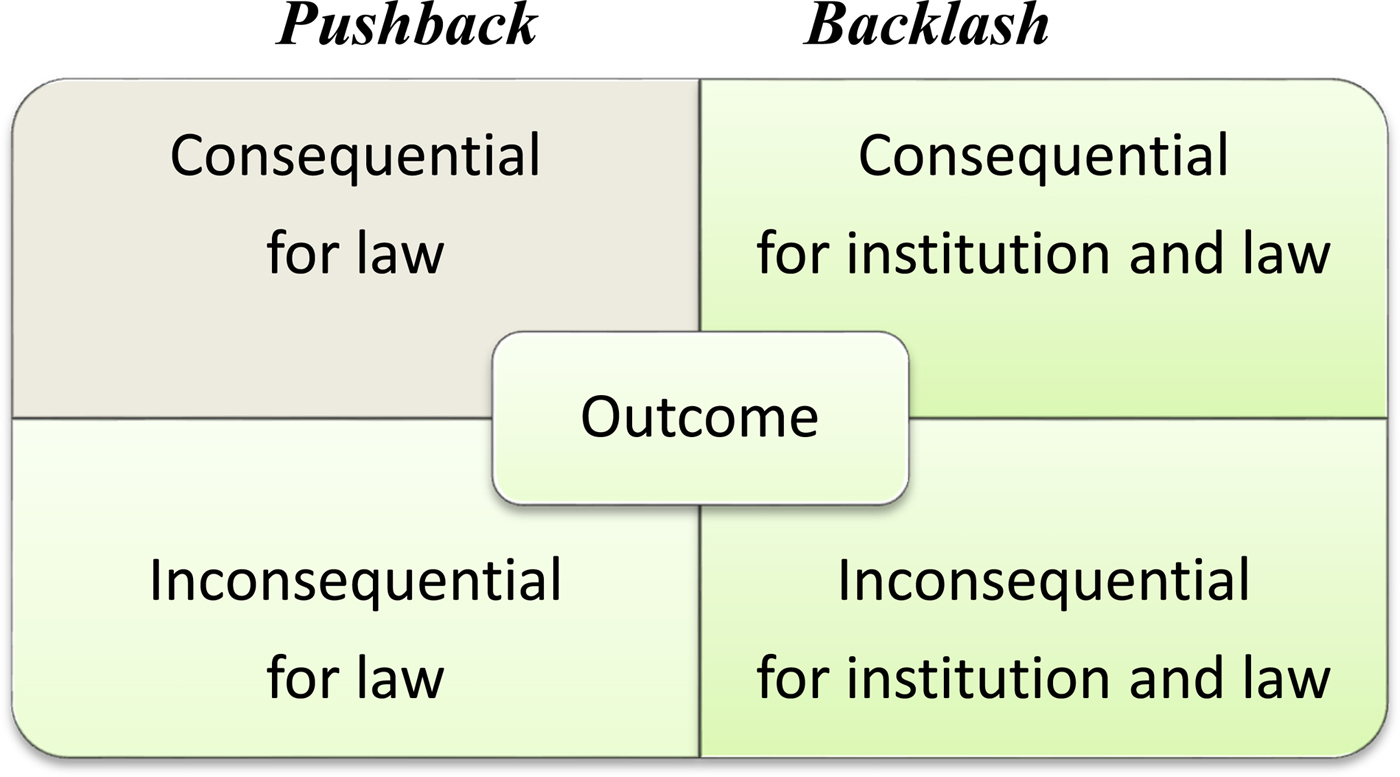
We have separated the question of the outcomes of resistance to ICs from the processes of opposition. As explained above, we did that for a number of reasons, one of them being to allow an analysis that considered the interplay of those opposing an IC and how the IC itself and its supporters reacted to that resistance. Yet, the outcomes of processes of resistance are obviously interesting. As a basic analytical framework, we suggest that the consequences of pushback and backlash can be visualised in a simple 2 × 2 matrix (Figure 1).
Outcomes of resistance to international courts.

As depicted in Figure 1, resistance can produce roughly four different general outcomes, depending on whether the resistance qualifies as pushback or backlash. Within the form of resistance we delineated as pushback, we include action leading to consequences or not for the development of law. Examples include the resistance to the development of law by an IC from, such as domestic courts seeking to change or reverse legal doctrine within a subfield of law. The most famous instances of such court-led resistance have been the skirmishes over the hierarchy between national courts and ICs. We have already cited studies of such conflicts with regard to the CJEU and the IACtHR. Another recent example is the struggle over supranational law in the CARICOM legal order and the role of the Carribean Court of Justice (CCJ) in this regard (Caserta, Reference Caserta2017; Caserta and Madsen, Reference Caserta and Madsen2016b). Such pushback can also be instigated by the agents of states before ICs, typically as a reaction to political pressure. Moreover, civil society actors might also initiate cases for reversing legal developments or intervene as third parties with those objectives before ICs. In terms of ordinary critique and resistance, these practices might or might not lead to consequences for the development of law. Even when they do not have immediate legal consequences, they send critical signals to the IC, which might influence its later decisions and judgments (Carrubba et al., Reference Carrubba, Gabel and Hankla2008; Larsson and Naurin, Reference Larsson and Naurin2016; for a different view, see Sweet and Brunell, Reference Sweet and Brunell2012).
Within the form of resistance we delineated as backlash, we include action leading to consequences or not for not only the development of law, but also the institution itself. The basic distinction between pushback and backlash is, as argued, whether the resistance seeks merely to counter developments in law or seeks to not only backslide the law, but also transform the institution. Within the broad category of backlash, we can further differentiate the outcomes. The main difference between outcomes in this regard are between those that somehow clip the wings of an institution by limiting its powers (procedural or substantial) and those that lead to the elimination of the institution as such. This corresponds to a difference between backlash leading to reduced power and backlash leading to diminished authority or no authority.Footnote 5 As an example of the former, we can mention the case of the EACJ, which was reformed as a reaction to its rulings on rule-of-law issues (Gathii, Reference Gathii2016) with the objective of controlling its further development in this area, including by establishing an appeals chamber and introducing new time limitations on filing cases. The 2012 Brighton Declaration can arguably also be seen as an attempt at reducing the power of the ECtHR (Madsen, Reference Madsen2016). As an example of actions challenging the authority of an IC, the case of the SADC Tribunal is illustrative (Nathan, Reference Nathan2013) but also an outlier. Backlash leading to the elimination of a tribunal has so far been very rare. The only other example of the elimination of an operational court is the collapse of the first CACJ.
Existing empirical studies of resistance to ICs provide many more examples of different outcomes. We will not detail those here but instead turn to some more general observations in this regard. A first general observation is that, in most cases, it is necessary to take a more long-term view in order to identify what events and mobilisations are consequential or not. We have already theorised how the processes of backlash often involve a transformation of resistance that in some instances starts as a legal-professional debate among insiders but eventually emerges as a broader critical movement. Empirically, those changes are observable in, for instance, language. As the resistance is no longer played out within the ordinary forms of criticism, it changes its code. It is no longer argued only in legal or diplomatic terms, but becomes a different and more direct political discourse that reflects different values, sensibilities and resentments.
Another general observation with regard to resistance to ICs and its outcomes is that the outcomes of pushback or backlash do not necessarily match the objectives that the critics originally campaigned for. An example is the aforementioned backlash against the EACJ, where Kenya initially sought to eliminate the court in the wake of some rulings that had allegedly expanded the court's competence in human rights matters. The court survived, but a new appeals chamber (among other modifications) was created to review the original court's rulings (Alter et al., Reference Alter, Gathii and Helfer2016a). In other instances, even though the goals of the backlash were formally achieved, they were not implemented. An example of the latter was the backlash against the current CACJ after its rulings in favour of President Bolaños of Nicaragua in the context of a failed coup d’état (Caserta and Cebulak, Reference Caserta and Cebulak2018). The response, when the losing parties had regained political power, was to strip the court of its competence to rule over separation-of-powers matters, but the reform was never implemented. Finally, we will find instances where there has been highly critical rhetoric but in practice no significant outcomes (at least so far).
These examples underline that it is important to separate the study of the internal mechanisms of resistance to ICs from the outcomes of those processes, as the outcomes seem to be mediated by a host of different factors, including time, civil society reactions and institutional reactions from the IC. Very often, in fact, the main outcome of the processes of resistance to ICs is critique in itself. Such a symbolic push against an IC might nonetheless have consequences, such as self-restraint on behalf of the court. Recent research has demonstrated that ICs are receptive to political signalling and this might influence their legal practices (Creamer and Godzimirska, Reference Creamer and Godzimirska2016; Larsson and Naurin, Reference Larsson and Naurin2016; Madsen, Reference Madsen2018b). These are outcomes that are not immediately visible, but consequential for the development of law. We turn to some of these effects in the following sections.
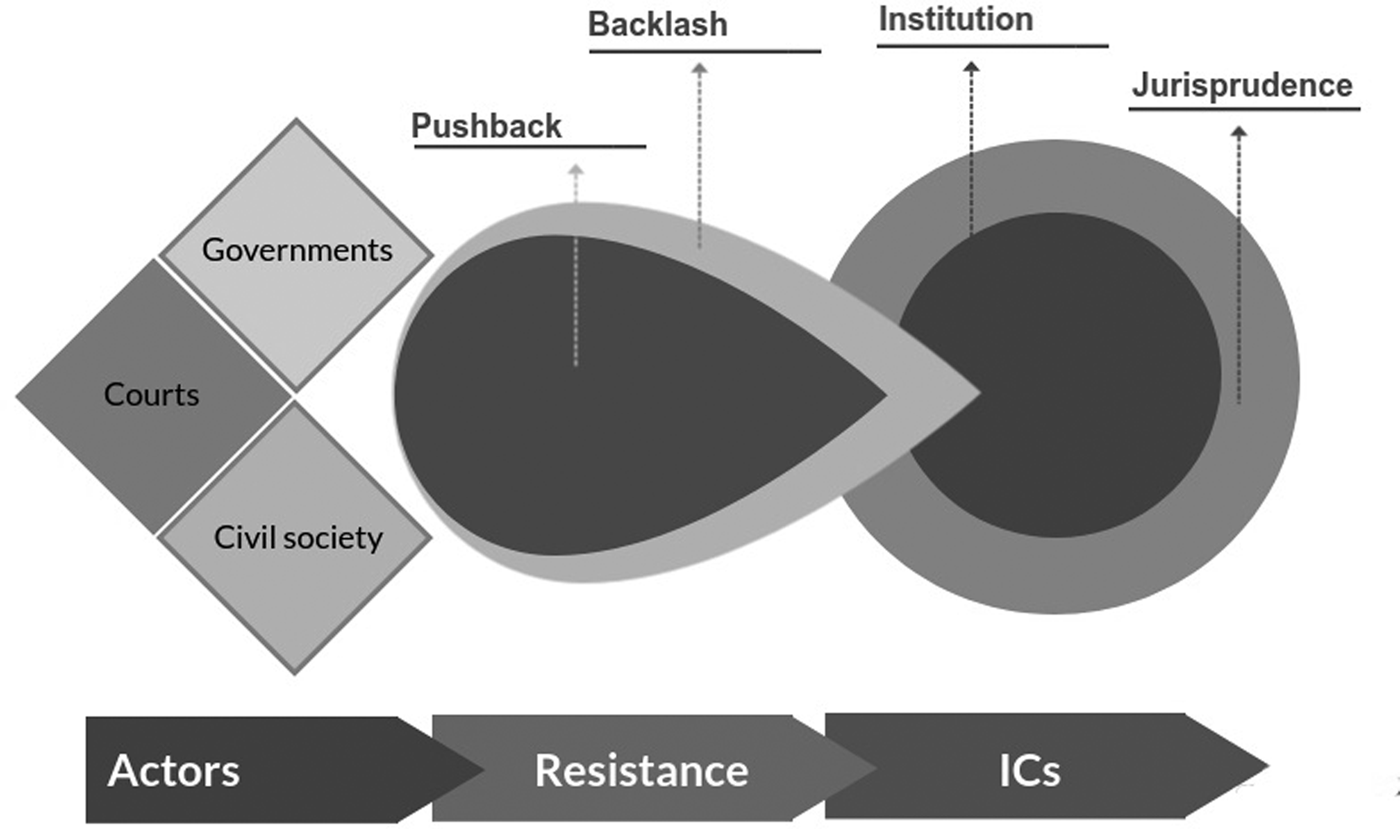
Considering these last observations on the outcomes of resistance to ICs, the different elements of our framework for analysing resistance to ICs can be integrated into a single model. The model is visualised in Figure 2.
Processes of resistance to ICs.

As depicted on the left in Figure 2, resistance typically starts with actions or reactions from national or transnational actors, including governments, civil society and courts. Other actors might also trigger a process of resistance such as practising lawyers, bar associations, academics, private businesses or business associations. These patterns of resistance are influenced by the specific constellations of actors mobilised and the kind of resources and power they bring to the campaign. The form of resistance is depicted in the middle of the figure, differentiating between the ordinary and extraordinary forms of critique in terms of pushback and backlash. This further corresponds with the target and objectives of the resistance, distinguishing between changes in law or institutional transformations as reflected in the two circles on the far right of the figure. However, as noted, ICs might react to resistance in various ways, thereby themselves becoming actors in these processes and influencing the ultimate outcomes. Processes of resistance to ICs are moreover influenced by the mobilisation of support for ICs. The next section turns to these internal dynamics of resistance to ICs.
3 Factors influencing resistance to ICs: a roadmap for empirical studies
This section provides a roadmap for empirical studies of resistance to ICs by identifying specific forms of resistance to ICs. Moreover, we are interested in the specific ways in which ICs might respond to such critique and thereby exercise agency in processes of resistance. Our goal is to provide guidelines with regard to detecting how resistance to ICs plays out in practice, using the general framework developed in Section 2. We therefore focus on the different forms of resistance in more detail, from public critique of an IC to expert critique of its institutional competences. We are moreover interested in the various resilience techniques deployed by ICs to mitigate the effects of such resistance, ranging from public outreach to subtle changes in interpretation. We then move on to identify contextual factors that affect the emergence and development of processes of resistance to ICs. The contextual factors include the scope of the resistance – from more limited groups of actors to resistance exercised in the context of broad transnational coalitions. In all cases, the aim is to locate concrete expressions of resistance and to link them to the discussed forms and patterns of resistance to ICs.
3.1 How are ICs challenged? Specific forms of resistance to ICs
Most types of resistance to ICs can be classified either as pushback or as backlash. There will, however, be forms of criticism that fall outside the scope of our object of inquiry. An IC might be criticised for not being progressive or interventionist enough by some actors. Such critique can be viewed as an encouragement for an IC to go further in its development of the law. Although such statements are critical of the status quo, they do not represent resistance to an IC in our framework of analysis. Similarly, actions against pushback or backlash – sometimes termed frontlash – also fall outside the scope of our inquiry. A more complicated type of behaviour, that in some instances can be a form of resistance, is discrete non-compliance by Member States, which is not always an expression of resistance. Non-compliance with a judgment is sometimes due to the elapse of deadlines, or institutional inertia. The implementation of some IC judgments might also take a very long time and involve multiple agencies of the state. Such instances of non-compliances do not represent resistance against an IC in our framework of inquiry. In line with our definition above, resistance is a reactionary action directed against the IC as an institution or its rulings. That means, conversely, that some forms of non-compliance will in fact be examples of resistance. For instance, the public opposition in the UK to the Hirst II ruling of the ECtHR (prisoners’ voting rights) and the original decision in parliament not to comply are undoubtedly examples of pushback (Madsen, Reference Madsen2016).
It should also be highlighted that we have chosen to focus on resistance to operational ICs. This generally excludes ‘paper courts’, namely ICs that – regardless of the existence of treaties formally establishing them – never have come into operation for various reasons. As shown by scholars, the twentieth century is replete with such never-operational ICs (Katzenstein, Reference Katzenstein2014). In some instances, the actions that have caused such institutions to remain paper courts might reflect resistance as defined in our framework but, as objects of inquiry, they are less interesting.
Our focus is on the two forms of resistance – pushback and backlash – and the processes they trigger, as well as the ultimate outcomes of such processes. Pushback is resistance exercised according to the ‘rules of the game’ and within the institutional system of the IC. Backlash is resistance aimed at changing the ‘rules of the game’ by limiting the competences or abolishing an IC altogether. This basic distinction between these two forms of resistance covers in practice a plethora of actions and types of critique. Moreover, to categorise an action as one of these forms of resistance will in many cases require contextual insights. For instance, a public statement criticising an IC can be within the bounds of ordinary critique of the system or exceed those, depending on who makes it, what its content is and how broad the support for it is. Nevertheless, against the backdrop of empirical studies, we can observe three main types of critique: (1) critique of the judicial functioning of an IC, (2) critique of its institutional set-up and (3) critique as negative public discourse regarding an IC. We will comment on each of them in turn.
3.1.1 Critique of the judicial functioning of an IC
Critique of the judicial functioning of an IC is the most common type and typically relates to (1) its membership, (2) its case-load, (3) access, (4) substantive elements of its adjudication or (5) compliance with its judgments.
Resistance with regard to the membership of an IC can occur when a Member State decides not to join a court or not to join it fully, such as by limiting its acceptance of the jurisdiction or the access of some actors. The ACtHPR has been facing such resistance through a limited approval of its jurisdiction – only thirty out of fifty-five Member States have accepted the jurisdiction of the court. An even more limited number of states have accepted access to the court by NGOs and individuals – only eight states have made such a declaration. This is not unique to the ACtHPR and in fact this problem of a tiered system of engagement has influenced the evolution of both the ECtHR and IACtHR (Huneeus and Madsen, Reference Huneeus and Madsen2018). Once a Member State has joined the jurisdiction of an IC, it can exercise resistance by threatening to withdraw, either partially or fully. This type of critique might challenge and even undermine the authority of an IC and can therefore be qualified as extraordinary critique. Examples of such backlash against ICs can be found inter alia in Latin America (Soley and Steininger, Reference Soley and Steininger2018) and Africa (Alter et al., Reference Alter, Gathii and Helfer2016a). The current Brexit discussion is another example.
Resistance to ICs can also be reflected in its case-load. Member States or private actors can deliberately – actively or passively – avoid bringing cases to the court, thereby minimising the effects of its adjudicatory function. This type of resistance is perhaps particularly widespread with regard to nascent ICs and such courts often – in response – adopt measures to activate their constituencies (Alter et al., forthcoming, Reference Alter, Helfer and Madsen2018). Resistance to an IC can also be expressed by the creation of a new or alternative legal institution. A new institution can either replace the IC or be created to co-exist alongside it. An example of the former is the Court of Justice of the EAEU that replaced the judicial body of the Eurasian Economic Community (Karliuk, Reference Karliuk and di Gregorio2016). This example amounts to backlash, as it seriously impairs the authority of the original court. However, the creation of a new judicial institution can also mean setting up a parallel institution that overlaps but does not replace the existing IC. Setting up such a parallel institution might, depending on the context, qualify as either ordinary or extraordinary critique. Ultimately, it depends on whether it aims at impairing the authority of the existing IC in part or in full. In Africa, the co-existence within in the field of human rights of a Pan-African human rights court, the ACtHPR and a number of subregional economic integration courts, such as the ECOWAS Court and EACJ, which have incrementally increased their mandate in the field of human rights, does not amount to a backlash in our framework. However, the co-existence of various courts with overlapping jurisdiction can create the option of avoiding an IC by ‘forum shopping’, which might amount to backlash. An important consequence can be that the IC is effectively deprived of the possibility to fully exercise its jurisdiction. A systematic and widespread avoidance of an IC can drastically limit its authority and, thus, amount to backlash.
National and transnational actors can also express resistance by limiting access to an IC. By amendments to its statutes, an IC can face restrictions of access, as well as its temporal and material scope of jurisdiction. This can in some circumstances be an expression of backlash, as it seeks to rewrite the rules of engagement with the ICs. On the other hand, pushback is also possible by contesting the court's jurisdiction at the admissibility stage of a particular proceeding. This ordinary litigation strategy can spiral up in terms of intensity of resistance when it gains broader support. For example, the temporal scope of jurisdiction has been a significant bone of contention in the early years of the IACtHR (Torelly, Reference Torelly and Engstromforthcoming, Reference Torelly and Engstrom2018). Another expression of resistance related to the procedural law of ICs is the lack of co-operation with ICs during proceedings. This can range from a total boycott of the proceedings to simply not showing up before the court or not replying to briefs. These forms of boycott can be either case-specific or systematic. The latter will amount to backlash, as it clearly challenges the authority of the court.
Resistance can also be triggered by substantive law aspects of international adjudication. It can be prompted by a singular case that triggers pushback within a particular issue area or is turned into a more general backlash against the IC as such. This was the case, for instance, with regard to the issue of the death penalty before the Inter-American system, where tensions emerged between national and regional law that eventually led to the withdrawal of Trinidad and Tobago (Soley and Steininger, Reference Soley and Steininger2018). However, the decision to reject the application of the case-law from ICs can also occur more silently. National courts and institutions can simply ignore relevant judgments of ICs or relevant provisions of international or regional law. Even though this might happen for a host of different reasons, including lack of knowledge of international and regional law, its systemic occurrence can be qualified as a form of resistance (Hofmann, 2018).
Non-compliance with the judgments of ICs can involve both pushback and backlash, as discussed. Systemic non-compliance goes beyond single cases and often involves key institutions of the Member State, including parliaments and courts. For instance, Russia and the UK have resisted the ECtHR in different forms. In both countries, one of the initial disagreements was between the highest national courts and the ECtHR on prisoners’ voting rights (Mälksoo, Reference Mälksoo2016). The domestic courts were opposing the ECtHR's case-law, which prescribed the liberalisation of blanket voting bans for prisoners. In the UK, this judicial conflict entered the political level and contributed to an agenda aimed at limiting the power of the ECtHR. This pushback eventually inspired the 2012 Brighton Declaration in 2012 (Madsen, Reference Madsen2018b). In Russia, on the other hand, the judicial conflict over prisoners’ voting rights was one of the reasons for the adoption of a legislative act giving the Constitutional Court the power to declare ‘impossible to implement’ judgments of a human rights body if inconsistent with the Russian Constitution. In 2016, the Russian Constitutional Court applied this doctrine and declared the case Anchugov and Gladkov v. Russia impossible to implement.Footnote 6
There is no doubt that the Russian case exemplifies strong resistance to an IC. But whether this will translate into pushback or backlash depends in practice on how systematically and frequently it will be used. If the Russian Constitutional Court will only use this new power very sporadically, it might only result in limited or partial non-compliance. Limited compliance will also be the case if the doctrine is only used with regard to a particular subset of cases, such as those concerning prisoners’ voting rights. Partial compliance is different but related. This is restricted compliance with only parts of an individual judgment. This will be the case if Member States only comply with some remedies prescribed by the IC and leave others unimplemented, for a variety of reasons ranging from lack of political will to lack of institutional and financial capacity. This can happen, for instance, when a respondent state before the international human rights courts pays the compensation to the victims of human rights violations, but continues the practice of said human rights violation. This has been the case in Russia, for example (Provost, Reference Provost2015).
3.1.2 Critique of the institutional set-up of an IC
The second category of resistance relates to the institutional arrangement of ICs. Resistance directed at tinkering with the institutional set-up and functioning of ICs by suspending or dissolving the IC or some of its important judicial procedures will most often classify as backlash. A soft strategy used in this regard is tampering with the budgets of ICs by threats of withdrawal of funding, which in some cases might challenge their de facto authority. It is important, however, to note that resistance related to the institutional functioning might also be part of ongoing reform processes that do not seek to challenge the IC's authority or core functions. This would fall within the category of ordinary critique or pushback. The 2012 Brighton Declaration exemplifies this.
Another example related to institutional functioning is the blocking of certain candidates for appointment to an IC, typically because the candidate is perceived to represent a particular direction of international law that is unfavourable to some Member States. Or, alternatively, by promoting candidates who are highly sceptical of ICs. In most cases, this will qualify as pushback. However, if the actions are directed at rendering an IC non-operational and it thereby loses its authority, it then amounts to a backlash. Therefore, a continuous blocking of appointments not because of political opposition to a particular judge, but to render a court non-functional, can also amount to a backlash. The WTO Appellate Body is currently facing such a situation as a result of the US continuously blocking nominations for new appointments (Shaffer et al., Reference Shaffer, Elsig and Pollack2017). Blocking strategies has also been used in the context of the SADC Tribunal and the EACJ (Alter et al., Reference Alter, Gathii and Helfer2016a). Moreover, tampering with judicial independence can amount to backlash, such as by putting pressure on serving judges or unfairly dismissing them before the end of their term.
3.1.3 Critique of ICs as negative public discourse
The final subcategory of resistance relates to negative public discourse on ICs. Negative statements about ICs can be examples of pushback or backlash, depending on their context. Such discourse on ICs may take a number of forms and patterns. As to forms, these include (1) critique of the quality of the legal reasoning or methods of an IC, (2) critique of the outcome of an IC judgment and (3) critique based on general popular resentment towards ICs (and often international organisations and society more generally). These forms of critique overlap in part with the discussion of resistance to ICs’ judicial functioning or their institutional set-ups. They can, however, also be general and express broader resentment to ICs.
As to patterns, these include one or more of the following: (1) critique by state officials via public statements in the media, (2) critique by state officials via statements in the institutional channels of international organisations, (3) critique deriving from transnational legal communities (including international and domestic judges) in professional outlets or the media, (4) critique deriving from politicians either in popular media or via the institutional channels of parliament or international organisations and (5) critique by ordinary citizens in op-eds, public discussion and the like. This is by no means an exhaustive list and other actors and patterns could be added.
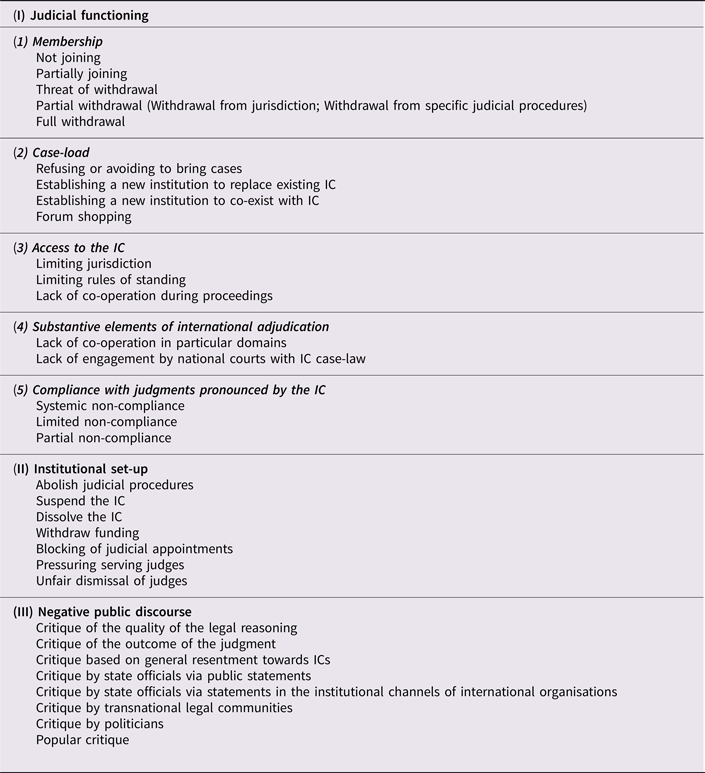
To give an example, public officials can make statements using either the institutional channels of international and regional organisations or official or unofficial statements to media outlets, or both. This critique can come in different forms and with different targets. The authority of a court can be affected by negative statements about its legal reasoning and methods, by substantive critique concerning its judgments or by more general resentment towards an IC or ICs as such. Similarly, a negative discourse in transnational legal communities, among politicians and the broader public, may take these forms – or combinations thereof. As empirical studies demonstrate, negative public discourse on ICs is sometimes only vaguely connected to the actual operation of ICs. Rather than actual legal discussion, they are more often triggered by perceptions of ICs. Such perceptions, whether based on facts or not, might feed into processes of resistance to ICs and contribute to the actions of key players, including Member State governments. For instance, in regime transitions, the judicial bodies tend to be perceived as reactive (May, Reference May2014). In all cases, however, the main distinction remains the same, namely whether they are merely ordinary critique within the bounds of a legal system or they seek to undermine the authority of an IC. But what makes them differ from other forms of critique is their more ambiguous nature. It is not possible to cover all the empirical instances of such critique and we have instead compiled a set of typical articulations in Table 1.
Forms of resistance to ICs.

3.2 Responding to resistance: techniques of judicial resilience
One benefit of our approach of emphasising processes of resistance to ICs is that it allows studying how ICs themselves are actors within such processes. Rather than being passive observers, ICs can deploy a host of techniques to either pre-emptively prevent resistance or mitigate the effects of resistance. In the following, we outline various resilience techniques used by ICs, first with regard to pre-empting critique and second with regard to mitigating the effects of resistance.
In order to prevent critique, the most obvious tool available to international judges is legal reasoning. ICs can, for example, engage in extensive comparative legal reasoning and frame their legal arguments within a broader context. This use of comparative legal techniques can take place either at the international level by referring to case-law of other ICs or by engagement with the national level, where an IC will rely on the legitimacy of domestic judicial systems to support its claims (Voeten, Reference Voeten2010). For example, the ACtHPR often refers to the ECtHR and the IACtHR in its case-law. ICs can also seek to prevent resistance by relying on external expertise to present certain aspects of their judgments as dictated by non-legal expertise and beyond debate. The reliance on expert studies and reports has been subject of academic debate, particularly in the context of international criminal law (Appazov, Reference Appazov2016). The level of engagement with the parties’ arguments can also be indicative of an IC taking a more cautious approach.
A comparison between the legal-reasoning style of the two European courts of the ECtHR and the CJEU illustrate, however, that it is very difficult to generalise in this regard. While the ECtHR delivers extensive judgments summarising and responding to arguments raised by the parties and include dissenting opinions, the CJEU adjudicates in a briefer style and without dissenting opinions (Bengoetxea, Reference Bengoetxea1993). The approach of the ECtHR may be regarded as a resilience technique in this regard. When faced with very controversial issues, it might resort to more elaborate legal reasoning. Particularly when a decision is likely to trigger resistance, it may deem it necessary to develop in detail its legal arguments, including its engagement with the arguments of the parties, to support a decision. The reasoning of the CJEU is more laconic and without dissenting voices. It would, however, be a mistake to see that as a less effective way of pre-empting critique than the extensive reasoning of, for instance, the ECtHR. Although it remains an open question which one of these reasoning styles is the most effective, there is little doubt that any reasoning that IC audiences find erroneous or amiss is likely to trigger resistance.
What most likely is important in this regard is not the way an IC reaches its conclusions, but the conclusions it reaches and the implications these might have for its constituencies. Scholars have long pointed to the fundamental legal diplomacy exercised by ICs in terms of stating legal bold principles but carefully considering the consequences to the Member States of those rulings. Karen Alter, for example, notes that ‘the early jurisprudence of the CJEU shows clear signs of caution. Although bold in doctrinal rhetoric, the CJEU made sure that the political impact was minimal in terms of both financial consequences and political consequences’ (Alter, Reference Alter2001, p. 115). Madsen has shown how the ECtHR in its early jurisprudence managed to balance the development of principles of law with political sensitivity towards the Member States, labelling this cautious judging ‘legal diplomacy’ (Madsen, Reference Madsen and Hoffmann2011). A study of the CCJ suggests that similar judicial strategies have been deployed by Caribbean judges (Caserta and Madsen, Reference Caserta and Madsen2016a).
Another way diplomacy might be exercised by judges is by using carefully balanced language or by developing doctrines of subsidiarity that allow deference to domestic actors, typically courts and parliaments. The ECtHR has famously developed the margin of appreciation doctrine to lower the scrutiny of its review where there is no European consensus among the Member States on a particular issue or where the domestic courts have already conducted a thorough review (Arnardóttir, Reference Arnardóttir2017). Proportionality is deployed by practically all international human rights courts and can also serve as tool for deference – both to domestic courts or political institutions. A particular articulation of deference to political institutions and processes is when ICs refuse to adjudicate on political questions (Odermatt, Reference Odermatt2018). Other techniques that ICs can deploy, and which might help to limit or deflect resistance, are to encourage a decentralised application of the law. ICs can empower national judges to apply international and regional law and case-law directly, as seen, for instance, with the development of the conventionality control doctrine of the IACtHR (Burgorgue-Larsen, Reference Burgorgue-Larsen, Haeck, Herrera and Chiriboga2015; Dulitzky, Reference Dulitzky2015) or with the doctrines of primacy and direct effect in the EU (Alter, Reference Alter2001). The recently developed subsidiarity doctrine of the ECtHR, following the 2012 Brighton Declaration, is also rebalancing the space of European human rights in favour of national institutions (Madsen, Reference Madsen2018b).
In addition to these various techniques of avoiding or deflecting resistance, ICs can also use legal tools to diminish the effects of resistance. First, when an IC is mostly ignored, it can interpret its rules on standing in an expansive way to facilitate access to the court. An example of this can be found in the ECOWAS Court of Justice in relation to the standing of NGOs and the exhaustion of national remedies requirement (Alter et al., Reference Alter, Helfer and McAllister2013). An entirely different way ICs can seek to limit critique is by developing a flexible relationship with its own case-law. It can do so by following, distinguishing or even overruling its previous decisions. Here, the IC can show itself to be attuned to political signalling and adjust some of its legal practices. An example of this can arguably be found in the jurisprudence of the ECtHR on voting rights, where the court seems to have retreated from an initial overreach (Madsen, Reference Madsen2016, p. 171).
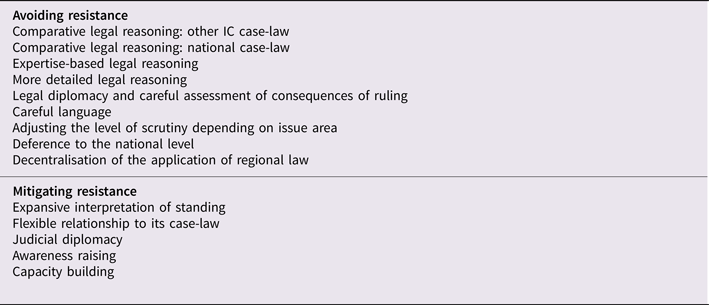
Besides these adjudicatory techniques, ICs can also directly or indirectly engage with relevant audiences to develop support. These practices include out-of-court judicial diplomacy, where, for instance, the court directly lobbies Member States to accept a protocol to its constitutive treaty, to expand its jurisdiction or to extend access to the court. Judges of the ACtHPR, for example, frequently engage with heads of state and other high-level officials during ‘sensitisation’ missions to convince them to issue a special declaration allowing individuals and NGOs to access the court (Daly and Wiebusch, Reference Daly and Wiebusch2018). Similarly, the CCJ has sought to expand its appellate jurisdiction by a host of outreach activities (Caserta, Reference Caserta2016). In practice, ICs and their judges are commonly engaged in such out-of-court activities to, for instance, raise awareness about the court or engage in capacity building via press statements, seminars, conferences, training and other forms of information sharing. Table 2 summarises these various judicial resilience techniques.
Judicial resilience techniques

3.3 Patterns of resistance: contextual factors influencing resistance and counter-resistance to ICs
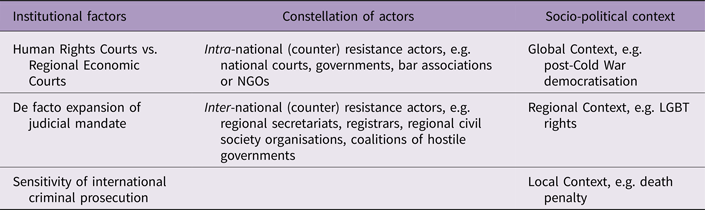
Drawing on our model for understanding resistance to ICs, this section briefly looks into other factors influencing resistance to ICs and what might mitigate them in addition to the already outlined resilience techniques. As the many case-studies cited in this paper suggest, similar forms and patterns of resistance can lead to very different outcomes. What seems to have the most influence on the direction of pushback and backlash are a set of contextual factors, including institutional factors, the constellation of actors involved in resisting or counter-resisting ICs, and the broader social and political contexts of the processes. We address each of these three sets of factors in turn.
With regard to the institutional factors, we have already dwelled on critiques of the judicial functioning of ICs and their institutional set-ups. But other institutional factors seem to matter in this regard, notably differences in the putative subject-matter jurisdiction of ICs. Human rights appear to be an issue area particularly prone to causing tensions between ICs and national institutions, even society at large. On the one hand, dedicated human rights ICs are often adjudicating cases stemming from politically sensitive areas. As the cited literature indicates, this is likely to produce critique and pushback but only rarely does it amount to backlash. This suggests that specialised human rights courts are operating in sensitive legal areas, but there is generally an acceptance of their authority to do so. On the other hand, when other ICs, typically regional economic courts, venture into the field of human rights and thus outside of their putative main mandate, we find that resistance to them is more likely to trigger backlash. It prompts critique directed against not only the outcome of their judgments, but also their assumed competence and authority with regard to human rights law.
Several organisations of regional economic integration now include ICs that adjudicate human rights disputes. While the ECOWAS Court has had its jurisdictional scope expressly extended to human rights in a protocol, the SADC Tribunal, the EACJ and the CJEU have included human rights in their jurisdictions by jurisprudential action. The SADC Tribunal applied the rule of law as a general principle of the regional legal order and faced backlash, leading to its suspension and de facto abolition. The EACJ also experienced severe backlash from one Member State, Kenya, which was partially successful, as it led to a significant institutional reform of the court. Other ICs, such as the CCJ and the CACJ, have steered clear of venturing into human rights matters outside their formal jurisdiction. An exception to this tendency is perhaps the CJEU, which for decades has incrementally developed and maintained a doctrine of fundamental rights as general principles of EU law. In 2009, the Member States even opted for adopting the Charter of Fundamental Rights of the EU, thereby codifying this practice. We do not specifically deal with international criminal law in this special issue, but it is well known that this area of law is also highly controversial. The reason for pushback and backlash is, however, not whether these ICs are entitled to rule on these matters (with the exception of questions related to the immunity of heads of state). This critique stems instead from the controversial nature of prosecution of individuals, from the Member States, for the most heinous international crimes.
The second general factor influencing processes of resistance to ICs is the constellation of actors involved in these processes. We have already discussed how different constellations of actors can mobilise critique against ICs. As noted, resistance often starts with a particular actor or group of actors opposing an IC. Those can be the highest court, the national government, bar associations or NGOs working in a particular issue area, as well as others. This resistance can then escalate both in terms of spreading to other actors and other Member States, as well as intensifying from pushback to backlash. Moreover, as described, certain forms of actions require the involvement of governments, notably in many of the actions we describe as backlash: institutional reform, blocking appointments or withholding funding. Equally important, however, are the actors who oppose the critique and instead support ICs in such contexts. Due to the fact that the rules of most regional organisations require consensus, even unanimity, for decision-making, institutional reform requires broader support from the Member States. The examples of the relative and reduced backlash against the ECOWAS Court and the EACJ underline the effects of counter-resistance. In both cases, the states starting the actions were countered by other Member States and civil society actors (Alter et al., Reference Alter, Gathii and Helfer2016a).
Individual states have in fact limited tools available for unilateral backlash: non-implementation, non-participation or withdrawal. Even the actions of a broader coalition in one country, such as involving actors from the judiciary, executive and legislative branches, are most likely to lead to non-compliance or withdrawal rather than abolition of an IC. To achieve institutional reform requires a broader coalition. But, even then, actors – and constellations of actors – countering such actions might deflect it or even neutralise its effects. The constellation of actors countering resistance to ICs is analytically just as important as the constellations of actors seeking resistance. Empirical studies suggest that constellations of actors that involve both national and regional civil society organisations and the support of some Member States can effectively counter attempts at backlash against ICs. Moreover, regional institutional players such as secretariats and registrars can play important roles as defenders of ICs.
The effects of resistance to ICs seem also to be mediated by the general socio-political – global, regional and local – contexts of their operation. Some issues have a particular resonance in a specific region, such as capital punishment in the Caribbean or LGBT rights in Eastern Europe, or specific countries, such as prisoners’ voting rights in the UK or abortion in Ireland. When the issue is specific to one country or small region of the membership, it is likely to be deflected by other Member States and civil society. Yet, when there is general interest in the region in the issue, mobilisation against an IC might gain momentum. This was, for instance, the case with the resistance to the ICC in a host of African countries (Clarke et al., Reference Clarke, Knottnerus and De Volder2016). Conversely, broader contexts might also facilitate the project of an IC. For instance, the post-Cold War democratisation context generally created favourable conditions for ICs. This correspondence between broader – domestic, regional or global – socio-political contexts and processes of resistance to ICs is, however, harder to pinpoint empirically. Moreover, as discussed earlier, general trends might trigger new cleavages in society. In all cases, these broader contexts influence processes of resistance to ICs and need to be considered in empirical studies.
Patterns of resistance – contextual factors

4 Conclusion
The key objective of this paper is to develop an analytical framework for the study of resistance to ICs. We have deliberately sought to develop the framework on general theoretical grounds in order to avoid the bias of Eurocentrism that has hampered much research of ICs. Although many regional ICs are inspired by the two European courts (the ECtHR and the CJEU) notably at the institutional level, the legal and political skirmishes we document are for the most part triggered by local or regional specificities. There is a very rich body of empirical literature regarding the CJEU, but it is not immediately applicable to other regional legal systems and courts due to the significant differences in the ways in which the various regional regimes work in practice. In our view, explaining resistance to ICs as a more global phenomenon requires a general theory that is conducive to conducting empirical studies of resistance to ICs.
Although the goal of this paper is theoretical and conceptual, we can nevertheless draw up a set of more empirical conclusions. A first key conclusion is that backlash against ICs is in fact very rare. There has been plenty of critique of ICs both historically and contemporarily, but only rarely has it seriously challenged and changed the authority of ICs. We suggest this is due to the many forces at play that seem to form counter-resistance to ICs, ranging from legal rules to the actions of ICs and their supporters.
Second, we can observe that patterns of resistance to ICs can change abruptly and do not seem to follow the same stages of evolution across different cases. Resistance to an IC can start as a pushback by one country on a particular issue and then quickly escalate to a broader backlash against the whole institution. However, it can also start directly as an attempted backlash, such as from the government, and then translate into some more insulated instances of pushback by courts or other agents. In most cases, however, it will be blocked or deflected by counter-mobilisations by other states or civil society, or both. All of this suggests that, although ICs in some ways are fragile institutions more prone to meeting resistance than for example domestic courts, they ultimately are fairly robust due to their structural legal set-up and their many potential supporters.
Third, critique and resistance to ICs do not necessarily lead to a disempowerment of ICs. Considering the set-up of ICs as often operating at a significant distance to immediate political checks, the critical input of governments or civil society actors might in the long run be beneficial to them, as it provides information – legal or political – that they might otherwise not have been aware of (Madsen, Reference Madsen, Mendes and Venzke2018a). In that sense, critique of ICs – even harsh critique from failed backlash attempts – might help the IC in the long run.
Fourth, and finally, are we witnessing a general decline of ICs as assumed in much of the recent literature? Using as a benchmark our literature survey and theoretical discussion, ICs do not appear to be in an existential crisis, neither are they generally disappearing from the map. Yet, there are general tendencies in the existing set-up of ICs towards pushback and stagnation. Currently, we do not observe exponential growth in the number of cases adjudicated by ICs or the creation of significant new institutions. This suggests that the proliferation of ICs over the past two decades has, if not come to an end, then at least slowed down. The many instances of pushback moreover suggest that what is currently occurring is a rebalancing of the relationship between ICs and domestic institutions. If we view the emergence of international organisations and ICs as part of a general response to growing international social, legal and political interaction over the past 100 years, it will take substantial and sustained collective action to transform that structure. The examples of pushback and backlash we can observe with regard to ICs are not of that magnitude. In fact, they might better be viewed as evidence of the importance of ICs in contemporary globalising society – and the frictions such societal evolution inevitably triggers.
Acknowledgements
This research is funded by the Denmark-Brazil Network on Regional and Constitutional Structures in Tension (RCST) (no. 6144–00110) and the Danish National Research Foundation Grant no. DNRF105 and conducted under the auspices of iCourts. Thanks to the participants at the Backlash Workshop, Berlin/Steinhöfel, 27–28 October 2017, especially Karen Alter and Michael Zürn.