The prevailing discourse about late eighteenth- and early nineteenth-century women farmers could be summed up by Leonore Davidoff's work on the trend initiated by middle-class entrepreneurial families for men and women to operate in separate spheres, which saw a woman's place as in the home, and which placed greater emphasis on the role of the male breadwinner who engaged with the outside public world. In her study of women farmers in Essex, Davidoff found that during the period 1780 to 1850 it became increasingly difficult for the widows and daughters of farmers to take over farm management. Landowners often regarded them as incompetent and required them to appoint a bailiff before allowing them to take over a tenancy, or have a son help them run the farm. Women had difficulty in gaining access to capital, in managing a predominantly male labour force, and in marketing their goods. Where widows did take on farm management, they often farmed as a ‘holding operation’ until a son was old enough to take over.Footnote 1 But as has become increasingly clear, the agrarian trends in the south and east were not always representative. Indeed there remained wide variation in regional social and economic practice.Footnote 2
The decline in women's economic roles in the eighteenth and nineteenth centuries, outside the bastions of female employment in the textile industry, has frequently been linked to the decline in household production and the family economy, which had made it easier for women to combine work and family roles.Footnote 3 In agriculture, a number of social and economic changes, including growing regional specialisation, the increased use of the scythe, the acceleration of enclosure and the commercialisation of the dairy industry, altered the division of labour between women and men.Footnote 4 As farm size grew, and more landless male labourers were available for employment, the work of women and children declined.Footnote 5 Amongst middle class women, it has also been argued that female withdrawal from active enterprise was essentially a function of increasing wealth. Women who could afford to do so found it easier to operate as a landlady, money-lender, rentier or investor than to run a male business in a male world.Footnote 6 By 1700, larger farms where the majority of the work was supplied by wage labour predominated in the south-east of England. The proportion of land occupied by family farms where family members supplied most of the labour continued to decline, and by 1851, a substantial family farm sector survived only in the far south-west and north of England.Footnote 7 These developments contributed both to fewer opportunities for women in England to become farmers, and perhaps to a declining desire amongst women themselves to do so.
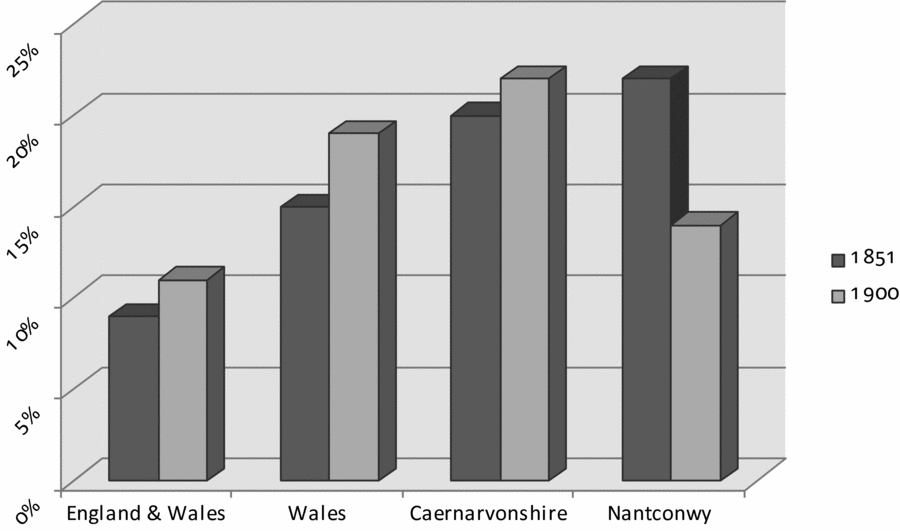
During the nineteenth century the proportion of women in charge of farms was rather higher in Wales than in England. In 1851, fifteen per cent of Welsh farmers were women compared to nine per cent in England and Wales as a whole, with Caernarvonshire having one of the highest percentages within Wales. These women were predominantly widows. During most of this period, married women could not hold property in their own right and were designated in the censuses as ‘farmer's wife’ or having no occupation. Both the percentage and the absolute number of women farmers in Wales increased during the late nineteenth century, as more men than women left farming, although Nantconwy seems to have gone against this general trend (see figures 1 and 2).
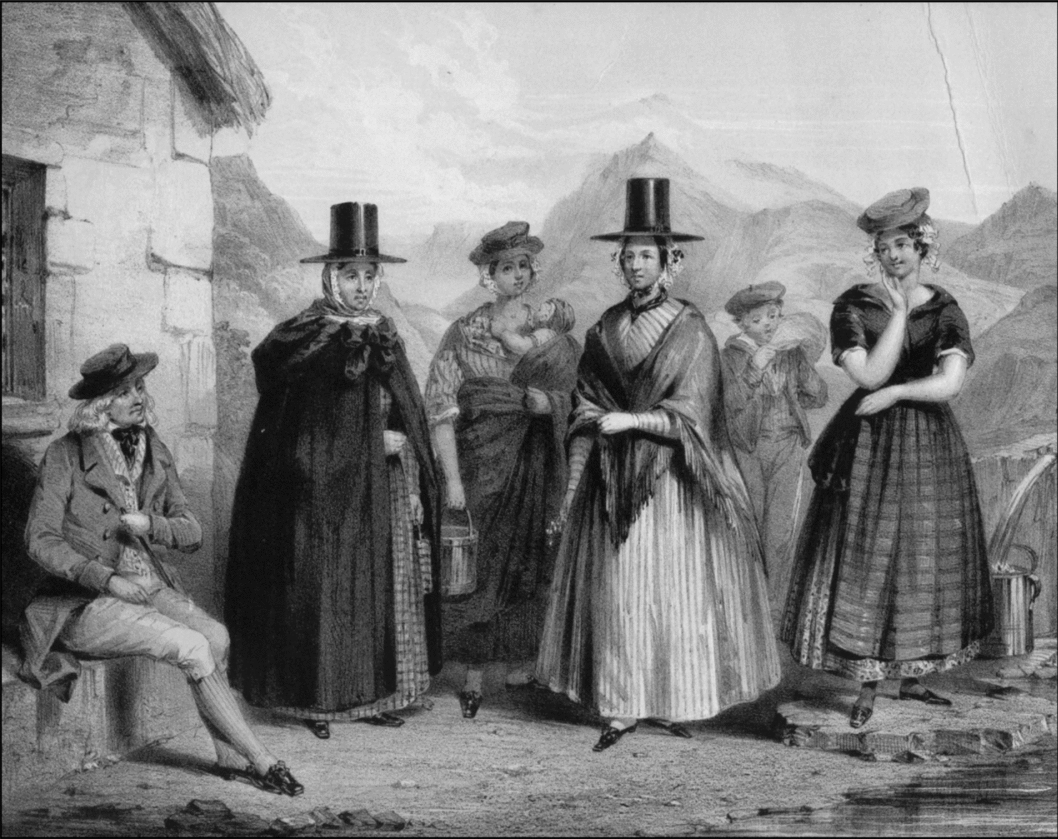
Snowdonia farming women, c.1850.

Proportion of women farmers, 1851–1901.
The hundred of Nantconwy in south-east Caernarvonshire comprised the parishes and townships of Trefriw and Llanrhychwyn, Bettwys y coed, Dolwyddelan, Penmachno, Gwydir and Eidda, its land rising from the lowlands of the Conwy valley to the mountaintops of Snowdonia. The area was very sparsely populated, with scattered farms and few villages until the late nineteenth century. The hundred depended for most of its services on the market town of Llanrwst on the Denbighshire bank of the River Conwy. During the eighteenth century, cattle farming formed the mainstay of the local economy, although most farms had a small arable area growing oats mainly for home consumption, with some wheat and barley in the more sheltered valleys. Sheep farming grew in importance throughout the period, especially in the later nineteenth century.
Data on women farmers
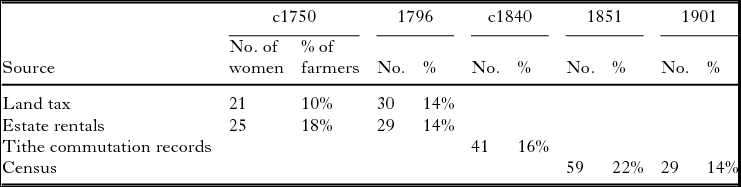
Before census occupational data became available in 1841, the proportion of women farmers was estimated from land tax returns for the period 1748 to 1810. Tenants and farm size data were available from estate rentals and surveys and from the tithe commutation records from around 1840. With the exception of tithe recipients and excise officers, all land tax payers in Nantconwy occupied farmland. The minimum size of farm paying tax in 1748 was nine acres in the more fertile Conwy valley, although the median size for farms occupied by women, where this could be ascertained from contemporary estate records, was ninety-eight acres. The 1748 land tax returns suggested that ten per cent of Nantconwy land occupiers were women, but estate rentals told a different story. On the Berthddu, Gwydir and Penrhyn estates which owned nearly all the land in six of the eight Nantconwy parishes, eighteen per cent of farm tenants in 1750 were women (see table 1).Footnote 8
Nantconwy women farmers 1750–1900.
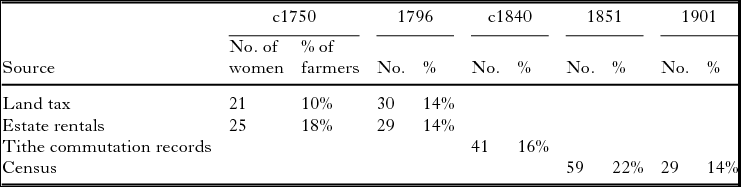
Sources: Nantconwy Land tax returns, 1748 and 1796; estate surveys and rentals for Berthddu, Gwydir, Mostyn, Nerquis Hall, Penrhyn, Soughton Hall and Wynnstay farms in Nantconwy; tithe commutation records for Bettwys y coed, Dolwyddelan, Gwydir, Penmachno and Trefriw and Llanrhychwyn; 1851 and 1901 census enumerators’ records.
The under-recording of women in the 1748 land tax records arose for several reasons. By 1750, many of the traditional farm units, some of which were named as early as the 1352 Record of Caernarvon, had been subdivided into two or more holdings, although often only the tenant of the traditional main holding was named in land tax records.Footnote 9 Estate rentals, on the other hand, usually recorded women as tenants in their own right, or occasionally sharing a holding, which men also did. Tax records were also more likely to be out of date, often recording a woman occupier's husband as the taxpayer for several years after his death. Overall, it seems likely that the proportion of women farmers around 1750 was closer to the eighteen per cent shown in estate rentals.
By 1800, population growth had led to more farms being sub-divided, increasing the number of holdings paying land tax by thirteen per cent. In spite of the growing competition for farms, the number of women tax payers had increased to fourteen per cent. The breakdown of land tax to individual holdings clearly produced a more accurate picture. An analysis of 207 Nantconwy tenants of the Gwydir, Mostyn, Nerquis Hall, Penrhyn, Soughton Hall and Wynnstay estates around 1800 also showed fourteen per cent of farms being held by women.Footnote 10
The tithe commutation records of around 1840 provide an even more detailed picture of Nantconwy landowners and tenants. Sixteen per cent of holdings of over eight acres were tenanted by women. Eight acres was taken as the typical landholding at which farming was the main occupation, and similar to the minimum size of holding paying land tax.Footnote 11 The average size of Nantconwy farms held by women was virtually identical to those held by men, with women holding 16.6% of farm acreage.Footnote 12 The higher percentage of women farmers recorded in the 1851 census (twenty-two per cent) suggests that a number with holdings of less than eight acres may have recorded their occupation as farmer.Footnote 13
Access to land
As over ninety per cent of the land in Nantconwy was owned by a small number of major landowners, obtaining a farm tenancy was the first requirement for women to become farmers. The practice of widows taking over farm leaseholds or copyholds had been widespread in England at earlier periods. However the number of yeoman family farms decreased rapidly in the English midlands during the eighteenth century, as landlords stopped renewing beneficial leases and leases for lives in order to create larger farms let at rack rents.Footnote 14 In Wales however, the survival of a custom of virtually hereditary tenancies enabled farmers’ widows and daughters to take over farm tenancies, despite the change to rack rents. Leases, usually for seven or twenty-one years, had been prevalent in Caernarvonshire during the seventeenth century. Nantconwy tenant farmers typically bequeathed the residue of a lease to their wife or other family members. Once a woman had demonstrated her ability to run the farm successfully, she could then apply for a new lease. By the late eighteenth century, annual tenancies at will were becoming the norm, but landowners appear to have been happy to continue the long-standing tradition of giving the widow the first option on the farm.Footnote 15 This practice was confirmed in evidence to the 1890s Royal Commission on Land in Wales and Monmouthshire. Landowners quoted numerous examples of de facto hereditary tenancies, where the same family had occupied a farm for over two hundred, and in some cases up to five hundred, years. For example, Colonel Hughes of the Wynnstay estates, the largest estate in Wales, stated that: ‘I cannot recall any case where the widow was not allowed to succeed her dead husband as tenant if she so wished, or failing her, the son or other near relative.’Footnote 16 Colonel the Honourable W. E. Sackville-West confirmed a similar practice on the Penrhyn estate in Caernarvonshire, where 167 farms had been held by the same families for fifty years. The Gwydir estate in Nantconwy clearly followed the same custom with one tenant in the 1890s, Bleddyn Lloyd of Gorddinen, being descended from the Madoc ap Blethyn Loyt mentioned in the fourteenth-century Record of Carnarvon.Footnote 17
A number of factors might account for the late survival of de facto hereditary tenancies in Wales. In the mid eighteenth century, stewardship of many north Wales estates remained largely unprofessional and in the hands of leading tenants or lawyers who were concerned mainly with collecting the rents. Ensuring that farms remained tenanted was a major priority, and the succession of other family members avoided the risk of farms remaining ‘on hand’ producing no rent or requiring the agent to farm the holding himself.Footnote 18 Furthermore, it was not easy for outsiders to take on the mountain holdings prevalent in Nantconwy. Hill farming involved different skills and a distinct way of life, as the Caernarvonshire topographer William Williams of Llandegai described:
The mountain people presume themselves in great measure a distinct race from the lowlanders; they but seldom come down to the lowlands for wives. . ..Their occupations are different, and it requires that their mates should be qualified for such different modes of living.Footnote 19
As sheep numbers increased during the nineteenth century, the practice of cynefin, that is, hefting sheep to know their unfenced boundaries on the mountains, passed on from ewe to lamb, also meant that maintaining the same stock on a mountain farm became of great importance, and this was easier to achieve if the tenancy were taken over by a family member who also inherited the stock.
The attachment of farmers from north Wales to their family holdings also created an important bond between tenants and landowners. This attachment was typified in Daniel Owen's novel Gwen Tomos, where the hero relates how his family had been tenants on Wern Ddu farm for four or five generations, and ‘its main concern was that one of them should always be a tenant at Wern Ddu’.Footnote 20 Indeed some estates held back from amalgamating holdings because, as Lord Newborough's agent pointed out in 1827, ‘the dispossession of any of the old families would create such lamentation and woe’.Footnote 21 For much of this period, rents on many estates were paid six months in arrears and considerably more than this during hard times.Footnote 22 Extracting rents from what one Gwydir agent described as ‘340 obstinate mountain tenants’ required much time and attention, even during the prosperous years of the Napoleonic Wars.Footnote 23 In hard times, agents found it even more difficult to obtain payment, but the ultimate sanction of eviction meant that hereditary tenants were more likely to reach some accommodation with the estate. Moreover, agents frequently struggled to extract rent arrears from a farmer's executors if the farm were not taken over as a going concern, particularly as the deceased's other debts for land tax, tithes, farm servants’ wages and borrowing to purchase stock might virtually wipe out their assets. The general shortage of capital amongst Welsh farmers and their reluctance to improve husbandry methods provided little incentive for agents to take a risk on new tenants with no attachment to the estate. New tenants were also more inclined to argue about husbandry clauses and expect the estate to pay land tax, poor rates and tithes on their behalf. Footnote 24
Despite the clear mutual advantage of customary hereditary tenancies to both tenants and landowners, this did not mean that widows were generally given preferential treatment compared to other tenants. Women farmers were expected to pay the same rents as men, and estates do not appear to have afforded them greater latitude on arrears. For example, when Jane Williams applied to take over the tenancy of the family's thirteen acre Fronfadog farm in Trefriw a year after her husband had suffered a fatal quarrying accident, the local Gwydir agent recommended her case because: ‘she is left with 3 of a family, the oldest about 12, no arrears stands in the Gwydir books against them.’Footnote 25 The degree of paternalism varied, however, according to the landowner, the agent's recommendations and the financial position of the estate. Widows, or indeed elderly male farmers who were farming on a reduced scale, could be particularly vulnerable at times of significant rent increase, which often led to a turnover of tenants. The first major increases occurred in the 1760s, following a long period of stable rents since the 1680s. At this time, landowners, who were nearly all absentees, started to take an active interest in their Nantconwy estates, having them valued with a view to raising rents and in some cases surveyed for possible improvements. Rents were also raised ahead of land sales in order to improve the purchase price, as when the Duke of Ancaster and Lord Grosvenor sold outlying portions of their Nantconwy estates to clear debts in the later eighteenth century.
Women farmers responded to the challenge of significant rent increases in a number of ways. Where their husband had accumulated two or more holdings, widows might pass a minor holding to another family member. For example, when the Gwydir Estate increased the rent of Margaret Jones’ 600 acre Dolwyddelan farm, Bwlch Cynnyd, by twenty-six per cent in 1767, she gave up to her youngest son a smaller seventy-two acre farm at Bryn Mwllach. Thereafter the rent remained the same till her death in 1797. The estate then took the opportunity to increase the rent by twenty-seven per cent when her eldest son took over. By contrast, Ellin Williams, who held a quarter of Coetmore farm in Dolwyddelan, was unable to pay a proposed increase from eight pounds and ten shillings to seventeen pounds, but was given instead a reduced sixteen acre holding plus a share of 1600 acres of rough mountain land at two pounds and fourteen shillings a year.
Further major rent increases came during the inflationary period of the Napoleonic Wars. The more paternalistic landowner of the Pengwern estate in Penmachno, Maurice Wynn, clearly took his tenants’ personal circumstances into account in deciding whether to follow his surveyor's recommendation for higher rents. He amended the increase for the 77 year-old Gwen Richard to only six shillings on account of her age, five pounds below the recommended valuation. In another case he moderated the proposed rent increase from fifty-four per cent to thirty-two per cent, ‘the old tenant being an old widow’. The significant remaining increase was accounted for by a major investment in building a mountain wall on the farm. Wynn's elderly male tenants were given similar consideration, even when holding large farms.Footnote 26
Access to capital or stock
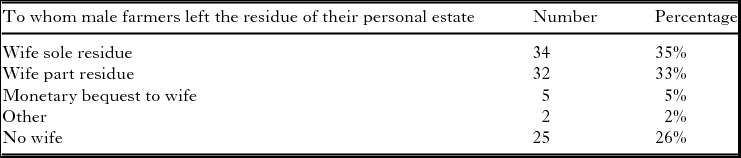
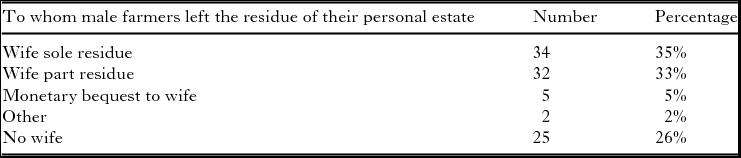
As well as obtaining land, women farmers in this predominantly stock rearing region needed capital, mainly comprising of cattle and sheep, and in valley farms with more arable farming the basic implements of husbandry were also required. To identify the extent to which women inherited farm stock, the wills of ninety-eight male farmers and fifty-six probate administration bonds plus their associated inventories from the Nantconwy parishes of Bettwys y coed, Dolwyddelan and Penmachno were analysed for the period 1750 to 1858 (table 2). The results demonstrated very clearly that most of the male farmers who made wills wished to afford their wives the option of continuing farming. In most cases, bequests of money, household goods or farm stock to other family members formed a relatively small part of the male farmers’ personal estates; indeed bequests to children of the proverbial shilling were not uncommon. If sons and daughters had not yet married or left home, they were typically left a portion, with twenty pound or thirty pounds representing a good inheritance around 1800. Where there was a surviving wife, she was bequeathed all or part of the residue of her husband's personal estate in ninety-three per cent of cases. In only seven per cent of cases was a wife left a purely monetary bequest, with the farm stock going to other relatives, and in most cases, this appeared to be because she was elderly.
Bequests in male farmers’ wills from three Nantconwy parishes, 1750–1858
Source: National Library of Wales, wills of male farm occupiers in parishes Bettwys y coed, Dolwyddelan and Penmachno.
Male tenant farmers appeared equally likely to leave their wife the residue of their personal estate whether or not there were sons or daughters. Of the forty-four wills which named a widow and children, the residue was given to the widow in twenty-four cases, with monetary bequests to children, whilst the widow shared the residue with one or more children in twenty-one cases. Where sons and daughters had already married or left home with a portion and might already be established on their own farm tenancies, Nantconwy fathers generally appear to have felt they had done enough for them. Younger children, especially if they were under age, were most likely to be given a share of the residue with their mother. Ellis Williams of Garnedd, Dolwyddelan, for example, revoked bequests of twenty pounds each to three daughters who had married since his will was first written, provided a thirty pound portion to his son John, and left the residue of his estate to his widow Mary Jones together with his youngest son and daughter.Footnote 27 John Williams of Llan, Dolwyddelan, adopted a similar family strategy, making a token bequest of five shillings to his eldest son William Jones, who was already established on the seventy-six acre farm of Murcoch; the considerable residue of £295 was then shared between Jones’ widow Alice and youngest son John.Footnote 28 The twenty-six per cent of male farmers who had no surviving widow also left all or a share of the residue of their estates to daughters and sisters in fifty per cent of cases, and to male relatives in sixty-two per cent of cases. Altogether, this meant that women were nearly twice as likely as men to inherit farm stock from male farmers.
Gwen Jones of Tuddun du in Penmachno was typical of widows who took over running the farm. Her husband, Edward Morgan died in 1793, leaving a personal estate valued at £113 8s, from which Gwen was to pay bequests of twenty pounds to their son John Edwards and twenty-five pounds to daughter Catherine.Footnote 29 Most of the value of the estate Gwen inherited was in animals: thirty-two cattle, eighty-five sheep, an old mare and a colt, together worth ninety-eight pounds. She inherited some basic implements of husbandry: a plough, a harrow and a pair of chains, an iron crow and an old spade. A spinning wheel and cheese sieve amongst the household stuff show how Gwen would have contributed to household management. Gwen continued to run the farm until at least 1799, as we know from land tax records and the Mostyn estate rental.Footnote 30
Whilst the majority of husbands who made a will were content to leave all or part of the residue of their personal estate to their wife, in the expectation that property would pass to their children after the wife's death, this family strategy would be upset if the widow remarried. At a time when married women had no property rights of their own, a widow's remarriage would result in all her property passing to her new husband. Not only would this mean that the children of the first marriage were unlikely to inherit their father's moveable property, it also made it less likely that they would inherit the farm tenancy. A significant minority of Nantconwy husbands guarded against this danger by imposing punitive conditions in their wills in the event of their widow remarrying.Footnote 31 The well-to-do Dolwyddelan yeoman Ellis Williams of Garnedd left the residue of his estate shared between his widow and two younger children on condition that if she remarried, she would receive only twelve pounds, with her share going instead to the children. In some cases, the remarrying widow would be entitled only to ‘bed and bedding’, or in the case of one of the wealthiest widows of the district, Catherine Jones of Benardd, Penmachno, ‘only one feather bed, bolster and bedclothes’ with her share of the residue going to her four daughters. Before 1820, over forty per cent of husbands imposed such conditions when bequeathing all or part of the residue to their wife. After this date, remarriage conditions became less common, being mentioned in only thirteen per cent of male farmers’ wills. This may reflect a decline in the proportion of farmers dying while their children were under age. Given the disincentive, whether moral or financial, it is not surprising that very few farmers’ widows did remarry, a factor which of course served to maintain the high proportion of women farmers in Nantconwy.
Where men died intestate, which was fairly common as most men only made a will on their deathbed, the widow was normally granted administration of the estate. Just under a third (thirty-two per cent) of male farmers in the Nantconwy sample who left a widow had not made a will. Under ecclesiastical law, the widow was entitled to a third of her husband's moveable property, with the remainder going to children. It is not clear whether widows of intestate Nantconwy farmers inherited less than those who made wills, as it is possible that men were less likely to make a will if there were no surviving children. As we shall see later however, a higher proportion of widows granted administration of their husband's estate by bond were found to have continued farming, suggesting that they must have inherited sufficient stock to do so.
Why did Nantconwy men generally favour passing on their personal estate to their wives rather than children? A possible explanation lies in the fact that a farming marriage was from the start very much a partnership. Children of both sexes received a similar portion when they married, or when their parents died; women were nearly as likely as men to bring stock to the marriage and often brought access to land by inheriting a tenancy. However, until the Married Women's Property Acts of 1870 and 1882, the property a woman brought to a marriage and anything she earned during the marriage came under the control of her husband, under the common law principle of coverture. Married women could also not make contracts or be sued.Footnote 32 Thus to some extent male farmers appear to have been acting equitably in bequeathing to their wife the property she had brought to the marriage and helped build up during the couple's farming partnership.
While lack of financial capital may have been a problem for women farmers in England, the notorious lack of capital among Welsh farmers was commented on again and again. Walter Davies considered want of capital the ‘obstacle of obstacles’ towards agricultural improvement in north Wales and the Royal Commission on Land in Wales and Monmouthshire also blamed lack of capital for the deterioration in the quality of land during the agricultural depression of the 1880s.Footnote 33 In this environment, widows who had inherited farm stock were probably better capitalised than most farmers’ sons seeking their first tenancy.
Farming know-how
In order to continue farming, a farmer's wife or daughter must either have possessed sufficient farming know-how herself or have obtained help from a son, other male relative, or senior male farm servant, known in Wales as a husbandman. Commenting on the proportion of women farmers in Wales in the half century before the Second World War, the agricultural writers Ashby and Evans were somewhat dismissive of their role in farm management: ‘As most of these were widows who are frequently helped by their sons, this [census data] is not conclusive as to the part played by women in farm management’.Footnote 34 It is therefore pertinent to look at information from contemporary sources about the activities undertaken by Nantconwy farmers’ wives and daughters, and at evidence concerning the role women played in farm management after becoming the head of household.
A gendered division of labour had long been apparent on British farms, although there was some significant overlap in the tasks performed by men and women.Footnote 35 During the eighteenth century, men were primarily responsible for ploughing and harrowing, reaping and mowing, and caring for horses, as well as the more occasional or seasonal work of hedging, ditching and threshing. Farmers’ wives were traditionally in charge of the dairy, including butter and cheese production, and of farmyard animals such as calves, pigs and poultry; they played a major role in managing the farm, including training and looking after servants, taking care of finances and marketing dairy, farmyard and garden produce. Women typically took part in planting, hoeing and stone-picking, muck spreading, as well as raking and gathering grain and hay at harvest time.Footnote 36 During the later eighteenth and early nineteenth centuries, increasing specialisation in agricultural regions, the decline of farm service in southern England, growth of services available from local towns or large villages, and mechanisation of spinning and cloth production all led to a reduced role for many English farmers’ wives. Some large farms in the south and east specialising in corn husbandry, and graziers close to London markets, gave up their dairies altogether. In other cases the farmers’ wives began to aspire to a more genteel lifestyle and withdrew from dairy management. By the end of the eighteenth century, large dairy farms in the south west increasingly sub-contracted dairying to male graziers.Footnote 37
The significant decline in living-in throughout many parts of England also reduced the responsibility of farmers’ wives for looking after farm servants and directing their work. The decline in farm service was widely attributed in the 1820s to status concerns and social pretensions to refinement by farmers’ wives, who objected to housing uncouth male servants under their roofs.Footnote 38 Status concerns, often attributed to farmers’ wives and daughters, were cited by ten per cent of respondents to the question: ‘Why are labourers no longer under their employers’ roofs?’ posed by the 1834 Poor Law Commission. The improvement in living standards and alteration of manners during the period of high agricultural prices was thought to have made farmers less willing to associate with their labourers.Footnote 39 Social pressures against women's involvement in field work also led in grain-growing regions to a more predominantly male labour force, and English women farmers would have found increasing difficulty in hiring day labourers and enforcing their authority over male labourers when they no longer overlooked the men's domestic lives as house-mistresses.Footnote 40
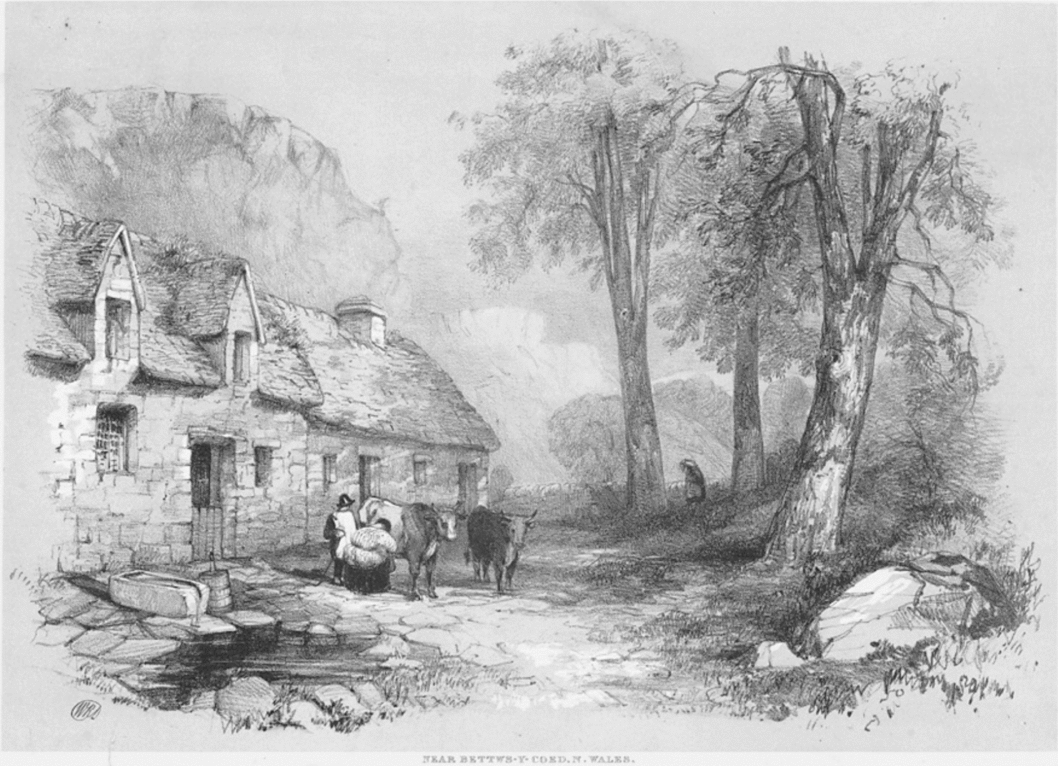
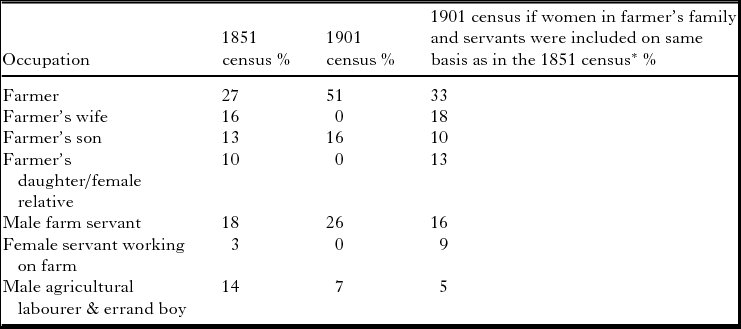
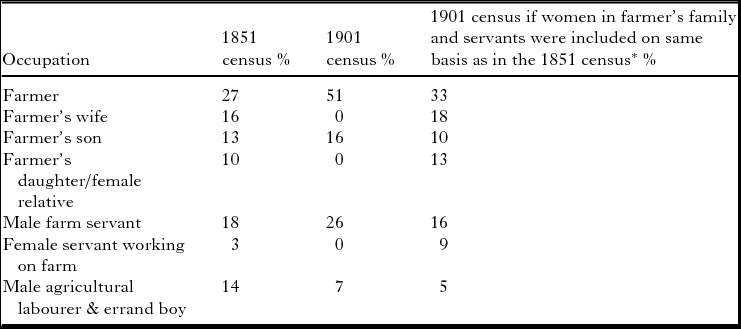
However, as Nicola Verdon has reminded us, the trend for the withdrawal of farmers’ wives from farm management by the early nineteenth century should not be overstated: the scale and character of their labour was influenced by many factors, including status, income, farm size, location and type.Footnote 41 In Wales, farmers’ wives remained very much involved in running the family farm throughout the period 1750 to 1900. The Reverend John Evans, visiting Nantconwy at the end of the eighteenth century, commented on the importance of animal husbandry in the area: ‘the farmers are chiefly dairy men: and make their rents from butter, wool, and lambs: they possess a few small cows, numerous sheep of diminutive size, and herds of goats’.Footnote 42 Milking cows, sheep and goats, butter and cheese making, spinning and knitting wool were of course traditionally women's work (figure 3). The importance of dairying in Snowdonia was also underlined in Walter Davies’ Board of Agriculture report: great quantities of butter of an excellent quality were made in the hilly parts and sent to various fairs, or by sea to Liverpool. Cheese was also made, but was mainly used for home consumption.Footnote 43 Data from the Nantconwy sample of probate inventories shows that farms kept a median of five milk cows, with a few owning ten or more. The prevalence of family farms and continuance of farm service meant that Welsh women remained actively involved in agriculture throughout the nineteenth century. Family labour provided two-thirds of the Nantconwy workforce in 1851. In addition, it is likely that many women and girls working on farms recorded as house servants undertook some farm work (table 3).Footnote 44
Women milking near Bettwys y coed.
Composition of Nantconwy farming population, 1851 and 1901
*See text for explanation.
By the end of the nineteenth century, a decline in the number of agricultural labourers had placed an even greater emphasis on the work of family members. Census statistics for 1901 are unfortunately not directly comparable with 1851, as the occupational categories of farmer's wife and farmer's daughter had been dropped: farmers’ wives and daughters and other female relatives were therefore likely to be shown as having no occupation, although most would probably have been engaged at least to some extent in farm work.Footnote 45 As the Penrhyn agent, Colonel Sackville West informed the Royal Commission on Land, farmers and their wives worked very hard, particularly in the case of small farms under fifty acres.Footnote 46 The same point was made by three Dolwyddelan farmers giving evidence on behalf of all the farmers in the parish: tenants, their wives, sons and daughters all took part in the work of the farm, as it would be impossible to pay the rents if wages had to be paid instead of the children's unpaid labour.Footnote 47 At the turn of the twentieth century, farmers on small Caernarvonshire farms typically worked twelve hours a day, seven days a week, and their wives fifteen hours.Footnote 48 The actual census statistics suggest that family members as a proportion of people occupied in agriculture remained steady at around two-thirds between 1851 and 1901; however, if female relatives recorded as unoccupied in the 1901 census were taken into account, family members would account for up to seventy-four per cent of people working on the farm.
A detailed account of late nineteenth-century farm organisation in south-west Wales described a pronounced gender division of labour, with men responsible for the cultivation of crops and looking after horses and store cattle, and women the dairying, tending farmyard animals, making hay, binding corn, loading dung carts, and lifting potatoes. This was in fact very similar to the traditional gender roles. Every farm needed a master and a mistress: if the farmer had no wife, a sister, daughter or housekeeper would undertake the mistress's role. A woman farmer needed a son or ‘husbandman’ to undertake the role of the master.Footnote 49 But in Nantconwy, where crops played a minor and decreasing role in local agriculture, there does not appear to have been such a strict gender division of labour. Caernarvonshire women were also involved in shepherding, sheep shearing and collecting peat. The most common Nantconwy woman farmer‘s household in 1901 included sons and/or daughters plus male and/or female servants. The next most frequent household types were female-only households with daughters, or where farm management was shared with a son. Where a son was not recorded as a farmer, his status as working for his mother was usually made clear by the occupational designation of farmer's son, farm servant, carter or shepherd. The evidence thus suggests strongly that on most Nantconwy holdings, farmers’ wives and daughters remained very much involved in agriculture throughout the nineteenth century, and would have been well placed to take over running a farm.
Lack of technical education for girls was another factor advanced to explain the low proportion of women farmers in mid-nineteenth century England. During the era of high farming, landlords in corn growing districts became increasingly reluctant to let large farms to women who lacked an understanding of advanced agricultural practices. Women were also virtually precluded from the male-dominated meeting places of market town public houses, agricultural societies and farmers’ clubs, the latter being one of the most effective avenues for disseminating improved farming techniques.Footnote 50 However the emphasis on dairy farming and stock rearing, together with the traditional nature of Welsh farming, imposed fewer such barriers to Nantconwy women. Moreover, the lack of agricultural literature in Welsh posed a handicap to the majority of farmers of both sexes in Welsh speaking areas.Footnote 51
In fact, the general lack of innovation amongst Welsh farmers was emphasised on numerous occasions. A survey of the Pant-Glas Estate in the Eidda township of Nantconwy underlined the traditional state of farming in the area in 1767:
There certainly is a soil of all kinds and fit for all purposes, but I fear seldom made use of, sometimes through ignorance, sometimes through indolence, and often I fear through perverseness by treading in the steps of their forefathers too closely.Footnote 52
By 1800, Nantconwy farmers had proved slow to take on improved farming methods, and were criticised for lack of improvement to animal breeds, lack of drainage, manuring and appropriate use of lime, as well as crop rotations that exhausted the soil.Footnote 53 Similar criticisms were still being voiced at the end of the nineteenth century, with the Gwydir estate land agent giving his opinion to the Royal Commission on Land that ‘no important changes in farming had taken place in 50 years’.Footnote 54 The Commissioners appeared to concur, concluding that ‘inferior and unskilful farming’ particularly prevalent on small mixed farms had reduced output, quality and productivity, and aggravated the impact of the agricultural depression on Welsh farming.Footnote 55
At the end of the eighteenth century, Welsh women were still playing a leading role in marketing farm produce. The Reverend John Evans noted how at Shrewsbury ‘the business of buying and selling is chiefly conducted by women here, and through all the markets of North Wales’.Footnote 56 Surplus wool that was not needed for family use in clothing, blankets and coverlets was sold at Llanrwst market, one of the major wool markets in Wales which set the trend for prices.Footnote 57 Wool was still spun at home by people of all social levels, from the womenfolk of the large farms to elderly male farm labourers. Hand knitting provided an important source of additional income. Evans remarked of Llanrwst market that:
Few men are to be seen, the business being conducted by women; and we could not refuse admiring the spirit of industry manifest on these occasions. No person is idle . . . . . but both the buyer and the seller are employed in knitting; and hundreds may be seen going and returning, earning their subsistence as they walk along.Footnote 58
Before the railway age, store cattle and sheep were generally sold off Caernarvonshire farms to drovers, who paid for them on their return from Midland or London markets.Footnote 59 Women farmers would therefore have encountered little difficulty in the marketing of their livestock, as well as more traditionally female produce.
Turning now to the question of whether women tenants were actively involved in running their farms, there is abundant evidence from estate and family correspondence and witnesses to the Royal Commission on Land of their active role. After the Napoleonic Wars, the Gwydir estate tried to forbid the traditional practice of paring and burning peat to clear old pastures for crops, which was considered injurious to the soil.Footnote 60 However the estate had difficulty in enforcing this husbandry clause in its leases, and the local agent had to report: ‘The tenants in all directions are playing the very devil with the grounds, ploughing meadows, push ploughing and burning, burning heath on the mountains.’ Amongst the culprits he named were Margaret Evans for burning heather, Margaret Jones, Coetmore for ploughing pasture, and Margaret Cadwaladr, Brynmwllach, for ploughing meadow.Footnote 61
The records of the Maen Honan (Nantconwy) court baron, which was reinstituted by the Gwydir estate in 1832, also show women tenants involved in regulating the farming community, bringing presentments and being held responsible for rectifying problems identified by other tenants. Ann Hughes of Garth, Llanrhychwyn, for instance, was ordered in 1836 to repair her share of the fence between her farm and Tai ucha. In the same year, four tenants, including Laura Evans of Pandy were instructed to send their teams to repair the road through Trefriw meadows, with ten less affluent tenants being required to contribute a day's labour apiece. There were regular presentments for trespass and damage, including one from Margaret Evans of Penrallt, Bettwys y coed, in 1838, complaining about damage to her fields caused by the search for lead ore of John Owen and Partners. Catherine Williams was one of fifteen Trefriw and Llanrhychwyn tenants who brought a presentment in 1844 that:
Notwithstanding a well understood usage that no person within the manor shall keep sheep in the vale or meadows, . . . sheep are in the constant habit of trespassing upon the complainants’ lands, destroying fences, eating up the produce besides causing much annoyance and vexation.Footnote 62
Finally, cooperative traditions and access to resources on the mountain commons and wastes would have been advantageous to women farmers. During the eighteenth century, many farms enjoyed access to commons, which provided summer pasture for cattle, sheepwalks, peat for fuel, and rushes for thatching, animal bedding and rush-lights. Although there was a tendency during the nineteenth century for landowners and tenants to restrict common rights in favour of sheepwalk rights exclusive to specific farms, a market developed in access to mountain resources such as peat and pasturage. The traditional cooperation amongst farmers at times of sheep gathering and shearing, hay and corn harvest also helped manage peak labour requirements.Footnote 63
Women's desire to continue farming
The fourteen to twenty-two per cent of Nantconwy farms occupied by women was unusually high, compared both to the proportion of women farmers found in earlier societies and to the overall incidence of female-headed households in England. In early eighteenth-century Montgomeryshire, by contrast, women on the Llwydiarth estate who often inherited land through leases for three lives comprised only nine per cent of farm tenants.Footnote 64 The proportion of English households headed by widows over the period 1574 to 1821 has been estimated at 12.9%, with female-headed households declining for the period 1787 to 1865 to 9.2%.Footnote 65 Widows in eighteenth-century England generally continued to run their farms only if there were no son to take over. In seventeenth-century Berkshire, men used their wills to encourage their widow and son to share control of the farm and widows who inherited while their son was under age often surrendered all or part of their freebench to the ‘waiting heir’ at his majority or marriage.Footnote 66 A widow who did not continue farming was then legally entitled to houseroom and board in her eldest son's house.Footnote 67 The high proportion of Nantconwy women farmers suggests however that widows here remained household heads for longer than average, and were less likely to surrender their farm to a son.
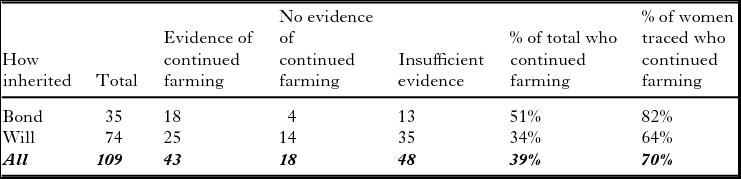
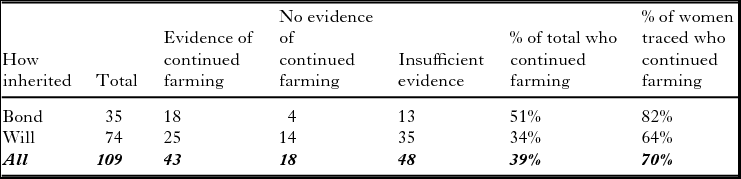
To investigate how many Nantconwy widows continued farming, and for how long, an attempt was made to trace the careers of widows from the male farmers’ probate sample who had inherited the residue of their husband's farm stock. Evidence of continued farming activity came from widows’ own wills and inventories, land tax and tithe commutation records, estate records, and censuses for the period after 1841. It was possible to trace fifty-six per cent of widows and, of these, seventy per cent were found to have continued farming, in some cases for many years after their husband's death (table 4).Footnote 68 The patchy nature of the sources meant that many of the women not traced might have died within a few years of their husband. Somewhat surprisingly, women who were granted probate administration by bond were more likely to continue farming, perhaps because they were less likely to have children.
Careers of widows who inherited all or part of residue of male farmer's personal estate, 1750–1858
Sources: Ninety-eight male farmer's wills and fifty-seven probate administration bonds for parishes Bettwys y coed, Dolwyddelan and Penmachno, thirty-three farmers’ widows’ wills or inventories, Nantconwy land tax records,1750–1820, estate rentals and surveys, tithe commutation records, 1841 and 1851 census enumerators’ records.
Widows who gave up farm management had a number of courses open to them. A few had passed the management of the farm to a son or daughter but continued to live on the farm, but might still continue to farm in a small way. Those with sufficient capital might sell up and move to the market town or remain in their parish as a moneylender, like Ann Cadwaladr, who gave up the large Penmachno farm Tyddyn bach to live off the interest on loans and mortgages totalling £466 made by her deceased husband Hugh, a wealthy drover.Footnote 69 Sharing the farm or sub-letting all or part was another option: mothers were more likely to do this as sons or daughters established their own families, and they themselves became elderly.Footnote 70 In other cases, widows continued to farm for some years, but retired as they became too old to farm the mountains, especially if they had no children to take over. One such was Mary Thomas, who gave up her tenancy of the remote Llanrhychwyn mountain farm Lledwigan in 1842, although she sought to do this on her own terms, when a new tenant could be found who was prepared to buy her stock as a going concern.Footnote 71
While increased wealth and ideas of respectability led many English farmers’ widows and spinster daughters to make their homes in market towns, living off a private income, ideas of ‘separate spheres’, with women as homemakers, were slow to permeate rural Wales. This was partly as a result of the language barrier, but when the cult of domesticity did become more influential later in the nineteenth century under the influence of Methodist ministers and more widespread education of girls, it appears that by no means all Welshwomen subscribed to the domestic ideal: the new social norms were negotiated with more traditional aspects of women's culture which emphasised communal solidarity, mutual dependency and complex ties of kinship and neighbourhood.Footnote 72 Moreover, relatively few Nantconwy farming widows inherited sufficient wealth to fund a genteel retirement.
Although tenancies tended to remain in the family, it was by no means assured that a son or daughter would be granted the succession of a large farm if a widow resigned her holding. Many widows therefore continued at least nominally in charge of the farm until they died, both as a means of providing their own livelihood, and to ensure economic opportunities for their children and grandchildren. The history of the Hughes family who tenanted Brynygefeiliau in Gwydir township illustrates how the resources of a large farm could be redistributed over time to accommodate changing family needs, within the custom of the widow remaining the household head:
- Grace Hughes took over the tenancy of the 640 acre farm from the Gwydir estate when she was widowed in 1839.
- In 1841 she was fifty-five and shared the farm with her eldest son Robert. Two younger sons, Maurice and William, also lived at home helping on the farm; her son-in law Price Davies worked as an agricultural labourer, living with his wife Margaret and their children in a cottage on the farm.
- By 1851, the eldest son Robert had moved out to take on a neighbouring smaller farm of his own. The youngest son William had married and taken over a quarter of Brynygefeiliau. Son-in-law Price Davies had also taken over a quarter, leaving Grace farming the remaining half, while her unmarried second son Maurice remained at home as a ‘farmer's son’.
- In 1861, the son-in-law had died, and Grace's daughter Margaret had taken over as farmer of a quarter of the farm.
- In 1871, Grace, now eighty-five, was still named in the census as the farmer of half the farm. Her son Maurice had died and her daughter Margaret was now living with her, presumably helping to run the farm. Margaret's sons David and Pierce assisted as shepherd and farm labourer. Grace's youngest son William now farmed half the farm.
- Finally by 1881, Grace and William had both died. Grace's grandson David now farmed all of Brynygefeiliau, assisted by his brother; his seventy-two year-old mother Margaret remained living with them. Grace's widowed daughter-in-law Mary remained in a cottage on the farm, supported by her two sons, who worked as miners.
The final question relates to the factors which might account for the significant reduction in the number of Nanconwy women farmers by 1901. The sell-off of Gwydir estate farms in Dolwyddelan, Trefriw and parts of Llanrhychwyn in 1894–6 appears to have had a major impact, with the number of women farmers falling by sixty per cent after the sale. None of the fifteen women tenanting farms sold off were able to buy; the average purchase price was around thirty years’ rent, mortgage costs were approximately double the previous rent, and new owner-occupiers also became responsible for their own repairs. Women sharing a farm were likely to be squeezed out by the sale and only two women remained tenants of their farm by 1901. Eleven did not have their tenancy renewed by the new owner, who might wish to occupy it himself, or to bring in a new tenant at a higher rent, although four new women did become farmers by 1901.Footnote 73 The demise of the largest of the great estates in Nantconwy had clearly brought the custom of hereditary tenancies to a rude halt, making it far more difficult for women to become or remain farmers.
This study has therefore revealed a number of factors that enabled women to become farmers in Snowdonia hill farms during the eighteenth and nineteenth centuries. Landlords were prepared to allow widows and daughters to take over farm tenancies. Male farmers nearly always bequeathed farm stock to their wife, providing the capital to continue farming. The persistence in Wales of traditional farming methods meant that women did not suffer a significant disadvantage in agricultural education, and most already had considerable experience as farmer's wife or daughter. Although there were strong social and sometimes financial disincentives against women farmers remarrying, it was not expected that mothers would surrender the farm to a son when he became old enough to take over. The absence of any right of family succession meant that women often chose to remain at least nominally in charge of the farm until they died, although some did retire if they could afford to do so when they became too old to continue farming in the harsh mountain environment. This combination of factors enabled a much higher proportion of women to remain in charge of Nantconwy farms than in England at the same time or in the early modern period, until the sell-off of the great estates undermined the custom of hereditary tenancies, which had been one of the key conditions for the survival of Welsh women farmers.
Acknowledgements
I would like to acknowledge the support and comments of Kate Tiller.