In Britain over the last decade a remarkable consensus has emerged in political and also in media circles that social mobility is in decline and has in fact reached an exceptionally low level. The aims of this paper are: (i) to give an account of how this consensus developed; (ii) to show that the consensus view is open to serious question, while also giving rise to much confusion among politicians; (iii) to present an alternative view that has a more secure social science grounding; and (iv) to suggest that, in the light of this alternative view, educational policy appears far more limited as a means of increasing mobility than is now supposed across the political spectrum.
The development of the consensus
The origins of the present political concern with social mobility can be traced back to the rise of New Labour: specifically, to the party's median-voter electoral strategy and to its efforts at policy ‘triangulation’. A focus on social mobility had obvious attractions for New Labour as a means of appealing to the supposed electoral middle-ground of ‘aspirational’ families, while at the same time taking over a recognised Conservative emphasis on greater equality of opportunity as opposed to greater equality of condition. Increased social mobility could be represented as being, in Tony Blair's words (speech, 9 June 2002), in itself ‘the great force for social equality in dynamic market economies’. And, further, the goal of increasing social mobility could plausibly be linked to policies of educational expansion and reform that the party wished to prioritise.
Following New Labour's access to power, the Performance and Innovation Unit (later the Prime Minister's Strategy Unit) within the Cabinet Office was charged with carrying out a comprehensive review of research on social mobility in Britain, in consultation with academics working in the field – at this time, largely sociologists. The review was written by Stephen Aldridge, Chief Economist at the Performance and Innovation Unit (PIU), and appeared in April 2001 (Aldridge, Reference Aldridge2001).
Aldridge noted that most of the research undertaken related to intergenerational mobility as between social classes, and in this regard the principal source on which he drew was Heath and Payne (Reference Heath, Payne and Halsey2000), supplemented by Breen and Goldthorpe (Reference Breen and Goldthorpe2001) and an early version of what became Goldthorpe and Mills (Reference Goldthorpe, Mills and Breen2004). Aldridge recognised at the outset the crucial importance that sociologists attach to the distinction between absolute and relative mobility rates. Absolute rates refer to the actual proportions of individuals of given class origins who are mobile to different class destinations, while relative rates compare the chances of individuals of differing class origins arriving at different class destinations and thus indicate the extent of social fluidity. In these two respects, Aldridge then accurately summarised the major research findings as follows:
(i) Absolute rates of intergenerational class mobility, as measured in percentage terms, appear quite high. Most notably, rates of upward mobility steadily increased in the course of the twentieth century, primarily as a consequence of class structural change – that is, of the expansion of professional and managerial positions creating ‘more room at the top’. However, immobility at the ‘top’ also increased, and there were indications that towards the end of the century rates of upward mobility among men were stabilising, as the growth of professional and managerial positions began to slacken and as men faced greater competition for these positions from women.
(ii) Relative rates of intergenerational class mobility, as measured by odds ratios, showed a basic constancy over most of the twentieth century, or at all events no sustained directional change, with the possible exception of some recent slight increase in fluidity among women. In other words, the strength of the association between the class positions of children and their parents, considered net of class structural effects, appeared remarkably robust. Although increasing upward mobility might create a contrary impression, Britain had not in fact become a significantly more fluid or ‘open’ society.
Despite the importance attached to the work of the PIU within government, it would appear to have attracted little wider attention. Media coverage was limited, and at this point social mobility still remained a matter of primarily academic concern. However, all this was soon to change, with the catalyst being research carried out by a group of economists associated with the Centre for Economic Performance at the London School of Economics, among whom Jo Blanden and Stephen Machin were most prominent. Their findings were first published as a CEP Discussion Paper (Blanden et al., Reference Blanden, Goodman, Gregg and Machin2001) and then in an important collective volume (Blanden et al., Reference Blanden, Goodman, Gregg, Machin and Corak2004).Footnote 1
In their research, the economists sought to follow in the steps of colleagues, notably in the US and Sweden, who had revived interest in intergenerational mobility treated not in terms of social class but rather of earnings or income. To this end, Blanden and her colleagues analysed data from two British birth cohort studies, the National Child Development Study and the British Cohort Study, which aim to follow through their life-courses all children born in Britain in one week in 1958 and in 1970, respectively. The major finding that the economists reported was the following. There was a stronger association in the 1970 cohort than in the 1958 cohort between the earnings of men and women when in their early thirties and their family incomes when they were age sixteen. In other words, between the two cohorts there had been a decline in intergenerational mobility in what was termed ‘economic status’ – and, it was held, one of a statistically significant and indeed substantial kind. The economists further argued that this decline could be associated with widening income inequality in Britain from the later 1970s and, more specifically, with the fact that children from better-off families had benefited disproportionately from the expansion of higher education, from which increasing earnings returns were being obtained (Blanden et al., Reference Blanden, Gregg, Machin, Machin and Vignoles2005a; cf. Blanden et al., Reference Blanden, Gregg and Macmillan2007; Lindley and Machin, Reference Lindley and Machin2012).
This one piece of research did then have a remarkable impact, becoming the empirical basis for the view that levels of social mobility in Britain have fallen to a disturbing degree – that is, for the view that in public discourse has by now assumed the status of unquestionable fact. In explaining how this impact was achieved, and the consensus view thus formed, three influences appear important.
First, the CEP economists’ research was from an early stage financed by the Sutton Trust, a charitable foundation committed to a programme of promoting mobility through reducing social inequalities in educational opportunity and attainment. Special reports on the research were prepared for the Trust (see, e.g., Blanden et al., Reference Blanden, Gregg and Machin2005b; Blanden and Machin, Reference Blanden and Machin2007) and were very effectively disseminated. The reports also referred to certain new findings of a kind likely to attract media attention. Most strikingly, it was claimed that rates of social (that is, income) mobility in Britain were at a lower level than in most other economically advanced societies.Footnote 2
Second, in governmental and political circles the economists’ findings proved highly opportune. For the New Labour government, evidence that mobility had declined and that this decline began in the period following the Conservatives’ return to power in 1979 was obviously welcome. It helped validate their commitment to a social mobility agenda, and the economists’ explanation of the decline could also be presented as confirmation of the view that the priorities of ‘education, education, education’ (Tony Blair, speech, 26 September 2000) would be crucial to restoring high levels of mobility.Footnote 3 References to the economists’ research figured prominently in a Cabinet Office discussion paper (Cabinet Office, 2008),Footnote 4 leading up to the government's White Paper on social mobility (HM Government, 2009a), and additional analyses were drawn on by the Panel on Fair Access to the Professions to show that chances of access had become more unequal in relation to family income (HM Government, 2009b). At the same time, though, the Conservatives also saw advantage in taking up the finding of declining mobility. It could be used to support the argument that the abolition of grammar schools had damaged the chances of upward mobility of working-class children and, as New Labour continued in power, the persistence and prevalence of the idea of declining mobility was increasingly drawn on as evidence of the ineffectiveness of its policies in dealing with the problem (see, e.g., Conservative Party, 2008). The Conservative–Liberal Democrat Coalition government formed in 2010 pursued this theme and proposed a new ‘strategy’ for social mobility (HM Government, 2011; cf. Liberal Democrat Party, 2009).
Third, the influence has also to be appreciated of what might be called ‘media hysteresis’: that is, the tendency within the media, once a particular ‘line’ on any issue has become widely accepted, for this line to be maintained as the standard output, regardless of any further inputs. Once the CEP economists had successfully got across the idea of declining mobility to the socio-political commentariat, any different view had little chance of serious consideration. Commentators apparently read each other rather than taking note of new research developments. In fact, rather than any more balanced assessments emerging, a spiral of hyperbole would appear to have set in, so that from the situation being one of declining mobility, it progressed to being one in which mobility had ‘fallen to its lowest recorded level’ or had indeed ‘ground to a halt’ (as some recent examples, see John Humphrys, YouGov, 14 May 2012; Suzanne Moore, Mail Online, 16 May 2012; Deborah Orr, Guardian, 20 May 2012).Footnote 5
Problems with the consensus view
Problems with the consensus view arise of both an empirical and an analytical kind. The source of the empirical problems is one that has been little commented on: namely, that for Britain there are in fact no high quality data available for the study of intergenerational earnings or income mobility. The economists on whose work the consensus view rests were from the start labouring under this handicap.
Two main problems arise with the earnings and family income data in the birth cohort studies that they use. First, for a large proportion of cohort members, such data are missing, partly on account of cohort attrition but also of item non-response. And, further, there are good grounds, accepted by the CEP economists, for regarding income data provided by small proprietors and the self-employed as being too unreliable to use. Second, the measures of individuals’ earnings and of their families’ incomes on which the economists have to base their analyses are ‘one-shot’ measures, while the desirability has been recognised, from the pioneering work of Atkinson et al. (Reference Atkinson, Maynard and Trinder1983) onwards, of having several measures that can be ‘time-averaged’: that is, in order to control for the transitory fluctuations in earnings or incomes that one-shot measures will reflect. Blanden et al. were well aware of the difficulty that they faced here, and acknowledged at the outset (2004: 136–8) that the validity of the comparison of levels of mobility that they made between the 1958 and 1970 cohorts would crucially depend upon the transitory component, in family income especially, being of much the same magnitude from one cohort to the other.
One critic of the economists’ work, Gorard (Reference Gorard2008), has focused sharply on the first problem of missing data and on the biases that could result. In fact, these biases may be less serious than feared (Erikson and Goldthorpe, Reference Erikson and Goldthorpe2010), and it is the second problem that must be regarded as the more serious: specifically, in that the transitory component in the family income variable for the 1958 cohort may well not be the same as in this variable for the 1970 cohort, but significantly larger (Erikson and Goldthorpe, Reference Erikson and Goldthorpe2010). If so, this would in itself help explain the weaker association in the 1958 cohort between family income and children's later earnings and, to this extent, the apparent decline in mobility would be artefactual rather than real. Critical comment on these lines is, not surprisingly, resisted by the CEP economists (Blanden et al., Reference Blanden, Gregg and Macmillan2013), and the debate is likely to continue. But, for present purposes, the following point may be made. Not only does the consensus view of declining mobility in Britain rest empirically on a single piece of research, it rests in effect on the interpretation of a single variable, the family income variable, constructed in the course of this research. Insofar as the cross-cohort comparability of this variable as regards its transitory component is not as secure as the economists would suppose, the empirical basis of the consensus view disappears; there is no back-up.
It should, moreover, be noted that this comparability is similarly crucial to the economists’ argument that a major factor in declining mobility between the 1958 and 1970 cohorts was an increasing inequality in access to higher education. If the weaker association between 1958 cohort members’ family incomes and their subsequent earnings could be, at least in some part, artefactual, then so too could the weaker association that shows up between their family incomes and their educational attainment. And a recent study by Boliver (Reference Boliver2011; see also Ianelli et al., Reference Ianelli, Gamoran and Paterson2011) does in fact indicate that from the 1960s through to the mid-1990s social class differences in access to higher education, though wide, remained essentially unchanged.
Apart from the inadequacies of the income and earnings data that they contain, there is one further way in which the 1958 and 1970 cohort studies were unsuited to the economists’ purposes: that is in providing information not for the population as a whole but only for two birth cohorts within this population, and only twelve years apart – a very limited basis for claims about mobility trends. This is indeed a point that Blanden and Machin have recognised in warning against the over-interpretation of their findings (Evidence to House of Commons Select Committee on Children, Schools and Families, 23 January 2008, Q.9).
Turning now to analytical problems of the consensus view, these stem primarily from the fact that the distinction between absolute and relative rates of mobility – recognised as crucial in the sociological literature – was not taken up in the CEP economists’ work, or at least not in any explicit way. Economists have in fact, until very recently, given little attention to absolute income mobility: that is, to the association between the real incomes of parents and their children as these reflect economic growth, the distribution of productivity increases, etc. Rather, they have been concerned with the relative positions of parents and children within income or earnings distributions and with the association between these positions. Blanden et al. (Reference Blanden, Goodman, Gregg, Machin and Corak2004) followed in this tradition, and chiefly relied on the standard method in the economics literature for measuring this association: that is, of estimating the loglinear regression of, in their case, children's earnings on family income. However, the β coefficients thus produced, taken to represent the intergenerational ‘elasticities’ of children's income with respect to that of their parents, are not an entirely satisfactory measure of relative mobility – as Blanden et al. recognise – in that they will be influenced by differences in the degree of inequality in the generational distributions as well as by the net intergenerational association (Björklund and Jäntti, Reference Björklund, Jäntti, Salverda, Nolan and Smeeding2009: 497). Consequently, Blanden et al. also report the correlation, r, between children's earnings and family income, which they treat as ‘β adjusted for changes in inequality’ (2004: 127–8). And in turn their focus on relative mobility emerges yet more clearly when, as a further method of analysis, they present mobility tables that cross-classify the positions of children and their families within earnings and income quartiles, respectively (2004, Tables 6.6a and 6.6b). In this case, of course, all marginal distributions are equal by construction, and it is thus only relative mobility that is in question: that is, only mobility reflecting the net association between the positions of parents and children. What, then, has to be recognised – as in the sociological literature – is that where mobility is understood in this relative sense, an equality must always exist between upward and downward movement; that is, if the net association between parents’ and children's positions strengthens or weakens, it must follow that upward and downward mobility will decrease or increase together and to exactly the same extent (for a formal proof, see Goldthorpe and Mills, Reference Goldthorpe and Mills2008: n. 9).
However, because the CEP economists did not make the distinction between absolute and relative mobility explicit, while actually concentrating on the latter, the reception of their findings in political and media circles, and the formation of the consensus view, was from the start attended by a large degree of confusion. To take an early example, in a major speech on social mobility (11 October 2004), Tony Blair noted the evidence on declining mobility and then expressed his wish and determination to see mobility rising again ‘as it did in the decades after the war’. But what happened in this ‘Golden Age’ of social mobility, as Blair could have readily learnt from the Aldridge review, was an increase in absolute rates of upward mobility – in terms of class and, one could suppose, in terms of income too – that was a consequence of structural change, while relative rates remained essentially unaltered. And what would be involved in redressing a situation of declining relative mobility, as claimed by Blanden et al. (Reference Blanden, Goodman, Gregg, Machin and Corak2004), would of necessity be increases in upward mobility that were complemented by exactly corresponding increases in downward mobility, which was not, one could suppose, what Prime Minister Blair had in mind – downward mobility being a more or less taboo political topic.
Blair's confusion has in fact remained pervasive within the consensus view. In later official reports (e.g. HM Government, 2009a; HM Government, 2012), the distinction between absolute and relative mobility is referred to but is not always correctly explained,Footnote 6 nor in any event is it systematically applied in sections dealing with proposed policies and their objectives. And how far it has gained any wider political recognition must be thought highly doubtful. For example, in the Interim Report of the All Party Parliamentary Group on Social Mobility (2012), it receives only passing mention and again with no consideration of its policy implications. Politicians can still urge (see further below) that the decline in mobility should be reversed yet at the same time insist that mobility need not be seen as a ‘zero-sum game’ in which upward and downward movements have to balance out, when the only evidence they have of a decline – that resulting from the CEP economists’ work – relates to mobility in just this zero-sum sense.
An alternative view
The essentials of an alternative to the consensus view can be readily presented: they are in fact contained in the conclusions reached by the Aldridge review of 2001, as earlier set out. Over the following years, research has served in large part to confirm these conclusions.
For example, in one important study – almost entirely ignored by the media – Paterson and Iannelli (Reference Paterson and Ianelli2007) constructed four ten-year birth cohorts from the British Household Panel Study, ranging from men and women born 1937–46 to those born 1967–76, and on this basis reinforced previous findings on class mobility in two main respects. First, as regards absolute rates, increasing upward mobility among the earlier cohorts was shown to level out somewhat among later cohorts. Second, relative rates of mobility were shown to remain more or less constant across the cohorts, indicating that the change observed in absolute rates was in very large part structurally determined.
Subsequently, Goldthorpe and Mills (Reference Goldthorpe and Mills2008) brought together data from thirteen representative surveys of the adult British population carried out between 1972 and 2005 and, with this largely different data-base, obtained findings on class mobility in most respects similar to those of Paterson and Iannelli, in particular as regards the levelling out of rates of upward mobility for men – though not for women – and no clear directional change in relative rates.
Why, then, should this alternative view be preferred to the consensus view? One rather obvious reason is that the alternative view is based on a far greater body of evidence. Instead of resting on the results of just one piece of research comparing the experience of two birth cohorts only twelve years apart (and in which the reliability of the comparison can be queried), the alternative view rests on a whole series of studies using different designs and data sources but covering the experience of men and women within the British population at large from the 1930s through to the beginning of the twenty-first century, and producing generally consistent findings.
There is, however, a second reason, of no less importance, for preferring the alternative view. If the basic concern that economists and sociologists share is to establish the extent to which more or less advantaged economic status is transmitted across generations, then class can be regarded as a better indicator of economic status than current income or earnings. Where class is treated, as in the research referred to above, on the basis of the EGP schema (Erikson et al., Reference Erikson, Goldthorpe and Portocarero1979; Goldthorpe, Reference Goldthorpe2007: vol. II: chapter 5) or of the National Statistics Socio-Economic Classification (Rose et al., Reference Rose, Pevalin and O'Reilly2005) – that is, in terms of individuals’ positions in employment relations – it is not only associated, and increasingly strongly (McGovern et al., Reference McGovern, Hill, Mills and White2008: 87–93; Williams, Reference Williams2012), with level of current earnings but, further, with earnings security, short-term earnings stability and longer-term earnings prospects and with the extent of fringe benefits gained from employment (Goldthorpe and McKnight, Reference Goldthorpe, McKnight, Morgan, Grusky and Fields2006; Chan and Goldthorpe, Reference Chan and Goldthorpe2007; McGovern et al., Reference McGovern, Hill, Mills and White2008: 91–103).Footnote 7
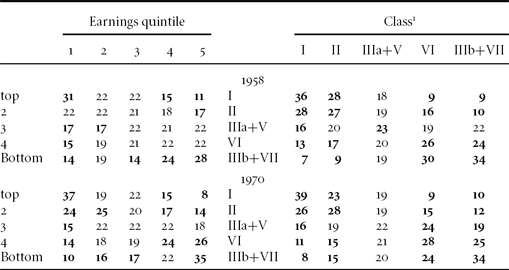
Evidence that brings out the significance of the above argument can be found in reverting to the comparison of the mobility experience of members of the 1958 and 1970 birth cohorts – the empirical basis of the consensus view. It can be shown (Erikson and Goldthorpe, Reference Erikson and Goldthorpe2010) that, for identical sub-samples of cohort members (that is, those for whom all relevant information is available) analyses based on five-class mobility tables, while indicating no change in relative rates between the two cohorts, capture a stronger intergenerational association than do quintile family income/earnings tables based on the CEP economists’ own data.
Table 1 presents the above findings, for men, in a less rigorous but more accessible form than originally. The class mobility tables have been adjusted (see Mosteller, Reference Mosteller1968) so as to have all marginal percentages at 20 per cent, in the same way as the quintile family income/earnings tables, while preserving the underlying odds ratios that express relative mobility rates. It is evident that the class tables show up stronger propensities for immobility and for the persistence of advantage and disadvantage across generations, and especially so in the case of the 1958 cohort (where the number of cells in the family income/earnings table with values close to the ‘perfect mobility’ expectation of 20 per cent must underline doubts earlier noted about this table). The corresponding findings for women (available on request) display a very similar pattern.
Family income/earnings quintile mobility tables and adjusted five-class mobility tables for identical sub-samples (N = 3,415) of male 1958 and 1970 birth cohort members, percentage by row – i.e., by family income quintile and father's class, respectively (percentages more than ±2% points different from the 20% ‘perfect mobility’ expectation are in bold)

Note: 1 Class I, Professional and managerial, higher; Class II, Professional and managerial, lower; Class IIIa+V, Routine nonmanual, higher and Lower supervisory and technical; Class VI, Skilled manual; Class IIIb+VII, Routine nonmanual, lower and Non-skilled manual.
Source: Adapted from Erikson and Goldthorpe (Reference Erikson and Goldthorpe2010).
What is then implied is that while treating mobility in terms of class, as an index of economic status, does not point to any recent decline in relative mobility in the way that Blanden et al. (Reference Blanden, Goodman, Gregg, Machin and Corak2004) have claimed, it does reveal the prevalence in Britain of a mobility regime clearly less fluid than that which is apparent if economic status is indexed simply by current income or earnings.
Implications for policy
Whether the consensus view or the alternative view is accepted is important not only from an academic standpoint but also in that the two views lead to very different ideas about the nature of Britain's social mobility problem and about the ways in which, and the extent to which, it might be addressed through public policy.
According to the consensus view, based on the work of Blanden et al.(Reference Blanden and Machin2004) on income mobility – and on over-interpretations or misunderstandings of this work – the problem is one of relatively recent origin; around the end of the twentieth century mobility in Britain declined, sharply and to a very low level, thus creating a situation in marked contrast to the Golden Age of mobility in the decades after World War II. According to the alternative view, based largely on the study of class mobility, the main way in which mobility rates have changed in the recent past is that the steady increase in absolute upward mobility that characterised the Golden Age has levelled out, at least so far as men are concerned – although any suggestion that, even with men, such mobility has ‘ground to a halt’ is quite nonsensical (see, e.g., Goldthorpe and Mills, Reference Goldthorpe and Mills2008: figures 4, 5 and 6). At the same time, though, a longer-term and more fundamental problem is identified: relative rates of class mobility, which reflect the extent of the intergenerational transmission of economic advantage and disadvantage more fully than do relative rates of income mobility, have shown an essential constancy over a period extending back, through the Golden Age itself, to the inter-war years – apart, possibly, for some emergent increase in fluidity among women. These two different ideas, of what the problem of mobility actually is, do then in turn critically shape ideas on policy.
Adherents of the consensus view, focusing on the period from the end of the 1970s and on the supposed decline in mobility, tend to accept the CEP economists’ explanation of this as a consequence of increasing inequality in incomes as reflected in similarly increasing inequalities in children's educational attainment. Following from this, the prevailing policy emphasis has been on the central role that education must play in overcoming the mobility problem – the major differences among the parties being over the particular lines of policy development that are required in order to ‘level up’ educational attainment (cf. HM Government, 2009a; HM Government, 2011; HM Government, 2012). However, the understanding of the relationship between education and social mobility implied here is one that, according to the alternative view with its much longer time perspective, appears very much open to question.
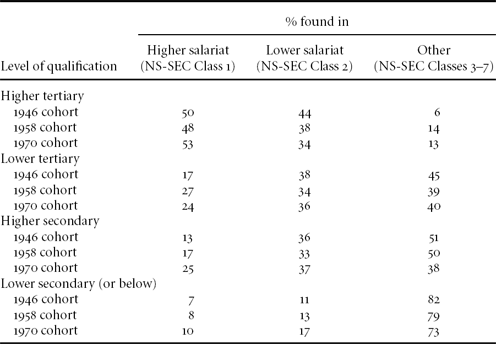
To begin with absolute rates, what has to be understood is that the rising upward mobility of the Golden Age had little at all to do with educational expansion or reform. It was, rather, essentially demand driven: that is, by the growth of professional and managerial employment that far outstripped the supply of highly qualified personnel. This is illustrated in Table 2, which includes data from the 1946 National Survey of Health and Development birth cohort as well as from the 1958 and 1970 cohorts. It can be seen that while in all three cohorts those with university degrees, or equivalents, were almost assured of professional and managerial positions (‘graduate jobs’), the chances of accessing the professional and managerial salariat were also high, and in general increasing, for the less well qualified – typically, through mobility in the course of their working lives. Thus, even for men with, at best, only lower secondary qualifications these chances had risen to above one in four for those in the 1970 cohort. Over the whole period covered, the relative advantage of having a degree actually declined (Bukodi and Goldthorpe, Reference Bukodi and Goldthorpe2011). Of course, still in this period, as at other times, an association can be observed between education and mobility chances; but it is important to recognise that this association relates to the individual rather than to the population level. Education has an effect on who is mobile, or immobile, rather than on the overall rate of mobility.
Probabilities (%) of men with differing levels of qualification in the 1946, 1958 and 1970 birth cohorts being found in the higher or lower levels of the professional and managerial salariat1
Note: 1 Men regarded as having achieved ‘occupational maturity’.
Source: See further Bukodi and Goldthorpe (Reference Bukodi and Goldthorpe2011).
Correspondingly, then, the stabilising of rates of upward mobility towards the end of the twentieth century, at least in the case of men, can be associated with a slowing rate of growth of the salariat. And, again, it is difficult to see education as an explanatory factor, except insofar as women's rising – but still strongly class-linked – levels of qualification have enabled them to compete more effectively with men for the professional and managerial positions that are available (Goldthorpe and Mills, Reference Goldthorpe and Mills2008).
In an attempt to sustain the case for the importance of education in reversing the – supposed – decline in mobility, New Labour under Gordon Brown resorted to a radical supply-side position, presumably under the influence of some rather naïve version of human capital theory. The argument was (e.g. Brown, Reference Brown2008; and speech, 16 January 2010; HM Government, Reference Marshall2009a: chs. 1,2) that there is now ‘no ceiling’ on the extent to which ‘top-end’ jobs can be created in Britain, since, in the context of a global economy, such jobs can be drawn in from around the world, provided only that Britain has a workforce sufficiently well-educated and skilled to perform them. In other words, through educational expansion and reform, supply can create its own demand, and a return can in this way be made to a situation of ever-increasing ‘room at the top’ in which – the great political attraction of the position – no need arises for mobility to become a zero-sum game.
However, the realism of this scenario can be doubted, and an alternative would be that, with the rapid expansion of tertiary education in the 1990s, a reversal of the mid-twentieth century situation is being brought about: that is, the supply of the higher qualified is tending to run ahead of demand. The concept of the ‘graduate job’ does in fact seem already to have disappeared, and research into ‘over-qualification’ indicates that in Britain, as in other advanced societies, this is increasing and becoming a prevailing feature of labour markets rather than the temporary disequilibrium that human capital theory might allow for (Chevalier and Lindley, Reference Chevalier and Lindley2009; Green and Zhu, Reference Green and Zhu2010; Wolf, Reference Wolf2011: part 2). Moreover, the idea that this situation could be redressed by attracting ‘top-end’ jobs into Britain from within the global economy faces the rather obvious difficulty that the newly industrialising countries, of Asia especially, can abundantly supply well-qualified personnel and at much lower cost (cf. Brown et al., Reference Brown, Lauder and Ashton2011).
While, then, claims are still being made, as, for example, by the ‘social mobility Tsar’, Alan Milburn (Reference Milburn2009, Reference Milburn2012), that a further period of rapid expansion of professional and managerial employment lies ahead, it would seem, to say the least, no less probable – and especially given the unfavourable economic outlook – that something like the present situation will continue: that is, any upgrading of the occupational and class structures will occur at a much slower rate than in the past. And, to the extent that governments are able to sustain such upgrading, this will need to be through economic rather than educational policy: that is, through policy aimed at economic growth – or, rather, development – in which investment in advanced technology and the ‘knowledge economy’ and also in the public and social services infrastructure is given high priority.
If, then, education had little to do with the rising (absolute) rates of upward mobility of the Golden Age, and cannot in itself be expected to produce a return to the benign structural conditions of that time, is the emphasis placed on educational policy any more justifiable in the case of relative rates?
In this case, two crucial assumptions underlying the consensus view should be noted: first, that raising levels of educational attainment among young people from less advantaged backgrounds is tantamount to achieving greater educational equality; and, second, that generally higher and more equal levels of educational attainment will, more or less automatically, translate into an increase in relative mobility (see, e.g., Blanden and Machin, Reference Blanden and Machin2007).
The view here implied of the relation between education and mobility can be questioned, first of all, at an empirical level. What in this case is significant is the essential constancy of relative rates of class mobility back to the inter-war years: that is, over a period characterised by a series of major educational reforms, all carried through with some degree of egalitarian intent, including the introduction of secondary education for all following the Butler Act of 1944, the increase in the school leaving age to fifteen in 1947 and to sixteen in 1972, the move from the selective tripartite system of secondary education to comprehensive schools from the later 1960s, the replacement of O-levels by GCSEs in 1988 and two major waves of expansion in tertiary education in the 1960s and 1990s. It is possible that these developments were associated with some, albeit modest, reduction in class-linked inequalities in educational attainment (Breen et al., Reference Breen, Luijkx, Müller and Pollak2009, Reference Breen, Luijkx, Müller and Pollak2010), although the issue is still debatable. But there is no indication whatever of them having any impact on mobility. And, in at least one respect, there is now direct evidence that they did not. Boliver and Swift (Reference Boliver and Swift2011) exploit the fact that children in the 1958 birth cohort were divided between those educated under selective and comprehensive systems, and in a careful comparison they find that the mobility chances of the two sets of children, whether considered in terms of class or income, were essentially the same. Conservative claims that the abolition of grammar schools has been damaging to social mobility are thus not supported; but neither are the hopes of those who saw in comprehensive schools the agencies of a more open society.Footnote 8
What the historical evidence suggests is that those who suppose it possible to modify the class mobility regime directly through educational policy overlook the regime's important self-maintaining properties: that is, properties that stem from the capacity of families with greater resources to use these resources specifically in reaction to situations in which some threat to their positions might arise. This capacity is manifested in at least two important ways.
First, parents in more advantaged class positions show in effect a clear awareness that education, in its relation to employment, operates primarily as a positional good (Wolf, Reference Wolf2002: ch. 8). What matters is not how much education individuals acquire but rather how much relative to others – within, say, the same birth cohort – with whom they will be in closest competition in labour markets. Thus, in the face of some general improvement in educational standards, these parents can be expected to respond by using their superior economic resources to engage in what Thurow (Reference Thurow1976: 95–7) has called ‘defensive expenditure’: that is, expenditure aimed at preserving their children's competitive edge. It is, for example, evident enough in Britain today that parental – and, perhaps, grandparental – resources, even if not sufficient to allow for children to be educated in the private sector, are still widely deployed to buy houses in areas served by high-performing state schools, to pay for individual tutoring, to help manage student debt, to support entry into postgraduate courses for which no loans are available or, in the case of educational failure, to fund ‘second chances’. And such courses of action, resulting in what Lucas (Reference Lucas2001) has called ‘effectively maintained’ educational inequality, are ones that can scarcely be precluded in a liberal society.
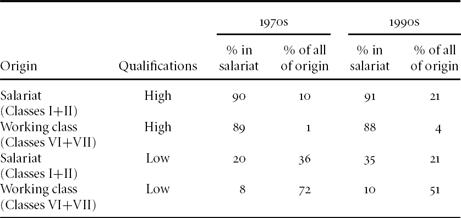
Second, it has to be recognised that even if children from more advantaged backgrounds do not achieve great educational success, this does not have the same damaging effect on their employment prospects as with children from less advantaged backgrounds; and this differential effect would appear to have been widening in later twentieth-century Britain, even as overall levels of educational qualification increased. Table 3 shows that in this period graduates’ chances of accessing the professional and managerial salariat were very high, regardless of their class origins. But while individuals of working-class origin with low-level qualifications had only slight chances of entering the salariat, their counterparts with parents in the salariat had far from negligible, and rising, chances of maintaining their parents’ position – chiefly, the indications are, through obtaining managerial positions in the expanding sales and personal services sectors (Goldthorpe and Jackson, Reference Goldthorpe, Jackson, Lareau and Conley2008). And important here, it would seem, in addition perhaps to helpful social networks, are the – very marketable – ‘soft skills’ and lifestyle and personal characteristics that these individuals acquire, less through their education than through their family, community and peer-group socialisation (Jackson, Goldthorpe and Mills, Reference Jackson, Goldthorpe and Mills2005), reflecting their parents’ superior social and cultural, as well as economic resources. There is, in other words, little evidence of, or reason to expect, sustained movement towards an ‘education-based meritocracy’ – a prime feature of which would be significantly more downward mobility than is in fact observed. Indeed, for most advanced societies, the evidence is that the effect of education on class destinations is actually tending to weaken (Breen and Luijkx, Reference Breen, Luijkx and Breen2004).
Probabilities (%) of being found in the professional and managerial salariat of individuals of salariat and working-class origins with high (degree level or equivalent) and low (some O-level or GCSE or below) qualifications, 1970s and 1990s
Source: General Household Surveys.
In sum, attempts at increasing equality of opportunity, in the sense of a greater equality of mobility chances, would seem unlikely to be effective, whether made through educational policy or otherwise, unless the class-linked inequalities of condition on which class mobility regimes are founded are themselves significantly reduced. It is notable that in discussion of Scandinavian societies, in which increased social fluidity can be most persuasively claimed as a political accomplishment, the emphasis has fallen less on educational policy per se than on the reduction of class differences in incomes and levels of living through redistributive fiscal and welfare policies and, further, on strong trade unionism and employment protection that help maintain the security and stability of incomes, of wage-earners especially, and on models of political economy that, again to the advantage of wage-earners, prioritise full employment (Erikson, Reference Erikson and Persson1990, Reference Erikson, Erikson and Jonsson1996; Ringdal, Reference Ringdal and Breen2004; Breen and Jonsson, Reference Breen and Jonsson2007). While educational expansion and reform may have played a part, their effects have been regarded as secondary to, if not dependent upon, more fundamental processes of what Marshall (Reference Marshall1950) in another time, but still aptly, called ‘class abatement’.Footnote 9
Conclusions
The finding reported by a group of economists that in the last decades of the twentieth century social – sc. income – mobility sharply declined in Britain has become widely accepted in political and media circles. However, on account of data problems, the reliability of this finding is open to doubt, and this is of greater significance than might otherwise be the case since the consensus that has formed has no other empirical basis. Moreover, a good deal of confusion has arisen in that the economists did not make any explicit distinction between absolute and relative mobility, so that, while they were in fact essentially concerned with relative mobility, among politicians and the socio-political commentariat their research has been widely interpreted as if it referred also, if not primarily, to absolute mobility.
An alternative to the consensus view can be put forward deriving from research into class mobility covering a lengthy historical period. In this case, no decline in mobility, absolute or relative, occurred in the late twentieth century, contrary to the widely accepted ‘factoid’. In this period, the main change was that the rising rates of upward mobility of the mid-twentieth century tended to level out, certainly so far as men were concerned. Relative mobility rates remained much the same as for decades previously, although if any directional change were in evidence, it was an actual increase in fluidity among women. This alternative view is grounded in a number of quite independent studies that have produced largely consistent findings. At the same time, there is evidence to indicate that analyses of class mobility more fully capture the degree of intergenerational continuities in economic status than do those of income mobility.
These two contrasting views lead to different understandings of the nature of Britain's social mobility problem and carry different implications for policy. According to the consensus view, educational policy appears as all-important. The decline in mobility that is believed to have occurred in the late twentieth century is seen as following from widening differences in children's educational attainment in relation to family income; and it is then supposed that if policies can be implemented that will raise the level of attainment of children from less advantaged backgrounds, these policies will in turn generate greater mobility.
According to the alternative view, the part that can be played by educational policy appears far more limited. What happens to absolute rates will be primarily determined, as it has been in the past, by changes in the occupational and class structures, and insofar as policy can have any impact here, it will be policy aimed at shaping the pattern of future economic development. As regards relative rates, what can be achieved by educational policy has to be seen as constrained in two different ways: first, by the ability of more advantaged parents always to use their superior economic resources as necessary in order to further their children's educational attainment and thus help maintain their positional advantage; and, second, by the fact that children from more advantaged backgrounds who do not do well educationally will still have family resources and personal attributes that can serve to protect them against any serious déclassement.
Given this perspective, what is then suggested is that policies aimed at creating more equal opportunities for higher educational attainment, essentially by ‘levelling up’, would best be advocated and pursued for their own sake: that is, in order to allow all young people to realise their full academic and wider human potentialities – with whatever beneficial economic effects might follow – and not as instruments of increasing mobility of very uncertain effectiveness. If, however, the creation of a more fluid and open society is a serious goal, then politicians will need to move out of the relative comfort zone of educational policy and accept that measures will be required, of a kind sure to be strongly contested, that seek to reduce inequalities of condition, of which those associated with social class would appear the most fundamental.