Introduction
The Camerata Wachsmuth and Springer, Reference Wachsmuth and Springer1885, is an Ordovician–Permian crinoid group and was the earliest clade to diverge among crinoids from stemmed echinoderms (Ausich et al., Reference Ausich, Kammer, Rhenberg and Wright2015; Cole, Reference Cole2017; Wright et al., Reference Wright, Ausich, Cole, Peter and Rhenberg2017). Of two camerate orders, the Diplobathrida Moore and Laudon, Reference Moore and Laudon1943, was the predominant constituent during the Ordovician, and the Monobathrida Moore and Laudon, Reference Moore and Laudon1943, was dominant during the post-Ordovician (Ausich et al., Reference Ausich, Kammer and Baumiller1994; Baumiller, Reference Baumiller, David, Guille, Féral and Roux1994; Ausich and Deline, Reference Ausich and Deline2012; Cole, Reference Cole2017). It is well acknowledged that there is significant paucity of Ordovician records of crinoids, including camerates, in East Gondwana, including Korea and China (Ausich and Kammer, Reference Ausich and Kammer2001; Lefebvre et al., Reference Lefebvre, Sumrall, Shroat-Lewis, Reich, Webster, Hunter, Nardin, Rozhnov, Guensburg, Touzeau, Noailles, Sprinkle, Harper and Servais2013).
Recent studies have provided a robust phylogenetic hypothesis for Ordovician camerates (Cole, Reference Cole2017) and the Diplobathrida (Cole, Reference Cole2019). The Ordovician camerate phylogeny identifies the Eucamerata Cole, Reference Cole2017, comprising the two orders and a few stem eucamerates (Cole, Reference Cole2017, fig. 2). The diplobathrid phylogeny shows that (1) there are two major diplobathrid clades, Clade A and B; (2) a majority of the Ordovician taxa (21/35 = 60%) are included in Clade A; and (3) all the Ordovician taxa in Clade A are classified into the Rhodocrinitidae Roemer, Reference Roemer and Brown1855 (14/21 = 67%) or Anthracocrinidae Strimple and Watkins, Reference Strimple and Watkins1955 (7/21 = 33%) (Cole, Reference Cole2019, figs. 2, 3). In both phylogenies, the internal nodes in the Early–Middle Ordovician greatly outnumber the diplobathrid taxa with their first stratigraphic appearance in the interval; 94% (29/31) and 68% (55/81) of nodes, and 24% (8/33) and 7% (7/103) of taxa, respectively (Cole, Reference Cole2017, fig. 3, Reference Cole2019, fig. 3). This suggests that the Early–Middle Ordovician was a crucial period for diplobathrid diversification.
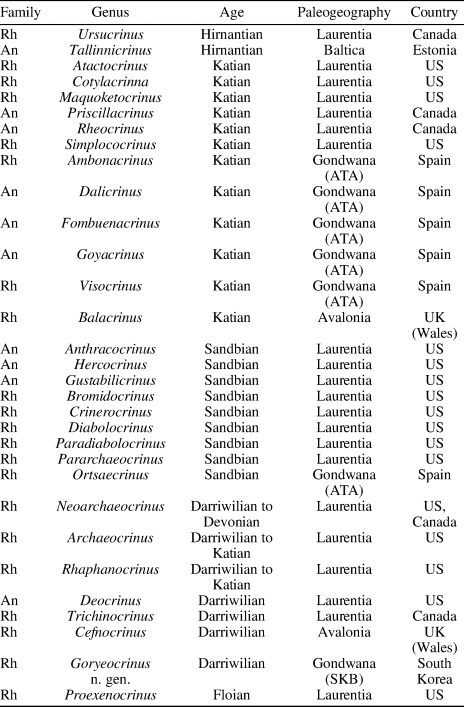
Of 30 well-defined Ordovician rhodocrinitids and anthracocrinids (Cole, Reference Cole2019, supplemental table 1), 22 occur in the Late Ordovician and seven in the Early–Middle Ordovician (one in the Floian and six in the Darriwilian, with three into the Late Ordovician or Devonian). Of these same 30 taxa, 21 were reported from Laurentia (US and Canada), six from West Gondwana (Spain), two from Avalonia (UK), and one from Baltica (Estonia) (Table 1); 15 taxa (48%) are from the Late Ordovician of Laurentia.
Stratigraphic and paleogeographic occurrences of 30 well-defined rhodocrinitid (Rh) and anthracocrinid (An) taxa and Goryeocrinus n. gen. (stratigraphic occurrence data after Cole, Reference Cole2019, fig. 3, with addition of Tallinnicrinus Cole et al., Reference Cole, Ausich and Wilson2021). ATA = Amorican Terrane Assemblage; SKB = Sino-Korean Block (= North China).

This study reports a new diplobathrid genus, Goryeocrinus n. gen., from the Middle Ordovician (middle Darriwilian) Jigunsan Formation of South Korea, which was part of the Sino-Korean (North China) Block, an eastern peri-Gondwanan terrane almost antipodal to Laurentia (Park et al., Reference Park, Lee, Woo and Lee2022, fig. 6). The South Korean occurrence of Goryeocrinus n. gen. drastically expands the Ordovician paleogeographic range of the diplobathrids, which will help in elucidating paleobiogeographic aspects of early camerate evolution.
Geological setting and biostratigraphy
The slab containing Goryeocrinus pentagrammos n. gen. n. sp. was found in an outcrop of the Middle Ordovician Jigunsan Formation, part of the Cambro-Ordovician Joseon Supergroup (Lee et al., Reference Lee, Cho, Choh, Hong, Lee, Lee, Lee, Lee, Park and Woo2022; Park et al., Reference Park, Lee, Woo and Lee2022). The formation mainly consists of mudstone with limestone layers in the upper part. The mudstone, which is dark gray and laminated, is interpreted to have been deposited in a low-energy, oxygen-restricted, clastic outer shelf and basin environment developed by rapid transgression (Woo and Chough, Reference Woo and Chough2007; Byun et al., Reference Byun, Lee and Kwon2018; Lee et al., Reference Lee, Cho, Choh, Hong, Lee, Lee, Lee, Lee, Park and Woo2022). Specimens of G. pentagrammos n. gen. n. sp. are associated with parallel-laminated, greenish gray siltstone and calcisiltite, which are interpreted to have been deposited in a storm-influenced deep subtidal, low-angle carbonate platform developed in the upper part of the formation (Woo and Chough, Reference Woo and Chough2007; Byun et al., Reference Byun, Lee and Kwon2018).
The Jigunsan Formation is the most fossiliferous Ordovician unit of the Joseon Supergroup, yielding various invertebrate fossils including trilobites, brachiopods, and cephalopods as major components (Lee et al., Reference Lee, Cho, Choh, Hong, Lee, Lee, Lee, Lee, Park and Woo2022). Minor components, such as echinoderms including Ohiocrinus (Park et al., Reference Park, Lee, Woo and Lee2022) and Goryeocrinus n. gen. described in this study, machaeridians, and possible soft-bodied fossils suggest that the Jigunsan fauna may have significant potential for understanding the East Gondwanan and Darriwilian aspect of the Great Ordovician Biodiversification Event, including early crinoid diversification.
Two conodont biozones, the Tangshanodus tangshanensis and Eoplacognathus suecicus zones, in ascending order have been established in the Jigunsan Formation (Cho et al., Reference Cho, Lee, Lee and Choh2021). The siltstone and calcisiltite lithology indicates that the slab occurs in the upper part of the formation, which is assigned to the middle Darriwilian (Dw2) E. suecicus Zone (Goldman et al., Reference Goldman, Sadler, Leslie, Melchin, Agterberg, Gradstein, Gradstein, Ogg, Schmitz and Ogg2020, fig. 20.3).
Material and methods
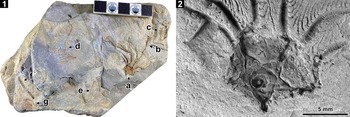
The slab was found in an exposure along a stream in the Gumunso section of the Jigunsan Formation (Park et al., Reference Park, Lee, Woo and Lee2022, fig. 1.2). It is possible that the slab was derived from the Jangseong section located 2.5 km upstream where a disparid, Ohiocrinus byeongseoni Park et al., Reference Park, Lee, Woo and Lee2022, occurs. A specimen with calyx and six arms is present along with four fragmentary arms and a stem (probably mesistele); a poorly preserved brittle star specimen, which has not been reported from the formation, also occurs on the slab (Fig. 1.1). The specimen with calyx is preserved sheared (Fig. 1.2). Since all the specimens are preserved as external molds, latex casts were prepared, then photographed using a digital camera after coating with magnesium oxide fume.
(1) Photograph of the slab (KIGAM-9J132) with specimens of Goryeocrinus pentagrammos n. gen. n. sp. from the Gumunso section of the Middle Ordovician (Darriwilian) Jigunsan Formation, Taebaek, South Korea; “a–f” is given to G. pentagrammos n. gen. n. sp. and “g” to the brittle star. (2) Calyx of holotype (KIGAM-9J132a), external mold, aboral view.

Phylogenetic analysis
In order to examine the phylogenetic relationship of Goryeocrinus n. gen. with other camerates, two analyses were performed. Goryeocrinus n. gen. was added to the matrix for Ordovician camerate analysis including Priscillacrinus Cole et al., Reference Cole, Ausich, Wright and Koniecki2018 (Cole et al., Reference Cole, Ausich, Wright and Koniecki2018, supplemental data 1) and to the matrix for diplobathrid analysis excluding Cleiocrinus Billings, Reference Billings1857 (Cole, Reference Cole2019, supplemental data 2); the matrices are available in Supplemental Data 1 and 2, and character descriptions are available in Cole (Reference Cole2017, supplemental data 2) and Cole (Reference Cole2019, supplemental table 2). The Tremadocian Eknomocrinus Guensburg and Sprinkle, Reference Guensburg and Sprinkle2003, a stem eucamerate, was selected as the outgroup, as in the previous analyses. A single most parsimonious tree for the Ordovician camerates (Cole et al., Reference Cole, Ausich, Wright and Koniecki2018, fig. 2) and 15 for diplobathrids (Cole, Reference Cole2019, supplemental data 3) were used as backbone topological constraints for each analysis. The matrices were analyzed with PAUP* v. 4.0a169 (Swofford, Reference Swofford2003) using a heuristic search with 10,000 random addition sequence replicates with tree bisection reconnection (TBR), holding 10 trees at each step and collapsing all branches with a maximum branch length of zero.
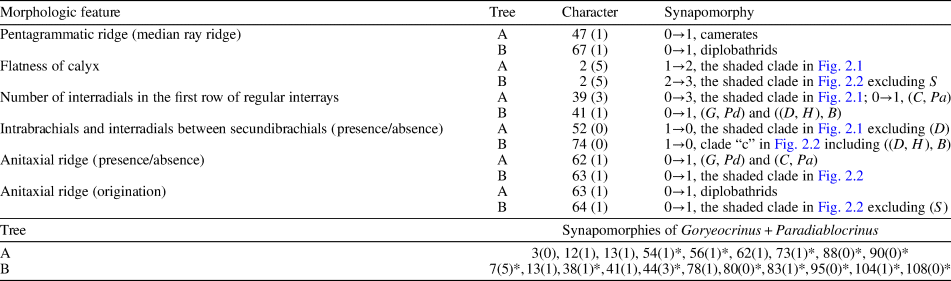
Morphologic features used in taxonomy of Goryeocrinus n. gen. and corresponding synapomorphies in the Ordovician camerate (A; Cole, Reference Cole2017, fig. 2, supplemental data 2) and diplobathrid (B; Cole, Reference Cole2019, fig. 2, supplemental table 2) trees; numbers in parenthesis indicate character state of Goryeocrinus n. gen.; abbreviations of generic names: Goryeocrinus n. gen. (G), Paradiablocrinus (Pd), Bromidocrinus (B), Hercocrinus (H), Deocrinus (D), Cefnocrinus (C), Pararchaeocrinus (Pa), Sphaerotocrinus (S). Synapomorphies of Goryeocrinus n. gen. and Paradiabolocrinus in each tree; “*” denotes characters coded unknown or ambiguous for either genus.

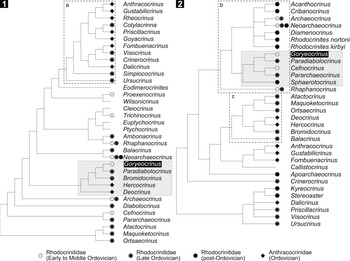
The single most parsimonious tree from the Ordovician camerate analysis indicates that Goryeocrinus n. gen. forms a clade with Paradiabolocrinus Brower and Veinus, Reference Brower and Veinus1974, which is subsequently nested with Bromidocrinus Kolata, Reference Kolata and Sprinkle1982, Hercocrinus Hudson, Reference Hudson1907, and Deocrinus Hudson, Reference Hudson1907 (Fig. 2.1; supplemental data 3). The strict consensus tree of 15 most parsimonious trees from the diplobathrid analysis shows that Goryeocrinus n. gen. is located in Clade A of the Diplobathrida, the recovered clade of Goryeocrinus + Paradiabolocrinus is the sister group to a clade of Cefnocrinus Botting, Reference Botting2003 + Pararchaeocrinus Strimple and Watkins, Reference Strimple and Watkins1955, and Sphaerotocrinus Goldring, Reference Goldring1923, is the sister group to these two clades (Fig. 2.2; Supplemental Data 4). All these taxa are Ordovician rhodocrinitids, except for Deocrinus and Hercocrinus (Ordovician anthracocrinids) and Sphaerotocrinus (Devonian rhodocrinitid).
(1) Single most parsimonious tree produced by Ordovician camerate analysis; only the diplobathrid clade (Cole et al., Reference Cole, Ausich, Wright and Koniecki2018, fig. 2) is shown. (2) Strict consensus tree of 15 most parsimonious trees produced by diplobathrid analysis; only Clade A of the Diplobathrida (Cole, Reference Cole2019, fig. 2) is shown. Taxa without a symbol belong to other diplobathrid families; “a,” “b,” and “c” indicate the clades discussed in the text.

Repository and institutional abbreviation
Specimens examined in this study are deposited in the Geological Museum, Korea Institute of Geoscience and Mineral Resources (KIGAM), Daejeon, South Korea. KIGAM-9J132 refers to the slab and “a–g” to the specimens.
Systematic paleontology
The classification follows Cole (Reference Cole2017) and Wright et al. (Reference Wright, Ausich, Cole, Peter and Rhenberg2017). Classification of the Diplobathrida at family level follows Cole (Reference Cole2019, supplemental table 1). Morphologic terminology mostly follows Ubaghs (Reference Ubaghs, Moore and Teichert1978b).
Class Crinoidea Miller, Reference Miller1821
Superclass Camerata Wachsmuth and Springer, Reference Wachsmuth and Springer1885
Infraclass Eucamerata Cole, Reference Cole2017
Order Diplobathrida Moore and Laudon, Reference Moore and Laudon1943
Superfamily Rhodocrinitoidea Roemer, Reference Roemer and Brown1855
Family Rhodocrinitidae Roemer, Reference Roemer and Brown1855
Genus Goryeocrinus new genus
Type species
Goryeocrinus pentagrammos new species, by monotypy.
Diagnosis
As for species, by monotypy.
Occurrence
As for species.
Etymology
After ‘Goryeoin’ (= people of ‘Goryeo,’ an ancient dynasty in the Korean Peninsula), referring to the Korean diaspora in Siberia and Kazakhstan, which are also under-sampled regions for Ordovician camerates.
Remarks
The superclass Camerata is characterized by having rigidly ankylosed calyx plates, fixed brachials and interradials, a subtegminal mouth, and additional plates in the posterior interray (Ubaghs, Reference Ubaghs, Moore and Teichert1978a; Cole, Reference Cole2017, Reference Cole2019; Wright et al., Reference Wright, Ausich, Cole, Peter and Rhenberg2017). Presence of the former two characters confirms that Goryeocrinus n. gen. is a camerate; the latter two characters are not known to the genus. The Diplobathrida is characterized by having an infrabasal circlet, basal concavity, basals partially visible in lateral view, and radials interrupted in all regular interrays (Cole, Reference Cole2017, Reference Cole2019; Wright et al., Reference Wright, Ausich, Cole, Peter and Rhenberg2017). All these features are observed in Goryeocrinus n. gen.
Goryeocrinus n. gen. forms a clade with two rhodocrinitids and two anthracocrinids in the Ordovician camerate tree (Fig. 2.1), and only with four rhodocrinitids in the diplobathrid tree (Fig. 2.2); the latter clade is part of a larger clade exclusively comprising rhodocrinitids (“b” in Fig. 2.2). This suggests that Goryeocrinus n. gen. can be classified into the Rhodocrinitidae. The family is the largest diplobathrid group for which no diagnostic combination of characters can be defined (Ausich, Reference Ausich1986; Ausich et al., Reference Ausich, Gil Cid and Alonso2002; Cole, Reference Cole2017; Cole et al., Reference Cole, Ausich, Wright and Koniecki2018). It has been noted that systematic revision of diplobathrid families is inevitable and the recent analyses corroborate their paraphyly (Cole, Reference Cole2017, Reference Cole2019; Cole et al., Reference Cole, Ausich, Wright and Koniecki2018). Goryeocrinus n. gen. is assigned to the Rhodocrinitidae because it bears more morphologic similarities to the rhodocrinitids than anthracocrinids (see below). Goryeocrinus n. gen. is distinguished by having a pentagonal, flat bowl-shaped calyx with a conspicuous pentagrammatic ridge, two interradials in the first row of regular interrays, an anitaxial ridge, and lacking intrabrachials between secundibrachials of each half-ray and interradials between those of adjacent half-rays. The combination of these characters is unique and not present in any rhodocrinitids, thus warranting erection of a new genus.
Goryeocrinus pentagrammos new species
Figures 1, 3, 4
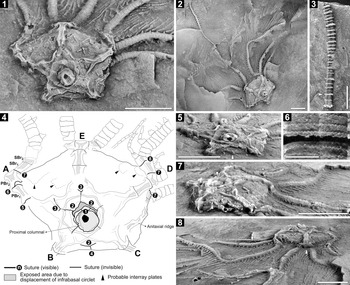
Goryeocrinus pentagrammos n. gen. n. sp. from the Middle Ordovician (Darriwilian) Jigunsan Formation of South Korea. (1, 2, 4, 5, 7, 8) Holotype (KIGAM-9J132a), latex cast; (1) magnified view of calyx, aboral view; (2) calyx with six arms, aboral view; (4) line drawing of calyx with rays A–E indicated (see text for details of numbered visible sutures); (5) BC interray (arrowhead indicates the suture between two interradials in the first row and basal), lateral view; (7) CD interray (upper and lower arrowheads indicate basal concavity and anitaxial ridge, respectively), lateral view; (8) E ray (left and right arrowheads indicate weakly cuneate brachials and T-shaped median ray ridge, respectively), lateral view. (3, 6) Paratype (KIGAM-9J132f), stem (probably mesistele); (3) overall lateral view, latex cast; (6) magnified view of stem indicated by arrowhead in (3) (note the crenulation of articulation facets), external mold. Scale bar = 5 mm, except (6) = 1 mm. (5, 7, 8) Made using focus stacking function in Adobe Photoshop.

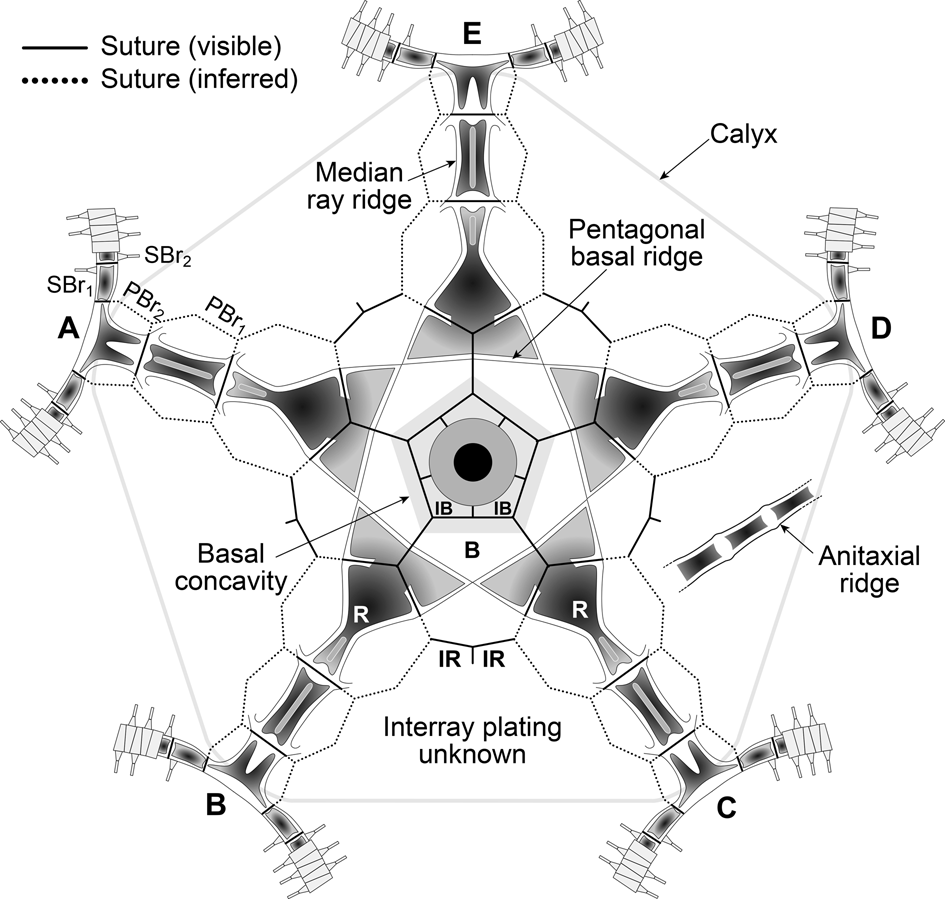
Interpretive plate diagram of Goryeocrinus pentagrammos n. gen. n. sp. Abbreviations: A–E = A ray through E ray; IB = infrabasal; B = basal; R = radial; IR = interradial in the first row; PBr1 and PBr2 = first and second primibrachial respectively; SBr1 and SBr2 = first and second secundibrachial, respectively.

Type specimens
KIGAM-9J132a, holotype (calyx with arms); KIGAM-9J132f, paratype (stem, probably mesistele).
Diagnosis
Rhodocrinitid with a pentagonal, flat bowl-shaped calyx; a conspicuous pentagrammatic ridge in aboral view formed by a bifurcated proximal median ray ridge and pentagonal basal ridge; at least two interradials in first row of regular interrays; anitaxial ridge originating from CD interray, but close to C radial; fixed first primibrachial and axillary, fixed second primibrachial with T-shaped median ray ridge; first and second secundibrachials free and pinnulate; no intrabrachials between secundibrachials of each half-ray, and no interradials between those of adjacent half-rays; 10 arms entirely uniserial and unbranching, with weakly cuneate brachials; and a heteromorphic column with holomeric columnals.
Occurrence
Middle Ordovician (Darriwilian) Jigunsan Formation, Taebaeksan Basin, Taebaek, South Korea.
Description
Calyx pentagonal (aboral view) with radius of ~4 mm, flat bowl-shaped (lateral view) with <0.25 height/width ratio; the widest point of calyx just below the top; basal concavity probably pentagonal in outline and includes entire infrabasal circlet and proximal one-tenth of basal circlet. Infrabasal circlet consists of five heptagonal (wider than high) plates. Basal circlet consists of five heptagonal (slightly wider than high) plates, partially visible in lateral view. Radial circlet consists of five, probably heptagonal (slightly wider than high) plates. Regular and posterior interrays approximately equal in area; plating in regular interrays unknown, except for at least two interradials of unknown shape in first row; interray surface ornamented with irregularly distributed elongated ridges and nodes. Calyx plate flat in cross-section. Anitaxial ridge with central depression and subordinate ridges divided into parts by transverse ridge, like median ray ridge, and originates in CD interray, but close to C ray radial; plate shape of anal series and plating in CD interray unknown.
Median ray ridge conspicuous, stands out on calyx surface (lateral view), and divided into three parts by two transverse ridges, with central depressions and subordinate longitudinal ridges; proximal and distal parts bifurcate at ~60° and 180°, respectively. Two transverse ridges, corresponding to boundary between radial and first primibrachial and between first and second primibrachials, extend laterally and disappear onto interray surface. Bifurcated proximal part conical, with base defined by ‘pentagonal basal ridge’ running through proximal third of basal circlet, showing pentagram-like arrangement (termed ‘pentagrammatic ridge’); secondary ridge develops inward from midpoint of bifurcated proximal part at right angle, corresponding to boundary between two basals and radial; no subordinate features identifiable in proximal triangular part, but weakly raised subordinate longitudinal ridge in distal neck part. Middle part, corresponding to first primibrachial, rectangular and constricted in middle, with central depression and weakly raised subordinate longitudinal ridge. Bifurcated distal part consists of T-shaped central segment with W-shaped depression, corresponding to second primibrachial, and two lateral rectangular segments with rectangular depression, each corresponding to first and second secundibrachial, respectively; depression of second secundibrachial opens distally.
First primibrachial fixed and probably hexagonal; second primibrachial axillary and of unknown shape. First and second secundibrachials free and pinnulate; no intrabrachials between secundibrachials of each half-ray; no interradials between secundibrachials of adjacent half-rays. First and second secundibrachials only represented by bifurcated distal part of median ray ridge.
Ten free arms with alternately arranged, weakly cuneate brachials, entirely uniserial and unbranching, and ~30 mm long (D ray); proximal brachials without median ray ridge wider than secundibrachials with median ray ridge. Pinnules free and slender; proximalmost part of pinnular isosceles triangle-shaped, with short projection at base toward distal end.
Column heteromorphic, with nodals at every five to eight columnals and thinner internodal(s) in some internodes; nodals thinner distally; columnals (proxistele and mesistele) holomeric and circular in cross-section, with symplectial articulation with crenularium around periphery of facet; lumen of proxistele and mesistele circular. Adoral side including tegmen and anal tube unknown.
Etymology
After the Ancient Greek ‘pentagrammos’ referring to the pentagrammatic pattern formed by median ray ridge and pentagonal basal ridge, which is the most conspicuous feature of the species.
Materials
Holotype KIGAM-9J132a (calyx with arms); KIGAM-9J132b–e (fragmentary arms); paratype KIGAM-9J132f (fragmentary stem, probably mesistele).
Measurements
Calyx ~4 mm in radius and arms ~30 mm long.
Remarks
Calyx plating of Goryeocrinus pentagrammos n. gen. n. sp. is unidentifiable, except for the following (Fig. 3.4): (1) distal four sides of infrabasals in E ray and distal two sides in A and D rays (the circlet is displaced); (2) proximal three sides of basals in AB and AE interrays, proximalmost side in CD and DE interrays, and distal two sides of basals in BC interray; (3) proximal two sides of the radials in A and E rays; (4) between two interradials in the first row of BC interray; (5) between radial and first primibrachial in A ray; (6) between first and second primibrachials in A ray; (7) between second primibrachial and first secundibrachial in A and D rays; and (8) between first and second secundibrachials in D ray. Unlike the typical diplobathrids with five equal-sized infrabasals, it is suspected that the infrabasal circlet of G. pentagrammos n. gen. n. sp. would comprise three plates, one smaller plate in the C ray and two equal-sized larger plates. This configuration is common in flexibles (Ubaghs, Reference Ubaghs, Moore and Teichert1978a; Wright et al., Reference Wright, Ausich, Cole, Peter and Rhenberg2017) and has been observed in a Devonian diplobathrid, Apurocrinus sucrei McIntosh, Reference McIntosh1981 (Thompson et al., Reference Thompson, Ausich and Smith2013). However, the presumed smaller infrabasal plate is located in the E ray, thus leading to our interpretation that the infrabasal circlet consists of five equal-sized plates and sutures delimiting the plates in the A–D rays are invisible. The interray plating is not identifiable, except for a few probable plates in AE and DE interrays (Fig. 3.4).
Based on these observations, we interpret that the calyx of G. pentagrammos n. gen. n. sp. consists of five pentagonal infrabasals, five heptagonal basals and radials, at least two interradials of unknown shape in the first row of regular interrays, a hexagonal first primibrachial, and a second primibrachial of unknown shape (Fig. 4). The basals may be hexagonal, considering that the angle between distal two sides is highly obtuse. The heptagonal radial and hexagonal first primibrachial follow those of Paradiabolocrinus (Brower and Veinus, Reference Brower and Veinus1974, pl. 12, fig. 6b; Kolata, Reference Kolata and Sprinkle1982, fig. 55; Hearn and Deline, Reference Hearn and Deline2012, fig. 4), the sister taxon to Goryeocrinus n. gen. in both trees (Fig. 2). The posterior interray is considered as wide as the regular interrays because of the nearly perfect pentameral symmetry shown by the pentagrammatic ridge.
The pentagrammatic ridge is the most conspicuous feature of G. pentagrammos n. gen. n. sp. (Fig. 3.1, 3.2). Paradiabolocrinus, the sister taxon to Goryeocrinus n. gen. in both trees (Fig. 2), has a remarkably similar pentagrammatic ridge (Brower and Veinus, Reference Brower and Veinus1974, pl. 12, fig. 6b, pl. 13, fig. 3b; Kolata, Reference Kolata and Sprinkle1982, pl. 21, fig. 9) and Diabolocrinus Wachsmuth and Springer, Reference Wachsmuth and Springer1897, also has a quite similar ridge (Kolata, Reference Kolata and Sprinkle1980, pl. 20, figs. 2, 10, 14, pl. 21, fig. 1). Goryeocrinus pentagrammos n. gen. n. sp. differs in having a secondary ridge corresponding to the boundary between the basals and radial; Paradiabolocrinus and Diabolocrinus have a discernible suture instead. Goryeocrinus pentagrammos n. gen. n. sp. has central depressions in the median ray ridge of the secundibrachials, whereas Paradiabolocrinus and Diabolocrinus have inflated secundibrachials without a median ray ridge. In addition, the latter genera have much more distinct subordinate ridges demarcated by deep furrows. Many rhodocrinitids, including Pararchaeocrinus and Cefnocrinus, that are nested with Goryeocrinus n. gen. (Fig. 2.2) have a pentagrammatic ridge, and there are variations in degree of prominence and subordinate features. For example, a weakly raised ridge without subordinate features is observed in Pararchaeocrinus Strimple and Watkins, Reference Strimple and Watkins1955 (P. decoratus Kolata, Reference Kolata and Sprinkle1982, pl. 18, fig. 7), Crinerocrinus Kolata, Reference Kolata and Sprinkle1982 (Kolata, Reference Kolata and Sprinkle1982, pl. 21, figs. 7, 8), Ortsaecrinus Gil et al., Reference Gil, Domínguez, Torres and Jiménez1999 (Ausich et al., Reference Ausich, Gil Cid and Alonso2002, fig. 5.1, 5.2), and Visocrinus Ausich et al., Reference Ausich, Gil Cid and Alonso2002 (Ausich et al., Reference Ausich, Gil Cid and Alonso2002, fig. 5.3); a strongly raised, annulated ridge ornamented with several thin subordinate ridges occur in Pararchaeocrinus (P. rugulosus Kelly and Pope, Reference Kelly and Pope1979, pl. 1, figs. 4, 5, 7), Cefnocrinus (Botting, Reference Botting2003, pl. 1, fig. 10; Donovan and Gilmour, Reference Donovan and Gilmour2003, fig. 4B), and Ambonacrinus Cole et al., Reference Cole, Ausich, Colmenar and Zamora2017 (Cole et al., Reference Cole, Ausich, Colmenar and Zamora2017, fig. 3.3–3.6); and three moderately raised parallel ridges with a central triangular depression are seen in Pararchaeocrinus (P. kiddi Cole et al., Reference Cole, Wright, Ausich and Koniecki2020, fig. 2.1).
The pentagonal calyx of G. pentagrammos n. gen. n. sp., although deformed, is the flattest (Fig. 3.8) among Ordovician rhodocrinitids, which generally have a low to medium height/width ratio. The calyx height/width ratio of G. pentagrammos n. gen. n. sp. (<0.25) is comparable to that of post-Ordovician diplobathrids, such as Pelidocrinus Frest and Strimple, Reference Frest and Strimple1981 (Frest and Strimple, Reference Frest and Strimple1981, pl. 2, figs. 3, 5).
Goryeocrinus pentagrammos n. gen. n. sp. has at least two interradials in the first row of regular interrays (Fig. 3.4, 3.5), while many rhodocrinitids are characterized by the presence of a single interradial. Paradiabolocrinus (Kolata, Reference Kolata and Sprinkle1982, fig. 55; Hearn and Deline, Reference Hearn and Deline2012, fig. 4) and Bromidocrinus (Kolata, Reference Kolata and Sprinkle1982, fig. 51), which are closely related to Goryeocrinus n. gen. (Fig. 2.1), have two or three interradials; Paradiabolocrinus sinuorugosus Brower and Veinus, Reference Brower and Veinus1974, is known to have a single interradial (Brower and Veinus, Reference Brower and Veinus1974, pl. 12, fig. 6b).
Goryeocrinus pentagrammos n. gen. n. sp. has neither intrabrachials between secundibrachials of each half-ray nor interradials between those of adjacent half-rays (Fig. 3.1, 3.4), while the rhodocrinitids including those closely related to Goryeocrinus n. gen. have them, including Paradiabolocrinus (Brower and Veinus, Reference Brower and Veinus1974, pl. 12, fig. 6c, pl. 13, fig. 3a; Kolata, Reference Kolata and Sprinkle1982, pl. 21, fig. 55; Hearn and Deline, Reference Hearn and Deline2012, fig. 4), Bromidocrinus (Kolata, Reference Kolata and Sprinkle1982, fig. 51), Cefnocrinus (Botting, Reference Botting2003, text-fig. 4), and Pararchaeocrinus (Kelly and Pope, Reference Kelly and Pope1979, text-fig. 1; Kolata, Reference Kolata and Sprinkle1982, fig. 54; Cole et al., Reference Cole, Wright, Ausich and Koniecki2020, fig. 3.1).
Anitaxial plating with or without a ridge is recognized in some taxa that are closely related to Goryeocrinus n. gen. and a few rhodocrinitids. Paradiabolocrinus has an anal plate series without a ridge (P. stellatus, Kolata, Reference Kolata and Sprinkle1982, pl. 21, fig. 11), Pararchaeocrinus has a weakly or moderately raised ridge and plates (P. decoratus Strimple and Watkins, Reference Strimple and Watkins1955, fig. 4; Kolata, Reference Kolata and Sprinkle1982, pl. 18, figs. 4, 7), and Cefnocrinus has a strongly raised ridge and plates (Botting, Reference Botting2003, pl. 1, figs. 1, 3). The ridge in each of these taxa originates on the C ray radial or first primibrachial, whereas the ridge of G. pentagrammos n. gen. n. sp. originates in the CD interray, but quite close to C ray radial (Fig 3.1, 3.4, 3.7).
Two fixed primibrachials with axillary second primibrachial, which is diagnostic of the rhodocrinitids, are present in Goryeocrinus n. gen. The second primibrachial of G. pentagrammos n. gen. n. sp. is distinguished in that the distal part is bifurcated and extended a short distance laterally, and only represented by a T-shaped median ray ridge with W-shaped central depression.
Deocrinus and Hercocrinus of the Anthracocrinidae are nested with Goryeocrinus n. gen., Paradiabolocrinus, and Bromidocrinus of the Rhodocrinitidae in the Ordovician camerate tree (Fig. 2.1). The two anthracocrinids are similar to Goryeocrinus n. gen. in having a pentagrammatic ridge and more than one interradial in the first row of regular interrays, but significantly differ in having a globose calyx, pentagonal or hexagonal second primibrachial without a ridge, intrabrachials and interradials between secundibrachials, and lacking an anitaxial ridge (Hudson, Reference Hudson1907, figs. 5–7, pls. 8–10). The diagnosis of the Anthracocrinidae emended by Cole et al. (Reference Cole, Ausich, Colmenar and Zamora2017) does not accommodate Goryeocrinus n. gen., which has two interradials in the first interray row and fixed brachials bifurcating only once (thus 10 free arms and no tertibrachials) and lacks fixed lower pinnules.
Of interest is that all the five taxa in the clade including Goryeocrinus n. gen. (Fig. 2.1) have more than one interradial in the first row of regular interrays. This appears to be the only feature of Deocrinus and Hercocrinus that does not accord with the diagnosis of the Anthracocrinidae and serves to significantly differentiate the three rhodocrinitids from all the other rhodocrinitids (see above). The clade including Goryeocrinus n. gen. and two anthracocrinids is located far away from a clade comprising all the other anthracocrinids in the Ordovician camerate tree (“a” in Fig. 2.1), and the clade of the two anthracocrinids is part of a clade that comprises only rhodocrinitids in the diplobathrid tree (“c” in Fig. 2.2). This suggests that membership of the Anthracocrinidae is as unstable as the Rhodocrinitidae, as discussed for Cotylacrinna Brower, Reference Brower1994, by Cole et al. (Reference Cole, Ausich, Wright and Koniecki2018).
In order to examine whether the morphologic similarities shared among the Ordovician rhodocrinitids and anthracocrinids are phylogenetically informative, they are compared with synapomorphies in the Ordovician camerate and diplobathrid trees (Table 2). The pentagrammatic ridge is the most conspicuous feature of Goryeocrinus n. gen. and partially corresponds to the median ray ridge. The presence of a median ray ridge is located very deep in both trees as a synapomorphy to define the ingroup in both trees. The origination of an anitaxial ridge from the C radial of Goryeocrinus n. gen. is a synapomorphy defining the diplobathrids in the Ordovician camerate tree. The remaining features are synapomorphies to define the shaded clade, including Goryeocrinus n. gen. in the trees (Fig. 2) or other clades consisting of the compared rhodocrinitids and anthracocrinids (Table 2), and thus they are phylogenetically informative. The shape of the second primibrachials was not used as a character in generating the trees, and the T-shaped primibrachial with W-shaped central depression appears to be another autapomorphy of Goryeocrinus n. gen.
Goryeocrinus n. gen. is most similar to Paradiabolocrinus and Diabolocrinus, in particular, in sharing the prominent pentagrammatic ridge. The clade of Goryeocrinus + Paradiabolocrinus is recovered in both trees (Fig. 2), but Diabolocrinus is basal to a large diplobathrid clade in the Ordovician camerate tree (Cole, Reference Cole2017, fig. 2; see also Fig. 2.1) or included in Clade B2 in the diplobathrid tree, not in Clade A, which includes Goryeocrinus n. gen. and Paradiabolocrinus (Cole, Reference Cole2019, fig. 2). The clade of Goryeocrinus + Paradiabolocrinus is defined by nine and 11 synapomorphies in each tree (Table 2); five and eight of these characters are coded unknown or ambiguous for either genus in each matrix. The presence of two or more interradials in the first row of regular interrays and anitaxial ridge are the synapomorphy in the Ordovician camerate and diplobathrid tree, respectively (Table 2). The presence of short ray lobes built with fixed brachials (character 13 in both trees) is the synapomorphy coded definitely for both taxa and found in both trees. Other synapomorphies include the lobation at proximal end of free arms (character 12) in the Ordovician camerate tree and grouped free arm openings (character 78) in the diplobathrid tree. Of these five characters, two (number of interradials and presence/absence of anitaxial ridge) are coded differently for Diabolocrinus from Goryeocrinus n. gen. and Paradiabolocrinus, whereas the other three are coded identically for the three genera. If the unknown or ambiguous character states are definitely coded for Goryeocrinus n. gen. and Paradiabolocrinus, and the pentagrammatic ridge and its subordinate features discussed above are utilized in a phylogenetic analysis, the three genera could be grouped as a clade.
The presence/absence of intrabrachials and interradials between secundibrachials was used as a distinguishing feature between Diabolocrinus and Paradiabolocrinus (Brower and Veinus, Reference Brower and Veinus1974). Paradiabolocrinus has these plates, whereas Diabolocrinus and Goryeocrinus n. gen. lack them. In the Ordovician camerate tree (Fig. 2.1), the absence is a synapomorphy to define the clade including Goryeocrinus n. gen. and Paradiabolocrinus (Table 2) and the presence is an autapomorphy of Paradiabolocrinus. In the diplobathrid tree, the presence is a synapomorphy to define a clade of Clade B2 including Diabolocrinus but excluding Goryeocrinus n. gen. and Paradiabolocrinus (Cole, Reference Cole2019, fig. 2), and the absence is an autapomorphy of Diabolocrinus. Thus, the feature is not phylogenetically informative.
Conclusions
Goryeocrinus pentagrammos n. gen. n. sp. is the first camerate recorded in South Korea, and the first Middle Ordovician diplobathrid recorded in East Gondwana. It is differentiated from other rhodocrinitids by having a conspicuous pentagrammatic ridge, two interradials in the first row of regular interrays, an anitaxial ridge originating from close to C ray radial, and T-shaped second primibrachial. It is most closely related to the Late Ordovician Paradiabolocrinus from Laurentia, which has cladistic support by the presence of two or more interradials in the first row and an anitaxial ridge.
Acknowledgments
We are grateful to the editor, associate editor (Gorzelak, P.), and three reviewers (Ausich, W.I., Cole, S.R., and an anonymous reviewer) for their constructive comments and suggestions, which helped us to significantly improve the manuscript. The authors are indebted to S.-B. Lee at the Geological Museum at the Korean Institute of Geoscience and Mineral Resources for allowing us to study the specimen. This research was supported by National Research Foundation of Korea to D.-C. Lee (Grant No. 2018R1A2B2005578).
Data availability statement
Data available from the Dryad Digital Repository: http://doi.org/10.5061/dryad.d2547d85p.