

About this study
Parts of southern and middle Babylonia, which had been under Babylon's dominion since Hammurapi's conquest of the kingdom of Larsa, came under the control of the dynasty of (É.)Uruku(g) following a period of turmoil during his successor's reign. This kingdom entered the historiographic tradition and was remembered in a chronicle of ancient kingsFootnote 1 as KUR tam-tì, the Sealand, which establishes a connection with the other dynasties of that name in the Babylonian King List A. Therefore, the dynasty of (É.)Uruku(g) will be named the Sealand I dynasty in this article.Footnote 2 For decades this dynasty had been known to assyriologists almost only from ancient historiographic texts until the publication of over 450 Sealand I archival documents by Dalley in 2009 made primary sources about palace administration in this polity available for the first time. The palace (É.GAL) in these documents is clearly to be understood as a physical entity, since parts of its structure (the gate, the roof) are mentioned as loci of activity.Footnote 3 This palace was not necessarily the main palace of the kingdom; it may just have been a provincial administrative centre.
The vast majority of these archival documentsFootnote 4 pertain to the movement of goods in palatial context. Various types of documents were drafted to keep track of these transactions, which can be grouped into the following main typological categories, according to keyword: delivery records, receipts and records of expenditure (e.g. offerings, travel allocation, gift). The aims of the present article are firstly to elicit general principles of accounting underpinning the Sealand I palatial administration of resources, and secondly to analyse in depth the texts pertaining to livestock and animal carcasses as a case study.Footnote 5 This corpus is well suited to such a case study, since it comprises more than one hundred texts, which yield information on the origin of the resources as well as their end use.
Typologies of administrative records in Mesopotamia are difficult to establish firmly, since recording practices varied even within a circumscribed time period and scribal environment (Van de Mieroop Reference Van de Mieroop, Hudson and Wunsch2004: 47–48). While typologies are usually either functional or semantic, they may also relate to formal aspects of the documents (layout, format, etc.). The present analysis will first proceed semantically, establishing categories of transaction records on the basis of administrative keywords. The formulary of the documents within each category (secondary keywords and information contained) will then be examined in order to determine the function of each main type of document;Footnote 6 this will make it possible to infer principles of palatial administration and resource management and to situate some record-keeping practices within other Babylonian traditions. Finally, information on ownership as well as elements of institutional organisation will be inferred,Footnote 7 in particular the level of economic integration of the palace and at least two (but probably more) temples. Whenever possible, general characteristics and principles of the palatial administration will be described, but the detailed discussion and examples will pertain to the administration of animal husbandry.
Besides discussions on the management of resources by sector of the economy, analyses of Babylonian institutional administrations often centre on the career and responsibility of individuals, or on the macro-economic role of the institution in the general economic setting. The Sealand I palace archive in CUSAS 9 cannot be easily approached from these perspectives, because it covers only a short period of time (twelve years or a little longer), and it remains, for that time and place, an isolated archive documenting only local palatial activity. The specific nature of the accounting practices reflected in it makes a conceptual analysis from the perspective of a supply chain unit the best way to describe it.
It will be shown that the Sealand I palatial administration was mainly outward-looking, recording transactions from the point of view of the external party and apparently largely disregarding palace-internal accountability. For incoming goods in particular, this is similar to the situation at Puzriš-Dagan (for livestock) prior to the reform in the forty-seventh year of Šulgi, and also in some texts from the early Old Babylonian Larsa kingdom (see below). No direct evidence of Palastgeschäfte Footnote 8 is discernible in the archive, although they were a common practice in the Old Babylonian period. This may or may not be due to the chance of discovery.Footnote 9 The palace appears to have owned flocks of sheep and goats, mostly for providing sacrificial animals to a number of temples and for its own consumption, including for extispicy. The ownership of cattle is unclear, but there is evidence that carcasses of cattle apparently not owned by the palace were processed by it. It is not possible to delineate with certainty the entire purview of the palace administration in animal husbandry; the portion of it that is reflected in the extant archive shows a palace economy of moderate size, functioning as an extended household, which also provided centrally for a number of temples. It was partly, but probably not entirely, self-sufficient; silver appears to have played a limited role, at least in the management of agricultural resources.Footnote 10
Inventory of sources,Footnote 11 semantic categorisation & general formulary
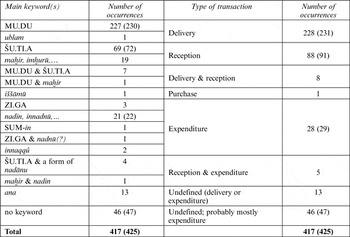
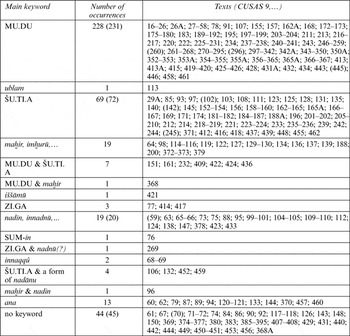
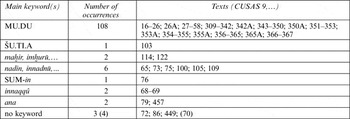
As shown in Table 1, the vocabulary of the Sealand I administrative texts is standardised. From this inventory I have excluded letters, texts that do not pertain to the handling of goods and texts whose type is uncertain because they are too fragmentary.Footnote 12 Most administrative texts were delivery records, followed by receipts, and finally records of expenditure, which include offering texts. The vocabulary used does not allow for the immediate identification of any internal transfers of goods.Footnote 13 A few texts record a movement of goods towards beneficiaries (keyword: ana) without further precision,Footnote 14 while other texts combine two transactions or two aspects of a transaction (for instance delivery and reception).Footnote 15 A single text specifies that the goods recorded were purchased. The texts were cast into one of three formats: transaction note, list or table. In a transaction note, the information takes the form of a standardised, more or less grammatical phrase, which may include an enumeration of goods or persons, but is often very short. Lists are documents consisting of a header and only one set of entries grouped in a column; these entries can be goods or persons. The remaining transaction information is contained in the header. TablesFootnote 16 are documents consisting of at least a main header and two sets of entries, that is, two columns. Tables can also have column headers in addition to the main header. Both lists and tables are ruled.
Keywords and types of transaction of Sealand I administrative texts.Footnote 17

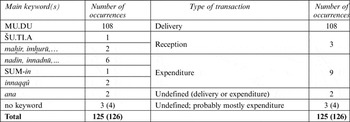
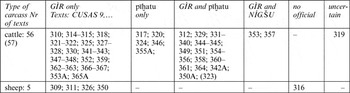
The verbal expression most often used to denote the type of transaction in delivery records and receipts is Sumerian MU.DU and ŠU.TI.A, respectively. Out of 228 documents recording deliveries, only CUSAS 9, 113 features the Akkadian verb ublam; this text does not appear to record a habitual delivery and was therefore apparently not subjected to the same conventions as other records.Footnote 18 Receipts offer more variation; out of eighty-eight receipts, nineteen feature forms of the verb maḫāru. Documents recording an expenditure are the most varied, even considering sub-groups of texts by type of expenditure. The record of purchase CUSAS 9, 421 uniquely uses the Akkadian verb iššāmū. The formulary used for both delivery records and receiptsFootnote 19 states minimally: 1) the goods; 2) the action performed (delivery or reception); 3) the person(s) performing the action; 4) the date. In addition, delivery records almost always specify the recipient, since he is not the party performing the action. Sealand I receipts do not feature the rubric “KI/itti PN” often found in receipts in other corpora. Expenditure records often omit the party performing the action, that is, the issuing party. Some types of expenditure records, such as ration lists, also often omit the action performed (no keyword), since it is implicit; indeed, when such texts state clearly that the goods listed are rations or offerings, we can assume that they deal with expenditures. However, a few tablets list only goods and names, so we cannot determine whether they constituted a delivery, a receipt or an expenditure. Turning to the texts pertaining to the movement of livestock and animal carcasses,Footnote 20 delivery records are still predominant, as shown in in Table 2.
Keywords and types of transaction for records pertaining to livestock and carcasses.Footnote 22

As delivery records are so well-represented, for animals in particular, an in-depth discussion of the delivery record as administrative document is required before treating the delivery of livestock and animal carcasses in more detail. The use of delivery records will be discussed in a diachronic perspective, before inferring principles of administration and establishing the formulary of delivery records.
Delivery records
Formulary and function
MU.DU was well established everywhere in Babylonia as record-keeping formulaFootnote 21 when the Sealand I kingdom emerged during the late eighteenth century. During the Old Babylonian period, it is found in all times and places for the delivery of goods: silver, animals, wool, dates, aromatics, etc. It was sometimes used in balanced accounts without further mention of the parties directly involved, for instance at Ur under Larsa rule (YOS 5 54; 58); the delivering party could also be an institution (the É.KIŠIB3.BA in YOS 5 54). Hence, the presence of this term in Sealand I delivery records does not require further comment. Its omnipresence for incoming goods, however, deserves notice.
The main difference from the nearly contemporary late Old Babylonian texts from northern Babylonia lies in the absence of another keyword alongside MU.DU (see Table 1). In late Old Babylonian texts the typical use of MU.DU is as one element of what Richardson (Reference Richardson2010: 13 notes on text 11) dubbed “the Late OB fixed sequence mu.túm PN / namḫarti PN”. When both delivery and reception are recorded, which is rare, the most common combination of keywords is MU.DU and ŠU.TI.A.Footnote 23 In the Sealand I archive, the MU.DU texts almost all specify that the delivery is “to the palace” / ana É.GAL. We can therefore assume that delivery texts usually recorded incoming goods. At Mari, Talon (Reference Talon1985: 230–31) considers that MU.DU was used for goods entering the royal administration. However, the term may have been used specifically for goods sent from a certain distance (Birot Reference Birot1960: 253; Durand Reference Durand1983: 1) and perhaps as a voluntary, polite gift (Durand Reference Durand1983: 515). No such nuance seems to apply to Sealand I MU.DU deliveries.
Examination of Old Babylonian documents from institutional archives seems to indicate that incoming goods were recorded preferably as “received (by)” rather than “delivered (by)”. An additional line “from Y” was often added after the rubric “received by X”, but the emphasis remained on the recipient. This may reflect an inward-looking culture of accountability of the receiving institution,Footnote 24 perhaps typical of a complex, bureaucratic organisation. The person or service responsible for the goods after the transfer was usually clearly identified; the source of the goods and the person or service responsible for their delivery were either obvious or deemed of lesser relevance for book-keeping purposes. The main exception appears to come from the early Old Babylonian Larsa kingdom, where incoming goods were sometimes registered in MU.DU delivery records (Simmons Reference Simmons1978: 13; Breckwoldt Reference Breckwoldt1995/1996: 66).Footnote 25
The extant Sealand I documents show a clear preference for the “delivery” keyword,Footnote 26 even considering accident of discovery. The very presence of a large number of texts featuring only “MU.DU PN ana É.GAL”,Footnote 27 some of them recording several deliveries in a short time interval, must have some significance. It suggests that an outward-looking accountability principleFootnote 28 was at work in the Sealand I palace administration. This is the basic formula chosen for nearly all deliveries of beer jarsFootnote 29 and several deliveries of malt. In these documents, no information is given regarding the internal organisation or internal individual accountability of the palace.Footnote 30 Importance was placed on the record of what had been transferred to the palace—animals, beer jars, animal carcasses, etc.—, and on who had issued and/or delivered the goods.Footnote 31 It strongly suggests a responsibility of delivery for the issuing party, which was considered a matter of great interest for the palace administration. Additional evidence will be shown to substantiate this interpretation.
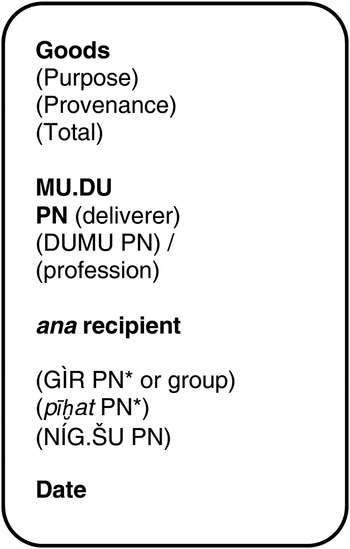
More detailed records are common for deliveries of barley and other foodstuffs, animals and animal carcasses.Footnote 32 First the scribe identified the goods that were the object of the transaction. Beneath, he sometimes added the purpose, the ultimate recipient or beneficiary to whom the goods were destined. The provenance of the goods was also sometimes indicated. After the main key-word MU.DU and the identification of the person performing the action, the formulary of delivery records almost always includes the primary recipient (see Fig. 1). As stated above, this primary recipient is, in nearly all extant texts, the palace (É.GAL).Footnote 33 Responsible officials introduced by the terms GÌR, pīḫat(u) and NÍG.ŠU, are all optional and their presence probably depended on the context of the delivery. GÌR is by far the most common. Sometimes two types of official presided, for instance the GÌR and the pīḫatu. The NÍG.ŠU is attested only twice in this context.
The formulary of delivery records. Entries in bold indicate obligatory information, which makes up the content of the most common type of delivery record. Entries with an asterisk indicate that a profession was sometimes added.

Delivery of livestock
The forty-four delivery recordsFootnote 34 concerning livestock tracked mostly sheep, sometimes including wool, some goats, and in a few cases cattle. As a rule, the purpose or end recipient of the animals is indicated.Footnote 35 These include: sacrifice, extispicy, various gods and temples, the (E)girmaḫ,Footnote 36 religious festivals, butchery and meals, as well as various individuals identified either by name (PN or “hand of PN”), by their function or status (messenger, king, or nadītu), or by their origins, such as “men of Nippur” or Kassites. Sacrificial and divinatory uses are the most common, but several animals were apparently destined for secular purposes, either for mealsFootnote 37 or to be given as gifts to various individuals.
Some animals were intended for use by the palace itself as an institution, such as for a royal meal (CUSAS 9, 45), or to be given to messengers—probably envoys received at the palace—(CUSAS 9, 29; 40; 44)Footnote 38 and probably also for extispicy (CUSAS 9, 20; 22 etc.) and sacrifice (CUSAS 9, 19) at the palace. Other animals were intended for another institution, for instance the temple of Ninurta (CUSAS 9, 25; 26; 35; 36), the temple of Šamaš (CUSAS 9, 50) or the (E)girmaḫ (CUSAS 9, 34; 37; 44). Several animals were simply earmarked for a god (ana DN) without apparent planned transfer to a separate institution, so that an offering within the palace, not necessarily as a physical, but as an institutional entity, may have been intended. Various purposes, intra- and extra-palatial, religious and secular, were sometimes recorded on the same document.Footnote 39 The same sealFootnote 40 was used to acknowledge reception of animals for these various ends. This shows that there was a palatial bureau or service responsible for the reception of livestock, which acted as point of entry for animals regardless of their intended purpose and destination inside the palatial economy or outside it when the palace acted as sponsor or provider.
The prosopography of the records yields valuable information about the individuals delivering livestock. Sheep were usually delivered by shepherds, whereas the profession of cattle herder is never clearly specified.Footnote 41 The profession ran in the family and more than one son could take it over from his father; two generations could be active at the same time. Several shepherds are attested in barley distribution lists,Footnote 42 with or without mention of their profession. Cattle herders are also probably represented in the same lists, although in that case the evidence rests only on the presence of clusters of names too numerous to be simply the result of homonymy. Shepherds are attested in miksu-payment ledgersFootnote 43 and once in a miksu-remission list.Footnote 44 This indicates that the shepherds (and possibly the cattle herders) who were responsible for delivering livestock to the palace were (at least partly) palace dependents, receiving rations and paying a tax on fields probably assigned to them on the basis of their service or their professional status vis-à-vis the palace.Footnote 45
Delivery of animal carcasses
Of the sixty-four delivery recordsFootnote 46 of animal carcasses, at least fifty-seven pertain to the delivery of bovine carcasses.Footnote 47 Besides the five delivery records of ovine and caprine carcasses,Footnote 48 CUSAS 9, 365 includes both live and dead sheep. In terms of temporal extent, the deliveries of cattle carcasses form the densest sub-group of texts in the archive, nearly all of themFootnote 49 being dated to a period of less than four months (from mid viii to early xii of year N). In two successive months (x and xi of year N), the twenty-sixth day saw a very high number of cattle carcasses delivered to the palace.Footnote 50 This could suggest a planned slaughtering near the end the month; indeed Dalley (Reference Dalley2009: 178) also observed that a major slaughter probably took place on the 26.x. It seems unlikely that these slaughtered animals entered the sacrificial economy, since sheep and goats intended for sacrifice always entered the palace alive. Even animals intended for meals, or a cow destined to unspecific “butchery” (a-na ṭù-bu-ú-ḫi Footnote 51 ), were delivered to the palace alive.
Delivery records of animal carcasses name at least one official.Footnote 53 The GÌR is almost always present, often the GÌR in combination with a pīḫatu, and sometimes the pīḫatu only. Exceptionally we find the combination of GÌR and NÍG.ŠU (see Table 3).
Officials in records of carcass delivery.Footnote 52

Occasionally, the killing of the animal by a predator is indicated as the reason for the delivery of a carcass: there are cattle killed by lions (CUSAS 9, 317; 337) as well as sheep and cattle killed by wolves (CUSAS 9, 316; 321; 326; 341). Deliveries of carcasses never state a purpose or end recipient, but sometimes appear to refer to the source of the dead animals; this applies only to cattle carcasses.Footnote 54 This rubric uses a frozen syntax: libbu (ša) X. Excluding libbu sūtīšu which will be discussed below, we find in order of frequency: “of (those of) the queen(?)”,Footnote 55 “of the good ones(?)”,Footnote 56 “of the ox-drivers”,Footnote 57 “of those of Šamaš”,Footnote 58 “of Anam-dingira”,Footnote 59 “of the iššâkātu”Footnote 60 and a few fragmentary passages.Footnote 61 The ambiguity of these terse administrative formulae makes it difficult to decide whether all or only some of these phrases refer to the ownership of the animals or to a quota of carcasses due to the palace by the individual or group in question.
To complicate matters, the libbu X phrase appears most frequently in the obscure expression libbu sūtīšu.Footnote 62 It could refer to the payment of a tax or a rent,Footnote 63 the sūtu. While it is not unexpected to have a rent or tax paid in kind, a payment in dead animals seems unusual.Footnote 64 Moreover, the reference to the sūtu is, in this archive, only found in this particular context and phrasing, which suggests that the sūtu payment was always in animal carcasses and was never paid in full; this seems unlikely.Footnote 65 Also, and perhaps most significantly, it would be a surprising coincidence to have two identical phrases (libbu X) meaning two different aspects of book-keeping in the same administration, the recording of the partial payment of a tax on the one hand, and the indication of the provenance of incoming goods on the other hand. However, I cannot explain the term sūtu Footnote 66 in its apparent use to indicate the provenance of a herd.
Study of the prosopography reveals that the same individuals could deliver live and dead animals, which shows that no knacker was involved or identified in the transaction between the deliverer of the dead cattle and the palace. The relation between the identified source of animals and the individuals deliveringFootnote 67 them is not entirely clear, but a level of correlation is visible for two specific herds: the cattle of the queen and the cattle of Šamaš. For these two herds, at least, it seems that the individuals delivering the carcasses belonged to the institution issuing and possibly owning the animals, or that they were assigned to the keeping of these specific herds. The cattle of the queen (six instances)Footnote 68 was delivered by four separate individuals who never delivered other cattle; the cattle of Šamaš (two instances)Footnote 69 was delivered by only one person, Aḫi-illika, probably the same Aḫi-illika who is identified as SANGA of Šamaš in CUSAS 9, 97. Other cattle was delivered by various individuals, each acting only once.
Delivery records of dead cattle almost always include the term šimtu (in such context: ownership mark). Because of the scarcity of evidence, we cannot establish whether the fact that this rubric is not found in delivery records of live cattle is significant. Sheep and goats, dead or alive, are never accompanied by this term. There is no perfect correlation between the presence of the rubric “ownership mark” and of the rubric “libbu X”. Moreover, when both are present, the syntax does not suggest that they both refer to the same ownership.Footnote 70 Therefore, we have to conclude that the rubric “ownership mark” stood on its own and could convey enough meaning in itself. Whether this was an abbreviation for the putative rubric “ownership mark of the palace” is impossible to determine, but it appeared important to make a difference between cattle carcasses bearing the mark and those not. While it does not inform us about the model of ownership of cattle, it does, together with the rubric libbu X, show a strong interest of the palace administration in the provenance of the dead cattle. This is also indicative of an outward-looking type of accountability. The quasi-omnipresence of the GÌR in the delivery records of animal carcasses suggests that this function was normally required for this transaction, which is not the case for livestock deliveries. The matter requires further discussion.
The GÌR role
The meaning of “GÌR PN” has been much debated. The term is well attested in administrative documents of the Ur III and Old Babylonian periods, but for both periods there are diverging opinions as to its meaning. One interpretation is that it is to be understood quite literallyFootnote 71 and that the person named after GÌR was the conveyor of the goods;Footnote 72 this is the interpretation chosen by Dalley (Reference Dalley2009). Other interpretations posit that the role of the GÌR was one of control over the received or spent goods and/or of responsibility for the transaction.Footnote 73 Leemans rendered the term as “for the correctness vouches”, following Ungnad (Leemans Reference Leemans1960: 107).Footnote 74 Sallaberger went in a similar direction for the Ur III texts.Footnote 75 Richardson (Reference Richardson2002: 119), commenting on late Old Babylonian Sippar, confers to the GÌR a general role of bureaucratic sanction: he made the transaction official. All agree that GÌR was a function and not a profession; the individuals acting as GÌR ranged from a scribe to a queen (short surveys are to be found in Falkenstein Reference Falkenstein1956: 46 n. 4; Leemans Reference Leemans1960: 107).Footnote 76 Breckwoldt (Reference Breckwoldt1995/1996: 70–71) suggested that sailors and animal drivers were probably among the GÌR, but this was based on her interpretation of the function of the GÌR, not on evidence; she also suggested merchants on the ground of prosopographical considerations, which are not further detailed.
The GÌR is absent from Middle Babylonian texts, which Sassmannshausen (Reference Sassmannshausen2001: 456) explains by assuming that the term was replaced by ŠU. Interestingly, the Tell Muhammad tablets, probably roughly contemporary with the Sealand I documents, also feature the GÌR in several administrative records (Al-Ubaid Reference Al-Ubaid1983: 192 ff. for instance IM 90603; IM 90616; IM 90611).Footnote 77 Thus it seems that the GÌR function, inherited from the Ur III and the Old Babylonian periods, survived after the fall of Babylon both in the Sealand I kingdom and at the mouth of the Diyala. Its later disappearance must have been the result of a reform in administrative practices under the Kassites.
There are approximately 139 mentionsFootnote 78 of a GÌR in the extant Sealand I texts. This function was performed by at least forty-five different individuals. With the exception of CUSAS 9, 52, the patronymic is never added, but the profession is sometimes indicated. The following professions are represented: one overseer of the cooks (UGULA MUḪALDIM.MEŠ) acting thirteen times as GÌR, three different barbers (ŠU.I),Footnote 79 one jeweller (KÙ.DIM)Footnote 80 and one scribe (DUB.SAR),Footnote 81 each acting once. The GÌR function was also performed by at least threeFootnote 82 professional groups identified collectively: the cooks (MUḪALDIM.MEŠ),Footnote 83 the diviners (MÁŠ.ŠU.GÍD.GÍD)Footnote 84 and the scribes (DUB.SAR.MEŠ).Footnote 85 The Sealand I evidence confirms the finding based on earlier texts that the GÌR function was not a profession.Footnote 86 The barbers officiating as GÌR may have their parallel in late Old Babylonian Palastgeschäfte.Footnote 87
The case of the cooks is the most eloquent of the Sealand I evidence: the GÌR function must have been part of their responsibilities in the palace household. The cooks appear no fewer than forty times as GÌRFootnote 88 for deliveries of animal carcasses and once for the delivery of live cattle. To this, we may add the fifteen deliveries in which Taribātu, their overseer, acted as GÌR.Footnote 89 Considering that these instances, taken together, represent almost the totality of all records of carcass delivery,Footnote 90 we can affirm that the cooks were in charge of the GÌR function for carcass deliveries in the years covered by the documents. They were sometimes represented directly by their overseer, sometimes probably by his subordinates in which case the name(s) were not specified: the scribe recorded simply “MUḪALDIM.MEŠ”. This responsibility of the cooks in the delivery of animal carcasses links the GÌR function with the further transformation of the product delivered to the palace rather than with the transport or the source of the goods; the administrative responsibility appears here to be rooted in the actual processing of the goods.Footnote 91
In the other groups of texts, no clear profile of the GÌR emerges. The profession is, with the exception of the occasional barber, almost never mentioned; most names occur only once and when names are repeated, the context does not suggest that it is necessarily the same individual.Footnote 92 Delivery records for livestock may show a slight correlation between the presence of the GÌR and the sealing of the tablet. More precisely, it could be that the presence of the GÌR made the sealing less important. Indeed, nearly all twenty-seven delivery records not featuring a GÌR were sealed,Footnote 93 while of the thirteen (possibly up to sixteen) delivery records featuring a GÌR, only between four and eight were sealed.Footnote 94 Without further evidence, final judgement must be reserved on this issue. While the role of the GÌR cannot be defined precisely, it seems that it could evolve as an extension of the processing of the received goods and that it may have entailed the “vouching for the correctness” of the transaction. The Sealand I GÌR was also sometimes involved in palace expenditures, as discussed below.
The NÍG.ŠU role
The common phrase NÍG.ŠU PN, probably read ša qāt in the Old Babylonian period, appears only five times in this archive,Footnote 95 and once as NÍG PN, which I take to be an abbreviation.Footnote 96 The syntax is always NÍG(.ŠU) PN only, without patronymic or profession. In Old Babylonian documents, the term is usually found in the context of expenditures. It has been interpreted in turn as: 1) the service issuing goods (in particular at Mari: Magness-Gardiner Reference Magness-Gardiner1987: 233; Rouault Reference Rouault1977: 254); 2) the service or person having responsibility for a transaction, some scholars putting more emphasis on the service, others on the person;Footnote 97 3) a person having authority over another person when the syntax is PN1 NÍG.ŠU PN2 (Charpin Reference Charpin1986: 159–60). The last two interpretations could be well summarised by Landsberger's observation that the term, applicable both to goods and persons, meant “jemandem (vom amtswegen) unterstellt” (Reference Landsberger1915: 496). Richardson (Reference Richardson2010: texts 17, 17a) noted a parallel with the function of witness in legal documents and with the GÌR function. His translation (ibid.: text 19) of NÍG.ŠU as “disbursing officials” reflects the fact that the role is most often found in disbursement records.
In the Sealand I texts, the NÍG.ŠU is only marginally represented, but his function was certainly not restricted to expenditures. Indeed, NÍG.ŠU appear twice in delivery records of cattle carcasses (CUSAS 9, 353; 357), twice in ledgers recording tax delivery (CUSAS 9, 415; 432), once in a record of expenditure (CUSAS 9, 389), and once in a document of unspecified type (CUSAS 9, 403). When recorded, he was named at the end of the document.Footnote 98 Prosopographical study does not yield any further information. The evidence is meagre and does not permit a clear assessment of the role and importance of this official. The only clear evidence concerning the NÍG.ŠU is that he is rarely mentioned. The NÍG.ŠU seems never to appear in Kassite administrative texts. As already mentioned, Sassmannshausen (Reference Sassmannshausen2001: 456) suggested that the occasional ŠU PN in the Middle Babylonian texts from Nippur was a replacement for the Old Babylonian GÌR. I would suggest that it was rather NÍG.ŠU that was replaced by ŠU PN, since we now know that the former was still alive in the post-Old Babylonian period. Also, the fact that ša ŠU PN is found alongside ŠU PN in Kassite administrative texts (Tenney Reference Tenney2011: 103) points towards a continued usage of the expression ša qāt and a simple change in orthography from NÍG.ŠU to (ša) ŠU during the Kassite period.Footnote 99
The pīḫatu role
The phrase “pīḫat PN” is common in the Sealand I documents, especially in delivery records of cattle carcasses (twenty-nine or thirty instances); it also appears in one cattle delivery record, one sheep delivery record, as well as in a few delivery records of malt and barley for malt. For Old Babylonian documents, the term pīḫatu has been interpreted as “representative” / Stellvertreter (Landsberger Reference Landsberger1915: 497), with the implication also that the representative was the subordinate of the person he represented (Yoffee Reference Yoffee1977: 18; 46 n.39). In an agricultural context, it was suggested that it designated an administrative sector / Verwaltungsbezirk (Landsberger Reference Landsberger1937: 130; Stol Reference Stol1976: 93) or part of a large domain (Walther Reference Walther1917: 149). In Kassite texts, pīḫatu is found with the meaning “province” (Sassmannshausen Reference Sassmannshausen2001: 22), but also to designate the supervisor of workers (Tenney Reference Tenney2011: 103). In the Sealand I documents, often the rubric is pīḫat PN alone, not following another name, so its meaning cannot simply be to qualify the role and rank of a person with regard to another. The evidence shows a high recurrence of certain individuals who appear in relation to only one type of goods: for instance, Ina-šammi-nadi acted eight times and Šumman-la-iliya four times as pīḫatu for deliveries of cattle carcasses, while Nanna-mansum acted three times as pīḫatu in the context of malting, once for the delivery of malt and twice for the reception of barley for malt.
As in the case of the other official roles, the patronymic is never given.Footnote 100 Three individuals acting as pīḫātu for deliveries of cattle carcasses bore the title AGA.UŠ, indicating that the function was compatible with military duties. Also, there appears to be a high proportion of pīḫātu for deliveries of cattle carcasses who also occur either as the deliverers or as the fathers of deliverers of cattle carcasses.Footnote 101 This seems to occur too frequently to be the product of homonymy alone. The fact that this official is often mentioned in carcass deliveries tallies with the fact that these records tend to give information on the source of the dead animals. The nature of this relationship between the source of animals and the pīḫatu remains obscure. It was apparently non-exclusive. Also, the presence of the pīḫatu was not mandatory for a delivery. The case of Iddin-Sîn illustrates this complexity: he acted as pīḫatu in a delivery of cattle carcasses “of Šamaš” (CUSAS 9, 349), but was not mentioned in a similar delivery (CUSAS 9, 363); on the other hand, he appeared in other deliveries of cattle carcasses, which were not “of Šamaš” (CUSAS 9, 360; 364). One possible way to reconcile these occurrences would be to speculate that the pīḫatu-function had a stronger geographical than organisational connotation.Footnote 102 Some of the pīḫātu may appear, without their title, in other documents such as ration lists or miksu-ledgers, although this may be the product of homonymy.
Sealing, copying and encasing
Roughly a quarter of the documents in CUSAS 9 are sealed, a little over a fifth of them are identified as copies and for just over four per cent of the tablets is it certain that they were—and sometimes still are—encased in an envelope. Almost all of these sealed, copied and/or encased documents are delivery records of livestock or animal carcasses. Copies bear the word me-eḫ-rum, usually written on the left edge.Footnote 103 All but twoFootnote 104 delivery records of animal carcasses and most delivery records of live animals are meḫrum-tablets,Footnote 105 which clearly indicates that it was common practice to produce a copy for this type of transaction and that the tablets found had belonged to the archive of the receiving party, namely the palace. The fact that the archive also contains some expenditures of animals by the palace confirms this. A strong correlation appears between the practices of copying and sealing documents: almost all meḫrum-tablets are sealed.Footnote 106 On delivery records of animals and animal carcasses, seal impressions are usually mainly on the obverse and reverse of the tablet with the inscription parallel to the text;Footnote 107 the emphasis seems to be on the inscription of the seal more than on the iconographic portion. Despite the very limited readability of the impressions, a few discrete seals could be recognised by Dalley (Reference Dalley2009: 32 and 161), some of which show enough on the photographs to be identified if not deciphered. The evidence shows that the same seal-bearers, in particular one individual,Footnote 108 were responsible for the reception of livestock and animal carcasses, ovine, caprine and bovine. How frequently tablets were encased is more difficult to assess. Firstly, we do not know how many envelopes were removed in antiquity, while the archive was still alive. Also, since the archive was not retrieved in a controlled archaeological excavation, we have no means of determining whether several broken envelope fragments, disregarded by the looters, might have matched some of the extant tablets. Neither do we know whether encased tablets were kept physically close or separate from tablets not encased in an envelope. However, all documents that are still in, or clearly once were in, an envelopeFootnote 109 are delivery records of livestock or carcasses.Footnote 110 Usually both tablet and envelope were sealed, which situates Sealand I encasing practices closer to Old rather than Middle Babylonian practices (Clay Reference Clay1906: 12).Footnote 111 In the Sealand I palatial administration, the same sub-group of documents were subjected to the administrative procedures of copying, sealing and encasing in an envelope. This fits well with Clay's (Reference Clay1906: 10–12) observation that sealing, copying and encasing tablets were all used for a similar purpose: to protect the integrity of the document.
The administrative procedure accompanying the delivery of animals and animal carcasses can be reconstructed.Footnote 112 Upon delivery, immediately or somewhat later, the palace official in charge of receiving livestockFootnote 113 or carcasses had a delivery record made out recording the transaction: the delivered animals, the person delivering/issuing, the destination (palace), and the date; he sometimes added the purpose, more details on the source or the ownership and the names of officials. The person responsible for delivering the animals received the original of the tablet, probably sealed with the seal of the official in charge of the reception; this original may have been encased in an envelope. A copy of the transaction record, marked meḫrum, was duly made and sealed, sometimes encased in an envelope, and was kept at the palace. The latter are the documents that have come down to us.
The great care given to protecting the integrity of the contents of delivery records of animals reinforces the idea of a mainly outward-oriented control exerted by the palace on the economic sector of animal husbandry. When responsibility for live or dead animals was transferred from the herders to the palace, the transaction was subjected to several recording and archiving proceduresFootnote 114 with the aim of avoiding future dispute between the two parties. Since neither merchants nor payment were ever mentioned, the situation is one of a habitual, institutionalised and carefully monitored delivery obligation to the palace. A functional approach would question the systematic recording of the destination ana É.GAL: was there a functional necessity to record it? If so, it would imply that herders did not deliver animals exclusively to the palace, but had other recipients. This, however, is speculative. The recording of the palace as destination may be the result of frozen usage.
Other types of records concerning livestockFootnote 115
Outgoing animals were recorded, usually together with other foodstuffs, in various types of receipts and records of expenditure. Texts recording this type of transaction are infrequent compared to delivery records (see Table 2). The choice of keyword for the transaction does not obey clear rules. For instance, Dummuqu the jeweller twice receives rams and other foodstuffs towards the end of the same year, once in a ŠU.TI.A receipt (CUSAS 9, 103) and once in a record of expenditure using the keyword nadānu (CUSAS 9, 105: 1–9). The archive offers no example of double recording, where a record of expenditure matches a receipt. Also, documents recording transactions other than delivery were less standardised, being cast using varying keywords, as can be seen in Tables 1 and 2. Bearing in mind also that these documents were not sealed, it seems that less control was invested in the recording of expenditures. This speaks against double recording. Therefore, it seems fair to posit that outgoing animals and foodstuffs could probably be written down as received by, or given to, the recipient, with the same book-keeping result.Footnote 116
Animals, together with other foodstuffs, were spent for palace-internal use, for instance for sacrifice or (sacrificial?) meal (CUSAS 9, 69; 109), for individuals (CUSAS 9, 103; 105; 114; 122) and for temples, namely the temple of Ninurta (CUSAS 9, 65; 73; 76)Footnote 117 and the dais of Šamaš (CUSAS 9, 65; 73). Animals were also given for sacrifices to deities without specifying where these would take place (CUSAS 9, 75; 79; 68; 70) or for a special occasion (the opening of the grain silo in CUSAS 9, 100). Besides the obviously specific naqû, other keywords are used independently of the type of recipient or intended use of the animals. The names of the persons or the services issuing the goods are not specified except for the king, who is explicitly named in CUSAS 9, 76, in which sacrificial animals and foodstuffs are given to the temple of Ninurta. Mention is made of a “gift of the king” in a wool expenditure to Dummuqu the jeweller (CUSAS 9, 457),Footnote 118 and in a few other expenditure records for various goods (oil, etc.) given to individuals. The fact that an expenditure was a gift of the king did not bring with it any change in the keyword used for recording, which remains unpredictable, but appears to have required the presence of a GÌR in most cases. The only three GÌR involved in the expenditures of animals and wool (CUSAS 9, 65; 122; 457) never acted as GÌR for the reception of animals, which suggests separate administrative responsibilities for incoming and outgoing animals, although the sample on the outgoing side is too limited to warrant any definitive conclusion.
The few available documents indicate that the recording of expenditures of animals was less standardised and submitted to less control than the recording of deliveries. This and the relative scarcity of records of expenditure when compared to deliveries indicate that this administration did not deem it more important to track disbursements than acquisitions, as may have been the case in the third millennium (Steinkeller Reference Steinkeller and Brosius2003: 37–38).Footnote 119 Furthermore, no clear distinction appears in the main keyword used for outgoing goods and palace-internal expenditures in Sealand I records of animal expenditures.
Conclusions
An outward-looking accountability
A review of administrative documents from the Sealand I kingdom, mostly pertaining to animal husbandry, shows that a mainly outward-looking accountability principle was at work in the palace administration. Delivery records identifying the delivering party are not only much more numerous, they are also more standardised than receipts and records of expenditure. Such recording from the “perspective of the outsider” had precedents: in Ur III institutions the MU.DU delivery record was the standard record for incoming goods (Steinkeller Reference Steinkeller and Brosius2003: 38 ff.) and, before the reform of the forty-seventh year of Šulgi, the recipient of incoming animals at Puzriš-Dagan was not identified (Sallaberger Reference Sallaberger, Attinger and Wäfler1999: 264); in 20th century Isin, this recording principle was also at work, but represented the exception since most incoming goods were recorded in receipts (Van de Mieroop Reference Van de Mieroop, Hudson and Wunsch2004: 48); MU.DU delivery records were also used in the kingdom of Larsa (Simmons Reference Simmons1978: 13; Breckwoldt Reference Breckwoldt1995/1996: 66). This outward-looking recording of deliveries to the palace was apparently still at work after the demise of the Sealand I dynasty in another area formerly controlled by it: Dilmun. There, a few delivery records from the early Kassite period feature the exact same formularyFootnote 120 and in at least one case, the tablet was marked as a meḫrum “copy”. This shows that this accounting principle was not specific to the particular palace that yielded the archive in CUSAS 9,Footnote 121 but may have extended to a large portion of the Sealand I kingdom. The practices of copying, sealing and encasing tablets all applied to the same groups of texts in the Sealand I palace administration: delivery records, mainly of livestock and animal carcasses. The attention given to ensuring the integrity of these records shows that deliveries were very carefully monitored. The fact that “to the palace” was always specified might indicate that the herders could deliver animals elsewhere. At least two administrative features are reminiscent of the early Old Babylonian kingdom of Larsa: the use of the term sūtu with a meaning other than a vessel or a measure and the use of MU.DU delivery records. This seems to anchor the Sealand I kingdom in a southern tradition.
Organisational integration of palace and temples
The purpose or end recipient of delivered livestock is very often specified. In the contemporary theory of logistics and supply chain management, a “pull” situation describes a strategy of acquisition of resources based on actual and immediate demand or need by the end recipient. By contrast, a “push” situation corresponds to resources entering an economic unit on the basis of expected need in the future. The Sealand I palace appears to have managed livestock on a purely “pull” basis: the palace's end recipients needed animals, therefore the palace requested animals to be delivered for these specific purposes. This end recipient was occasionally an institution: the temple of Ninurta, the temple of Šamaš, and the (E)girmaḫ.Footnote 122 The level of integration between the palace and these institutions cannot be assessed precisely on the basis of the extant information. The available evidence indicates that the temple of Šamaš at least was probably a partly independent economic body that owned cattle, since cattle carcasses “of Šamaš” were delivered twice to the palace probably by the SANGA of Šamaš. Both relevant delivery records were copied and sealed like the others, which implies a level of administrative separation between the primary receiving party (the palace) and the delivering party (the temple of Šamaš). On the other hand, the fact that the carcasses were delivered to the palace without any mention of the purpose suggests that this was routine, implying that the palace processed and exploited animal carcasses on behalf of the temple. Either they had close organisational economic ties or the palace imposed the delivery of carcasses on all cattle owners.
The archive contains some expenditure records to the benefit of temples, although not enough to decide whether all regular offerings in any of them came from the palace. Therefore, it cannot be determined whether the king and the palace were simply important sponsors or whether the relationship was organisational, the palace being the main source of revenue for many temples or at least a sort of clearinghouse for the handling of some of their goods. In the latter alternative, the situation would be similar to that prevailing in early Old Babylonian Nippur, where livestock seems to have been managed by a central authority provisioning several or all temples (Robertson Reference Robertson and Ellis1992). In the Sealand I town where the archive comes from, this central authority would have been the palace. The animal husbandry texts reveal that the palace referred to in them functioned as an extended household, producing, acquiring, and transforming resources for its own consumption, for a number of temples, and perhaps for limited state activity, which could be assimilated with the management of the palace household (e.g. gift of sheep to foreign envoys).Footnote 123 The case of the Egirmaḫ is also uncertain, but different. A ŠU.TI.A receipt of flour by this institution (CUSAS 9, 131) states that the flour was received by the cooks (MUḪALDIM.MEŠ). If the cooks are the same professional group that acted as GÌR in animal deliveries, the Egirmaḫ was presumably an entity functioning within the palace. That a receipt was issued for this palace expenditure could speak against this interpretation, but the recording of receipts and expenditures was not standardised.
Officials involved in animal husbandry
The GÌR role was ubiquitous in the Sealand I palace administration. While this role could be fulfilled by various professionals, it was part of the responsibilities of the palace cooks for cattle (and/or carcasses) deliveries and could thus be rooted in the processing of received goods. For livestock, this official may have rendered sealing less necessary, which would indicate that he “vouched for the correctness” of the record. For expenditures, the GÌR's presence was only occasionally recorded. This tallies with the overall low standardisation in the recording of outgoing goods which shows great variation in the vocabulary used. The NÍG.ŠU is barely ever mentioned, but the meagre evidence does not confirm his Old Babylonian association with expenditures. The pīḫatu role, commonly found in cattle carcass deliveries, could be fulfilled by the delivering party. There may have been a geographical connotation to the role.
Flock ownership
Since ownership marks are never mentioned for sheep and goats, and since shepherds seem well represented in ration lists, it is fair to assume that the sheep and goats recorded in the extant texts belonged to the palace. Shepherds were responsible for delivering (mostly live) animals at the request of the palace and were at least partly palace dependents; they inherited their position from their father.
Cattle ownership
In the case of dead animals, almost always cattle, more emphasis is given to their origin; there was probably a “push” situation, which is not surprising, since the deliveries were partly triggered by the unplanned death of the animals. The professional status of cattle herders is not clear beyond the fact that a familial structure is recognisable. The recording practices show that cattle ownership was a matter of interest to the palace when carcasses were delivered, therefore they probably came from herds held by various owners, including the temple of Šamaš.