In bilinguals, the two languages are known to interact and mutually influence each other throughout the processing stream, with bilinguals frequently borrowing (e.g., Myers-Scotton, 1992), transfering (e.g., Gass, 1996; Jarvis & Odlin, 2000; Jones, 2005; Treffers-Daller & Mougeon, 2005), and code switching1
Language interaction involving phrases, clauses, and sentences is referred to as code switching. In the present study, code switches did not occur, and were therefore not considered.
Borrowing is an overt verbal behavior consisting of the speaker “switching” into the other language and actively using single words or entire phrases from that language. Transfer is a covert behavior consisting of the speaker using the target language in a way that is semantically or syntactically appropriate for the other language (but not for the target language), without overtly switching languages (Odlin, 1989). Although most studies of transfer have focused on the influence of first language (L1) on second language (L2), recent research suggests that language interaction is bidirectional, and that the L2 can also influence the L1 (e.g., Bernardini & Schlyter, 2004; Heredia & Altarriba, 2001; Pavlenko & Jarvis, 2002; Wolff & Ventura, 2003). Although traditionally viewed as a stepping-stone on the way to L2 proficiency (Schachter, 1983), transfer and borrowing are not always tied to proficiency, and may offer unique insights into bilingual cognitive architecture by revealing how languages interact during bilingual production.
MECHANISMS DRIVING BILINGUAL LANGUAGE INTERACTION
Generally speaking, cross-linguistic interaction can stem from differences in the bilinguals' language environment, as well as from differences in the structures of the two languages. In the current study, influences from both the language environment (exogenous, extrinsic to properties of language) and the linguistic architecture (endogenous, intrinsic to properties of language) were examined.
Influences of language environment on bilingual language interaction include language at the time of speaking, as well as language in which the described experience originally took place. We refer to language environment at the time of speaking as the “interview language,” and use it to denote narratives in either the first and more proficient language or the second and less proficient language. We predicted that patterns of language borrowing and transfer would vary across bilinguals' two languages. We refer to the linguistic environment in which the described experience took place as the “encoding language,” and use it to denote the language in which the content of a narrative was formed. Although it is difficult to accurately measure previous language use, autobiographical narratives provide a unique opportunity to examine such linguistic influences because bilinguals can usually recall with accuracy what language was spoken when a particular event took place (using cues such as age, location, and people present at the time of event). Previous studies have shown that memory for semantic and episodic information is improved by a match between the languages of retrieval and encoding (Marian & Fausey, 2006; Marian & Kaushanskaya, 2004; Marian & Neisser, 2000). We predicted that patterns of language borrowing and transfer would be similarly influenced by the language in which the content was encoded and that bilinguals would show more cross-linguistic interaction when speaking about an event that took place in the other language.
Influences of linguistic architecture on bilingual transfer and borrowing stem from the fact that languages vary across semantic and syntactic properties. These structural cross-linguistic differences influence the organization of the bilingual lexicon, with languages interacting either on-line via a processing-based account, or/and off-line via a representation-based account. The dichotomy of processing versus representational influences on bilingual language interaction is consistent with Paradis' (1993) two levels of bilingual interference: functional (dynamic) and representational (static). The processing-based account suggests that the nontarget language influences selection of structures in the target language during on-line lexical access. The representation-based account suggests that language interaction is a product of permanent change to the mental representation. These changes are manifested when L2 structures are used during L1 production after acquisition of a L2 (e.g., Wolff & Ventura, 2003), or when L1 structures are used during L2 production as a result of calcified representations acquired through the L1 (e.g., Waxman, 2004; Waxman & Braun, 2005). We predicted that representational and processing differences in language architecture would result in cross-linguistic interaction between linguistic structures associated with the two languages.
LANGUAGE ARCHITECTURE AND CROSS-LINGUISTIC INTERACTION
Semantic/syntactic structure
In bilinguals, semantic systems pertaining to the two languages appear to be integrated, with concepts shared across both languages (e.g., Basden, Bonilla-Meeks, & Basden, 1994; Snodgrass & Tsivkin, 1995). However, because different languages may conceptualize the same notion in different ways (e.g., Boroditsky, Schmidt, & Phillips, 2003; Bowerman & Choi, 2001; Gumperz & Levinson, 1996), and because concepts may be viewed as sums of multiple features (De Groot, 1989), the semantic representations in bilinguals may remain somewhat distinct for the two languages. That is, although lexical translation equivalents share many conceptual features, they do not always share all of them (Van Hell & de Groot, 1998). Activation of a lexical item activates all conceptual features associated with it, including those that are idiosyncratic to the nontarget language. Therefore, preparation of a message in a target language includes activation of both shared and idiosyncratic features, coactivating the lexical item in the nontarget language, as empirical evidence confirms (e.g., Colome, 2001; Costa, Miozzo, & Caramazza, 1999). When parallel activation of a lexical item in the nontarget language entails a meaning not subsumed by the target language, semantic transfer may occur.
In addition to semantic transfer, bilinguals also experience transfer that stems from application of syntactic rules of one language while using the other language. Evidence of syntactic transfer can be found in studies of L2 acquisition in children (e.g., Muller, 1998) and of language processing in bilingual adults (e.g., Ellis, 1994; Odlin, 1990). In an adult bilingual cognitive system, the syntax of the two languages is somewhat integrated, with shared aspects of grammar represented in the system once and used when speaking both languages, but language-specific aspects of grammar represented separately for two languages (e.g., Hartsuiker, Pickering, & Veltkamp, 2004). The languages spoken by the bilinguals tested in the present study differ along a number of syntactic properties. For instance, Russian grammaticizes aspect and gender, and has an extensive case system. English, conversely, possesses a more extensive verb tense system. When syntactic rules differ across the two languages, syntactic expression in the target language can be influenced by the stored syntactic knowledge for the nontarget language, thus yielding a detectable syntactic transfer.
Grammatical category
Given that differences in semantic and syntactic representations drive language interaction, any systematic variability in organization of the lexicon will then manifest itself in borrowing and transfer patterns. One of the main organizing principles of conceptual and syntactic representations relies on differences between grammatical categories, most notably between nouns and verbs. Previous studies have shown that nouns and verbs differ in a number of ways; for instance, nouns depict entities, which can often be identified by a set of sensory properties, whereas verbs depict relations between entities and are more difficult to define by sensory properties (Gentner, 1981, 1982; Joanette & Goulet, 1991; Paivio, 1986; Zingeser & Berndt, 1990). Moreover, actions and relations, which are expressed by verbs, are encoded by other grammatical categories as well, and vary more drastically across languages (Gentner, 1981, 1982; Slobin, 1996). Nouns are acquired earlier than verbs (at least in English; e.g., Bates et al., 1994; Choi, 1997; Gentner, 1982; Nelson, 1973), are easier to access than verbs (e.g., De Bleser & Kauschke, 2003), and are thought to be more tied to real-world referents than verbs (e.g., Gentner, 1981, 1982).
Consistent with these differences between nouns and verbs in monolinguals, the two grammatical categories also show different organization patterns in the bilingual lexicon. Using a bilingual word-association task, Van Hell and de Groot (1998) found that nouns elicited more similar responses and shorter reaction times across languages than verbs, suggesting that verbs may be represented in language-specific conceptual stores, whereas conceptual representations for nouns may be more integrated in the bilingual lexicon. Further, it has been suggested that memory for nouns is superior to memory for verbs (Earles & Kersten, 2000; Engelkamp, Zimmer, & Mohr, 1990; Kintsch, 2001), and that memory for verbs is more dependent on reinstating the linguistic context of the original encoding than memory for nouns (Kersten & Earles, 2004). Because fluent bilinguals switch between languages, the changing linguistic context may influence encoding of nouns and verbs, and may result in different cross-linguistic interaction patterns for the two grammatical classes, with verb encoding more influenced by language change than noun encoding.
Concreteness
Within each grammatical class, some nouns and verbs are more concrete than others. For example, nouns referring to imageable concepts (e.g., apple) are more concrete than nouns referring to unimageable concepts (e.g., peace). Similarly, verbs referring to highly imageable actions (e.g., jumped) are more “concrete” than verbs referring to feelings or states (e.g., felt). Concreteness has been found to facilitate noun acquisition and processing so that concrete nouns are more easily acquired by children (e.g., Brown, 1957; Gentner, 1982), and are recognized and processed more rapidly by adults (e.g., Kroll & Merves, 1986; Paivio, 1971; Strain, Patterson, & Seidenberg, 1995). Schwanenflugel and Shoben (1983) suggested that concrete words rely on greater availability of contextual information, and are processed with greater ease than abstract words, and Plaut and Shallice (1991) suggested that processing of concrete words is supported by more semantic features than processing of abstract words. In studies with bilinguals, concrete nouns were translated faster than abstract nouns (e.g., De Groot, Dannenburg, & Van Hell, 1994; Van Hell & De Groot, 1998) and showed more reliable cross-linguistic priming effects than abstract nouns (e.g., Jin, 1990; Paivio, Clark, & Lambert, 1988). Van Hell and De Groot (1998) suggested that meanings of concrete translation equivalents share more features, whereas features of abstract translation pairs may be more language specific. Moreover, meanings of abstract translation equivalents may be less similar than meanings of concrete translation equivalents (e.g., Taylor, 1976), and may depend more on linguistic context than concrete words (e.g., Breeding, Saffran, & Coslett, 1994).
Just as processing of nouns is influenced by concreteness, so is processing of verbs influenced by the degree to which a verb is tied to its perceptual referent. For example, verbs of motion such as ran and walked are likely to be more concrete, whereas state verbs such as liked and imagined are likely to be more abstract. Action and state verbs have been found to be processed differently in bilingual contexts, with classification of motion verbs taking longer than classification of state verbs in the L1, but not in the L2, possibly because of greater interconnectivity of verbs in the L1 compared to the L2 (Segalowitz & De Almeida, 1992). Moreover, languages differ in how they encode verbs (Slobin, 2003), especially action verbs of motion, such as “walked” (Talmy, 1975, 1985, 2000). For example, unlike English, Russian has an extensive prefixial system that encodes the direction of action. A Russian–English bilingual who says “come to the house” instead of “come into the house” is likely adapting the Russian verb-framed system (instead of the English satellite-framed system), in which the same preposition would be used to denote both to and into, and the difference would be marked with a prefix before the verb “come” (prishel v vs. voshel v, where the prefix “pri” signifies movement toward and the prefix “vo” signifies movement inward). Use of the Russian verb-framed system while speaking English is an example of syntactic transfer resulting from syntactic differences between the two languages.
OBJECTIVES OF THE PRESENT STUDY
The goal of the present study was to examine language interaction in fluent bilinguals by studying transfer and borrowing in language production. Although previous studies have found more borrowings for nouns that for verbs in bilinguals (e.g., Angermeyer, 2002; Joshi, 1985; Myers-Scotton, 1993), differences between the two grammatical categories have not been explored in bilingual transfer. Moreover, although bilingual transfer has been documented for both nouns (e.g., Jarvis & Odlin, 2000; Pavlenko & Jarvis, 2000) and verbs (e.g., Helms-Park, 2001; Wolff & Ventura, 2003) in general terms, differences between and within each grammatical category have not been studied. A complete picture of bilingual language interaction requires understanding of influences from both language environment (interview language, encoding language) and language architecture (semantic/syntactic structure, grammatical class, concreteness) on patterns of transfer and borrowing. The present study examined the effects of language environment and language architecture on bilingual language interaction and predicted the following:
- bilinguals would produce transfers and borrowings in both languages, patterns of language interaction would vary across languages of testing and encoding, and more cross-linguistic interactions would be produced when speaking about an event that took place in the other language;
- bilinguals would produce both syntactic and semantic transfers across both languages, because representation and processing of syntactic and semantic structures differ across languages;
- bilinguals would show different patterns of language interaction for nouns and verbs, because representation and processing properties of nouns and verbs make them differentially susceptible to cross-linguistic influences; and
- bilinguals would show different language interaction patterns depending on concreteness, because concrete and abstract entities are organized and processed differently in the bilingual mental lexicon.
METHOD
Participants
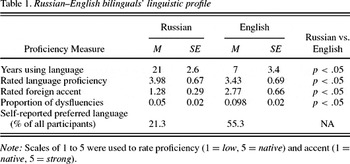
Forty-seven Russian-English bilinguals (23 males, 24 females) were tested. Their mean age at the time of the experiment was 21 years (SD = 2.6 years), and their mean age at the time of immigration to the United States was 14 years (SD = 3.4 years). Table 1 includes information about the bilinguals' linguistic profiles. Two independent coders rated bilinguals' proficiency and accent; point-to-point Pearson r reliability between the two coders was 93% for proficiency ratings and 92% for accent ratings. Proficiency was rated on a scale from 1 (lowest) to 5 (highest) and accent was rated on a scale from 1 (heavy accent/poor intelligibility) to 5 (no perceivable accent/nativelike pronunciation). In addition, proportions of disfluencies (such as repetitions of words and syllables, pauses, and interjections) were computed by dividing the number of disfluencies by total number of words in a narrative. Results suggest that bilinguals were more proficient in Russian (M=3.98, SE = 0.67) than in English (M=3.43, SE = 0.69), paired samples t(46)=3.33, p<.01, had a heavier accent when speaking English (M=2.77, SE = 0.66) than when speaking Russian (M=1.28, SE = 0.29), paired samples t(46)=9.11, p<.01, and produced more disfluencies in English (M=0.098, SE = 0.02) than in Russian (M=0.05, SE = 0.02), paired samples t(46)=5.97, p<.01.

Design and procedure
The present analyses of language interaction were based on a database of bilingual autobiographical narratives (Marian & Neisser, 2000). To collect these narratives, participants were interviewed individually; all interviews were tape-recorded. Each interview consisted of two parts, an English part and a Russian part, with the order of languages counterbalanced across participants. The experimenter and the participant spoke only in the language appropriate for that part; the participant was explicitly instructed not to switch into the other language. Sixteen Russian–English pairs of prompt words were selected, so that each member of a pair was the direct translation of the other. Participants were asked to describe an event from their life that a particular prompt brought to mind. Each prompt word was presented to a participant only once, with half of the words presented in one language and half in the other, in counterbalanced order. After all narratives had been recorded, participants were asked to indicate the language used at the time of each event. Narratives were coded as Russian at encoding, English at encoding, or mixed Russian and English at encoding, depending upon where the events took place (i.e., United States or Russia), and who else was present at the time of the event. Narratives where language of encoding was mixed (both Russian and English) were omitted from analyses because of low incidence (N was too low for statistical comparisons).
The resulting 752 narratives (47 participants × 16 narratives each) were transcribed by a Russian–English bilingual speech–language pathologist experienced in working with language samples. An English monolingual and a second Russian–English bilingual verified the transcripts and made corrections when necessary.
Coding
In each transcript, all instances of cross-linguistic borrowing and transfer were recorded by another highly proficient Russian–English bilingual speech–language pathologist. Borrowings were coded by counting the number of times participants used words from the nontarget language. For example, saying, “oni nashli nam apartment” (“they found us an apartment”) while speaking Russian was coded as a borrowing because the English word apartment was used instead of the Russian word kvartira. Transfers were coded by counting the number of times participants used syntactic constructions or semantic structures inconsistent with the target language, but consistent with the nontarget language. A semantic transfer was recorded when a concept expressed idiosyncratically in one language was transferred into another language. In other words, we defined semantic transfer as the use of a word or phrase that was inappropriate in a target language, but was consistent with the semantic content of its translations equivalent in the nontarget language. For instance, the use of the word table in “I was very hungry and was happy to see the table” was coded as a semantic transfer because in Russian, the word table (stol) can mean either the actual table or the food on the table. The Russian speaker in this case was referring to the food on the table when speaking English. Syntactic transfer was used as an umbrella term to refer to any type of language interaction that involved syntactic structures. This was done for two reasons: (a) targeting specific syntactic structures was not possible in spontaneous autobiographical narratives, and (b) the low overall incidence of syntactic transfers prevented a further and more detailed classification. Instead, a syntactic transfer was recorded when a syntactic rule or construction from one language was used when speaking another language. In other words, we defined syntactic transfer as use of a word or phrase in the target language that was consistent with a syntactic structure in the nontarget language, but did not obey the conventional syntactic rules for a given context in the target language. For instance, when speaking English, the phrase “When I first time drove” is ungrammatical, because in English, the verb must precede its adverbial modifier. In Russian, however, word order is free to vary and adverbs can precede verbs. Syntactic constructions that were inconsistent with both languages (i.e., did not reflect grammatical rules in either language) were coded as errors. The same structures were transferred repeatedly 19% of the time during Russian narratives and 29% of the time during English narratives (percentages of repeated transfers were calculated out of the total number of transfers).
All transfers and all borrowings were also coded for grammatical category (noun, verb, adjective, adverb, pronoun, and preposition).2
Transfers at the phrasal level were also coded, but their limited incidence prevented any meaningful statistical analyses. Phrasal transfers occurred at a phrase or clause level; for instance, very many times was coded as a phrase transfer because the Russian phrase ochen' mnogo raz translates word for word into English as very many times.
Verb transfers were coded for type based on their function in a sentence. Verbs denoting an action or a motion (e.g., “talked,” or “entered”) were coded as action verbs, verbs denoting a state or a sensation (e.g., “liked,” or “believed”) were coded as state verbs, and auxiliary and copula verbs in English (e.g., “is,” “are”) and so-called “helping verbs” in Russian (e.g., byl “was,” “had”) were coded as function verbs.
Coding was performed by three bilingual coders who were highly proficient in the two languages, had linguistics backgrounds, and were experienced in transcribing narrative and discourse data. First, a Russian–English bilingual (L1, Russian) and an English–Russian bilingual (L1, English) worked together to identify all transfers and borrowings and code them for type. Disagreements between the two coders were discussed until a consensus was reached. Second, an independent coder, who was a native Russian speaker fluent in both languages and was blind to the experimental manipulation and conditions of the study, coded 13% of all data. Point-to-point Pearson r was 87% for identifying transfers and 100% for identifying borrowings. Point-to-point Pearson r was 100% for coding type of transfer and 100% for coding type of borrowing.
A complete list of all borrowings and transfers, as well as a complete transcript of all bilingual narratives, is available upon request.
Analyses
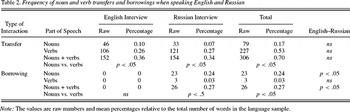
Bilinguals' narrative length was on average 81 words (SD = 70.36, mode = 43, median = 64, range = 10–704). To adjust for length of narrative, the raw number of transfers and borrowings was divided by the total number of words in a narrative and multiplied by 100. All statistical analyses were performed on percentages of transfers, and data were analyzed by subject. Both raw numbers and proportion (relative to total number of words in the language sample) of transfers and borrowings are included in Table 2.

Patterns of transfer and borrowing were examined for interview language (Russian, English), encoding language (Russian, English), language structure (semantic, syntactic), grammatical category (noun, verb), and concreteness (concrete, abstract). However, including all variables into one repeated-measures comparison at the same time would result in 64 conditions per subject (2×2×2×2×2×2), and would render the analyses meaningless. Therefore, separate analyses were performed to test different hypothesis. Note that in repeated-measures comparisons, if at least one of the conditions is missing data, all data from that participant are eliminated. For example, many of the bilinguals tested in the present study did not produce any narratives in some encoding-language conditions. As a result, only 26 of the 47 participants contributed data to all cells in analyses that included encoding language as an independent variable, resulting in 25 degrees of freedom for those analyses. A high number of independent variables and conditions would increase likelihood of missing data in at least one condition per subject, and would result in exclusion of too many participants. To circumvent this limitation, three sets of analyses were performed.
In the first set of analyses, we examined the influence of language environment on bilingual transfer and borrowing. We tested the hypothesis that patterns of language interaction would vary across language spoken at the time of testing and language spoken when the event was encoded. General patterns across languages of interview and encoding were established and only factors revealed by significant main effects or interactions were analyzed in more detail across semantic/syntactic structures, grammatical category, and concreteness.
In the second set of analyses, we tested the hypothesis that language architecture would influence patterns of language interaction. However, the nature of the dataset dictated that different variables be included in transfer and borrowing analyses because of three reasons. One reason is that transfer could be either semantic or syntactic, whereas borrowing could be semantic only; therefore, semantic/syntactic structure was included as an independent variable in analyses of transfer, but not in analyses of borrowing. Another reason stemmed from result patterns revealed by the first set of analyses, where encoding language was found to influence borrowing, but not transfer. Therefore, the second set of analyses included encoding language as an independent variable for borrowings, but not for transfer. Finally, because bilinguals transferred during both languages, but borrowed during Russian only, interview language was included as an independent variable in analyses of transfer, but not in analyses of borrowing. Thus, the second set of analyses compared transfers across three independent variables (nouns/verbs by semantic/syntactic by interview language) and compared borrowings across two independent variables (nouns/verbs by encoding language).
In the third set of analyses, we tested the hypothesis that language interaction is subject to concreteness effects. Because nouns varied across two levels (concrete, abstract) and verbs varied across three levels (action, state, function), the two grammatical classes necessitated separate analyses. Concreteness analyses could be performed for transfers only, because the number of borrowings was too low and yielded insufficient data to make statistical analyses possible.
In sum, three sets of analyses, as specified above, were performed. In addition, correlations were used to examine the extent to which transfer was associated with borrowing and the extent to which different types of transfer and borrowing were associated with each other. Each of the six independent variables was examined against each of the other variables and significant correlations were reported.
RESULTS
Transfer
First, the influence of language environment on patterns of transfer was examined using a 2×2 analysis of variance (ANOVA), with language of interview (Russian, English) and language of encoding (Russian, English) as independent variables. Results revealed a main effect of interview language, F(1, 25)=5.30, p<.05, with participants transferring more when speaking English (M=7.40, SE = 2.10) than when speaking Russian (M=2.60, SE = 0.4). No significant effect of encoding language, F(1, 25)=0.84, p>.3, or interaction, F(1, 25)=2.16, p>.1, were observed. Encoding language was not included in further analyses because its influence on transfer was not significant.
Second, the influence of language architecture on patterns of transfer was examined using a 2 × 2 × 2 repeated-measures ANOVA with language structure (semantic, syntactic), grammatical category (noun, verb), and interview language (Russian, English) as independent variables. Results revealed a main effect of grammatical category, F(1, 46)=34.99, p<.05, with more transfers for verbs (M=0.13, SE = 0.013) than for nouns (M=0.04, SE = 0.0087). A significant interaction between interview language and semantic/syntactic structure was also observed, F(1, 46)=12.07, p<.05; bilinguals produced more syntactic transfers (M=0.24, SE = 0.04) than semantic transfers (M=0.10, SE = 0.025) when speaking Russian, paired samples t(46)=3.16, p<.05, and more semantic transfers (M=0.23, SE = 0.042) than syntactic transfers (M=0.13, SE = 0.03) when speaking English, paired samples t(46)=1.86, p=.069. No other main effects or interactions were observed (all p values > .1).
Third, concreteness effects were examined for each grammatical category, comparing abstract and concrete nouns and comparing action, state, and function verbs. For nouns, a 2 × 2 × 2 ANOVA (Language of Interview × Semantic/Syntactic Structure × Concreteness) revealed a main effect of concreteness, F(1, 46)=37.30, p<.001, with concrete nouns (M=0.062, SE = 0.001) transferred more than abstract nouns (M=0.001, SE = 0.003). In addition, a significant interaction between semantic/syntactic structure and language of retrieval, F(1, 46)=14.37, p < .001, revealed more syntactic transfers (M=0.11, SE = 0.03) than semantic transfers (M=0.05, SE = 0.02) when speaking Russian, paired samples t(46)=4.39, p<.05, and more semantic transfers (M=0.10, SE = 0.02) than syntactic transfers (M=0.02, SE = 0.01) when speaking English, paired samples t(46)=12.67, p<.01. For verbs, a 2 × 2 × 3 ANOVA (Language of Interview × Semantic/Syntactic Structure × Verb Type) revealed a main effect of verb type, F(1, 46)=9.23, p<.05, with action verbs (M=0.08, SE = 0.01) transferred more than function verbs (M=0.04, SE = 0.01), and with both action and function verbs transferred more than state verbs (M=0.01, SE = 0.004), all p values < .05 (corrected for multiple comparisons using the Bonferroni method). In addition, a significant interaction between language structure and verb type, F(1, 46)=17.67, p<.05, revealed that action verbs (M=0.09, SE = 0.02) were transferred more than state verbs (M=0.01, SE = 0.004, p<.05) or function verbs (M=0.004, SE = 0.003, p<.05) during semantic transfer and that function verbs (M=0.08, SE = 0.01) and action verbs (M=0.01, SE = 0.001) were transferred more than state verbs (M=0.002, SE = 0.01, p<.05) during syntactic transfer.
Borrowing
First, the influence of language environment on patterns of borrowing was examined using a 2 × 2 ANOVA with language of interview (Russian, English) and language of encoding (Russian, English) as independent variables. Results revealed a main effect of language of interview, F(1, 25)=13.46, p<.05, a main effect of language of encoding, F(1, 25)=5.47, p<.05, and a significant interaction between the two, F(1, 25)=5.47, p<.05. Participants borrowed only when speaking Russian (M=0.58, SE = 0.20), but not when speaking English (M=0.00); they borrowed more when language of encoding was English (M=0.48, SE = 0.001) than when it was Russian (M=0.15, SE = 0.001); and they borrowed more in the mismatch condition (when speaking Russian if the language of encoding was English, M=0.85, SE = 0.003) than in the match condition (when speaking Russian if the language of encoding was Russian, M=0.30, SE = 0.001, p<.05).
Second, the influence of language architecture on patterns of borrowing was examined with a 2 × 2 repeated-measures ANOVA with grammatical category (noun, verb) and language of encoding (Russian, English) as independent variables. Results revealed more borrowings for nouns (M=0.24, SE = 0.001) than for verbs (M=0.03, SE = 0.0003), F(1, 26)=4.57, p<.05 (because participants borrowed only when speaking Russian, interview language was not included as an independent variable). No other significant main effects or interactions were observed (all p values > .1).
Correlations
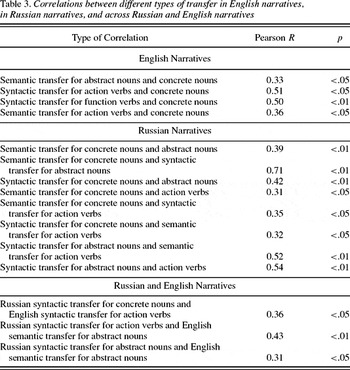
Overall correlation analyses on co-occurrence of transfers and borrowings within each bilingual were not significant (R=0.15, p=.33). Co-occurrence of transfer and borrowing was also examined across different types of transfer and borrowing. Noun borrowings correlated with semantic transfer of concrete nouns (R=0.33, p<.05) and action verbs (R=0.39, p<.01) across both languages. Within borrowing, co-occurrence of different borrowing types was examined and revealed a significant correlation between noun and verb borrowings (R=0.50, p<.05). Within transfer, correlation analyses within and across languages were also performed and significant co-occurrences are reported in Table 3. None of the other correlations were significant (p>.1).

DISCUSSION
Cross-linguistic interactions within the bilingual language system were found in both overt borrowing and covert transfer. Across both languages, more nouns were borrowed than verbs, but more verbs were transferred than nouns. Concrete nouns were transferred with greater frequency than abstract nouns and action verbs were transferred with greater frequency than state or function verbs. Bilinguals produced more borrowings when speaking their L1, which was also their less recent language, and more transfers when speaking their L2, which was also their less proficient language.
Transfer and borrowing in bilingual language interaction
There are at least two potential explanations for the higher rates of borrowing observed in Russian narratives. The first explanation relies on accessibility and sociolinguistic factors (e.g., recency of use, overall linguistic environment, language status, etc.). It is possible that the bilinguals tested in this study borrowed more English words when speaking Russian because English was the language of the immediate surrounding environment (the campus of an American university). The immediate linguistic environment may have influenced the frequency of use and relative status of English, causing higher activation of English lexical items and driving single-word borrowings into Russian. An alternative explanation for the observed patterns of borrowing is rooted in acquisition patterns. Borrowing may be more frequent when speaking Russian because some of the concepts that have been newly acquired in an English-speaking environment are new precisely because there are no equivalents to them in the Russian language.
We also found that bilinguals borrowed more when the language in which the original event took place was different from the language of interview. That is, when speaking Russian, they were more likely to borrow from English if talking about an event during which English was used than if talking about an event during which Russian was used. This increase in borrowing behavior when there was a mismatch between the languages of encoding and retrieval is consistent with the language-dependent memory hypothesis (Marian & Neisser, 2000) and with findings of increased likelihood of borrowing if the borrowed item was previously used in the nontarget language (Angermeyer, 2002). The finding that, unlike frequency of borrowing, frequency of transfer was not influenced by language of encoding suggests that transfer may be subject to changes in the linguistic environment to a lesser extent than borrowing. Instead, transfer may be influenced more by linguistic architecture, including representational differences, such as those that underlie the linguistic relativity hypothesis (Whorf, 1956). For example, a bilingual who has no difficulties distinguishing between the words finger and toe when hearing them in English, but who consistently makes production errors in which toes are labeled fingers is likely influenced by the lexicosemantic representations of the L1 in which no lexical distinction between the two is made and the same word is used to refer to both (as is the case for Russian, for instance). This is not to say that these bilinguals do not know the difference between the two; rather, it suggests that their semantic representations of fingers and toes are less clearly delineated. Additional research will need to explore whether such effects are due to permanent changes to the semantic representation or to parallel activation and interference of the nontarget language during lexical access. Moreover, it is difficult to disambiguate language–interaction effects from deficiencies of knowledge, because transfers that are rooted in conceptual melding of the two languages are likely to be produced repeatedly. Future research will need to either document knowledge acquisition longitudinally or target specific structures experimentally for evidence of correct use.
Semantic and syntactic constraints on language interaction
Bilinguals produced both semantic and syntactic transfers in their two languages, suggesting that semantic and syntactic representations influence each other across languages during bilingual production. More lexical/semantic transfers were detected when speaking the L2, but more syntactic transfers were detected when speaking the L1. The finding of greater prevalence of lexical/semantic transfers into the second, and less proficient language, is consistent with previous studies that found transfer to be more prevalent from a more into a less proficient language (e.g., Dopke, 1992). This suggests that L1 semantic representations may be fairly stable and resist transfer. The greater number of syntactic transfers for nouns and verbs from L2 into the L1 is unexpected, and suggests that L1 syntax may be more sensitive to cross-linguistic influence than L1 concepts. Although the exact reasons for this prevalence of syntactic transfer into L1 are unclear, it may stem from the ambiguity of the Russian syntactic system, compared with the English syntactic system. For instance, Russian syntax appears to include more options than English syntax, such as grammatical gender and free word order. Muller (1998) showed that syntactic transfer is especially likely to take place into a language in which syntactic rules are more ambiguous, and less transparent. For example, whereas Russian possesses three grammatical genders for inanimate objects (feminine, masculine, neuter), English does not. In our study, fluent Russian–English bilinguals who did not use grammatical gender or used it incorrectly when speaking Russian may have done so because of becoming less sensitive to grammatical gender as a result of English use, a hypothesis that can be tested experimentally by future research.
Grammatical category constraints on language interaction
Comparisons across grammatical categories yielded different patterns of language interaction for nouns than for verbs. Nouns were subject to overt cross-linguistic borrowing more than verbs, but verbs were subject to covert cross-linguistic transfer more than nouns. These findings reinforce existing knowledge about the organization of the bilingual lexicon, as well as existing knowledge about processing differences between nouns and verbs. In the bilingual lexicon, nouns are more likely to be integrated across the two languages, and verbs are more likely to be represented in language-specific conceptual stores (Van Hell & de Groot, 1998). In addition, nouns are easier to access than verbs (e.g., De Bleser & Kauschke, 2003), and verbs, by virtue of being encoded by other grammatical categories as well, are more tightly interconnected within a sentence, making them more difficult to borrow intrasententially (e.g., Joshi, 1985; Myers-Scotton, 1993). Therefore, language interaction that takes place at the lexical level should affect nouns more than verbs (because nouns are more integrated conceptually and easier to access lexically) and language interaction that takes place at the conceptual level should affect verbs more than nouns (because verbs are more distinct conceptually and are more connected within a sentence). The results, with more borrowings for nouns and more transfers for verbs, suggest that the lexicon is the more likely locus of borrowing, whereas the conceptual storage is the more likely locus of transfer; however, the actual language interaction system is probably more complex. For example, borrowing may take place at the conceptual level if a lexical item does not have a representational equivalent in the other language. Similarly, transfer may include the lexical level when the underlying representations are highly imageable and include numerous overlapping features, as is the case for concrete nouns and action verbs.
Concreteness constraints on language interaction
Although it may seem that the pattern of results for concrete and abstract nouns should follow that of noun/verb differences, the opposite was true, with more transfers observed for concrete than for abstract nouns. Similarly, action verbs, which are more concrete, were transferred more than state verbs, which are more abstract. The direction of differences for grammatical categories (with verbs transferred more than nouns) is opposite to that for levels of concreteness (with concrete entities transferred more than abstract entities), likely due, at least in part, to differences in levels at which grammatical category and concreteness effects operate. Although concreteness may act at the lexical level, grammatical category (verbs vs. nouns) may act at the level of semantic representation. Even more likely, these differences may stem from the fact than noun/verb effects result from representational differences between the two, whereas abstract/concrete effects result from processing differences in activation patterns. That is, the conceptual differences between nouns and verbs, as discussed in the introduction (e.g., verbs are represented in more language-specific ways, etc.), may make verbs more susceptible to cross-linguistic influences. At the same time, because concrete nouns (and action verbs) are more integrated in the bilingual lexicon than abstract nouns (and state verbs), translation equivalents and their semantic neighbors are more likely to be coactivated during production of concrete items than during production of abstract items (e.g., Van Hell & De Groot, 1998). Coactivation of nontarget language translation equivalents for concrete entities may make them more vulnerable to processing-based transfer. Finally, it is also possible that the greater number of transfers for concrete versus abstract nouns observed in the present study is a coding artifact: because concrete words tend to have fewer synonyms than abstract words, it could be more difficult to detect the transfer of an abstract concept. In the same vein, transfer of state verbs may be more difficult to detect, because of greater flexibility in ways of expressing mental states than in ways of expressing actions and motions.
The high number of semantic transfers for action verbs is probably due to the variable nature of representations for relations across languages, high susceptibility of relational terms to language influences, and differences in motion verb encodings across Russian and English. Another mechanism driving the high number of semantic transfers for action verbs may rely on the nature of L2 learning, with L2 words often learned in a linguistic context (either in a classroom setting or by forming translation equivalents). In a study of adult language learning, Gillette, Gleitman, Gleitman, and Lederer (1999) found that adults learning words from a linguistic context (e.g., written sentences) acquired action verbs with more difficulty than state verbs. If action verbs are learned with more difficulty than state verbs in linguistic contexts, and if much of adult L2 learning takes place in a linguistic context, then it is not surprising that L2 action verbs are more susceptible to semantic transfer, therefore contributing to the overall main effect of concreteness for verbs. This, of course, does not explain the pattern in the L1, and is likely acting only as part of a cumulative mechanism that relies primarily on cross-linguistic interconnectedness for concrete nouns and verbs. Overall, the differences between concrete and abstract transfers should be interpreted cautiously, as the total number of transfers for concrete and abstract nouns was relatively low. However, the similar patterns for nouns and verbs suggest that the concreteness constraint acts similarly on different grammatical categories, and this convergence across grammatical categories adds credibility to the findings.
Implications for models of bilingual language production
Models of bilingual language production incorporate control mechanisms into their frameworks to different degrees. Although some postulate top-down mechanisms in deactivating the nontarget language when speaking the target language (Green, 1986, 1998), others suggest that different activation thresholds for target and nontarget lexical items account for language selection (e.g., Thomas & Van Heuven, 2005; Van Heuven, 2000). Whatever the exact architecture, an on-line control mechanism that can inhibit interference of the nontarget language during target–language production would have a stronger influence at the lexical level than at the conceptual level (given the more integrated conceptual system). A control mechanism would therefore influence borrowing more than transfer, resulting in higher rates of transfer than borrowing in situations in which bilinguals are consciously attempting to communicate in one language only and to control language changes, as was the case in the present study, where bilinguals were explicitly instructed not to use their other language. Thus, although attempting to stay within one language, it appears that bilinguals were able to exert more control over borrowing than over transfer, with covert interactions more frequent than overt ones. Moreover, bilinguals were fully able to control their borrowings when speaking English, but not when speaking Russian (where the recorded borrowings appeared automatic, with the participants not aware that they used words from the other language). These findings suggest a possible asymmetry in the control mechanism across the two languages, a hypothesis that will need to be tested explicitly in future research. In the Russian–English bilinguals tested, this asymmetry is likely reinforced by previous experiences. Specifically, this population of bilinguals can always (or almost always) switch into English when speaking Russian, because most of their Russian-speaking interlocutors in the United States also speak at least some English. However, they cannot always switch into Russian while speaking English, because not all of their English-speaking interlocutors in the United States also know Russian. The finding that overall correlation analyses on co-occurrence of transfers and borrowings were not significant confirms that control mechanisms act differently upon the two types of language interaction.
Finally, such a control mechanism may also influence grammatical category constraints and level of concreteness constraints. Recall that our findings led to the inference that the level of concreteness constrains transfer on-line during lexical selection, whereas grammatical category constrains transfer off-line at the level of conceptual representations. If a control mechanism influences concreteness constraints more than grammatical category constraints, then differences between nouns and verbs should remain constant regardless of the degree to which a control mechanism is involved during language production. Differences between concrete and abstract entities may remain more susceptible to control mechanisms, with abstract nouns more sensitive to control mechanisms than concrete nouns and state verbs more sensitive to control mechanisms than action verbs, a hypothesis confirmed by the findings of the current study. Future studies in which bilinguals are free to use both languages can further test the hypotheses that the conceptual level is the locus of grammatical category constraints on transfer and is less susceptible to on-line control mechanisms.
CONCLUSIONS AND FUTURE DIRECTIONS
In sum, analyses of bilingual narratives reveal cross-linguistic language interaction in naturalistic speech samples. These interactions appear to be influenced by differences in language environment (at the time of speaking and at the time when the content was formed), and by the architecture of the language system, including linguistic structure (semantic and syntactic), grammatical category (noun and verb), and concreteness level (abstract/concrete for nouns, action/state/function for verbs).
However, it is necessary to qualify the findings of the current study by pointing out that the observed patterns of language interaction may be characteristic of bilinguals whose L1 is more proficient and whose L2 is more recent. In the present study, it is impossible to separate the individual contributions of proficiency, order of acquisition, and specific language. It is a question for future research whether the same language interaction patterns will hold for bilinguals with different proficiency and age of acquisition profiles, in other production contexts, and with languages that follow different structural properties. Moreover, sociolinguistic factors such as language status and the local production context may also impact language interaction. For instance, the number of borrowings would decrease if participants were interviewed by monolingual speakers of the two languages and would increase if participants were free to code switch. Such differences would only be observed for language interactions that result from on-line interference, but not for those that stem from modification of the conceptual representation.
The different effects of language environment and language architecture on borrowing versus transfer suggest that the two types of cross-linguistic interaction take place at different levels of cognitive processing. Borrowing may be rooted in lexical access phenomena, and transfer may be rooted in representational/conceptual phenomena, although this dichotomy is most likely not absolute. Grammatical category and level of concreteness also appear to constrain language interaction differentially, with grammatical category more likely to exert an influence on conceptual representations and level of concreteness more likely to exert an influence on lexical access. Control mechanisms may further influence the two types of language interaction, especially for overt borrowings. These findings reinforce the idea that the bilingual language system is highly interactive, with processing in one language influenced by knowledge of another language at all levels of the system, including lexical access and semantic representation.
This work was supported in part by NICHD Grant 1R03HD046952-01A1 and NSF Grant BCS-0418495 to the first author. The authors thank Usha Goswami, Editor, and three anonymous reviewers for comments on an earlier version of the manuscript and Brighid Heenan, Caitlin Fausey, Olga Boukrina, Avital Rabin, Henrike Blumenfeld, Elena Dukhovny, Sonja Nosonofsky, Preeti Sivasankar, and Sarah Valliath for assistance at various stages of the project.