Introduction
While the number of disasters that occurred in 2010 approximated the annual average of the preceding decade, the economic impact of natural disasters in 2010 was estimated at US $109 billion, 125% of the annual average for 2000 through 2009. 1 Natural disaster damage in 2010 ranked fourth during the past decade, surpassed in 2004 mainly as a result of the Niigata-ken earthquake in Japan, in 2005 due to hurricanes Katrina, Rita, and Wilma, and in 2008 with the Sichuan earthquake. Damage from the Chilean earthquake, estimated at US $30 billion, accounted for nearly one-quarter of economic damages from natural disasters in 2010; floods and landslides in China and Pakistan ranked second and third at US $18 billion and US $9.5 billion, respectively, and the Haiti earthquake was the fourth most costly disaster at approximately US $8 billion. 1 The original United Nations flash appeal for Haiti was for US $575 million and the World Bank has estimated that the overall damages were US $7.8 billion. 2 , 3 In Pakistan, the UN requested US $1.9 billion for the immediate response and recovery needs, and the World Bank estimates that the overall relief, recovery, and medium- to long-term reconstruction cost are US $8.7-$10.9 billion. 4 , 5
The human impact in 2010 was even greater. The government of Haiti estimated that the earthquake affected three million Haitians, displaced almost two million, destroyed or damaged over 300,000 homes, killed an estimated 230,000 people, and injured 300,000. 6 These numbers have been disputed through population-based epidemiological studies and geospatial analysis, which estimated lower levels of human impact for these indicators.Reference Schwartz, Pierre and Calpas 7 - Reference Kolbe, Hutson and Shannon 9 Regardless of which estimates are more accurate, the Haiti earthquake was one of the deadliest and most impactful disasters in recorded history. The flooding along Pakistan's Indus River in the summer of 2010 submerged one-fifth of the entire country and was one of the greatest natural disasters in history; it affected over 20 million people, killed 1,985, and destroyed or damaged 1.6 million homes. The floods affected more people than the 2004 Asian tsunami, the 2005 Kashmir earthquake, the 2008 Cyclone Nargis, and the 2010 Haiti earthquake combined. 10 - Reference Solberg 12
Both countries, Pakistan and Haiti, are considered to have low social development indicators. Pakistan ranks 125 out of 169 countries in terms of the Human Development Index (HDI), and an estimated 45 million Pakistanis (approximately 23%-24% of the population) are considered severely food insecure. 13 , 14 In comparison, Haiti ranks 145 on the HDI and has a food insecure population of around 1.9 million (approximately 21% of the population). 13 , 15
The Haiti earthquake and the Pakistan floods occurred approximately six months apart, and were different in many ways: the causal events were different, as were the landscapes and populations affected; the affected population in Pakistan was mostly rural, but urban in Haiti; and the human casualties in Haiti were enormous, while in Pakistan, the economic impact was greater. While they were similar in terms of the large-scale scope of the devastation, this study compares and contrasts the predisaster situations and the effects of the two disasters on the people of Haiti and Pakistan to compare the impacts and the response and recovery efforts of these different types of events. While acknowledging the differences in the two populations, all humanitarian responses should be equitable with the goal of returning to normalcy, and they should adapt to the individual populations’ needs.
Methods
In both Haiti and Pakistan, similarly structured population-based surveys were carried out to assess disaster outcomes and response, and to enable comparisons. Both surveys were conducted in January 2011 and used cluster designs with probability proportional to size sampling. Sample size was calculated based on the study objectives to detect a ⩾ 10% difference in the prevalence of various living conditions and health and economic impact indicators (based on an estimated conservative prevalence rate of 50% for any given indicator) between the two countries, with 80% power, alpha = 0.05, and an anticipated cluster sample design effect of 1.5. The surveys were conducted in the most severely affected areas as identified by international humanitarian agencies. Households were included in the survey if they indicated that had been affected by the disaster (defined as experiencing death, injury, damage to property, or economic loss in the household), if an adult (≥ 18 years of age) belonging to that household was present, and if they agreed to participate. A household was defined as a group of people who lived in the same living quarters and shared meals, regardless of biological relation. If a household was not eligible, or not inhabited at the time of the survey, then the next closest was approached. For dwellings with multiple households, only a single household was chosen at random. In each setting, the survey instruments were developed in English and translated into the local languages, then verbally back-translated again into English to verify translation accuracy. The surveys were then tested, refined and validated locally, and conducted by trained nationals using the local language. Interviewers received extensive training on basic principles of human subjects’ protections and selection and survey techniques. The surveys included questions on individual and household demographic characteristics, pre and postdisaster living conditions and household wellbeing, health needs and access to care, and perceptions of aid received and unmet needs.
Pakistan Survey
The survey included 80 clusters of 20 households in the 78 most-affected districts of the four affected provinces: Balochistan, Khyber Pakhtunkhwa, Punjab, and Sindh. 5 Clusters were chosen randomly with probability proportionate to population size as follows: the number of clusters assigned to each province was chosen based on the proportion of the flood-affected population; then within each province, the number of clusters for each affected district was chosen based on the proportion of affected population; and finally, using randomly generated geographic information system (GIS) coordinates, the starting point for each cluster was identified within the most severely-affected tehsils (counties) or union councils (subcounties). The first household in each cluster was the nearest to the GIS coordinate. In rural areas with large distances between houses, the next nearest house was chosen until 20 households were surveyed. In urban settings, each fifth house after the initial house was sampled. The final sample included 1,552 households across 80 clusters.
Haiti Survey
The survey included 60 clusters of 20 households in metropolitan Port-au-Prince and employed a stratified design. The proportionate size of affected populations in camps and neighborhoods could not be estimated accurately from available information, so an equal distribution was used. Camps were sampled from a list of planned and spontaneous settlements obtained from the UN Camp Coordination and Management Cluster. 16 Within each camp, an intersection of two major walkways was randomly selected as the cluster starting point, and every third shelter was selected until a sample of 20 households was completed. In neighborhoods, cluster allocation was done using a remote sensing building damage assessment based on the assumption that the number of moderately and heavily damaged residential structures was proportional to the earthquake-affected population in that area. 17 Within communes, the number of clusters was assigned proportionally to 2009 population estimates. 18 Within each neighborhood section, GIS coordinates were randomly selected and the nearest intersection of main roads was used to identify the cluster starting point (a relatively equal spatial distribution of the population within each section was assumed). From the cluster starting point, a randomly selected number and direction were used to identify the number of streets or pathways to walk to arrive at the first household, after which every third residential entrance from the street or pathway was sampled. The final sample included 1,196 households across 60 clusters.
Data entry was done in Microsoft Excel (Microsoft Corporation, Redmond, Washington USA) and standard quality checks were performed to ensure accuracy. Analyses were conducted using the Stata 11 (STATACorp LP, College Station, Texas USA) and Tableau Desktop (Tableau Software, Seattle, Washington USA) software packages. Descriptive statistics and summary measures were calculated and comparisons were drawn using standard statistical significance tests for means and proportions, including chi-square and t tests.
The study was approved by the Johns Hopkins School of Public Health Institutional Review Board and by the Pakistan Ministry of Health and the Haiti Ministry of Public Health and Population.
Results
Household Demographics
The mean household size in Haiti was 5.5 pre-earthquake and 5.3 postearthquake, and in Pakistan, mean household size was 8.2 preflood and 8.1 postflood; household size in Pakistan was significantly larger than in Haiti for both time periods (P < .001). Males headed 66.2% of households in Haiti and 96.7% in Pakistan (P < .01). Head of household (HoH) level of education also varied significantly between the two countries, with 65.7% of Haitians HoHs completing secondary school or beyond, compared with only 16% of Pakistani HoHs (P < .01). The highest level of education of any member of the household was also significantly higher for Haitian households, with 76.3% of households having a member that had completed at least a secondary education, compared with 30.6% of Pakistani households surveyed. In Haiti and Pakistan, respectively, 5.3% and 2.3% of households reported a change in HoH following the disasters. The reasons for the change in the HoH were similar, including: (1) temporary separation of the family (50% Haiti; 52% Pakistan); (2) death of the household head (31% Haiti, 29% Pakistan); (3) household head was injured or disabled (5% Haiti; 0% Pakistan); and (4) other unspecified reasons (16% Haiti; 19% Pakistan). Little change was reported in the average household size, the average number of children, or the household composition following either disaster in Haiti or Pakistan.
Immediate Disaster Impacts
Housing and Displacement
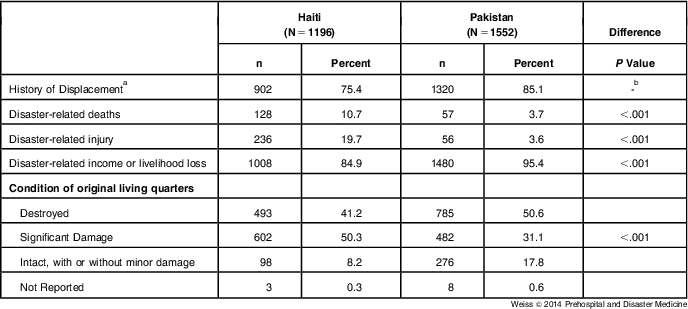
The physical and economic impacts of the events were widespread in the surveyed areas of both countries. In Pakistan, 95.1% of households reported damage to their home, and 95.4% loss of income or livelihoods; in Haiti, 93.1% reported home damage and 84.9% income or livelihood losses, significantly higher in Pakistan (P < .05 and P < .001, respectively). In contrast, morbidity and mortality rates were markedly different. In Pakistan, 3.6% and 3.7%, respectively, of households had injuries and deaths, whereas in Haiti, 19.7% of households reported injuries and 10.7% reported fatalities (P < .001 for both comparisons). Table 1 describes immediate household-level disaster impacts.
Household-level Disaster Impacts

a Defined as > 1 Month in Haiti and > 2 weeks in Pakistan.
b Time frames do not perfectly overlap, so test of significance not meaningful.
The proportion of homes that were destroyed or seriously damaged was very high in both settings, but significantly higher in Haiti (91.5% vs 81.7%, P < .01). The odds of a Haitian household having a destroyed or significantly damaged home was 2.0 (95% CI, 1.4-4.2) times greater than for a Pakistani household. Displacement from their home of origin was widespread, with 75% of Haitian households displaced more than one month, and 85% of Pakistani households displaced for more than two weeks.
Mortality and Injury
Among Haitian households, 10.7% reported death(s) as a result of the event compared to 3.7% of Pakistani households (P < .001). The odds of death and injury in a Haitian household were 3.1 (95% CI, 2.3-4.4) and 6.6 (95% CI, 4.8-9.0) times greater than in a Pakistani household. Given that the average household size in Haiti was significantly less than in Pakistan, the difference in mortality was even more pronounced when assessed at the individual level, where crude mortality rates for the survey populations were 25/1000 in Haiti and 4.6/1000 in Pakistan (P < .001). A similar pattern was observed for injury: in Haiti, 19.7% of households reported injuries and the crude injury rate was 40.7/1000, and in Pakistan, 3.7% of households reported injuries and the crude injury rate was 5.9/1000 (P < .001 for both comparisons).
Comparisons of Response Activities
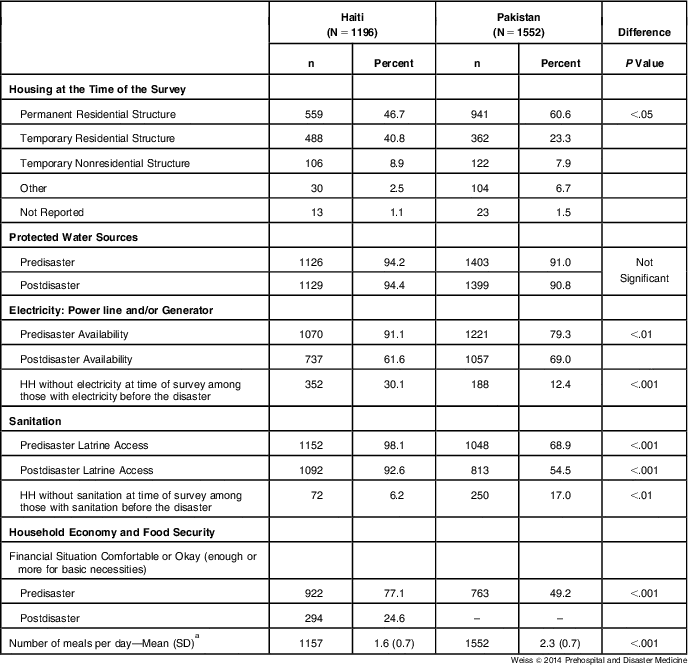
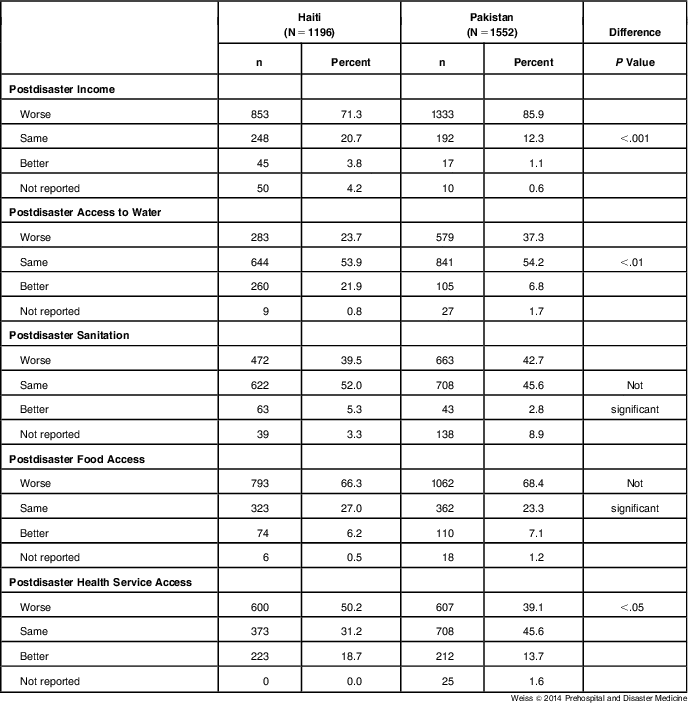
A unique feature of this survey was to use both objective measures and subjective reports of the impact of the events and recovery process. Living conditions, including housing type, access to basic services (including electricity, water, and sanitation), and food security and livelihoods are summarized in Table 2. Table 3 summarizes the subjective impressions by the HoH of the household's recovery (“Better,” “Same,” or “Worse”).
Living Conditions at the Time of the Survey and Before the Event

Abbreviation: HH, households.
a In Haiti, on the preceding day and in Pakistan daily average for the preceding week.
Perceived Change in Household Status and Access to Basic Services

Housing
Displacement at the time of the surveys remained a significant issue in both Haiti and Pakistan with 53.3% and 39.4%, respectively, of households living in temporary housing, but this finding was more concerning in Haiti, one year after the event, compared to six months into the Pakistan recovery. Few households in each country reported that their original homes were intact (8.2% Haiti; 17.8% Pakistan). Half of Haitian households were still living in temporary residential structures, such as tents (40.8%), or were living in nonresidential structures, such as warehouses (8.9%). Fewer Pakistani households were living in temporary residential structures, such as tents (23.3%), or nonresidential structures, such as warehouses (7.9%), at the time of the survey.
Electricity
Access to electricity had worsened significantly in both countries, but more so in Haiti. Haitian households were significantly more likely to have access to electricity before the disaster than Pakistani households (91.1% vs 79.3%, P < .01), but there was no significant difference in electricity access after the disasters (61.6% vs 69.0%). Reported access to electricity in Haitian households decreased by 30% after the earthquake, while in Pakistani households, it decreased only 10%. A Haitian household had 3.0 (95% CI, 2.5-3.7) times greater odds of reporting worse electricity access at the time of the survey, compared to before the survey, than a Pakistani household.
Water
The proportion of households using water from protected sources was high before and after in both countries, and did not change in either country because of the disaster. The percent of Pakistani and Haitian households reporting worse access to water at the time of the survey was similar (43.2% vs 40.4%, P > .05). Among Haitian households surveyed, 94.2% reported that their main source of water was from a protected source (indoor plumbing, tanker truck delivery, or protected pump/well) both before and after the earthquake. Among Pakistani households surveyed, 91% reported that their primary source of water was from a protected source, both before and after the floods. The type of protected water source used as the household's main source of water did change after the events. Prior to the earthquake in Haiti, the three principal water sources were public pumps (31.7%), tanker truck (31.1%), and piped water (29.6%); at the time of the survey, half of the population used public pumps as the primary water source with smaller minorities using tanker trucks (26.8%) and piped water (16.2%) (P < .001). In Pakistan, the type of protected water source shifted only slightly, with majorities of the population using boreholes, hand pumps, taps, or protected wells, both before (74.5%) and after (72.7%) the floods.
Sanitation
Access to sanitation facilities (latrines or toilets) changed significantly for the worse in both countries after the disasters, but more significantly for Pakistani households. At the time of the surveys, Pakistani households were 9.5 (95% CI, 7.6-12.1) times more likely to lack access to basic sanitation than Haitian households. Sanitation access in Pakistan before and after the floods was 68.9% and 54.5%, respectively; this was worse than Haiti at both time periods (P < .001). Among Haitian households surveyed, access to sanitation changed for the worse in a small, but significant way, due to the earthquake, from 98.1% of surveyed households before the earthquake compared to 92.6% after one year (P < .001). While change in the proportion of households with access to sanitation was relatively small in Haiti, the type of sanitation facility changed greatly and much more than in Pakistan. Before the earthquake, almost all Haitian households surveyed reported the use of a private sanitation facility, either a private latrine (66.3%) or an indoor toilet (26.9%). Following the earthquake, only 47.8% Haitian households reported that they had a private sanitation facility. Almost half (45.3%) of the Haitian households who had had a private latrine before the disaster were using a shared public latrine at the time of the survey. This was a very different situation than in Pakistan, where only 14.4% of households with a private latrine before the disaster were then using a public latrine at the time of the survey (P < .001). Compared to Pakistan, the odds in Haiti of a household shifting from a private latrine to a public latrine were 4.9 (95% CI, 3.7-6.6) times higher.
Household Economy and Food Security
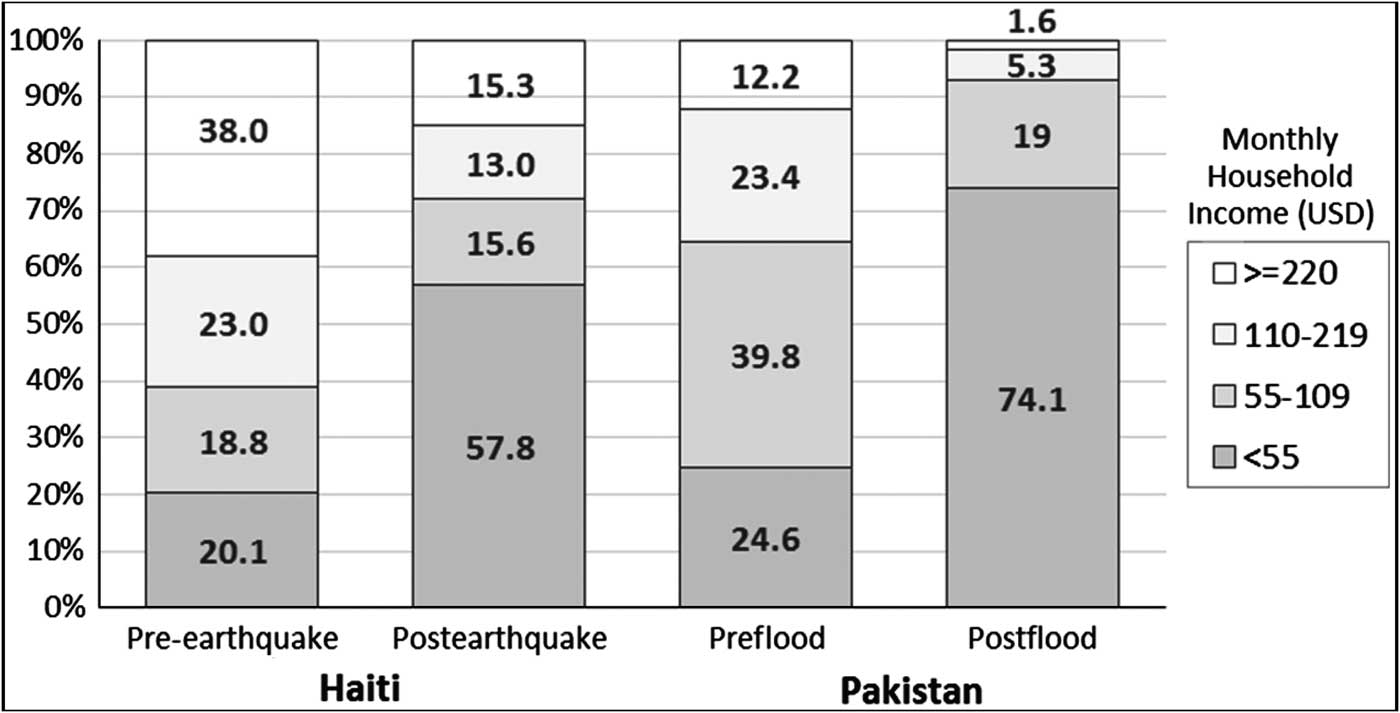
The postdisaster decline in income was widespread in both countries, but Pakistani households reported greater changes in income. The percent of households earning less than US $55/month nearly tripled in both countries (24.6% to 74.1% in Pakistan and 20.1% to 57.8% in Haiti). The distribution of household incomes pre and postdisaster is summarized in Figure 1.
Household Income Distribution, Pre and Postdisaster

Food insecurity was a much more significant problem in Haiti than in Pakistan. The mean number of meals eaten by Haitian households on the day prior to the survey was 1.6 compared to 2.3 meals per day, on average, the week prior to the survey for Pakistani households (P < .001). Among Haitian households, 46.3% reported consuming one or fewer meals per day, compared to 6.8% of Pakistani households (P < .001). The odds of a Pakistani household consuming two or more meals a day was 11.6 (CI: 9.2-14.8) times higher than that for Haitian households. Receipt of food aid was reported by 28.2% of Pakistani households at the time of the survey, compared to less than 3% of Haitian households (P < .001), which was a contributing factor to the comparatively better food security situation.
Subjective Reports of Household Recovery
HoHs were asked to compare their postdisaster status to predisaster for each major area in the survey. These responses paralleled the reporting of the specific indicators listed above, and are summarized in Table 3. In some areas, the recovery efforts seem to have successes: Haitian and Pakistani households reported “Same” or “Better” access to clean water (75.8% and 91.5%) and sanitation facilities (57.3% and 48.4%) after the disasters, and in Pakistan, 59.3% of households reported baseline or better access to health services, compared to 49.9% in Haiti. Pakistani households perceived changes in access to water as worse than Haitian, with 37% reported that their access to water was worse at the time of the survey, compared to 24% of Haitian households (P < .001). The odds of a Pakistani household reporting worse water access after the disaster were 2.0 (95% CI, 1.3-3.0) times higher than for a Haitian household.
The perceived progress of the recovery was poor in the areas of “Income” and “Food Security.” A large majority of both Haitian and Pakistani HoHs reported “Worse” income (71.3% and 85.9%, respectively) and access to food (66.3% and 68.4%, respectively) since the disasters. Pakistan households were more likely to report having lost income after the disaster than Haitian (P < .001). The odds of a Pakistani household reporting that their income was worse at the time of the survey, compared to before the disaster, was 2.4 (95% CI, 2.0-3.0) times higher than for a Haitian household.
Discussion
The number and impact of disasters has been increasing over the past few decades. 19 As such, annual spending on global disaster response has risen continuously in the recent past, and this trend is likely to continue. 20 Governmental humanitarian assistance contributions totalled US $12.8 billion in 2008, while private contributions to humanitarian response agencies were around US $4.1 billion. 21 Given the rise in disaster frequency and the economic crisis affecting humanitarian funding streams, it is increasingly important to measure the impact of humanitarian response activities and to adopt realistic expectations with respect to return to normalcy.
These surveys were designed to assess the impact of, and recovery from, the disasters in Haiti and Pakistan from the perspective of affected households. Both surveys were conducted in January 2011, six months after the start of the flooding in Pakistan, and one year after the earthquake in Haiti. The findings presented in this study provide insight into the longer-term impact of these disasters, and, to a certain degree, may help in assessing the impact of response and recovery efforts. In addition, the subjective and objective reports identified problems in food and economic security that persisted many months after the disasters. This information may be useful for prioritization and planning of future humanitarian efforts in Haiti and Pakistan, as well as responses to other large-scale natural disasters. The most striking finding of these surveys is that, despite massive response efforts, recovery from these events has been slow, with few households reporting a return to their baseline household economic situation or similar access to services at six to twelve months postdisaster.
The frequency of reported injuries and deaths was much greater in Haiti. However, the economic impact on households was significantly more widespread from the floods in Pakistan. This is likely due to the relatively slow onset, but widespread nature, of the damage from the floods, particularly the damage to the agricultural economy. The earthquake, though devastating, caused relatively focused, and sometimes only partial, damage in the Port-au-Prince metropolitan area. Destruction or significant damage to homes was widespread, but significantly more common in Haiti. Housing recovery in Pakistan was much more rapid: after six months, 61% of Pakistani households had returned to a permanent residential structure, such as a house or apartment, compared to only half of Haitian households at one year following the disaster. In Haiti, there were still larger percentages of the population living in temporary shelters, even after sustained relief efforts, even with twice the number of months to respond to this problem. This finding likely reflects the increased legal and political complexities of development planning and land tenure in urban areas, especially in an earthquake zone.Reference Durand-Lasserve and Royston 22 - Reference Lundahl 24
Limitations
Cross-sectional cluster surveys are common in the absence of a nominal list of affected individuals but have important limitations. Both Haitian noncamp clusters and Pakistani clusters at the final stage were selected by proximity to randomly selected geographic coordinates. In Pakistan, this sampling procedure is likely to have biased the information toward rural households (rural households may have a higher relative probability of being included in a survey cluster compared to urban households). Therefore, the findings may overrepresent the impact of the flooding on rural households. In Haiti, however, the entire survey (outside of camps) was conducted in an urban area (where a relatively even spatial distribution of households within the survey catchment area was assumed). As aid distributions often are tied to family size and need, it is possible that interviewees exaggerated the size of the household and severity of need. Similarly, the self-reporting of economic and service status also has limitations; those surveyed may have felt that reporting a worse status would lead to further assistance. The presently described survey could not include households in which all members died or households inaccessible due to security, which is another important limitation and potential source of bias.
Conclusions
These two disasters were severe events, leading to widespread destruction and social disruption. Response efforts from the international community have been massive, but with varying results. These surveys demonstrated that, with the exception of protected water sources and some sanitation services, reduced access to food and income remained widespread in both countries, and the situations had not yet returned to normal by the time of the surveys. The use of subjective estimates of household recovery may help to direct response efforts in future events.