Personal collections
In recent years, there has been a growing trend for writers' personal libraries to be donated or acquired and incorporated into institutional collections. However, this apparent fad is not new: one finds in literature examples such as, in the 18th century, the empress of Russia, Catherine II, that acquired the personal library of the Enlightenment french writer and philosopher Voltaire, including the personal archive with his correspondence and manuscripts, which is to this day in the Russian National Library in St Petersburg. Victor Hugo, in the following century, declared in his will (1881) that he was leaving “everything found written or drawn” by him to the French National Library.
Since the 19th century, the personal collections of writers and intellectuals have had their value recognised by specialists and institutions whose aim is to conserve and preserve the personal and collective memory within a historical and cultural context. According to Krtalic, Dinneen, Liew & Goulding (2021),
People of cultural significance sometimes keep extensive personal collections that attest to their life's work and their influence on society and even capture the social and political milieu of their time. Sometimes such collections are donated to organizations that preserve and make those collections accessible to others, like national memory or heritage institutions (…).
Nélida Piñon's library is a snapshot of her experience and her movement around the world. The writer's collection, like every personal collection, brings together a diversity of artefacts that can range from a book to a work of art. Such objects serve as research not only into the literary and intellectual formation of a given author, but also into the historical, social and cultural context in which he or she is inserted.
What follows is a discussion of Nélida Piñon's personal library and her decision to donate it to the Instituto Cervantes.
Instituto Cervantes Rio de Janeiro
The Instituto Cervantes is a public organization founded by the Government of Spain in 1991 whose mission is the promotion and dissemination of Spanish and Hispanic American language and culture throughout the world (Law 7/1991, 21 March 1991).
The library of Instituto Cervantes Rio de Janeiro belongs to the Instituto Cervantes Libraries Network (RBIC – Red de Bibliotecas del Instituto Cervantes), the largest international network of Spanish specialized libraries in the world. It is integrated in the Spanish Library System and is subject to the same regulations as the rest of the state libraries. At present, it is made up of 60 libraries spread over five continents.
The RBIC libraries are usually named after a Spanish or Hispanic-American writer. The case of the Nélida Piñon Library is unique because it is the only one to carry the name of an author who does not write in Spanish or in one of the co-official languages (Basque, Catalan and Galician). This exception is a gesture of honour towards a language and culture to which Spaniards feel very close and for this reason they wanted to do it in the person of one of the greatest contemporary writers of the Portuguese language, Nélida Piñon, and also to highlight the nature of the meeting place of languages and cultures that the Instituto Cervantes represents. As a token of gratitude, the writer and academic Nélida Piñon donated her personal library to the Instituto Cervantes Rio de Janeiro.
The Nélida Piñon Library in Rio de JaneiroFootnote 2 is one of the information centers of RBIC in Brazil, offering its collections and services to anyone interested in Spanish and Hispanic American language and culture since 2004. On 20 June 2022 it was inaugurated as Nélida Piñon Library with the presence of the director of all Institutos Cervantes in the world, the Spanish poet Luis García Montero, and Nélida Piñon.
Nélida Piñon
Nélida Piñon (born 1937) is a Brazilian novelist and short-story writer of Galician descent, recognised internationally and especially in the Ibero-American world. Her literary work has been published in more than 30 countries and translated into more than eight languages. She has received many awards and acknowledgements at national and international levels. She became the first Brazilian and first woman to win Mexico's Juan Rulfo Prize for Latin American and Caribbean Literature (1995); the first woman president of the Brazilian Academy of Letters (1996–1997); Rosalía de Castro Award of Galicia (2000); Jorge Isaacs Ibero-American Narrative Award of Colombia (2001); the Menéndez Pelayo International Prize (2003); the Spain's Prince of Asturias Prize for Literature (2005). Since 2012, she has served as the Ibero-American Cultural Ambassador. Among other activities, Nélida was Professor of Humanities at the Stanford University (1990–2003).
A ballet lover since her childhood, Nélida Piñon attended the official ballet seasons at the Municipal Theatre of Rio de Janeiro. Her fascination was such that at the end of the performances she used to go to the dressing rooms to greet the dancers and ask for autographs. Nélida also kept the programmes of each performance from 1948 to 1957, which she later bound in four volumes.
In the 1950s, the ballet seasons lasted about three months, which enabled the artists to live during that period in Rio de Janeiro. According to Nélida, during her walks through the city centre she used to meet them strolling in the cafés and bookstores of that time.
In this way, Nélida created bonds with some dancers, becoming friends, for example, with Tamara Toumanova, Margot Fonteyn and Tatiana Leskova. Her interest in ballet was so great that she exchanged correspondence with the most important British ballet critics of the time, Arnold Haskell and Cyril W. Beaumont.
According to Piñon, the ballet publications were imported from United Kingdom and United States of America and she used to find at Freitas Bastos Bookshop in Rio de Janeiro city centre. There were no local editions in Portuguese. She also informed that Argentina is a reference in the history of ballet in South America. It is important to emphasise that the oldest South-American ballet company is that of Colón Theatre in Buenos Aires. The first translations of works on ballet in Spanish were published by Argentinian publishers.
The Ballet Collection
In addition to programmes, the collection comprises works dealing with different aspects of ballet, such as history, technique, critics, dictionaries, biographies, periodicals, encyclopedias, etc.
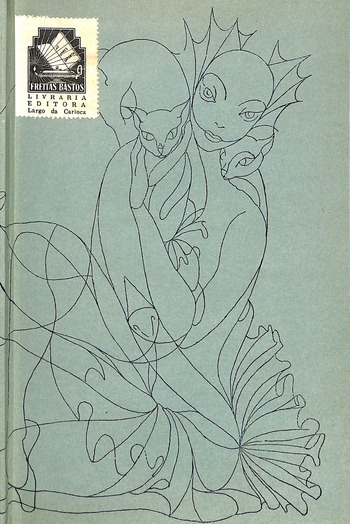
Through Piñon's collection, it is possible to recognise the presence and importance of ballet at that historical moment in South America. The main titles of works on ballet published in Europe were imported by the bookstore Freitas Bastos Livraria Editora, where the writer would buy them. In most of the works it is possible to identify the provenance mark on the bookshop label affixed to the upper left-hand side of the page.
Freitas Bastos Livraria Editora. Fonteyn: Impressions of a ballerina, written and decorated by William Chappell.

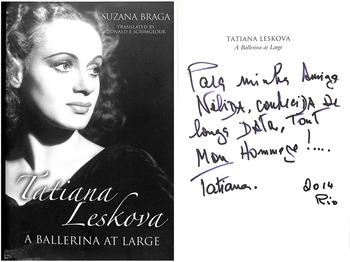
Tatiana Leskova Dedication. Tatiana Leskova: a ballerina at large, Suzana Braga.

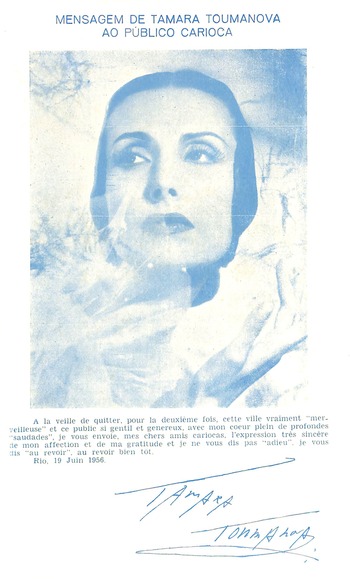
Tamara Toumanova. Menssage from Tamara Toumanova to the carioca public.

Contextualising Nélida Piñon's Ballet Colletion
In the first half of the 20th century, ballet expanded internationally with the creation of the company Les Ballets Russes (1907), followed by others such as the London Ballet (1931) and the American Ballet (1937). Many of these companies toured Brazil, Uruguay and Argentina with some frequency during the 1940s and 1950s. Great dancers such as Alicia Markova and Tamara Toumanova have performed in the theatres of Buenos Aires; Montevideo, São Paulo and Rio de Janeiro. Some of their members ended up settling in South America, such as Tamara Grigorieva, Tatiana Leskova and Nina Verchinina.
The stylistic evolution of South American ballet occurs with the influence of Diaghilev's Ballets Russes (1913 and 1916) and others such as Montecarlo's Ballets Russes (Leonide Massine) and Basil's Ballet Russe du Colonel (Tamara Grigorieva, Tatiana Leskova and Yurek Shaboevsky). From the latter, Tatiana Leskova, who was in charge of the ballet at the Municipal Theater of Rio de Janeiro, became a friend of Nélida.
As mentioned above, translations into Spanish of works on ballet are appearing in Argentina, making the reading of the main authors accessible. Among them are, for example, publications on the Russian Ballets, works of Arnold Haskell and Jean-Georges Noverre.
In an informal conversation with one of the authors, Nélida Piñon informed that the publications on ballet were in English, with no publications in Portuguese. The first works in Spanish were editions from Argentina, the country where the oldest ballet company in South America - the Compañia de Ballet del Teatro Colón - was founded.
After searching through national catalogues, the authors noticed the absence of Portuguese language editions and/or translations in Brazil in this period. By way of example, we cite some titles published in Argentina acquired by the writer:
Noverre, Juan Jorge. Cartas sobre la danza y sobre los ballets. Buenos Aires: Ediciones Centurión, 1946.
García Victorica, Victoria. El original Ballet Russe en América Latina = The original Ballet Russe in Latin America. Buenos Aires: Ediciones Arturo Jacinto Álvarez, 1948.
Karsavina, Tamara. Los Ballets Rusos: (mis memorias). Buenos Aires: Editorial Schapire, 1953.
Cataloguing the collection
For the technical processing of the personal collection of the writer Nélida Piñon, a cataloguing project was created in order to guarantee that the works are catalogued according to the norms established by the Library Network of the Cervantes Institute. In order to describe the characteristics, the marks of provenance, the dedications, the annotations found in each work making them available to society.
As every librarian knows, the descriptive representation of a document requires a concern with information retrieval. In this sense, it is necessary to take into account during the cataloguing process that a private collection is being handled, whose information contained therein will be made available to the public. One should observe, according to Ulpiano Meneses (p. 89), ‘the displacement of objects and collections from the personal to the public field’, which implies to include in the document description the marginal information that make each document unique. This is the case of Nélida Piñon's personal collection that now forms part of the collection of the library of Instituto Cervantes in Rio de Janeiro, whose mission is to make this information available to the public.
Facing a collection with so many particularities and informational richness, questions arise for the cataloguing team: How to describe a binding that brings together different programmes of ballet seasons in different theatres? How to indicate the pages signed by the dancers? How to indicate the author's notes on the scene of a particular ballet?
To answer these and other questions, the cataloguing team has drawn on documents and experiences from other libraries with similar personal collections. Although provenance marks are provided for in the MARC format, field 561, information and communication technology tools cannot cater for the diversity of marginal information that is present in this type of collection.
In the case of a network of libraries with a collective catalogue, such as Biblioteca Nélida Piñon, provenance marks and other information are being inserted in the copy file.
The diversity of data in marginalia led the team to elaborate a system to classify the categories of each type of information, as well as to establish abbreviations and acronyms to identify the main sub-collections within this collection. Besides the Ballet section (CNP_BALLET), there is Nélida's Galicia (CNP_GALICIA DE NELIDA), Machado de Assis (CNP_MACHADO DE ASSIS), Brazilian Academy of Letters (CNP_ABL), etc.
Conclusions
Although the project of cataloguing the personal collection of the writer Nédida Piñon at the Instituro Cervantes Rio de Janeiro is under development, it is verified that many discoveries will come up, because as it was mentioned before, each item unveils new information to be registered
It is observed that the collection gathered by the academic reflects the most diverse areas of knowledge to which she is dedicated and interested. Preserving the memory of a life, keeping objects that translate the lived moment is a frequent practice among the “men of letters”, as Chartier (1996, p.160) calls them - those who dedicate themselves to research, study, reading, in short, individuals who have the habit of preserving documents. These form their personal collections with various collections. The same principle applies to the academic writer Nélida Piñon with her impeccable ballet collection.
As verified in the literature on the history of ballet in Brazil, the absence of documents of testimonial nature that show the historical course of the corps de ballet and ballet companies leaves gaps for the recovery of data that subsidize studies on this theme. According to Pereira (p. 8), “only three books are exclusively dedicated to the task of approaching the history of ballet in Brazil”: O Ballet no Brasil, by Edméa Carvalho (1965); A Dança no Brasil, by Antônio José Faro (1988); A Dança Teatral do Brasil, by Eduardo Sucena (1988).
Thus, this collection is considered to be a reference for research on ballet in South America. The catalographic processing (interpretation and transcription of dedications and commentaries, among others) and the making available of this collection to society will enable research into the history of ballet and corps de ballet in Brazil, the presence of international ballet companies as well as publications on ballet available to South America in the first half of the 20th century.