Introduction
By introducing ‘Payment by Results’ (PbR) the NHS in England is emulating the USA, Australia and many European countries by funding providers on the basis of the ‘equal pay for equal work’. Under PbR, purchasers (Primary Care Trusts) pay a fixed price – the national tariff – to providers for each patient treated. As income depends on activity, low cost providers have strong incentives to do more work and reduce waiting lists and all providers have an incentive to reduce costs in order to maximise ‘profit’ from their activity. PCTs have the financial incentive to prevent hospital admission because they can spend the tariff on primary and community care. The English have introduced innovative design features to this payment system but further lessons can be learned from international experience. This paper discusses this experience and argues that further policy reform is needed to prevent PbR increasing health care costs and distorting health priorities.
Driving day case activity
The first innovative English feature epitomises how prices can be designed to change behaviour because there are strong incentives for hospitals to undertake work in the cheaper day case setting, a policy advocated for over 30 years (Department of Health and Social Security, 1976). For each treatment, defined by Healthcare Resource Group (HRG), the elective price is based on the national average reference cost for inpatient care for each HRG and the average reference cost for day cases, weighting these two averages according to the proportion of activity nationally that is undertaken in inpatient and day case settings respectively.
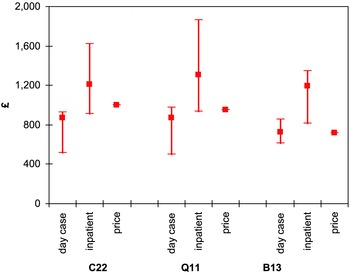
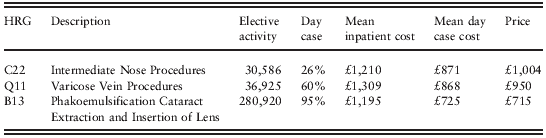
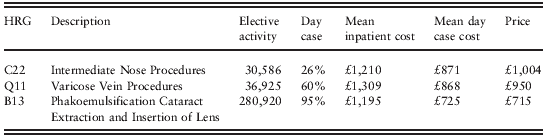
Figure 1 illustrates the relationship between costs and the national price based on activity and cost data for three HRGs as shown in Table 1. For each HRG, the national average and inter-quartile range in day case costs is shown as the first vertical line; inpatient costs are shown in the second vertical line. As the proportion of day case activity increases, the price covers less of the cost of inpatient treatment. This will encourage managers to persuade their clinicians to provide more care on a day case basis.
Costs and prices for three HRGs, 2005/06

Activity, costs and prices for three HRGs, 2005/06
Prices and costs
The second innovation is that England is unique in having mandated cost collection from all public hospitals (Schreyögg et al.). In other countries, cost information is drawn from either a `representative' sample of hospitals (e.g. Netherlands) or from hospitals with good accounting systems (e.g. Australia, Italy, Germany, and Spain) (Jackson, 2001; Schreyögg et al.).
But this wealth of English information is not well used in setting prices, which, by and large, reflect average cost. This is inconsistent with statements showing that there has been wide variation in hospital performance for decades (Department of Health and Social Security, 1976; Dredge, Reference Dredge2003; Department of Health, 2006a). Although the prices include an across-the-board adjustment for efficiency improvements, they encourage providers to become ‘average’ rather than to improve their performance more dramatically (Llewellyn and Northcott, Reference Llewellyn and Northcott2005). While high cost hospitals strive to be more efficient and reduce their costs, these gains may be offset by the low cost hospitals increasing capacity or making investments that fail to generate sufficient revenue to cover the cost of these investments.
In other countries prices do not reflect average costs, partly because sampling is limited to selected hospitals (Schreyögg et al.). But even then, sample average costs are rarely the basis of price setting (France being the exception). Rather a more challenging benchmark is established, so all hospitals have an incentive to improve their performance (Duckett, Reference Duckett2000).
Another feature of international policy is a deliberate separation between prices and the underlying cost information on which they are based. Instead of reporting price in monetary units, in Australia and Norway cost information is converted into a points system, whereby a benchmark treatment is assigned a score of (say) 100 points, with more points for more costly procedures (Jackson, Reference Jackson2001; Kjerstad, Reference Kjerstad2003; Schreyögg et al., Reference Schreyögg, Stargardt, Tiemann and Busse2006a). Policy makers then decide how much to pay per point and, if necessary, can adjust this monetary value periodically to control global expenditure (Kjerstad, Reference Kjerstad2003).
Tariffs and quality
There need not be a direct relationship between price and cost at all. Prices should reflect costs only if the current mix of services is appropriate, which is unlikely. By moving from cost based pricing, it is possible to provide enhanced incentives to undertake some types of activities, such as to prioritise patients on waiting lists or to prioritise treatments which have a greater impact on health status (Street and Duckett, Reference Street and Duckett1996). English policy makers are considering how to set prices that reflect best practice or quality improvements, but the basis for this has not yet been established (Department of Health, 2007b). Without a move away from cost based pricing, well-established inefficiencies and variations in performance will not be confronted.
One option is to adjust prices according to quality but this is not straightforward. If quality adjustments are treatment-specific, this will require that levels of ‘quality’ are determined and measured for each treatment. This might involve using patient reported outcome measures either to adjust prices or to allow PCTs to pay providers at less than tariff if the quality of patient care is poor (Department of Health, 2005b; Appleby and Devlin, Reference Appleby and Devlin2005).
Most components and drivers of quality are not treatment-specific but are related to process rather than outcomes. Quality payments can be made for meeting specialty- or hospital-level standards (Health and Community Services, 1994). In the US, the Centers for Medicare and Medicaid Services encourage participation in quality assurance programmes by reducing the price paid by 0.4% for all treatments provided in hospitals that fail to submit performance data on quality (Centers for Medicare and Medicaid Services, 2004). Similar incentives could be introduced in England, by building upon the assessments of quality undertaken by the Healthcare Commission (Healthcare Commission, 2007) or using performance information generated by the NHS Institute for Innovation and Improvement (Department of Health, 2006a).
Commissioning and cost control
In the past in England there was tight control of global expenditure with hard cash limits and managers being highly motivated by the risk of job loss to keep their organisations within budget. There are four main ways in which PbR policy has undermined this historical control.
First, PCTs may face a short-term cost hike as hospitals improve their counting and coding of activity to ensure that they are paid for what they do, facilitated by computer software that seeks to assign patients with multiple co-morbidities to HRGs that attract higher prices (Carter et al., Reference Carter, Newhouse and Relles1990, Hsia et al., Reference Hsia, Ahern, Ritchie, Moscoe and Krushat1992). This effect will not persist because such ‘upcoding’ will be incorporated into future revisions of the price. Second, hospitals may do more for patients once they are admitted so that they receive higher payments, which might be evidenced by an increase in consultant-to-consultant referrals or increased intervention rates.
Third, expenditure may increase in Accident and Emergency, for a combination of reasons, including the incentive to increase activity under PbR, the 4-hour waiting time target for assessment in A&E, and the relaxation of GPs’ out-of-hours obligations under their new contract (National Audit Office, 2006). To limit the financial consequences of these influences, a ‘two-part tariff’ has been introduced for emergency admissions. In 2007/8, hospitals are paid the full price for emergency admissions up to a threshold based on their activity in 2005/6. Hospitals receive only 50% of this price if their actual activity is above this threshold, on the assumption that this reflects the marginal cost of providing additional treatment beyond this threshold (Department of Health, 2006b).
Fourth, no threshold has been imposed for elective activity and hospitals can increase activity without prior approval from PCTs. PCTs have recognized the advantage of trying to keep people out of hospital, by encouraging GPs to limit their rates of referral or investing in alternatives to hospital care. But PCTs have few levers to influence GP referrals, the main hope being Practice Based Commissioning (PBC) under which GPs manage budgets for their patients. This requires that GPs work together to manage demand effectively (Mannion et al., Reference Mannion, Marini and Street2006). But the incentives and sanctions for GPs to live within their budgets may be too weak. The GP fundholding experience, which is similar to the PBC model, shows that GPs were able to generate savings from reduced admission to hospital care (Dusheiko et al., Reference Dusheiko, Gravelle, Jacobs and Smith2006), but these savings did not even cover the management allowance that practices received to manage the budget. The incentives under PBC may be diluted by other concurrent policies. For instance, GPs receive a payment of 96 pence for each patient they refer using the Choose and Book computer system and for delivering choice to patients (Department of Health, 2007a), which may encourage rather than dampen referrals.
Gradually PCTs are recognising the need to control potential expenditure inflation locally with more rigorous capacity planning that caps their liabilities. This is a complex task for which many PCTs lack skills and requires careful modelling of elective flows to meet waiting list targets and of emergency activity, which is highly unpredictable. Rather than developing a strategic response to an emerging problem, PCTs tend to be relying on adapting existing initiatives, such as providing GPs with better information about their referral practices, improving patient management in primary care, or investing in services like Walk in Centres that might substitute for hospital based care (Mannion et al., Reference Mannion, Marini and Street2006). While each of these has a role, evidence of their effectiveness in influencing activity and expenditure is limited (Mannion et al., Reference Mannion, Marini and Street2006).
Initially, then, the overall effect of these influences may be to attract even more patients into hospital and thwart Government attempts to shift resources to primary care, with the NHS becoming increasingly demand-driven (Clews, Reference Clews2006). This may be incompatible with the NHS's founding principle of ensuring access to care on the basis of need. Increases in local activity may exceed the local funding levels allocated to PCTs on the basis of the health needs of their populations. The dangers are that, without vigorous and effective capacity planning, PbR will both undermine expenditure control and distort needs-based funding unless the limited ability of PCTs to control demand is addressed (Department of Health, 2004).
Instead of placing all the onus on PCTs to control demand, an alternative is to moderate the incentives of the payment system itself. A well-designed example is that introduced in the Australian State of Victoria where PbR-type funding was introduced in the early 1990s, with the aims of stimulating activity, prioritising waiting list patients, and controlling aggregate expenditure (Duckett, Reference Duckett1994). This was achieved by paying each hospital a fixed unit price p 1 up to a pre-specified target level of activity, which was related to historical activity, and paying at a different price p 2 for activity beyond the target level. Importantly, the value of p 2 was not specified in advance. Rather, a separate budget was set aside to pay for extra activity across the hospital sector as a whole, so p 2 was determined by dividing the available budget by the total amount of extra activity that was provided. Waiting list patients were prioritised by making access to this budget conditional on whether or not each hospital had cleared its waiting list. If not, the hospital was not paid for additional activity.
PbR coverage and roll-out
The intention is that 90% of hospital care, including non-electives, outpatients, and accident and emergency, is funded on the basis of national tariff by 2007/08 (Department of Health, 2005a). It is also planned to extend PbR to mental health services, ambulances, community services, and long-term conditions. Such ambition is unique to England. Other countries have not rolled out these payment arrangements to the non-acute sector where it is difficult to describe patient care requirements and cost variations may be high. It is best to decide how to pay for non-acute care by first stating what payment is designed to achieve and then evaluating the funding options. The English are making the decision back-to-front by deciding to extend PbR and then trying to make the service fit into this payment model.
Even for acute services, there is a notable difference between English and international policy. When first announced the intention was that in England all commissioning arrangements in the NHS would be paid on the basis of the national tariff (Department of Health, 2002), albeit with compensatory payments for unavoidable costs that some hospitals have to pay for staff, land, and buildings, which are partly driven by differences across the country in local market conditions (Department of Health, 2007b). Only Germany – another recent convert to this payment system – has a stated political aim to reimburse hospitals solely on the basis of activity (Schreyögg et al., Reference Schreyögg, Tiemann and Busse2006b). In other countries, hospital income comprises a mixture of activity-related payments and block grants. For instance, PbR-type payments account for 30% of hospital income in Spain, between 20–50% in Denmark, 50% in Ireland and Portugal, and 70% in parts of Sweden (Wiley, Reference Wiley, Sussex and Street2004). These mixed funding arrangements allow for more evenly spread incentives for expenditure control between providers, which cannot easily change their spending in line with activity, and PCTs, which need to live within a budget (Ellis and McGuire, Reference Ellis and McGuire1986).
Conclusions
So how should international lessons inform English policy design? First, the relationship between price and average cost should be broken. Rewards should be based on best not average practice so as to stimulate efficient provision and purchasing of health services. In clinical trials relative cost-effectiveness is used to determine which of alternative treatments should be adopted. Tariffs could be adjusted in recognition that some treatments deliver superior health outcomes than others. This requires much more information about the health outcomes associated with routine NHS treatment, and there are signs that such information will be collected in future. For example, the Department of Health is collecting patient reported health outcome data for five surgical procedures performed in treatment centres and day surgery units, with a view to extending the exercise to other treatments (Department of Health, 2005b) and CHKS Ltd, a benchmarking organisation, is piloting two health outcome measures in four acute English trusts (CHKS Ltd, 2005).
Second, instead of being a passive ‘price taker’, the government should provide incentives to improve quality and to change the mix of service provision. At present the English are following the example of Medicare in the US, by simply converting cost information into prices. Despite the intention that the US prospective payment policy would reduce variations in hospital costs (Vaida, Reference Vaida1984), variations remain substantial (Fisher et al., Reference Fisher, Wennberg, Stukel, Gottlieb, Lucas and Pinder2003; Fisher, Reference Fisher2003). If the task of setting tariffs is reduced to a technical exercise, perhaps undertaken by an independent body, there would have been little point introducing PbR in the first place. Instead, the English should be more adventurous and use PbR to signal what activities are most desirable and to reward the NHS and independent sector for achieving them. Without this, inefficient practice, epitomised by clinical practice variations and a failure to exploit the potential of day surgery, will continue to waste scarce resources.
Third, better expenditure control is required. Although PbR is designed to stimulate activity growth, increases need to be affordable and appropriate. PCTs have limited ability to counteract the incentives hospitals have to increase activity or to control consultant-to-consultant and GP referrals. Expenditure control needs to be exercised at both local and national levels, and this implies controlling demand and careful management of capacity with providers and refinement of prices and the payment system. The Victorian model is worth emulating to stimulate activity within a fixed budget.
Finally, continual refinement of the payment system is not a sign of political weakness but of economic necessity. It is indicative of prudent economic appraisal of international and emerging national evidence, derived from careful definition of what behaviours are desired and determination of the appropriate incentive structure to deliver them. Policy should be driven by explicit formulation and ranking of objectives not by straightforward transfer of a technique that might work well in the acute setting but need not in another. The English are slowly adopting some of the lessons from elsewhere, but there is still much to be learned if PbR is to be effective in advancing the objectives and performance of the NHS.