INTRODUCTION
Phylogenetic approaches can provide unprecedented insights into the patterns of species relatedness, as well as on the biological processes generating molecular divergence among species, by incorporating models of genetic processes into the phylogenetic estimation procedure. For example, phylogenetic estimates have been improved by what is now the routine use of nucleotide models of molecular evolution in phylogenetic methods (Felsenstein, Reference Felsenstein2004). Likewise phylogenetic procedures that incorporate models of other biological processes underlying patterns of molecular divergence among species – species tree approaches (Knowles and Kubatko, Reference Knowles, Kubatko, Knowles and Kubatko2010) – also can significantly improve phylogenetic estimates.
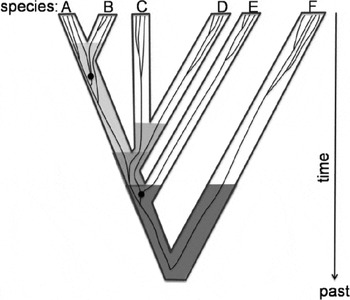
Notable among the insights that species tree approaches offer is the phylogenetic resolution of some notoriously difficult scenarios for historical reconstruction (Maddison and Knowles, Reference Maddison and Knowles2006; Carstens and Knowles, Reference Carstens and Knowles2007; Brumfield et al. Reference Brumfield, Liu, Lum and Edwards2008; Kubatko and Gibbs, Reference Kubatko, Gibbs, Knowles and Kubatko2010). This includes cases involving recently diverged species (e.g. species A and B in Fig. 1), as well as cases of rapid speciation (e.g. the short internal branches in the species tree separating species E from the ancestor that gave rise to the sister taxa C and D in Fig. 1). Under such situations gene tree discord is expected (Takahata, Reference Takahata1989; Maddison, Reference Maddison1997) and species relationships may be obscured by the deep coalescence (i.e. the failure of gene lineages to coalesce within a species lineage before subsequent speciation events; see Fig. 1). Likewise, when the discord among gene trees is not taken into account when estimating a phylogeny, the general reliability of the inference becomes questionable (Kubatko and Degnan, Reference Kubatko and Degnan2007; Degnan and Rosenberg, Reference Degnan and Rosenberg2009; Huang and Knowles, Reference Huang and Knowles2009) and the interpretation of support for particular relationships becomes problematic (Mossel and Vigoda, Reference Mossel and Vigoda2005; Cranston et al. Reference Cranston, Hurwitz, Ware, Stein and Wing2009). Lastly, accurate phylogenies can be estimated with fewer loci with a species tree approach relative to the failure to incorporate an appropriate model (e.g. by concatenating data despite differences in the gene trees of independent loci). This means that investigations into the amount of data required for accurate phylogenetic estimates have been overestimated and reflect the problems associated with concatenating data-sets, as opposed to an inherent property of estimating species relationships per se (see Maddison and Knowles, Reference Maddison and Knowles2006; Liu and Pearl, Reference Liu and Pearl2007).
Species tree with contained gene tree showing the deep coalescence of gene lineages (marked with circles). Incongruence between a gene tree and the underlying species tree may occur in not only recently derived species, but also can extend back in time along the internal species-tree branches (i.e. those shown in shades of grey). The deep coalescence of gene lineages in the more distant past (i.e. the short internal branches in the species tree separating species E from the ancestor that gave rise to the sister taxa C and D) arises from the random loss of gene lineages by genetic drift of the two or more gene lineages that coexisted in the past, even though multiple ancestral gene lineages no longer persist in species C, D and E because they did not diverge recently. In other words, even in monophyletic species (e.g. species C, D and E), deep coalescence in the past leads to gene tree-species tree discord in the present (from Knowles, Reference Knowles2009).

Despite the relative recency of species tree approaches (i.e. Maddison and Knowles, Reference Maddison and Knowles2006), there has been a proliferation of methods (reviewed in Degnan and Rosenberg, Reference Degnan and Rosenberg2009; Liu et al. Reference Liu, Yu, Kubatko, Pearl and Edwards2009; Knowles and Kubatko, Reference Knowles, Kubatko, Knowles and Kubatko2010). While much of the research on obtaining direct estimates of species trees has been driven by computational developments, these methodological changes do not represent the inception of new core phylogenetic concepts. In spite of the fact that estimating species trees involves a fundamental shift in how molecular data are used and interpreted, the target is still the phylogeny. The estimation of a species tree puts the focus on the object of systematic interest – species relationships.
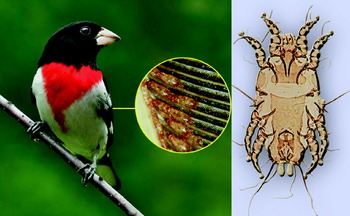
Here we estimate a species tree for a group of very diverse feather mites – the pinnatus species group (genus Proctophyllodes) (see Fig. 2). Species of the genus Proctophyllodes are common, worldwide-distributed ectosymbionts of passeriform birds (rarely others) that inhabit the underside of wing and tail flight feathers at all developmental stages (Atyeo and Braasch, Reference Atyeo and Braasch1966). The mites feed on uropygial gland secretions and other material trapped in this oil (e.g. aging feather fragments, sloughed cells from the skin), but do not appear to cause damage to the bird feathers or skin (Atyeo and Braasch, Reference Atyeo and Braasch1966; Blanco et al. Reference Blanco, Seoane and de la Puente1999; Hartup et al. Reference Hartup, Stott-Messick, Guzy and Ley2004).
Rose-breasted grosbeak, Pheucticus ludovicianus (left), the host of the mite Proctophyllodes pheuctici (right) showing the typical location of mites on the wing primary feathers. The bird photo was downloaded from http://pixdaus.com (public domain); the photos of the mites are from Barry OConnor (UMMZ vouchers BMOC 08-0320-003 and BMOC 07-0626-001; reproduced with permission).

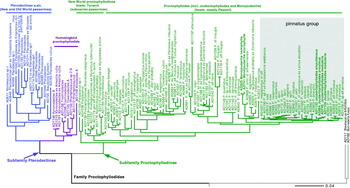
We focus on the pinnatus-group of feather mites, with 35 described species, because of several aspects of the history of diversification. Preliminary phylogenetic analyses reveal that the taxa in the pinnatus-group of feather mites are characterized by relatively short internodes compared to the other described species of Proctophyllodes (Fig. 3). Secondly, the pinnatus-group has a large number of constituent species (i.e. it is among the most diverse group of the ten species groups in the genus Proctophyllodes) (Atyeo and Braasch, Reference Atyeo and Braasch1966; Badek et al. Reference Badek, Dabert, Mironov and Dabert2008), which means that the speciation rate is higher compared to other groups of similar age. Such historical scenarios – the formation of many species over a relatively short period of time – are expected to be characterized by widespread discord among gene trees (reviewed in Knowles and Kubatko, Reference Knowles, Kubatko, Knowles and Kubatko2010). As such, the pinnatus-group of feather mites is an ideal group to analyze using species-tree approaches that model the discord among loci, rather than ignore it (as with analyses of concatenated data).
Schematic showing the phylogenetic position of the Proctophyllodes pinnatus-group within the subfamily of the Proctophyllodinae (based on analyses of 18S, 28S, EF1-α, SRP54, and HSP70; Klimov and OConnor, unpublished). Note the relatively short internodes separating species within the pinnatus species group that suggests species-tree methods are particularly relevant to resolving phylogenetic relationships because of expected gene tree discord (reviewed in Knowles and Kubatko, Reference Knowles, Kubatko, Knowles and Kubatko2010).

MATERIALS AND METHODS
Taxon Sampling
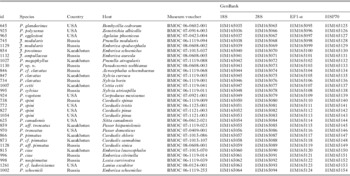
A total of 21 species (of the 35 described species from the pinnatus-species group, genus Proctophyllodes) and 3 outgroup species were sequenced in this study (Table 1). Of these, 21 ingroup species, 27 individuals collected from 26 bird hosts were sequenced such that the study also included samples across hosts for a given species (Table 1). Genomic DNA was extracted according to previously described protocols (Klimov and OConnor, Reference Klimov and OConnor2008).
Taxonomic sampling and GenBank reference numbers of the Proctophyllodes pinnatus-group and outgroups

P. – Proctophyllodes; J. – Joubertophyllodes (=Proctophyllodes, synonymy not yet published); Proctophyllodes glandarinus, P. polyxenus, and P. egglestoni are outgroups. The following multiple samples from specific species were included in the study: 745, 1129 (J. modularis); 847, 734 (P. clavatus); 738, 772, 827, 1054 (P. spini); 815, 996 (P. ciae).
Sequence Data
Four nuclear genes: the ribosomal loci 18S (1767 nt aligned) and 28S (3677 nt), and the protein-coding loci elongation-factor 1α, EF1-α (1215 nt), and heat-shock protein-70, HSP70-5 (1713 nt) were sequenced. Alignments of the ribosomal loci conformed with alignments of a large mite data-set (based on 543 sequences of mites; data not published) using as reference the secondary structures of Apis mellifera (Gillespie et al. Reference Gillespie, Johnston, Cannone and Gutell2006) and Saccharomyces cerevisiae available from the Comparative RNA Web site (Cannone et al. Reference Cannone, Subramanian, Schnare, Collett, D'Souza, Du, Feng, Lin, Madabusi, Muller, Pande, Shang, Yu and Gutell2002). Individual sequences, especially hairpin-stem loops, were further evaluated in the program mfold v.3.1, which folds rRNA based on free energy minimization (Mathews et al. Reference Mathews, Sabina, Zuker and Turner1999; Zuker, Reference Zuker2003), using the default settings. Although alignments of exons of protein-coding genes were unambiguous (i.e. they did not contain gaps), a few regions containing introns were excluded from the phylogenetic analyses to avoid errors associated with possible mis-assignment of homology arising from gaps in the sequences. A total of 7982 nt were analyzed (18S: 1722 nt; 28S: 3485 nt; EF1-α: 1077 nt; HSP70: 1698 nt). Primer sequences and PCR protocols are given in Supplement 1 (The online supplementary material can be viewed at http://journals.cambridge.org/par). All sequences were deposited in GenBank (Accession Nos. HM165035 through HM165154) (Table 1).
Phylogenetic analyses
Best-fit models of nucleotide substitution were identified for each locus using Akaike information criterion values in the program Modeltest (Posada and Buckley, Reference Posada and Buckley2004) and used in the Bayesian estimates of species trees and gene trees.
Species and gene trees were estimated in *BEAST v.1.5.4 (Drummond and Rambaut, Reference Drummond and Rambaut2007). The program *BEAST (Heled and Drummond, Reference Heled and Drummond2010) was used, as opposed to BEST (see Liu et al. Reference Liu, Yu, Kubatko, Pearl and Edwards2009), because of computational differences that make *BEAST more efficient (for details, see Heled and Drummond, Reference Heled and Drummond2010). These programs do not accommodate recombination. Recombination could potentially reduce the support for species relationships by introducing additional uncertainty in the estimated gene trees (note that all phylogenetic methods for estimating gene trees would be similarly affected by violating the assumption of no recombination).
Several short exploratory runs were conducted in *BEAST to fine-tune the parameter-specific settings for MCMC search. The species tree was estimated from two separate MCMC analyses which were run for 2×10⁸ generations with parameters sampled every 1000 steps (discarding a burn-in of 1·2×105 generations). Independent runs were combined using the program LogCombiner v.1.4.6 (Drummond and Rambaut, Reference Drummond and Rambaut2007). The program Tracer v1.5 (Rambaut and Drummond, Reference Rambaut and Drummond2009) was then used to determine if individual chains mixed well and the analyses had converged by graphing the trace plots of multiple MCMC chains started from random starting positions. Effective sample size of each parameter exceeded 200, except for the 28S alpha parameter where it was fluctuating at around 140. For each independent run, posterior probabilities for each node were compared to further ensure convergence. Tree topologies were visualized using the programs TreeAnnotator v.1.5.4 (Drummond and Rambaut, Reference Drummond and Rambaut2007) and FigTree v1.3.1 (Rambaut, Reference Rambaut2009).
RESULTS
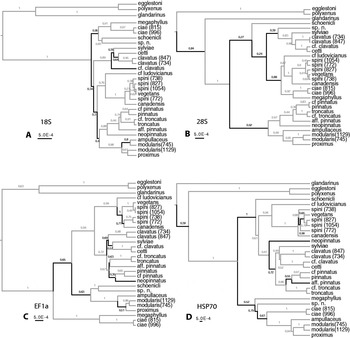
Estimates of the gene trees for the four nuclear loci (Fig. 4) show that among the 21 species in the pinnatus-group of feather mites there is considerable discord across the gene trees. Much of the discord is concentrated among the short branches separating the deeper divergence events as opposed to those separating the terminal branches. The relationships among sister taxa/clades are generally consistent across the individual gene trees. The primary exception occurs with the taxa: P. neopinnatus, P. cf clavatus, and P. aff. pinnatus.
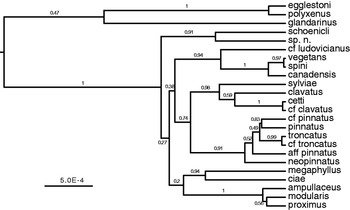
Many of the branches are resolved in the Bayesian estimate of the species tree with relatively strong support (Fig. 5). This includes cases where a clade has relatively strong support in the species tree, even though within any of the individual gene trees (except for the 28S gene tree; Fig. 4) the support is very low (e.g. the clade of P. cf. ludovicianus, P. canadensis, P. spini, and P. vegetans). However, the deeper nodes remain ambiguous.
Estimated gene trees for the nuclear loci: (A) 18S, (B) 28S, (C) EF1-α, and (D) HSP70. Branches that are not congruent with the species tree are shown in black, whereas congruent branches across the independent loci are shown in grey. Posterior probabilities are shown for each node.

Bayesian estimate of the species tree for the Proctophyllodes pinnatus-group with posterior probability values for species relationships shown.

Despite the low support among the some of earliest splits within the pinnatus-group of feather mites, there are some interesting relationships that are hypothesized. For example, the species tree places the 5 taxa, P. megaphyllus, P. ciae, P. ampullaceus, P. modularis, and P. proximus, in a clade. Yet in the individual gene trees, these taxa occur in different clades, and in some cases distantly related clades (e.g. the gene trees of 28S and 18S, Fig. 4). Consideration of certain morphological apomorphies pertaining to the male genitalia in the pinnatus-group (Atyeo and Braasch, Reference Atyeo and Braasch1966; Badek et al. Reference Badek, Dabert, Mironov and Dabert2008), revealed that they are also shared with P. megaphyllus, P. ciae, P. ampullaceus thus justifying the placement of these three taxa in the pinnatus-group rather than previous assignment to a separate genus, Joubertophyllodes.
DISCUSSION
Confronted with the question of how to analyze data when gene trees estimated from independent loci often differ, the increased availability of multi-locus data (ironically) leaves empiricists in a state of limbo as the awareness and popularity of species-tree approaches grows (e.g. Carstens and Knowles, Reference Carstens and Knowles2007; Edwards et al. Reference Edwards, Liu and Pearl2007; Belfiore et al. Reference Belfiore, Liu and Moritz2008; Brumfield et al. Reference Brumfield, Liu, Lum and Edwards2008; Joly et al. Reference Joly, McLenachan and Lockhart2009; Kubatko and Gibbs, Reference Kubatko, Gibbs, Knowles and Kubatko2010; Linnen, Reference Linnen, Knowles and Kubatko2010; McCormack et al. Reference McCormack, Heled, Delaney, Peterson and Knowles2011; Oneal et al. Reference Oneal, Otte and Knowles2010). Species-tree approaches clearly can provide a powerful framework for estimating phylogenetic relationships (reviewed in Knowles, Reference Knowles2009; Liu et al. Reference Liu, Yu, Kubatko, Pearl and Edwards2009; Knowles and Kubatko, Reference Knowles, Kubatko, Knowles and Kubatko2010). Moreover, by incorporating a model of the coalescent process (along with a model of the nucleotide substitution process), these new methods can provide accurate phylogenetic estimates despite widespread incomplete lineage sorting and discordance among the gene trees from independent loci (Maddison and Knowles, Reference Maddison and Knowles2006; Eckert and Carstens, Reference Eckert and Carstens2008; McCormack et al. Reference McCormack, Huang and Knowles2009; Mossel and Roch, Reference Mossel and Roch2010). However, the species relationships may not all be resolved simply by applying a species tree approach, as in the case of the pinnatus-group of feather mites considered here (Fig. 5). Does this mean that we should forego species tree approaches and opt for the simpler approach of concatenating the data from discordant loci (i.e. combining the sequences across loci into a single nucleotide matrix for analysis)?
There are actually a number of reasons not to concatenate the data. First, concatenation itself will not necessarily lead to better-resolved species relationships. When data are concatenated across independent loci with differing gene trees, there is no way to know whether the estimated tree matches the underlying species tree (Maddison, Reference Maddison1997; Maddison and Knowles, Reference Maddison and Knowles2006). The addition of nucleotide sequences to concatenated data may actually be positively misleading (i.e. the estimated tree will not match the true species tree even with the addition of concatenated data – Kubatko and Degnan, Reference Kubatko and Degnan2007), and higher support for such trees may simply be an artifact of constraining the data to fit a single tree when in reality there is a mixture of trees (see Mossel and Vigoda, Reference Mossel and Vigoda2005; Cranston et al. Reference Cranston, Hurwitz, Ware, Stein and Wing2009).
The species tree estimated for the pinnatus-group of feather mites could definitely be improved upon. Among the well-resolved nodes within clades is ambiguity among the relationships of the clades (Fig. 5). Although less than ideal, there are several noteworthy aspects about the resolved nodes, as well as the unresolved nodes (which are discussed in further detail below). First, without the species-tree analysis, it is not possible to infer clades within the diverse species group based on estimates of the individual gene trees. Not only do the hypothesized clades differ across loci, but the constituent members of putative clades also varies among the gene trees. For example, consider the clade identified in the species tree comprised of the species P. megaphyllus, P. ciae, P. ampullaceus, P. modularis, and P. proximus. This clade is not consistently identified in the individual gene trees. Yet, this clade estimated in the species tree is corroborated by a morphological character shared with (and unique to) the species in the pinnatus-group – shared derived genitalic characters in the males. This phylogenetic estimate suggests that other characters associated with mating in this clade of taxa (i.e. the enlargement of posterior legs in males) that had been used to place P. ampullaceus, P. modularis, and P. proximus in a different genus, Joubertophyllodes, is an example of rapid morphological evolution of characters misinterpreted under a traditional taxonomic paradigm as evidence of clade distinct from the pinnatus-group. The species-tree estimate based on the molecular data highlights an alternative set of morphological characters which is diagnostic to the pinnatus-group (including “Joubertophyllodes”), proposing a classification of these mites based on their phylogenetic affinities rather than on a divergent, but admittedly arbitrary, character. Second, the species tree has fairly strong support for many of the relationships (see below for a discussion of the nodes without strong support). Notwithstanding the theoretical problems associated with concatenating data across discordant gene trees discussed above, from an empirical perspective, the phylogenetic relationships estimated in the species tree (Fig. 5) are a step forward in trying to resolve the enigmatic phylogeny of this diverse group of feather mites and clearly demonstrated the need to revise the current taxonomic classification to include Joubertophyllodes into the pinnatus-group of the genus Proctophyllodes.
What underlies the poor resolution among some branches in the species tree?
The unresolved branches in the species tree could reflect characteristics of the history of diversification itself, aspects of the data-set used to estimate the phylogeny, or an interaction of these two properties. We discuss the likelihood of each of these in detail and what each would imply about possible strategies to improve the phylogenetic estimate.
Phylogenetic estimation is difficult because of the diversification history
The history of diversification itself might be particularly difficult if the rate of speciation in the pinnatus-group of feather mites is high (i.e. if the group has undergone rapid diversification). This is suggested by the large number of taxa (i.e. it is among the most diverse species groups in the genus Proctophyllodes – Badek et al. Reference Badek, Dabert, Mironov and Dabert2008). Relative to other clades in the genus, the internodes separating the species also appear to be short (Fig. 3) (although aspects of the mutational processes can not be ruled out as discussed below). These patterns suggest the history of diversification itself in the pinnatus-group might contribute to the poor phylogenetic resolution. This is because with rapid diversification there is insufficient time for the sorting of ancestral gene lineages (i.e. the fixation of a gene lineage within a species lineage by genetic drift) before subsequent speciation events, which gives rise to widespread discord across the gene trees of independent loci (Maddison, Reference Maddison1997; Degnan and Rosenberg, Reference Degnan and Rosenberg2009; Knowles, Reference Knowles2009).
Simulation studies show that, all else being equal (i.e. similar levels of molecular divergence across species for a given number of taxa), diversification histories characterized by more gene tree discord will require sequence data from more independent loci to obtain accurate phylogenetic estimates (e.g. Maddison and Knowles, Reference Maddison and Knowles2006; Knowles and Chan, Reference Knowles and Chan2008; McCormack et al. Reference McCormack, Huang and Knowles2009). Consequently, one possible solution to resolving the enigmatic relationships within the pinnatus-group of feather mites is to simply collect more data.
What type of data to collect is actually more nuanced than the choices when simply concatenating data and will depend very much on the history of diversification. For example, for very recently diverged taxa, collecting sequence data from more individuals can actually increase the accuracy of species tree estimates (Maddison and Knowles, Reference Maddison and Knowles2006; McCormack et al. Reference McCormack, Huang and Knowles2009). However, if the species exhibit reciprocally monophyletic gene trees, there is no additional phylogenetic genetic information contained in the sequences of multiple individuals. Instead, increasing the number of loci sampled will improve phylogenetic accuracy. Note that if a preponderance of deep coalescence (Fig. 1) has generated gene tree discord among loci, the key is to collect data from more loci, not simply more base-pairs for the sampled loci included in the study. This is because with histories characterized by widespread gene tree discord, only with the sampling of additional loci can the relative probabilities of different gene trees become apparent, and thereby provide the relevant information for distinguishing among alternative species trees (Maddison and Knowles, Reference Maddison and Knowles2006). For example, different gene trees (i.e. different topologies) might be possible under different species trees. However, the relative probabilities of the gene trees (and hence the frequency that a certain topology is observed across loci) will differ across alternative species trees (Degnan and Salter, Reference Degnan and Salter2005). In other words, because the species tree itself specifies the probability of observing different gene trees (Takahata, Reference Takahata1989; Degnan and Salter, Reference Degnan and Salter2005), the distribution of observed gene trees contains information about the actual phylogenetic history (i.e. the underlying species tree).
Aspects of the collected data make phylogenetic estimation difficult
In addition to the contribution of deep coalescence to gene tree discord (Fig. 1), aspects of the data may make phylogenetic estimation difficult. Limited amounts of sequence variation could lead to poorly resolved gene trees. Likewise, the estimated gene trees may be compromised by errors in their estimation. With regards to the unresolved branches in the estimated species tree for the feather mites, these explanations seem generally unlikely. First, many of the nodes in the species tree do indeed have strong support (Fig. 5). This includes branches separating recently derived species. If limited sequence variation was causing problems, it is exactly in the cases of recent speciation events where there has not been sufficient time to accumulate mutations that one would expect to see poor resolution of species relationships. However, this is not the case in the estimated species tree of the pinnatus-group. This argues against errors in the estimation of the gene trees as a general explanation for the unresolved nodes in the estimated species tree for the pinnatus-group. Moreover, the Bayesian approach used to estimate the species tree in our study also accounts for uncertainty in the estimated gene trees.
Even if gene trees are estimated accurately, the estimated gene tree may not actually match the underlying genealogical history of loci. What is observed in empirical data-sets are estimated gene trees – that is, the product of the underlying genealogical history of gene lineages and the mutational process that provides the information for estimating that genealogical history. This mutational variance can cause difficulties with obtaining accurate estimates of species trees (see Huang and Knowles, Reference Huang and Knowles2009; Huang et al. Reference Huang, He, Kubatko and Knowles2010) because the probabilities provided by the coalescent models used in species tree approaches are based on the unobservable quantity – the actual underlying gene genealogy – rather than the data input of these methods – the estimated gene tree. This leaves open the possibility that a difference between the underlying gene genealogy and the estimated gene tree might affect the accuracy of species tree estimates (Huang et al. Reference Huang, He, Kubatko and Knowles2010). As with the nuanced effects of sampling design on the accuracy of species tree estimates (e.g. McCormack et al. Reference McCormack, Huang and Knowles2009), the relative contribution of mutational variance versus coalescent variance (i.e. the discord across loci caused by the deep coalescence of gene lineages; Fig. 1) differs depending on the underlying history of species diversification, the sampling design and the total sampling effort (Huang and Knowles, Reference Huang and Knowles2009; Huang et al. Reference Huang, He, Kubatko and Knowles2010). Although increasing the number of loci will increase the accuracy of species tree estimates (Knowles, Reference Knowles, Knowles and Kubatko2010), there is also a greater contribution of mutational variance (i.e. the mismatch between the estimated gene tree and the underlying gene genealogy) relative to coalescent variance (i.e. gene tree discord caused by the deep coalescence of gene lineages) with increased sampling of loci. One possible (but as yet unexplored) solution would be to identify loci with higher rates of evolution. This would in principle increase the probability that branches in the genealogy experience mutations, so it is less likely the estimated gene tree would differ from the underlying gene genealogy.
CONCLUSIONS
There are many theoretical reasons that species tree approaches should increase the accuracy of phylogenetic estimates. The benefits of adopting a species tree approach, as exemplified in this study, can also be realized in practice. Many of the clades within the diverse pinnatus-group of feather mites in the estimated species tree are well supported, despite the discord in the constituent gene trees across loci (i.e. comparing Fig. 4 and 5). The lack of resolution among some of the branches in this empirical study (most notably among the short internodes separating the clades) is consistent with the expected phylogenetic difficulties when species have diversified rapidly. Luckily, species tree approaches not only provide a means for estimating such recalcitrant phylogenies, but simulation studies offer helpful guides for making decisions about how to effectively deal with such difficult historical scenarios. Given that interactions between host and parasite can accelerate speciation rates, species tree approaches should be especially useful for estimating the phylogenetic histories of such groups.
ACKNOWLEDGEMENTS
We thank Dr. S. Mironov (Zoological Institute, Russian Academy of Sciences, Saint Petersburg) for taxonomic discussion and Barry OConnor for sharing his photo of mites of the pinnatus-group. This work was supported by grants from the National Science Foundation (DEB-0918218 to L. Lacey Knowles and DEB-0613769 to Barry OConnor) and the Russian Ministry of Education and Science (02.740.11.5139) to Pavel B. Klimov. The molecular work of this study was conducted in the Genomic Diversity Laboratory of the University of Michigan Museum of Zoology.