Introduction
Depressive disorders constitute a major global health problem (World Health Organization, 2001; Lopez et al., Reference Lopez, Mathers, Ezzati, Jamison and Murray2006). Psychosocial treatments are as effective as medication (National Institute for Health and Clinical Excellence, 2009; Spielmans et al., Reference Spielmans, Berman and Usitalo2011; Cuijpers et al., Reference Cuijpers, Berking, Andersson, Quigley, Kleiboer and Dobson2013) and are often preferred by patients (Zimmerman et al., Reference Zimmerman, McGlinchey, Posternak, Friedman, Boerescu and Attiullah2008; McHugh et al., Reference McHugh, Whitton, Peckham, Welge and Otto2013; Hanson et al., Reference Hanson, Webb, Sheeran and Turpin2016). Cognitive-behavioural therapy (CBT) has a large evidence base, including data on cost-effectiveness (Cuijpers et al., Reference Cuijpers, Berking, Andersson, Quigley, Kleiboer and Dobson2013; The Community Mental Health Team, 2016). Interpersonal psychotherapy (IPT), a brief psychotherapy addressing interpersonal problems of individuals with depression, has a smaller evidence base (Lemmens et al., Reference Lemmens, Arntz, Peeters, Hollon, Roefs and Huibers2015). Longer-term recovery is not guaranteed even by CBT or IPT (the ‘best’ evidence-based treatments) (Hollon et al., Reference Hollon, Stewart and Strunk2006; Karyotaki et al., Reference Karyotaki, Smit, de Beurs, Henningsen, Robays, Huibers, Weitz and Cuijpers2016; The Community Mental Health Team, 2016). Choice of therapy is important because no single modality has been firmly established as superior (Cuijpers et al., Reference Cuijpers, van Straten, Andersson and van Oppen2008, Reference Cuijpers, Geraedts, van Oppen, Andersson, Markowitz and van Straten2011, Reference Cuijpers, Berking, Andersson, Quigley, Kleiboer and Dobson2013, Reference Cuijpers, Koole, van Dijke, Roca, Li and Reynolds2014).
Several randomized controlled trials (RCTs) have examined the effectiveness of psychodynamic psychotherapy for depression. Evidence for its efficacy is accumulating (Fonagy, Reference Fonagy2015; Leichsenring et al., Reference Leichsenring, Luyten, Hilsenroth, Abbass, Barber, Keefe, Leweke, Rabung and Steinert2015). Meta-analytic findings reveal large pre–post treatment effects, with results maintained at long-term follow-up (Driessen et al., Reference Driessen, Cuijpers, de Maat, Abbass, de Jonghe and Dekker2010, Reference Driessen, Hegelmaier, Abbass, Barber, Dekker, Van, Jansma and Cuijpers2015; Abbass et al., Reference Abbass, Kisely, Town, Leichsenring, Driessen, De Maat, Gerber, Dekker, Rabung, Rusalovska and Crowe2014). Psychodynamic psychotherapy has been shown to be non-inferior to other active treatments, including cognitive therapy (Driessen et al., Reference Driessen, Hegelmaier, Abbass, Barber, Dekker, Van, Jansma and Cuijpers2015; Connolly Gibbons et al., Reference Connolly Gibbons, Gallop, Thompson, Luther, Crits-Christoph, Jacobs, Yin and Crits-Christoph2016; Steinert et al., Reference Steinert, Munder, Rabung, Hoyer and Leichsenring2017). The National Institute for Health and Care Excellence (NICE) (2017) identifies short-term psychodynamic psychotherapy (STPP) as an option for people who have declined CBT and IPT, but there are several implementations.
Some UK providers have adopted Dynamic Interpersonal Therapy (DIT; Lemma et al., Reference Lemma, Target and Fonagy2010, Reference Lemma, Target and Fonagy2011) as a ‘prototype’ of STPP. DIT's structured framework enables therapists without extensive training in psychodynamic psychotherapy to practise. DIT is a time-limited 16-session treatment that formulates the presenting symptoms of depression as responses to interpersonal difficulties or perceived threats to attachments. It is therefore particularly well suited to implementation in a primary-care, community-based context.
The Improving Access to Psychological Therapies (IAPT) programme in England is an internationally unique implementation of evidence-based psychological therapies for common mental disorders in the community (Clark et al., Reference Clark, Canvin, Green, Layard, Pilling and Janecka2018). It provides a number of evidence-based treatments for depressive disorders [the most common problem for which psychological therapy is offered (Perfect et al., Reference Perfect, Jackson, Pybis and Hill2016)]. In line with guidelines from NICE (2017), CBT is currently offered to most patients presenting with depression in IAPT services; DIT is offered in relatively few services. IAPT is committed to improving access to and widening the choice of psychological therapies (Guy et al., Reference Guy, Loewenthal, Thomas and Stephenson2012). Therefore, evidence for the effectiveness of alternative treatments is crucial. DIT's effectiveness as a STPP for patients with depression within community services has not yet been established. The REDIT (Randomized Evaluation of Dynamic Interpersonal Therapy) study aimed to (i) evaluate DIT's effectiveness for moderate to severe depression in adults within IAPT, comparing the outcomes associated with DIT with a low-intensity treatment (LIT) condition, and (ii) evaluate the feasibility of comparing the treatment of adult depression with DIT and CBT within IAPT services.
Method
Trial design
The trial was conducted within IAPT services, which are based on a stepped-care model, where patients recognized as depressed in primary care or hospital settings (Step 1) are offered triage or low-intensity (Step 2) or high-intensity (Step 3) treatment, depending on clinical need. Triage followed the IAPT protocol and focused on evaluating severity and suicide/self-harm risk. Low-intensity treatment (LIT), delivered by a Psychological Wellbeing Practitioner (PWP), involves guided self-help. High-intensity treatment typically involves face-to-face treatment, such as CBT, with an accredited therapist. Participants were recruited from four sites: two for the DIT v. LIT comparison, and two separate sites for the DIT v. CBT comparison. Participants in the LIT condition who had not recovered were offered high-intensity therapy after completing 4–6 months of guided self-help treatment. In parallel, at two IAPT sites, patients were randomized to either DIT or CBT. The trial was granted ethical approval by NHS Research Ethics Committees and was registered with the ISRCTRN Registry (ISTCRN38209986; ISTCRN06629587).
Sample size calculation
Recruitment was powered for a superiority trial of DIT v. LIT. An a priori power analysis suggested that a sample size of 54 (27 in each group) was required to detect a mean difference of 5 (s.d. = 5.62) on the Hamilton Rating Scale for Depression (HRSD-17) at 90% power and a 5% Type I error rate. The study was thus well powered to detect superiority in the DIT v. LIT comparison (n DIT = 48 and n LIT = 31 at 6 months). There was no intention to incorporate a CBT v. LIT comparison (n CBT = 15 at 6 months) because the CBT arm was included only to assess the feasibility of comparing DIT and CBTFootnote †, Footnote 1. We report on results obtained from CBT without comment other than in relation to the acceptability, attrition, and timing of assessments for the sake of comprehensiveness.
Participants
Recruitment took place from November 2012 to January 2015. Patients consecutively referred to four metropolitan IAPT sites, aged 18 and above, who met DSM-IV criteria for a major depressive episode (American Psychiatric Association, 1994) as established by research staff using the MINI Plus 6.0 interview (Sheehan et al., Reference Sheehan, Lecrubier, Sheehan, Amorim, Janavs, Weiller, Hergueta, Baker and Dunbar1998), scored >14 on the HRSD-17 and >10 on the Patient Health Questionnaire (PHQ-9) (Kroenke et al., Reference Kroenke, Spitzer and Williams2001), and were identified as likely to require high-intensity treatment after triage, were approached to participate. As in most instances there would be a significant delay in implementing high-intensity treatments, the referral to a low-intensity treatment with the offer of high-intensity treatment to follow if required was considered ethically acceptable. Exclusion criteria were current psychotic symptoms or bipolar disorder, clinical contraindications for short-term psychotherapy including current use of antipsychotic medication, historical clinical diagnosis of Axis II disorder, historical or current repeated non-suicidal self-injury, disclosure of current suicidal intent and plans, historical or current eating disorder, and historical or current substance abuse. Furthermore, non-English speakers, those who had participated in another clinical trial within the past year in which they had received CBT or STPP for depression, those who had had previous unsuccessful CBT, and those with highly unstable or insecure life arrangements were excluded from the trial. Figure 1 shows recruitment to the trial.
CONSORT diagram.

Assessments
Clinicians at recruiting IAPT sites referred suitable patients to the trial team. Referred patients were given a baseline assessment by a research assistant to assess eligibility. This included structured clinical interviews and self-report measures. Participants were followed up mid-treatment (3 months; approximately 90 days) and after the end of treatment (6 months; approximately 180 days). Those in the DIT arm were followed up on average 12 months (approximately 360 days) post-randomization to establish whether treatment gains were maintained.
Randomization
Participant randomization was undertaken by an administrator independent of the trial, based at a different location from the research team and blind to the hypotheses or trial conditions. Following the completion of a baseline assessment by the research team, minimization criteria (including sex, severity of depression and age) were e-mailed with the request for randomization. Depending on the site at which they were recruited, participants were randomized to either the DIT or LIT condition, or the DIT or CBT condition, using a minimization algorithm with an 80% bias to minimize imbalance in a ratio of 3:2:1 for the three treatment groups.
Interventions
Dynamic interpersonal therapy
DIT is a brief dynamically oriented intervention informed by attachment and mentalization theory (Lemma et al., Reference Lemma, Target and Fonagy2010, Reference Lemma, Target and Fonagy2011; Luyten and Blatt, Reference Luyten and Blatt2012) which owes much to conceptualizations of dynamic therapy advanced by Luborsky and Crits-Christoph (Reference Luborsky and Crits-Christoph1998) and Kernberg (Reference Kernberg1988). It views symptoms of depression and anxiety as responses to interpersonal difficulties or perceived threats to attachments (loss/separation) and hence also as threats to the self. DIT aims to help patients improve their ability to cope with current attachment-related interpersonal challenges through better understanding their subjective reactions to them as threats, making implicit anxieties and concerns explicit, and improving their ability to reflect on their own and others' thoughts and feelings. DIT helps patients understand the connection between their presenting symptoms and their relationships by identifying a core, non-conscious, repetitive pattern of relating. This pattern, termed the interpersonal affective focus, becomes the therapy's central focus, and the therapist works on the conscious cost of such repetitive patterns. DIT primarily targets the assumed dynamic origins of depressive symptoms and, secondarily, enhanced interpersonal functioning through improved capacity to reflect on the individual's own states of mind as well as those of others.
DIT was delivered within IAPT services by trained DIT practitioners with an approved DIT supervisor. Participants were offered 16 weekly sessions, each lasting approximately 1 h.
Low-intensity treatment
LIT had a comparable time span to DIT. It consisted of fortnightly individual sessions with a PWP using a self-guided manual-based programme commonly used in IAPT services (Coull and Morris, Reference Coull and Morris2011). The LIT condition was designed to reflect interventions usually offered at Step 2 within IAPT services, including guided self-help, psychoeducation, and face-to-face and telephone support using NICE-recommended interventions. The maximum number of sessions offered was nine. After the 16–24-week LIT period, all participants who had not recovered were offered high-intensity therapy (CBT, IPT, counselling or DIT).
Cognitive-behavioural therapy
CBT was delivered within IAPT services by trained CBT practitioners under supervision following the standard IAPT high-intensity protocol (Roth and Pilling, Reference Roth and Pilling2015). Therapists followed a cognitive therapy model (Beck and Haigh, Reference Beck and Haigh2014). Patients were offered 14–18 sessions of CBT over a 16–24-week period, each session lasting approximately 1 h.
Trial therapists
Seventeen DIT therapists saw an average of 4.2 patients (s.d. = 3.0, range: 1–12). All sessions were recorded and up to three sessions per case (M = 2.5, s.d. = 0.9, range: 1–3), sampled from the beginning, middle and end of each treatment, were assessed using the DIT adherence/competence measure (Lemma et al., Reference Lemma, Target and Fonagy2012), rated by the developers (M.T. and A.L.) and an expert rater independent of the study. Agreement between the developers and the independent rater was high (intraclass correlation coefficient = 0.82).
Ten PWPs offered LIT, each seeing 5.3 patients on average (s.d. = 3.0, range: 3–10). Their sessions were recorded, but not coded for fidelity, although PWPs received routine supervision.
Thirteen CBT therapists saw an average of 1.54 patients (s.d. = 0.66, range: 1–3); their sessions were recorded and they were routinely supervised.
Outcomes
The prespecified primary outcome measure was change in mean scores on the 17-item version of the HRSD at 6 months indicating full or partial remission (Hamilton, Reference Hamilton1960), rated by research assistants who were blind to treatment allocation. Secondary outcome measures included the Beck Depression Inventory-II (BDI; Beck et al., Reference Beck, Steer and Brown1996), Brief Symptom Inventory (BSI; de Beurs and Zitman, Reference de Beurs and Zitman2006), revised Social Adjustment Scale (SAS; Weissman et al., Reference Weissman, Prusoff, Thompson, Harding and Myers1978), EQ-5D (The EuroQol Group, 1990), Experiences in Close Relationships Questionnaire-Revised (ECR-R; Fraley et al., Reference Fraley, Waller and Brennan2000) and Inventory of Interpersonal Problems-64 (IIP-64; Horowitz et al., Reference Horowitz, Rosenberg, Baer, Ureno and Villasenor1988).
Statistical analyses
Therapeutic benefit was assessed by end-point scores and the rate of change on the HRSD-17 (primary outcome) and BDI-II (secondary outcome) using linear mixed-effects models and marginal means. Models included the fixed effects of treatment group (with DIT as the reference groupFootnote 2, e.g. DIT v. LIT and DIT v. CBT), linear time (baseline = 0, 3 months = 1, 6 months = 2), quadratic time (baseline = 0, 3 months = 1, 6 months = 4), age, sex, ethnicity, marital status, higher education status, income bracket, concurrent medical problems, and assessment variability (days until assessment relative to the respective assessment period), as well as the random effects of patient and time. We tested a random intercept for randomization site but this explained almost no variance when covariates were added to the model (see online Supplement 3). Treatment differences between the DIT and LIT/CBT groups at the primary end-point (6 months) were evaluated with marginal means and Wald χ2 tests.
All available data post-randomization was used (intention-to-treat analysis). There were no missing observations on the HRSD-17 or BDI-II at baseline. However, 24% of observations on the HRSD-17 and BDI-II were missing at mid-treatment (3 months), and 35% at post-treatment (6 months; 57% of missing observations occurred at both mid- and post-treatment). Sixty percent of DIT cases were lost to follow-up. Covariates also showed small amounts of missing data: higher education status (7%), marital status (5%), ethnicity (5%), and income (24%). There were no signs of major bias in the cases showing missing values on the outcome measures or covariates, but for completeness we replicated the analysis while handling missing data with multiple imputation by chained equations (see online Supplement 2).
Reliable and clinically significant change on the HRSD-17 and BDI-II was calculated using Jacobson and Truax's (Reference Jacobson and Truax1991) criteria. Specifically, reliable change indices were calculated using the sample's baseline standard deviation on each measure, and reliability estimates (Cronbach's α) from meta-analyses [e.g. HRSD-17 = 0.79 (Trajkovic et al., Reference Trajkovic, Starcevic, Latas, Lestarevic, Ille, Bukumiric and Marinkovic2011); BDI-II = 0.89 (Erford et al., Reference Erford, Johnson and Bardoshi2017)]. Reliable improvement (or deterioration) was defined as pre–post difference scores >4.81 (or <−4.81) on the HRSD-17, and >7.60 (or <−7.60) on the BDI-II. No reliable change was defined as pre–post difference scores between −4.81 and 4.81 on the HSRD, and between −7.60 and 7.60 on the BDI-II. Validated clinical cut-offs defined clinically significant improvement. For instance, baseline HRSD-17 scores ≥8 or BDI-II scores ≥13 (i.e. mild to severe depression) and 6-month HRSD-17 scores ≤7 or BDI-II scores ≤12 (i.e. no depression) defined clinically significant improvement (Dozois et al., Reference Dozois, Dobson and Ahnberg1998; Zimmerman et al., Reference Zimmerman, Martinez, Young, Chelminski and Dalrymple2013). The proportion of patients in each treatment group showing reliable improvement, deterioration, no reliable change, and clinically significant change was compared using logistic regressions while controlling for covariates (age, sex, ethnicity, marital status, higher education status, income bracket, concurrent medical problems, and end-point assessment variability). Results were also replicated while handling missing data with multiple imputation (see online Supplement 2).
Additional secondary measures included the ECR-R, BSI, EQ-5D health status measure, IIP-64, and SAS. Missing data rates for these measures were non-ignorable (range: 5–40% at baseline and 34–53% at end of treatment). As the missing values appeared Missing At Random (see online Supplement 2), we applied multiple imputation to handle missingness. We imputed and analysed all subscales apart from the child, family, and marital subscales of the SAS due to disproportionate amounts of missing data (>70%). Treatment differences on each secondary outcome at the primary end-point were evaluated using linear regressions on the imputed datasets, with treatment contrast (DIT v. LIT, DIT v. CBT), HRSD-17 and BDI-II scores at baseline, and age, sex, and end-point assessment variability as covariates. To ensure that no further bias was introduced by the imputation model, we replicated the analyses with the observed data (see online Supplement 2).
Results
Sample characteristics
The final sample included 147 patients (39% mild, 47% moderate, and 14% severe on the HRSD-17, and 6% mild, 23% moderate, and 71% severe on the BDI-II). Of these, 73 were randomized to DIT, 20 to CBT and 54 to LIT, until the end of DIT treatment (minimal treatment control). Three percent of observations were discarded because the discrepancy between the actual and planned assessment period was too large (greater than a month) to assign the observation to a specific time-point.
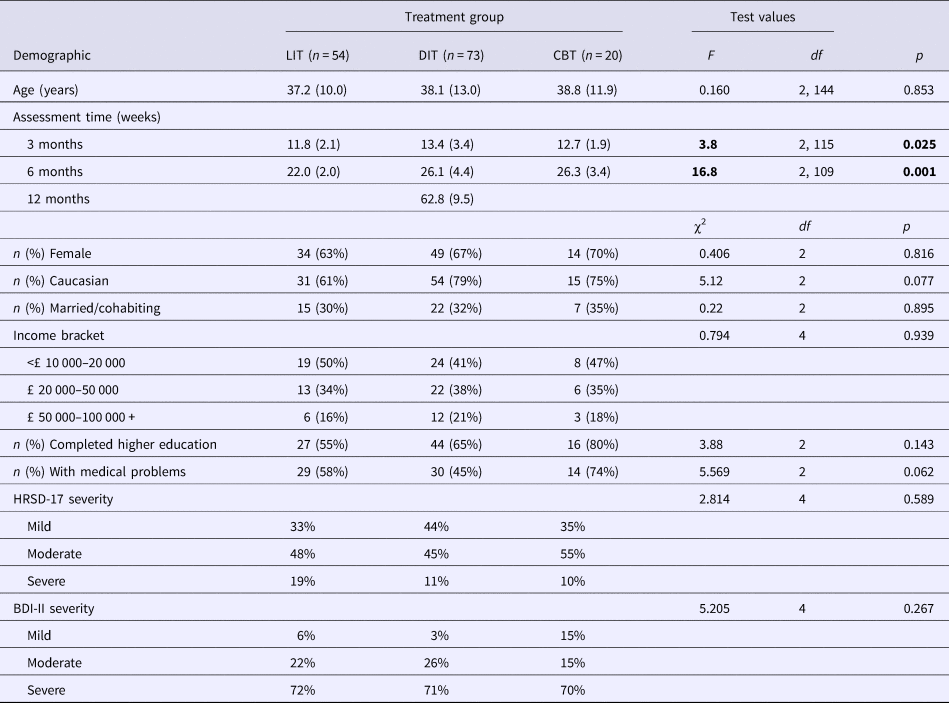
Table 1 summarizes demographics for the three groups. They did not differ significantly on any demographic variable, but there was a trend towards a difference on the percentage of patients with long-term health conditions (e.g. diabetes); therefore, a binary variable coding for medical problems was used as covariate in all subsequent analyses. The treatment groups showed similar levels of moderate to severe depression at baseline.
Participant demographics in each treatment group

CBT, cognitive-behavioural therapy; DIT, Dynamic Interpersonal Therapy; LIT, low-intensity therapy; HRSD-17, Hamilton Rating Scale for Depression-17; BDI-II, Beck Depression Inventory-II.
Count variables differ in the number of respondents. For continuous measures, values in brackets represent standard deviations. Significant results are in bold.
Primary outcome
Analyses were based on an intention-to-treat sample of 147 patients using all available data. A mixed-effects linear regression that included linear and quadratic slopes for time, treatment contrast (DIT v. LIT, DIT v. CBT), covariates (age, sex, higher education status, marital status, ethnicity, income bracket, co-occurring medical problems, and assessment variability; see online Supplementary Table S1 for regression coefficients), a random intercept for patient, and random linear slope for time fitted the data well (fixed portion: χ2(17) = 137.71, p < 0.001; random portion: χ2(2) = 81.05, p < 0.001). Patients varied in their baseline scores (random intercept = 7.96, 95% CI 4.85–13.06) and amount of change over time (random slope = 5.49, 95% CI 3.15–9.57).
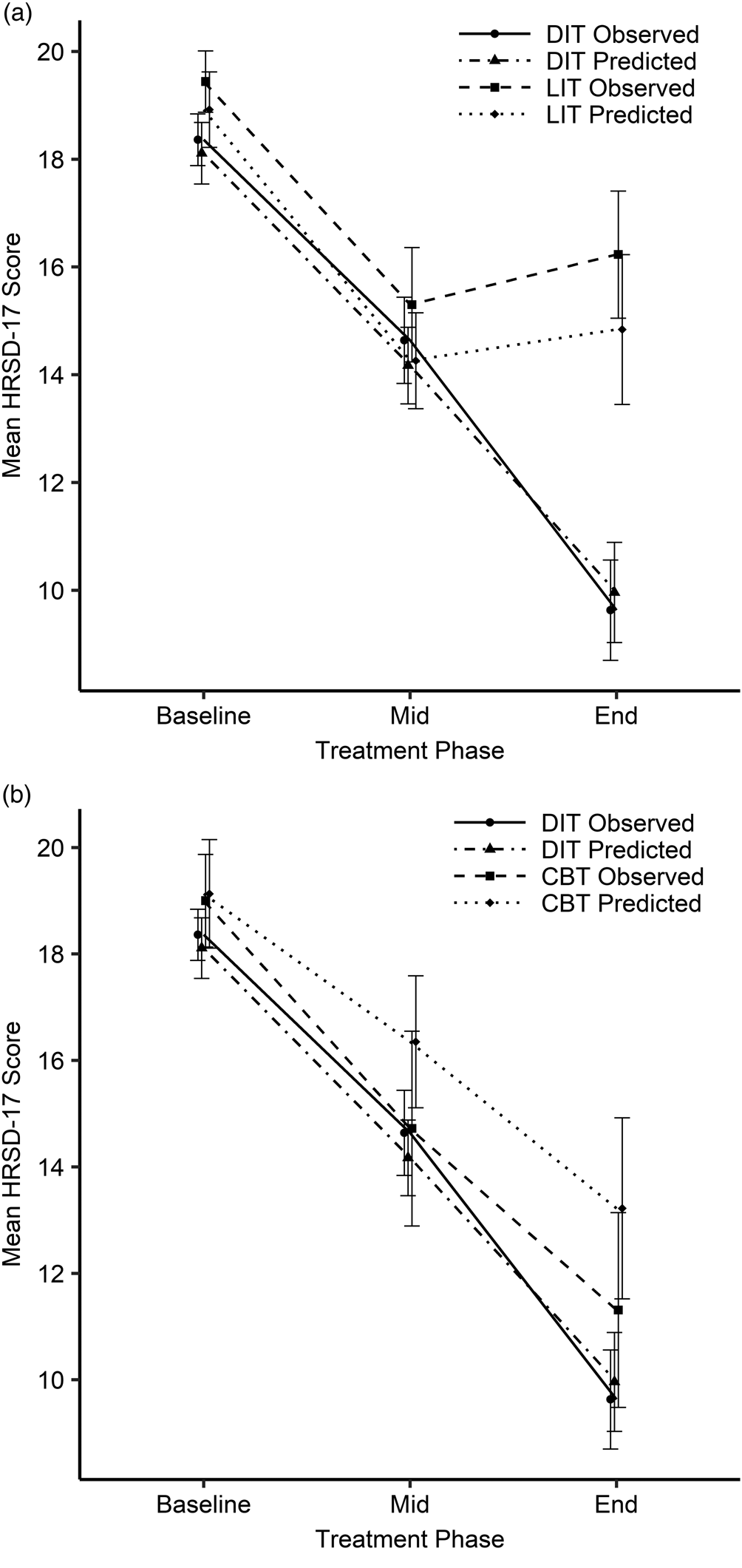
HRSD-17 scores showed a linear decline over time (b = −3.81, z = −3.11, p = 0.002, 95% CI −6.21 to −1.41). The rate of change also differed between treatment groups: the LIT group showed a stronger quadratic pattern of change compared with the DIT group (b = 2.75, z = 2.89, p = 0.004, 95% CI 0.89–4.62). That is, the DIT group showed a steady rate of decline over the treatment period, while the LIT group plateaued between the middle and end of treatment (Fig. 2). A separate model that included all four assessment points for the DIT group only (i.e. baseline, mid-treatment, post-treatment, and follow-up) showed that there was no significant difference between marginal HRSD-17 scores at post-treatment and follow-up (post-treatment = 10.0 v. follow-up = 10.7; Wald χ2(1) = 0.28, p = 0.596, 95% CI −2.28 to 3.97). Therefore, the DIT group maintained their gains at follow-up.
Predicted and observed mean scores on the HRSD-17 at baseline, mid-treatment, and post-treatment for (a) the DIT and LIT groups, and (b) the DIT and CBT groups.

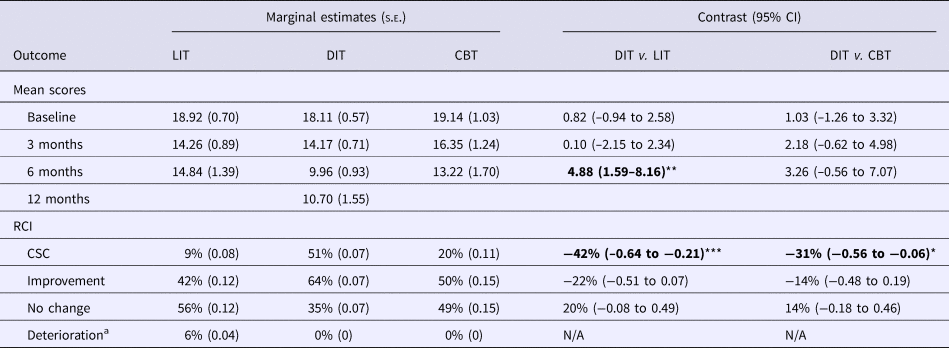
At post-treatment, the DIT group scored significantly lower on the HRSD-17 than the LIT group (marginal means: 9.96 v. 14.84; Wald χ2(1) = 8.47, p = 0.004, 95% CI 1.59–8.16; marginal d = 0.70, 95% CI 0.24–1.16). There were no significant differences between the DIT and CBT groups in end-point marginal means (DIT = 9.96, CBT = 13.22, χ2(1) = 2.80, p = 0.094, 95% CI −0.56 to 7.07; d = 0.50, 95% CI −0.07 to 1.07).
A logistic regression model with treatment contrast (DIT v. LIT, DIT v. CBT), baseline HRSD-17 scores, and covariates (age, sex, higher education status, marital status, ethnicity, income bracket, co-occurring medical problems, and end-point assessment variability) showed that more DIT patients achieved clinically significant change than LIT patients (marginal percentages: 51% v. 9%; χ2(1) = 14.70, p < 0.001, 95% CI −0.64 to −0.21; RR = 5.17, 95% CI 1.75–15.25) and CBT patients (51% v. 20%; χ2(1) = 5.94, p = 0.01, 95% CI −0.56 to −0.06; RR = 2.55, 95% CI 1.00–6.54). All treatment groups showed moderate-to-high levels of reliable improvement, moderate levels of no reliable change, and low levels of deterioration (see Table 2). Sensitivity analyses demonstrated that the results were maintained when (i) multiple imputation was used to handle missing data on the HRSD-17 (see online Supplement 2), (ii) the BDI-II was used as the outcome measure (see online Supplement 1 and online Supplementary Table 4), and (iii) mild cases were excluded (see online Supplement 3).
Marginal means and percentages on the HRSD-17 for each treatment group at each assessment point

s.e., Standard error; CI, confidence interval; LIT, low-intensity therapy; DIT, Dynamic Interpersonal Therapy; CBT, cognitive-behavioural therapy; RCI, Reliable Change Indices; CSC, clinically significant change.
Outcomes at 12 months were not collected for the LIT and CBT groups.
a χ2 difference testing could not be performed due to lack of variation in at least one of the group estimates.
Significant results are in bold: * p < 0.05; ** p < 0.01; *** p < 0.001.
Secondary outcomes
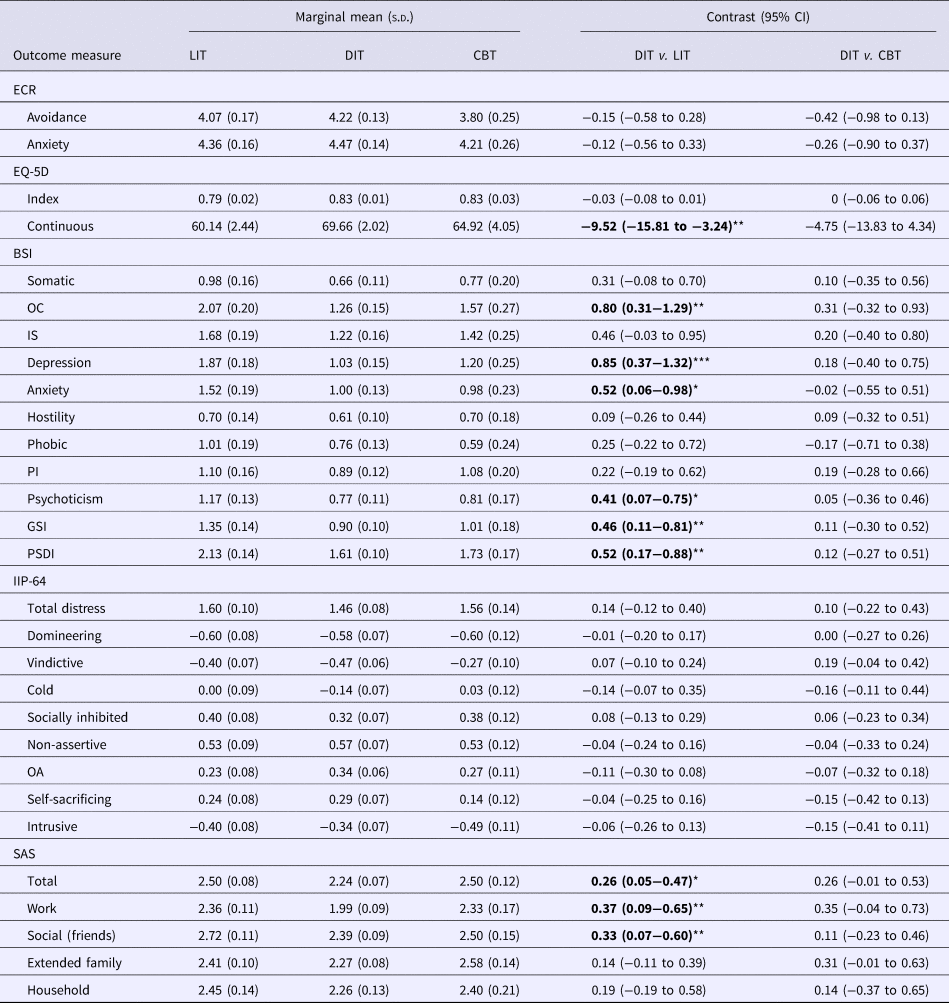
We used linear regression models with multiple imputation to examine treatment differences on each secondary outcome subscale at post-treatment. Models included treatment group (DIT v. LIT, DIT v. CBT), baseline scores on the subscale in question, and the covariates listed above. Marginal means at post-treatment are described below and reported in Table 3. Marginal means at baseline are presented in online Supplementary Table S7 (available online).
Pro-rated and imputed marginal means and contrasts for the secondary measures at post-treatment

s.e., Standard error; CI, confidence interval; LIT, low-intensity therapy; DIT, Dynamic Interpersonal Therapy; CBT, cognitive-behavioural therapy; BSI, Brief Symptom Inventory; OC, Obsessive-compulsive; IS, Interpersonal sensitivity; PI, Paranoid ideation; GSI, Global Severity Index; PSDI, Positive Symptom Distress Index; IIP-64, Inventory of Interpersonal Problems-64; OA; Overly Accommodating; SAS, Social Adjustment Scale.
Significant results are in bold: * p < 0.05; ** p < 0.01; *** p < 0.001.
The DIT group reported lower end-point scores on the BSI compared with the LIT group, specifically in depression (1.03 v. 1.87; t (141) = 3.58, p = 0.001, 95% CI 0.37–1.32, d = 0.66, 95% CI 0.30–1.02), anxiety (1.00 v. 1.52; t (141) = 2.29, p = 0.026, 95% CI 0.06–0.98, d = 0.43, 95% CI 0.08–0.79), obsessive-compulsiveness (1.26 v. 2.07; t (141) = 3.28, p = 0.002, 95% CI 0.31–1.29, d = 0.59, 95% CI 0.23–0.95), psychoticism (0.77 v. 1.17; t (141) = 2.42, p = 0.01, 95% CI 0.07–0.75, d = 0.44, 95% CI 0.08–0.79), general severity (0.90 v. 1.35; t (141) = 2.63, p = 0.01, 95% CI 0.11–0.81, d = 0.49, 95% CI 0.13–0.84), and symptom distress (1.61 v. 2.13, t (141) = 2.98, p = 0.005, 95% CI 0.17–0.88, d = 0.57, 95% CI 0.21–0.93). There were no significant differences between the DIT and CBT groups.
On the SAS, the DIT group reported fewer social problems overall compared with the LIT group (2.24 v. 2.50; t (141) = 2.47, p = 0.016, 95% CI 0.05–0.47, d = 0.45, 95% CI 0.09–0.81). Specific improvements were found at work (1.99 v. 2.36; t (141) = 2.66, p = 0.01, 95% CI 0.09–0.65, d = 0.47, 95% CI 0.11–0.82) and with friends (2.39 v. 2.72; t (141) = 2.48, p = 0.016, 95% CI 0.07–0.60, d = 0.44, 95% CI 0.08–80) compared with the LIT group.
Finally, DIT patients reported higher health-related quality of life scores on the EQ-5D than LIT patients (69.66 v. 60.14; t (141) = −3.02, p = 0.003, 95% CI −15.81 to −3.24, d = 0.55, 95% CI 0.19–0.90). Results were replicated using the observed rather than imputed data (see online Supplementary Table S2).
Therapist fidelity and competence
Competency ratings were high for all DIT therapists (M = 53.3, s.d. = 10.6, range: 19–65). All therapists were coded as adherent on 80% of recordings (see online Supplementary Table S2).
We explored whether competency ratings predicted treatment outcomes. A mixed-effects model was used to predict HRSD or BDI-II scores at 6 months from the fixed effects of therapist competence (i.e. competence ratings averaged across sessions for the 55 participants who completed DIT) and covariates (age, sex, education, medical problems, and assessment variability at 6 months), and random effects of baseline HRSD-17 (or BDI-II) scores. Random effects for therapist and site were not included as they did not significantly improve model fit (χ2(2) = 0.013, p > 0.05). Therapist competence did not significantly predict 6-month HRSD-17 (t (47) = 0.483, p > 0.05) or BDI-II (t (47) = 0.459, p > 0.05) scores. Results were no different when using competence ratings at the initial, mid, or late phases of treatment, or when using a log-normal distribution to account for the mild skewness in residuals.
Discussion
This is the first RCT investigating the effect of DIT on moderate to severe depression and the first trial of STPP in an IAPT context. Participants randomized to DIT reported significantly lower levels of depression following treatment than those who received LIT on both clinician-rated (HRSD-17) and self-report (BDI-II) measures. Over half of DIT patients made clinically significant improvements, i.e. full recovery, while only 9% of LIT patients achieved this. The benefits of DIT were maintained at 12-month follow-up. At post-treatment, the DIT group showed reduced overall symptom severity and distress, better social adjustment, and fewer health-related problems than the LIT group. Benefits on measures of attachment (ECR-R) and interpersonal problems (IIP-64) were less marked. The findings are nevertheless encouraging as, unlike many other trials of psychodynamic psychotherapy (Gerber et al., Reference Gerber, Kocsis, Milrod, Roose, Barber, Thase, Perkins and Leon2011), this study made use of an active control group (LIT) that represents a bona fide form of lower-intensity treatment actually regularly provided within the IAPT system by providers who believe in the method.
These results are consistent with meta-analytic findings that reveal medium or large pre–post treatment effects of psychodynamic therapy, with results maintained at longer-term follow-up (Abbass et al., Reference Abbass, Kisely, Town, Leichsenring, Driessen, De Maat, Gerber, Dekker, Rabung, Rusalovska and Crowe2014; Driessen et al., Reference Driessen, Hegelmaier, Abbass, Barber, Dekker, Van, Jansma and Cuijpers2015; Connolly Gibbons et al., Reference Connolly Gibbons, Gallop, Thompson, Luther, Crits-Christoph, Jacobs, Yin and Crits-Christoph2016). This study offers further evidence for STPP in the treatment of depression with moderate severity, and confirms that these effects are maintained at least in the short term. The relatively large number of trial therapists involved increases confidence in the generalizability of the findings. The current trial was not designed to investigate equivalence between STPP and CBT, but results suggest that an equivalence trial could be performed.
The NICE depression guidelines recommend CBT as a first-line psychological intervention because of its relatively strong evidence base. This study adds to the evidence base for STPP. Recently published data for 2015–2016 show that the vast majority of patients in England were offered CBT and counseling, with DIT offered to only 1% of patients (The Community Mental Health Team, 2016). This may reflect the lack of RCTs supporting the specific implementation of dynamic therapy or, more likely, the lack of trained staff able to deliver STPP. DIT is unique among the psychodynamic therapies in offering a treatment manual and curriculum to enable those without a background in psychodynamic therapies to deliver it (Lemma et al., Reference Lemma, Target and Fonagy2017). It is part of a family of dynamic treatments designed to be delivered by a broad range of healthcare professionals to optimize accessibility to these approaches (Bateman and Fonagy, Reference Bateman and Fonagy2009, Reference Bateman and Fonagy2019; Bateman et al., Reference Bateman, O'Connell, Lorenzini, Gardner and Fonagy2016). DIT may have a significant role in increasing the general availability of psychodynamic approaches by increasing the accessibility of training in this modality. There have been a number of different trials of psychodynamic therapy for depression based on different manuals, but DIT attempts to be unique by providing an introduction to psychoanalytic ideas and introducing a clinical approach to those with very limited experience of working with these models in the hope of making a dynamic approach available at scale. The evaluation of DIT training protocols in relation to clinical outcomes is the next hurdle in the dissemination of this approach within IAPT.
This paper also reports a smaller-scale study, which aimed to assess the feasibility of an RCT comparing DIT and CBT for depression. Participants readily accepted randomization to DIT and CBT, per-protocol treatments and assessments were delivered to almost all participants, and 6-month assessments indicated the potential for meaningful comparisons between DIT and CBT. No patient, when offered randomization to DIT or CBT, refused being randomized, or once assigned refused to take up the treatment. Although the proportion of early terminations was significant (approximately 25% in each group), it was no higher than may be expected in routine care at these IAPT sites. Patients found DIT acceptable. 85% of the CBT group and 80% of the DIT group were available for assessments at 6 months, indicating comparable fidelity to the research protocol. The findings support the feasibility of randomizing individuals to either of these high-intensity therapies in the context of routine service provision and thus provide the basis for implementing a protocol to test the hypothesis that certain patients with major depressive disorder and co-occurring disorders may specifically benefit from STPP or CBT. On the basis of this preliminary investigation, given the large number of patients with depression currently seen in IAPT, we plan to examine the hypothesis that DIT may be considered as a potential alternative to CBT in an adequately powered RCT comparing the two treatments.
The study has a number of important limitations. The LIT group, while realistic as a comparison given the stepped-care protocol implemented in IAPT settings, is not an adequate control, as participants may not have had comparable expectations of benefit in the two arms of the trial. Participants agreed to randomization to LIT (guided self-help) in the knowledge that they would be offered a high-intensity psychological therapy at the end of that treatment if they felt they needed it. Many participants did not take up this offer, but the LIT condition has features in common with nocebo designs, which may have slightly worse outcomes for depressed patients than no-treatment control conditions (Furukawa et al., Reference Furukawa, Noma, Caldwell, Honyashiki, Shinohara, Imai, Chen, Hunot and Churchill2014). Given that participants may have perceived the offer of further treatment as contingent on their non-responsiveness to the LIT intervention, it is possible that the observed impact of DIT was exaggerated in this comparison. However, although comparison with the CBT arm was not part of the trial design, the lack of a marked difference in the outcomes of the two high-intensity arms suggests that the superiority of DIT to LIT may be genuine. While adherence to the assessment and treatment protocol was relatively good, a substantial proportion of the sample failed to complete the additional outcome measures, and multiple imputations were needed to provide adequate analysis of the data. Furthermore, 3% of the assessments fell outside the pre-specified window and had to be discarded, further reducing the power of available contrasts. While the size of the sample for the key comparison of DIT v. LIT was adequate, the study is relatively small.
This study also investigated whether therapist competence was associated with outcomes. No evidence of this was found, perhaps because the DIT therapists working in the study were all functioning significantly above a minimal level of competence and were supervised by the developers. The fact that neither adherence nor competence were examined in the CBT pilot group is a further limitation of the study highlighting the need for caution in relation to these findings.
Conclusion
As IAPT services offer psychodynamic therapy, its efficacy in real-world settings is highly relevant to patients, therapists, and the healthcare system. Evidence for the efficacy of psychodynamic therapy for common mental disorders is available (Leichsenring et al., Reference Leichsenring, Luyten, Hilsenroth, Abbass, Barber, Keefe, Leweke, Rabung and Steinert2015), but this study is the first to demonstrate DIT's effectiveness in primary care. Encouraging remission rates were obtained, particularly given the severity of depression in the sample and the low recovery rate in the LIT condition. Further work is warranted in the IAPT setting to identify patient groups for whom DIT may be indicated. We noted informally that referrals to DIT were often individuals with adverse childhood experiences, possibly because of the implicit belief that DIT may be better at addressing persistent distortions of relationship representations, perhaps associated with a history of trauma. This, in turn, in the context of large-scale effectiveness studies, will require the implementation of DIT at scale in the IAPT setting.
Supplementary material
The supplementary material for this article can be found at https://doi.org/10.1017/S0033291719000928.
Author ORCIDs
Peter Fonagy, 0000-0003-0229-0091
Financial support
This work was supported by the National Institute for Health Research (NIHR) under its Research for Patient Benefit Programme (grant number PB-PG-0610-22287). P.F. is in receipt of a NIHR Senior Investigator Award (grant number NF-SI-0514-10157) and was in part supported by the NIHR Collaboration for Leadership in Applied Health Research and Care (CLAHRC) North Thames at Barts Health NHS Trust. S.P. is in receipt of funding from the National Institute for Health and Care Excellence (grant number 541506) and the NIHR (grant number 541918), and receives support from the UCLH Biomedical Research Centre. The views expressed are those of the authors and not necessarily those of the NHS, the NIHR or the Department of Health and Social Care.
Conflict of interest
P.F. delivers training on DIT organized by the Anna Freud National Centre for Children and Families (AFNCCF), of which he is Chief Executive Officer. He also receives royalties from books related to DIT. A.L. and M.T. deliver training on DIT organized by the AFNCCF, for which they are paid, and receive royalties from books related to DIT. P.L. has been involved in the development, training and evaluation of psychodynamic treatments. S.O'K., M.P.C., T.V.W., E.A., A.R., J.C., and S.P. have no interests to declare.