1. INTRODUCTION
There is a long tradition in computer science and artificial intelligence that equates knowledge with facts in order to represent knowledge (Brewster & O'Hara, Reference Brewster and O'Hara2007). This tradition has led to the contemporary explosion of interest in ontology as a medium for knowledge representation occurring in many domains (Davis et al., Reference Davis, Shrobe and Szolovits1993). An ontology can be described as an explicit specification of a shared conceptualization, which can be taxonomically or axiomatically based (Gruber, Reference Gruber1993). In general, an ontology consists of three parts: concept definitions, attribute definitions, and further inference definitions.
The concept definitions set up all the types of concepts in the domain. There can be three parts to the concept definitions:
1. Concept taxonomy is common to most knowledge representation languages, and through it is specified the nature of the categories in terms of generalization and specialization.
2. Concept defaults specify for each concept what the default values are for any attributes.
3. Concept restrictions specify the constraints on the values for each concept, for example, the types of values or number of values that are acceptable.
In the simplest case, an attribute for a concept just has a value but attributes may also express relationships between concepts. An attribute definition may have up to three parts as well:
1. The attribute taxonomy specifies the generalization/specialization between attributes.
2. Relational attribute inverses provide a form of inference allowing the addition of a relation in the opposite direction to the forward link between concepts.
3. The relational attribute maybe defined by attribute restrictions such that it can only appear between concepts of certain types (domain/range restrictions), or can only appear a specified number of times (cardinality restriction).
The final part of an ontology is the specification of additional inference that the model provides. Examples of this are forward and/or backward chaining rules, path grammars, subsumption and/or classification, demons, and so forth.
As new applications of ontologies have appeared, it is evident that whereas some types of knowledge are eminently suitable to representation by ontologies (taxonomic information most obviously), others may not be. Furthermore, others argue ontologies as artefacts are unsuited to real-world applications once they are beyond a certain level of complexity; in other words, lightweight ontologies are acceptable, but there is a trade-off between expressivity and usability.
2. RESEARCH MOTIVATION AND AIMS
The motivation of this research is to understand the benefits and limitation of approaches of developing engineering design ontologies (DOs) and hence contribute to a general understanding of the engineering DO field. In particular, the approaches for two independent research studies leading to the development of two ontologies were examined: engineering design integrated taxonomies (EDIT; Ahmed, Reference Ahmed2005) and DO (Štorga et al., 2008). EDIT employs an empirical and user-centered approach for its development, and DO is modeled from engineering design theories. EDIT was developed through a bottom-up approach developed in the context of the aerospace industry, with a focus upon a specific application of indexing design knowledge. DO was based upon a theoretical model and utilized a top-down approach, but the EDIT ontology was intended for a wide variety of applications in engineering design.
This research is concerned with the development of ontologies for supporting engineering design and has two main aims:
1. to examine and contrast two perspectives to developing ontologies in the engineering design domain, namely, theoretical and empirical approaches that were employed in previous research results (EDIT and DO), and to discuss their advantages and limitations of each of the results obtained;
2. to investigate if a combined approach may improve the shortcomings of each ontology.
Hence, a general merged ontology is proposed, termed merged ontology for engineering design (MOED), which can be tailored for a practitioner or researcher's particular needs. MOED was developed as an outcome of contrasting and mapping of EDIT and DO.
The next section describes a brief overview of ontologies in engineering design and approaches to developing an ontology in Section 3. Section 4 reports the research approach adopted for this research, and in Section 5, the results from contrasting the two approaches to developing ontologies and a proposal of a merged ontology are presented. The final section discusses the implications of the research together with conclusions.
3. BACKGROUND
A complete discussion of ontologies and their development isoutside the scope of this paper; however, a brief introduction to the engineering DO follows. The motivation for developing an ontology in the engineering domain includes knowledge sharing and developing a standard engineering language. For example, a structured basis for navigating, browsing, and searching engineering knowledge through the descriptions of the ontologies. This is particularly useful when engineers are unaware of the information available, and hence, they can retrieve documents by submitting natural language queries or navigating the ontology space. Another important motivation for building ontologies is the integration of knowledge models in different subdomains of the engineering process into a coherent framework (Uschold & Gruninger, Reference Uschold and Gruninger1996). Example applications include business process reengineering (an integrated knowledge model of the enterprise and its processes, organizations, products, goals, and customers is needed), distributed design among multicultural teams (where different participants need to communicate and solve problems), and in concurrent engineering and design. The application area of engineering ontologies can be divided into three main areas:
1. a foundation for the business/engineering processes formalization,
2. a foundation for achievement of full interoperability between different participants (humans and computer systems) of engineering process, and
3. a foundation for the effective implementation of engineering knowledge management methods and tools.
Previous research efforts in developing ontologies for the engineering design (Sections 3.1 and 3.2), in addition to the approaches undertaken by the authors for the development of ontologies from an empirical and theoretical viewpoint are described together (Sections 3.3 and 3.4) with the approach to integrate these efforts in the following sections.
3.1. Engineering ontologies
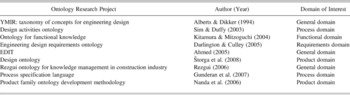
The importance of a sharable ontology for systematic exchange and management of knowledge in the engineering design field is recognized by many researchers. Early research projects include YMIR, which specifies a taxonomy of concepts for engineering design that define the semantic of design knowledge in multiple engineering domains (Alberts & Dikker, Reference Alberts, Dikker and Gero1994). The concepts that YMIR represent are generalization of concepts used in the individual design domains, such as electrical engineering, mechanical engineering, and civil engineering. The same ontological basis was used for the integration of design synthesis knowledge and design standards in design process. The Rezgui (Reference Rezgui2006) ontology for knowledge management in construction industry was developed through eliciting concepts from documents, through the removal of stop words and summarizing the documents. The ontology works together with profiles containing users preferences to support knowledge management. Two approaches based on formal ontologies to better organize information handled during the engineering design process are proposed by Gunderan et al. (Reference Gunendran, Cutting-Decelle, Young and Bourey2007): Process Specification Language as a key enabler for process-based communications and information exchanges and methods and tools facilitating communications through model-based transformation approaches. Darlington explores the process of developing ontologies for use in real-world problem solving and showed, by example implementation, how an ontology developed to capture suitable domain knowledge may be used for supporting engineering design requirement captures (Darlington & Culley, Reference Darlington and Culley2008). Hence, illustrating the general potential of ontologies to support the engineering design process support.
Ontologies have also been used to describe design activity. Sim and Duffy's (Reference Sim and Duffy2003) ontology categorizes activities as design definition, evaluation, and management, which is based upon the literature. The ontology is seen as providing a consistent and coherent description of design activities upon which design education, system developers, and design researchers can extend further. The ontology of Sim and Duffy (Reference Sim and Duffy2003) is extended with the use of design structure matrices to analyse information flows from activities for the generic design activity ontology of Kumar and Mocko (Reference Kumar and Mocko2007).
Other applications of ontologies in engineering design include the systematization of functional knowledge (Kitamura & Mitzoguchi, Reference Kitamura and Mitzoguchi2004). Kitamuara and Mitzoguchi applied their ontology for functional decomposition in the electric industry in Japan with successful results. A final application of ontology is the product family ontology development methodology (Nanda et al., Reference Nanda, Simpson, Kumara and Shooter2006) that combines research in formal concept analysis, Semantic Web, and Web Ontology Language (OWL) in order to provide a structured methodology for product family ontologies. It aims to facilitate a shared, consistent, and traceable ontology development process within a diverse product development team.
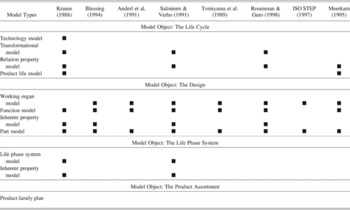
A brief overview of ontologies and their applications in engineering design domain has been described, and the diagrammatic summary is provided below (Table 1).
Recent ontology development in engineering design

The concept of warrants or the authority on which the ontology can be based is discussed in the following section to better understand the differences in origin an approach when building engineering design ontologies.
3.2. Approaches to developing ontologies
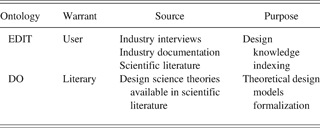
Warrants are the authority that is evoked by the classification to justify and verify decisions of the structure and choice of classes and concepts included in an ontology (Beghtol, Reference Beghtol1986). Hence, the types of warrants that are possible and those employed by the two ontologies (DO and EDIT) are reviewed to obtain a greater understanding of the limitations of these approaches.
The two warrants referred to in the standards are literature and user. These and others found in literature are described by the following [National Information Standards Organisation (NISO), 1994]:
• Literary warrant: words and phrases from the literature determine the formulation of descriptors (NISO, 1994)
• User warrant: representation of the inclusion of a concept is due to frequent requests for information on the concept (NISO, 1994)
• Scientific warrant: the best philosophical and scientific consensual thinking (Beghtol, Reference Beghtol1986)
• Cultural and epistemological warrant: “ensuring that concepts and semantic relations are dependent on the broader cultural context and incorporate different cultural views (Beghtol, Reference Beghtol1986).
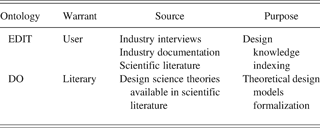
The vast majority of engineering design ontologies reviewed in Section 3 employs the literary warrant only. However, as the EDIT (further described in Section 3.3) approach originated through eliciting user concepts from interviews and the literature was consulted to identify taxonomies, it can be described as closest to the concepts of the literary and user warrant, although not quite the same. The users concepts were elicited from interviews that determined the choice of concepts rather than the users requesting the concepts. Further, the DO (described in Section 3.4) originated from eliciting concepts and their relations from the existing theoretical foundation in the engineering design domain, followed by derivation of terms and definitions based on the epistemological foundation of high-level ontologies [suggested upper merged ontology (SUMO)], can be described as based upon a scientific and epistemological warrant (Table 2).
Contrasting EDIT and DO warrants
3.3. EDIT
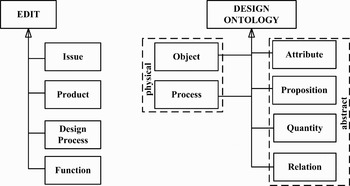
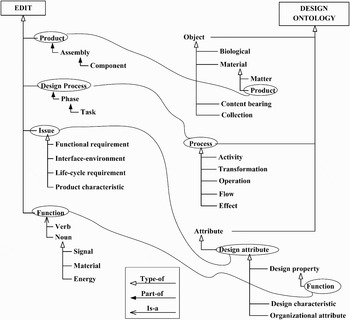
EDIT was developed through a systematic methodology aimed at gaining a cognitive understanding of engineering designers (Ahmed, Reference Ahmed2005). The ontology was developed within the context of the aerospace industry, and its primarily application is in managing design documentation through the provision of a visible indexing structure for users to search for knowledge. EDIT was developed through a user-centered approach following the conceptual models of users, in this case engineering designers. Eighteen designers were interviewed to understand how designers described the process of designing of particular product from two companies. Hence, the root concepts of EDIT, shown in Figure 1 (together with the roots concepts of DO further described in Section 3.4.), were elicited from these interviews, through classifying the designers' descriptions of design process. From this analysis, four root concepts emerged:
1. The design process itself, that is, a description of the different tasks undertaken at each stage of the design process, for example, conceptual design, detail design, and brainstorming.
2. The physical product to be produced, that is, the product (component, subassemblies, and assemblies) using part of relations, for example, a cup or the handle of a cup. In the case of designers working on a subassembly or a component of the whole product, the components and assemblies that share a physical or functional interface with, what is being designed would also be considered. For example, when designing a turbine blade, the disk that holds the blade also needs to be considered to ensure that the interface between the disk and blade is appropriate.
3. The functions that must be fulfilled by the particular component or assembly. For example, one of the functions of a compressor disk is to secure the compressor blade or one of the functions of a cup is to contain liquid.
4. The issues, which are considerations the designer must take into account while carrying out the design process, for example, the unit cost or manufacturing considerations.
The EDIT and DO root concepts.

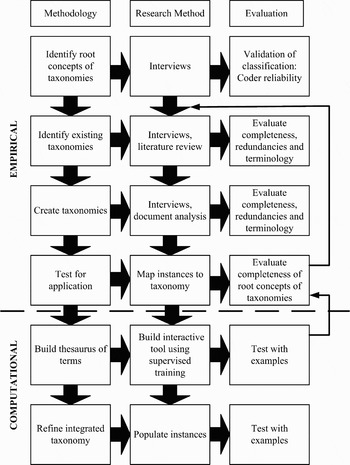
The root concepts formed individual taxonomies within the ontology and were validated through indexing a set of 92 documents and through interviews. Individual taxonomies were either identified from literature, as was the case for the function taxonomy where the functional basis from Hirtz et al. (2006) is employed, or created if an appropriate taxonomy could not be found, as was the case for the remaining three taxonomies. The EDIT ontology consists of around 1000 classes. The EDIT ontology once populated with instances from the aeroengine is closer to 2000 terms, with the largest contribution from the product taxonomy. In addition to static relationships between classes, dynamic relations across taxonomies are created based upon a set of rules. Dynamic relationships between concepts are extracted as the ontology is populated with instances (described in Ahmed, Reference Ahmed2006a, Reference Ahmed2006b). The methodology employed during EDIT resulted in the development of a generic methodology to develop engineering DOs that can be found in Ahmed and colleagues (Ahmed, Reference Ahmed2005; Ahmed et al., Reference Ahmed, Kim and Wallace2006). The process of developing the ontologies was conducted in several stages. The stages were
1. identifying the taxonomies that form an engineering DO (referred to as the root concept of the taxonomy),
2. searching for existing taxonomies for each of the root concepts from the previous stage,
3. creating taxonomies if no existing taxonomy was found,
4. testing the taxonomies for the particular application (in this case for indexing design knowledge),
5. building a thesaurus for the integrated taxonomy, and
6. refinement of the integrated taxonomy.
Each of the six stages of the methodology has a clear output and at least one clear evaluation step, and is summarized in Figure 2. Each of the three columns illustrates the methodology; research methods employed, and evaluation procedure for each of the six stages. Each of the rows (excluding title row) represents the six stages of the methodology.
The EDIT methodology for building an ontology.

3.4. DO and SUMO
The DO project started with the recognition of the “design as a product” ontology as a main presumption for the successful knowledge management and exchange among different participants in product development process. In building a general DO, the domain description vocabulary was defined as the desired research result (Štorga et al., Reference Štorga, Andreasen, Marjanović, Samuel and Lewis2005, Reference Štorga, Marjanović and Andreasen2007, 2008). Theoretical literature related to engineering design and designing was analyzed with the purpose to understand terminology applied amongst different researchers in the domain. The main conclusion from this review was that the domain terminology is not unified, and definitions provided were not consistent or clear. Many relations between terms in theoretical literature were described as causal (if at all); these informal models cannot be utilized for any form of automatic reasoning. These findings motivated the research to build a formal model of the theoretical background: DO. The DO development process was conducted in six stages following the previously mentioned EDIT methodology; however, the research methodology employed focused upon understanding engineering design theory as was mentioned before rather than the described empirical approach (Fig. 2). This phase included domain documentation analysis (theoretical models, industrial reports, and software documentation), identification of the key concepts and relations between them, and classification of the concepts and relations into taxonomies.
The genetic design model system (GDMS; Mortensen, Reference Mortensen1999) was selected as the main theoretical background for extracting the DO terms and definition. It was selected because it is built upon a strong theoretical background including the theory of technical systems (Hubka & Eder, Reference Hubka and Eder1988), theory of properties (Hubka & Eder, Reference Hubka and Eder1988), theory of domains (Andreasen, Reference Andreasen1980), design process theory (Hubka, Reference Hubka1976; Pahl & Beitz, Reference Pahl and Beitz1988), and theory of dispositions (Olsen, Reference Olsen1992; Table 3).
Relating the GDMS to existing design model systems

Data are according to Mortensen (Reference Mortensen1999).
Knowledge about the product/design as the result of the development process is by Mortensen (Reference Mortensen1999) centered on four different conceptual model object or viewpoints:
1. The design: defines functional, organ, and part view on the design/product; inherent properties that are possessed by the design/product itself, that is, strengths, ductility, and so forth; and design/product view relevant for the different meetings during its life cycle.
2. The life cycle phases: technology model that defines the considerations during the product life, product life model, activity model describing intended and realized activities between the design and the operand/environment, and relational property model, that is, costs, lead time, quality, and so forth.
3. The life phase systems: the systems that gradually realize product life, that is, production, sales, and services with inherent properties.
4. The product assortment: a design normally belongs to the product family or product assortment that can be described by a plan that consists of an assortment/family elements structure and constraints between them.
After the extraction of vocabulary entities from theory, the main concepts were characterized and formally defined following Mekhilef et al.'s (Reference Mehkilef, Bourey and Bigand2003) four levels of formalization procedure: epistemological-, domain-, application-, and project-modeling level. The SUMO (www.ontologyportal.org), an effort by IEEE (www.ieee.org) collaborators from the field of engineering, philosophy, and information science, was selected as an epistemological foundation for building the DO. SUMO originally concerned itself with metalevel concepts (general entities that do not belong to a specific problem domain). SUMO is aimed at creating a framework where ontology developers may utilize a common knowledge for derivation of the more domain-specific ontology (Niles & Pease, Reference Niles and Pease2001). Some of the distinct advantages of the SUMO proposal in a comparison to the other high-level ontology efforts are described here (Niles & Pease, Reference Niles and Pease2001):
1. The SUMO is the working effort sponsored by open-source engineering community. This means that potentially users of SUMO can be more confident that this upper ontology will eventually be embraced by a large class of users.
2. The SUMO was constructed with reference to pragmatic principles. Hence, any distinctions of strictly philosophical interest have been removed.
3. The entire SUMO is mapped to the WordNet® lexicon (wordnet.princeton.edu), providing a link between the formal content expressed in SUMO and natural language, that is, paraphrasing the hard to read logical inscription of axioms into natural language.
Accordingly to the SUMO proposal, the vocabulary of the DO has been classified into six main subcategories as shown in Figure 1. At the top level of the SUMO hierarchy, the concept of Entity subsumes the concepts Physical and Abstract, where the former category includes everything that has a position in space/time, and the latter includes everything else. From the viewpoint of the DO research, the concept of Physical subsumes the disjoint concepts of Object and Process. The concept of Object is the most general concept of the Entity that exists in space. The concept of Process corresponds to any sustained phenomenon or one marked by gradual changes (space/time). Returning to the highest level distinction in SUMO hierarchy, the concept of Abstract subsumes four disjointed concepts relevant for the DO: Attribute, Proposition, Quantity, and Relation. The concept of Attribute includes all qualities, properties, and so forth, of an Entity that are not regarded as Object. The concept of Proposition corresponds to the notation of semantic or informational content. The Quantity concept is understood as a count independent of an implied or explicit measurement system together with a particular unit of measure. The concept of Relation is an abstraction belonging to or characteristic of ordered Entity tuples and connects two or more concepts. An example of a simple definition that was extracted and formally defined is shown below. The definition provided by GDMS was in the first step interpreted utilizing the terms included in the DO and then formalized as a DO definition.
- GDMS definition:
“Function is ability of machine to deliver a purposeful effect.”
- Ontology building interpretation:
If ?MACHINE is an Instance of Machine and ?MACHINE is an Instrument of ?PRODUCTLIFECYCLEPHASE, then there exists ?FUNCTION so that ?PRODUCTLIFECYCLEPHASE Results with purposeful ?EFFECT.
- Formal ontology definition:
(=>
(and
(Instance ?MACHINE Machine)
(Instrument ?PRODUCTLIFECYCLEPHASE ?MACHINE))
(Exists (?FUNCTION)
(Result ?PRODUCTLIFECYCLEPHASE?EFFECT)))
The ontology was evaluated for reliability using the Cohen kappa coefficient of reliability following the EDIT methodology, which takes into consideration the agreement of the relevant experts in the researched field and subtract the percentage of the agreement that can be expected from chance (Bakemann & Gottam, Reference Bakemann and Gottam1997; Ahmed et al., Reference Ahmed, Kim and Wallace2007). In the final step of the research, a computer thesaurus has been created using the Ontoprise® ontology development environment (www.ontoprise.de). Using the thesauri, the knowledge evolved during a real product development case study was described, and the set of instances created were used for the ontology model to check consistency and for refinement.
4. RESEARCH METHODOLOGY
4.1. Ontology mapping: The state of the art
During the presented research on confronting the two ontologies, the authors were faced with an enormous diversity of work claiming relevance to ontology mapping and merging. For example, terms and works encountered in the literature include: alignment, merging, articulation, fusion, integration, morphism, and so forth. Given this diversity, it is difficult to identify problem areas and comprehend solutions provided. Kalfoglu and Schorlemmer (Reference Kalfoglou and Schorlemmer2003) scrutinized the literature and critically reviewed works originating from a variety of fields. They understand ontology mapping and merging as the task of relating the vocabulary of two ontologies that share the same domain of discourse in such a way that the mathematical and logical structure of ontological signatures and their intended interpretations, as specified by the ontological rules, are respected. From the literature reviewed, the difficulty in identifying transparent and repeatable procedures for mapping ontologies is evident. Even within the field of engineering design, ontologies may focus upon design activity or product relations, and hence, cannot easily be compared. Benchmarking, as employed in domains such as optimizations, is also difficult to apply as ontology is not as easily measurable as algorithms. Most approaches reviewed describe mapping between two ontologies where the process needs to be repeated for an additional mapping. The mapping procedure employed for this study is described in the following section. The merging of the two ontologies was an outcome of this activity, and is described in the Section 5.
4.2. Mapping approach in presented research
For the presented research, the methodology for mapping the two engineering DOs approaches derives from different perspectives, as it was difficult to apply any one proposed approach, because of previously described differences in the ontology scope and warrant. Similarly applying any automatic tool to do this mapping/merging was not considered for the same reasons, and both of the proposed ontologies were not semantically strong enough to apply formal mathematical and logical methods. Hence, the most relevant approaches for the particular project were ideas from several approaches that were intuitively combined.
The starting point of the research is aligned with the idea of integrating ontologies based on taxonomic features and detection of synonymous concepts in the two ontologies as described by Fernandez-Breis and Martinez-Bejar (Reference Fernandez-Breis and Martinez-Bejar2002). The difference between the applied procedures is that it was not possible to consider the attributes of concepts (because they are not defined). Therefore, it was not possible to define a typology of equality criteria for concepts for automatically integration.
The research methodology adopted was for the authors to examine each of the concepts and relations contained within one of the ontologies, DO, with respect to the other, EDIT. Because not all of the concepts and relations contained in EDIT are contained in DO, this process was then repeated but starting with the concepts and relations in EDIT. This process involved understanding the different terminologies that may have been used to describe the same concept. Because the authors are also the originators of the two contrasted ontologies, it was easier to ensure that mapping went beyond terminology than if this were not the case. In addition to contrasting the concepts and relations of ontologies, the structures of the ontology, that is, placement of concepts at different levels, the parents and siblings of each concept were also examined.
The ontologies were examined in order to do the following:
• to identify concepts that were in common, which may have had different labels;
• to identify concepts that were only present in one of the two ontologies;
• to identify relations employed between concepts, for those that were common between the two ontologies, and to understand the relationships between the different concepts within each of the ontologies. This is important, as even if both ontologies contained the same concepts, their placement within the particular ontology could be different because of the relations employed between them;
• to compare the placement of common concepts in each of the two ontologies.
Each ontology was already evaluated during its development. Hence, the evaluation here focused upon the following:
1. What is missing and is redundant from DO?
2. What is the applicability of DO? Identifying concepts that are too abstract for a specific purpose.
3. What is missing and redundant from EDIT?
4. Evaluate the theoretical background of EDIT, thus moving from a concrete and specific case study to a generic ontology.
5. RESULTS
The comparison of the two approaches and their results brought an understanding of the main differences between them: the starting point of the DO is to describe “design as a product,” and of EDIT is to describe “design as an activity,” incorporating both product and process. Realizing this difference was the key to understanding the nature of the ontology's concepts and relations to characterize the overlapping and mapping between the two ontologies. A second difference was identified: the hierarchical structure of the DO vocabulary represents the is a kind of relationships, highlighting a taxonomy of general and more specific concepts and relations of different kinds. In contrast, the structure of the EDIT concepts contains different kinds of relationships between concepts: part of, type of, and has a. Because of this understanding, the authors decided to consider separately the nature of the concepts and those of the relations to ensure mapping at the same level.
5.1. Mapping of the concepts
At the start of the research, it was recognized that mapping all the concepts directly from one ontology to another was not expected. After the preliminary research, it was concluded that it was relatively easy to map the top level concepts as their definitions are easily understandable and similar from both the theoretical and the practical viewpoint (see Fig. 3). Figure 3 illustrates the mapping of concepts at the top level, illustrating how each are mapped together and also the relations between concepts at this top level. For the concept on the lower levels, the situation was not so obvious, as concepts of the same kind in one ontology maybe placed differently in the second.
The EDIT and DS mapping at the top level.

The mapping of the concepts from the EDIT to the concepts in DO could be done as follows:
• The Product (EDIT) could be mapped to the concept of the Product (DO) as they both represent the physical result of the product development process.
• The Design Process (EDIT) could be mapped to the concept of the Process (DO) because both represent the technical process as a chain of activities that should be completed to define the physical product.
• The Issues (EDIT) could be mapped to the concept of Design Attribute (DO) because both represent the considerations that should be addressed by the engineers during the product development process to describe their solutions.
• The Function (EDIT) could be mapped to the concept of Function (DO) as they both represent the functions or the expected purpose that each product (including component and assemblies) should address.
Mapping of the concepts in the opposite direction, from the DO to the EDIT, brought out more problems:
• In DO, Content Bearing Objects exists explicitly as a physical object that is bearing some informational content (e.g., document). Conversely, Document is not explicitly defined as a concept in EDIT but one that utilizes the ontology to be indexed, and it is an instance to which any number of concepts may be linked.
• Operation is defined in the DO as the smallest single step of the Activity, but it is outside of the scope of EDIT, it is too prescriptive, and therefore was not mapped. The Transformation defined in the DO could be mapped to the Phase of the Design Process in EDIT, and the Activity from the DO responds to the single Task defined as a smallest part of the phase in EDIT.
• In DO, Organizational Attributes are related to each concept and relation (e.g., time of the creation, i.d., the creator, time of the last change, etc.). In EDIT, they are implicit and linked to the particular Document as source of the concepts and relations between them.
• The concept of the Flow from DO could be mapped to the Energy Flow function in the EDIT, and the DO concept of Effect could be mapped to the Energy Effort function in the EDIT.
• DO abstract Propositions like Idea, Fact, Principle, Plans, and so forth, in EDIT exist only implicitly and are described in Documents, so they cannot be directly mapped.
• The DO concept of Collection, including concepts of Group, Assortment, and Family, cannot be mapped into EDIT, because these concepts were not anticipated by EDIT. This also applies to the concept of Quantities.
5.2. Mapping of the relations
Mapping of the relations was only possible on a general level. The reason for this is that in EDIT all the relations besides those mentioned part-of, type-of, and has-a are dynamic (Ahmed, Reference Ahmed2005). They are not part of the EDIT definition, are generated dynamically as the result of a search through knowledge sources (documents) based upon prescribed rules, and differ from case to case. In contrast, DO specifies the relation taxonomy as a static structure, and the instances of relations between the concepts could be defined based upon these rules.
The three main relations that are part of the EDIT taxonomies definition could be mapped to DO as follows:
1. The part-of (EDIT) relation could be mapped to the Compositional relation as is defined in DO, describing the relation between the complex entities and its constituent.
2. The has-a (EDIT) relation is utilized by taxonomies that are part of the EDIT and could be mapped to the class of the General relations (DO) describing that an Entity is characterized by another Entity (e.g., the function is characterized by verb and noun).
3. The type-of (EDIT) relation is used in both proposals as a main relation that is utilized for building the taxonomies: in DO for the whole concepts' taxonomy in a form of the is-a relation, and in EDIT for describing the Issues and Function taxonomies.
The seven main classes of the relations described in DO could be mapped to EDIT as follows:
1. Compositional relations (DO) could be mapped to the Part-of relation (EDIT) as is described earlier.
2. Spatial relations (DO) could be mapped to the physical relations that could be derived between the Product and another Product in EDIT, representing the physical connection that exists between the Products and Issues–Product Characteristic–Geometry–Geometric interface.
3. Case role relations (DO) represent the role of an Entity in a Process, and therefore could be mapped to the relations that could be derived between the Design Process and Issues domains (EDIT).
4. Dependency relations (DO) could be mapped to the functional relations that could be derived between the Product and another Product (EDIT), representing the abstract connection between the two products.
5. Influence relations (DO) could be mapped to the relations that could be derived between the Issue and another Issue (EDIT) and also between the components, representing the abstract connection between them.
6. Temporal relations (DO) could be mapped to the Phase structure in design process taxonomy (EDIT), representing the time line of the Design Process.
7. The General relation (DO) could be mapped to the relations that could be derived between the four main taxonomies (i.e., top four root concepts) contained within EDIT.
5.3. Evaluation
The ontologies were examined in contrast to the methodology from which they were developed; DO, which is based upon a design theory, was examined for its applicability to an applied industrial context, whereas EDIT, which is empirical, derived and for a particular application in mind, was evaluated for its theoretical background. The evaluation described here is to understand the limitations of the approaches to develop ontologies, which may result in changes in each of the ontologies. The evaluation does not focus on evaluating each of the ontologies, as this has already been carried out. EDIT employed the EDIT methodology described earlier and found in detail in Ahmed et al. (Reference Ahmed, Kim and Wallace2007). The methodology has an evaluation at each of its six stages; a modified version of this was applied for the DO (Štorga et al., in press).
5.3.1. Evaluation of DO
During the process of comparing the ontologies, some of the concepts within the DO were reevaluated. These changes were made as a result of the comparison with EDIT; the changes were made if the original concept (or its position within the ontology) was inconsistent, or if it was beyond the limits of an ontology for engineering design. One of the difficulties with an ontology that has a theoretical basis is setting the limits and boundaries; by having a particular purpose (i.e., a concrete application) it is easier to evaluate whether a concept is necessary, and to understand its positioning.
The Object domain should be reconsidered to understand if/how it differs from the concept of Material domain. In EDIT, Material is used as part of the Function taxonomy together with the concepts of signal and energy. It is important to understand that both approaches refer to the same kinds of material, signal and energy, because taxonomy of the functions used in EDIT is originated in the work of Hirz et al. (Reference Hirtz, Stone, Szykman, McAdams and Wood2001) based on the same background as used in DO. Object in EDIT is embedded much deeper, that is, at a lower lever than in DO. The thinking behind this is related to literature that describes energy, material, and signal as the three main concepts that pass through a technical system. Similarly, the Energy (DO) should be reconsidered to be moved from the Process domain into the Functional Qualities, representing the amount of something that could be measured by standard units.
The concept of Symbol was removed from the ontology, as was Abstract–Propositions–Element, as it was believed to be beyond the boundaries of the ontology. In addition, the following concepts were moved within the DO:
• Flow and Effects were moved from Process to Abstract–Quantities–Functional Quality domain,
• Abstract–Propositions–Behavior were moved to Attributes, and
• the concept of Signal as a physical Content Bearing Object was reconsidered as Abstract.
5.3.2. Evaluation of EDIT
The comparison of DO with EDIT resulted in the addition of the concepts family and assortment related to product. Because EDIT is created primarily to provide a visible browsing and navigational structure when searching for knowledge, and as an ontology to index engineering knowledge, differences between the treatment of Material, Energy, and Signal within EDIT and DO became apparent; these are treated as an abstract within EDIT, which is not the case within DO. Function is an abstract concept, that is, the Function that a Product (component or assembly) needs to fulfill may exist before a concept or a product exists. The Function taxonomy within EDIT uses combination of verbs and nouns; the nouns are not all abstract concepts, for example, under Material there is Material–Solid Object. However, the use of them as a combination to represent a function means that the concept is now abstract. As a noun independent of a Verb–Noun combination (describing a function) Material–Solid Object is physical, and similarly Human (part of Function–Noun–Material–Human) maps directly to DO Physical–Object–Biological–Human. This difference is related to the application of the ontology: Material, including Human and Material Object are physical, but the use of them as part of a combination of verb–noun is abstract. If Material were place as physical (and therefore not part of the function taxonomy), it would be difficult for a user (engineering designer) to locate, for example, a solid object when trying to describe a Function, as the concept will be located away from Function. Hence, for pragmatic reasons, the position was not changed in EDIT.
5.4. Discussion on mapping and evaluation of two approaches
It was found that a theoretical view point may ensure that the concepts and relations are mapped correctly; however, there is a difference between a theoretically consistent ontology and one that is accessible for engineering designers to use in a specific context. For example, the concept Product, if the concept of the product is to be placed consistent to the theoretical approach (as employed by DO), it would appear as part of the attributes in Entity–Physical–Object–Material Object and hence would be embedded very deep within the ontology or in EDIT would be part of the Function–Noun–Material–Solid Object. In the application of EDIT, and indeed many engineering DOs, the physical product (or service) is a central view for the users of the ontology; for example, if searching for knowledge, documents related to other similar documents are very relevant. Hence, there is a strong argument for Product to be at a much higher level in the ontology than it would otherwise be. Therefore, there is a need for two different views for ontologies: one that is theoretically sound, and contributes to engineering design theory and understanding, whereas another in a view that is applicable. For each new application new classes may be needed below the top level of the EDIT ontology; however, the theoretical ontology does not necessarily need these.
The two ontologies may exist with different structures but overlapping concepts. In addition, as users' conceptual models are different depending on their roles or their organization context, that is, they understand the same concept with different terminology, each ontology derived for a particular purpose may use different labels for concepts in different contexts and for different users; however, the concepts, relations, and structures stay the same.
5.5. MOED proposal
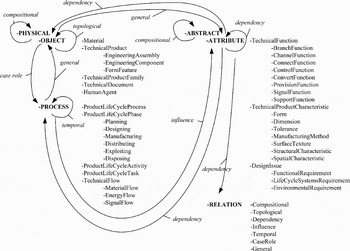
Based upon the previously described evaluation and mapping, the concepts and relations from both ontologies were merged into single proposal: MOED (www.cadlab.fsb.hr/moed). MOED is aimed to be a starting template for researchers and practitioners alike that can be tailored to build ontologies for their particular needs and context. To ensure backward compatibility with the high-level ontologies, SUMO in this case, the four resulting taxonomies (object, process, attribute, and relation) classified between the physical and abstract domains, were generated, merging the knowledge and understanding gained from the previous research work on building two ontologies from different perspectives. Figure 4 shows the concepts on the first two levels of the MOED taxonomies and indicates the relations defined between them.
The MOED concepts and relations at the top level.

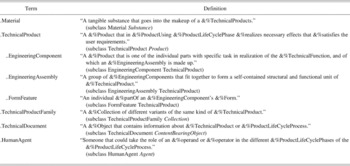
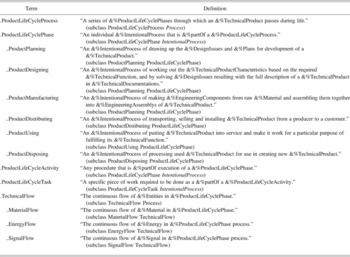
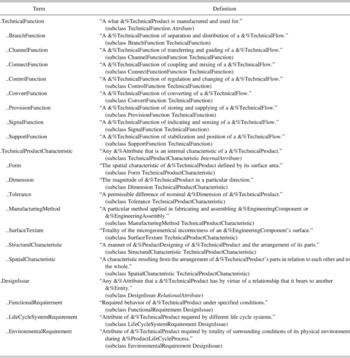
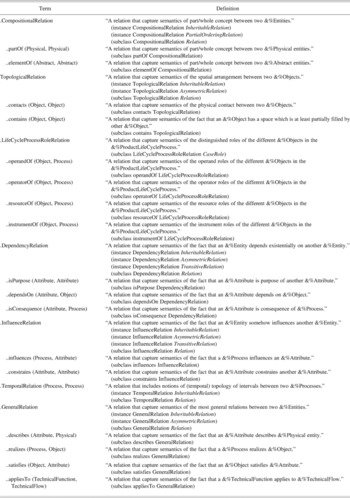
The definitions of the terms in the first two levels of the MOED taxonomies are shown in the following tables. The level of the MOED vocabulary term among specific domains is indicated by the number of dots in the prefix of every particular term and shown in the left column of each table. The definitions of the concepts and relations behind terms, derived based on EDIT, DO, SUMO, and WordNet inputs, are quoted in the right column, as well as definition of the SUMO term that is specialized in the MOED term to ensure compatibility (the SUMO concepts are written in italic style). The prefix “&%” in definitions refers to the MOED term defined in one of the taxonomies (Tables 4–7).
Taxonomy of the MOED physical-object domain

Taxonomy of the MOED physical-process domain

Taxonomy of the MOED abstract-attribute domain
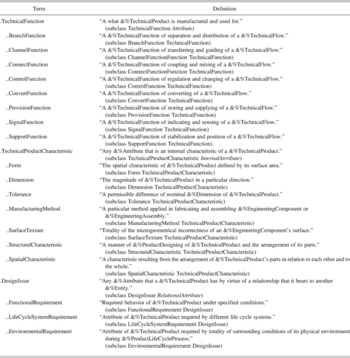
Taxonomy of the MOED abstract-relation domain

The axioms and rules that already exists in SUMO are inherited from the terms defined in SUMO and specialized for the MOED terms. To characterize relations usefully, they are, in addition, defined by axioms considering their logical properties of symmetry, reflectivity, and transitivity that enable inference of the new facts/knowledge among the existing model.
The criteria for evaluating the ontology proposal should include ontological completeness, clarity, and coherence (Wand & Weber, Reference Wand and Weber1993; Uschold & Gruninger, Reference Uschold and Gruninger1996). The evaluation of the MOED ontological completeness is based on the presumption of involving two different ontologies, empirical and theoretical based, that have been evaluated previously. Therefore, the MOED ontology is sufficiently expressive in eliciting the shared meaning of the concepts and relations describing the phenomenon of the engineering design process and its results. Ontological clarity is concerned with the interpretation of meaning of the engineering design concepts and relations applied between them. The aim of MOED has been to derive a shared understanding of the meaning of the concepts and relations identified by categorizing the concepts and relations from engineering design research and design practice according to the high-level ontology. This has been achieved by comparing and contrasting the descriptions given by two different ontological approaches and resolving any ambiguities that arose. As a result, a theoretically consistent and application-sound categorization and definition of each concept and relation are derived. Hence, MOED should address the shortcomings of both DO (which is theoretical) and EDIT (which is for a specific application of indexing knowledge). For example, an ontology to support planning in the product development process in the aerospace industry, could take MOED as a starting point, where the physical process (Table 6) forms the main body, together with relevant concepts from the physical–object domain (to describe the projects that the product development processes refer to) and concepts such as human relations (Table 5). In contrast to the previous ontologies, EDIT did not include human relations, as this was not relevant for the specific application of indexing design knowledge, and DO would be structured from a theoretical viewpoint; hence, the physical product would be embedded low down in the classes.
The engineering design concepts identified have been classified depending on their nature with the purpose of resolving the complexity and uncertainty related to the engineering design process. By describing the relationships between these concepts for each category it is intended that the meaning of each concept has been clearly and consistently defined and the relationships identified. Hence, it is reasonable to suggest that MOED presented here displays ontological coherence. Further work envisaged will focus on extending and evaluating MOED for domain-specific tasks as well as for the specific applications.
6. CONCLUSION
The comparison of the two separate ontologies, DO, with a theoretical foundation, and EDIT, with an empirical foundation, has been undertaken. The process of comparing the ontologies required a deep understanding of the concepts, classes, and relations contained within both ontologies. The comparison process of both approaches enabled the researchers to gain a deep understanding of an alternative research approach to their own, and to validate the two ontologies. The findings are promising in that despite the different approaches employed, the vast majority of concepts and classes were common to both ontologies. All of the top levels contained in EDIT could be found in DO; however, the taxonomies (e.g., function, and issues) may be fragmented and placed in different locations. That is some of the concepts could be found in more than one place, for example, nouns that are physical, but when used in combination with verbs to describe a function become an abstract concept. The comparison process resulted in an evaluation of both ontologies, with a proposal of changes resulting from this.
It was found that it is difficult to set the boundaries of a theoretical ontology; by confronting these with an applied ontology EDIT some of the boundaries became apparent. Without testing a theoretical ontology it is difficult to assess the validity, in terms of usefulness for the particular application. Similarly, an ontology that is based empirically with a particular purpose in mind, such as EDIT, which is primarily focused on indexing of engineering design knowledge, may be presented from the viewpoint of the user in that particular application; hence, concepts may be placed differently from how they would placed in ontologies based on theory.
These conclusions points to the need for tailoring general domain ontologies for a specific application. These conclusions are based upon the ontology studied within the engineering design domain; however, it is not clear that these are specific to the engineering design domain. The approach adopted in the presented research was to create MOED as a template, which is theoretically consistent, but aligned with practitioners' view on the engineering process and product description. It is expected that MOED can contribute to the development of effective and efficient engineering knowledge management methods and tools in the future.
ACKNOWLEDGMENTS
This work was partially funded by the National Foundation for Science, Higher Education and Technological Development of the Republic of Croatia. The materials, ideas, and results reflect the views of the authors and do not necessary reflect the views of the National Foundation for Science. The authors acknowledge the support of EPSRC, Rolls–Royce, and BAE Systems through the UTP for Design for the research leading to the development of EDIT. In particular, we thank Dr. Michael Moss and all of the participating designers for giving their time.
Saeema Ahmed is an Associate Professor in the Department of Management Engineering at the Technical University of Denmark. She achieved her PhD at the Engineering Design Centre Cambridge, where she was also a Research Associate and a Fellow of New Hall. Dr. Ahmed has published over 40 journal and conference papers and book contributions and has served on the scientific boards of three journals and the scientific committees of numerous international conferences. Her research interests include design thinking, management of design knowledge and information, ontology, and product and process modeling.
Mario Štorga is an Associate Professor in the Department of Design in the Faculty of Mechanical Engineering and Naval Architecture at the University of Zagreb, Croatia. He has been a Visiting Researcher at the Technical University of Denmark, Ecole Centrale de Paris, and University of Bath UK. He received his PhD at the University of Zagreb. Dr. Štorga has published over 30 journal and conference papers and has served on the scientific boards of two journals and numerous international conferences. His research interests include product life-cycle management, product and process formal modeling, and design knowledge and information management.