

Even though the full process of seed dispersal is the combination of movement mode and distance, deposition, successful germination and survival (Nathan Reference NATHAN2006, Westcott et al. Reference WESTCOTT, BENTRUPPERBAUMER, BRADFORD and MCKEOWN2005), relatively few studies have documented the role of mammals as facilitators of germination and survival (Paine & Harms Reference PAINE and HARMS2009). In particular, the effectiveness of large terrestrial mammals (>50 kg) as effective dispersers of large seeds is poorly known, but has been linked to the treatment of the seeds in their digestive system, the deposition of viable seeds in nutrient-rich environments (faeces) and favourable sites. Other aspects related to long-distance movements, defecation patterns and home-range size are frequently cited as factors that favour the deposition of seeds far from parent trees, which is expected to reduce predation and intraspecific competition, and enhance fitness (Schupp et al. Reference SCHUPP, MILLERON, RUSSO, Levey, Silva and Galetti2002). We addressed these issues through a large-scale field experiment.
Tapirs are probably one of the last remaining long-distance dispersers for large-seeded species that were once dispersed by Pleistocene mammals, especially in the Neotropics (Janzen & Martin Reference JANZEN and MARTIN1982). For example, in South America, Fragoso (Reference FRAGOSO1997) observed that the lowland tapir (Tapirus terrestris) dispersed large Maximiliana maripa seeds. However, more experiments are needed to demonstrate the role of tapir as an effective long-distance disperser, especially of large-seeded plants.
In this study we tested whether Baird's tapir (Tapirus bairdii; Gill, 1865) facilitates seed dispersal (germination and survival to 1 y) of the large-seeded, dominant tropical tree Manilkara zapota (L.) Royen. In a recent study, we reported intact and viable M. zapota seeds and seedlings in Baird's tapir dung (O'Farrill et al. Reference O'FARRILL, CALMÉ and GONZALEZ2006), contrary to previous observations suggesting that M. zapota seeds are too large and weak to withstand the molar mill of a tapir (Janzen Reference JANZEN1982). Therefore, we designed a large-scale field experiment to mimic the dispersal of M. zapota seeds by tapir to determine: (1) if tapir facilitate Manilkara zapota seed germination, and (2) how deposition sites influence seed germination and survival.
We conducted this research in the Greater Calakmul Region located in the centre of the Yucatan Peninsula in southern Mexico (19°15′–17°50′N, 90°20′–89°00′W). Manilkara zapota is among the co-dominant species in the region (Cruz-Rodriguez & Lopez-Mata Reference CRUZ-RODRIGUEZ and LOPEZ-MATA2004). Manilkara zapota trees are commonly found in stands in non-inundated habitats, but trees are also found at low densities in inundated forest (Heaton et al. Reference HEATON, WHITKUS and GÓMEZ-POMPA1999). In the Greater Calakmul Region, fruits of M. zapota weigh on average (mean ± SD) 30 ± 23 g (n = 925) and contain 2 ± 1.58 seeds. Seed mean dimensions (n = 1900) are: 1.99 ± 0.26 cm long, 1.12 ± 0.26 cm wide and 0.62 ± 0.17 cm thick. Several animal species show a preference for M. zapota fruits in their diets (Reyna-Hurtado et al. Reference REYNA-HURTADO, ROJAS-FLORES and TANNER2009, Rivera & Calmé Reference RIVERA, CALMÉ, Garber, Estrada, Pavelka and Luecke2006), especially at the peak of the dry season (Estrada et al. Reference ESTRADA, LUECKE, VAN BELLE, BARRUETA and ROSALES MEDA2004). In French Guiana and Costa Rica, studies have suggested that howler monkeys (Alouatta spp.) are able to disperse seeds of the Sapotaceae including Manilkara spp. (Chapman Reference CHAPMAN1989, Julliot Reference JULLIOT1996); however in Mexico, extensive field observations suggest that both howler and spider monkeys do not ingest M. zapota seeds (J.C. Serio & S. Calmé, pers. comm.).
In May 2006, we set up an experiment to compare the germination success of M. zapota seeds extracted from fruits (n = 1678) to those obtained from tapir dung (n = 617), when planted in two germination substrates (tapir dung or soil). We planted seeds in fresh tapir dung to mimic the conditions associated with tapir seed dispersal and in soil to simulate the conditions of seed deposition without endozoochorous seed dispersal. Tapir dung was found near waterholes and near M. zapota clumps, so we planted seeds in both habitats. Seeds were deposited at different locations to mimic dispersal to different deposition sites, here different distances from the edge of seasonal waterholes, and beneath or beyond M. zapota crowns in non-inundated M. zapota stands.
We set germination stations during the dry season, and the fruiting period of M. zapota. Germination is expected to vary with distance from the edge of the waterholes because of changing water levels through the dry and wet seasons. As expected during the wet season (2 mo after the experiment was started) the waterholes expanded and we found some germination stations under water. This was not considered a problem, as the location of germination stations close to the regular edge of the waterhole (as defined by soil and vegetation characteristics) were set to mimic the natural deposition of dung piles in latrines often found close to waterholes. Our design thus estimates germination probabilities under natural conditions.
We randomly selected eight M. zapota clumps in our area. Tapirs visit M. zapota clumps regularly during the M. zapota fruiting period. In each M. zapota clump we randomly selected two pairs of M. zapota trees separated by 100 m. Crowns of paired trees did not overlap. From each pair, we selected one focal tree. Its pair was its closest neighbour, which on average was at 17.6 ± 7.18 m. At these pairs of trees, we placed germination stations with tapir and fruit seeds at two different deposition sites: underneath the canopy of the focal tree, and beyond the canopy of the focal tree at half the distance separating the focal from the paired tree. This design allowed us to test germination and survival success depending on whether seeds are under the direct influence of a conspecific tree canopy or not.
At both waterholes and M. zapota stands, we protected each germination station from small predators with a cylindrical wire cage. Stations were set in a paired design. The germination stations contained two seeds extracted from fruits and two seeds extracted from tapir dung. To minimize seasonal variation, all seeds were planted within a 10-d period. We put four seeds per cage, as this was the mean density of seeds observed in 325 dung piles collected. However seed number in dung varied from two to 40, which suggests that potential density effects may arise.
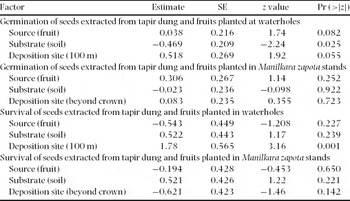
For data collection, we visited the sites once a month from May to September 2006 and in April and May 2007. During each visit we recorded seed germination. At the end of the experiment, we recorded seeds as germinated if a seedling developed even if it died sometime after germination. Here we report a seedling as survived if it had not died by May 2007 (after 1 y). We analysed the effects of the experimental treatments on (1) germination, and (2) survival of tapir and fruit seeds in waterholes and M. zapota stands with hierarchical mixed models and binomial errors. Our full models included source (tapir or fruit) and substrate (dung or soil) as fixed factors (Table 1). We nested site, replicate, deposition site, cage and substrate hierarchically. We treated source, substrate, site, replicate, deposition site and cage as categorical variables. The response variables were binomial: germinated or not germinated, survived or nor survived. We conducted all statistical tests using R 2.70.
Outputs of the hierarchical mixed-model analyses for germination and survival of seeds extracted from tapir dung vs. seeds extracted directly from fruits and planted in the two types of habitat, waterholes and Manilkara zapota stands. Pr (>|z|) represents the probability of z score.

After 1 y, one-third of the total number of seeds planted germinated (340 seeds out of 1024), with similar germination success for tapir (155/512 = 30%) and fruit (185/512 = 36%), seeds. At the end of this experiment, 65% (221/340) of the seedlings survived, 63% (102/163) in waterholes and 67% (119/177) in M. zapota stands. Therefore, by the end of the experiment, the recruitment of seedlings corresponded to 22% of the initial number of seeds planted.
At waterholes we planted a total of 512 seeds extracted from tapir dung and fruits of which 32% (163/512) germinated. We did not find a significant difference in germination between seeds from tapir dung and fruit (z = 1.74, P = 0.082). The main effect of substrate revealed that germination probabilities were significantly lower in soil than dung (z = −2.24, P = 0.025). Given that waterholes can flood during the wet season, we expected lower germination probabilities closer to water. We found that seeds planted at 100 m from the regular edge of the waterhole germinated slightly more (by 9%) than seeds planted at 2 m; however these differences were not significant (z = 1.92, P = 0.055). In M. zapota stands, 35% (177/512) of planted seeds germinated. There were no significant differences in source and substrate effects on mean germination probability (Table 1), suggesting that tapirs do not compromise seed germination. There was no effect of deposition site (beneath or beyond the crown) on mean germination success.
At waterholes, 63% (102/163) of the emerged seedlings survived, 70% (50/71) from seeds extracted from tapir dung and 56% (52/92) from seeds extracted directly from fruits. We did not find a significant difference in the survival of seedlings emerging from seeds extracted from tapir dung and seeds extracted directly from fruits when planted either in soil or dung. Deposition site had a significant effect on survival; seedlings survived on average 30% more when planted at 100 m than at 2 m from the edge of the waterhole. Of the total number of seeds planted at waterholes, 20% (102/512) produced seedlings that survived after 1 y. In M. zapota stands, 67% (119/177) of the emerged seedlings survived, 62% (52/84) from tapir seeds and 72% (67/93) from fruit seeds. Of the total number of seeds planted in this habitat type, 23% (119/512) produced seedlings that survived after 1 y, a percentage similar to the recruitment found in waterholes. For seedlings in M. zapota stands, we did not find statistically significant effects of the main factors in our analysis.
Seed dispersal is the movement of seeds far from parent trees and the deposition of seeds in favourable sites for germination. Seed-dispersal studies should evaluate the role of dispersers in facilitating/inhibiting germination both through ingestion and deposition at sites of variable quality for germination success. The presence of intact M. zapota seeds in tapir dung together with their germination demonstrates that tapirs move viable seeds throughout their habitat. The neutral effect of tapir on seed germination observed in this study is consistent with the neutral effect of non-flying mammals on germination found in 40% of the studies reported by Traveset (Reference TRAVESET1998). Contrary to other studies with large terrestrial mammals, our results did not show that passage through the animal's digestive system enhanced germination (Campos et al. Reference CAMPOS, PECO, CAMPOS, MALO, GIANNONI and SUAREZ2008). In addition, seed dispersal by endozoochory always results in seed deposition in dung, but the effect of dung on the germination probabilities of dispersed seeds has often been neglected (Andresen Reference ANDRESEN2002).
Our results show that germination probabilities generally increase in the dung substrate. This suggests that the microhabitat conferred by dung may enhance the survival of seeds even if damaged during digestion (Campos et al. Reference CAMPOS, PECO, CAMPOS, MALO, GIANNONI and SUAREZ2008, Fragoso & Huffman Reference FRAGOSO and HUFFMAN2000), or deposited in soil types that inhibit germination. Tapir seeds planted in dung and soil showed similar germination probabilities in the M. zapota stands, suggesting better soil conditions promoting seed germination of fruit seeds in M. zapota stands than in waterholes. This result indicates that the net effect of tapir dispersal does not reduce germination probability and introduces the potential benefit of long-distance displacement, although germination success will depend upon site quality.
Our experimental design allowed us to show that dispersal by other animals (e.g. monkeys or bats) that do not pass the large Manilkara seeds through their digestive system and simply drop them on bare ground in the absence of dung (fruit seeds planted in soil experimental conditions) does not inhibit germination. However tapirs, that can move many kilometres over the time required for digestion, have the potential benefit of dispersing seeds over long distances and far from parent trees.
Although previous field studies on the role of tapirs as seed dispersers exist (Fragoso Reference FRAGOSO1997, Fragoso & Huffman Reference FRAGOSO and HUFFMAN2000, Galetti et al. Reference GALETTI, KEUROGHLIAN, HANADA and MORATO2001, Tobler et al. Reference TOBLER, JANOVEC and CORNEJO2010), this study is novel because it demonstrates experimentally the effect of the digestive system, deposition substrate (dung) and site effects on the germination success and survival when seeds are deposited in locations regularly visited by tapirs.
ACKNOWLEDGEMENTS
We are grateful to the people of Nuevo Becal. Nicolas Arias, Miguel Xijun, Eduardo Carrera and Kim Gauthier provided invaluable assistance during fieldwork. Colin and Lauren Chapman made helpful suggestions for improving the experiment. Colin Chapman, Norbert Cordeiro and Martin Lechowicz provided valuable comments on the manuscript. We acknowledge the financial support of the American Society of Mammalogists (G.O.), Idea Wild (G.O.), the National Science and Engineering Research Council from Canada (NSERC) through Discovery grants (R.S. and A.G.) and Canada Research Chair Program (A.G.), and the NASA-LCLUC program (NAG5-6046 and NAG5-11134) to the Southern Yucatán Peninsular Region (SYPR) project (S.C.). Consejo Nacional de Ciencia y Tecnologia-Mexico (CONACYT) supported G.O. through a doctoral fellowship.