Depression is a chronic, recurrent disorder resulting in substantial health and economic burdens. In the USA, annual costs associated with depressive disorders are estimated at approximately $83 billion(Greenberg et al. Reference Greenberg, Kessler, Birnbaum, Leong, Lowe, Berglund and Corey-Lisle2003) and depressive disorders are projected to be the leading cause of disease burden by the year 2030 (Mathers & Loncar, Reference Mathers and Loncar2006). A significant attributing factor to the disease burden associated with depressive disorders is the prevalence of co-morbid medical conditions in persons with depression. Compared with the general populations, persons with depression are more likely to have cardiovascular disease, type 2 diabetes, and certain cancers (Musselman et al. Reference Musselman, Evans and Nemeroff1998; Musselman et al. Reference Musselman, Betan, Larsen and Phillips2003; Currier & Nemeroff, Reference Currier and Nemeroff2014).
Underlying all of comorbid medical conditions may be the influence of metabolic syndrome (MetS). MetS is a constellation of conditions associated with an increased risk of cardiovascular disease and type 2 diabetes. It is estimated that over 40% of individuals with depression meet criteria for MetS (Rethorst et al. Reference Rethorst, Bernstein and Trivedi2014). The relationship between depression and MetS appears to be bi-directional as MetS is associated with an increased risk of future depression, and conversely depression is a risk factor for future onset of poor metabolic health (Kinder et al. Reference Kinder, Carnethon, Palaniappan, King and Fortmann2004; Goldbacher et al. Reference Goldbacher, Bromberger and Matthews2009; Pan et al. Reference Pan, Keum, Okereke, Sun, Kivimaki, Rubin and Hu2012).
Given the risk of poor physical health associated with both depression and MetS, it is unsurprising that previous research has also demonstrated the detrimental effects on mortality for both depression and MetS (Cuijpers & Smit, Reference Cuijpers and Smit2002; Ford, Reference Ford2005; Church et al. Reference Church, Thompson, Katzmarzyk, Sui, Johannsen, Earnest and Blair2009). However, no previous research has examined the two risk factors concurrently. Additionally, persons with depression (Galper et al. Reference Galper, Trivedi, Barlow, Dunn and Kampert2006; Vallance et al. Reference Vallance, Winkler, Gardiner, Healy, Lynch and Owen2011) and MetS (Park et al. Reference Park, Zhu, Palaniappan, Heshka, Carnethon and Heymsfield2003; Ford et al. Reference Ford, Kohl, Mokdad and Ajani2005; Brien et al. Reference Brien, Janssen and Katzmarzyk2007; Sisson et al. Reference Sisson, Camhi, Church, Martin, Tudor-Locke, Bouchard, Earnest, Smith, Newton, Robert and Rankinen2009) engage in less physical activity and have poorer cardiorespiratory fitness (CRF). The effect of CRF on mortality is well-established (Blair et al. Reference Blair, Kohl, Paffenbarger, Clark, Cooper and Gibbons1989; Church et al. Reference Church, Cheng, Earnest, Barlow, Gibbons, Priest and Blair2004; Church et al. Reference Church, Lamonte, Barlow and Blair2005; Lee et al. Reference Lee, Shiroma, Lobelo, Puska, Blair and Katzmarzyk2012), suggesting that higher levels of CRF might attenuate the mortality risk associated with depression and/or MetS. However, the effect of CRF on mortality in individuals with depression and/or MetS has not been established.
The purpose of this paper is to quantify the mortality risk associated with depression and MetS in data from the Cooper Center Longitudinal Study (CCLS). We hypothesized that depression and MetS would each be associated with an increased risk of mortality and that these effects would be independent such that individuals with comorbid depression and MetS would have the highest mortality risk. Furthermore, we examined the effect of CRF on mortality risk of in the presence of depression and MetS. We hypothesized that individuals with high CRF would have lower mortality risk such that high CRF individuals with depression and/or MetS would not demonstrate an increased mortality risk.
Methods
CCLS overview
The CCLS is a prospective study of individuals who complete a preventive medical examination at the Cooper Clinic in Dallas, TX from 1986 to 2010. In the present analysis, conducted in 2015–2016, participants were excluded if they reported a personal history of cardiovascular disease (n = 153), did not reach 85% of their predicted maximal heart rate on the treadmill test (n = 2568) or were outside the age range 20–75 years (n = 441). Participants were also excluded if they had missing data for covariates (n = 9733) or had less than 1 year of follow-up (n = 14). These criteria resulted in an analytic sample of 13 868 women and 33 834 men aged 20–75 years. The Cooper Institute's Institutional Review Board reviewed and approved the overall study annually. CCLS details have been described previously (Blair et al. Reference Blair, Kohl, Paffenbarger, Clark, Cooper and Gibbons1989; Blair et al. Reference Blair, Kampert, Kohl, Barlow, Macera, Paffenbarger and Gibbons1996; Wei et al. Reference Wei, Gibbons, Kampert, Nichaman and Blair2000; Church et al. Reference Church, Cheng, Earnest, Barlow, Gibbons, Priest and Blair2004; Church et al. Reference Church, Lamonte, Barlow and Blair2005). Below is an overview of study methodology relevant to the current analysis.
Clinical examination
Participants completed self-report assessments of health history and medication use, which were then verified by a physician during the medical exam. Waist circumference and blood pressure were assessed by trained technicians using standard protocols. Fasting blood draws were collected and serum samples were analyzed for MetS criteria. A maximal exercise test utilizing a modified-Balke protocol was conducted to assess CRF (Blair et al. Reference Blair, Kohl, Paffenbarger, Clark, Cooper and Gibbons1989).
Measures
History of depression
History of depression was determined by patient response (yes or no) to standardized medical history questionnaire (Please indicate whether you have had a significant problem with any of the symptoms or conditions listed below).
Metabolic syndrome
MetS was categorized using the American Heart Association/National Heart, Lung, and Blood Institute criteria for MetS (Grundy et al. Reference Grundy, Cleeman, Daniels, Donato, Eckel, Franklin, Gordon, Krauss, Savage and Smith2005). Presence of MetS was defined as presence of three or more of the following risk factors: elevated waist circumference (⩾ 40 inches in men, ⩾ 35 in women), elevated triglycerides (⩾ 150 mg/dL), reduced HDL-C (<40 mg/dL in men, < 50 mg/dL in women,), elevated blood pressure (⩾ 130 mm Hg systolic blood pressure or ⩾ 85 mm Hg diastolic blood pressure), and elevated fasting glucose (⩾ 100 mg/dL) (Grundy et al. Reference Grundy, Cleeman, Daniels, Donato, Eckel, Franklin, Gordon, Krauss, Savage and Smith2005).
Cardiorespiratory fitness
CRF was estimated from the final speed and grade of a treadmill graded exercise test and expressed as metabolic equivalent of tasks (American College of Sports Medicine, 2013). As with previous analyses of the CCLS data, patients were grouped by fitness categories (low, moderate, high) using age- and sex-specific normative data in the entire study cohort (Blair et al. Reference Blair, Kohl, Paffenbarger, Clark, Cooper and Gibbons1989).
Mortality
Participants were followed from the date of their baseline visit until date of death or 31 December 2010. Mortality status for each participant was attained from the National Death Index. Mean follow-up period for the sample was 12.4 years.
Covariates
Age, sex, and smoking status were collected via patient self-report and were included as covariates in the statistical analysis.
Statistical analysis
The current analysis utilizes data from CCLS subjects enrolled prior to 2010. Subjects were excluded from the analysis if data were missing for history of depression, MetS criteria, or CRF. Demographic and clinical characteristics were summarized by history of depression at baseline. Differences between those with a history of depression and those without were tested using likelihood ratio chi-square statistics for nominal characteristics and rank-sum statistics for ordinal and continuous characteristics. Empirical survival v. age at follow-up was estimated and tested using the Breslow method to account for late entry to the risk set (Breslow, Reference Breslow1972). Unadjusted and adjusted hazard ratios were estimated using proportional hazards regression. Age at follow-up was specified as the dependent variable, and a counting process formalism was used to account for late entry and right censoring. Adjustment variables included sex, age, current smoking, and CRF. Preliminary models including interaction terms for history of depression and MetS and for each adjustment variable with history of depression and MetS; insignificant interaction terms were dropped from the final model. All analyses were programmed in SAS/STAT®, version 9.4 (SAS Institute Inc., Cary NC, USA).
Results
Descriptive statistics
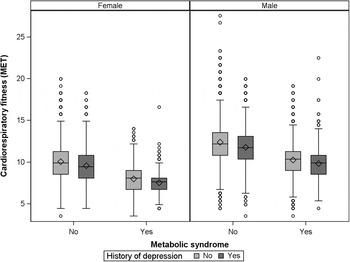
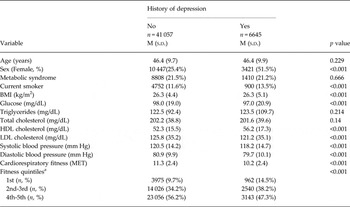
A total of 47 702 individuals are included in the analysis, of which 6645 (13.9%) reported a history of depression, 10 218 (21.4%) met criteria for MetS, and 1410 (3.0%) met criteria for MetS and reported a history of depression. Those reporting a history of depression were more likely to be female, a current smoker, and have lower CRF. There was no difference in prevalence of MetS across those with and without depression history; however, there were significant differences between the groups in individual components of MetS (Table 1). Males had a significantly higher CRF than females, while history of depression and MetS were both associated with significantly lower CRF (p < 0.001; Fig. 1).
Cardiorespiratory fitness by sex, history of depression, and MetS status. Boxes extend from the 25th to 75th percentiles. Within the boxes, medians are indicated by horizontal lines and means by diamonds. Outliers, data located more than 1.5 inter-quartile ranges above or below the box, are shown as circles. Whiskers extend to the range of data excluding outliers.

Baseline demographic and clinical characteristics

a Fitness quintiles by CCLS age- and sex-adjusted fitness quintiles
Mortality associated with depression and MetS
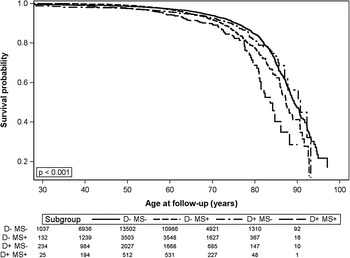
There were 1733 deaths overall including 684 among those with history of depression or MetS at baseline. History of depression (unadjusted HR = 1.17, 95% CI 1.02–1.34, p = 0.027) and MetS (unadjusted HR = 1.58, 95% CI 1.43–1.75, p < 0.001) were independently associated with an increased risk of mortality. As can be seen in the empirical survival curve (Fig. 2), the greatest mortality risk was among individuals with both MetS and a history of depression. The interaction effect of history of depression and MetS on mortality was not significant (HR = 1.33 v. sum of main effects, p = 0.054, post hoc power = 44%, with 80% power to detect HR ⩾ 1.56 or ⩽ 0.64).
Unadjusted empirical survival by depression and MetS status.

Effect of CRF on mortality
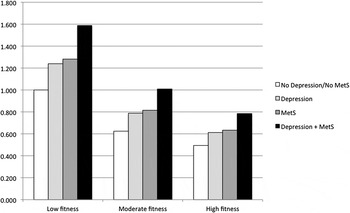
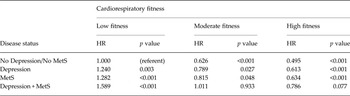
In the adjusted model, history of depression (HR = 1.24, p = 0.003) and MetS (HR = 1.28, p < 0.001) remained associated with increased risk of mortality. CRF was associated with a significantly lower risk of mortality. The hazard ratio of those of moderate fitness relative to those of low fitness was HR = 0.64 (p < 0.001), while those of high fitness relative to those of low fitness was HR = 0.50 (p < 0.001). To illustrate the effect of CRF on mortality, even those with comorbid MetS and history of depression in the moderate or high fitness category were not at greater risk of mortality compared with the reference group (Table 2, Fig. 3). The effect of CRF on mortality was consistent across the entire sample and not significantly different among individual with a history of depression and/or MetS.
Adjusted hazard ratio for mortality by depression, MetS, and cardiorespiratory fitness status.

Joint association of depression, metabolic syndrome and cardiorespiratory fitness on all-cause mortality a

HR: Hazard ratio as compared with reference group (no depression, no MetS, lowest quintile fitness).
a Fitness categories by CCLS age- and sex-adjusted fitness quintiles: Low = Q1, Moderate = Q2–3, High = Q4–5.
Discussion
This study revealed that a history of depression and MetS were each associated with a significant mortality risk. Depression and MetS have both previously been associated with an increased risk of mortality. Our analysis indicates that the effects of these disorders on mortality are independent.
Our results highlight the detrimental long-term health effects associated with depression, independent of MetS. Depression and MetS are commonly co-occurring disorders and our results indicate that both must be managed to optimize patient outcomes. In primary care settings, depression is often underdiagnosed (Coyne et al. Reference Coyne, Schwenk and Fechner-Bates1995) and this may be especially true of patients with chronic physical health conditions. Among patients with diabetes, it is estimated that nearly half of cases of depression are not diagnosed (Katon et al. Reference Katon, Simon, Russo, Von Korff, Lin, Ludman, Ciechanowski and Bush2004). Furthermore, depression treatment is suboptimal in this population, with only 64% receiving adequate dosage of an antidepressant medication or psychotherapy (Katon et al. Reference Katon, Simon, Russo, Von Korff, Lin, Ludman, Ciechanowski and Bush2004).
The mortality risk was greatest for those with the lowest CRF. The mortality risk among individuals in the lowest category of fitness was more than 50% greater compared with those who were most fit. This result highlights the detrimental effects of low CRF in persons with depression and/or MetS. The protective effects of CRF suggest that increasing physical activity in persons with depression would have result in substantial improvements in health. Though we must note that while CRF and physical activity are highly correlated, recent research has identified the two constructs as independent predictors of cardiovascular health (DeFina et al. Reference Defina, Haskell, Willis, Barlow, Finley, Levine and Cooper2015; Myers et al. Reference Myers, McAuley, Lavie, Despres, Arena and Kokkinos2015). Our analysis also shows that those with a history of depression and/or MetS are more likely to be unfit. Previous research has also demonstrated lower fitness or physical activity in these patient populations. Analysis of the National Health and Nutrition Survey data indicates individuals with depression engage in 50% less moderate-to-vigorous physical activity compared with those without depression (Vallance et al. Reference Vallance, Winkler, Gardiner, Healy, Lynch and Owen2011). Similarly, those with MetS also engage in less physical activity (Ford et al. Reference Ford, Kohl, Mokdad and Ajani2005). Therefore, these individuals are among those most likely to benefit from strategies to increase physical activity. An example of this is illuminated in recent research in cardiac rehabilitation patients. Psychological distress and depression are predictive of poor outcomes in this population (Kachur et al. Reference Kachur, Menezes, De Schutter, Milani and Lavie2016); however, engaging these patients in exercise reduces these psychological risk factors and improves long-term prognosis (Lavie et al. Reference Lavie, Menezes, De Schutter, Milani and Blumenthal2016).
Despite the large sample size and the objective measurement of CRF, there are limitations to our study. Generalizability is limited as the study sample was primarily of higher socioeconomic status Caucasians. Another limitation is reliance on a single item self-report to define who had and had not been depressed. This approach does not allow for assessment of depression severity, duration, or recurrence, all of which may be associated with an increased mortality risk. However, the advantage to this approach is that it allows for assessment of lifetime prevalence of depression in contrast a depression symptom scale, which would only capture point prevalence of depression.
We found that a history of depression and MetS were independently associated with a greater mortality risk such that those with both a history of depression and MetS had the greatest mortality risk. Moderate or high CRF was associated with a lower mortality risk in the persons with a history of depression and/or MetS. These findings suggest that interventions that increase CRF could significantly reduce the health burden experience by individuals with a history of depression and/or MetS.
Acknowledgements
We would like to thank A. John Rush for his thoughtful review and critique of the manuscript. In addition, we thank Dr Kenneth H. Cooper of the Cooper Clinic for establishing the CCLS, the Cooper Clinic physicians and technicians for data collection, and The Cooper Institute staff for data management. No funding sources were involved in the design or conduct of the study. Chad D. Rethorst is supported by NIMH K01MH097847. NIMH had no role in the analysis and interpretation of the data; or preparation review, or approval of the manuscript; or the decision to submit the manuscript for publication.