

Introduction
To an outside observer of Italian politics, the 2018–2022 legislative period must seem like a variety show. Following the 2018 elections, executive changed hands in quick succession: from a populist coalition (Conte I, supported by the Five Star Movement – M5S – and the League) to a mixed populist-mainstream government (Conte II, supported by the M5S and the Democratic Party), and finally to an all-out technocratic cabinet led by former ECB president Mario Draghi, supported by an oversized coalition. This sequence is highly unusual in comparative perspective. While populist parties in government have become more frequent across Europe, all-populist coalitions remain rare (Monaco, Reference Monaco2023). Moreover, technocratic cabinets and non-partisan prime ministers are generally appointed in times of national crisis, rather than as a result of “ordinary” politics (Brunclík and Parízek, Reference Brunclík and Parízek2019). The brief return of the previously governing Democratic Party, connecting these two anomalies, only underscores the “rollercoaster” experience of Italian politics.
What is unusual about these developments is not the formation of unconventional cabinet coalitions per se: in parliamentary government the constellation of the legislative party system constrains executive politics, occasionally forcing politicians to explore new solutions (e.g. Casal Bértoa and Weber, Reference Casal Bértoa and Weber2024). However, in this recent Italian case, the quest for executive office possibly led party elites to depart from the very logic of policy-oriented coalition building. Rather than trading pledges for policy goals, political competition shifted toward a focus on the way such goals are defined, justified, and pursued. A shift most evident in the attempts of the populist contenders in the first part of the term to distinguish themselves from the established “elite” (Albertazzi and Vampa, Reference Albertazzi and Vampa2021), and also in the rhetoric that surrounded the later technocratic government (Giannone and Cozzolino, Reference Giannone and Cozzolino2023). A notable example of this debate became popular on the media, extracted from a parliamentary debate on July 20, 2022, shortly before the fall of the Draghi government. During this session, Draghi, echoing some of the technocratic-populist rhetoric seen in mainstream newspapers, stated, “I'm here because Italians asked me.”Footnote 1 Parliament veteran Pier Ferdinando Casini quickly replied “[you are here] because there was no no-confidence vote in Parliament.”Footnote 2
The relevance of this tumultuous 2018–2022 legislative term in Italy becomes evident when assessed against the backdrop of canonical theory. Traditionally, parties compete through policy differentiation, either changing positions on specific issues or selectively emphasizing their most favorable policy objectives. In this sense, party competition revolves around proposing specific policy goals, where such goal definition can be considered as the defining feature of politics itself (Parsons et al., Reference Parsons, Bales and Shils1953). However, we argue that these peculiarities observed in Italy point to additional aspects of party differentiation, possibly of broader relevance in comparative perspective: that is, preferences not related to the content of a policy but to the definition of goals that can be legitimately discussed and pursued, with specific regard to the actors and interactions involved in defining the goals of a polity.
In this article, we then first argue for the relevance of two additional dimensions complementing traditional dimensions of issue politics. These dimensions – elite vs. bottom-up and monist vs. pluralist preferences – capture the goal definition preferences of parties and citizens. We not only draw connections to, but also expand upon, the literature on conflicts at the origin of mass democracy (e.g. Lipset and Rokkan, Reference Lipset, Rokkan, Lipset and Rokkan1967; Dahl, Reference Dahl1971), the crisis of the party government model (e.g. Katz and Mair, Reference Katz and Mair1995), and discussions on populism, technocracy, and process preferences (e.g. Caramani, Reference Caramani2017; Bertsou and Caramani, Reference Bertsou and Caramani2022). Recent political developments have indirectly highlighted the relevance of these dimensions, through models identified in the literature as either populist or technocratic: models emphasizing broader conflicts, such as elites vs. masses and the acceptance of pluralism, which have been crucial since the inception of mass democracy (Lipset and Rokkan, Reference Lipset, Rokkan, Lipset and Rokkan1967; Dahl, Reference Dahl1971) and continue to shape the evolution and crisis of party government, with relevance for vote choice (e.g. Michels, Reference Michels1911; Katz and Mair, Reference Katz and Mair1995; Barker and Carman, Reference Barker and Carman2010; Akkerman et al., Reference Akkerman, Zaslove and Spruyt2017; Andreadis and Stravrakakis, Reference Andreadis and Stravrakakis2017; Van Hauwaert and Van Kessel, Reference Van Hauwaert and Van Kessel2018; Werner, Reference Werner2019; Hawkins et al., Reference Hawkins, Kaltwasser and Andreadis2020; Costa, Reference Costa2021; Heyne and Costa Lobo, Reference Heyne and Costa Lobo2021; Lavezzolo et al., Reference Lavezzolo, Ramiro and Fernández-Vázquez2021). Overall, quite many roads may lead to Rome and into its government institutions.
By exploring these additional spatial dimensions, we aim to integrate emerging insights with the existing spatial modeling literature. This approach allows us to evaluate the electoral impact of goal definition preferences compared to more commonly studied policy preferences, thus determining their relative importance in a nuanced understanding of party preferences. Our empirical investigation begins with a comparative exploration, revealing that common survey items pertaining to these dimensions are significant predictors of party choice across various countries, with Italy ranking in the middle. Focusing on the distinctiveness of the Italian case (in terms of the significant incorporation of these dimensions into party supply), we conduct a detailed empirical analysis of this case. This analysis leverages a theoretically grounded operationalization of the two proposed dimensions through an extensive set of survey items and original expert survey data. Our empirical findings show that these dimensions influence voter and party differentiation in Italy in 2022, demonstrating their substantial relevance for party preference, even compared to traditional policy issues. This suggests the presence of another “sleeping giant” (Van der Eijk and Franklin, Reference Van der Eijk, Franklin, Marks and Steenbergen2004) in popular preferences that could be activated by appropriate party supply. We discuss the implications of our findings for general and Italian politics in the concluding section.
Are elitism and pluralism relevant for party choice? A first comparative exploration
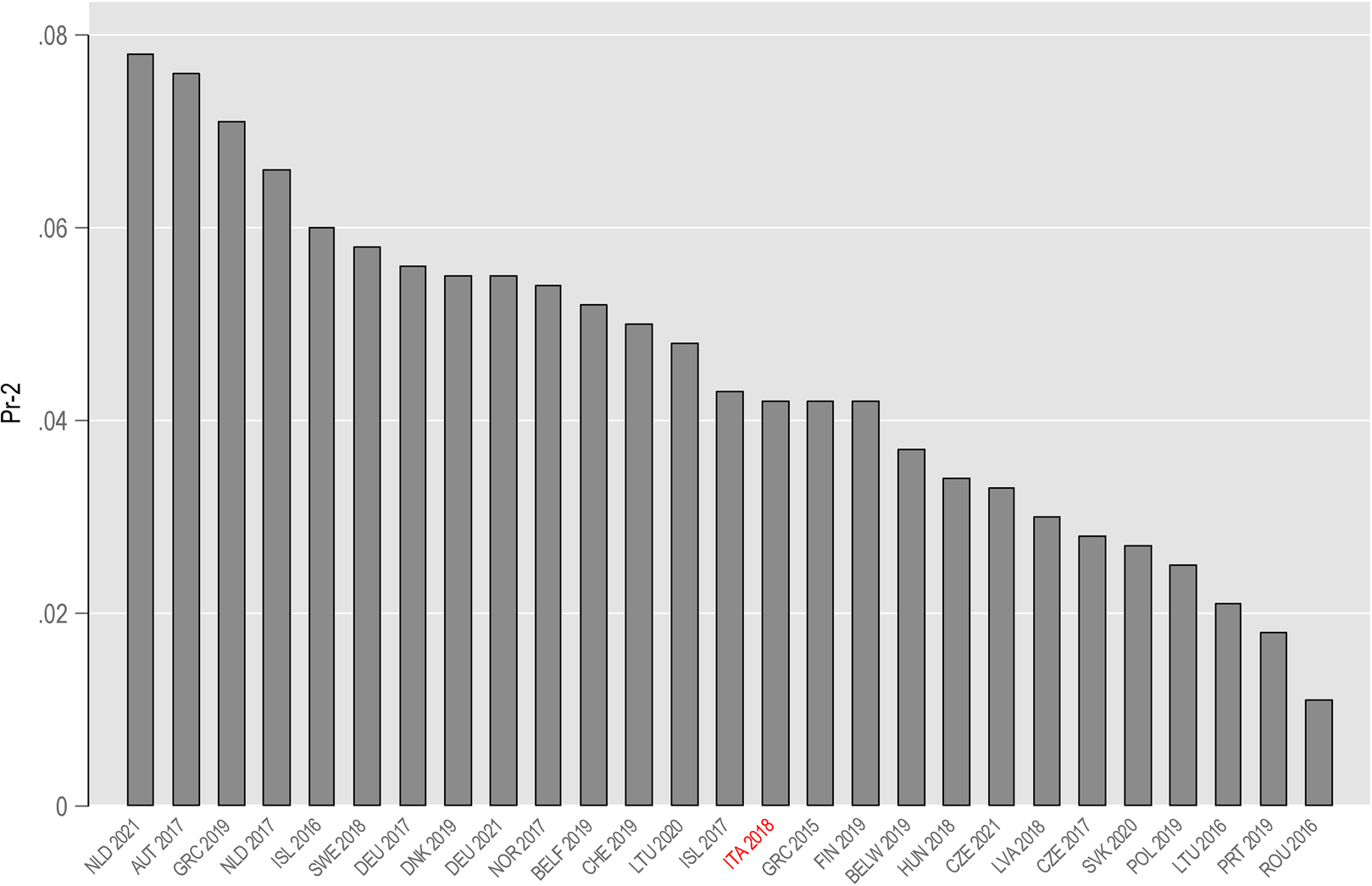
Our interest in the relevance of elitism and pluralism for party choice and competition emerges from their significance in recent Italian political developments, which we detail below. However, developing a theoretical and measurement framework for in-depth analysis is only justified for a phenomenon with potentially broader implications. Thus, we introduce a preliminary empirical exploration of how elitism and pluralism influence party choice, in comparative perspective. Using data from the fifth wave of the Comparative Study of Electoral Systems (CSES, 2016–2021), which includes items related to elitism and pluralism, we ran country-specific (multinomial logit) regression models of vote choice on elitism and pluralism for 27 elections.Footnote 3 Figure 1 presents country-election-specific model performance (pseudo-R 2).
Performance of voting choice models based on elitism and pluralism (pseudo-R 2) across 27 elections.

The key finding is that goal definition preferences are differentiated among voters, and these differences are significantly associated with party preferences in many polities. Apparently, in several countries party choice is already non-negligibly affected by voter attitudes on issues related to elitism and pluralism. Interestingly enough, this is happening in countries that have yet not experienced a full supply-driven mobilization of these conflict dimensions in terms of viable government options (as we shall argue for Italy 2018–2022 below). This pattern suggests the existence of a “sleeping giant” in voter demand (Van der Eijk and Franklin, Reference Van der Eijk, Franklin, Marks and Steenbergen2004) that could be awakened by active party strategies – an observation calling for more in-depth theorization and measurement due in the next section.
Interestingly, the predictive ability of elitism and pluralism for Italy (2018) is not particularly high. Italy ranks quite median (15th) among European countries, despite the 2018 elections marking the highest success ever for the M5S, and few years after the Monti technocratic government. In other words, Italy in 2018 was no front-runner in terms of voter demand, rather holding a somewhat intermediate position. This observation sets the stage for a second feature of the analysis, presented later: a dedicated focus on voter attitudes and party choices in Italy 2022, after a turbulent legislative term. Before delving into this empirical analysis, we first introduce the theoretical framework and our operationalization.
Defining political goals
The study of preferences regarding which kind of actors and decision-making processes should govern a country has long been a cornerstone of political science (e.g. Almond and Verba, Reference Almond and Verba1963). Recently, however, there has been a resurgence of interest on support for specific decision-making mechanisms and instruments (König et al., Reference König, Siewert and Ackermann2022), examining, for example, support for the introduction or strengthening of direct democracy instruments (e.g. Gherghina and Geissel, Reference Gherghina and Geissel2020), fostering deliberative democracy (e.g. Pilet et al., Reference Pilet, Bol, Vittori and Paulis2023), or increasing the involvement of technical experts in democratic decision-making processes (e.g. Bertsou and Pastorella, Reference Bertsou and Pastorella2017; Chiru and Eynedi, Reference Chiru and Enyedi2022; Lavezzolo et al., Reference Lavezzolo, Ramiro and Fernández-Vázquez2021).
While the burgeoning literature on process preferences mostly focuses on actual processes, means, and techniques to identify goals, our approach adopts a broader perspective. We focus on general preferences regarding the mode of interactions for goal definition. We posit that preferences of citizens (and parties) can be parsimoniously arranged on two dimensions:
(1) A vertical dimension: considering that there is a clear differentiation in resources between (political and non-political) elites and the large mass of ordinary citizens, should goals be identified through top-down selection, originating from elites, or bottom-up selection originating from ordinary citizens?
(2) A horizontal dimension: on each policy issue, should a polity legitimately accept only a single, widely shared common goal (a monist vision of government), or should multiple, alternative goals be accepted, forming a pluralist competition among different parts of society (implying that the view of a majoritarian part of society can legitimately be pursued by the whole government)?
In fact these two dimensions shaped the very birth of mass democracy, seen as a transition from closed hegemonies to polyarchies (Lipset and Rokkan, Reference Lipset, Rokkan, Lipset and Rokkan1967; Dahl, Reference Dahl1971): the gradual legitimation of opposition marked a transition from an ideal of monism to full acceptance of pluralism; and increasing opportunities for participation realized the inclusion of ordinary citizens into goal definition (Dahl, Reference Dahl1971). With the advent of mass democracy and pluralist party government (Katz, Reference Katz, Rohrschneider and Thomassen2020) these dimensions became less prominent: but still with a relevance of the vertical, elite-mass dimension, especially for conflicts among and within parties.
A crucial aspect of this vertical dimension is who gets to define political goals considered acceptable for discussion and decision-making in a political system. When ordinary citizens define them, the citizens–elites interaction is “bottom-up,” while becoming “top-down” when elites define these goals. This opposition can be associated with what is known in the literature as elitism (vs. anti-elitism), along with the corresponding attitudes; and it clearly resonates with acknowledged distinctions between populism and technocracy (Caramani, Reference Caramani2017): technocracy stresses the role of objective scientific rationality in decision-making, pledging for increased importance of non-political expert elites in identifying societal problems and advancing technical solutions; populism, on the other hand, highlights the centrality of the will of the uncorrupt people in guiding decision-making processes.
But this distinction is also relevant for the classic function of political parties in representative democracy: they select goals as part of their platforms while intentionally neglecting others, thus with a key agenda-setting role. This raises an important question: should parties adopt a bottom-up perspective, essentially mirroring the political goals of their supporters, or should their leadership have relative autonomy in identifying these goals?
This latter conflict has shaped the analysis of political parties in Western Europe: from historical contributions on oligarchic tendencies in mass parties (Michels, Reference Michels1911) to genetic and organizational distinctions between elite (cadre) and mass parties (Duverger, Reference Duverger1950). Additionally, scholars noted growing independence of party elites from their constituency, often geared toward more policy flexibility to build alliances with other elites, that is, interest groups (Kirchheimer, Reference Kirchheimer, La Palombara and Weiner1966; Panebianco, Reference Panebianco1987); detaching from society as parties evolved into elite-oriented articulations of the state (Katz and Mair, Reference Katz and Mair1995). Such transformations, weakening the party on the ground (Katz and Mair, Reference Katz and Mair1993) vis-à-vis the elite faces of the party, also led to increasing relevance of the conflict between top-down and bottom-up views of party behavior and government, related to a general debate about democratic representation (Andeweg and Thomassen, Reference Andeweg and Thomassen2005) and to the responsiveness–responsibility tension emerging in party government action (Mair, Reference Mair, Schäfer and Streeck2013, Reference Mair and Mair2014; Karremans and Lefkofridi, Reference Karremans and Lefkofridi2020).
Regarding the horizontal dimension (monism vs. pluralism), diffusion of the party government model of mass democracy (Schattschneider, Reference Schattschneider1942; Rose, Reference Rose1969; Katz, Reference Katz and Katz1987, Reference Katz, Rohrschneider and Thomassen2020; Thomassen, Reference Thomassen, Jennings and Mann1994) somewhat reduced its prominence, due to relatively uncontested acceptance of pluralistic goal definition, implicit in the competition between rival parties with clearly distinct political goals. However, the emergence of models recognized in the literature as either populist or technocratic attests to the renewed importance of this dimension in light of recent political developments.
These models are understood as alternative modes of representation to traditional party government and a response to its crisis. They suggest a renewed relevance of monism vs. pluralism through their emphasis on how decisions should be taken. While clearly different on the elite-mass dimension, both share a monist position setting them against the traditional party government model: positioning themselves as anti- and above party politics, criticizing the very fact that each political party only represents a part of society, and claiming that government should instead pursue “a unitary, general, common interest of a given society” (Caramani, Reference Caramani2017: 60). A position (see also Bertsou and Caramani, Reference Bertsou and Caramani2022) ostensibly echoing the central monist, anti-party argument that dominated the critique of democracy in the age of closed hegemonies (Dahl, Reference Dahl1971). Consequently, a key shared element is the claim that – on each issue – the definition of problems in a given political context involves only one possible (politically acceptable) solution (goal), refusing the possibility of multiple rival goals. They explicitly reject the pluralist view that other (competing or even contrasting) views should be represented in the political process.Footnote 4
That anti-pluralism serves as linchpin for some complementarity between populism and technocracy is not a novelty. Mudde (Reference Mudde2007) already argued that populism is not opposed to technocracy, as the populist vision implicitly suggests that while the people should inform the content of a policy, its implementation should be provided by experts. Müller (Reference Müller2014) contends that populism and technocracy are two sides of the same coin: if populism supports the existence of a single popular will, technocracy similarly identifies a single possible policy solution. Both models rest, in fact, on the assumption that “there is no real room for debate and disagreement: after all, there is only one correct policy solution, just as there is only one authentic popular will” (Müller, Reference Müller2014: 490).Footnote 5
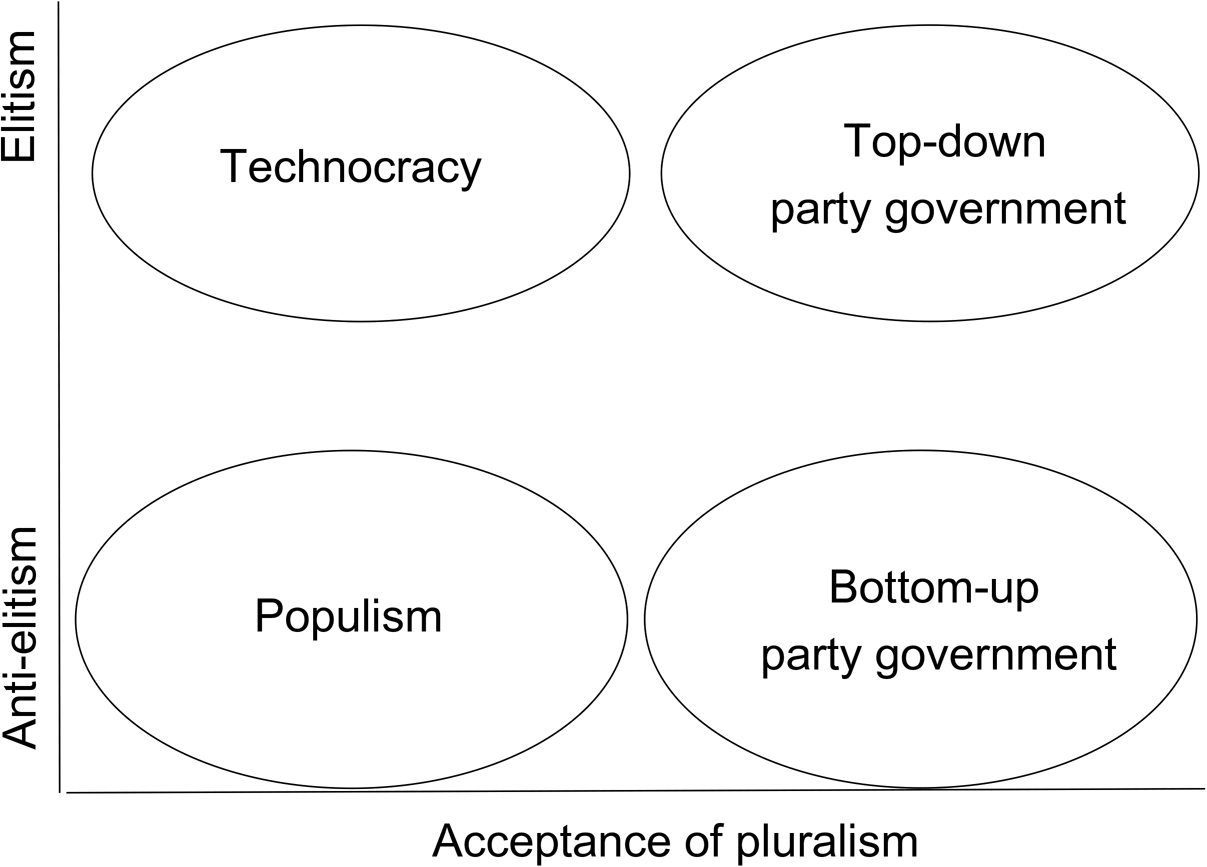
Against this background, our proposed combination of the elitism and pluralism dimensions accounts for complex differences in goal definition. Not only do these dimensions shed light on different preferences (top-down vs. bottom-up) within the party government model, but also on preferences characterizing models that are clearly in opposition to party government (i.e. populism and technocracy). By combining the two dimensions we can then draw a two-dimensional representation (Figure 2) offering parsimonious conceptualization of goal definition preferences. This approach accommodates complex preference models, expressing aspects of policy, strategy, ideology, and communication within a common spatial scheme (see Weber, Reference Weber2022, Reference Weber, Diehl and Bargetz2023).
Four models in our two-dimensional conceptualization of interaction for goal definition.

As such, this scheme can complement standard dimensions of political competition reflecting economic and cultural issues. To explore its empirical relevance, we now proceed to: (1) empirically assess the presence and extent of citizen and party differentiation on the two dimensions; (2) model the relevance of voter–party proximities for party preference, in the classic fashion of spatial modeling. Before doing so, we present details about the Italian case in the 2018–2022 legislative term.
Italy: the 2018–2022 legislature, in light of a longer-term emergence of (anti-)elitism and (anti-)pluralism
Italy gained unprecedented visibility in 2018, after a general election seeing the triumph of the populist M5S: this ideologically cross-cutting party had already become Italy's largest in 2013 (its first general election) with 25.6% of votes (albeit not entering government, refusing to join any coalition). In 2018 the party became even larger with 32.7% and decided to accept coalition governments, thus leading (with the right-wing League) to the first entirely populist government in a large West European country, led by newcomer Giuseppe Conte (Conte I). The government featured an issue-structured division of labor between the two parties: the M5S prioritized introducing the “reddito di cittadinanza” (combining an unemployment subsidy with a poverty protection scheme) while the League – led by Matteo Salvini – focused on a tough immigration policy. This lasted until August 2019, after Salvini (galvanized by having drained the right-leaning half of M5S voters by the 2019 European election) withdrew support, aiming at new elections. However, mainstream-left Partito Democratico (plus radical-left Liberi e Uguali and centrist Italia Viva) accepted to join the M5S in a new government (Conte II, September 2019), which faced the outbreak of the COVID-19 pandemic and then negotiated the introduction of the Next Generation EU funding scheme, securing key recovery funding for Italy. And precisely conflict over the distribution of such funds led to the fall of the Conte II government, as the small Italia Viva centrist party withdrew support, aiming toward a new government; which materialized shortly after, as a technocratic cabinet supported by an oversized coalition and led by former ECB president Mario Draghi. The Draghi government (February 2021) lasted until summer 2022, when – after the M5S quit due to disagreement on environmental policy – even center-right supporting parties League and Forza Italia quit (joining the more radical Fratelli d'Italia, led by Giorgia Meloni, who had never supported Draghi) leading to snap elections (Chiaramonte, Reference Chiaramonte2023).
A first observation concerning these developments is that, besides day-to-day strategizing in a parliamentary system, the alternation of government experiences embodying real alternatives to the party government model (the genuinely populist Conte I, the genuinely technocratic Draghi) indeed resonated with ongoing, existing dimensions of discussion and mobilization in Italian politics.
As first regards the (anti-) elite dimension, the success of the M5S, through all the 2010s, had stemmed from the very beginning from mobilizing an anti-elite dimension that had long been relevant in Italian politics, and not necessarily (or originally) combined with populist attitudes. A first strong anti-elite movement advocating bottom-up politics (the Girotondi) emerged in the Italian left in 2002 (Ceri, Reference Ceri, Albertazzi, Brook, Ross and Rothenberg2009), contesting the dominant mainstream left party Democratici di Sinistra – accused of complacency with Berlusconi – in years when this left-wing party had experienced clear cartelization (Pasquino, Reference Pasquino2003). This ongoing within-party-politics, bottom-up contestation also led in 2004 – in the center-left camp – to the introduction of primary elections for selecting candidates for regional presidential elections, for mayoral elections, and finally to the direct election of regional and national secretaries in the newly founded (2007) Partito Democratico (Bernardi et al., Reference Bernardi, Sandri and Seddone2017). Finally, since 2005 comedian Beppe Grillo had already started his own Amici di Beppe Grillo (Friends of Beppe Grillo) movement, inviting citizens to form grassroots activity clubs using the MeetUp platform, which would evolve into the M5S. This (anti-) elite dimension was not limited to the left-wing camp. From the very beginning of its career, even Silvio Berlusconi (Tarchi, Reference Tarchi, Mény, Surel and Y2002) strategically framed himself as a hard-working outsider siding with hard-working people, opposed both to “lazy” left-wing elite intellectuals and – as a successful self-made businessman – to the rentier Italian family capitalism (Porro and Russo, Reference Porro and Russo2000). And even the League rhetoric had long mobilized small business owners and the self-employed against economic and political elites.
As regards the monism–pluralism dimension, monist messages and rhetoric emerged later, and from different sources. While clear in the populist appeals of the M5S,Footnote 6 with its leader Beppe Grillo claiming to be above artificial left-right divisions, promoting the genuine will of the people (Pirro, Reference Pirro2018), monist messages were however also common among the business community, advocating governmental decision-making inspired to technical efficiency, rather than taken by litigious adverse politicians. Similar messages were already in the popular book La casta that denounced scandals among politicians (written in 2007 by two journalists from the mainstream, quality Corriere della Sera), but such rhetoric further increased on mainstream media with technocratic governments (both with Monti in 2011 and with Draghi in 2021), praising the ability of technical figures to pursue the general interest, vis-à-vis the partisan views of politicians. And in the 2018–2022 legislative term, monist technocratic rhetoric became very prominent toward the end of the Conte II government, where most mainstream newspapers (including the leading Corriere della Sera and La Repubblica) attacked the “too partisan” decisions of the Conte government (especially due to lockdown measures hurting businesses) advocating for its replacement with a new, technocratic government pursuing the “real” interests of the country.Footnote 7 This rhetoric even affected Draghi himself, who in a parliamentary debate came to declare “I'm here because Italians asked me.”
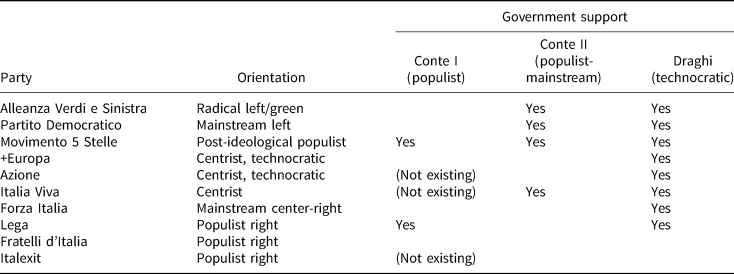
As a result, we argue that these recent anomalies of the Italian case point to the relevance of our newly proposed elitism and pluralism dimensions of political contestation. It is also important to observe that these political developments suggest possibly active channeling of voter demand, structured along these lines, by specific and lively supply of parties and leaders. Finally, the information we have presented so far can lead to background expectations about the placement of different parties (and their electorates) on the two dimensions (empirically assessed later). For convenience, we summarize such information in Table 1, featuring a characterization of each party, and its government support record.Footnote 8
Parties' characterization and government support in the 2018–2022 legislative term

All in all, we deem the Italian case is of special importance for testing the relevance of these two newly introduced dimensions.
Data and methods
For our analyses, concerning voters' and parties' positions on elitism and pluralism, we draw upon two different data sources. For voters, we rely on the panel component (N = 1132) of the 2022 ITANES (Italian National Election Study) pre-post panel CAWI survey, based on a sample of the voting-age population, representative of age, gender, and geographical region (Vezzoni et al., Reference Vezzoni, Basile, Garzia, Maggini, Moreno and Paparo2022). For parties, we fielded an original expert survey, to ensure consistent indicators across parties and voters and thus comparable measures of elitism and pluralism. Obviously, determining voter positions based on self-reported attitude items is not entirely symmetrical with asking experts to locate parties on the very same items; still, we deemed this asymmetry to be outweighed by the advantage of substantively comparable operationalizations when using the same items (see below). We thus administered a questionnaire to 10 experts of Italian politics (at different levels of seniority, to limit biases) between the 6th of July and the 8th of August, 2023, asked to place each party on the pertinent ITANES-matched items. We then derived party positions by averaging each item across all experts, and then constructed elitism and pluralism scales.
For voters' survey data, we relied on the ITANES 2022 questionnaire. We selected items on purely theoretical grounds, following two criteria. First, we included those items containing maximum reference to our original concepts (elitism vs. anti-elitism; pluralism vs. monism), and minimum reference to other concepts, such as specific characteristics of particular models (e.g. populism or technocracy). Second, we excluded items that were simply descriptive about reality, which may receive agreement even from respondents who dislike the situation being described.Footnote 9
As a result, we operationalized elitism relying on four items measuring respondent agreement with these statements: (1) “Citizens and not politicians should take political decisions”; (2) “I would rather be represented by a citizen than by a specialized politician”; (3) “I prefer to trust the wisdom of ordinary people more than the opinions of experts”; (4) “Political parties in parliament must follow the will of the people.” From response categories ranging from 1 “Fully disagree” to 5 “Fully agree,” we then oriented items to always have higher values for more elitist positions and computed a summary elitism index as the mean of all four, finally rescaled to the 0–1 range. Our measure of pluralism was built with the same procedure, but based on these four statement-agreement items: (1) “If people were knowledgeable enough, everyone would agree on the political decisions that are best for the country”; (2) “The people I disagree with politically are just misinformed”; (3) “Making compromises in politics means selling out one's principles”; (4) “To have a strong leader in Italy is a good thing, even if s/he violates the rules to get things done.” Item consistency diagnostics provide empirical validation for our choices.Footnote 10
Regarding the expert survey questionnaire,Footnote 11 statement items had the exact same wording, simply with a different initial prompt: “What do you think is the position of the various political parties on the issue summarized by the following statement?”. Expert scores on each item were then used to build an index of elitism and pluralism, with calculations identical as for voters.
Given that our test assesses the contribution of our newly introduced dimensions to spatial accounts of vote choice and party competition, we also needed measures of respondent policy positions on standard economic and cultural issue dimensions. Thus, we selected four positional items, each related to one of these dimensions: income redistribution, immigration, EU membership, and same-sex marriage.Footnote 12 Party placement on such items was calculated by averaging voter positions for each party: thus, these issues act as conservative controls on the effects of elitism and pluralism, given that mean-voter party positioning – unlike expert-survey party positioning – by definition introduces maximum congruence between a party and its electorate.
Italy 2022: a political space for elitism and pluralism
Our main argument is about an issue competition space enriched by pluralism and elitism. For this space to be relevant, we need empirical differentiation among parties and voters along these dimensions. Therefore, our initial analysis assesses variance in voter and party placements on these dimensions.
Voter positions
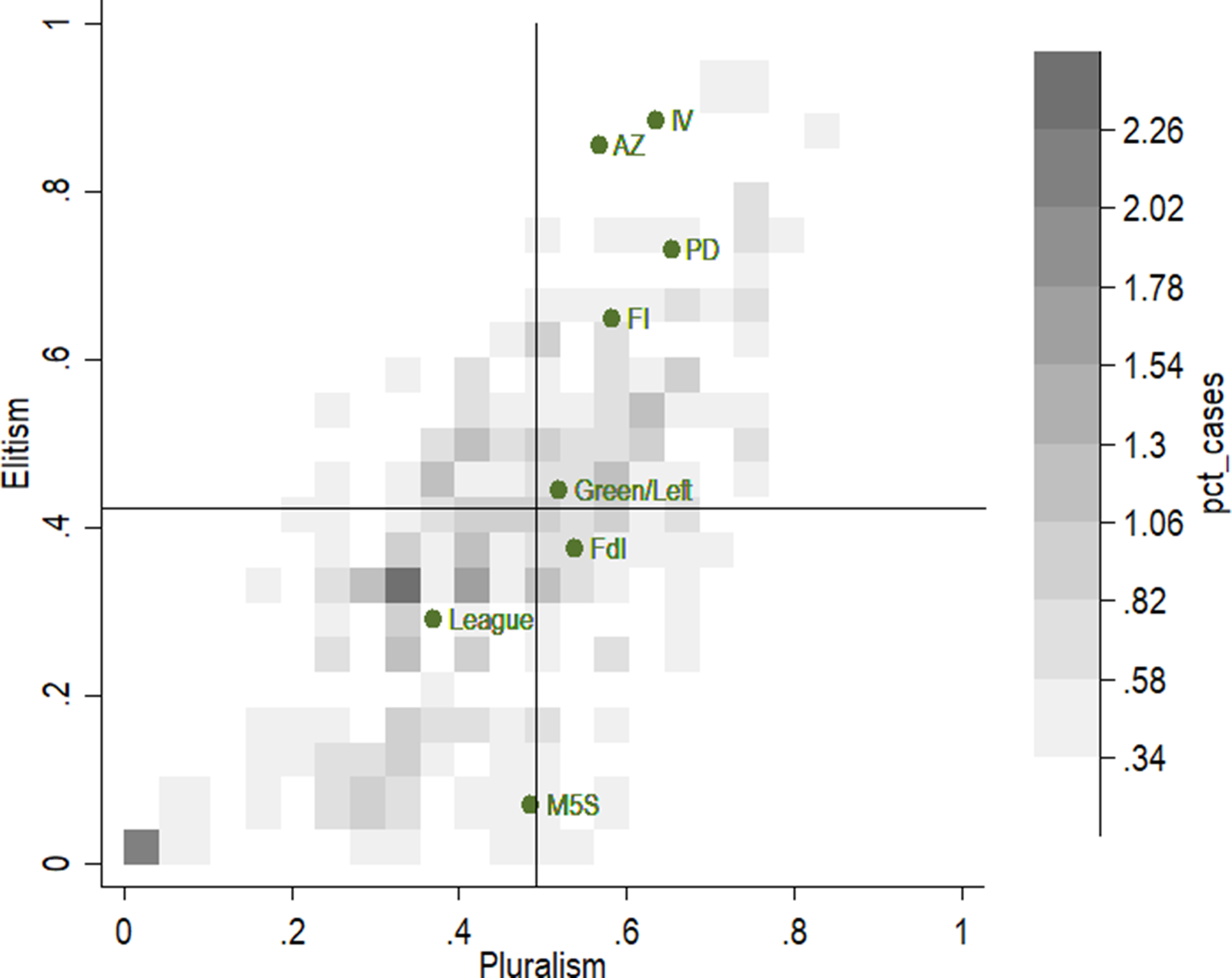
Figure 3 plots voter density in the pluralism–elitism space; for easier interpretation, we added four quadrants, delimited by average voter positions on both dimensions. Although elitism sees greater variability in voters' positions, even on pluralism voters differentiate quite evidently. Most voters lie in the upper right and lower left quadrants (respectively 35 and 33% of the electorate), corresponding to polar types we respectively labeled as top-down-party-government and populism. Still, a significant portion of voters is located in the lower right quadrant (20% of the electorate, bottom-up-party-government) and in the top left quadrant (about 12% of the sample, technocratic).
Joint distribution of voters along pluralism and elitism, with expert-survey party positionings superimposed; added lines report average voter positions.

Larger concentration in specific quadrants is somehow expectable. That more than one-third of respondents prefer the classic model of the party government – albeit in a top-down incarnation, in line with cartelization of mainstream parties – is not surprising, in a country where political parties have historically been key players of the political process. Analogously, even the weight of the populist (monist, people-centric) quadrant is not surprising in a country often defined as the promised land of populism. Still, there is clearly sizable support even for the quadrant combinations closer to technocracy and bottom-up party government ideal types. Overall, the data suggest consistent variability of voter positions on both dimensions.
Party positions
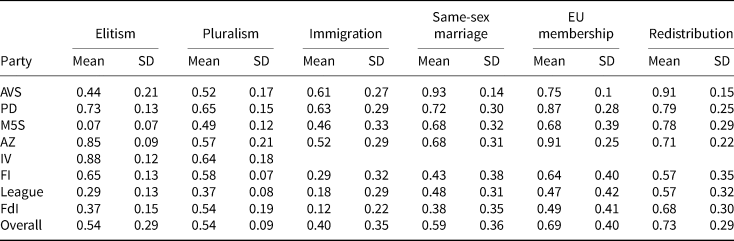
Figure 3 also reports party positions, estimated by averaging expert evaluations for each single party; these are also reported in Table 2, along with their respective standard deviations, to capture expert uncertainty, and with analogous figures for other relevant issue dimensions, thus offering a richer characterization of the structure of the party competition space in Italy.Footnote 13
Expert-survey placement of parties on elitism and pluralism

Parties are ordered by their left-right position (average left-right party placement by ITANES survey respondents). For additional information, also main issue positions of party electorates are reported.
Note: Azione and Italia Viva were presented to experts as separate parties to assess, while – as they ran together in the general election – they were presented as a joint list in the ITANES survey: thus the mean positions of their electorate are reported as single joint figures.
A first interesting element in Table 2 is the sizeable variability of party positions on both elitism and pluralism. For elitism (in a theoretical 0–1 range), empirical values range between 0.1 (for the M5S, the most anti-elitist) and 0.9 for parties like Azione and Italia Viva, emerging as fully elitist. For pluralism, empirical variation is smaller: values range between 0.4 for the League (the least supportive of pluralism), and 0.6 for PD, Azione, and Italia Viva, in fact seen as strongest supporters of pluralism. Secondly, note that position differences on the two dimensions are not captured by the left-right dimension. For elitism, association with party ideology appears rather curvilinear: more extreme parties (including Green/Left, M5S, League, FdI) tend to be less elitist than the system average; while the opposite is true for mainstream and centrist parties (FI, PD, AZ, IV). Association with ideological positioning seems uncertain for pluralism too. PD, centrist parties (AZ, IV), and FI are placed as more pluralist than average; the opposite emerges for the League. The Green/Left, the M5S, and FdI, instead, are in the middle.
In any case, the key prerequisite for our argument emerges as clearly fulfilled. Among both parties and voters there are relevant position differences on both dimensions.
Partisan sorting across pluralism and elitism
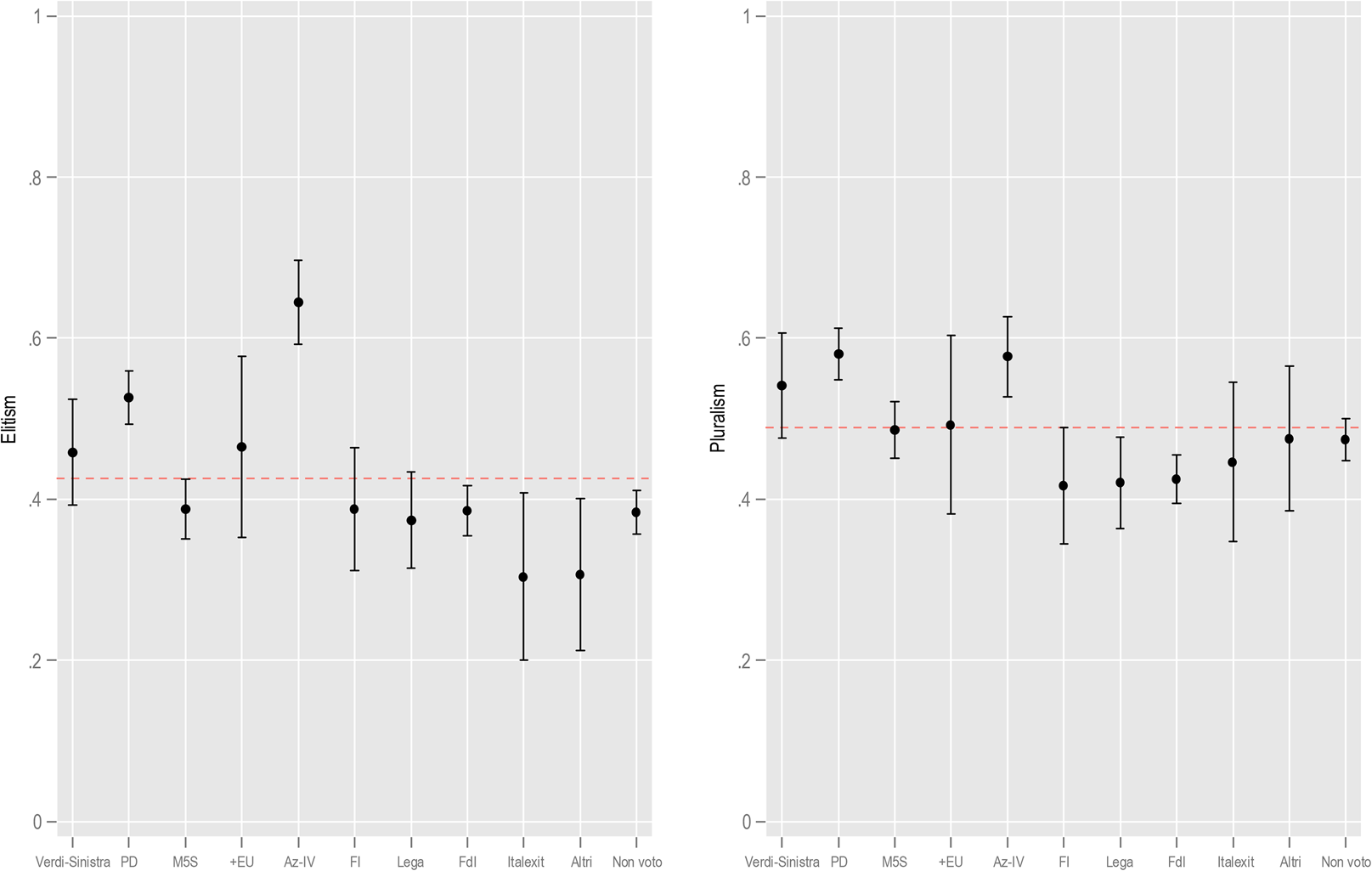
One way to delve deeper into voter differentiation on the two dimensions is to assess how voters of different parties position themselves on both dimensions. Figure 4 addresses this question, by presenting means of elitism and pluralism broken down by party voted for. For pluralism, a clear relationship with ideology is confirmed, with voters of left-wing parties tending to score above average (especially for Green-Left, PD, and the centrist AZ-IV alliance). The M5S electorate, despite its left-wing placement consistent with the leadership of Giuseppe Conte (De Sio et al., Reference De Sio, Maggini, Mannoni, Chiaramonte and De Sio2024), still shows a specificity, with slightly below-average support for pluralism. This is shared with voters of more radical right-wing parties (Fdi, Italexit, partly FI, and the League). Centrist voters of More Europe (+Eu) fall, instead, in middle ground. Interestingly, and perhaps predictably, non-voters tend to have a more monist orientation than average (although only marginally significant).
Party electorates' differences in elitism and pluralism: effects on elitism and pluralism (predicted values) of party vote dummies (95% CIs).

Elitism shows a less clear association with ideology. While voters of right-wing parties (FdI, Italexit, and partly League and FI) consistently show less elitism than the mean, the same does not apply to the left: only PD voters are significantly elitist above average, with Green-Left voters not significantly different, and M5S voters even significantly below average. Most notably, the highest levels of elitism are among centrists from Azione and Italia Viva. Lastly, non-voters are significantly more people-centric than average; they form a typical populist cluster leaning toward monism and people-centrism.
The impact of pluralism and elitism on party preference
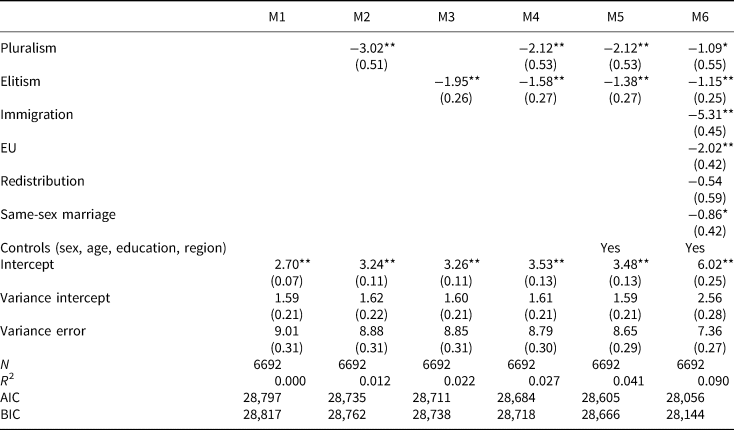
After exploring the spatial nature of pluralism and elitism, we now assess their relevance for party preference. We estimated models of party preference in a data matrix that is “stacked” by party, with each row corresponding to a party-respondent combination (for each respondent, one separate row for each party). Models in such a matrix are “generic”: coefficients do not express effects on preferring a particular party, but in fact the importance of the predictor for party preference in general (Van der Eijk et al., Reference Van der Eijk, De Sio, Vezzoni, Schmitt, Van der Eijk and Segatti2021). Focal predictors here are voter–party distances for pluralism, elitism, and for standard items representing other policy dimensions (thus allowing direct comparison);Footnote 14 controls include sex, age, class, geographical area, and education.Footnote 15 Finally, the party preference outcome is operationalized through widely used party-specific PTV (propensity-to-vote) items, asking respondents about how likely it is (0–10 scale) that they will ever vote for the party: these items capture the current state of party preferences, and work effectively even for small parties (Van der Eijk and Niemoller, Reference Van der Eijk and Niemoller1983).
Models 2 and 3 in Table 3, separately testing the effects of elitism and pluralism, already show significant effects. Model 4 tests the two dimensions together, confirming the significant effects of both, which also survive the introduction of important sociodemographic controls (model 5). Finally and most importantly, model 6 shows that these effects stay strong and significant even when controlling for items representing other important issue dimensions, such as immigration, EU integration, economic redistribution, and same-sex marriage. In this full model, pluralism and elitism indeed have the third- and fourth-largest coefficient respectively, outperforming redistribution and same-sex marriage. This demonstrates the significance of both, with even greater weight than some standard issue dimensions.Footnote 16
OLS generic models of party preference (PTVs)

Standard errors in parentheses.
**P < 0.01, *P < 0.05, +P < 0.1.
Discussion
Our analysis of the Italian case shows that pluralism and elitism contribute substantively to a standard model of issue-based party preference, expanding and complementing the relevant issue space. This might be simply the rediscovery of quite ancient conflicts. While the post-WWII consensus of liberal democracy marginalized these conflicts, recent decades have seen a re-politicization of preferences for political goal definition. These preferences now compete with several other issues for attention. Models of governance and representation can be primed in the minds of voters, as may be most obvious in the case of populism (Hawkins et al., Reference Hawkins, Kaltwasser and Andreadis2020). Meanwhile, other parties will emphasize their respective models, be it technocracy, responsibility, or responsiveness. These choices can be seen as part of a larger model of strategic issue emphasis with the aim of shifting the electoral playing field in one's favor (De Sio and Weber, Reference De Sio and Weber2014). The question of goal definition preferences may best be seen in this context. While one may think of these as “meta-preferences” – preferences about how to decide over rival preferences – this view depends on the state of the debate. Other dimensions may equally claim “meta” relevance: the economy for essential government resources; defense for the existence and security of the polity; social policy for the basic fabric of society, environmental policy for the survival of humanity, etc. Issue domain primacy is a matter of political competition. Our framework allows to assess the relative importance of elitism and pluralism as goal definition preferences vis-à-vis other policy dimensions, and indeed to reveal how these are already relevant for party competition in the political context we analyzed.
The preference variance that our analysis discovered in the Italian case allows us to make an educated guess regarding the future role of goal definition preferences in electoral politics more generally. On the one hand, Italy has experienced a series of cabinets in fact constructed on models of goal definition, and we found that related preferences are important factors for party attitudes. On the other hand, our comparative analysis shows that Italy does not stand out among other European countries in that respect: on the demand side, many countries show the potential for a realignment along conflicts over goal definition. A metaphor capturing this situation is that of the “sleeping giant” proposed by Van der Eijk and Franklin (Reference Van der Eijk, Franklin, Marks and Steenbergen2004) for the European integration issue, with the “giant” representing popular demand for certain government actions. As with any dimension of electoral competition, serious impact can be expected when demand and supply conditions meet. This has been the case in Italy's 2018–2022 term, when goal definition preferences dominated cabinet politics. In a nutshell, we argue that the peculiarity of the Italian case might simply lie in the presence of an appropriate supply that channeled voter demand arguably common to other countries as well, thus with the possibility to awake a sleeping giant beyond the Italian context. At the same time, we also see that such an “outbreak” is hard to maintain, needing to be reconciled with other policy conflicts in the longer run. In Italy, this quickly led to an alignment of party positions with the dominant antagonism of a pluralist/elitist pole (in the form of top-down party government) vs. a monist/anti-elitist pole (in the form of populist government). At the same time, popular preferences remain more diverse, suggesting that demand has become quite robust and does not simply follow party cues. Thus, incentives for political entrepreneurs to produce appropriate supply might prevail. This permanent potential for an “awakening” of the giant also appears to be descriptive of wider European politics. Integrating preferences over goal definition into standard models of vote choice and party competition provides a promising avenue for making sense of some perplexing developments in modern electoral politics.
Funding
This research received no specific grant from any public or private funding agency.
Data
The replication dataset is available at http://thedata.harvard.edu/dvn/dv/ipsr-risp.
Supplementary material
The supplementary material for this article can be found at https://doi.org/10.1017/ipo.2024.28.
Acknowledgments
The authors would like to thank Susan Scarrow, Giliberto Capano, and the participants of the workshop “Italy: Outlier or Forerunner,” held at LUISS University in Rome on November 16–17, 2023. The authors also extend their gratitude to the anonymous reviewers who significantly contributed to improving the article, and to the scholars who kindly shared their expertise in the expert survey.
Competing interests
The authors declare none.