INTRODUCTION
Rising health care costs are directing a shift toward community-based care, with family members playing a greater role throughout the continuum of cancer treatment and disease progression (Hileman et al., Reference Hileman, Lackey and Hassein1992; Longman et al., Reference Longman, Atwood and Blank-Sherman1992; Stetz & Hanson, Reference Stetz and Hanson1992; Houts et al., Reference Houts, Nezu and Nezum1996; Barg et al., Reference Barg, Pasacreta and Nuamah1998; Arno et al., Reference Arno, Levine and Memmott1999; Speice et al., Reference Speice, Harkness, Laneri, Frankel, Roter and Kornblith2000). Often family members are ill prepared for the caregiving role and the physical, emotional, and financial burdens inherent in it (Blanchard, Albrecht, & Ruckdeschel, Reference Blanchard, Albrecht and Ruckdeschel1997; Haley, Reference Haley2003; Wiles, Reference Wiles2003). Interventions aimed to increase caregivers’ competence are essential to adequately address cancer patient care and need to be timely, relevant, and efficient, meeting caregivers’ needs as they arise (Silveira & Winstead-Fry, Reference Silveira and Winstead-Fry1997). To address this issue, this study examines caregivers’ needs along the advanced cancer disease trajectory, expanding current research models by looking at more specific key experiences and extending the trajectory into bereavement.
As the patient transitions along the cancer disease trajectory, each phase presents new challenges and stressors for the caregiver. Patients and families must develop new skills or enhance effective coping strategies to meet new demands (Holland, Reference Holland, Holland and Rowland1989). Cancer patients and caregivers have numerous needs across a variety of areas (Longman et al., Reference Longman, Atwood and Blank-Sherman1992; Mills & Davidson, Reference Mills and Davidson2002), with a significant number of needs falling into the categories of psychological, household management, and informational (Wingate & Lackey, Reference Wingate and Lackey1989) and, to a lesser degree, physical and respite, legal and financial, and spiritual needs (Hileman & Lackey, Reference Hileman and Lackey1990; Stelle & Fitch, Reference Steele and Fitch1996; Thielemann, Reference Thielemann2000).
Although many information needs exist, receiving general information addressing numerous areas can often be overwhelming. The best circumstances for adult learning are when the person feels there is a need and when the information is relevant (Hardwick & Lawson, Reference Hardwick and Lawson1995). Accordingly, systematic caregiver education requires empirical knowledge about when patients and their caregivers want specific information (Harrison et al., Reference Harrison, Galloway and Graydon1999). Current literature provides a foundation for understanding patient and caregiver needs at general stages along the cancer disease trajectory: diagnosis, treatment, and, to a lesser degree, palliative care. However, any one general stage encompasses a variety of experiences and issues. For example, active treatment involves the treatment decision, the start of treatment, the treatment course (including side effects), and the end of treatment. Whereas information regarding treatments may be more paramount in the decision stage, emotional needs for support may be more important in coping with concerns when treatment ends. Further empirical evaluation is indicated on types of information needs across a greater number of specific illness experiences. Even the more extended models of patient or caregiver needs tend to omit bereavement. But, as caregiving experience can impact bereavement adjustment (Bass & Bowman, Reference Bass and Bowman1990; Bernard & Guarnaccia, Reference Bernard and Guarnaccia2003), examination of caregiver needs should naturally include end-stage illness and the aftermath of patient death.
Although current literature has identified caregiver and patient needs at broad stages of the cancer trajectory (i.e., diagnosis, treatment, and end of life), it was hypothesized that needs will vary across specific key experiences that occur within a given stage. Using cross-sectional analyses of retrospective self-report data, this study examines familial caregivers’ needs at nine specific cancer-related key transitional experiences along the advanced cancer disease trajectory, including caregiver bereavement. These key transitional experiences include start of treatment, end of treatment, nonroutine hospitalization, leaving the hospital for home, transitioning from curative to palliative care, entering hospice, patient death, immediately after death, and bereavement.
METHODS
Participants
One hundred eighty-two current or former primary caregivers of advanced cancer patients were recruited. Primary caregiver in this study refers to the self-identified main person regularly assisting in the care and support of the person with advanced cancer. Former caregivers cared for someone who died within the last 6 years. To participate, caregivers needed to be at least 18 years of age and English literate at a minimum of the sixth grade level.
Procedure
Cancer caregivers, primarily in Wisconsin and nearby areas of the Midwest, were recruited through fliers and magazine advertisements. Advertisements were also placed in electronic newsletters targeting local health care and university settings and national caregiver populations. Survey packets, including informed consent forms, were mailed to interested respondents. Completed surveys were returned by mail and caregivers were offered $20.00 reimbursement. This study was approved by the Institutional Review Board at the University of Wisconsin, Madison.
Measures
To examine a detailed listing of needs along specific experiences of the cancer disease trajectory, including bereavement, the Cancer Caregiver Needs Checklist was developed for this study. This index includes a list of 104 need items covering a broad base of cancer topics, yielded using the critical incident interview technique (Gustafson et al., Reference Gustafson, Arora and Nelson2001), and refined through clinician and caregiver review. Caregivers completed the Cancer Caregiver Needs Checklist by indicating whether they “wanted or would want information on” each individual need item at each of 10 key experiences along the disease trajectory (item not checked, scored 0; item checked as wanted, scored 1). The specific experiences are transition events highlighting key opportunities for information interventions, including start of treatment, end of treatment, nonroutine hospitalization, leaving the hospital for home, transitioning from curative to palliative care, entering hospice, patient death, immediately after death, and bereavement. Because this is an index of information needs at given experiences, rather than a psychometric scale measuring a latent construct, examination of psychometric properties is not appropriate (Bollen, Reference Bollen1989). Copies of this measure may be obtained by request from the corresponding author.
Analyses
Due to the large number of individual need items in the Cancer Caregiver Needs Checklist, analyses of information needs for this study focus on categories of information based on item groupings. Five information categories were determined to represent the current cancer caregiver literature: disease/medical information, caregiving, caregiver well-being, financial/legal, and spirituality. Four additional categories were developed to address content beyond categories in the literature: relating with the patient, family and close others, future outlook, and dying. Items were placed into categories based on the sorting of eight cancer professionals. Seventy-five percent interrater agreement was required for grouping. Eighteen items not meeting criterion were dropped from analysis.
The Cancer Caregiver Needs Checklist identifies 10 specific key illness-related experiences of the advanced cancer disease trajectory. These key experiences can be grouped into general stages that align with the broad stages in previous literature. These general stages include: (1) cancer progression (in this case involving the experience of “being informed of cancer progression or advanced disease,” which may also be conceptualized as the diagnosis of advanced illness), (2) treatment (including “start of new treatment,” “end of specific treatment,” “nonroutine hospital stay,” and “leaving hospital for home”), and (3) end of life (including “curative to palliative care,” “going into hospice,” and “patient death”). Note that for this study “patient death” is inclusive of the period just prior to the patient's death or the immediate acts of dying, as well as the death itself. This study extends the current literature to include after patient death as a fourth stage of the disease trajectory (including “immediately after death” and “bereavement”). Initial analyses at this general stage-level (Bernard, Reference Bernard2004) support the current literature that needs differ across broad stages of illness. By examining how caregiver needs differ between specific key experiences that occur within each of these broad stages, this study extends the needs literature.
To see if information needs differ across specific experiences within each of the broad cancer stages, pairwise t tests were calculated for each combination of two experiences within a stage, using Bonferroni-like corrections to guard against Type I errors. As not all caregivers sampled had encountered all experiences on the Cancer Caregiver Needs Checklist, only those caregivers who had encountered all experiences within a given stage were used for analyses comparing information need across experiences. For example, at the end of life stage, only 75 caregivers had all three experiences within this stage: transferring from curative to palliative care, entering hospice, and patient death. These were the only caregivers used in analyses comparing information need across these three key experiences. Accordingly, sample size for analyses between experiences in the treatment stage was 115 and for the after patient death stage was 67. Because the cancer progression stage only had one experience—learning that the cancer has progressed—comparisons of information need are not applicable to this stage.
RESULTS
Sample Characteristics
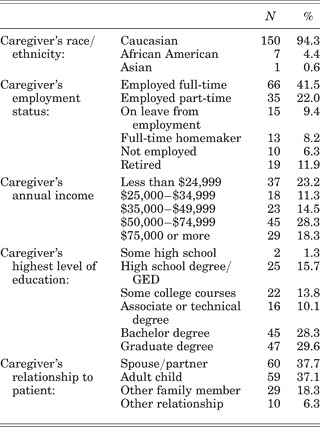
Through convenience sampling, our initial sample yielded 24 male (13.1%) and 159 female (87.4%) current and former caregivers. As the number of male caregivers are underrepresented by sampling, and insufficient to power gender comparisons, the male sample was not used in these analyses. For the remaining female sample, caregivers had a mean age of 50.28 years (SD = 12.91) and patients’ mean age was 61.51 years (SD = 17.34). The majority of this female caregiver sample are former (bereaved) caregivers (117; 73.6%) who live(d) in the same household as the patient (112; 70.4%). Caregivers were predominantly Caucasian, either a spouse/partner or adult child of the person with cancer, and employed full-time, and mean annual household income was $35,000–$49,999 (see Table 1 for counts and percentages). Although a variety of cancers were represented in this sample, the following areas comprise the majority of the sample: lung (24.5%), gastro-intestinal (14.4%), breast (13.8 %), head or neck (12.0%), liver, kidney or pancreas (10.0%), and leukemia or lymphoma (6.9%). Just over half of the patients were male (83; 52.2%).
Counts and percentages for categorical demographic variables item

Information Need Comparisons
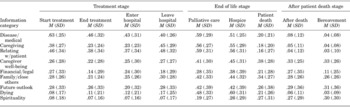
Table 2 contains the means and standard deviations for endorsement of an information need for each category at each of the nine key experiences.
Mean endorsement and standard deviations for information categories across experiences of the treatment, end of life and after patient death stages

Treatment Stage
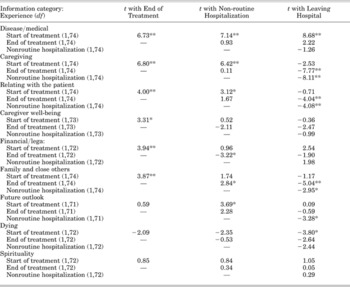
The treatment stage includes the key experiences starting treatment, ending treatment, nonroutine hospitalization, and leaving the hospital for home. Pairwise t tests compared desire for each of the nine information categories between the specific key experiences of the treatment stage (see Table 3). A Bonferroni-like correction was used setting criteria for significance at p ≤ .008 (.05/6 paired tests per information category). For all categories except spirituality, information need differed between the specific experiences of the treatment stage. Disease/medical information was most wanted when starting treatment. Caregiving and relating with the patient information were most wanted when starting treatment and leaving the hospital for home. Dying information was least wanted at start of treatment, future outlook least wanted at nonroutine hospitalization, and family and close others least wanted at ending treatment. Financial/legal information was least wanted at the end of treatment and leaving the hospital for home.
Pairwise t tests comparing mean information category need between experiences during the treatment stage

* p ≤ .008 (Bonferroni-like correction); **p ≤ .001.
End of Life Stage
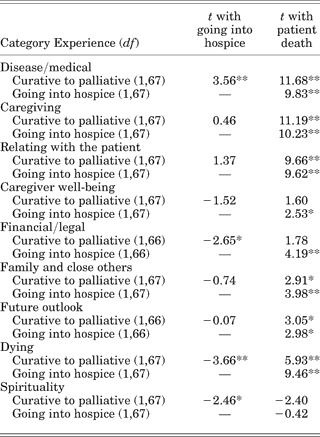
The end of life stage includes the experiences of transitioning from curative to palliative care, going into hospice, and patient death. Pairwise t tests compared need for each of the nine information categories across the experiences within the end of life stage (see Table 4). Again, a Bonferroni-like correction was used requiring p ≤ .017 (.05/3 paired tests per information category) for significance. For all information categories, information need differed between at least two experiences within the end of life stage. Disease/medical information was most wanted at the transition from curative to palliative care and least wanted at patient death. Information about caregiving, relating with the patient, family and close others, and future outlook was most wanted at the experiences of transitioning from curative to palliative care and going into hospice and least wanted at patient death. Spirituality information was most wanted at going into hospice and patient death, whereas dying information was most wanted when going into hospice and least wanted at patient death.
Pairwise t tests for mean information category need between experiences during the end of life stage

* p ≤ .017 (Bonferroni-like correction); **p ≤ .001.
After Patient Death Stage
The after patient death stage consists of the experiences immediately after patient death and bereavement. Pairwise t tests compared information need across these two experiences for each of the nine information categories. Significant differences were found for disease/medical (t = 5.00, p < .001), financial/legal (t = 5.88, p < .001), and dying information (t = 5.74, p < .001), where information need was greater immediately after death than at bereavement.
DISCUSSION
The literature provides general understanding of information needs at broad stages of the cancer trajectory, demonstrating that caregivers’ information needs differ across these general stages. However, the broad divisions of the cancer trajectory limit practical application of this knowledge. Therefore, the more thoroughly we can define and understand the unique needs of caregivers’ immediate experience, the more effective educational interventions targeting these caregivers will be. In an effort to expand knowledge of caregiver information needs at more specific cancer-related key experiences, this study compared information needs across key experiences occurring within three broad stages of the advanced cancer trajectory: treatment, end of life, and after patient death. For all three broad stages, information needs were found to significantly differ between specific key experiences. This supports the need for more precise distribution of specific information content at distinct times in the illness course.
The start of treatment is a time that often requires decision making about treatment options. Thus, illness and treatment information is crucial for effective patient and caregiver participation in this decision-making process. Accordingly, caregivers reported greatest desire for disease/medical information at this key experience of the treatment stage. When leaving the hospital for home, whether to recover from an inpatient procedure or to initiate home–hospice care, caregivers have heightened responsibility for the patient's home-based medical care. Accordingly, caregivers need information about caregiving and dying most during this transition, as many tasks of aftercare are novel to the nonmedical professional and may require complicated regimens.
The change in focus from curative to palliative treatment often involves difficult choices about whether or not to continue curative treatments, as well as among palliative care options. Patients and caregivers likely look for information to inform such decisions. It follows that disease/medical information is most needed when facing this transition at the end of life stage. Information regarding caregiving, relating with the patient, family and close others, and future outlook is important both when transitioning from curative to palliative care and when going into hospice. This follows logically for patient care at end of life when, outside of the immediate experience of the patient dying, attention can focus more on interactions between the caregiver and the patient and other family members, as well as on preparing for relationship closure. Dying information was most wanted when going into hospice and least at patient death (when the patient is actively dying), reflecting the importance of information to cope through preparation for the future. As discussion of dying is difficult for most people, it is often avoided throughout the course of illness. However, hospice is often considered a marker of acceptance of the approaching end of life. Therefore, it is a time when more information about dying may be either necessitated by the patient's condition or more accepted given outward acknowledgement of death's imminence. Before this acknowledgment, efforts to educate caregivers on dying may more likely be resisted.
The immediate aftermath of a person's death requires the family to focus on practical tasks of legal, financial, and medical issues (such as those involved in notification of the death and implementation of funeral plans) than are needed over the longer course of bereavement. As a result, caregivers have greater need for information regarding these practical issues during the period immediately after death.
Limitations and Future Directions
Several limitations arise from volunteer convenience sampling. Our recruitment yielded a primarily homogeneous sample of educated Caucasian female caregivers. Therefore, we were not able to examine other potentially influential factors on caregiver needs, such as gender, ethnicity, or education level. Understanding other groups of caregivers’ potentially unique information and support needs is crucial for advancing practical support for such caregivers. Future studies need to consider such caregiver characteristics as a sampling concern. Furthermore, volunteer sampling may bias results toward caregivers with less burden, as those more burdened by caregiving may be less likely to volunteer. Therefore, this sample may underrepresent those with the greatest need.
This cross-sectional study found that differences exist in caregivers’ information needs across more specific key experiences within the cancer trajectory. However, retrospective report data have limitations. Longitudinal studies that directly assess needs over the illness trajectory could explore change in information need over time. Such studies could yield more refined and innovative educational interventions.
Furthermore, just as the stages of the cancer illness trajectory were too broad for specific clinical interventions, there is also a need for examining more specific needs across experiences. The information categories examined here offer an index of the general type of needs caregivers face at various experiences. However, to better offer the most relevant educational interventions, we need to identify even more specific needs. This study serves as a foundation for greater efforts to examine individual need items at these key transition events. Although examination of the numerous individual needs in the Cancer Caregiver Needs Checklist was beyond the scope of this study, future work analyzing the individual needs across the 10 cancer-related experiences will further inform development of educational caregiver interventions.
Clinical Applications
Dependence on informal caregivers is projected to continue to grow, requiring health care systems to develop innovative educational interventions to assure that caregivers are adequately prepared for the care responsibilities they face. Information relevance is a key feature to effective information interventions (Hardwick & Lawson, Reference Hardwick and Lawson1995; Harrison et al., Reference Harrison, Galloway and Graydon1999; Thielemann, Reference Thielemann2000). With a matrix of information needs by key cancer experience, even a small understaffed cancer treatment program could prepare targeted educational interventions as the need arises. In this way, they could provide patients and caregivers with key experience-linked information in a timely and relevant manner. This study's collection of systematic information needs data provides the foundation for developing a cancer caregiving information system to address such educational needs.
ACKNOWLEDGMENTS
This study was funded in part through grants from the National Institute of Nursing Research, R01 NR008260-01, and the National Cancer Institute, 1 P50 CA095817-01A1.