INTRODUCTION
The genus Terschellingia (Nematoda: Linhomoeidae) was erected by de Man (Reference De Man1888) on the basis of the following features: four cephalic setae, buccal cavity small or absent and circular amphidial fovea located far forward on the head region. The etymology of the genus refers to the origin of the type specimens i.e. collected at Terschelling Island in The Netherlands. In general, species pertaining to this genus are cosmopolitan and very often numerically dominant in muddy subtidal bottoms (Heip et al., Reference Heip, Vincx and Vranken1985). Therefore, they play an important ecological role in the sedimentary environment where they inhabit. Despite the notable presence of individuals belonging to the genus Terschellingia in samples from benthic studies, currently, identification to species level remains problematic.
The valuable compilation of free-living marine nematodes by Gerlach & Riemann (Reference Gerlach and Riemann1973) indicated 28 valid species of Terschellingia and six synonymies. The present study describes 38 nominal species and a possible substantial taxonomic inflation (sensu Alroy, Reference Alroy2002). Most of the descriptions of Terschellingia species were carried out by pioneers of nematology (e.g. Cobb, de Man, Filipjev, Gerlach and Timm) dating from more than 50 years ago. This implies the lack of holotypes, the statement of new species on the basis of one or two specimens, often females with relatively few features of taxonomic value. The relatively slow flow of information among researchers in those years and the reduced access to some journals also enhanced the existence of a plethora of synonymies. Three taxonomic keys have been elaborated (Wieser, Reference Wieser1956; Gerlach, Reference Gerlach1963; Austen, Reference Austen1989), however, these keys do not cover all species of the genus and they are not updated.
The problematic assessment of the genus Terschellingia fits in the larger gap about the taxonomic status of the family Linhomoeidae. The last revision of this family was published by Gerlach (Reference Gerlach1963) and no further revision has been carried out since. Lorenzen (Reference Lorenzen1994), in his cladistic phylogenetic outline about free-living nematodes, recognized that more extensive analyses are still needed before relationships can be determined.
The ‘ideal’ taxonomic assessment of any taxon should be based on a phylogenetic approach, combining molecular techniques, like DNA sequence analysis, with morphological data to constitute an appropriate basis for studies of diversity of nematodes (De Ley, Reference De Ley2000; Nadler, Reference Nadler2002). However, the promising application of molecular techniques for delimitation of species currently rests on a preliminary morphological approach (Derycke et al., Reference Derycke, Remerie, Vierstraete, Backeljau, Vanfleteren, Vincx and Moens2005). A framework of nearly 40 species of Terschellingia, most of them poorly described and morphologically similar, is not the best scenario for: (i) developing an easier way for identification and classification of relevant taxa in order to reduce the taxonomic impediment (De Ley, Reference De Ley2000); and (ii) applying a molecular approach to the taxonomy of the genus. Currently, the exhaustive revision of any taxon of free-living marine nematodes based exclusively on morphology appears in general not enough for a conclusive statement about taxonomy and relationships though it provides a basis for readdressing future studies on particular morph-species and phylogenetic relationships.
The genus Terschellingia possesses relatively few characters of diagnostic value. For example, labial sensilla are reduced (= small), cuticularized structures in buccal cavity as rings or teeth are absent or rarely present, precloacal supplements are rarely present, and the body cuticle lacks ornamentations such as pores or spines. The high morphological plasticity within species of this genus biases to clear identification of morph-species, and is surely related to the cosmopolitan distribution and numerical dominance of the genus in soft bottom habitats. Several appealing features within the genus, such as sperm dimorphism in T. glabricutis (Yushin, Reference Yushin2008) and possible presence of cryptic species in T. longicaudata (Bhadury et al., Reference Bhadury, Austen, Bilton, Lambshead, Rogers and Smerdon2008), are an incentive for the continuation of the studies about the genus Terschellingia. The ‘classical’ morphological characters used for the diagnosis of species (e.g. relative position of amphidial fovea in the head region, the pattern of somatic setae and tail length) are clearly not sufficient and other morphometric characters were explored in order to refine species diagnoses.
Ecological studies in subtidal muddy bottoms from Cienfuegos Bay, Cuba, Caribbean Sea indicated a notable numerical dominance of the genus Terschellingia in the sediments. Three sympatric species are redescribed in the present study. The aims of this research are: (1) to identify the most important diagnostic features of the genus Terschellingia de Man Reference De Man1888 and redefine the genus diagnosis; (2) to provide a comprehensive diagnosis of the valid species within the genus; and (3) to construct a pictorial key to species level. Additional information is provided for known species collected in Cuba.
MATERIALS AND METHODS
Samples were taken in February 2006 in six subtidal stations from Cienfuegos Bay, Caribbean Sea (22° 07′ N 80°22′ W). The bay is a semi-enclosed body of water with relatively high organic content in sediment and predominance of muddy bottoms. Samples were collected using hand-held cores and preserved in 8% buffered formalin. Sediment samples were processed by sieving over two sieves with 500 µm and 45 µm mesh size and specimens were extracted by the flotation technique using a high-density sugar solution (1.16 g cm−3). Sorted animals were transferred to anhydrous glycerol and mounted on glass slides. The description (including measurements) of the three identified species (T. communis, T. gourbaultae and T. longicaudata) was performed with a contrast phase microscope Leica DMR (maximum magnification 1000 X) with drawing tube.
Most of the data of the species were collected from original descriptions using the NeMys database (www.nemys.ugent.be; Deprez et al., Reference Deprez, Vanden Berghe, Vincx and Vanden Berghe2004). From species of which original descriptions lacked relevant morphometric data, measurements were obtained directly from the illustrations. Measuring was carried out by a curvimeter for curvilinear (e.g. body length) and a ruler for straight measurements (e.g. body diameter); the maximum accuracy was 0.5 µm in 1000 X. We used a rule for measurement of cephalic sensilla length in order to obtain the maximum possible accuracy.
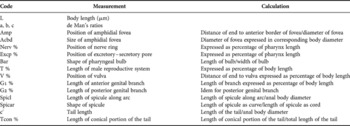
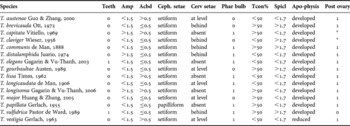
The set of morphometric features considered of taxonomic relevance was mainly based on ratios (Table 1). Ratios were considered more convenient for comparisons than absolute measurements due to large variability (Fortuner, Reference Fortuner1990) and because they were more accurately assessed from original drawings. A set of six morphological features was defined for comparison among species: presence of teeth, position/presence of cephalic setae, position/presence of cervical setae, presence of pharyngeal bulb, development of gubernaculum apophysis and shape of the tail (conical portion less or larger than 50% of total length).
Morphometric features defined for the analysis of the genus Terschellingia.

The great difference in number of described specimens for each species (i.e. replicates) prevented the application of statistical comparisons and the complete evaluation of the intraspecific variability. For the species reported from the literature only the measurements correspondent to holotype were used, therefore, statistical significance among species could not be tested.
RESULTS AND DISCUSSION
The genus Terschellingia de Man, 1888
The genus belongs to the family Linhomoeidae (Monhysterida), a taxon of heterogeneous nature without known holapomorphy (Lorenzen, Reference Lorenzen1994). Three subfamilies are recognized: Desmolaiminae Schneider, Reference Schneider1926, Eleutherolaiminae Gerlach & Riemann, Reference Gerlach and Riemann1973 and Linhomoeinae Filipjev, Reference Filipjev1922. The genus Terschellingia belongs to the Desmolaiminae, a subfamily mainly characterized by (modified from Schneider, Reference Schneider1926): cuticle smooth or faintly annulated, second and third circle of anterior sensilla close (6 + 10) or separate (6 + 6 + 4), amphidial fovea circular, buccal cavity conical and presence of cardia between pharynx and intestine.
Terschellingia, emended diagnosis. Desmolaiminae. Cuticle faintly striated (may appear smooth under light microscope); amphidial fovea rounded. Buccal cavity absent or minute, cuticularized structures (i.e. teeth) rarely present. Pattern of anterior sensilla: 6 + 6 + 4; the labial sensilla only detectable in larger specimens at high magnification and they are almost in the same level that cephalic sensilla; the four cephalic sensilla setiform, submedian and non-jointed. Pharynx shape variable (with or without set off bulb). Cardia valve rather well developed. Secretory–excretory pore located posterior to the nerve ring. Male diorchic, posterior testis reflexed; spicules curved; gubernaculum with apophyses (poorly developed in one species). Female didelphic–amphidelphic (rarely monodelphic–prodelphic), ovaries outstretched, vulva at about mid-body. Tail anteriorly largely conical, posterior part cylindrical and tail tip rounded, without terminal setae.
Type species: Terschellingia communis de Man Reference De Man1888.
Evaluation of taxonomic diagnostic characters among Terschellingia species
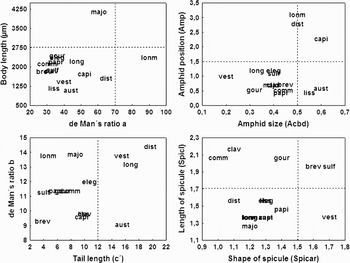
The examination of six morphological (=qualitative) and 17 morphometric features allowed to detect the characters of diagnostic value within the genus. Scatter plots of selected morphometric features were analysed in order to look for those which discriminate among groups of species (Figure 1). The features related to body size (length and de Man's ratios a and b) not only showed poor discrimination among species but also tend to show high correlation (Fortuner, Reference Fortuner1990). In addition, the significant relationship between body dimensions and food availability (dos Santos et al., Reference Dos Santos, Derycke, Fonsêca-Genevois, Coelho, Correia and Moens2008) suggested the lesser diagnostic value. Features related to relative position and size of amphidial fovea, length of the tail (relative to anal body diameter) and length and shape of spicules allowed discrimination of groups of species (Figure 1) and were therefore considered of diagnostic value.
Scatter plots of morphometric features of valid species of the genus Terschellingia. Measurements correspond to holotype. Labels defined as 3–4 first types of the specific names in Table 3 (except for T. longisoma = lonm). Dashed lines indicate possible cut-values for discriminating among species.

Morphological characters would be highly useful in diagnosis of species. We selected six features: presence/absence of teeth, shape of cephalic setae (papilliform and setiform), presence/position of cervical setae (absent, at level of or posterior to amphidial fovea), presence/absence of pharyngeal bulb, developed/reduced apophysis and shape of the tail (conical portion less or more than 50% of total length of tail). The number of developed ovaries appears to be a feature with taxonomic value, but it is not always described, mainly in old studies. The presence/pattern of precloacal supplements has been used extensively as a taxonomic character; although supplements are present in at least one species (T. longicaudata) they are hard to observe with light microscope, and thus less useful as a diagnostic character.
Discrimination of species within the genus Terschellingia
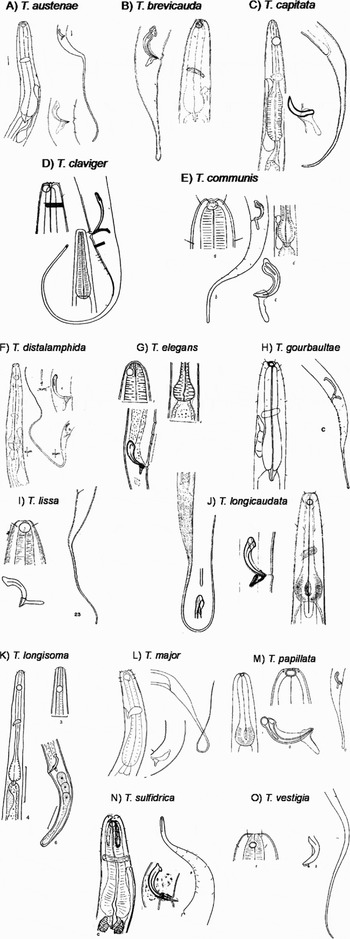
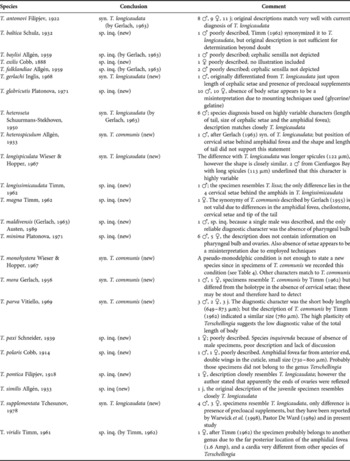
Within the genus, 38 nominal species have been described. However, according to our results only 15 of them are considered as valid. From the 23 non-valid species, 14 are species inquirendae and nine are junior synonyms of one of the valid former species (see Table 2 for explanations). Pictorial (Figure 2) and tabular (Table 3) keys summarize the main diagnostic characters for discrimination among valid species of Terschellingia and an explanation follows below.
Outline of 15 valid species of the genus Terschellingia. Drawings not to same scale and reproduced from original description (except for T. communis, reproduced from Gerlach, Reference Gerlach1963).

Outline of non-valid Terschellingia species. Abbreviations: sp. inq., species inquirend a; syn., synonymy. For additional abbreviations see Table 1. The numbers of specimens used in the original descriptions are indicated.

The presence of small teeth in the buccal cavity is the main taxonomic feature that distinguishes T. elegans and T. sulfidrica from the other species of the genus. Both species can be differentiated from one another by shape and length of spicules (more curved and larger in T. sulfidrica; Figures 1 & 2), tail shape (>50% conical in T. sulfidrica versus >50% filiform in T. elegans), and the presence of a single ovary in T. sulfidrica. According to Gagarin & Vu-Thanh (Reference Gagarin and Vu-Thanh2003), T. elegans closely resembles T. supplementata (here synonymized with T. longicaudata) but mainly differs from it and in extension also from T. longicaudata by the presence of a tooth, the shorter cephalic setae and the absence of cervical setae.
Three species of Terschellingia have the amphidial fovea located relatively far from the anterior body end: T. capitata, T. distalamphida and T. longisoma (Figures 1 & 2). Terschellingia distalamphida can be distinguished from the other two species by the presence of cervical setae and a filiforme tail (<50% conical and more than 12 anal diameters length). Terschellingia capitata is characterized by a large and muscular pharyngeal bulb (bar 3.4 versus 1.3 and 1.9 in T. distalamphida and T. longisoma respectively). Terschellingia longisoma is characterized by a very long and thin body (total length holotype: 2156 µm, a = 90); also it has a tail very poorly attenuated to the terminus (Gagarin & Vu-Thanh, 2006).
Terschellingia papillata is the only species of the genus with cephalic setae papilliforme. The spicules of T. papillata are very similar to those in T. longicaudata (Figure 2), but the former lacks the cervical setae and it has a larger conical portion of the tail.
On the basis of presence/absence of pharyngeal bulb, two groups of species can be distinguished: a group of ten species with clear set-off pharyngeal bulb (six of them already characterized above). The remaining four species (i.e. T. communis, T. lissa, T. longicaudata and T. vestigia) differ from each other by a combination of characters (Table 3).
Main diagnostic characters differentiating the valid species of the genus Terschellingia de Man Reference De Man1888. Abbreviations in Table 1; additional abbreviations: ceph. setae, shape of cephalic setae; cerv. setae, presence/position of cervical setae (first somatic setae) with respect to amphidial fovea; phar. bulb, pharyngeal bulb; post., posterior. States of character: 0 = absence; 1 = presence. *No females described.

Terschellingia lissa can be differentiated from the other three Terschellingia species by a larger size of amphidial fovea (>0.5 cbd), conical portion of the tail is less than 50% of total length and lack of cervical setae. In addition T. lissa has a relatively small body length within the genus (<1000 µm).
The main differences between T. communis and T. longicaudata rest on the length of the conical portion of the tail. The length of the tail appears to be useful for differentiating most of the specimens (i.e. T. communis c′: <12; T. longicaudata c′: >12; Figure 1). However, we recorded in Cienfuegos Bay some unusually large male specimens of T. longicaudata with ‘short tail’ (c′: 5.5–8.8); and some females of T. communis can have a relatively long tail (c′: 10–12). The original description by de Man (Reference De Man1888) of T. communis showed a completely conical tail with pointed tip, not found in any other description of the species; the latter feature was discussed by Timm (Reference Timm1962) as ‘problematic’. Reviewing the literature and based upon our own material, we found that the tail tip is rounded. The length of spicules appears to be an important feature for differentiating between the holotypes of T. communis and T. longicaudata (Figure 1). However, there are not clear differences between T. communis and T. longicaudata regarding spicule length on the basis of the few studies including absolute measurements: 54–61 µm (1.6–1.9 abd) versus 47–48 µm (1.7 abd) in Warwick et al. (Reference Warwick, Platt and Somerfield1998); 38–44 µm (1.2–1.4 abd) versus 38–113 µm (1.4–1.9 abd) in specimens from Cienfuegos Bay. However, since Figure 1 shows a clear cut-value around 1.7 abd for holotypes, we include the spicule length as a useful character for diagnosis.
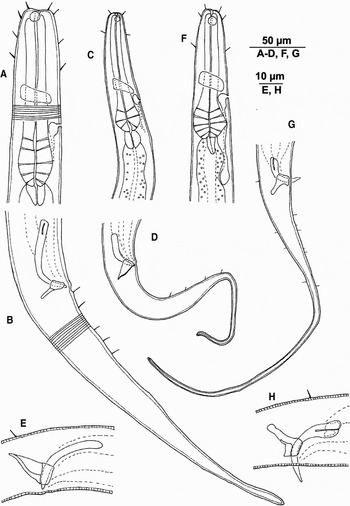
Other important, but more difficult to standardize, differences between T. communis and T. longicaudata are regarding to cervical setae, shape of cardia, and shape of spicules and gubernaculum apophysis. So far, the main difference with respect to the pattern of cervical setae is the position (at level of amphidial fovea in T. longicaudata; posterior to the fovea in T. communis). However, the number of cervical setae and their relative position in the anterior region is variable in specimens of T. longicaudata as has been reported by other authors (e.g. Chitwood, Reference Chitwood1951; Timm, Reference Timm1961; Wieser & Hopper, Reference Wieser and Hopper1967; Bhadury et al., Reference Bhadury, Austen, Bilton, Lambshead, Rogers and Smerdon2008) and from specimens from Cienfuegos Bay. The cardia is larger, rounded and without pericardiac cells in T. communis versus cylindrical and rounded by intestinal cells in T. longicaudata; nevertheless the shape would be affected by the processes of preservation and mounting for the specimen. In relation to accessorial reproductive structures, T. communis has a proximal end of spicules non-cephalated and the apophysis of gubernaculum wide and cuticularized in ventral border; T. longicaudata has a cephalated spicule with central septum in manubrium and a narrower apophysis of the gubernaculum. However, intraspecific variability in spicule shape and gubernaculum has been observed (i.e. compare T. communis in Figures 2E & 3E).
Species of the genus Terschellingia recorded in Cienfuegos Bay, Caribbean Sea. T. gourbaultae: (A) anterior part; (B) tail; (G) spicular apparatus; T. communis: (C) anterior part; (D) tail; (E) spicular apparatus; T. longicaudata: (F) anterior part; (G) tail; (H) spicular apparatus.

The high number of junior synonymies of T. longicaudata (in total five; see Table 2) could be explained by: (i) high abundance and cosmopolitan distribution leading to numerous descriptions by different authors; and (ii) high morphological plasticity. There are, for instance: large variation in body habitus (de Man's ratio a ranged 29–40 after Timm, Reference Timm1962), sexual dimorphism in size of amphidial fovea (♂ 0.3 cbd; ♀ 0.5 cbd after Wieser, Reference Wieser1956) and in relative position of amphidial fovea (Amp ♂ 0.5; ♀ 0.9 after Vitiello, Reference Vitiello1969), different aspect of spicular apparatus (Vitiello, Reference Vitiello1969) and presence or absence of precloacal supplements.
The diagnosis of T. vestigia is based on the presence of a reduced dorsal apophysis of the gubernaculum. However, since only one male was described, putative intraspecific variability cannot be assessed. We prefer to maintain this species as valid given that it is relatively easy to check this diagnostic character.
Five species of Terschellingia lack a set-off pharyngeal bulb; the table elaborated by Austen (Reference Austen1989) and summarizing main differences among these species has been updated by Guo & Zhang (Reference Guo and Zhang2000) and Huang & Zhang (Reference Huang and Zhang2005) with addition of one species respectively but without further discussion. We found that some of the proposed diagnostic characters are less useful for species differentiation. Length-related measurements (total body length, de Man's ratio a and tail length) were notably overlapping among species. The body length is not a good main diagnostic character, even for species with extreme body sizes (T. austenae <950 µm; T. major > 3436 µm) since in some monhysterids, body size is influenced by environmental factors such as food availability (dos Santos et al., Reference Dos Santos, Derycke, Fonsêca-Genevois, Coelho, Correia and Moens2008). In addition, the length of spicules in five specimens of T. gourbaultae from Cienfuegos Bay was shorter (59–66 µm) than specimens from the Tamar Estuary, England reported by Austen (Reference Austen1989) (80–88 µm), suggesting high variability in this character.
Two species (T. austenae and T. claviger) have less than 50% of total tail length conical, with the distal third portion filiforme. These species can be differentiated from each other by the relative size of amphidial fovea and the position of cervical setae; in addition, the length and shape of spicules and apophysis of gubernaculum would be useful diagnostic characters (Table 3).
Differences among T. brevicauda, T. gourbaultae and T. major are more subtle on the basis of taxonomic characters currently proposed. Austen (Reference Austen1989) pointed out that the shorter tail in T. brevicauda (c′ 3.5–4.3) allows its differentiation from other species; the tail of T. gourbaultae is effectively larger (c′: 5.5–8.0 after Austen; 5.1–9.4 in specimens from Cienfuegos Bay). An additional feature, maybe less variable (and so more useful), is the position of the cervical setae (Table 3). The spicular apparatus is different in appearance (Figure 2) and in absolute measures (spicule length: 47–53 µm for T. brevicauda versus 80–88 µm for T. gourbaultae), but other morphometric measures such as relative length and shape of spicules failed to show differences (Figure 1). The unique record of T. brevicauda in North Carolina, USA (Ott, Reference Ott1972) does not allow to assess possible intraspecific variability.
Two conspicuous features allow to identify specimens belonging to T. major; i.e. large body size (>3000 µm), and presence of precloacal supplements (>30). The latter character has been recorded in T. sulfidrica; but in specimens described from several geographical regions (e.g. T. longicaudata) the presence and number of supplements appeared variable. On the basis of the proposed differential diagnosis for species of Terschellingia (Table 3) the discrimination between T. gourbaultae and T. major would become problematic if high intraspecific variability exists in the latter species. The differences in relative length of spicules between holotypes suggest the usefulness of this feature for discrimination (Figure 1).
Description of Terschellingia species from Cienfuegos Bay
For most of the features measured on specimens from Cienfuegos Bay they were relatively different from the data for the holotypes. This suggests a continuum in the size of body structures and a high morphological plasticity in the three species analysed. The high morphological plasticity in some nematode genera with numerical dominance (e.g. Daptonema, Sabatieria and Terschellingia) could adjust in a more general model relating morphological plasticity and ecological success (Hollander, Reference Hollander2008 and references herein). It should be interesting to assess the level of intraspecific variability (i.e. morphological plasticity) in rarer species of nematodes; and also to test for relationships between morphological plasticity and ecological dominance in free-living marine nematodes.
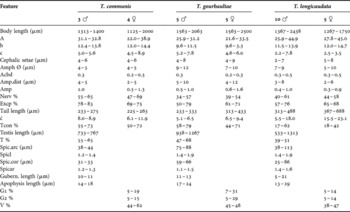
The morphometric data are presented in Table 4 and illustrations in Figure 3. We only include in this section those features with some variation compared to older descriptions of the species.
Morphometric data (minimum–maximum) for males and females of Cuban specimens of the genus Terschellingia. Abbreviations in Table 1; additional abbreviations: amph Ø, diameter of amphidial fovea; amp.dist, distance of amphidial fovea to anterior end; gubern., gubernaculum; spic.arc and spic.cor, length of spicules as arc and cord respectively.

TERSCHELLINGIA COMMUNIS DE MAN, 1888
Material measured: 3 ♂; 4 ♀; 2 j
Remarks. Body length of juveniles: 1000–1125 µm; differentiation between juvenile stages could not be determined beyond doubt. The degree of development of ovaries was variable either anterior ovary more developed than posterior one, reverse or equally developed. The shape of the spicules and gubernaculum apophyses shows variability in some details among the descriptions by de Man (Reference De Man1888), Timm (Reference Timm1962), Gerlach (Reference Gerlach1963) and our observations. A conspicuous feature is presence of a developed cardia between pharynx and intestine (however, the shape sometimes appears to be affected by preservation or physiological condition of the specimen). This character has not been pointed out by the earlier descriptions of the species but could be a useful character for identification.
TERSCHELLINGIA GOURBAULTAE AUSTEN 1989
Material measured: 5 ♂; 3 ♀; 4 j.
Remarks. T. gourbaultae has been described relatively recently and was recorded only in British and French estuaries. Body length of juveniles: 767–2125 µm; differentiation between juvenile stages could not be determined beyond doubt. The pattern of cervical setae described for holotype (i.e. three circles of cervical setae each one with eight setae) was common; but presence of only a single circle also occurred as well as a reduction in number of setae per circle (to 4–6). The specimens from Cienfuegos Bay closely resemble the holotype, except for the proximal end of the spicule. This suggests that morphological details of accessory reproductive structures have to be interpreted with caution since they can vary among populations.
TERSCHELLINGIA LONGICAUDATA DE MAN 1906
Material measured: 10 ♂, 5 ♀, 6 j.
Remarks. The specimens of T. longicaudata collected at Cienfuegos Bay closely resemble the original description of the holotype. Total length of juveniles: 733–1188 µm. Main differences are with regard to the pattern of cervical setae and shorter length of cephalic setae in juveniles. The intestine is often filled with conspicuous green granules all over its length. Precloacal supplements present, visible as small pits (6–7 in number) in large specimens using light microscopy; in smaller specimens only visible by scanning electron microscopy (results not shown). Two large-sized male specimens (4280 and 4800 µm) of Terschellingia were described by Murphy (Reference Murphy1965) who suggested that they belong to T. communis. However, those specimens were similar to T. longicaudata in the habitus, pattern of anterior sensilla, and shape and size of spicules; the main difference was the length of the tail (c′: 7). We also collected two large males (2375 and 2438 µm) with tail unusually short (c′:5.5 and 8.6) and large spicules (113 µm both specimens). A recent study (Bhadury et al., Reference Bhadury, Austen, Bilton, Lambshead, Rogers and Smerdon2008), combining morphological and molecular tools points to the presence of cryptic species of T. longicaudata. In our study, the exploration of ultrastructure-based characters by SEM (as suggested by Bhadury et al., Reference Bhadury, Austen, Bilton, Lambshead, Rogers and Smerdon2008) did not add any additional character of diagnostic value for discrimination among putatively cryptic species of T. longicaudata. Therefore, future refining of molecular techniques on this species (in combination with morphological analysis) is the most promising way forward for dealing with this taxonomically problematic species.
ACKNOWLEDGEMENTS
Financial support was provided by the International Foundation for Science (research grant IFS A-4004/1 to M. Armenteros), and Ghent University (doctoral scholarship BOF 01W01607 to M. Armenteros; project BOF 01GZ0705 ‘Biogeography and Biodiversity of the Sea’ to M. Vincx). The Belgian Focal Point to the Global Taxonomy Initiative (project 2406JVG2) powered the taxonomic expertise in nematodes of the Cuban authors. We thank staff of the Center for Environmental Studies of Cienfuegos (CEAC) for the valuable collaboration, particularly R. Fernández-Garcés (Cacho) and L. Díaz-Asencio for help with sampling and initial processing of samples. Our colleagues C. Pastor de Ward, and A. Tchesunov kindly provided us with valuable literature. Thanks to Marjolein Couvreur for assistance with the microscopy. We acknowledge two anonymous referees who improved considerably the manuscript with their comments.