




No CrossRef data available.
Article contents
- Abstract
- CONVENTIONAL WISDOM AND THE MIDDLE PRECLASSIC IN THE BELIZE VALLEY
- THE MIDDLE PRECLASSIC IN THE BELIZE VALLEY: WHAT'S REALLY THERE
- ETHNOLINGUISTIC IMPLICATIONS
- THE MIDDLE PRECLASSIC BELIZE VALLEY: RETROSPECT AND PROSPECT
- THE UMBRAL CERAMIC COMPLEX AND ITS CULTURAL HISTORICAL ASSOCIATIONS
- AFTER THE “RISE”: BELIZE VALLEY CULTURE HISTORY TO THE FIFTH CENTURY a.d.
- RESUMEN
- ACKNOWLEDGMENTS
- References
RECONSIDERING THE BELIZE VALLEY PRECLASSIC: A case for multiethnic interactions in the development of a regional culture tradition
Published online by Cambridge University Press: 04 March 2004
Article contents
- Abstract
- CONVENTIONAL WISDOM AND THE MIDDLE PRECLASSIC IN THE BELIZE VALLEY
- THE MIDDLE PRECLASSIC IN THE BELIZE VALLEY: WHAT'S REALLY THERE
- ETHNOLINGUISTIC IMPLICATIONS
- THE MIDDLE PRECLASSIC BELIZE VALLEY: RETROSPECT AND PROSPECT
- THE UMBRAL CERAMIC COMPLEX AND ITS CULTURAL HISTORICAL ASSOCIATIONS
- AFTER THE “RISE”: BELIZE VALLEY CULTURE HISTORY TO THE FIFTH CENTURY a.d.
- RESUMEN
- ACKNOWLEDGMENTS
- References
Abstract
Despite more than two decades of extensive and highly productive research programs by a series of institutions and individuals focusing specifically on the Preclassic archaeology of the Belize River Valley, understanding and appreciation of the region's ceramic tradition and interpreted culture history today effectively remain based on, and dependent on, unmodified conceptual formulations from the 1940s through the 1960s. These incorporate a view of the zonal Preclassic ceramic sequence as the physical embodiment of a uniform and even unitary local producer–consumer system tied directly and genetically to the later Classic and Postclassic Maya inhabitants of the region. In this paper, we question both these assumptions and the soundness of the conceptual constructs (ceramic complexes) and framework (ceramic sequence) on which they are based. We examine the content and analyze the composition of the Belize Valley Middle and Late Preclassic ceramic complexes as dynamic, composite, producer–consumer circulation assemblages rather than as static, synthetic archaeological units, and we conclude that they reflect a much more complex socioeconomic, cultural, and sociopolitical landscape than has yet been recognized and appreciated by other investigators. We propose the presence and interaction within the valley during the Middle and Late Preclassic of at least two distinct dialectal, ethnic, or ethnolinguistic groups, and we argue that the local cultural tradition emerging in the area by the ceramic Protoclassic represented a ranked amalgamation of these. The paper also presents the first comprehensive and complete type-variety typologies for the Middle through Late Preclassic ceramic complexes of the upper Belize Valley, incorporating both new data from the 1980s and 1990s and substantive revisions of earlier work by J. E. S. Thompson and James C. Gifford.
Information
- Type
- Research Article
- Information
- Copyright
- © 2003 Cambridge University Press
Over the past half-century and more, researchers have accumulated enormous quantities of data pertaining to the Preclassic archaeology of the Belize Valley and its immediate surroundings (Figures 1 and 2). The history of Preclassic studies in the valley extends from the recognition of Middle Preclassic horizon ceramics at Xunantunich (Benque Viejo) by J. E. S. Thompson (1942) and the identification of Middle Preclassic architecture at Nohoch Ek by William Coe and Michael Coe (Coe and Coe 1956) through the definition of a comprehensive and enduring central western Belize Preclassic ceramic sequence by Gifford and his colleagues based on findings at Barton Ramie, Melhado, and other local sites (Gifford 1965, 1976; Willey and Bullard 1956; Willey and Gifford 1961; Willey et al. 1965). It has continued with the recent and ongoing applications of these earlier baselines by the Trent University Preclassic Maya Project under the general direction of Paul F. Healy in the upper or western valley (Awe 1992; Healy 1999; Healy [editor] 1999; Healy and Awe 1995, 1996) and a Southwest Texas State University project directed by James F. Garber in the lower or eastern valley (Brown 1999; Brown and Garber 1997; Garber 1997, 1998, 1999; Garber, Brown, and Hartman 2002). Laudably, all of these investigators have reported their discoveries promptly and in detail, and this has made these findings available to other scholars for use in an almost overwhelming abundance and complexity. To date, however, there has been an absence of any overarching synthesis of these data by any single researcher, and this has left them a virtual mishmash of nebulous and at times confusing and seemingly even contradictory information. What has substituted has been a simple equation of the published Barton Ramie ceramic typology and its sequencing (Ball 1976; Gifford 1965, 1976; Sharer and Chase 1976; Willey and Gifford 1961) with zonal “cultural history.”

Sites with reliable known evidence of Middle Preclassic occupation.

Sites with known early Late Preclassic (100 b.c.–a.d. 200) monumental public architecture.
With few exceptions (Garber 1999; Garber, Hartman, and Brown 2002), there has been a general operating assumption that the Barton Ramie sequence as established by Gifford (1965, 1976) substantially delineated and documented zonal Preclassic prehistory and that subsequent research largely involves its correct application to more recently recovered data. Generally, this adherence to a construct rooted more in conventional wisdom than the scientific method has been coupled with a manifestly perfunctory questioning of what might well be styled “the Barton Ramie paradigm,” but an inevitable continued reliance on it. The bare bones represented by the sequence might be fleshed out or given fresh interest through the recovery of new data on the non-ceramic aspects of Preclassic culture, but what questions or problems relating to it remained unresolved generally were considered to be issues of chronology and external derivations. Reflecting this, and notwithstanding a mid-1990s revisionist statement on the conceived goals of Preclassic research in the region (Healy and Awe 1995a), the most ambitious and extensive campaigns of field investigations focusing specifically on the Belize Valley's Preclassic archaeology during the early 1990s emphasized the temporal parameters and priority of the earliest ceramics—and so, by definition, of the “earliest Maya”—and their relationships to the northern Belize Swasey complex/sphere and other equally early assemblages (Awe 1992; Awe et al. 1990; Cheetham and Awe 1996; Healy and Awe 1995b). A related but secondary issue was the possible origin of these early “Maya” settlers. This is in no way to undervalue or belittle the rich and important information on Preclassic settlement, culture, society, and economy that has resulted from this research (Awe and Healy 1996; Healy [editor] 1999; Healy and Awe [editors] 1995, 1996), but the truth is that the primary interest of the program always remained the demonstration of temporal priorities for what was assumed to be an established cultural continuum or tradition represented by what had come to be a reified ceramic “history.”
In 1994, the authors began an intensive analysis of the full Middle and Late Preclassic ceramics recovered between 1984 and 1992 at the sites of Cahal Pech, Buenavista del Cayo, Guerra de Buenavista, Nohoch Ek, and Las Ruinas de Arenal by the San Diego State University Mopan–Macal Triangle Archaeological Project (Figure 1). At the request of colleagues Jaime Awe and Paul Healy, we also included materials from the Trent University investigations at Cahal Pech in our study; however, it should be noted that the latter were limited to materials of full Middle through Late Preclassic age and did not include any consideration of their postulated initial “Early” (or early Middle) Preclassic complex or subcomplex, “Cunil” (Awe 1992; Awe et al. 1990; Cheetham 2001; Cheetham and Awe 1996).
Instead of merely classifying or “typing” the ceramics in question, we undertook a full-dress descriptive analysis starting from scratch and encompassing typological, modal, and inspectionally observable technological attributes. In the course of this analysis, we became increasingly aware of a number of serious anomalies in the “conventional-wisdom model” of the ceramic history and derived cultural history of the valley, and in attempting to address these we gradually developed the new interpretations of the data and the hypothetical model based on them presented in this paper. Readers should understand these to be tentative and thus subject to significant modifications based on future field and laboratory research. In many respects, the present paper is intended more as a stimulus to and design for future research that we hope others will find suitable to pursue than as some new, “final,” alternative interpretation of the Belize Valley Preclassic ceramic sequence and its significance. Probably the most appropriate point with which to begin this reassessment is a single fundamental fact concerning the “earliest Maya” of the Belize Valley as represented by the established early facet Jenney Creek, Benque Viejo 1a, and early facet Kanluk ceramic complexes. Simply put, these earliest permanent settlers of the valley may not have been Maya. At the very least, they most certainly were not the Maya associated with the Classic-era florescence either in the valley or across the southern lowlands of the Peten to its west.
A lengthy and animated dialogue on this point with John Clark, Richard Hansen, and Don Forsyth at the 2000 Society for American Archaeology Meeting in Philadelphia and additional discussion with Michael Love served to convince the authors that it is at the least equally probable that two distinct groups of Maya, very possibly speaking two entirely different Mayan languages, are represented by the Swasey–Bladen–Mamom and Jenney Creek/Kanluk–Barton Creek/Xakal ceramic traditions. Currently accepted glottochronological reconstructions certainly support both diversification of the language family by the end of the second millennium b.c. and the emergence by then of what would become the major Lowland Maya language groups of the Classic period and later. We hazard no speculations as to which groups might have been represented or their identification with one or the other of the two ceramic traditions under discussion, given the actively ongoing and complex controversies regarding the actual geospatial distributions of Yucatec-, Cholan-, and other Mayan-speakers during the Classic period and the relationships of these to the creators of that era's hieroglyphic inscriptions (Houston et al. 2000). At the same time, we note that in a painstaking study in which they use many of the same data that we do, as well as many other data, to reach dramatically different conclusions, John Clark, Richard Hansen, and Tomás Pérez (2000) nevertheless concur with our assessment and that of René Viel (Viel and Hall 2000) that the Preclassic base population of the Copan Valley was most likely of Mixe–Zoque rather than Maya affinity. It is precisely this population with which we argue that our Jocote system ceramic data ties the pioneer Jenney Creek/Kanluk settlers of the Belize Valley (see later).
Hereafter in this paper, we refer to the two hypothetical early ethnic groups and their reflective ceramic/cultural traditions as the SBM (Swasey–Bladen–Mamom) Tradition and the KXM (Kanluk–Xakal–Madrugada) Tradition. We have elected to use the as yet relatively unknown upper Belize Valley Buenavista Preclassic complexes rather than the well-known Barton Ramie ones because of the major and seemingly inescapable “historical” interpretive loads associated with the Floral Park complex and its predecessors (for an exhaustive, recent summary of these, see Brady et al. 1998).
CONVENTIONAL WISDOM AND THE MIDDLE PRECLASSIC IN THE BELIZE VALLEY
While the temporal and historical priority of the Jenney Creek complex in the lower valley and of the Benque Viejo la or Kanluk complex in the western or upper valley are now well established, the true chronology, composition, and functional character of one unit—the “Cunil” complex or subcomplex (Figure 3)—until quite recently remained open to debate (Ball 1996; Cheetham and Awe 1996). In consequence, and given its ambiguity and controversiality, the authors chose to exclude treatment of “Cunil” from the present study. New discoveries at Blackman Eddy and fresh data from Cahal Pech now appear to resolve these issues and to document the composition and status of “Cunil” (see later; Garber, Hartman, and Brown 2002; Hartman et al. 2002). Given the nature of the new findings, we think it is important to emphasize that they in no significant way affect the position taken or arguments made in this paper in that we consider and discuss the Kanluk and Jenney Creek complexes as components of established, in-place systems rather than as intrusive, evolving, or otherwise dynamic entities.

Cunil assemblage vessels (all from the lowermost depositional levels beneath Structure 6 (Awe's B-4, Cahal Pech). Drawn from actual vessels.
A sufficient body of radiometric determinations on the early facets of Kanluk and Jenney Creek have accumulated from Cahal Pech, Pacbitún, Blackman Eddy, and other sites to document a consistent positioning of this material between about 900–850 b.c. and 700–650 b.c. (Garber, Hartman, and Brown 2002; Hartman et al. 2002; Healy 1990; Healy [editor] 1999; Healy and Awe 1995b; Hohmann and Powis 1996; all dates in this article represent approximate actual calendar ages based on variously calibrated radiometric determinations, none of which differs significantly from the others for the time frame concerned.) Persistence as a late facet after 700–650 b.c. also is well documented, but determination of how long this second aspect continued before grading into or being replaced by a terminal Middle Preclassic–initial Late Preclassic complex—designated “Umbral” in the upper valley—is complicated both by depositional mixing of the component elements as subfloor and structural fill during the Late Preclassic and by the exceptional levels of de Vries effect atmospheric noise affecting global carbon levels and so both radiometric determinations and their calibration for the period between about 800 and 400 b.c. (Damon and Jirikowic 1992; Renfrew and Bahn 1996:134–135; Taylor 1997:76–78, Table 3.1; Tolstoy 1989:281–282, Figure 12.1).
The temporal span of the Umbral complex also remains to be determined exactly, but combining typological cross-dating and bracketing radiocarbon dates suggests an interval between about 550 and 200 b.c. The stratigraphically younger Xakal and late Barton Creek complexes are of what might be called “stereotypical” Chicanel sphere composition and can be dated securely to after 300 b.c.
The typological and modal compositions of the several early complexes have been presented on a number of previous occasions. Jenney Creek and early Barton Creek have been described by Gifford (1965, 1970; Sharer and Gifford 1970), Robert Sharer (1976), and Joseph Ball (1976). Both Thompson (1942) and Ball (1996; Tables 1 and 2) have discussed the Kanluk or Benque Viejo 1a complex, and this study's senior author treated Umbral in an earlier paper (Ball 1996).
Typological (type–variety) constitution of the Kanluk ceramic complex

Middle to early Late Preclassic Belize Valley ceramic units, assemblages, and ethnocultural assignments

Awe (1992), David Cheetham (Cheetham and Awe 1996, 2001), and Duane Strelow (Strelow and LeCount 2001) have provided preliminary descriptions of the material comprising “Cunil,” and discoveries at Blackman Eddy in 2001 and 2002 (Garber et al. 2002; Hartman et al. 2002), together with new (2002) data from Cahal Pech, promise finally to resolve the long debate concerning the actual composition of the “Cunil assemblage” as they have already resolved its functional status as a true, full complex, and its exact chronological position antecedent to Kanluk and Jenney Creek (James Garber, personal communication 2002).
In 2001 and 2002, the Southwest Texas State University Belize Valley Archaeology Project, directed by Garber and M. Kathryn Brown, located and excavated an extensive, stratigraphically isolated occupational deposit of seemingly pure “Cunil” material directly overlying bedrock and sealed beneath a lengthy sequence of architectural constructions extending from early in the Jenney Creek ceramic phase up through the entire Middle, Late, and Terminal Preclassic spans into the full Classic era (James Garber, personal communications 2001–2002; Garber, Brown, and Hartman 2002; Hartman et al. 2002). Although structural levels above it contained what were by then archaeologically familiar admixtures of “Cunil” and Jenney Creek ceramics, such definitive Jenney Creek/Kanluk hallmarks as orange Savana group types and true Jocote Orange-brown initially appeared to be absent from the constructionally sealed basal deposit. The deposit was well preserved and rich in carbon, faunal remains, and artifactual materials, including “retouched flakes, scrapers, drills, burins, chert macroblades, hammerstones, quartzite and granite manos, tecomate stone bowls, polished greenstone, marine and freshwater shell disk beads, bone needles, bone rings, stingray spines, stone pendants, ceramic ocarinas, and molded ceramic figurines” (Garber, Hartman, and Brown 2002:54), as well as pottery. It represented, in short, a complete cultural assemblage of pre–Jenney Creek vintage. Garber named the associated ceramic complex “Kanocha.”
Especially critical is the rigorously monitored and recorded stratigraphic integrity and situation of this deposit of which the Southwest Texas State team excavated well over 120 horizontal square meters. The soundness and reliability of these should address virtually all of the concerns confounding previous reported finds of “Cunil” materials at Cahal Pech (Awe et al. 1990; Cheetham 1995, 1996, 1998; Cheetham and Awe 1996, 2001) and Xunantunich (Strelow and LeCount 2001). Continuing field and lab studies and reports that are now in preparation on the content and radiometric chronometry of the Blackman Eddy deposit ultimately will constitute contributions of immense and seminal importance to the archaeology and culture history of the Belize Valley and our understandings of these.
It is important to emphasize that until the 2001–2002 Blackman Eddy discoveries, no genuinely acceptable unambiguous data existed as to the actual composition, functional status, or exact relative temporal position of “Cunil.” The senior author (Ball) ultimately reached this conclusion only after carefully re-examining and reconsidering all of the formally presented (Awe 1992; Awe and Campbell 1991; Awe and Healy 1994; Awe et al. 1990; Cheetham 1995, 1996, 1998, 2001; Cheetham and Awe 1996, 2001; Healy and Awe 1995b; Strelow and LeCount 2001) and anecdotal evidence (Jaime Awe, David Cheetham, and John Hodgson, personal communications 1991–1992, 1995–1997, 2000) available regarding the composition, depositional distribution, and interpreted stratigraphy of the “Cunil assemblage” as of July 2001, and following extensive discussions with Awe (personal communication 2000) and John Hodgson (personal communication 2000)—one of the two on-site excavators actually responsible for exposing and recovering the “Cunil” deposit at Cahal Pech in 1991–1992. Important new data from Xunantunich (Strelow and LeCount 2001) served to support the existence of a discrete “Cunil assemblage” but still failed to resolve issues of its functional character or true age.
Lying directly over bedrock deep beneath Structure A6 (El Castillo), arguably the most sacred spot on the ridge supporting the site, the Xunantunich “Cunil” depositional layer was itself overlain and sealed sequentially by one virtually sterile soil horizon, another of “Barton Creek” (early Xakal)–equivalent age, and a series of strata representing a combination of natural, habitational, and monumental construction agencies of Early Classic and later date. No Savana Orange or other definitive “Jenney Creek” (Middle Preclassic) ceramic markers were present in the strata overlying the “Cunil” deposit; nor was there any evidence to support a complex-level as opposed to subcomplex status or a chronological position other than “pre–Barton Creek” (i.e., pre–Xakal/pre–400 b.c.). Thus, the sub-A6 Xunantunich deposit decidedly verified and improved our knowledge of “Cunil assemblage” composition, but it in no way and to no extent advanced our understanding of its functional status or actual age.
In sum, the senior author had been able to find no inarguably solid or validly convincing basis for identifying “Cunil” as anything other than a probable special-purpose ceramic subcomplex of generic Middle Preclassic horizon vintage. In this respect, it also merits note that until the discoveries of 2001–2002 at Blackman Eddy, some of the most pertinent independent light available concerning the nature and relationships of “Cunil” came not from the Belize Valley but from Tikal, Guatemala (Laporte and Fialko 1993a, 1993b; Laporte and Valdés 1993). The extensive investigations carried out in the “Mundo Perdido” complex between 1979 and 1984 encountered what the researchers Juan Pedro Laporte and Vilma Fialko classified as early-facet Eb pottery (Laporte and Fialko 1993a), and in 2000 the Cahal Pech archaeologist David Cheetham identified as true “Cunil” ceramics among the contents of two small chultunes dug into the limestone bedrock underlying the group (John Clark and Donald Forsyth, personal communication 2000). Each of the two early-facet Eb deposits (Deposits PNT-006 and PNT-012), as well as a third late-facet Eb deposit (PNT-013), was recovered from a cavity dug into the limestone bedrock and sealed by multiple unbroken plaster floorings of late Eb or Tzec and later construction date. (It should be recalled that the two Eb deposits recovered years earlier by the University of Pennsylvania's Tikal Project also were recovered from depositional contexts consisting of artificial cavities, or chultunes, dug into the limestone bedrock underlying the site.) For a combination of context-based and content-related reasons, investigating archaeologists Laporte and Fialko (1993a:53) characterized these as “problematic” or “special” deposits and suggested that they very likely represented special-purpose subcomplexes rather than full assemblages.
Of considerable interest with respect to the status of the Cahal Pech “Cunil” material is the typological composition of the three deposits as determined by Laporte and Fialko (1993b:53–69). Excepting some minor relative frequency increase–decrease trends, the three deposits are generally comparable to one another in content and content frequencies and so were combined by the analysts for economy of presentation. Recent reanalysis of the chultun collections by Bernard Hermes (1999:11) emphasized the distinctiveness of the ceramics from Tzec–Mamom types but did not otherwise meaningfully alter the earlier findings or conclusions of Laporte and Fialko (1993a, 1993b). The most significant points suggested by the collections are these: (a) stratigraphically and chronologically, Eb clearly is antecedent to the Tzec Mamom assemblage; (b) what are recognizably diagnostic Cahal Pech “Cunil” types and modes are associated depositionally at Tikal with ceramics comprising the latter site's Eb or early Eb complex; (c) based on what in the senior author's judgment remain controversial and arguable contextual and compositional information, and in accord with the original investigators (Laporte and Fialko 1993a, 1993b), early-facet Eb (or “Eb,” following Hermes 1999) also appeared as likely to have been a functionally specialized subcomplex as it does a functionally complete full complex.
Following the established protocols of type-variety systematics, we believe it best to maintain the term “Cunil” for the upper-valley manifestation of this assemblage based on its established priority in the literature (Awe 1992; Awe et al. 1990; Cheetham and Awe 1996). However, we advise interested researchers and scholars that any valid or reliable definition of the assemblage and its content must be based on the more recent recognition and documentation of the lower valley “Kanocha complex” (ca. 1200–850 b.c.; Garber, personal communication 2001; est. Garber, Hartman, and Brown 2002) at the lower Belize Valley site of Blackman Eddy. This reflects persistent serious and continuing inconsistencies, discrepancies, and internal self-contradictions in all descriptions of the Cahal Pech “Cunil” material offered to date (Awe 1992; Cheetham and Awe 1996, 2001; Cheetham 1998, 2001).
The cited treatments of Kanocha, Cunil, Kanluk, Umbral, and Benque Viejo 1a all have been preliminary in nature, and a thorough, monograph-length study of the Middle Preclassic (Kanluk) through Protoclassic (Madrugada) archaeological pottery from Buenavista and Cahal Pech is only now in preparation by the authors. What we are concerned with calling to attention here is that all of the past treatments have involved synthetic associations of the earliest materials based on unstated assumptions of common origin or manufacture and circulation derived from depositional consociations that do not necessarily support the inferred relationships. In all of these studies, there has been an implicit assumption that depositional associations reflected not only depositional contemporaneity and so contemporaneous availability and use, but also functional integrity at the manufacturing and distribution levels as well. However, neither the Jenney Creek nor the Kanluk archaeological ceramic complex as defined represents a genuinely monolithic ceramic assemblage if such is conceived as the depositional product of a single, closed system of manufacture, distribution, use, and discard. Each is an artificial composite reflecting the full range of ceramic wares, vessels, and oddities actually in use in the Belize Valley between about 950 and 500 b.c. Ascription of either to a single producer community, economy, or even ethnic group or culture is neither justified nor correct. This is equally true for later periods, but the complexity, sophistication, and individuality of Classic- and Postclassic-era Mesoamerican pottery has made the recognition of intersite and interregional tradewares, gifts, and other exotica analytically simpler. This is not yet so for Preclassic-horizon ceramics, and a tacit assumption that depositional association reflects common producer output remains the rule concerning the ceramics of the era for a majority of Maya archaeologists. Perhaps nowhere has this assumption had so detrimental an effect on data interpretation as in the Belize Valley—a region that is ethnographically, historically, and archaeologically known to be associated with ethnically Maya societies. There, what is in fact a minority component of readily recognized Maya ceramics occurs within a matrix of not so easily identified local, generic Middle Preclassic-horizon pottery.
The easy identifiability of regularly present—although never abundant—examples of classic waxy red Joventud-group sherds and vessels, supported by the less common occurrence of polished black Chunhinta-group pottery and rarer yet appearances of cream-colored Pital monochromes and red-and-white Muxanal dichromes, pointed to a cultural affinity and so ethnic identity of the early Belize Valley Jenney Creek and Kanluk ceramics with the Maya (Tables 1 and 2; Figures 4, 5, and 6e). Not discounting the possibility that the area's aceramic Archaic dwellers might have included the Mayan-speaking ancestors of the later, “archaeologically visible” ethnic Maya (for discussion, see Iceland 1997, 2001), these early settlers potentially would have included some of the earliest Maya to enter the southern lowlands during the Preclassic period. The presumption of Maya cultural and ethnic identity was buttressed further by the presence among the local burnished orange and red-slipped orange paste-wares of an almost stereotypic Middle Preclassic vessel-form repertoire that many Mayanists seem to have forgotten is characteristic of the broader eastern Mesoamerican Middle Preclassic horizon, not exclusively of the Lowland Maya Mamom sphere alone (Figures 7, 8, 9, and 10; Drennan 1976; Lowe 1977, 1978, 1989; Lowe and Mason 1965).

Mamom ceramic sphere pottery from Cahal Pech and Buenavista del Cayo, red Joventud group, mixed types and forms (true SBM wares).

Mamom ceramic sphere pottery from Cahal Pech and Buenavista del Cayo, black Chunhinta group, mixed types and forms (true SBM wares).

Swasey–Bladen and Mamom ceramic sphere pottery from Cahal Pech and Buenavista del Cayo: (a) Pettville Red-and-Cream (Consejo group); (b) Fireburn Red-and-Cream (Consejo group); (c) Tower Hill Red-on-Cream (Quamina group); (d) Quamina Cream; (e) cream Pital group, mixed types and forms (true SBM wares).

Mars Orange Paste-Ware pottery from Cahal Pech, Guerra de Buenavista, and Las Ruinas de Arenal, orange Savana group, mixed types and forms (KXM wares).

Mars Orange Paste-Ware pottery from Cahal Pech, Guerra de Buenavista, and Las Ruinas de Arenal, mixed types and forms: (a) orange Savana group; (b) black Quemado group (KXM wares).

Mars Orange Paste-Ware pottery from Cahal Pech, Guerra de Buenavista, and Las Ruinas de Arenal, orange-red Rejolla group, mixed types and forms (KXM wares).

Mars Orange Paste-Ware pottery from Cahal Pech, Guerra de Buenavista, and Las Ruinas de Arenal, orange-red Rejolla group, mixed types and forms (KXM wares).
Our position on this is not very different from that recently espoused by Kent Flannery and Joyce Marcus (2000) with respect to the widespread conflation of many generic Mesoamerican Early to Middle Formative modes and motifs with “Olmec” or “Gulf Coast” culture or civilization. Paralleling them, we suggest that those investigators and students who make what is literally a knee-jerk assumption of “Maya” ethnolinguistic identity for the early Belize Valley materials solely because “it's a Maya area” should familiarize themselves with the extensive literature on the Mesoamerican Formative horizon from outside this single zone. This may seem an unduly strong admonition, but over the past four years the authors have on several occasions had others seriously proffer the latter opinion as well as contend that “[The ceramics] look Maya,” “They've ‘always’ been called Maya,” and “Everybody knows they're Maya” as acceptable “arguments” for the status quo. Quite simply, these are not valid arguments in any way or to any degree.
Although the Kanluk and Jenney Creek ceramic complexes as defined are based on stratigraphic depositional associations, they do not represent one-to-one equivalents of local Middle Preclassic production–consumption assemblages but depositional composites made up of locally manufactured and used pottery plus additions resulting from local exchange, long-distance trade, possible gift-giving, the curation of heirlooms or antique vessels, and other processes. The evidence for some of these processes is easily recognized; that for others is not. However, what should be understood is that the compositional character of a Middle Preclassic complex such as Jenney Creek or Kanluk really is no different from that of a central lowlands Terminal Classic complex that includes fine orange, plumbate, or thin-slate ceramics or a northern lowlands Late Classic complex with inclusions of Palmar or Petkanche group polychromes or fine-paste wares from outside the immediate region of archaeological recovery (Ball 1977a, 1993; Ball and Andrews 1975).
Admittedly, identifying assemblage exotics in a Middle or Late Preclassic complex may be more challenging than recognizing them in stylistically more distinctive later situations; however, it still can be done (Neff et al. 1999). That it has not been attempted more generally is largely a result of not trying, not believing it possible, or of not crediting the likelihood on the Preclassic horizon of long-distance movement for the heavy, awkward, and very breakable commodity that pottery represents (Rathje et al. 1978).
A corollary—often implicit—to the assumption of assemblage integrality has been that a straight-line developmental relationship amounting to virtually a genetic connection existed between the Preclassic Belize Valley complexes and later ceramic industries, thereby tying the early pottery to the ethnic Maya of later times and so confirming the identity of its producer–users as the “earliest Maya” occupants of the greater Belize Valley region, if not the eastern lowlands as a whole. From Thompson through myriad present-day investigators, the assumption has been that the Benque Viejo 1a and Jenney Creek complexes associated with these settlers represented the pottery assemblages produced by the earliest continuous inhabitants of the Belize Valley. Gifford (1970, 1974:77–98, esp. 77–80; Willey and Gifford 1961) stands out as an almost sole exception to this. Gifford saw each successive ceramic complex—Jenney Creek–Xe, Mamom, Chicanel, Floral Park, and their successors—as evidence of a new and distinct population intrusion into the region, each of these, however, of Maya ethnicity although at first possibly influenced heavily by “Olmec” ideology and culture. Together with Sharer, Gifford (1970; Sharer and Gifford 1970) proposed a probable highland Central American origin for the Jenney Creek–Xe people and their pottery. Perhaps erring in the extremeness of his views regarding periodic mass-population movements, Gifford's recognition of the close ties linking the Jocote group of the Belize Valley and unslipped wares from the Pasión drainage (Altar de Sacrificios Xe and Seibal Real complexes) and the southeastern Maya Highlands (Chalchuapa Colos and Kal complexes) nevertheless remains sound. The relationships are clear, strong, and significant, and group/type-level identities at the very least are plainly involved. The Puleston (Puleston and Puleston 1971) riverine ingress model of the early 1970s to a large extent was based archaeologically on the analyses by Gifford and Sharer.
The present authors, however, as much as anyone else originally accepted a “genetic descent model” of occupational continuity and straight-line historical development for the valley and have used it as a basis for data interpretation since the early 1970s (Ball 1976). Indeed, ceramic evidence links the Belize Valley settlers with neighbors to the north of demonstrable Maya cultural affiliation from early in the first millennium b.c.
Unequivocal examples of Bladen horizon wares including Pettville Red-and-Cream, Fireburn Red-and-Cream, and an unspecified Consejo Red variety closely related to the northern Belize Estrella Variety (all Río Nuevo Glossy Ware; Kosakowsky 1987:23–34)—dated in their zone of origin to between 900 and 650 b.c. (Kosakowsky and Pring 1998)—have been recovered from multiple Belize Valley contexts at Cahal Pech, Buenavista, and Las Ruinas de Arenal (Tables 1 and 2; Figure 6a–d).
Pettville Red-and-Cream and Fireburn Red-and-Cream consistently have been misidentified and reported by Belize Valley archaeologists as “Tower Hill Red-on-Cream,” a type that in fact is quite distinct from them. Both occur only in the same, single vat-like jar form, and it seems highly likely that what was coming into the valley from the north was not pottery per se but some substance or commodity held by and transported in these vessels. True Tower Hill Red-on-cream is present but extremely rare and has been over-reported due to these misidentifications. Its chronological position also is somewhat less clear than that of the other Consejo group types and most likely is of late Kanluk 2 or even Umbral placement. As noted, most of the sherds that to date (2001) have been “identified” as “Tower Hill Red-on-Cream” actually belong to the Pettville or Fireburn types. It is also highly likely that most if not all sherds identified as “Consejo Red” actually are body fragments from red-slipped areas of these same dichrome vessels.
All of the foregoing—as well as slightly later Paso Caballo–Flores Polished Ware Joventud, Chunhinta, Pital, and Muxanal group ceramics—represent Middle Preclassic exotics, however, not locally manufactured components of the Kanluk or Jenney Creek assemblages. The latter consisted initially of pottery belonging to the Jocote (Tumbac Unslipped Ware, undesignated paste-ware), Savana and Quemado (Mars Orange Ware, Mars Orange Paste-Ware), and Rejolla (Ares Orange Ware, Mars Orange Paste-Ware) ceramic groups, progressively complemented and then replaced by local (Yesoso Orange Paste-Ware, ware undesignated) representatives of the Joventud and Sierra groups (Tables 1 and 2).
What we wish to emphasize, however, is that those ware sets of groups and types that can with real certainty be attributed to the long-lived Lowland Maya ceramic tradition occur only as traces or minority elements in the Belize Valley complexes of the Middle Preclassic period, and that once the inarguably “Maya” types are removed from the Kanluk and Jenney Creek configurations, the otherwise stereotypical “generic Middle Preclassic,” as opposed to Middle Preclassic “Maya” character of the remainder, becomes readily apparent despite some regional provincialisms (Tables 2 and 3).
Mopan–Macal Triangle Middle–early Late Preclassic ceramic collectionsa

The literature on the ceramics and stylistic modes of this period from throughout both eastern and western Mesoamerica is enormous, and we will not pretend to survey it even summarily here. Instead, we refer readers to the exhaustive work by E. Wyllys Andrews V (1990), Ann Cyphers Guillén (1992), Robert D. Drennan (1976), Kent Flannery and Joyce Marcus (1994, 2000), David C. Grove (1989, 1997), Thomas A. Lee, Jr. (1989), Gareth W. Lowe (1977, 1978, 1989; Lowe and Mason 1965), Robert J. Sharer (1978, 1989), among others, on which we have relied to determine the most plausible cultural affiliations and ethnic associations of the early Middle Preclassic Belize Valley pottery as argued in the following sections of this essay.
THE MIDDLE PRECLASSIC IN THE BELIZE VALLEY: WHAT'S REALLY THERE
Our analysis of the Belize Valley Preclassic ceramics has not been unusually sophisticated in any way. It began with a traditional type-variety classification of the selected collections (Tables 1 and 2). Given common practice in the Belize Valley during the late 1980s and 1990s, we must emphasize that this did not involve an attempt to match or fit sherds into previously established typologies from either the valley or elsewhere. Potential varieties, types, and groups were isolated through sorting, descriptively defined, and then compared to existing typologies to determine possible affiliations or connections. Complexes were established on the grounds of consistent depositional associations, not typological or modal parallels. The deposition-founded complexes then were redivided on the basis of a macroscopic examination of paste variants and slip qualities believed to reflect consistent manufacturing techniques. These were treated as independent variables from those of vessel form, dimensions, surface color, and decorative modes of all kinds. Neither absolute nor relative frequencies were taken into consideration at this point, although their potential importance was recognized.
Our result for the Middle Preclassic collections examined was the identification of seven distinct ceramic ware-sets within the Kanluk and Jenney Creek complexes. Of these, five comprised slipped wares and two consisted of unslipped pottery (Table 3). The absolute and relative frequencies for these ware-sets next were calculated, with the results displayed in Table 3. These figures represent composite statistics based on two separate column samples drawn from two separate, depositionally contemporary, construction-sealed primary refuse deposits incorporated as core within and beneath the architectural body of Structure B-4 at Cahal Pech. The two deposits were found and excavated by members of the Trent University team between 1990 and 1992, over which time their stratigraphic situations and integrity were examined in the field and verified and their depositional character and most likely systemic derivation was determined independently by this paper's senior author. The depositional date of the materials was assessed to be very late to terminal Kanluk 2, and their probable origination age was evaluated as middle to late Kanluk 2. Together, the two samples included nearly 20 kilos of large pottery sherds with angular edges and little indication of surface exposure or erosion. The frequencies presented are the composite totals and deposit percentage ranges. Sorting criteria were selected and applied in such a manner that potentially ambiguous sherds consistently were included within the more common of two possible alternative ware classes resulting in the “greater than or equal to (≥)” and “less than or equal to (≤)” rather than absolute equivalency (=) values.
We have a strong impression that there was a progressive increase in sets a (waxy wares) and c (mimics) over time, but this must be regarded as anecdotal for the present. Interestingly, although there is also a very slight increase in the frequency of unslipped set e (the striated Sapote group), there is little evident impact on the relative abundance of unslipped set d (the Jocote ceramic group) which continued through the Late Preclassic with little change and on to the “ceramic Protoclassic” horizon as the Chan Pond group (Tumbac Unslipped Ware). Jocote Orange-brown itself also persisted as a special-purpose cache ware until at least the start of the local Early Classic Ahcabnal and Hermitage phases in the early fifth century a.d.
As analytical constructs, both Kanluk and Jenney Creek incorporate at least two separate and distinct but thoroughly intermingled traditions of ceramic production (Tables 1, 2, and 3). There is a majority core assemblage (KXM Tradition) of locally manufactured domestic and ritual pottery that is the fingerprint of the region from its arrival through its eventual amalgamation or replacement by a discernibly bona fide Lowland Maya ceramic industry during the Terminal Preclassic and Early Classic periods, and there is a distinctive and culturally important but nonetheless secondary minority set (SBM Tradition) representing the local circulation of exotic vessels produced by non-local Maya potters. The latter pottery may have been present as a function of some form of exchange ranging from trade to gifting, as a reflection of interethnic marriages, possibly as a byproduct of intrusive settlements, or any combination of these.
If the production circumstances of the Classic-period Lowland Maya pottery remain poorly understood (Rice 1985, 1987), those of the Preclassic represent as yet barely plumbed regions of investigation (for a rare exception, see Angelini 1998). Keeping this in mind, we nevertheless have hazarded what we believe is a reasonable albeit hypothetical breakdown of the majority KXM component of the Middle Preclassic Belize Valley complexes into two separate subsets or systems. One of these, the Jocote system (Figures 11, 12, and 13), very probably represents household-level production of a commonplace domestic necessity—basic utilitarian pottery for water procurement and storage and general cooking and foodstuff containment. This system, which Gifford first identified and, in collaboration with Sharer, examined some of the most far-flung distributions of (Gifford 1970, 1974, 1976; Sharer and Gifford 1970), seems to embody both a very basic level of production and a set of broadly shared norms or standards as to just how domestic pottery should be shaped, finished, and decorated.

Jocote group pottery from Cahal Pech, Buenavista del Cayo, Nohoch Ek, and Las Ruinas de Arenal, mixed types and forms (KXM wares).

Jocote group pottery from Cahal Pech, Buenavista del Cayo, Nohoch Ek, and Las Ruinas de Arenal, mixed types and forms (KXM wares).

“Decorated” Jocote group pottery from Cahal Pech, Buenavista del Cayo, Nohoch Ek, and Las Ruinas de Arenal, mixed types and forms: (a) Luminoso Burnished: Luminoso Variety; (b) Luminoso Burnished: Pattern-burnished Variety; (c) Chacchinic Red-on-plain; (d) Palma Daub (KXM wares).
The second Middle Preclassic ceramic system identified in our analysis is a heterogeneous grouping of slipped and unslipped-burnished wares in orange, orange-red, red, and dull black (Figures 7, 8, 9, and 10). Necked jars, tecomates, and a broad range of composite silhouette bowls and simple incurving to outsloping and gently flaring shallow dishes were produced in these wares, their surfaces generally undecorated although, in the case of the orange and black-colored groups, sometimes embellished with postslip incised or excised bouncing lines, zigzags, hatched triangles, or paw wings. We believe this pottery represents at least part-time specialist production at a household, barrio, or community level, although in this we tread on much more speculative ground than in our hypothesized ascription of Jocote series ceramics to household-level domestic production.
This second series of ceramic wares is technologically and stylistically far more sophisticated and also more heterogeneous than the Jocote series. Empirically, it also has proved far less useful in examining possible interregional connections. One important element of its composition is the well-known Savana Orange (Figures 7 and 8a) or “Mars Orange Ware” (properly, “Mars Orange Paste-Ware”; Rice 1976; Smith and Gifford 1966:162, 170). Neither coextensive with nor exclusive of the Jocote series in its distribution, the Savana group in some cases overlaps the latter, in others is present in its absence, and in still others is absent in its presence.
Jocote System Distribution
Pottery of the Jocote series demonstrates an extraordinary homogeneity throughout its known range, which extends northward in a narrowly expanding band (Figure 14) from its southernmost identified occurrence at Chalchuapa in the Salvadoran highlands. As reported from Chalchuapa (Sharer 1978:17), Jocote Orange-brown: Tahualpa Variety and Citalia Red-on-orange-brown are not at all that different in appearance, surface finishing, form repertoire, decoration, or technology from their Belize Valley counterparts, Jocote Orange-brown: Jocote Variety and Chacchinic Red-on-plain (Sharer 1976:63–69). The distribution of Jocote series pottery is probably denser, if not more extensive, than now recognized. To the north-northwest, it extends as far as Altar de Sacrificios in the southern Peten, for which all indications are that the Achiotes Unslipped: Raudal Variety unit originally established by Richard Adams (1971:18) should have been (and today would be) classified as Jocote Orange-brown: Raudal Variety (Adams 1971:18, 118–119, Figures la–e, j, k, u, 2b, e, m, 3d; Gifford 1970:2–3; Sharer 1976:63–64; Sharer and Gifford 1970:446). To the north-northeast, it occurs at Copan (Longyear 1952:89–90, Figures 30a–h, 31e, 32a–e, g–j, 33a, c–e) and northward along the coastal plain of Belize (Graham 1994:Figures 5.37d [Mayflower site], 5.37e [Kendal site]) to the Belize River Valley (Ball 1976; Gifford 1965; Sharer 1976; among others). Prudence Rice (1979:29, Figure 7jj–mm) also reports a trace presence in the Yaxha–Sacnab lakes basin to the west of the valley.
At San José, less than 30 km north of the Belize Valley at the extreme southern headwater of both the New River and Hondo River drainages, Jocote group pottery continues to appear as an important component of the local Middle Preclassic assemblage (Thompson 1939:72–74, Figures 22a–q, 23a–e). In marked contrast, less than 60 km beyond that, with the exception of a minuscule exotic occurrence at Cuello (Kosakowsky and Pring 1998:62–63), neither the group nor anything closely resembling it has been recognized among the late Early and Middle Preclassic complexes of the Swasey–Bladen (Bolay–Lopez/Chiwa/Chaakkax) tradition of the northern Belize coastal plain (Ball 1983; Kosakowsky 1983, 1987; Kosakowsky and Pring 1998; McAnany and Varela 1999; Pring 1977; Robertson-Freidel 1980; Valdez 1987). Fred Valdez (1987:57) does report a possible occurrence of the Chacchinic type at Colha, but in the absence of any actual description, illustration, contextual and other intrasite associational data, intersite comparisons, or other information, and given the documented presence only 30 km to the immediate west at El Pozito of a superficially very similar Terminal Preclassic/Early Classic (protoclassic) type, Granate Composite (Case 1982:103–113, Figure 3a–h), this particular assignment must be regarded as questionable, at best. Information regarding the occurrence or absence of Jocote series pottery at Lamanai and Chau Hiix (situated respectively about 40 km northeast and 42 km east-northeast of San José and each a onetime subject of extensive archaeological investigations) would be of considerable interest but remains unavailable at this time.
Mars Orange Paste-Ware and Yesoso Orange Paste-Ware Distributions
Mars Orange Paste-Ware is heavily represented at sites throughout the Belize Valley from the Blackman Eddy area at its eastern end (M. Kathryn Brown, personal communications 1998, 2000) to Xunantunich and Las Ruinas in the west (LeCount 1996; Taschek and Ball 1999; Thompson 1942). Its distribution elsewhere in the valley has been extensively documented (Ball 1996; Coe and Coe 1956; Gifford 1976; Healy 1990; Willey and Bullard 1956; Willey et al. 1965). Beyond the valley (Figure 14), a spotty, progressively decreasing distribution to the west previously interpreted by Rice (1979) to reflect its probable movement into that region from the Belize zone includes light to moderate concentrations at Uaxactún (Smith 1955:31–32) and Tikal (Culbert 1963:34–35; Hermes 1993; Laporte and Fialko 1993b), with trace occurrences at Yaxha (Rice 1979) and across the intervening landscape (Bishop 1986). The ware has also been reported from the south-central coastal plain of Belize at the Mayflower site together with Jocote Orange-brown (Graham 1994). Where valid, a scattering of more distant reported “possible” occurrences (Adams 1971 [Altar de Sacrificios]; Forsyth 1989 [El Mirador]) most likely represent transported rather than locally manufactured vessels. Gifford's (1970; Sharer and Gifford 1970) onetime identification of some Chalchuapa material as “Savana Orange/Mars Orange,” however, has long since been rejected by other researchers (Sharer, personal communications 1989, 2000).
A substantial proportion of the Middle Preclassic Belize Valley orange paste wares were finished with a hard, highly adherent, bright red double slip rather than either being slipped orange (Ares Orange Ware) or simply burnished (Mars Orange Ware), as is commonly the case described for Mars Orange elsewhere. This slip generally preserves well and is characteristically a well-polished, clear, glossy bright red. It is neither “waxy” nor “soapy” in luster but possesses a high to velvety true gloss that can easily result in its being mistaken for “Consejo Red” or one of its other northern Belize counterparts. A pale orange to orange red paste and comparatively thin vessel walls serve to distinguish it definitively from the Swasey–Bladen tradition redwares, however. Based on a consistent combination of a glossy bright red slip with a variably tempered to temperless orange paste fabric, we have classified it as a separate and distinct paste ware from Mars Orange—“Yesoso Orange” (Figures 15 and 16; Table 2)—and we identify it as the majority local slipped ware of the full Middle Preclassic Belize Valley.
Decoration is uncommon to rare and is limited to the visually subtle, light preslip groove incising or sharp incising of circumferential lines or very simple geometric patterns on vessel exteriors, or the postslip, pre-firing excision of these designs through the secondary application just to the surface of the underlying primer slip. Although it bears a superficial horizon-level similarity to other Middle Preclassic redwares from the Yucatan coastal plain to the Chiapas highlands—hence its Joventud group assignment—its occurrence outside the Belize Valley zone is questionable. From Thompson's (1939:75–84, Figures 24–34) published descriptions, however, at least a small portion of his San José I Red Ware sounds likely to be related closely to the Belize Valley material.
In their reviews of this paper, Norman Hammond (personal communication 2001) and Laura Kosakowsky (personal communication 2001) each questioned the justification and basis for distinguishing a new paste-ware and type series distinct from the highly similar Consejo group of Rio Nuevo Glossy Ware. Fundamentally, “Consejo [group] pottery is characterized by a glossy red slip applied over a creamy white, pale buff, or orange underslip or wash” (Kosakowsky 1987:16). Homogeneous in color, it centers on Munsell 10R4/8 occasionally ranging to 10R5/8 and 2.5YR4-5/8. In a visually subtle but definitive contrast, Yesoso series pottery is characterized by a glossy red slip applied over a good red underslip. Also homogenous in color, its central tendency revolves fairly evenly around red 2.5YR4-5/8 and 10R5-4/8 occasionally ranging to 10R4/6 and 4/8 and sometimes 7.5R4/8. The differentiating attribute—the character of the base underslip—is a subtle but significant one and suggests to the authors two parallel, linked potting traditions separated by space and time and distinguished by available local resources. Hence, the typological differentiation.
What we can safely state regarding both the Joventud and later Sierra group ceramic types of the Yesoso Orange Paste-Ware series is that they were manufactured locally—that is, within the short-distance circulation sphere of the Belize Valley proper; that they were manufactured using locally available paste and tempering resources; and that they did incorporate vessel-form and finishing canons reflective of Mamom horizon “Maya” culture. What remains unresolved is who in fact produced them. Were these products of émigré settlers from the north and their descendants employing locally available resources to re-establish and continue their own imported traditions, or do they reflect economic adaptations and decisions by already established potters or potting communities to manufacture a line of products modeled after less available northern imports? In the latter case especially, was the target audience for the Yesoso industry polished wares the original KXM population, a growing immigrant SBM population, or both? Was the decision to adopt SBM finishing, decorative, and form modes driven by considerations of status (the emulation of “high value” exotics); a changing consumer market; or simply taste—the desire for the “latest” in vogue styles and fashions? These stand as unanswered and provocative questions yet to be addressed in the incontestably rich and accessible area for Preclassic studies that is the Belize Valley. Sufficient contextual data to test the suggested possibilities very likely already exist as products of the past 15 years of archaeology in the valley or could easily be acquired through future problem-oriented investigations. Unfortunately, such data were not available to us as we formulated this model.
The Yesoso Paste-Ware tradition proved a durable one, and once established, it persisted through the Kanluk and subsequent Umbral (see later) and Xakal ceramic phases. The extent of its duration into the Madrugada ceramic Protoclassic is still under evaluation; however, its complete disappearance did not occur until the appearance of the Early Classical Ahcabnal assemblage sometime between a.d. 400 and 450.
Captured in the foregoing families of slipped pottery were the fashions and styles of the day rather than specific community or societal norms regarding proper procedures in pottery manufacture and appropriate product appearance. In these wares, we see a local amalgamation of contemporary areal and regional styles in specific vessel form shapes, surface coloration, surface finishing, and surface decoration. Of the ideas, techniques, and decorative modes involved, some were borrowed from neighboring Maya and Zoque populations, some were drawn from the Mexican Gulf coast, some doubtless represented homegrown ideas and preferences, and some reflected the adoption of widespread horizon-level conventions and styles. The final products were the distinctive, local slipped subassemblages of the Jenney Creek and Kanluk complexes that both resemble and at the same time differ from other functionally comparable contemporary ceramic units. The pottery that makes up these systems in fact tells us little about the extra-local affinities of the Middle Preclassic occupants of the greater Belize Valley, but it can serve as a fingerprint of their contributor-role interactions with other areas. Interestingly, these interactions now appear to have been oriented largely in a west-northwestward direction into the central Peten rather than northward or northeastward to the communities of the Carribean coastal plain.
ETHNOLINGUISTIC IMPLICATIONS
The general areal distribution of Jocote series pottery was recognized as early as the late 1960s by Gifford (1970, 1976:Figures 215, 216 [these two figures were inadvertently reversed in publication. The Jocote series distribution described in the Figure 215 caption actually appears as “Figure 216.”]), and he along with Sharer (Sharer and Gifford 1970), as well as Dennis and Olga Puleston (1971) quickly recognized the broader cultural and historical implications of the data in terms of population linkages and expansions involving the regions extending from the southern highlands of Guatemala and El Salvador northward into and along the riverine drainages and coastal plain zones of Honduras, eastern Belize, and the southernmost Peten. What they did not choose to pursue at that time, however, was the possible ethnic or linguistic identity of the population(s) producing and so represented by the Jocote series. All of these scholars, as well as those who followed them, presumed that they were dealing with the earliest ethnic “Maya” pioneers of the Maya Lowlands—a natural, reasonable, and obvious conclusion to draw. However, it is a conclusion that we now believe may have been incorrect.
One early 1970s researcher, LeRoy V. Joesink-Mandeville (Joesink-Mandeville 1970, 1971, 1972, 1977; Joesink-Mandeville and Meluzin 1976), did argue aggressively to identify the Gulf coast “Olmec” as ethnically and linguistically Maya. However, in his efforts to equate the San Lorenzo–La Venta “Olmec” with the Preclassic Maya, and thus the origins of Maya civilization, Joesink-Mandeville persistently and erroneously ascribed ceramics of the Joventud, Chunhinta, Pital, and other Mamom sphere “waxy ware” ceramic groups to a Gulf coast “Olmec” derivation. Untenable as this position was even in the 1970s, subsequent research at Cuello, Mirador, and Nakbe, among other sites, has clearly demonstrated the genetic relationship of the Mamom–Chicanel assemblages to Classic Maya ceramics and so invalidated this thesis once and for all (Andrews 1990; Brady et al. 1998; Kosakowsky 1987; Kosakowsky and Pring 1998; Lowe 1977, 1989). It is highly conceivable that a combination of the controversies stirred by Joesink-Mandeville's work and the historical reluctance of American archaeologists to correlate pottery and ethnicity too facilely resulted in a more than usual reticence on the part of other investigators to explore these possibilities beyond the superficially obvious conclusions.
Further expansion on the early ceramic histories of the southern Maya Lowlands and Highlands and the potential ethno-linguistic significance of these histories came in the late 1970s and 1980s in a series of cogent, interlinked papers by Andrews (1990), Arthur A. Demarest (1989), Gareth W. Lowe (1977, 1989), and Sharer (1989). Brought together in synthesis, their individual studies meld to reaffirm the earlier identified distributions of Jocote series ceramics from the Belize Valley zone westward into the Pasión drainage of the southern Peten and southward through riverine and coastal lowlands to the Copan Valley. From there, they trace such pottery into the southeastern Maya Highlands and on to the Pacific coastal plain of Chiapas, Guatemala.
At least implicit in this argument is the possible association of the local assemblages of which the series formed an integral part with the ethnic Zoque of the Greater Isthmian region. Ultimately pushed ever farther westward by expanding Maya groups before and after the Classic period, there is no reason to assume that the ultimate late historical and ethnographic era distribution of Mixe–Zoquean groups (Andrews 1990:Figure 1.2; Campbell and Kaufman 1976:Figure 1) in a westward-curving arc from the Pacific to the Gulf coastal plain corresponded to their early Preclassic distribution. Although their model differs significantly from ours and they are not in agreement with our specific argument, Clark and colleagues (2000) argue an analogous westward shifting of Zoque and Maya ethnolinguistic boundaries during the Late Preclassic and later eras. Following their logic, we can see no reason that still earlier times could not have witnessed even more different distributions from the present.
In one study that is a model of critical scholarship, Demarest (1989) argued that the Rayo and Gordon complexes of the Copan Valley can be tied to the Tok, Colos, and Kal complexes of Chalchuapa, and thence both to the Greater Isthmian Conchas tradition. Demarest balked, however, at any identification of these assemblages with the Gulf coast “Olmec” culture. However, not counting a number of today largely rejected or abandoned equations of the Preclassic or Formative Maya themselves with the archaeological Gulf coast “Olmec” civilization (Coe 1962; Jiménez Moreno 1942; Joesink-Mandeville 1972, 1977; Joesink-Mandeville and Meluzin 1976; Thompson 1954), a number of scholars have suggested a possible Mixe–Zoquean (or “Greater Isthmian”) presence in the Maya Lowland area during Middle Preclassic times (Andrews 1986, 1990; Lowe 1977). The evidence for this possible presence ranges from such concrete contextual situations as an “Olmec”-like offering cache at Seibal (Smith 1982:118, 243, Figures 188, 189; Willey 1978:88–89, Figures 90, 91) to incidental occurrences of plainly redeposited isolates and groups of objects from as far afield as Isla de Cozumel (Rathje et al. 1973 [San Gervasio site]), central Yucatan (Andrews 1986 [Chacsinkin site]), northern Belize (Hammond 1999 [Cuello site]), and southern Belize (Healy and Awe 1996 [Uxbenca site]). The spectacular ceramic and jadeite burial furnishings from the Gordon subcomplex “Olmec” cemetery at Copan (Fash 1982, 1991:67–70, Figures 31–34) generally have been seen as more likely to indicate links to highland central Mexico than to the Gulf coastal lowlands (Demarest 1989; Tolstoy 1989).
By far the most thorough and thoughtful exegesis of the “Zoque hypothesis,” however, has been presented by Andrews (1990) based on an extensive comparative examination of excavated Middle and Early Preclassic horizon ceramic collections from throughout the lowlands of eastern Mesoamerica. Andrews (1990:7–10, 15–16) proposed the Xe sphere assemblages of the Pasión drainage were not Maya but Mixe–Zoque in ethnic affiliation and origin and that they represented one of two distinct early colonizations of the southern and southeastern lowlands, one that he believes most likely originated in eastern Chiapas or the northern highlands region of Guatemala. He identifies the earliest certain evidence for a Maya ethnic and cultural presence in the lowlands with the Swasey complex of northern Belize, an assertion with which the present authors are in full agreement. Data from multiple sources (Chase and Chase 1987; Kosakowsky 1987; Kosakowsky and Pring 1998; McAnany and Varela 1999; Robertson-Freidel 1980; Valdez 1987) documented a rapid expansion and modest evolutionary diversification of Swasey after 900 b.c. into several localized assemblages (Bladen at Cuello; Bolay at Colha, etc.), crystallizing ultimately as the many aspects of the Mamom sphere. In his study, Andrews (1990:10, 16–17) recognized the existence of a non-developmental relationship between the Xe and Mamom sphere complexes of the Pasión drainage, suggesting either an amalgamation of the two or a replacement of the former by the latter as ethnic Maya populations expanded into areas already occupied by Zoque groups, either displacing or absorbing them. The authors would underscore the likelihood of amalgamation, synthesis, or absorption rather than replacement, a probability that the upper Belize Valley data would appear to support.
Andrews's arguments remain essential to any critical examination of Preclassic culture history in the Maya Lowlands and are important in our interpretation. We have considered them carefully and are convinced of their validity. At the same time, we would emphasize that our conclusions were reached independently of Andrews's. Thus, rather than being an application of his hypothesis, our findings represent a parallel and potentially validating evaluation of it.
THE MIDDLE PRECLASSIC BELIZE VALLEY: RETROSPECT AND PROSPECT
Sound data now document occupations of the Belize Valley by the tenth century b.c. Farming the rich riverine bottom lands of the eastern coastal lowlands and so expanding upriver along them (Puleston and Puleston 1971), such pioneering settlers quickly recognized the advantages offered by the surrounding hillocks and ridges as to breezier, cooler, and more insect-free residential settings, and, still well within the ninth century b.c., they had occupied virtually all such elevated locations, as indicated by extensive archaeological testing over the past century. Very early, these Belize River pioneers were in interaction with neighbors of indisputable Maya culture-tradition affiliation to their north. The actual nature and intensity of this interaction remains undetermined. One thing that is clear, however, is that those ceramic groups and types that can with real certainty be attributed to the long-lived Lowland Maya (SBM) ceramic tradition occur only as traces or minority elements in the Middle Preclassic Belize Valley complexes. Their frequencies fluctuated considerably during the Late Preclassic, with an especially dramatic spike at the start of that era. Whether this increase reflects a genuine cultural historical situation, however, or is merely an artifact of sampling biased somehow toward compositionally distinct but contemporary contexts and occupational deposits from this period is unclear and remains to be resolved. In other words, SBM Tradition (classic Lowland Maya tradition) ceramics may have gained predominance in the Belize Valley during the Late to Terminal Preclassic, or SBM Tradition settlement sites and contexts of this period from within what was actually a dual settlement system may have been sampled selectively by archaeologists due to some unrecognized biasing factor. This is an intriguing and important question. In any event, as measurable by archaeological ceramic type frequencies and the apparent impact of “foreign” ideas on and in zonal pottery traditions, interaction with pottery makers of “Southern Lowland” Maya culture or an actual physical “Southern Lowland” Maya presence does appear to have increased significantly in the valley from the seventh century b.c. on.
The authors see early facet Kanluk and Jenney Creek as local expressions of widespread Middle Preclassic ceramic traditions that might just as easily have been associated with ethnic Zoque as with one or more Mayan-speaking groups or subgroups. As of this writing, this remains a call that neither can be made certainly nor should be made lightly.
Pioneering settlement fission and expansion into the still largely virgin tropical riverine environments of the southern lowlands underlie the provincializations that distinguish the Pasión Xe assemblages from those of the Belize Valley—and, for that matter, from the greater Isthmian and Gulf coastal regions—much as an analogous process likely underlay the considerable heterogeneity of early Mamom complexes (Ball 1977b). At the same time, a common ethnic identity, cultural background, and fundamental ideology could very credibly have sustained the ceremonial and social as well as more essential economic interactions that spread throughout these populations not only such commodities as obsidian but ritual ideological and status-relevant concepts, stylistic expressions, and paraphernalia ranging from jadeite statuettes and decorative designs to whole-scale caching or offering patterns as at Seibal. Were-jaguars, paw wings, flame-eyebrows, and other such motifs might be executed locally via a broad range of media. Actual objects such as jadeite bloodletters, spatulas, statuettes, and mosaic mask elements bespeak even more concrete interactions. It is significant that those of verifiable context occur in formal ceremonial situations as at Seibal and Cahal Pech. Although we may not be dealing with “Olmecs” or with émigrés from either the Gulf Coast or the Mexican highlands, we most certainly are dealing with groups or individuals who either shared or had “bought into” their ceremonial–ideological system and ritual knowledge and were trying hard to emulate these. In the Belize Valley, this pattern continued through the entire Middle Preclassic, as far as can be determined based on available data.
Whatever the actual case, it is our belief that the centuries following 700 b.c. witnessed a gradual but continuous expansion into the area of culturally distinct Maya groups from the north. Proximate settlement and incidental contact plausibly could have led to cross-group marriages, and if the circum-Palenque region of present-day Tabasco and Chiapas can serve as any sort of ethnographic model, a mosaic-like settlement system of interspersed “KXM Maya” (or Zoque) and “SBM Maya” farming hamlets and villages is not an unrealistic proposition for the later Middle Preclassic pattern in the valley. We believe something like this does reflect the actual reality during that period.
“Complex society” in the form of a “minimal chiefdom” had made an appearance in the Belize Valley by sometime between 500 and 200 b.c. in the context of the mixed ethnocultural mosaic described earlier. We here equate “complex society” with multi-community “ranked” societies or “chiefdoms,” reflected minimally in the appearance of substantial public or private masonry architecture; indications of multi-level social ranking; a multi-tier settlement/site hierarchy; and an identifiable “great” (or widespread) art style or tradition as opposed to one that is merely recognizably distinct from its contemporaries, predecessors, and successors (for elaboration on the concept from the eastern Mesoamericanist perspective, see Ball 1977b; Clark et al. 2000; for broader perspectives: Carneiro 1981, 1991; Marcus and Flannery 1996). Evidence of significant, sustained long-distance trade in both basic commodities and luxury goods provides additional supporting weight. We recognize that these all had appeared some centuries earlier elsewhere in the Maya lowlands as at Nakbe (ca. 500 b.c., Clark et al. 2000) as well as nearly a half-millennium earlier on the Mexican Gulf coast and in the Mexican highlands (Marcus and Flannery 1996), but what we are concerned with in this study is not the origin of Maya or Mesoamerican “civilization” in general but its very earliest glimmerings in the Belize Valley zone. Archaeologically, it is associated with the local Umbral ceramic complex that bridges the late Middle Preclassic–Late Preclassic threshold.
THE UMBRAL CERAMIC COMPLEX AND ITS CULTURAL HISTORICAL ASSOCIATIONS
“Umbral” is a compositionally interesting and historically important ceramic complex that as yet remains very poorly understood. To our knowledge, all investigators—including the present authors—have routinely classified Umbral materials and deposits as “late-facet Jenney Creek” or “late Kanluk.” This alone indicates much concerning its composition. The hallmarks of “Umbral” are a proliferation, although decidedly still not a predominance, of high-luster “waxy” or “greasy” red (Figure 17), black, cream, and dichrome slipped wares (Figure 18); the appearance of a low-polish, calcareous white pottery (Iguana Creek White; Figure 18b); and the appearance of the wide everted-rim dish or bowl—a virtually pan-Mesoamerican diagnostic of the Chiapa IV/Francesca or Terminal “Olmec” horizon throughout Mesoamerica (Figure 18; Drennan 1976; Lee 1989:211–213, Figure 9.3; Lowe 1989:37, 56–61; Lowe and Mason 1965:Figures 12–13). With the exception of the last-noted vessel form, the foregoing all are considered effectively to be “Maya” ceramics in the currently accepted conventional wisdom of Mesoamerican archaeology.

Known distributions of Jocote and Mars Orange Paste-Ware series pottery. Representative occurrence sites only indicated within each zone of distribution.

Middle Preclassic (red Joventud group) Yesoso Orange Paste-Ware pottery from the upper Belize Valley, representative types and forms from multiple sites (SBM “mimics,” KXM paste-ware tradition).

Middle Preclassic (red Joventud group) Yesoso Orange Paste-Ware pottery from the upper Belize Valley, representative types and forms from multiple sites (SBM “mimics,” KXM paste-ware tradition).

Umbral complex types from Cahal Pech, Buenavista del Cayo, and Tolok, red Sierra group, Ahuacan series, mixed types and forms (true SBM wares).

Umbral complex types from Cahal Pech and Buenavista del Cayo, mixed groups, types, and forms: (a) Sierra Red: Ahuacan Variety; (b) Iguana Creek White; (c) Ahchab Red-and-Buff; (d) Repasto Black-on-red; (e) Zapatista Trickle-Dichrome (true SBM wares).
By far the quantitatively most important Umbral slipped ware is a non-waxy, high-polish, double-slipped redware with a clear, hard, blemish-free, bright red finish (no illustration, but see Figures 15 and 16 for immediate antecedents). Shallow dishes, bowls, and necked jars were produced in this ware; their surfaces frequently decorated with visually subtle, very shallow preslip grooving in diagonally hatched or crisscrossing multiple-line patterns. The incising is so light as to be barely perceptible in most cases (Figure 16). The paste fabric of this redware is of a dense, compact to medium to coarse texture, pale orange to light orange-red color variably tempered with volcanic tuff, carbonates, or crystalline quartz. Based on the overall inventory of forms and decorative modes represented, we have assigned this undesignated ware—it lacks the surface finish and slip qualities of Paso Caballo–Flores Polished—to locally manufactured Yesoso Orange Paste-Ware representatives or mimics of the Joventud and Sierra groups. This pottery is plainly related (perhaps too plainly with regard to classificatory objectivity and taxonomic assignment) directly to the earlier Mars Orange (Savana, Quemado, and Rejolla ceramic groups; Mars Orange and Ares Orange Wares) and Yesoso Orange (Joventud and other ceramic groups) paste-ware traditions and represents continuity in exploited clay resources, preparation recipes, and production technology coupled with an adaptive adoption of what appear to be ever more “Maya” canons of form and style.
As previously indicated, it remains uncertain whether we are dealing with a ware tradition produced by SBM immigrants adapting local resources to their conventions of expression or one created by “indigenous” KXM potters in imitation of SBM imports for local consumption by the resident valley populace—whether “newcomers,” “old-timers,” or both. Even as of this publication, the authors themselves remain divided on this issue, an important one with significant ramifications for subsequent Belize Valley cultural history. What is clear is that Yesoso Paste-Ware ceramics continued a tradition of local production employing local resources; an earlier established double-slipping technology; and an increasing emphasis on the production of conventionally “Maya” forms. Regarding the last, we again emphatically remind readers that a significant proportion of such forms in fact represent a virtually stereotypical southern Mesoamerican Preclassic repertoire that many (perhaps too overspecialized?) “Mayanists” today seem not to be aware is found throughout broader southeastern Mesoamerica, not in the culturally “Maya” Lowland and Highland heartland alone.
In a lengthy and thoughtful written review of this article for Ancient Mesoamerica, Donald Forsyth (personal communication 2002) pointed out:
A number of other explanations might account for the data…. For example, it is not altogether implausible that producers of the KXM tradition pottery added the SBM tradition pottery to their productive inventory (that is, learned to manufacture for internal “sale” valued “foreign” pottery that had previously been traded in from the outside) while continuing to manufacture the traditional pottery for differing ceramic demands. In other words, the same producers as before, but with a more diversified ceramic product for a more economically diversified “demand.” Since … this is precisely the period when evidence of increasing social differentiation seems to be present, the demand for fancy or high prestige “foreign-inspired” pottery might very well have increased significantly.
Still another possibility is that the SBM pottery was indeed manufactured by new producers, distinct from those continuing to make the KXM tradition pottery, but that they were simply new producers within the same ethnic community who learned from producers in the SBM tradition to produce higher prestige (or perhaps simply different) ceramic products for a more diverse market, along the lines stated above.
Both of these hypotheses assume the same producer/consumer argument upon which Ball and Taschek base their model, but merely assume that the SBM ceramics were adapted into the production mechanisms of the local population. The point is not that either of them is correct, …. [but] that the local production of SBM pottery, earlier associated with “Maya” to the north, alongside the earlier KXM tradition, associated, according to Ball and Taschek, with “Belize Valley Zoque or Maya” to the south, might involve the movement of SBM producing communities into the Valley, but that is not the only process by which it could have occurred.
Although we agree entirely with Forsyth's comments, we believe that we must underscore yet again that Yesoso Paste-Ware ceramics are not themselves evidence for or of the presence of a second ethnic group in the Belize Valley. Rather, they evince the production of SBM-like ceramics within the valley by local potters using local resources. As repeatedly observed, this pottery might have been produced by new arrivals using local resources, or by the indigenous (KXM) population for any or all of the several reasons suggested.
Whatever the case, our model supposes both the intent and knowledge and the physical resources necessary to maintain traditional paste and slip recipes, production techniques, and formal canons by newcomers as well as continuing high levels of regular interaction and exchange among the valley's inhabitants. We believe that the archaeological record preserves and reflects just such a scenario. As in the case of the Kanluk–Jenney Creek assemblages, essential to our model is the premise that the population represented by the archaeological ceramics consisted not only of pottery consumers but producers. Granting this, the model is viable and “works.” Failing this, the model is readily disputed using a “sherds/pots don't equal people” argument. We propose that both the “principle of abundance” and what little we do know concerning the non-sumptuary, short-range ceramic production and distribution economies of historic and prehistoric lowland eastern Mesoamerica support our premise (Ball 1993; Ball and Taschek 1992; Bishop 1975, 1976, 1980; Farriss 1984; Fry 1979; Fry and Cox 1974; Jones 1982; Rice 1985, 1987). Having ventured onto this somewhat hazardous ground, we would still caution that ceramics are at best tricky as indicators of their users' ethnicity or cultural identity. Even more tenuous is the possibility that they can be used identify polities or political spheres in the way that some researchers recently have done (Andrews and Robles 1985; Robles and Andrews 1986).
Conversations with multiple project directors and their laboratory personnel over the past 15 years have documented that both Joventud and Sierra group Yesoso Orange Paste-Ware sherds have been classified routinely but unsystematically as “Black Rock Red,” “Sampoperro Red,” “Hillbank Red,” or “Sierra Red,” without any rhyme or reason (for more or less applicable definitions in all cases, see Gifford 1976). As there is absolutely no way to distinguish among these given the haphazard bases of their assignments, all must or should be regarded as invalid, whether fortuitously accurate or not. The reality is that we cannot distinguish among them, given their invalid bases. Conversations with several colleagues and students at the 2000 SAA Meeting in Philadelphia indicate that there is little hope for this much needed change in the immediate future. The “tyranny of tradition,” it appears, will continue to prevail.
The majority Umbral slipped wares combine an interesting amalgamation of an already existing (Kanluk phase) paste-clay tradition, a finishing or slipping technology that might equally have been native or more newly introduced, and a horizon-level form-mode tradition. Umbral forms—other than those of the definitively Maya types—conform to a generic Mesoamerican late Middle to early Late Preclassic pattern. The bottom line is that it is far from clear who the producers, let alone the consumers, of the late Middle to Late Preclassic ceramic assemblages of the upper Belize Valley actually were. Today's assumptions and reconstructions—based as they are on recent ethnographic and post-Contact historical demographic situations and the meticulous research of Grant Jones (1977, 1989), Thompson (1972, 1977; Scholes and Thompson 1977) and other scholars (Bolland 1977)—still yield pictures of the region as it has been since the sixteenth and fifteenth centuries and shortly before. Whether these sketches are applicable to the Classic or even Terminal Classic eras remains open to debate, and their validity as bases for declaring the ethnic and linguistic affiliations of the zone's Preclassic inhabitants is highly dubious.
Known architectural caches of Umbral date now number at least eight, including one from Blackman Eddy, one from Buenavista, and six from Cahal Pech and its immediate environs such as the Tolok group. Intriguingly, some of these, such as those from Tolok and Buenavista, consist of high-quality “Maya” ceramics of the early Ahuacan–Sierra series whereas others, such as those from Cahal Pech and Blackman Eddy, combine contemporary Maya vessels with “curated” or recovered pieces of local Jenney Creek/Kanluk or even apparent “Gulf Coast” affinities. One cache from Blackman Eddy, for example, in addition to a number of other possibly associated Jenney Creek vessel fragments, included two highly eroded and fragmentary spouted jars of Rejolla Orange-red and Mucnal Incised (Ares Orange Ware: Rejolla ceramic group); much of a broken Jocote Orange-brown jar; a complete small Chacchinic Red-on-plain bowl; and two Sierra Red dishes, including one each of the Ahuacan and the Sierra Variety (personal observation 1998; Brown and Garber 1999:15–16; Brown et al. 1999:Figures 3.12–3.15).
Ahuacan-series vessels also occurred in caches at Buenavista (Figure 17, bottom center) and Tolok (Figure 17, bottom right; Powis and Hohmann 1995:Figure 9). A locationally important structural cache of Umbral date from Cahal Pech (sealed within the core of Structure 4-6th, the earliest detected construction beneath the site's principal eastside funerary monument) consisted of a single small jadeite bead and three glossy, opaque-white “enameled” stingray spines—actual organic spines into whose surfaces chevron patterns were groove incised following which they were coated with the same emulsion used to slip Iguana Creek White series pottery. Another major offering deposit at the south edge of the Cahal Pech ridge included a stylistically “Gulf Coast” Preclassic jadeite mosaic element together with several specialized cache vessels and other exotic articles.
What is most interesting about Umbral, however, are not the new wares or their increased incidence, but two other aspects of the complex. One is the persistence of the basic domestic unslipped-ware “Jocote tradition” in conjunction with an otherwise classically “Maya” ceramic assemblage and the continued rarity—in the upper valley, at least—of the elsewhere widespread Achiotes–Sapote/Paila group types. The potential significance of this anomaly with respect to zonal marriage patterns and household composition is enormous, but not realistically pursuable on the bases of the data now available. Here, however, is yet another area of enquiry for future investigation. Interestingly, Clark and colleagues (2000) describe a virtually identical situation at El Cerrito in the Grijalva River Valley at about the same time and interpret it in a comparable way.
The other noteworthy aspect of Umbral is the direct association of the complex with an almost explosive proliferation of plastered masonry platform architecture throughout the Belize Valley, including what seem to be both private residential constructions and public monuments including an interesting class of low, broad, round performance stages (Aimers et al. 2000). Thus far, Umbral architecture has been reported from the El Pilar, Actuncan, Arenal, Buenavista, Cahal Pech, and Blackman Eddy centers and from a number of smaller plaza-group and plazuela sites including among others Nohoch Ek, Tolok, and Barton Ramie (Figure 1).
The significance of these features and their association with the threshold Late Preclassic Umbral ceramic complex is that they materially reflect the appearance of chiefdom-level society—or “civilization” as defined conventionally and for the purposes of this study. In considering the appearance in the Belize Valley of complex sociopolitical organization in the form of a minimal chiefdom sometime between the late seventh and late fourth centuries b.c., we found ourselves impressed by the arguments of participants in a 1988 symposium focusing on the potential roles of intra-societal or “factional” competition in the New World development of social ranking and associated authority-structures, and so ultimately of political complexity (Brumfiel and Fox 1994). Although the participants' arguments pertain properly only to factional divisions or fractionations of already existing entities, such as established states or chiefdoms—a critical fact which Marcus (personal communication 2001) brought to our attention appeared to have escaped a number of the contributors—they serve to highlight the potential importance of localized intergroup (or intragroup) competition in the emergence of complex societal organizations among such peoples as the Lowland Maya.
To date, the iconographically and epigraphically obvious importance of competition and warfare in Lowland Maya sociopolitical history has been examined primarily as a Classic-period phenomenon (Freidel 1986; Freidel and Suhler 1998; Pohl and Pohl 1994; Schele and Freidel 1990; Webster 2000). A quarter-century ago, however, David L. Webster (1977) and this paper's senior author (Ball 1977b) both advanced arguments for the role of warfare in the initial Preclassic development of Lowland Maya political complexity. The arguments then advanced were based on scenarios and premises quite different from those now suggested to have been at play in the Middle Preclassic Belize Valley case. For there, we propose a model involving the coextensive presence in the Middle Preclassic Belize Valley of two distinct dialectal, ethnic, or linguistic groups. These included a first-wave population of “KXM Maya” (or Zoque) settlers from the south who, not long after their arrival if not previous to it, were in direct and immediate contact with “SBM Maya” populations already present in the coastal lowlands to their north, and a secondary flow of latecomers emigrant from among those very same northern “SBM” populations. Over the early half of the first millennium b.c., interaction between the two regions continued and possibly increased. We suggest that one aspect of this interaction involved a progressive flow of “SBM Maya” into the valley either as immigrant families or in-marrying individuals, and that the late seventh to fifth century b.c. Belize Valley provided one meeting ground for the ultimately inevitable joining of these two populations. By that time, we conjecture that settlement in the valley was a mosaic of interspersed “KXM Maya” (or Zoque), “SBM Maya,” and ethnically mixed hamlets and small villages. Rather than any real melding of these distinct (dialectal, ethnic, or linguistic) groups, however, we suggest increasing social tension between them over the late middle first millennium b.c., even as their respective material cultures were becoming ever more synthesized.
Although neither inevitably nor necessarily contentious, we believe that in the Belize Valley zone growing intergroup tensions and rivalries and their attempted sublimation did play a key role in the development of ranked (complex) societal organization and ruling authority and the overt behavioral and material manifestations of these that we term “civilization.” Early forays in this direction possibly are documented at Blackman Eddy in the lower valley by as early as the seventh century b.c. (Brown 1999; Brown et al. 1999, Garber et al. 1998), and a combination of data suggests the establishment of a long-term resident seat of chiefly authority on Cahal Pech Hill in the upper valley by about 500 to 400 b.c.
Stela 9 of Cahal Pech (Figure 19), the sole known sculptured stone monument from that center, is a carved-in-the-round monolith that was found ritually “buried” in a late-seventh-century vaulted chamber tomb within the principal pyramid platform of a plaza group 350 m south of the site core at the end of a connecting sacbe. In a collaborative study of the monument's depositional context, associations (more than 200 small unslipped bowls and human phalanges and other human remains), and iconography (Awe and Grube 2001), Nikolai Grube has presented compelling comparative evidence that Stela 9 is of Late Preclassic age, possibly from early in that era, and that its closest similarities and parallels in imagery and iconography are with carved monuments of late Middle to early Late Preclassic date from Izapa, Tiltepec (near Tonala, Chiapas), Monte Alto, Kaminaljuyu, Tres Zapotes, and La Venta. All of these pertain to what Lowe (1971, 1977) termed the “Greater Isthmian” Tradition. Grube proposes a late date for Stela 9 and sees it as potentially derivative from the architectonic stucco mask tradition of the Late Preclassic Maya lowlands, perhaps transitional between it and the Classic era carved stela–altar complex. We suggest that Grube's own arguments are equally supportive of a late Middle–early Late Preclassic age (ca. 550–250 b.c.), and that its relationship if any to the stucco mask tradition is as likely to be one of inspiration as of derivation. At Blackman Eddy, Structure B1-4th (Figure 20) was the first to carry such decoration (Brown et al. 1998; Garber et al. 1998). At Cahal Pech, the earliest recorded façade masks flank the inset centerline stairway of Structure 6-4th (B-4-3rd), built sometime in the first century b.c. Whatever its relationship to these monuments and events, the Stela 9 monument—and presumably the lineage it represented—remained “active” until sometime in the late seventh century a.d. when it was formally and ceremoniously interred with much accompanying ritual in its vaulted plaza tomb.

Stela 9, Cahal Pech (height of monument, 1.6 m). After a photograph and drawings by Nikolai Grube, 1994.

Structure B1-4th, Blackman Eddy from the southeast (after Garber et al. 1998:Figures 3, 5; Brown and Garber 1999:Figures 1.4–1.6.)
The hypothesized co-occupation of the valley means that there were no invaders and no “invaded” population but, rather, two distinct interacting groups competing for ascendancy. Unabashedly stretching the analogy, the region might be compared to an ancient “Yugoslavia” or “Kosovo” ripe for the controlling authority of some Preclassic Tito. Elizabeth Brumfiel (1994) has argued that in the Postclassic Valley of Mexico an important function of the centralized bureaucratic state was integration of otherwise potentially conflictive ethnic groups. Bruce Byland and John Pohl (1994) describe a similar scenario for the Postclassic Mixteca Alta.
Whether rooted in ethnic diversity or otherwise, had overt intergroup competition (and raiding) played any real role in the development of ranked society in the greater Belize Valley region, we should expect some evidence of its existence in the presence of competition or even actual conflict. Clear and incontrovertible evidence of hostilities on the Middle Preclassic horizon is rare (Webster 2000), but some of the little that is known derives from a late Middle Preclassic context associated with early monumental public architecture at Blackman Eddy in the lower Belize Valley. There, Garber, Brown, and colleagues have identified evidence of the fiery destruction of monumental public architecture sometime during the terminal Middle Preclassic era (Brown and Garber 1999). While Garber and Brown continue to evaluate the significance of their Structure B1-4th data, they have favored reading these as evidence of intentional desecration and violent conflict. Their interpretation accords with our own model of the era's history as proposed in this paper, and we look forward to its further testing in the future. Interestingly, while skeptical of our reading of the Belize Valley evidence, Clark and colleagues (2000) argue similarly for late Middle and Late Preclassic interethnic hostilities and site destruction along the central Chiapas Zoque/Maya interface including at least one Blackman Eddy–reminiscent event of fiery architectural destruction involving the “Mound 5 Palace.”
AFTER THE “RISE”: BELIZE VALLEY CULTURE HISTORY TO THE FIFTH CENTURY a.d.
Which among the possible competing groups or chiefly villages ultimately emerged dominant is not clear. Full Late Preclassic (200 b.c.–a.d. 50) Belize Valley offerings and caches typically include items potentially representing either one or the other or even both of the hypothesized groups concerned, although archaeological convention has been simply to brand all these materials as “Maya.” In most cases, the basis for this assignment has been the recovery of the objects within a culturally Maya archaeological domain, nothing more.
For the post-Umbral, pre-Classic era (200 b.c.–a.d. 420), the local indicator groups suggesting continued, distinct “KXM” and “SBM” cultural patterns are the persisting Jocote and new Chan Pond types (KXM Tradition) and the widespread Late Preclassic Maya lowland Sapote (Paila) series (SBM Tradition). Each of these is part of the domestic household production ceramic system and is associated—respectively, we believe—with either local “KXM Maya/?Zoque” or local “SBM Maya” potters. Using these as indicators, excavation data from throughout the valley recovered over the past century by numerous investigators suggest a mixed settlement mosaic of KXM Tradition, SBM Tradition, and mixed KXM–SBM villages for the era with some suggestion of a heavier “SBM Maya” presence in the lower (eastern) valley. This is, of course, only an impression at this point, but it is one that merits investigation.
Despite the prevailing conventional wisdom of the past half-century and today, the sociocultural and ethnic landscape of the Belize Valley over the seven centuries following the emergence in the valley of a complex sociopolitical structure or “civilization” remains enigmatic. Using the assemblage rather than the complex as each has been defined herein as the basis for our assessment, we believe that available data do not support a fully and completely continuous “Maya” occupation of the valley until the early fifth century a.d., at which time it was associated with the inception of the local Early Classic period as represented by the upper valley Ahcabnal and lower valley Hermitage ceramic phases. Granting—and only given—the stratigraphic associational integrity and validity of the Madrugada–Ahcabnal and Floral Park–Hermitage complexes as published (Brady et al. 1998; Gifford 1976), the total data available today strongly suggest a progressive “creep” of “SBM” groups from the north and east with full cultural and ethnic “Mayanization” of the zone evident in the lower valley by between a.d. 350 and 400 but not in the areas to the west of Baking Pot until sometime after a.d. 400. Not surprising today, this expansion was associated with the appearance of “Teotihuacan-like,” Teotihuacan or Veracruz-derived, and other “Mexican” objects, ceramics, and stylistic elements.
Its peripheral location notwithstanding, it appears that the Belize Valley as elsewhere across the Maya lowlands experienced an Early Classic “colonization” in some manner associated with the interests or ambitions of the central Mexican Teotihuacan state. Once more, in this regard, new data from the past ten years neither answer questions nor resolve problems but indicate some fascinating avenues for investigation by future researchers. One thing that is certain is that the pre-Classic era culture history of the Belize Valley—generally regarded as a marginal area on the extreme periphery of the core Maya heartland—was far more interesting than has generally been assumed and at least as complex as that of any other region in early Mesoamerica.
RESUMEN
A pesar de más de dos décadas de programas de investigación extensivos y muy productivos que se concentran específicamente en la arqueología del preclásico del valle de Belice, nuestra comprensión y apreciación de la tradición cerámica e histórica cultural de la región hoy interpretadas eficazmente se quedan aún basadas y dependen de las formulaciones conceptuales inalteradas e incontestadas desde 1940 hasta 1960.
Estos incorporan una percepción de la secuencia cerámica del preclásico zonal como la encarnación física de un sistema local de productor-consumidor uniforme e incluso unitario relacionado directamente y genéticamente a los habitantes mayas clásicos y posclásicos de la región. En este trabajo, cuestionamos estas asunciones y la entereza de las estructuras conceptuales (los complejos cerámicos) y la armazón (la secuencia cerámica) en que ellos se basan. Examinamos el contenido y analizamos la composición de los complejos cerámicos del preclásico medio y tardío del valle de Belice como complejos culturales de circulación; ambos dinámicos y compuestos en lugar de cómo unidades arqueológicas sintéticas y concluimos que ellos reflejan una situación socio-económica, cultural y sociopolítica más compleja que tiene que ser reconocida todavía por otros investigadores.
Proponemos la presencia y la interacción dentro del valle desde el preclásico medio hasta el preclásico tardío de al menos dos grupos de dialectos, étnicos o lingüísticos distintos y sugerimos que la tradición cultural que apareció en el área por el protoclásico cerámico presentó una fusión de éstos. Usando el sistema “tipo-variedad”, este trabajo también presenta las primeras tipologías comprensivas y completas para los complejos cerámicos de los períodos medio y preclásico tardío del valle superior del río Belice incorporando nuevos datos de los años 1980 y 1990 y revisión mas sustantiva del trabajo más temprano de Thompson (1942) y Gifford (1976).
En nuestro modelo, la cerámica y otros datos indican que los complejos cerámicos del preclásico medio y del valle de Belice superior (Kanluk) y baja (Jenney Crek) son unidades analíticas compuestas que representan complejos culturales originalmente constando de componentes de la producción local (la mayoría) y exótica (la minoría) también como cantidades minoritarias que difiere por contexto de contaminantes o persistencia más temprana (Cunil y Kanocha). Las composiciones topológicas, las formas y los atributos diagnósticos de estos complejos sugieren orígenes e historias de desarrollo que involucran por lo menos a dos zonas de origen o grupos-productores diferentes.
Sostenemos que uno de éstos-nuestro grupo étnico “KXM” (Kanlux-Xakal-Madrugada) constituía la mayoría de la población del valle en todo el preclásico medio y bien avanzado el preclásico. Este grupo era responsable de la producción de los grupos cerámicos Jocote, Chan Pond, SavanaQuemado y Rejolla; y muy posiblemente de los grupos locales Juventud, Sierra, Yesoso Orege Paste-Ware (vajilla de pasta). Étnicamente y culturalmente, este grupo podría haber sido maya o no maya (posiblemente zoque) en su afiliación étnica-lingüística y cultural.
Mucho antes del año 800 a.C., los habitantes “KXM” del valle de Belice estaban en contacto directo y regular con los mayas de la tradición cerámica Swasey-Bladen Mamom (SBM) de la zona costera de Belice norteña, participando en una interacción que trajo vasos reales producidos por alfareros “SBM” de la tradición canónica “SBM” físicamente localizados en el valle de por lo menos el siglo noveno a.C. hasta el final del período preclásico tardío. Desde algún momento entre los años 800 y 600 a.C. en adelante, la producción local de cerámica fue muy parecida a la de “SBM” que comenzó en el mismo valle junto a inmigrantes del norte, o por emuladores indígenas “KXM” de la tradición “SBM”.
Desde los años 600 y 500 a.C., con el inicio de la fase Umbral, una oleada intensa pero breve en la frecuencia de importaciones reales “SBM” (tipos de los grupos cerámicos Juventud y sierra del Paso Caballo Polished Ware) demuestra un importante aumento en el valle de esta cerámica exótica o una influencia única de cerámica o fabricantes bien adiestrados y experimentados en esa tradición. Cualquiera de estas situaciones podría enlazarse bien a la apariencia de la clasificación jerárquica social local y la complejidad indicada esta vez por otras evidencias. Rápidamente después de esto, la frecuencia de tales importaciones verdadera disminuye, pero la incidencia de las imitaciones localmente fabricadas (la serie del grupo Sierra Paste Ware) permanece constante o aumenta. Estas imitaciones podrían haber sido producidas por los descendientes de una tradición intrusa de “SBM” o por alfareros de la tradición “KXM” que de forma selectiva asumieron los cánones de “SBM” específicamente identificables. Tal circunstancia podría ser el resultado de cualquiera de varios factores, incluyendo entre ellos la imitación que orientó a una posición social de importación exóticas “caras,” es decir la producción impulsada por la demanda para un mercado de consumidores creciente con tales gustos o simplemente por la preferencia de un estilo nuevo de vanguardia durante el período preclásico tardío y no a través del subsecuente período preclasico terminal o “protoclásico.” Era solamente con los complejos cerámicos del clásico temprano—el Ahcabnal (en el valle superior) y el hermitage (el valle bajo)—del siglo quinto siguiente que una verdadera y continua tradición “maya” fue establecida finalmente en el valle de Belice.
Ciertamente no esperamos convencer a cada lector de la presencia simultánea en el valle de Belice en la era preclásica de dos grupos étnicos distintos—si ambos eran mayas o uno maya y uno zoque. Sin embargo, esperamos animar a todos a revisar seriamente y en tono de crítica por lo menos parte de la sabiduría convencional empotrada con respecto a la historia cultural maya, la cerámica y las relaciones de éstos, para si que, en realidad, están basados en nada más que ideas preconcebidas, suposiciones y obviedades, todas sin poner a prueba e infundadas. A la magnitud que eso ocurre, este trabajo habrá logrado sus objetivos.
ACKNOWLEDGMENTS
This paper reflects more than 15 years of serious study and thought by the authors on the Middle through Late Preclassic archaeological data recovered from the Belize Valley. Although this subject was never a matter of focus, directed research, or even particular interest during the course of our 1984–1992 field investigations—and never one that drew much of our effort during that time—it was one that was inescapably thrust on us both by the ubiquitous occurrence of remains from the period encountered in the course of virtually all our excavations, and by persistent queries, requests, and challenges from colleagues and their students regarding the status of Belize Valley Preclassic studies. In the mid-1990s, issues involving the application and even existence of what most of us recognize as the “scientific method” also came to figure in our decision to address this period and these data. Ultimately, we felt both professionally compelled and ethically required to address these data, our appraisals of them, and our readings of these appraisals. This end product is both more ambitious and more surprising than anything that we ever envisioned, and we can only hope that it will prove useful as a stimulus to further debate, thought, discussion, and research.
The investigations reported on in this paper were supported by grants from the National Science Foundation (BNS-8310677 and BNS-8719157), the U.S. Agency for International Development, the Belize Ministry of Tourism and Environment, the Belize Ministry of Trade, San Diego State University, and multiple private donors. Permission to carry out fieldwork in Belize was generously extended by the Honorable Glenn D. Godfrey, Minister of Tourism and the Environment; by successive Belize commissioners of archaeology, including Harriot Topsey, Winel Branche (acting commissioner), and Allan Moore (acting commissioner); and by Pablo Guerra, Hector Guerra, and Manuel Silva Mena, on whose lands the Buenavista and Las Ruinas sites are located. We especially acknowledge the late Harriot W. Topsey for encouraging us to pursue investigations at Cahal Pech and Buenavista del Cayo and continuing to support our work at those sites through 1992.
Among the numerous laborers and staff who participated in and contributed to the progress of these investigations, we especially acknowledge field assistants Eduardo Alfaro, Elias Alfaro, Jr., Ubaldamir Alfaro, Eduardo Chi, José Chi, Ventura Cocom, and Gilberto Uck; field-staff members Marc Brown, Steve Elder, Cynthia James, Richalene Kelsay, David Major, Barbara Otto, Dominique Rissolo, and Carol Winkler; lab supervisor JoAnne Gilmer; and lab assistants Bruce Lumsden, Amin Salazar, and Chad Tritt.
Our immense thanks for generously shared information or observations to Jaime Awe, Kathryn Brown, David Cheetham, Pat Culbert, Donald Forsyth, Jim Garber, John Hodgson, Gyles Iannone, Lisa LeCount, Terry Powis, Cynthia Robin, Robert Sharer, Duane Strelow, and René Viel. Thanks for comments to Will Andrews, John Clark, Arthur Demarest, Norman Hammond, Paul Healy, Laura Kosakowsky, Joyce Marcus, and René Viel. All were helpful and constructive. Thanks especially for lively, intelligent, stimulating argument and debate to Ron Bishop, John Clark, Donald Forsyth, Arthur Demarest, and Richard Hansen, and for painstaking (and sometimes painful) editorial critiques and suggestions to John Clark, Donald Forsyth, Norman Hammond, Laura Kosakowsky, Joyce Marcus, and Prudence Rice. We thank the editors of Ancient Mesoamerica and the formal reviewers for their helpful comments on earlier drafts of this manuscript.
All illustrations in this article are the work of Jennifer Taschek. The drawings are based not on whole or complete vessels but on sherds—often quite small—with sufficient rim-to-base and depictive wall-surface to allow valid depictions. Given the interpretive rather than descriptive or analytic intent of this article, the authors deliberately chose to use a visually effective depictive presentation of the pottery involved rather than one of the conventional “keyed” formats employed in formal reports. The authors take complete and sole responsibility for any errors of fact, interpretation, or other shortcomings from which the article may suffer.
References
REFERENCES
Adams, Richard E.W.
1971
The Ceramics of Altar de Sacrificios.
Papers of the Peabody Museum of Archaeology and Ethnology Vol. 63, No.
1.
Harvard University,
Cambridge, MA.
Aimers, James J.,
Terry G. Powis, and
Jaime J. Awe
2000
Preclassic Round Structures of the Upper Belize River Valley.
Latin American Antiquity
11:71–86.Google Scholar
Andrews, Anthony P., and
J. Fernando Robles Castellanos
1985
Chichén Itzá and Cobá: An
Itzá–Maya Standoff in Early Postclassic Yucatan. In
The Lowland Maya Postclassic, edited by
Arlen F. Chase and
Prudence M. Rice, pp.
62–72.
University of Texas Press,
Austin.
Andrews, E. Wyllys V
1986
Olmec Jades from Chacsinkin, Yucatán, and Maya Ceramics
from La Venta, Tabasco. In
Research and Reflections in Archaeology and History: Essays in
Honor of Doris Stone, edited by
E. Wyllys Andrews V, pp.
11–47.
Middle American Research Institute, Publication 57.
Tulane University,
New Orleans.
Andrews, E. Wyllys V
1990
Early Ceramic History of the Lowland Maya. In
Vision and Revision in Maya Studies, edited by
Flora S. Clancy and
Peter D. Harrison, pp.
1–19.
University of New Mexico Press,
Albuquerque.
Angelini, Mary Lee
1998
The Potter's Craft: A Study of Formative Maya Ceramic
Technology at K'Axob, Belize (Cuello, Colha, Cerros).
Unpublished Ph.D. dissertation,
Department of Archaeology, Boston University,
Boston.
Awe, Jaime J.
1992
Dawn in the Land between the Rivers: Formative Occupation at Cahal
Pech, Belize and its Implications to Preclassic Developments in the
Central Maya Lowlands.
Unpublished Ph.D. dissertation,
Institute of Archaeology, University College,
London.
Awe, Jaime J., and
Mark D. Campbell
1991
Summary of the 1990 Field Season at Cahal Pech, Belize.
Unpublished field report on file,
Belize Department of Archaeology, Government of Belize,
Belmopan, Belize.
Awe, Jaime J., and
Nikolai Grube
2001
La Estela 9 de Cahal Pech: Un Monumento Preclásico del
Valle del Río Belice. In
Los Investigadores del la Cultura Maya 9, vol. 1, pp.
55–65.
Universidad Autónoma de Campeche,
Campeche, Mexico.
Awe, Jaime J., and
Paul F. Healy
1994
Flakes to Blades? Middle Formative Development of Obsidian Tools in
the Upper Belize River Valley.
Latin American Antiquity
5:193–205.Google Scholar
Awe, Jaime J., and
Paul F. Healy
1996
Preclassic Maya of the Belize Valley.
Paper presented at the 61st Annual Meeting of the Society for
American Archaeology,
New Orleans.
Awe, Jaime J.,
Mark D. Campbell,
Cassandra R. Bill, and
David T. Cheetham
1990
Early Middle Formative Occupation in the Central Maya Lowlands:
Recent Evidence from Cahal Pech, Belize.
Papers of the Institute of Archaeology
1:1–6.Google Scholar
Ball, Joseph W.
1976
Ceramic Sphere Affiliations of the Barton Ramie Ceramic
Complexes. In
Prehistoric Pottery Analysis and the Ceramics of Barton Ramie in
the Belize Valley,
compiled by Carol A. Gifford, pp.
323–330.
Memoirs of the Peabody Museum of Archaeology and Ethnology Vol.
18.
Harvard University,
Cambridge, MA.
Ball, Joseph W.
1977a
The Archaeological Ceramics of Becan, Campeche, Mexico.
Middle American Research Institute, Publication 43.
Tulane University,
New Orleans.
Ball, Joseph W.
1977b
The Rise of the Northern Maya Chiefdoms: A Socioprocessual
Analysis. In
The Origins of Maya Civilization, edited by
Richard E.W. Adams, pp.
101–132.
University of New Mexico Press,
Albuquerque.
Ball, Joseph W.
1983
Notes on the Distribution of Established Ceramic Types in the
Corozal District, Belize. In
Archaeological Excavations in Northern Belize, Central America,
edited by
Raymond V. Sidrys, pp.
203–220.
Institute of Archaeology, Monograph XVII.
University of California,
Los Angeles.
Ball, Joseph W.
1993
Pottery, Potters, Palaces, and Polities: Some Socioeconomic and
Political Implications of Late Classic Maya Ceramic Industries. In
Lowland Maya Civilization in the Eighth Century A.D., edited by
Jeremy A. Sabloff and
John S. Henderson, pp.
243–272.
Dumbarton Oaks,
Washington, DC.
Ball, Joseph W.
1996
Type-Variety Systematics, Typology, and the Belize Valley
Preclassic: Some Working-Paper Observations.
Paper presented at the 61st Annual Meeting of the Society for
American Archaeology,
New Orleans.
Ball, Joseph W., and
E. Wyllys Andrews V
1975
The Polychrome Pottery of Dzibilchaltún, Yucatán,
Mexico: Typology and Archaeological Context. In
Archaeological Investigations on the Yucatán Peninsula,
edited by
Margaret A. Harrison and
Robert L. Wauchope, pp.
227–247.
Middle American Research Institute, Publication No. 31.
Tulane University,
New Orleans.
Ball, Joseph W., and
Jennifer T. Taschek
1992
Economics and Economies in the Late Classic Maya Lowlands: A Trial
Examination of Some Apparent Patterns and Implications.
Paper presented at the 1992 Wenner-Gren Foundation Symposium:
The Segmentary State and the Classic Lowland Maya: A “New”
Model for Ancient Political Organization,
Cleveland State University,
Cleveland.
Bishop, Ronald L.
1975
Western Lowland Maya Ceramic Trade: An Archaeological Application
of Nuclear Chemistry and Geological Data Analysis.
Unpublished Ph.D. dissertation,
Department of Anthropology, Southern Illinois University,
Carbondale.
Bishop, Ronald L.
1976
Textural and Chemical Variation in a Numerical Study of Western
Lowland Maya Ceramic Trade. In
Archaeological Frontiers: Papers on New World High Cultures in
Honor of J. Charles Kelley, edited by
R.B. Pickering, pp.
1–44.
Southern Illinois University,
Carbondale.
Bishop, Ronald L.
1980
Aspects of Ceramic Compositional Modeling. In
Models and Methods in Regional Exchange, edited by
Robert E. Fry, pp.
47–65.
Papers of the Society for American Archaeology No. 1.
Washington, DC.
Bishop, Ronald L.
1986
Neutron Activation Study Verifying Middle Preclassic Period Mars
Orange from the Tikal–Yaxhá Area. In
Population Growth and Social Complexity: An Examination of
Settlement and Environment in the Central Maya Lowlands, edited by
Anabel Ford, pp.
167–170.
Anthropological Research Papers No. 35.
Department of Anthropology, Arizona State University,
Tempe.
Bolland, O. Nigel
1977
The Maya and the Colonization of Belize in the Nineteenth
Century. In
Anthropology and History in Yucatán, edited by
Grant D. Jones, pp.
69–99.
University of Texas Press,
Austin.
Brady, James E.,
Joseph W. Ball,
Ronald L. Bishop,
Duncan C. Pring,
Norman Hammond, and
Rupert A. Housley
1998
The Lowland Maya “Protoclassic”: A Reconsideration of
its Nature and Significance.
Ancient Mesoamerica
9:17–38.Google Scholar
Brown, M. Kathryn
1999
Investigations of Middle Preclassic Public Architecture at the Site
of Blackman Eddy, Belize. Available at:
http://www.famsi.org.
Brown, M. Kathryn, and
James F. Garber
1997
Middle Preclassic Monumental Architecture at the Site of Blackman
Eddy.
Paper presented at the 62nd Annual Meeting of the Society for
American Archaeology,
Nashville, TN.
Brown, M. Kathryn, and
James F. Garber
1999
Evidence of Conflict during the Middle Preclassic in the Maya
Lowlands: A View from Blackman Eddy, Belize. In
The Belize Valley Archaeology Project: Results of the 1998 Field
Season, edited by
James F. Garber, pp.
5–21.
Southwest Texas State University,
San Marcos.
Brown, M. Kathryn,
James F. Garber, and
Christopher J. Hartman
1998
A Middle Preclassic Mask, Triadic Architectural Arrangement, and
Early Ritual Deposits at Blackman Eddy: Implications for Social
Complexity during the Middle Preclassic. In
The Belize Valley Archaeology Project: Results of the 1997 Field
Season, edited by
James F. Garber, pp.
33–48.
Southwest Texas State University,
San Marcos.
Brown, M. Kathryn,
James F. Garber, and
Christopher J. Hartman
1999
Middle Preclassic Ritual Behavior in the Maya Lowlands: An Example
from the Site of Blackman Eddy, Belize. In
The Belize Valley Archaeology Project: Results of the 1998 Field
Season, edited by
James F. Garber, pp.
41–67.
Southwest Texas State University,
San Marcos.
Brumfiel, Elizabeth M.
1994
Ethnic Groups and Political Development in Ancient Mexico. In
Factional Competition and Political Development in the New World,
edited by
Elizabeth M. Brumfiel and
John W. Fox, pp.
89–102.
Cambridge University Press,
Cambridge.
Brumfiel, Elizabeth M., and
John W. Fox (editors)
1994
Factional Competition and Political Development in the New World.
Cambridge University Press,
Cambridge.
Byland, Bruce E., and
John M.D. Pohl
1994
Political Factions in the Transition from Classic to Postclassic
in the Mixteca Alta. In
Factional Competition and Political Development in the New World,
edited by
Elizabeth M. Brumfiel and
John W. Fox, pp.
117–126.
Cambridge University Press,
Cambridge.
Campbell, Lyle, and
Terrence Kaufman
1976
A Linguistic Look at the Olmecs.
American Antiquity
41:80–89.Google Scholar
Carneiro, Robert L.
1981
The Chiefdom: Precursor of the State. In
The Transition to Statehood in the New World, edited by
Grant D. Jones and
Robert R. Kautz, pp.
37–79.
Cambridge University Press,
Cambridge.
Carneiro, Robert L.
1991
The Nature of the Chiefdom as Revealed by Evidence from the Cauca
Valley of Colombia. In
Profiles in Cultural Evolution: Papers from a Conference in Honor
of Elman R. Service, edited by
A. Terry Rambo and
Kathleen Gillogly, pp.
167–190.
Anthropological Papers of the Museum of Anthropology No. 85.
University of Michigan,
Ann Arbor.
Case, Robert P.
1982
Type-Variety Analysis and the Protoclassic Ceramics of El Pozito,
Belize: A Critical Review.
Unpublished M.A. thesis,
Department of Anthropology, San Diego State University,
San Diego.
Chase, Arlen F., and
Diane Z. Chase
1987
Putting Together the Pieces: Maya Pottery of Northern Belize and
Central Petén, Guatemala. In
Maya Ceramics: Papers from the 1985 Maya Ceramic Conference,
edited by
Prudence M. Rice and
Robert J. Sharer, pp.
47–72.
BAR International Series No. 345.
British Archaeological Records,
Oxford.
Cheetham, David T.
1995
Excavations of Structure B-4, Cahal Pech, Belize: 1994
Operations. In
Belize Valley Preclassic Maya Project: Report on the 1994 Season,
edited by
Paul F. Healy and
Jaime J. Awe, pp.
18–44.
Occasional Papers in Anthropology No. 10.
Trent University,
Peterborough, Ontario.
Cheetham, David T.
1996
Reconstruction of the Formative Period Site Core of Cahal Pech,
Belize. In
Belize Valley Preclassic Maya Project: Report on the 1995 Season,
edited by
Paul F. Healy and
Jaime J. Awe, pp.
1–33.
Occasional Papers in Anthropology No. 12.
Trent University,
Peterborough, Ontario.
Cheetham, David T.
1998
Interregional Interaction, Symbol Emulation, and the Emergence of
Socio-Political Inequality in the Central Maya Lowlands.
Unpublished M.A. thesis,
Department of Anthropology and Sociology, University of British
Columbia.
Cheetham, David T.
2001
Cunil: A Pre-Mamom Horizon in the Southern Maya Lowlands.
Paper presented at the 66th Annual Meeting of the Society for
American Archaeology,
New Orleans.
Cheetham, David T., and
Jaime J. Awe
1996
The Early Formative Cunil Ceramic Complex at Cahal Pech, Belize.
Paper presented at the 61st Annual Meeting of the Society for
American Archaeology,
New Orleans.
Cheetham, David T., and
Jaime J. Awe
2001
The Cunil Ceramic Complex at Cahal Pech, Belize.
Ms on file,
Department of Anthropology, Trent University, Peterborough, ON,
Canada.
Clark, John E.,
Richard D. Hansen, and
Tomás Pérez Suárez
2000
La Zona Maya en el Preclásico. In
Historia Antigua de México Vol. I: El México Antiguo,
sus Áreas Culturales, los Orígenes y el Horizonte
Preclásico, edited by
Linda Manzanilla and
Leonardo López Luján, pp.
437–510.
Instituto de Investigaciones Antropológicas,
Instituto Nacional de Antropología e Historia, Mexico, DF.
Coe, Michael D.
1962
Mexico: From the Olmecs to the Aztecs.
1st ed.
Thames and Hudson,
London.
Coe, William R., and
Michael D. Coe
1956
Excavations at Nohoch Ek, British Honduras.
American Antiquity
21:370–382.Google Scholar
Culbert, T. Patrick
1963
Ceramic Research at Tikal, Guatemala.
Ceramica de Cultura Maya
3:34–42.Google Scholar
Cyphers Guillén, Ann
1992
Chalcatzingo, Morelos: Estudio de Cerámica y Sociedad.
Instituto de Investigaciones Antropológicas,
Universidad Nacional Autónoma de Mexico, Mexico, DF.
Damon, P.E., and
J.I. Jirikowic
1992
Solar Forcing of Global Climate Change? In
Radiocarbon after Four Decades: An Interdisciplinary Perspective,
edited by
R.E. Taylor,
A. Long, and
R. Kra, pp.
177–179.
Springer-Verlag,
New York.
Demarest, Arthur A.
1989
The Olmec and the Rise of Civilization in Eastern Mesoamerica. In
Regional Perspectives on the Olmec, edited by
Robert J. Sharer and
David C. Grove, pp.
303–344.
Cambridge University Press,
Cambridge.
Drennan, Robert D.
1976
Fabrica San José and Middle Formative Society in the Valley
of Oaxaca.
Memoirs of the Museum of Anthropology No. 8.
University of Michigan,
Ann Arbor.
Farriss, Nancy M.
1984
Maya Society under Colonial Rule: The Collective Enterprise of
Survival.
Princeton University Press,
Princeton, NJ.
Fash, William L., Jr.
1982
A Middle Formative Cemetery from Copán, Honduras.
Paper presented at the 81st Annual Meeting of the American
Anthropological Association,
Washington, DC.
Fash, William L., Jr.
1991
Scribes, Warriors, and Kings: The City of Copán and the
Ancient Maya.
Thames and Hudson,
London.
Flannery, Kent V., and
Joyce Marcus
1994
Early Formative Pottery of the Valley of Oaxaca, Mexico.
Memoirs of the Museum of Anthropology No. 27.
University of Michigan,
Ann Arbor.
Flannery, Kent V., and
Joyce Marcus
2000
Formative Mexican Chiefdoms and the Myth of the “Mother
Culture.”
Journal of Anthropological Archaeology
19:1–37.Google Scholar
Forsyth, Donald W.
1989
The Ceramics of El Mirador, Petén, Guatemala.
Papers No. 46.
New World Archaeological Foundation, Brigham Young University,
Provo, UT.
Freidel, David A.
1986
Maya Warfare: An Example of Peer Polity Interaction. In
Peer Polity Interaction and Socio-political Change, edited by
Colin Renfrew and
John F. Cherry, pp.
93–108.
Cambridge University Press,
Cambridge.
Freidel, David A., and
Charles Suhler
1998
Life and Death in a Maya War Zone.
Archaeology
51:28–34.Google Scholar
Fry, Robert E.
1979
The Economics of Pottery at Tikal, Guatemala: Models of Exchange
for Serving Vessels.
American Antiquity
44:494–512.Google Scholar
Fry, Robert E., and
S.C. Cox
1974
The Structure of Ceramic Exchange at Tikal, Guatemala.
World Archaeology
6:209–225.Google Scholar
Garber, James F. (editor)
1997
The Belize Valley Archaeology Project: Results of the 1996 Field
Season.
Southwest Texas State University,
San Marcos.
Garber, James F. (editor)
1998
The Belize Valley Archaeology Project: Results of the 1997 Field
Season.
Southwest Texas State University,
San Marcos.
Garber, James F. (editor)
1999
The Belize Valley Archaeology Project: Results of the 1998 Field
Season.
Southwest Texas State University,
San Marcos.
Garber, James F.,
M. Kathryn Brown, and
Christopher J. Hartman
1998
Middle Preclassic Public Architecture: The Blackman Eddy Example.
In
The Belize Valley Archaeology Project: Results of the 1997 Field
Season, edited by
James F. Garber, pp.
5–32.
Southwest Texas State University,
San Marcos.
Garber, James F.,
M. Kathryn Brown, and
Christopher J. Hartman (editors)
2002
The Belize Valley Archaeology Project: Results of the 2001 Field
Season.
Southwest Texas State University,
San Marcos.
Garber, James F.,
Christopher J. Hartman, and
M. Kathryn Brown
2002
The Kanocha Phase (1200–850 b.c.) on Structure B1: Results
of the 2001 Field Season at Blackman Eddy. In
The Belize Valley Archaeology Project: Results of the 2001 Field
Season, edited by
James F. Garber,
M. Kathryn Brown, and
Christopher J. Hartman, pp.
42–75.
Southwest Texas State University,
San Marcos.
Gifford, James C.
1965
Ceramics. In
Prehistoric Maya Settlements in the Belize Valley, edited by
Gordon R. Willey,
William R. Bullard, Jr.,
John B. Glass, and
James C. Gifford, pp.
319–390.
Papers of the Peabody Museum of Archaeology and Ethnology Vol.
54.
Harvard University,
Cambridge, MA.
Gifford, James C.
1970
The Earliest and Other Intrusive Population Elements at Barton
Ramie May Have Come from Central America.
Ceramica de Cultura Maya
6:1–10.Google Scholar
Gifford, James C.
1974
Recent Thought concerning the Interpretation of Maya Prehistory.
In
Mesoamerican Archaeology, New Approaches, edited by
Norman Hammond, pp.
77–98.
University of Texas Press,
Austin.
Gifford, James C.
1976
Prehistoric Pottery Analysis and the Ceramics of Barton Ramie in
the Belize Valley.
Memoirs of the Peabody Museum of Archaeology and Ethnology Vol.
18.
Harvard University,
Cambridge, MA.
Graham, Elizabeth
1994
The Highlands of the Lowlands: Environment and Archaeology in the
Stann Creek District, Belize, Central America.
Monographs in World Archaeology No. 19.
Prehistory Press,
Madison, WI.
Grove, David C.
1989
Olmec: What's in a Name? In
Regional Perspectives on the Olmec, edited by
Robert J. Sharer and
David C. Grove, pp.
8–14.
Cambridge University Press,
Cambridge.
Grove, David C.
1997
Olmec Archaeology: A Half Century of Research and Its
Accomplishments.
Journal of World Prehistory
11:51–101.Google Scholar
Hammond, Norman
1999
The Genesis of Hierarchy: Mortuary and Offertory Ritual in the
Pre-Classic at Cuello, Belize. In
Social Patterns in Pre-Classic Mesoamerica, edited by
David C. Grove and
Rosemary A. Joyce, pp.
49–66.
Dumbarton Oaks,
Washington, DC.
Hartman, Christopher J.,
James F. Garber, and
M. Kathryn Brown
2002
The Early Facet Jenny Creek Phase on Structure B1: Results of the
2001 Field Season at Blackman Eddy. In
The Belize Valley Archaeology Project: Results of the 2001 Field
Season, edited by
James F. Garber,
M. Kathryn Brown, and
Christopher J. Hartman, pp.
5–41.
Southwest Texas State University,
San Marcos.
Healy, Paul F.
1990
Excavations at Pacbitún, Belize: Preliminary Report on the
1986 and 1987 Investigations.
Journal of Field Archaeology
17:247–262.Google Scholar
Healy, Paul F.
1999
Preclassic Maya of the Belize Valley: Some Observations (1999).
In
Belize Valley Preclassic Maya Project: Report on the 1996 and 1997
Field Seasons, edited by
Paul F. Healy, pp.
83–102.
Occasional Papers in Anthropology No. 13.
Trent University,
Peterborough, Ontario.
Healy, Paul F. (editor)
1999
Belize Valley Preclassic Maya Project: Report on the 1996 and 1997
Field Seasons.
Occasional Papers in Anthropology No. 13.
Trent University,
Peterborough, Ontario.
Healy, Paul F., and
Jaime J. Awe
1995a
Preclassic Maya of the Belize Valley: 1994–1995 Project
Research Objectives. In
Belize Valley Preclassic Maya Project: Report on the 1994 Season,
edited by
Paul F. Healy and
Jaime J. Awe, pp.
1–17.
Occasional Papers in Anthropology No. 10.
Trent University,
Peterborough, Ontario.
Healy, Paul F., and
Jaime J. Awe
1995b
Radiocarbon Dates from Cahal Pech, Belize: Results from the 1994
Field Season. In
Belize Valley Preclassic Maya Project: Report on the 1994 Season,
edited by
Paul F. Healy and
Jaime J. Awe, pp.
198–215.
Occasional Papers in Anthropology No. 10.
Trent University,
Peterborough, Ontario.
Healy, Paul F., and
Jaime J. Awe
1996
The Uxbenca Jade: A Middle Preclassic Jade Spoon from Belize?
In
Belize Valley Preclassic Maya Project: Report on the 1995 Season,
edited by
Paul F. Healy and
Jaime J. Awe, pp.
175–180.
Occasional Papers in Anthropology No. 12.
Trent University,
Peterborough, Ontario.
Healy, Paul F., and
Jaime J. Awe (editors)
1995
Belize Valley Preclassic Maya Project: Report on the 1994 Field
Season.
Occasional Papers in Anthropology No. 10.
Trent University,
Peterborough, Ontario.
Healy, Paul F., and
Jaime J. Awe (editors)
1996
Belize Valley Preclassic Maya Project: Report on the 1995 Field
Season.
Occasional Papers in Anthropology No. 12.
Trent University,
Peterborough, Ontario.
Hermes Cifuentes, Bernard
1993
Dos reportes del laboratorio cerámico: Vasijas miniatura y
adiciones tipológicas para la época
preclásica. In
Tikal y Uaxactún en el Preclásico, edited by
Juan Pedro Laporte and
Juan Antonio Valdés, pp.
47–52.
Universidad Nacional Autónoma de México,
Mexico, DF.
Hermes Cifuentes, Bernard
1999
La Cerámica y otro tipo de evidencia anterior al
Período Clásico en Topoxté, Petén. In
XII Simposio de Investigaciones Arqueologicas en Guatemala, 1998,
edited by
Juan Pedro Laporte,
Héctor L. Escobedo, and
Ana Claudia Monzón de
Suasnávar, pp.
3–49.
Ministerio de Cultura y Deportes, Instituto de Antropología e
Historia, Asociacion Tikal, Guatemala,
Guatemala.
Hohmann, Bobbi M., and
Terry G. Powis
1996
The 1995 Excavations at Pacbitún, Belize: Investigations of
the Middle Formative Occupation in Plaza B. In
Belize Valley Preclassic Maya Project: Report on the 1995 Season,
edited by
Paul F. Healy and
Jaime J. Awe, pp.
98–127.
Occasional Papers in Anthropology No. 12.
Trent University,
Peterborough, Ontario.
Houston, Stephen D.,
John Robertson, and
David Stuart
2000
The Language of Classic Maya Inscriptions.
Current Anthropology
41:321–356.Google Scholar
Iceland, Harry B.
1997
The Preceramic Origins of the Maya: The Results of the Colha
Preceramic Project in Northern Belize.
Unpublished Ph.D. dissertation,
Department of Anthropology, University of Texas,
Austin.
Iceland, Harry B.
2001
The Preceramic to Early Middle Preclassic Transition in Northern
Belize.
Paper presented at the 66th Annual Meeting of the Society for
American Archaeology,
New Orleans.
Jiménez Moreno, Wigberto
1942
El Enigma de los Olmecas.
Cuadernos Americanos
1:113–145.Google Scholar
Joesink-Mandeville, LeRoy V.
1970
The Comparative Cultural Stratigraphy of Formative Complexes in the
Maya Area: A Reappraisal in Light of New Evidence from
Dzibilchaltún, Yucatan.
Unpublished Ph.D. dissertation,
Department of Anthropology, Tulane University,
New Orleans.
Joesink-Mandeville, LeRoy V.
1971
The Olmec Gulf Coast Region and Northwestern Yucatán during
the Middle Formative.
Paper presented at the Annual Meeting of the Southwestern
Anthropological Association,
Tucson.
Joesink-Mandeville, LeRoy V.
1972
Concerning Olmec–Maya Relationships: A Correlation of
Linguistical Evidence with Archaeological Ceramics.
Paper presented at the 37th Annual Meeting of the Society for
American Archaeology,
Miami Beach.
Joesink-Mandeville, LeRoy V.
1977
Olmec–Maya Relationships: A Correlation of Linguistic
Evidence with Archaeological Ceramics.
Journal of New World Archaeology
2:30–39.Google Scholar
Joesink-Mandeville, LeRoy V., and
Sylvia Meluzin
1976
Concerning Olmec–Maya Relationships: Olmec Influence in
Yucatan. In
Origins of Religious Art and Iconography in Preclassic Mesoamerica,
edited by
Henry B. Nicholson, pp.
89–105.
UCLA Latin American Studies Center and Ethnic Arts Council of Los
Angeles,
Los Angeles.
Jones, Grant D.
1977
Levels of Settlement Alliance among the San Pedro Maya of Western
Belize and Eastern Petén. In
Anthropology and History in Yucatán, edited by
Grant D. Jones, pp.
139–189.
University of Texas Press,
Austin.
Jones, Grant D.
1982
Agriculture and Trade in the Colonial Period Southern Maya
Lowlands. In
Maya Subsistence: Studies in Memory of Dennis E. Puleston,
edited by
Kent V. Flannery, pp.
275–293.
Academic Press,
New York.
Jones, Grant D.
1989
Maya Resistance to Spanish Rule: Time and History on a Colonial
Frontier.
University of New Mexico Press,
Albuquerque.
Kosakowsky, Laura J.
1983
Intrasite Variability of the Formative Ceramics from Cuello,
Belize: An Analysis of Form and Function.
Unpublished Ph.D. dissertation,
Department of Anthropology, University of Arizona,
Tucson.
Kosakowsky, Laura J.
1987
Preclassic Maya Pottery at Cuello, Belize.
Anthropological Papers of the University of Arizona No. 47.
University of Arizona Press,
Tucson.
Kosakowsky, Laura J., and
Duncan C. Pring
1998
The Ceramics of Cuello, Belize—A New Evaluation.
Ancient Mesoamerica
9:55–66.Google Scholar
Laporte, Juan Pedro, and
Vilma Fialko
1993a
El Preclásico de Mundo Perdido: Algunos Aportes sobre los
Orígenes de Tikal. In
Tikal y Uaxactún en el Preclásico, edited by
Juan Pedro Laporte and
Juan Antonio Valdés, pp.
9–46.
Universidad Nacional Autónoma de México,
Mexico, DF.
Laporte, Juan Pedro, and
Vilma Fialko
1993b
Análisis Cerámico de Tres Depósitos
Problemáticos de Fase Eb, Mundo Perdido, Tikal. In
Tikal y Uaxactún en el Preclásico, edited by
Juan Pedro Laporte and
Juan Antonio Valdés, pp.
53–69.
Universidad Nacional Autónoma de México,
Mexico, DF.
Laporte, Juan Pedro, and
Juan Antonio Valdés (editors)
1993
Tikal y Uaxactún en el Preclásico.
Universidad Nacional Autónoma de México,
Mexico, DF.
LeCount, Lisa J.
1996
Pottery and Power: Feasting, Gifting, and Displaying Wealth among
the Late and Terminal Classic Lowland Maya.
Unpublished Ph.D. dissertation,
Department of Anthropology, University of California,
Los Angeles.
Lee, Thomas A., Jr.
1989
Chiapas and the Olmec. In
Regional Perspectives on the Olmec, edited by
Robert J. Sharer and
David C. Grove, pp.
198–226.
Cambridge University Press,
Cambridge.
Longyear, John M., III
1952
Copán Ceramics, A Study of Southeastern Maya Pottery.
Publication 597.
Carnegie Institution of Washington,
Washington, DC.
Lowe, Gareth W.
1971
The Civilizational Consequences of Varying Degrees of Agricultural
and Ceramic Dependence within the Basic Ecosystems of Mesoamerica. In
Observations on the Emergence of Civilization in the Americas,
edited by
Robert F. Heizer and
John A. Graham, pp.
212–248.
Contributions No. 11.
University of California Archaeological Research Facility, University
of California,
Berkeley.
Lowe, Gareth W.
1977
The Mixe–Zoque as Competing Neighbors of the Early Lowland
Maya. In
The Origins of Maya Civilization, edited by
Richard E.W. Adams, pp.
197–248.
University of New Mexico Press,
Albuquerque.
Lowe, Gareth W.
1978
Eastern Mesoamerica. In
Chronologies in New World Archaeology, edited by
R. Ervin Taylor and
Clement Woodward Meighan, pp.
331–393.
Academic Press,
New York.
Lowe, Gareth W.
1989
The Heartland Olmec: Evolution of Material Culture. In
Regional Perspectives on the Olmec, edited by
Robert J. Sharer and
David C. Grove, pp.
33–67.
Cambridge University Press,
Cambridge.
Lowe, Gareth W., and
J. Alden Mason
1965
Archaeological Survey of the Chiapas Coast, Highlands, and Upper
Grijalva Basin. In
Archaeology of Southern Mesoamerica, edited by
Gordon R. Willey, pp.
195–235.
Handbook of Middle American Indians, Vol. 2.
University of Texas Press,
Austin.
Marcus, Joyce, and
Kent V. Flannery
1996
Zapotec Civilization: How Urban Society Evolved in Mexico's
Oaxaca Valley.
Thames and Hudson,
New York.
McAnany, Patricia A., and
Sandra López Varela
1999
Re-creating the Formative Maya Village of K'axob: Chronology,
Ceramic Complexes, and Ancestors in Architectural Context.
Ancient Mesoamerica
10:147–168.Google Scholar
Neff, Hector,
James W. Cogswell,
Laura J. Kosakowsky,
Francisco Estrada Belli, and
Frederick J. Bove
1999
A New Perspective on the Relationships among Cream Paste Ceramic
Traditions of Southeastern Mesoamerica.
Latin American Antiquity
10:281–299.Google Scholar
Pohl, Mary E.D., and
John M.D. Pohl
1994
Cycles of Conflict: Political Factionalism in the Maya Lowlands.
In
Factional Competition and Political Development in the New World,
edited by
Elizabeth M. Brumfiel and
John W. Fox, pp.
138–157.
Cambridge University Press,
Cambridge.
Powis, Terry G., and
Bobbi M. Hohmann
1995
From Private Household to Public Ceremony: Middle Formative
Occupation at the Tolok Group, Cahal Pech, Belize. In
Belize Valley Preclassic Maya Project: Report on the 1994 Season,
edited by
Paul F. Healy and
Jaime J. Awe, pp.
45–94.
Occasional Papers in Anthropology No. 10.
Trent University,
Peterborough, Ontario.
Pring, Duncan C.
1977
The Preclassic Ceramics of Northern Belize.
Unpublished Ph.D. dissertation,
Institute of Archaeology, University of London,
London.
Puleston, Dennis E., and
Olga S. Puleston
1971
An Ecological Approach to the Origins of Maya Civilization.
Archaeology
24:330–337.Google Scholar
Rathje, William L.,
David A. Gregory, and
Frederick M. Wiseman
1978
Trade Models and Archaeological Problems: Classic Maya Examples.
In
Mesoamerican Communication Routes and Cultural Contacts, edited by
Thomas A. Lee, Jr. and
Carlos Navarrete, pp.
147–175.
Papers No. 40.
New World Archaeological Foundation, Brigham Young University,
Provo.
Rathje, William L.,
Jeremy A. Sabloff, and
David A. Gregory
1973
El Descubrimiento de un Jade Olmeca en la Isla de Cozumel,
Quintana Roo, México. In
Estudios de Cultura Maya Vol. IX, edited by
Alberto Ruz Lhuillier, pp.
85–91.
Centro de Estudios Mayas, Universidad Nacional Autónoma de
Mexico,
Mexico, DF.
Renfrew, Colin, and
Paul Bahn
1996
Archaeology–Theory, Methods, and Practice.
Thames and Hudson,
New York.
Rice, Prudence M.
1979
Ceramic and Non-Ceramic Artifacts of Lakes
Yaxhá–Sacnab, El Petén, Guatemala. Part I, The
Ceramics: Section A.
Ceramica de Cultura Maya
10:1–36.Google Scholar
Rice, Prudence M.
1985
Maya Pottery Techniques and Technology. In
Ancient Technology to Modern Science, edited by
W.D. Kingery, pp.
113–132.
American Ceramic Society,
Columbus.
Rice, Prudence M.
1987
Lowland Maya Pottery Production in the Late Classic Period. In
Maya Ceramics: Papers from the 1985 Maya Ceramic Conference, Part
II, edited by
Prudence M. Rice and
Robert J. Sharer, pp.
525–543.
BAR International Series No. 345.
British Archaeological Records,
Oxford.
Robertson-Freidel, Robin A.
1980
The Ceramics from Cerros: A Late Preclassic Site in Northern Belize.
Unpublished Ph.D. dissertation,
Department of Anthropology, Harvard University,
Cambridge, MA.
Robles Castellanos, J. Fernando, and
Anthony P. Andrews
1986
A Review and Synthesis of Recent Postclassic Archaeology in
Northern Yucatan. In
Late Lowland Maya Civilization, edited by
Jeremy A. Sabloff and
W. Wyllys Andrews V, pp.
53–98.
University of New Mexico Press,
Albuquerque.
Schele, Linda, and
David A. Freidel
1990
A Forest of Kings: The Untold Story of the Ancient Maya.
William Morrow and Company,
New York.
Scholes, France V., and
J. Eric S. Thompson
1977
The Francisco Pérez Probanza of 1654–1656 and the
Matrícula of Tipu (Belize). In
Anthropology and History in Yucatán, edited by
Grant D. Jones, pp.
43–68.
University of Texas Press,
Austin.
Sharer, Robert J.
1976
The Jenney Creek Ceramic Complex at Barton Ramie. In
Prehistoric Pottery Analysis and the Ceramics of Barton Ramie in
the Belize Valley,
compiled by Carol A. Gifford, pp.
61–83.
Memoirs of the Peabody Museum of Archaeology and Ethnology
Vol 18.
Harvard University,
Cambridge, MA.
Sharer, Robert J.
1978
The Prehistory of Chalchuapa, El Salvador: Pottery and Conclusions.
University of Pennsylvania Press,
Philadelphia.
Sharer, Robert J.
1989
The Olmec and the Southeast Periphery of Mesoamerica. In
Regional Perspectives on the Olmec, edited by
Robert J. Sharer and
David C. Grove, pp.
247–271.
Cambridge University Press,
Cambridge.
Sharer, Robert J., and
Arlen F. Chase
1976
New Town Ceramic Complex. In
Prehistoric Pottery Analysis and the Ceramics of Barton Ramie in
the Belize Valley,
compiled by Carol A. Gifford, pp.
288–314.
Memoirs of the Peabody Museum of Archaeology and Ethnology Vol
18.
Harvard University,
Cambridge, MA.
Sharer, Robert J., and
James C. Gifford
1970
Preclassic Ceramics from Chalchuapa, El Salvador, and their
Relationships with the Lowland Maya.
American Antiquity
35:441–462.Google Scholar
Smith, A. Ledyard
1982
Excavations at Seibal, Department of Petén, Guatemala: Major
Architecture and Caches.
Memoirs of the Peabody Museum of Archaeology and Ethnology Vol 15,
No. 1.
Peabody Museum of Archaeology and Ethnology, Harvard University,
Cambridge, MA.
Smith, Robert E.
1955
Ceramic Sequence at Uaxactún, Guatemala.
Publication 20.
Middle American Research Institute, Tulane University,
New Orleans.
Smith, Robert E., and
James C. Gifford
1966
Maya Ceramic Varieties, Types, and Wares at Uaxactún:
Supplement to Ceramic Sequence at Uaxactún, Guatemala. In
Middle American Research Records, vol. III, pp.
125–174.
Publication No. 28.
Middle American Research Institute, Tulane University,
New Orleans.
Strelow, Duane, and
Lisa J. LeCount
2001
Regional Interaction in the Formative Southern Maya Lowlands:
Evidence of Olmecoid Stylistic Motifs in a Cunil Ceramic Assemblage
from Xunantunich, Belize.
Poster displayed at the 66th Annual Meeting of the Society for
American Archaeology,
New Orleans.
Taschek, Jennifer T., and
Joseph W. Ball
1999
Las Ruinas de Arenal, Belize—Preliminary Report on a
Subregional Major Center in the Western Belize Valley (1991–1992
Excavations).
Ancient Mesoamerica
10:215–235.Google Scholar
Taylor, R.E.
1997
Radiocarbon Dating. In
Chronometric Dating in Archaeology, edited by
R.E. Taylor and
Martin J. Aitken, pp.
65–96.
Plenum Press,
New York.
Thompson, J. Eric S.
1939
Excavations at San José, British Honduras.
Publication 506.
Carnegie Institution of Washington,
Washington, DC.
Thompson, J. Eric S.
1942
Late Ceramic Horizons at Benque Viejo, British Honduras.
Publication 528, No. 35.
Carnegie Institution of Washington,
Washington, DC.
Thompson, J. Eric S.
1954
The Rise and Fall of Maya Civilization.
1st ed.
University of Oklahoma Press,
Norman.
Thompson, J. Eric S.
1972
The Maya of Belize: Historical Chapters since Columbus.
The Benex Press,
Belize City.
Thompson, J. Eric S.
1977
A Proposal for Constituting a Maya Subgroup, Cultural and
Linguistic, in the Petén and Adjacent Regions. In
Anthropology and History in Yucatán, edited by
Grant D. Jones, pp.
3–42.
University of Texas Press,
Austin.
Tolstoy, Paul
1989
Western Mesoamerica and the Olmec. In
Regional Perspectives on the Olmec, edited by
Robert J. Sharer and
David C. Grove, pp.
275–303.
Cambridge University Press,
Cambridge.
Valdez, Fred, Jr.
1987
The Prehistoric Ceramics of Colha, Northern Belize.
Unpublished Ph.D. dissertation,
Department of Anthropology, Harvard University,
Cambridge, MA.
Viel, René, and
Jay Hall
2000
Factional Competition at Copán, Honduras.
Paper presented at the 65th Annual Meeting of the Society for
American Archaeology,
Philadelphia.
Webster, David L.
1977
Warfare and the Evolution of Maya Civilization. In
The Origins of Maya Civilization, edited by
Richard E.W. Adams, pp.
335–372.
University of New Mexico Press,
Albuquerque.
Webster, David L.
2000
The Not So Peaceful Civilization: A Review of Maya War.
Journal of World Prehistory
14:65–119.Google Scholar
Willey, Gordon R.
1978
Excavations at Seibal, Department of Petén, Guatemala:
Artifacts.
Memoirs of the Peabody Museum of Archaeology and Ethnology Vol. 14,
No. 1.
Harvard University,
Cambridge, MA.
Willey, Gordon R., and
William R. Bullard, Jr.
1956
The Melhado Site: A House Mound Group in British Honduras.
American Antiquity
22:29–44.Google Scholar
Willey, Gordon R., and
James C. Gifford
1961
Pottery of the Holmul I Style from Barton Ramie, British
Honduras. In
Essays in Pre-Columbian Art and Archaeology by Samuel K. Lothrop
and Others, edited by
D.Z. Stone,
J.B. Bird,
G.F. Ekholm, and
G.R. Willey, pp.
152–170.
Harvard University Press,
Cambridge, MA.
Willey, Gordon R.,
William R. Bullard_Jr.,
John B. Glass, and
James C. Gifford
1965
Prehistoric Maya Settlements in the Belize Valley.
Papers of the Peabody Museum of Archaeology and Ethnology Vol.
54.
Harvard University,
Cambridge, MA.
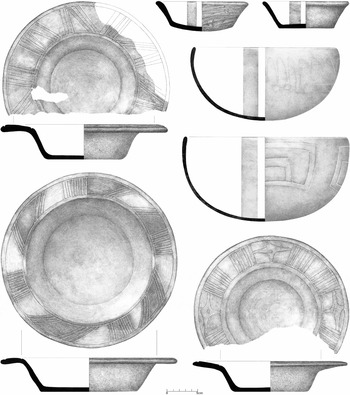
Cunil assemblage vessels (all from the lowermost depositional levels beneath Structure 6 (Awe's B-4, Cahal Pech). Drawn from actual vessels.
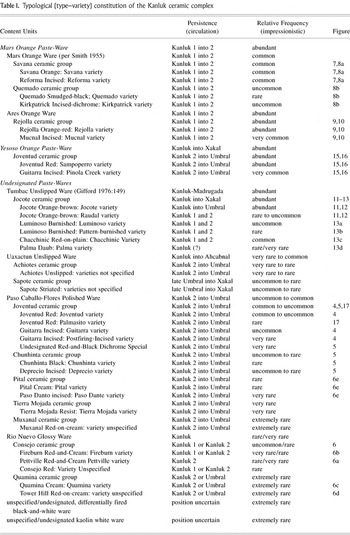
Typological (type–variety) constitution of the Kanluk ceramic complex
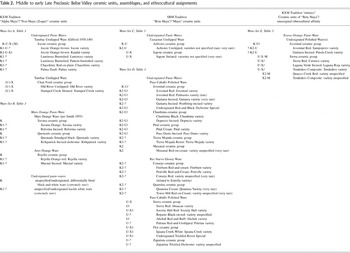
Middle to early Late Preclassic Belize Valley ceramic units, assemblages, and ethnocultural assignments
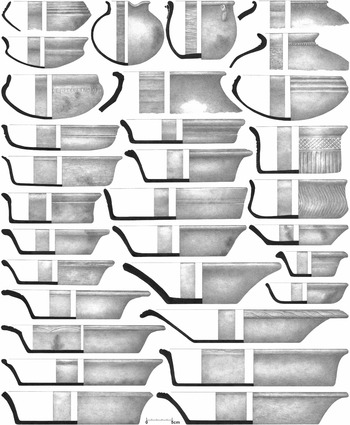
Mamom ceramic sphere pottery from Cahal Pech and Buenavista del Cayo, red Joventud group, mixed types and forms (true SBM wares).
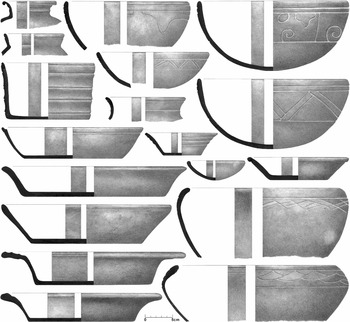
Mamom ceramic sphere pottery from Cahal Pech and Buenavista del Cayo, black Chunhinta group, mixed types and forms (true SBM wares).
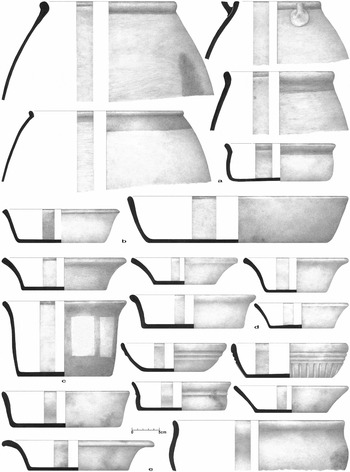
Swasey–Bladen and Mamom ceramic sphere pottery from Cahal Pech and Buenavista del Cayo: (a) Pettville Red-and-Cream (Consejo group); (b) Fireburn Red-and-Cream (Consejo group); (c) Tower Hill Red-on-Cream (Quamina group); (d) Quamina Cream; (e) cream Pital group, mixed types and forms (true SBM wares).
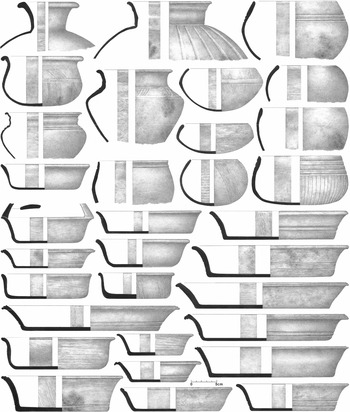
Mars Orange Paste-Ware pottery from Cahal Pech, Guerra de Buenavista, and Las Ruinas de Arenal, orange Savana group, mixed types and forms (KXM wares).
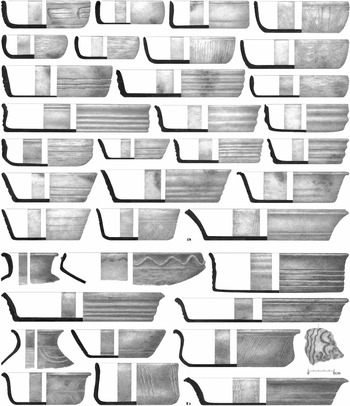
Mars Orange Paste-Ware pottery from Cahal Pech, Guerra de Buenavista, and Las Ruinas de Arenal, mixed types and forms: (a) orange Savana group; (b) black Quemado group (KXM wares).
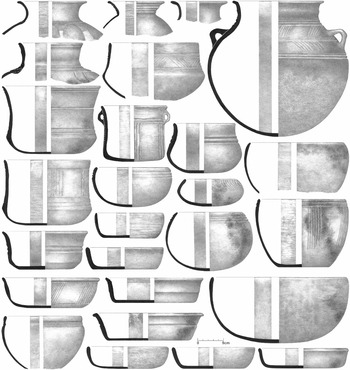
Mars Orange Paste-Ware pottery from Cahal Pech, Guerra de Buenavista, and Las Ruinas de Arenal, orange-red Rejolla group, mixed types and forms (KXM wares).
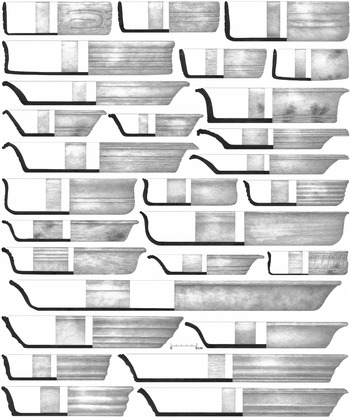
Mars Orange Paste-Ware pottery from Cahal Pech, Guerra de Buenavista, and Las Ruinas de Arenal, orange-red Rejolla group, mixed types and forms (KXM wares).
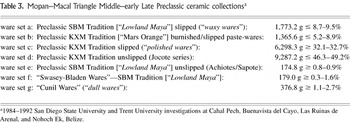
Mopan–Macal Triangle Middle–early Late Preclassic ceramic collectionsa
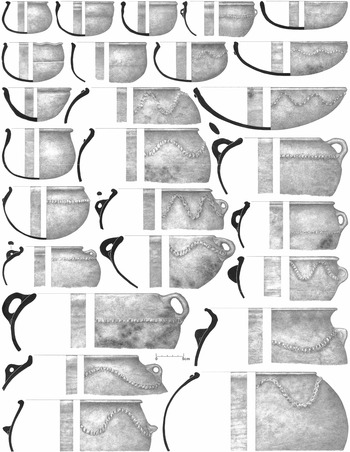
Jocote group pottery from Cahal Pech, Buenavista del Cayo, Nohoch Ek, and Las Ruinas de Arenal, mixed types and forms (KXM wares).
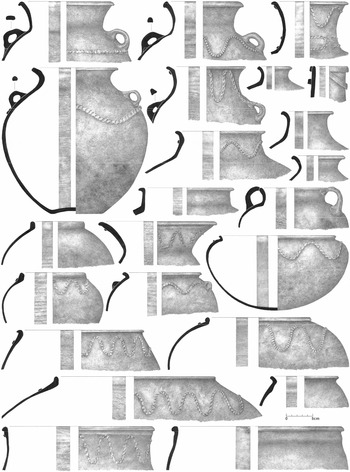
Jocote group pottery from Cahal Pech, Buenavista del Cayo, Nohoch Ek, and Las Ruinas de Arenal, mixed types and forms (KXM wares).
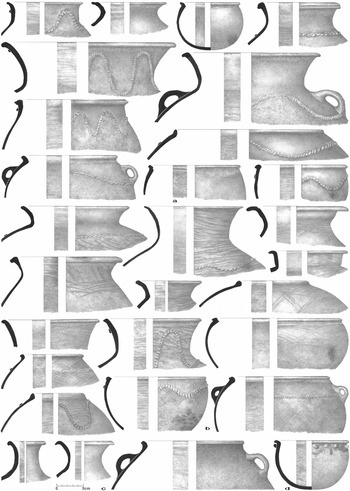
“Decorated” Jocote group pottery from Cahal Pech, Buenavista del Cayo, Nohoch Ek, and Las Ruinas de Arenal, mixed types and forms: (a) Luminoso Burnished: Luminoso Variety; (b) Luminoso Burnished: Pattern-burnished Variety; (c) Chacchinic Red-on-plain; (d) Palma Daub (KXM wares).
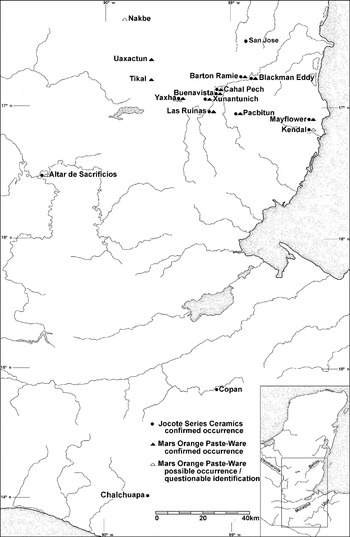
Known distributions of Jocote and Mars Orange Paste-Ware series pottery. Representative occurrence sites only indicated within each zone of distribution.
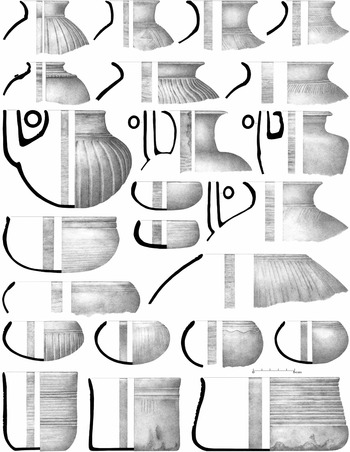
Middle Preclassic (red Joventud group) Yesoso Orange Paste-Ware pottery from the upper Belize Valley, representative types and forms from multiple sites (SBM “mimics,” KXM paste-ware tradition).
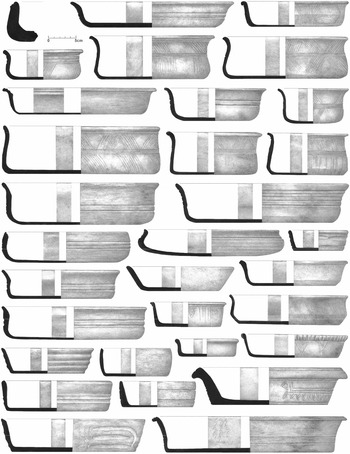
Middle Preclassic (red Joventud group) Yesoso Orange Paste-Ware pottery from the upper Belize Valley, representative types and forms from multiple sites (SBM “mimics,” KXM paste-ware tradition).
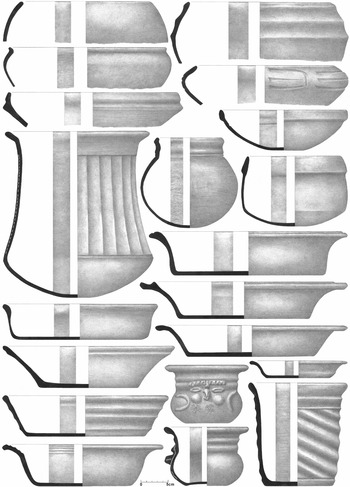
Umbral complex types from Cahal Pech, Buenavista del Cayo, and Tolok, red Sierra group, Ahuacan series, mixed types and forms (true SBM wares).
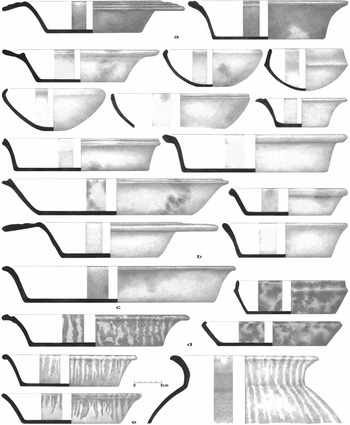
Umbral complex types from Cahal Pech and Buenavista del Cayo, mixed groups, types, and forms: (a) Sierra Red: Ahuacan Variety; (b) Iguana Creek White; (c) Ahchab Red-and-Buff; (d) Repasto Black-on-red; (e) Zapatista Trickle-Dichrome (true SBM wares).
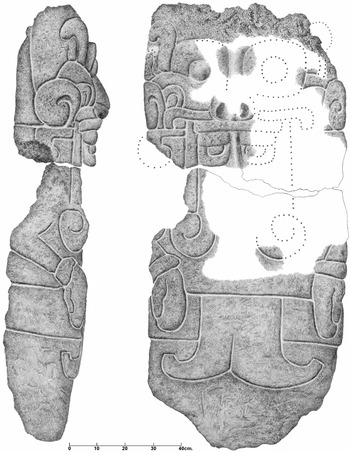
Stela 9, Cahal Pech (height of monument, 1.6 m). After a photograph and drawings by Nikolai Grube, 1994.
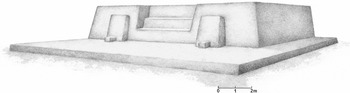
Structure B1-4th, Blackman Eddy from the southeast (after Garber et al. 1998:Figures 3, 5; Brown and Garber 1999:Figures 1.4–1.6.)
 You have
Access
- 17
- Cited by