1 Introduction
In spite of substantial typological differences between Basque and Spanish, both languages display remarkably similar phonological systems (see Elejabeitia et al. Reference Elejabeitia, Iribar, Pagola and Túrrez2016 for detailed information on the phonology of Basque and its dialects). Both languages have a five-vowel system /i e a o u/, with almost identical vowel qualities. The most significant difference lies in the subsystem of sibilant consonants: Spanish has two fricatives, interdental /θ/ and alveolar /s/, as well as a prepalatal affricate /tʃ/, while Basque exhibits three fricative–affricate pairs: lamino-alveolar /s/–/ts/ (also transcribed /s̻/–/ts̻/ by Hualde, Lujanbio & Zubiri Reference Hualde, Lujanbio and Zubiri2010), apico-alveolar /s̺/–/ts̺/, and prepalatal /ʃ/–/tʃ/. Furthermore, the palatal series includes plosives /c ɟ/ in Basque. As for sonorants, a previous study (Iribar, Pagola & Túrrez Reference Iribar, Pagola and Túrrez2013) observed certain articulatory differences between /l/ and /n/ in Basque and Spanish which revealed the need to make a detailed analysis of the position of the tongue in the articulation of these elements in Basque.
From a general cross-linguistic perspective, two articulatory variants of lateral alveolar consonant /l/ are usually identified, light (or clear) and dark. According to Recasens’s (Reference Recasens2011) description, in light /l/ the body of the tongue rises and moves forward so that a large cavity is formed preceding the primary constriction; the articulation point can be more advanced (dento-alveolar), with a laminal constriction. In dark /l/, the low predorsum and postdorsum is retracted towards the uvular or pharyngeal-uvular area (to varying degrees), and the cavity is therefore divided in two subcavities: oral and pharyngeal; the articulation is fully alveolar, with a more apical constriction.
As regards the distribution of these two variants, Recasens & Espinosa (Reference Recasens and Espinosa2005) classified languages/dialects into three main groups, depending on whether they have (i) a dark /l/ in all positions (Russian, some varieties of English, Portuguese and Catalan); (ii) a dark /l/ based on the syllabic position (Dutch, other varieties of English) or (iii) a light /l/ in all positions (standard varieties of Spanish, French, Italian, German). Some of the languages in the last group can have some degree of darkness depending on the context (Finnish, Norwegian).
The most relevant descriptions of these two models of /l/ have been made for English. Thus, Giles & Moll (Reference Giles and Moll1975) characterised dark /l/ mainly by the retraction of the back of the tongue, while Sproat & Fujimura (Reference Sproat and Fujimura1993) focused on velarisation. Browman & Goldstein (Reference Browman, Goldstein, Bell-Berti and Raphael1995) conducted an experimental articulatory analysis in which tongue-tip height measurements were provided, among others. Narayanan, Alwan & Haker (Reference Narayanan, Alwan and Haker1997) showed MRI images of both models and provided data about lengths, area functions and cavity volumes. Zhou (Reference Zhou2009) performed a detailed study based on MRI-3D of American English /l/, where he described and compared the articulatory and acoustic differences between both variants, light and dark.
In a comparative study of the midsagittal production of liquid consonants in Spanish and Russian using ultrasound data, Proctor (Reference Proctor2011: 478) concluded that ‘clear/dark lateral allophony results not from the absence of a dorsal gesture in the clear lateral, but from differences in tongue body constriction location’.
Regarding Basque, Navarro Tomás (Reference Navarro Tomás1925) conducted the first experimental study on the articulation of /l/. His description of Basque and Spanish /l/ is similar: alveolar with a flat tongue dorsum, which may sometimes be slightly concave (at the end of the syllable or in tonic position) but without reaching the secondary velar articulation of English or Catalan /l/ (Navarro Tomás Reference Navarro Tomás1918: 114).
For MacMurraugh (Reference MacMurraugh1981), Basque /l/ may have two different realisations: one similar to that described by Navarro Tomás, and the other one, specific to Basque, clearly retroflex in nature. MacMurraugh (Reference MacMurraugh1981) also observed a retroflex articulation in the alveolar nasal /n/ and in the alveolar affricate /ts̺/. Txillardegi (1980) also assumed this articulation for /l/.
The retroflex articulation of /l/ was also found in some dialects of Navarre by Salaburu (Reference Salaburu1984) and Pagola (Reference Pagola1992), although it was observed not to be the most common realisation. Pagola (Reference Pagola1992) highlighted two factors that promote retroflexion: coda position in the syllable and formal register. Iribar et al. (Reference Iribar, Pagola and Túrrez2013) compared the articulation of the isolated and prolonged alveolar lateral in Basque and Spanish using MRI and identified some differences between them. Both are apico-alveolar, but the constriction in Spanish tends to be slightly more retracted than in Basque, where it may be described as apico-dento-alveolar. In Basque, /l/ is articulated with greater labial opening; the tip of the tongue adopts a characteristic elongation, with varying degrees of retroflexion, which does not appear in Spanish; the tongue dorsum has a concave-convex curvature, while it is more or less flat in Spanish; the tongue root is retracted, while it is advanced in Spanish; consequently, varying degrees of velarisation occur in Basque, which are not present in Spanish. The differences of articulation in both languages are shown in Figure 1.
MRI images of /l/ produced by four speakers in Spanish and Basque (Iribar, Pagola & Túrrez Reference Iribar, Pagola and Túrrez2013: 148).

Regarding the alveolar nasal /n/, the form adopted by the tongue does not seem to have been the main focus of interest in experimental research. Dang, Honda & Suzuki (Reference Dang, Honda and Suzuki1994) conducted an MRI-based comprehensive analysis of the overall nasal cavity during the production of nasal consonants. Story, Titze & Hoffman (Reference Story, Titze and Hoffman1996) carried out a 3D reconstruction of the vocal tract of the English nasal consonants, including the area function values and the calculation of their resonance frequencies. Demolin et al. (Reference Demolin, Lecuit, Metens, Nazarian and Soquet1998) studied the behaviour of the velum in French nasal vowels. Also for French, Serrurier & Badin (Reference Serrurier and Badin2005, Reference Serrurier and Badin2008) reconstructed the velum in nasal articulations. Ramanarayanan et al. (Reference Ramanarayanan, Byrd, Goldstein and Narayanan2010) used MRI to analyse the articulatory and acoustic differences of the nasal in two speech styles in English (reading and spontaneous speech). Their articulatory parameters for the tongue (there are several others for other aspects, such as the velum) are the following: tongue tip constriction degree (TTCD), tongue dorsum constriction degree (TDCD) and tongue root constriction degree (TRCD).
There are few studies on the articulation of the alveolar nasal in Basque. Navarro Tomás (Reference Navarro Tomás1925) described it as alveolar, but did not mention retroflexion. However, MacMurraugh (Reference MacMurraugh1981) defined it as retroflex, just as Salaburu (Reference Salaburu1984) did for the speech of Baztan (Navarre). Txillardegi (1980) pointed out that retroflexion could be considered a regressive trait. Pagola (Reference Pagola1992) considered that the usual articulation of /n/ is not retroflex, although she did find a few cases of retroflexion in the Basque varieties of Navarre. However, it is worth remembering that retroflexion was found for the nasal in intervocalic or initial positions since, in coda position, it adopts the place of articulation of the following consonant and, therefore, the tongue contour tends to adapt to it.
Finally, Iribar et al. (Reference Iribar, Pagola and Túrrez2013) described considerable variation in the articulatory models of /l/ in Basque. This suggests the hypothesis that there may be a double articulatory model of /l/, which can be possibly extended to other alveolar consonants of Basque. To verify this, this paper aims to describe the position of the tongue in the articulation of sustained /l/ and /n/, based on a set of measurable articulatory parameters in a collection of midsagittal MRI images.
2 Materials and method
2.1 Material collection
2.1.1 Informants
Basque has great dialectal diversity, including a widely used standardised common variety known as Euskara Batua, which is the variety analysed in this paper. Six speakers who regularly use this variety were selected, three men and three women (see Table 1). A set of preliminary recordings of the informants were made at the Phonetics Laboratory of the University of Deusto to detect any possible anomalies in the realisation of these sounds by the selected informants; the spectrographic analysis showed normal value ranges for these sounds. Speakers across a wide age range were used to examine possible differences. All informants were bilingual, with Spanish as their second language; therefore, Basque speakers with French as second language were not considered.
Informant characteristics.

2.1.2 Survey and recording
The data were elicited by asking informants to produce the entire phonemic inventory of Basque, with [a] serving as a supporting vowel for consonants and [p] serving as a supporting consonant for vowels. For [–continuous] consonants, the full syllable ([pa], [ta], etc.) was repeated. Therefore, the informant first repeated the syllable [la] or [na] several times until the position of the articulated consonants was established, and maintained the utterance of [l] or [n] during the time of capture (48 seconds). Both elements were recorded just once by each informant. Nineteen images of each element and informant were analysed for this study. Therefore, the total of the images analysed in this study is 114 (6 informants × 19 images).
The recording sessions were held at Quirón Bizkaia Hospital using 1.5T. GE HealthCare equipment, which obtains dynamic SSFSE (Single Shot Fast Spin Echo) sequences, with a TR (Repetition Time) of 4.8 and a TE (Echo Time) of 1.3 at 24 frames per minute with a sagittal plane.
The images are in DICOM format, 5 mm deep, and have a 16-bit gray-scale, with a spatial resolution in X and Y of 1.07, 0.88, 0.98, 1.07, 1.07 and 0.78 pixels/mm, respectively, for the different informants (both values being the same for all of them).
2.2 Material analysis
2.2.1 DicomPas software tool
This paper uses the DicomPas framework, presented in García Arroyo et al. (Reference Arroyo, Luis, Zapirain, Ruiz and Méndez2013), designed and developed by our own research team for articulatory characterisation studies of MRI images. This framework has already been used in several studies (Iribar Reference Iribar2013, Iribar et al. Reference Iribar, Pagola and Túrrez2013). By using this tool, the articulatory parameters previously defined can be directly measured on the MRI images. Using DicomPas algorithms to process the measurements can also be performed on an ad hoc basis to generate quantitative data from which to extract knowledge through statistical or data mining methods.
2.2.2 Set of tongue parameters used
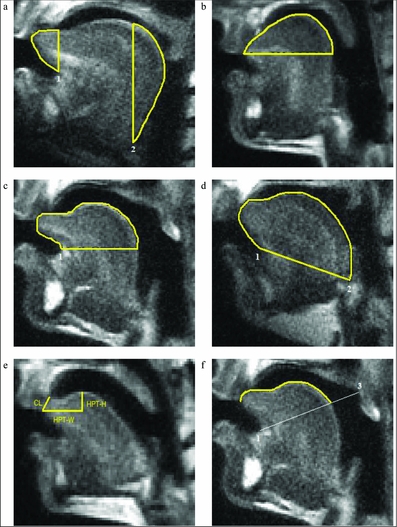
The parameters proposed in this paper aim to describe the position of the tongue in the articulation of /l/ and /n/ in Basque based on midsagittal images. The differences attributable to the side channels of /l/ cannot be examined using these images and therefore fall outside this study. The following parameters are used: tongue tip (TT), Figure 2a; tongue dorsum from the start of the constriction (TD-SC), Figure 2b; tongue dorsum from the sublingual apex (TD-SA), Figure 2c; tongue root (TR), Figure 2a; total area of the tongue (TA), Figure 2d; constriction length (CL), Figure 2e; tongue dorsum length (TDL), Figure 2f; width of the highest point of the tongue from the start of the constriction (HPT-W), Figure 2e; and height of the highest point of the tongue from the start of the constriction (HPT-H), Figure 2e. TT and CL focus on the primary constriction; the parameters TD-SC and TDL, on the other hand, analyse the dorsum shape and its retroflexion, if there is any, while TH and HPT analyse any possible velarisation. The lines of all the parameters in Figure 2 have been thickened only to improve visibility), although it should be taken into account that the thickness of the lines used for the analysis is 0.9375 mm (1 pixel).
Articulatory parameters of tongue shape: (a) tongue tip (TT) and tongue root (TR); (b) tongue dorsum from the start of the constriction (TD-SC); (c) tongue dorsum from the sublingual apex (TD-SA); (d) total area of the tongue (TA); (e) constriction length (CL), width of the highest point of the tongue from the start of the constriction (HPT-W) and height of the highest point of the tongue from the start of the constriction (HPT-H); (f) tongue dorsum length (TDL).

To measure the parameters objectively and consistently, physiological reference points were used in certain cases. From the anterior fold of the tongue (marked ‘1’ in Figure 2), parameter TT was obtained by drawing a vertical line, and parameter TD-SA was obtained by drafting a horizontal line. By drawing a vertical line from the glossoepiglottic fold or vallecula (‘2’ in Figure 2), parameter TR was obtained. For Parameter TA, the two points referred to were used as a reference. Parameter TDL was measured from the start of the constriction to the intersection between the dorsum with an imaginary line drawn from the anterior fold of the tongue to the end of the soft palate (‘3’ in Figure 2). Parameter TD-SC was obtained by drawing a horizontal line from the start of the constriction. In some images, these three reference points were difficult to determine accurately. In these cases, as a reference, points already fixed in the rest of the images of each series were used.
Parameters CL and TDL are length measurements (mm). For the rest of the parameters, in addition to the area and perimeter values, the following shape coefficients were obtained: Ferets (the greatest distance between two points in the convex hull of the figure); Aspect Ratio (the relationship between the width and the height of the figure); Circularity (the deviation of the figure from a perfect circle); and Solidity (the relationship between the area of the figure and its convex hull). Regarding the units of measure of the parameters, Length, Perimeter and Ferets are expressed in mm; Area in mm2; Aspect Ratio, Circularity and Solidity are calculated coefficients without a unit of measurement (García Arroyo et al. Reference Arroyo, Luis, Zapirain, Ruiz and Méndez2013: 388).
The numerical data corresponding to the parameters described above were processed using SPSS statistical package (v.22) to obtain descriptive statistics, the usual comparisons and correlations of variables, among others. The correlations between the values of two parameters were analysed by Pearson’s r test. The relationship between the values of a parameter and the three dichotomous variables used (sex, element and articulatory model, discussed below) was examined by a one-way ANOVA test, with df = 1 and p < .05.
3 Results
3.1 Tongue shape parameters for /l/
Figure 3 shows images of the production characteristics for the six informants, obtained through the procedure described in Section 2.1.2. The place of articulation of the lateral was alveolar or dentoalveolar. The active articulator was the tongue tip, which exhibited a characteristic elongation. In some cases (S2, S4 and S6), some degree of retroflexion occurred, and in S2, the apex of the tongue was even curled up. There were notable differences in terms of contact surface, from the smallest in S1 to the largest in S2. The sublingual contour could be straight (S1, S3, S5) or convex (S2, S4, S6).
Representative images of the production of /l/.

The tongue dorsum, always located in an upward position, acquires a double curvature with varying degrees: it is concave on the blade and convex on the back. This dual lingual curvature is accompanied by velarisation, which varies among informants: it is very evident in S1 and S4, but hardly appears in S6. The lingual root, which is directly related to velarisation, adopts different positions: retracted (S1, S4), straight (S2, S3, S5) and advanced (S6).
These characteristics allowed the variants studied to be associated with those of dark /l/, not only because of the elevation and retraction of the tongue dorsum but also considering the elongation of the tongue tip and its double curvature.
The data on the parameters measured (average (X) and deviation (SD) for length, area and perimeter, as well as the shape values) are shown in Table 2. The total area of the tongue, expressed by the parameter TA, showed – as expected – a sex-based distribution, given that the highest values corresponded to male informants. The largest difference corresponded to S1, whose area (2840 mm2) was not only above that of the three female informants (1803, 1966 and 1692 mm2, respectively, for S4, S5 and S6), but – to a lesser extent – was also higher than that of the other two males (2003 and 2080 mm2, respectively, for S2 and S3). The perimeter values showed a significant difference (F(1,4) = 8.46, p = .04 in the ANOVA test) between the male and female informants. As was to be expected, the correlation between the TA area and perimeter values was high (r = .91, p = .01) and constant for the six informants.
Average results of the articulatory parameters for /l/, calculated from the values obtained in the 114 images (6 informants × 19 images).

Fer. = ferets, Asp. = aspect ratio, Circ. = circularity, Sol. = solidity. For abbreviations TT, etc. refer to Figure 2 caption above.
The parameters that were most directly involved in the individual tongue shape for the articulation of the /l/ were not related to the total size of the tongue. Parameter TT, which indicated the shape adopted by the tongue tip, therefore, showed a very low and non-significant correlation with the TA (r = .17, p = .74), similarly to the TD-SC parameter, which showed the shape adopted by the tongue dorsum (r = .22, p = .66). When this parameter was added to the area corresponding to the portion of the tongue that reaches the anterior fold of the tongue (parameter TD-SA), the correlation increased considerably and became significant (r = .80, p = .05). Finally, in those cases in which the TR parameter values were positive, it also had a high correlation with the size of the tongue (r = .96, p = .00). Regarding distance parameters, the HPT-W parameter showed a high but non-significant correlation with the total area of the tongue (r = .73, p = .07). The correlation of the TDL (r = .47, p = .34) and HPT-H (r = .31, p = .50) parameters with the TA, while noteworthy, suggested that the shape of the tongue dorsum was more important than the absolute value of its length. The importance of the shape of the tongue dorsum was confirmed by the observation that it was precisely parameter TD-SC that showed a clearly lower correlation (although still high: r = .73, p = .09) between its area and its perimeter values.
The dispersion values were similar for all the parameters, with the exception of the TR, which reflected the different positions of the tongue root, as mentioned earlier. In all cases, the deviation was lower in the perimeter values than in the area values, which seemed to corroborate the stability in the shape the tongue adopts in articulation, as mentioned above.
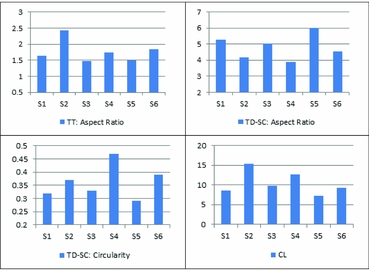
The shape coefficients of the parameters most directly associated with tongue behaviour (TT and TD-SC) suggested that there may be two different types of articulatory behaviour, one represented by the group consisting of S1, S3 and S5 and the other by the group consisting of S2, S4 and S6. The articulation of the first group showed a reduced length of tongue contact (Parameter CL) and a more elongated dorsum (highest HPT-W values); on the other hand, the greater degree of retroflexion of the second group involved a greater curvature of the tongue blade. However, in the ANOVA test, only Aspect Ratio (F(1,4) = 12.60, p = .02) and Circularity (F(1,4) = 8.67, p = .04) coefficients of TD-SC are significantly different for the two groups mentioned, which shows that they are not two different /l/ sounds, but a single element with two articulation submodels. Figure 4 shows the distribution of the most prominent values.
Distribution (by informant) of the four /l/ variables: aspect ratio of TT and TD-SC, circularity of TD-SC (both coefficients without measure units) and CL (mm).

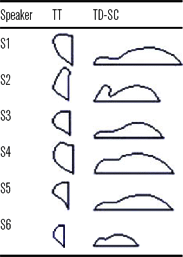
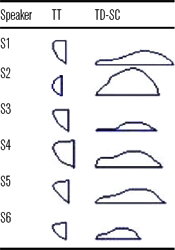
The shape of the tongue apex and the tongue dorsum is an articulatory feature of /l/ in Basque, and it points to the possible existence of two production variants: S1, S3 and S5, on the one hand, and S2, S4 and S6, on the other. Table 3 shows a typical example for each of the informants.
Representative examples by informant for parameters tongue tip (TT) and tongue dorsum from the start of the constriction (TD-SC) of /l/, selected from the 19 images of each informant.

3.2 Tongue shape parameters for /n/
Figure 5 shows images of the production characteristics of /n/ for each of the informants, obtained through the procedure described in Section 2.1.2. The nasal place of articulation was alveolar or dentoalveolar. The active articulator was the apex of the tongue, which was slightly elongated, resulting in minor contact, with the exception of informant S2, whose articulation was lamino-alveolar with a large surface contact. The sublingual contour showed different degrees of curvature; its length was shortest for S2.
Representative images of the production of /n/.

The tongue dorsum showed a double concave-convex curvature to different degrees. Informant S2 was different, as his dorsum showed the most pronounced degree of convexity of all the speakers. The dorsum was always straight or rising slightly, except for S2, for whom the rise was abrupt. Four informants (S1, S2, S4, S5) presented different degrees of velarisation. A retracted tongue root was found for S1, a straight tongue root was found for S2 and a more or less advanced tongue root was found for the rest.
Table 4 shows the average values (X) and the standard deviation (SD) of the length, areas and perimeters of the parameters analysed. The TA parameter clearly showed a sex-based distribution. Two extreme informants stand out: S1 and S6, with S1 having an area (2584 mm2) more than double that of S6 (1206 mm2); however, the TA values for the other two male informants (S2 and S3, with 1846 and 1781 mm2) were more than 20% larger than those for S4 and S5 (1439 and 1353 mm2). The correlation between the area and perimeter values is very high (r = .94, p = .00).
Average results of the articulatory parameters for /n/, calculated from the values obtained in the 114 images (6 informants × 19 images).

Fer. = ferets, Asp. = aspect ratio, Circ. = circularity, Sol. = solidity. For abbreviations TT, etc. refer to Figure 2 caption above.
The areas of the TD-SA and TR parameters were strongly correlated with the TA parameter (r = .94, p = .04 and r = .83, p = .03, respectively). The length of the TDL also showed a noteworthy but non-significant correlation (r = .66, p = .14), similar to that for HPT-W (r = .69, p = .11). There was a non-significant and minimal, or even inverse, correlation for those parameters more directly related to the tongue shape during articulation, such as TD-SC (r = .12, p = .81), CL (r = –0.07, p = .89) and TT (r = –0.50, p = .31). The considerable inverse correlation of TT could be due to the presence of two factors: the different shape of S2’s tongue apex and the greater retraction of the sublingual apex in S4 and S6.
The extremely high standard deviation values of the TR parameter are explained by the large difference between S1 and the rest of the informants, which was gender-related, as mentioned above. The large dispersion of the area (but not the perimeter) values for the TD-SC parameter is mainly explained by the different tongue shape in S2’s articulation.
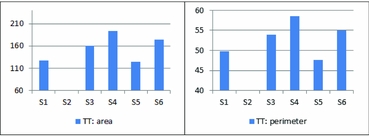
This different articulatory behaviour of S2 prevented us from finding a variable that was able to group the six informants together in the two variants mentioned above. However, if only S1–S3–S5 are considered, compared with S4–S6, the values of the TT area (F(1,3) = 7.76, p = .06) and perimeter (F(1,3) = 5.32, p = .10) are differentiated, but not significantly. Figure 6 shows the distribution of these values (the values for S2 are not shown).
Distribution by informant of the tongue tip (TT) area (mm2) and perimeter (mm) values for /n/.

Table 5 shows a typical example of the shape of the tongue apex and the tongue dorsum for each of the informants, where the different realisation produced by S2 can be clearly observed.
Representative examples by informant for parameters tongue tip (TT) and tongue dorsum from the start of the constriction (TD-SC) of /n/, selected from the 19 images of each informant.

3.3 Comparison between /l/ and /n/
The total tongue area (TA parameter) is always larger in /l/ than in /n/. This difference affects the area and perimeter values (although not significantly), and also those related to shape, especially that of Solidity (F(1,10) = 5.00, p = .04).
In general, the shape the tongue adopted in the articulation of the two elements was very similar, although several differences were identified. The largest difference between the two articulations was found for the apex of the tongue. The values of parameter TT were significantly different both in area (F(1,10) = 8.23, p = .01) and in perimeter (F(1,10) = 11.66, p = .007) as well as in two of the shape coefficients: Ferets (F(1,10) = 11.15, p = .007) and Solidity (F(1,10) = 5.21, p = .04). Informant S6 was an exception in this case, as her TT values were very similar in the two realisations.
The area of parameter TD-SC tended to be larger in /l/, although the data were inconclusive, especially due to the different behaviour of S2. Parameter TD-SA had values higher in /l/, significantly in perimeter (F(1,10) = 6.52, p = .02) and not in area (F(1,10) = 4.45, p = .06).
The tongue dorsum length (parameter TDL) was always greater in /l/ (F(1,10) = 16.35, p = .002), as was the case with constriction length (parameter CL), although in this case, S2’s values were also different from the rest. Excluding this informant’s data, the difference in favour of /l/ remains significant (F(1,8) = 6.80, p = .03).
4 Discussion
The results of this study are consistent with the proven direct correlation between tongue size, and the height, weight and body mass related to sex (Liégeois, Albert & Limme Reference Liégois, Albert and Limme2010). In addition, they show another difference: the total tongue area is always larger in /l/ than in /n/.
The tongue shape in the articulation of /l/ in Basque is, in general terms, in line with the dark articulation variant. The differences in articulation observed among informants were consistent with the gradualness hypothesis, which states that ‘darkness ought to be considered a gradual phonetic property, rather than a categorical attribute’ (Recasens & Espinosa Reference Recasens and Espinosa2005: 2). The two possible articulatory realisations observed corresponded therefore to the ‘intermediate darkness categories’ (Recasens Reference Recasens2011: 381).
As regards retroflexion, it appears clearly in three cases, although only the articulation of S2 is similar to the characteristic tongue position of the fully retroflex articulation of /l/, as shown for Tamil in Narayanan et al. (Reference Narayanan, Nayak, Lee, Sethy and Byrd2004). However, two main differences between both articulations can be observed: the apex in /ɭ/ of Tamil is more prominent and its articulation is more rearwards.
Consequently, our data support those studies which have found the articulation of /l/ in Basque to be different from that of Castilian Spanish (Txillardegi 1980 and MacMurraugh Reference MacMurraugh1981). However, this articulation is not so much a retroflex /ɭ/, as they propose, but more a dark /l/ ([ɫ]), which can sometimes have retroflexion in varying degrees. In addition, while the light variant did not appear in our experiment, this should not lead to the assumption that it does not exist in real speech. The hyper-articulation inherent in obtaining MRI images needs to be taken into account because, according to Pagola (Reference Pagola1992), this favours retroflex articulation – that is, dark /l/ – which does not appear so much in relaxed speech. This could explain why Navarro Tomás (Reference Navarro Tomás1925) concluded that /l/ is articulated in the same way in Basque and Spanish.
As for the articulation of /n/, the data obtained do not allow to describe it as retroflex with a curled-up apex shape (MacMurraugh Reference MacMurraugh1981: 78 for Basque; Ladefoged Reference Ladefoged2001: 159–160 from a general point of view), although some of the observed characteristics, such as the elongation of the apex or the dorsal curvature, are also typical of this type of articulations. The most common utterance of /n/ is similar to that described by Navarro Tomás (Reference Navarro Tomás1918: 111) and Quilis (Reference Quilis1985: 55) for Spanish, although with two main differences: the tongue dorsum curvature and velarisation. This model is similar to that described for dark /l/ (Recasens Reference Recasens2011).
5 Conclusions
The articulation of /l/ can be described as apico-alveolar or apico-dento-alveolar lateral with a characteristic elongation of the apex, a straight or convex sublingual contour (retroflexion), a concave/convex tongue dorsum shape and the posterior area usually not drawn forward with various degrees of velarisation: high in S1 and S4, medium in S2, S3 and S5, and, finally, low in S6. Some of these characteristics – elongation of the apex, shape of tongue dorsum, velarisation – correspond to what is known as dark /l/.
The articulation of /n/ can be described as apico-alveolar or apico-dento-alveolar nasal, with a slight elongation of the apex, a variable sublingual contour, a concave/convex tongue dorsum shape and the posterior area usually drawn forward.
Despite the similarities in tongue shape between both articulations, noticeable differences can be identified: the elongation of the apex is more marked in the lateral and, therefore, has a larger area and longer tongue constriction (parameters TT and CL); the concave/convex tongue dorsum shape is also more marked in the lateral, which explains its higher values for TD-SC, TD-SA and TDL; the posterior tongue body is usually drawn forward in /n/ and retracted in /l/ (parameters TR and HPT-W); however, velarisation occurs in both elements, although not in all cases or to the same extent.
The data obtained suggest that there are two articulatory realisations in the informants under study. For /l/, one of the variants shows a more elongated apex and a more curved dorsum than the other. These two realisations are not as clearly observed in the nasal due to the different behaviour of one of the informants. Nevertheless, this difference only concerns the apex of the tongue, not the dorsum. Additionally, the fact that there could be other realisations without velarisation in continuous speech, both for /n/ and for /l/ (the so-called light /l/), must be taken into account. The results of this study come from the analysis of isolated and prolonged articulations, so, obviously, other articulatory variants might be registered in connected speech.
The proposed set of parameters has proven efficient to characterise the tongue shape in the articulation of the two consonants under study. Some of these parameters (TA, TD-SA) are more directly related to physiological peculiarities associated with gender, whereas others (TT, TD-SC, TDL) are more directly related to articulatory gestures.
Acknowledgements
This paper was developed at the Universidad de Deusto with the financial support of the Spanish State Secretariat of Research, Development and Innovation (Secretaría de Estado de Investigación, Desarrollo e Innovación) (MICINN FFI2009-10706). The recording protocol was developed with the collaboration of Dr Estepan Imanol Gainza Jauregi, a radiology specialist at the Quiron Bizkaia Hospital. The authors extend their thanks to Jon Ortiz de Urbina and our anonymous reviewers for JIPA for the helpful comments.