Implications
The first weeks after weaning are regarded as some of the most crucial in the pork production cycle because they represent a period of intense stress for piglets, with profound consequences on growth, physiology and gut mucosal function and integrity. The addition of crude fibre concentrate (CFC) to the diet showed to enhance the adaptability of the piglets to weaning. Specifically, CFC has improved the welfare and growth playing a role in the regulation of hormones related to feed intake and energy balance.
Introduction
In weaned piglets, an adequate intake of nutrients is essential not only to ensure a successful growth potential but also to avoid the histological variations in the proximal small intestine. An impairment of gut mucosal function and integrity influences the digestive, absorptive and secretory ability of the small intestine, regardless of age of pig at weaning (Campbell et al., Reference Campbell, Crenshaw and Polo2013).
Functional feed ingredients may indirectly, through enhanced feed intake, or directly, through specific effects, improve the intestinal mucosa integrity in order to maximize the growth. Growing evidence exists that many fibre sources can help the piglets to overcome the limitations of an impairment gastrointestinal tract (Montagne et al., Reference Montagne, Pluske and Hampson2003; Molist et al., Reference Molist, Gómez de Segura, Gasa, Hermes, Manzanilla, Anguita and Pérez2009; Bach Knudsen et al., Reference Bach Knudsen, Hedemann and Lærke2012). Nevertheless, the type of fibre to be included in the diet or the duration of such inclusion is open for discussion. It is believed that functional properties of fibrous sources are likely more important than the chemical composition of the fibrous ingredients in piglet’s diet (Molist et al., Reference Molist, Gómez de Segura, Gasa, Hermes, Manzanilla, Anguita and Pérez2009; Jha and Berrocoso, Reference Jha and Berrocoso2015). The polysaccharides that make up the cell wall and their intermolecular association are responsible for chemical and physical characteristics in the plant material and among them, hydration capacity and particle size are believed to be responsible for the major functional properties of the dietary fibre. Feed efficiency and nutrient digestion in weaned piglets has been improved by reducing particle size and increasing hydration capabilities of feed (Lindberg, Reference Lindberg2014). Conversely, an increase of viscosity in the digesta can limit the interaction between nutrients and enzymes with the formation of an unstirred water layer in the intestinal surface. This physical barrier reduces nutrient digestion and absorption (Jha and Berrocoso, Reference Jha and Berrocoso2015).
Various techniques (pelleting, fibrillation, enzymatic treatment) can be applied to modify the physicochemical characteristics and enhance the utilization of available fibrous resources (Lindberg, Reference Lindberg2014; Ulbrich and Flöter, Reference Ulbrich and Flöter2014). This may be relevant for feed resources characterized by poor nutritive value due to lignin and cellulose content (i.e. wood products). Thermomechanical concentration processes, as high-pressure centrifugal fibrillation, may structurally modify lignocellulose cell wall of debarked wood, with a complete breakup of the cell wall and fibre disintegration. This process produces the insoluble CFC. The refined fibres obtained show an intensive capillary network effect and surface activity that increase their hydration capacity (Lahtinen et al., Reference Lahtinen, Liukkonen, Pere, Sneck and Kangas2014). In poultry diets, the addition of CFC has proven to enhance physiological activity and health of the gastrointestinal tract, increasing nutrient digestion and absorption (Lim et al., Reference Lim, Juan, Celestino, San Andres and Martin2013). We hypothesize that structural changes induced by technological treatment on the lignocellulose can improve the nutritional and metabolic status of weaned piglets. In this study, we assessed whether a diet supplementation of CFC affects the endocrine, immune and metabolic responses of piglets, to allow the expression of their growth potential during the entire post-weaning period.
Material and methods
The experimental protocol was designed in compliance with recommendations of the Italian law (Lgs. D. 26/2014) within the scope of the Directive 2010/63/EU on the protection of animals used for scientific purposes.
Animals and diets
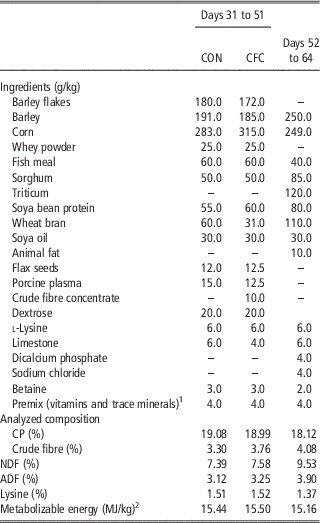
The study was conducted in a commercial farm and involved 108 piglets (D×(Lw×L)) from 12 litters weaned at day 28 of age. No creep feed was provided to the piglets during the lactation period. At weaning, animals were assigned based on sex and BW to two groups: control (CON) and CFC. Each group had nine pens (six pigs per pen), located in the same room. Pens were equipped with a nipple drinker and a feeder to provide a free access to water and feed. During 3 weeks (31 to 51 days of age), piglets of the CON group (30 castrated males and 24 females) were fed with a basic diet. The CFC group (28 castrated males and 26 females) received a diet supplemented with 1% of CFC. Isoenergetic, isofibrous and isonitrogenous diets were formulated. The insoluble CFC powder (Arbocel® RC Fine; J. Rettenmaier & Söhne GmbH Co., Rosenberg, Germany), consisting of thin (width between 20 and 30 µm) and long (250 µm) refined fibres, was obtained by an extraction process and high-pressure centrifugal fibrillation from wood spruce (Picea abies L.). This product was characterized by a water-binding capacity of 6 g water/g of dry matter (DM) and a content of NDF, ADF and ADL of 942, 748 and 258 g/kg, on DM, respectively. Subsequently, until the end of the post-weaning period (64 days of age), all piglets were fed with the same starter diet. Diets did not contain antimicrobial growth promoters. Ingredients and chemical composition of diets are reported in Table 1. During the overall period (days 31 to 64 of age) average temperature and relative humidity (RH) of not air-conditioned room were 24.84°C (±3.13°C) and 56.59 RH (±12.19 RH), respectively.
Ingredients and chemical composition (as-fed basis) of the diets utilized by piglets from days 30 to 51 and from days 52 to 64 of age

CON=diet unsupplemented with crude fibre concentrate 1%; CFC=diet supplemented with crude fibre concentrate 1%.
1 The premix provides for kilogram: vitamin A, 160 000 IU; vitamin D3, 106 60 IU; vitamin E, 1330 mg; vitamin K, 27 mg; vitamin B1, 20 mg; vitamin B2, 80 mg; pantothenic acid, 100 mg; vitamin B6, 27 mg; vitamin B12, 0.4 mg; vitamin PP, 400 mg; biotin, 1.33 mg; folic acid, 10.3 mg; vitamin C, 533 mg; I, 20 mg; Co, 4 mg; Se, 1.6 mg; Cu, 1000 mg; Mn, 666.6 mg; Zn, 1400 mg; Fe, 2133 mg.
2 According to the equation proposed by Noblet and Perez (Reference Noblet and Perez1993).
Measurements
Piglets were ear tagged and individually weighed at days 30, 51 (end of dietary treatment) and 64 of age (end of post-weaning period). Daily feed intakes, consistency of the faeces and number of piglets with diarrhoea were recorded per pen. The average daily gain (ADG), average daily feed intake (ADFI) and feed efficiency ratio were evaluated in both periods (days 31 to 51 and days 52 to 64) and overall. Piglets with diarrhoea were treated for 1 up to 3 days with 0.5 ml i.m. injection of Enrofloxacin (Baytril® 5%; Bayer HealthCare LLC, Shawnee Mission, KS, USA). The number of piglets treated with antibiotic and mortality because of diarrhoea were daily registered per pen.
To assess the effects of the dietary treatment on adaptability of piglets to weaning, blood samples were collected at 31, 38, 45 and 52 days of age from 10 piglets/group at 0800 h. Jugular venepuncture in 10 ml vacutainer tubes with lithium heparin was used. Whole blood was refrigerated and quickly (30 min) transported to laboratory. Plasma was obtained by centrifugation at 1800×g for 10 min at room temperature and then stored at −20°C until analysis. Samples were assayed in duplicate (intra-assay variability coefficient) and in different analysis (inter-assay variability coefficient). In each analysis, the same control sample was included.
Analyses
Diets
Proximate analysis of diets was performed according to the Commission Regulation (EC) 152/2009 laying down the methods of sampling and analysis for the official control of feed (Annex III). Cell wall components were analyzed according to Van Soest and Wine (Reference Van Soest and Wine1967).
Hormones
Plasma samples were assayed for growth hormone (GH) by ELISA as previously described (Baratta et al., Reference Baratta, Saleri, Mainardi, Valle, Giustina and Tamanini2002). The intra- and inter-assay CV were 5.3% and 7.8%, respectively. The minimal detection limit was 100 pg/ml. Plasma IGF-I content was evaluated using a multispecies IGF-I ELISA (Alpco Diagnostic, Salem, NH, USA), according to manufacturer’s instructions. The intra- and inter-assay CV were 6.9% and 5.3%, respectively. The minimal detection limit was 30 pg/ml. Plasma IGF-binding protein 3 (IGFBP-3) levels were determined by a specific commercial ELISA Kit (ELISA Kit for porcine Insulin-Like Growth Factor-Binding Protein 3; Wuhan USCN Business Co., Ltd, Houston, TX, USA). The intra- and inter-assay CV were 7.4% and 7.3%, respectively. The minimal detection limit was 0.312 pg/ml. Leptin in plasma was determined by a commercial kit (Multispecies Leptin RIA; Linco Research, St. Louis, MO, USA). The sensitivity of the method was 100 pg/ml and the variability coefficients within and among samples were 4.7% and 9.1%, respectively.
Circulating acute-phase proteins
Haptoglobin (HP) was assayed by Pig Haptoglobin ELISA Kit (GenWay Biotech Inc., San Diego, CA, USA). The intra- and inter-assay CV were 2.9% and 10.4%, respectively. The minimal detection limit was 0.12 ng/ml. Pig-major acute-phase protein (Pig-MAP) was determined by a commercial kit (Pig-MAP ELISA Kit; MyBioSource, San Diego, CA, USA). The intra- and inter-assay CV were 6.2% and 8.5%, respectively. The minimal detection limit was 1.0 µg/ml.
Pro-inflammatory cytokines
Peripheral blood mononuclear cells (PBMC) were isolated from 4 to 5 ml of pig blood sample. Samples were taken and then stratified on Histopaque-10771 solution (1 : 1, v/v) (Sigma-Aldrich, St. Louis, MO, USA) and centrifuged at 400×g for 30 min; purified PBMC were washed with sterile phosphate-buffered saline (Sigma-Aldrich) supplemented with 1% foetal bovine serum (FBS) and re-suspended in RPMI-1640 (Gibco, Carlsbad, CA, USA) supplemented with 10% FBS, 2 mM l-glutamine, 100 µM non-essential amino acids, 50 µM 2β-mercaptoethanol (Sigma-Aldrich) and 100 U/ml penicillin G, 100 µg/ml streptomycin and 0.25 µg/ml amphotericin B. Such solution is referred as complete RPMI-1640.
Gene expression levels of tumour necrosis factor-α (TNF-α), interleukin-6 (IL-6) and interleukin-1β (IL-1β) were determined in swine PBMC. Total RNA extraction and quantification was performed within 1 week after sample collection and storage. The RNA extraction was performed by using TRI reagent (Ambion-Life Technologies, Grand Island, NY, USA) according to the manufacturer’s instructions; purity and concentration were assessed by UV spectrophotometry at 260/280 and 260 nm, respectively (GeneQuant Pro; Amersham Pharmacia Biotech–GE Healthcare Life Sciences, Little Chalfont, UK). The RNA integrity and quality were assessed by using an Agilent Bioanalyzer 2100 and RNA 6000 LabChip Kit (Agilent Technologies, Santa Clara, CA, USA). The RNA samples were stored at −80°C until reverse transcription (RT). All RNA samples were DNAse-treated (Sigma-Aldrich) before complementary DNA (cDNA) synthesis. Total RNA (1 µg/20 µl) was reverse transcribed using a High-capacity cDNA Reverse Transcription Kit (Applied Biosystems, Foster City, CA, USA). The RT was performed by using a StepOne thermocycler (Applied Biosystems, StepOne software v. 2.1) and, according to the manufacturer’s instructions, under the following thermal conditions: 10 min at 25°C; 120 min at 37°C followed by 5 min at 85°C. All cDNA samples were stored at −20°C until real-time PCR was performed.
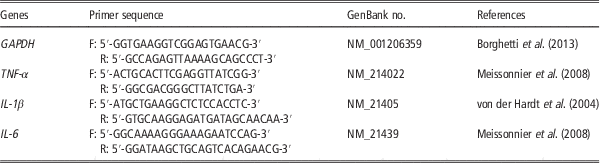
The cDNA samples (20 ng) were used as a template for real-time PCR performed by using a StepOne thermocycler. The cDNA (20 ng/20 µl) was amplified in triplicate with Fast SYBR® Green-1 Master Mix (Applied Biosystems) and specific sets of primers optimized at 150 nM for IL-6 and 300 nM for the other cytokines were used. The primers used were based on published sequences (Fisher et al., Reference Fisher, Buttner and Rziha2006; Meissonnier et al., Reference Meissonnier, Pinton, Laffitte, Cossalter, Gong, Wild, Bertin, Galtier and Oswald2008) and purchased from Eurofins MWG Operon (Ebersberg, Germany). Details of each primer set for detection of cytokine gene expression are reported in Table 2. The reference gene glyceraldehyde-3-phosphate dehydrogenase (GAPDH) was selected as endogenous control according to minimal intra-/inter-assay variation (Fisher et al., Reference Fisher, Buttner and Rziha2006; Ferrari et al., Reference Ferrari, Borghetti, Gozio, De Angelis, Ballotta, Smeets, Blanchaert and Martelli2011). Samples were kept at 95°C for 20 s (hold step) to allow DNA polymerase activation and then subjected to 40 cycles consisting of a denaturation step at 95°C for 3 s followed by an annealing/extension step at 60°C for 30 s. Fluorescence due to SYBR® Green-1 incorporation was acquired at the end of the extension step. No-template and no-RT controls were included in each experiment. A melting curve analysis for specific amplification control was performed (from 60°C to 95°C) at the end of the amplification cycles. No-template controls were assumed negative and reliable if the quantification cycle was ⩾35. Data were analyzed according to the
 $2^{{{\minus}\Delta \Delta C_{t} }} $
method (Livak and Schmittgen, Reference Livak and Schmittgen2001) in which expression levels of each cytokine are normalized to the GAPDH cDNA amount and expressed as relative quantities.
Primer sequences for real-time PCR amplification

GAPDH=glyceraldehyde-3-phosphate dehydrogenase; TNF-α=tumour necrosis factor-α; IL-1β=interleukin-1β; IL-6=interleukin-6.
Statistical analysis of results
Piglets were the experimental unit for growth and haematological data; feed intake and feed efficiency, as health status parameters used the pen as the experimental unit. Body weight and ADG were analyzed by ANOVA using a mixed model (SAS Institute Inc., Reference Summer, Saleri, Malacarne, Bussolati, Beretti, Sabbioni and Superchi2012) with group, sex and the interaction between group and sex as fixed factors, and pen nested within group as a random factor. Data for feed intake and feed efficiency were analyzed using a mixed model with group as a fixed factor. A logistic regression analysis was performed to determine the treatment effect on the diarrhoea incidence and on the antibiotic interventions, using a model with group as a fixed factor. Data from logistic regression analysis are presented as estimate of the group effect, together with its probability and odd ratio estimates of CON v. CFC group. Haematological data, sampled at different timepoints, were analyzed using a repeated-measure ANOVA, with group, sex and interactions sex×group and group×time as fixed factors. The α level used for the determination of significance for all the analyses was 0.05. Data from ANOVA are presented as least squares means±standard errors. Sex, sex×group and group×time interactions were not significant and therefore only the main effects of group have been presented in tables.
Results
Growth performance
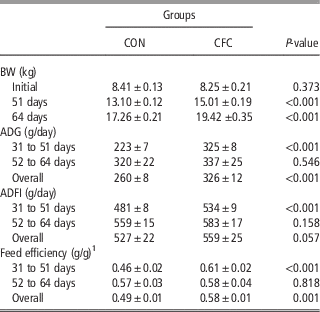
The cumulative performance results of piglets are summarized in Table 3. Body weight resulted higher in CFC than CON group after the 3 weeks of dietary treatment and at the end of the study (P<0.001). However, while from 31 to 51 days of age animals fed the CFC diet showed a higher ADG, ADFI and feed efficiency (P<0.001) compared with the CON diet, no differences were observed between groups from 52 to 64 days (P>0.05). Despite the overall ADFI differences were not significant (P>0.05), CFC diet increased the overall ADG (P<0.001) and the overall feed efficiency (P=0.001) compared with CON group.
Effects of crude fibre concentrate on growth performance of piglets (least squares means±SE)

CON=diet unsupplemented with crude fibre concentrate 1% from 31 to 51 days of age; CFC=diet supplemented with crude fibre concentrate 1% from 31 to 51 days of age; ADG=average daily gain; ADFI=average daily feed intake.
1 Feed efficiency=grams of ADG/gram of ADFI.
Hormones
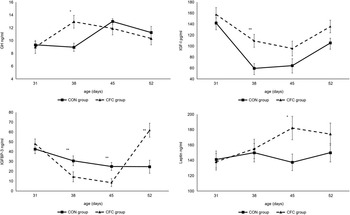
Effects of dietary treatment on GH, IGF-I, IGFBP-3 and leptin levels during the first period of the post-weaning are plotted in Figure 1. Significant differences in GH and IGF-I levels between groups were observed. Piglets fed the CFC diet showed higher GH levels (P<0.05) at the end of the 1st week but not in subsequent samplings (P>0.05) compared with CON group. Despite the IGF-I trend was similar between groups, higher levels were achieved in the CFC group than in the CON group 1 week after starting treatment (P<0.01). The IGFBP-3 levels were higher in the first 2 weeks and lower in the 3rd week in CON group compared with CFC group (P<0.01). Consequently, the IGFBP-3 trend was consistent with that of IGF-I in CFC group but not in CON group. A significant increase of leptin level at 2 weeks after start of treatment in CFC than CON group was observed (P<0.05).
Growth hormone (GH), IGF-I, IGF-binding protein 3 (IGFBP-3) and leptin plasma levels in piglets fed with a basic diet (control (CON) group) or a diet supplemented with 1% of crude fibre concentrate (CFC group) from 31 to 51 days of age. Data are presented as least squares means±SE. Statistically significant effects of the dietary treatment are indicated by * for P<0.05 and ** for P<0.01.

Health status
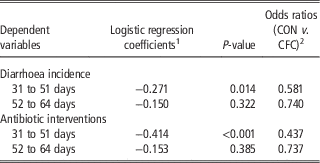
No clinical signs of disease were observed in both groups. A total mortality of 4.6% (three piglets in CON group and two in CFC group) was observed. In Table 4, the effects of dietary treatment on diarrhoea incidence and antibiotic interventions are reported. From 31 to 51 days of age, piglets fed the CFC diet showed a lower diarrhoea incidence (P<0.05) than CON diet. At the same time, antibiotic interventions were higher in CON than CFC group (P<0.001). Data from logistic regression analysis showed that for every 10 pigs with diarrhoea in CON group, only six pigs presented diarrohea in the CFC group and that daily antibiotic interventions were 2.3 times more frequent in CON than in CFC group. Conversely, no differences were observed between groups from 52 to 64 days (P>0.05).
Effects of crude fibre concentrate on diarrhoea incidence and antibiotic interventions of piglets

CON=diet unsupplemented with crude fibre concentrate 1% from 31 to 51 days of age; CFC=diet supplemented with crude fibre concentrate 1% from 31 to 51 days of age.
1 Change in the log odds of the parameter for a one unit increase in the predictor variable (group).
2 Multiplicative change in the odds for a one unit change in the predictor variable (group).
Acute-phase proteins and pro-inflammatory cytokines
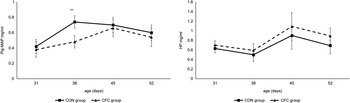
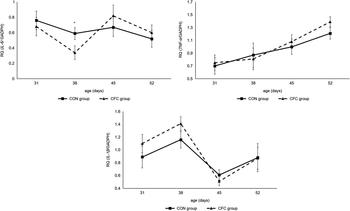
During the 3 weeks of dietary treatment, differences in inflammatory responses were observed only at the end of 1st week between groups. A significant increase of Pig-MAP level in CON group than CFC group (P<0.01) was observed (Figure 2). Conversely, in the HP levels did not differ between groups (P>0.05). Among pro-inflammatory cytokines, IL-6 but not TNF-α and IL-1β gene expression was higher in the CON than CFC group (P<0.05) (Figure 3).
Pig-major acute-phase protein (Pig-MAP) and haptoglobin (HP) plasma levels in piglets fed with a basic diet (control (CON) group) or a diet supplemented with 1% of crude fibre concentrate (CFC group) from 31 to 51 days of age. Data are presented as least squares means±SE. Statistically significant effects of the dietary treatment are indicated by ** for P<0.01.

Peripheral blood mononuclear cells gene expression levels of interleukin-6 (IL-6), tumour necrosis factor-α (TNF-α) and interleukin-1β (IL-1β) in piglets fed with a basic diet (control (CON) group) or a diet supplemented with 1% of crude fibre concentrate (CFC group) from 31 to 51 days of age. Expression levels of each cytokine are normalized to the glyceraldehyde-3-phosphate dehydrogenase (GAPDH) complementary DNA amount and expressed as relative quantities (RQ). Data are presented as least squares means±SE. Statistically significant effects of the dietary treatment are indicated by * for P<0.05.

Discussion
The first result that stands out from this study is that the presence of CFC in the diet enhanced the feed intake after weaning and improved feed efficiency over the entire post-weaning period. A previous research (Molist et al., Reference Molist, Gómez de Segura, Gasa, Hermes, Manzanilla, Anguita and Pérez2009) showed that insoluble fibre sources supplementation in non-isofibrous starter diets improves feed intake and ADG but not feed efficiency. In this instance, the higher ADG would be due to the effect of bulky diets on the digestive tract development and not to a true body growth (Gerritsen et al., Reference Gerritsen, van der Aar and Molist2012). In our study, the high feed efficiency shown by piglets receiving the CFC diet may not be as much related to the crude fibre content that has not been intentionally modified but rather to its direct intervention on intestinal functionality. It has been shown that an insoluble fibre diet (barley hulls) improves the morphology of the gut, increasing the villus height and the enzymatic activity of the mucosa if compared with a soluble fibre (pectin) containing diet (Hedemann et al., Reference Hedemann, Eskildsen, Laerke, Pedersen, Lindberg, Laurinen and Bach Knudsen2006). In our opinion, the CFC addition could help the adaptation of piglets during the post-weaning, improving the growth. Linear growth is predominantly regulated by GH via IGF-I, the main mediator of GH action. Insulin-like growth factor-I is an important anabolic hormone that mediates growth and development in animals and its increase in blood was associated with enhanced growth performance (Slifierz et al., 2014). The extent of IGF-I bioavailability and stability during transport throughout the bloodstream is related to binding proteins, particularly to IGFBP-3. In CFC group, IGF-I and IGFBP-3 supported the increase in BW. Conversely, in CON group the lower feed intake may have redirected the anabolic effect of IGF system. In fact, in these piglets the action of GH appeared unhooked to IGF-I system. Several studies suggest that the normal regulatory link between GH and IGF-I is uncoupled during an immune challenge (Hevener et al., Reference Hevener, Almond, Armstrong and Richards1997; Borghetti et al., Reference Borghetti, Saleri, Mocchegiani, Corradi and Martelli2009). The emerging concept is that a critical balance exists between hormones, for example GH, and inflammatory factors involving nervous, endocrine, immune organs (like the thymus) and so called ‘target’ tissues (i.e. adipose and muscle tissue). This balance can influence the immune response and, consequently, the body growth. In fact, positive acute-phase proteins levels were correlated in pigs with decreased weight gain (Piñeiro et al., Reference Piñeiro, Piñeiro, Morales, Carpintero, Campbell, Eckersall, Toussaint, Alava and Lampreave2007). In our study, the lowest growth shown by CON group was accompanied by an increase of Pig-MAP plasma levels and a higher incidence of diarrhoea. In contrast, HP did no significantly change under these conditions. Evidence suggests that Pig-MAP would be the most sensitive protein in the detection of the stress/inflammation caused by changes of environment and diet (Grau-Roma et al., Reference Grau-Roma, Heegaard, Hjulsager, Sibila, Kristensen, Allepuz, Piñeiro, Larsen, Segalés and Fraile2009). We may hypothesize that in CON group, the piglets sustained an immune/inflammatory defensive response, that is primary on growth. As indicated above, all piglets were apparently healthy with no sign of clinical infection, although sub-clinical infections due to malabsorption were possible. This assumption is confirmed by the higher decrease of IL-6 gene expression in the earlier phase of weaning in CFC group than in CON group. In inflammation, IL-6 has a major effect on the hepatic synthesis of acute-phase proteins and is also critical in controlling the extent of acute local and systemic inflammation (Borghetti et al., Reference Borghetti, Saleri, Mocchegiani, Corradi and Martelli2009). In the contest of our study, we can consider that the transitory higher levels of IL-6 gene expression and Pig-MAP and the unmodified levels of TNF-α and IL-1β gene expression could indicate a local extension of acute inflammation, such as the observed diarrhoea in CON group.
Furthermore, we observed a lack of association among BW, feed intake and leptin levels after weaning. Leptin, was extensively studied for its key role in the central regulation of food intake and energy expenditure (Summer et al., Reference Slifierz, Friendship, de Lange, Slavic, Grgic and Farzan2009; Gautron and Elmquist, Reference Gautron and Elmquist2011). Even if a direct connection between leptin and GH axis has been demonstrated in ob/ob mice, data on the role of leptin on spatial growth are conflicting (Odle et al., Reference Odle, Haney, Allensworth-James, Akhter and Childs2014). We tend to read our data as indicative of the role of leptin in energy balance. In fact, leptin levels do not vary significantly between groups during the first days post-weaning, when the energy balance is primarily designed to compensate the stress induced by weaning. In CFC group from the 2nd week of dietary treatment, the leptin level increase was accompanied by high ADG and ADFI. We believe that structural changes induced by the technological treatment on the lignocellulose cell wall derived from debarked wood have improved the energy balance of these subjects. Taken together, these results suggest that CFC dietary inclusion in the post-weaning period enhancing the growth and feed efficiency may help to ensure a successful growth potential of pigs. However, further research will be needed to fully understand the effects of CFC on the energy balance in relation to their physiological status.
Acknowledgement
The authors thank Dr Elena Garella for her contribution in this study.