

INTRODUCTION
The National Survey on Low Secure Services (Pereira et al., Reference Pereira, Dawson and Sarsam2006a,b) established a data set of all the psychiatric intensive care units (PICUs) and low secure units (LSUs) in the United Kingdom. A total of 307 units were identified, comprising of 170 PICUs and 137 LSUs. It highlighted some important similarities and differences between PICUs and LSUs regarding the unit and patient characteristics. But little is known about the differences between the working of NHS and private units.
This paper is based on the National Survey of Low Secure Services and focuses on the unit and patient characteristics comparison between NHS and private LSUs, including the staffing, interventions, facilities, type of patients cared for and pathways for admission and discharge, patient demographics and clinical issues.
METHOD
Design
A cross sectional census day questionnaire design was employed to ensure uniformity of data.
Criteria for inclusion
For the purpose of the study the following definition of an LSU was derived: a unit providing ongoing care and rehabilitation, usually within conditions of security for mentally disordered patients who exhibit behavioural disturbance. Patients may have a mixture of offending and non-offending behaviours. The unit is not a medium secure unit. The definition was read out when the units were contacted to resolve inclusion.
Identification and recruitment of units
The project received MREC ethical approval. The Mental Health Act committee provided details of services in England and Wales to house detained patients. A similar list was obtained for Scotland and Northern Ireland from the Department of Health in their respective countries. Each service was individually contacted via the mental health bed manager to identify the presence of a LSU. Subsequently, each individual ward manager was contacted to finalise inclusion or not.
The survey
An eight-section questionnaire was designed by a multi-disciplinary panel of health care professionals. The questionnaire was piloted on four PICUs and one LSU after which minor changes were made to the wording and layout. The questionnaire comprised the following sections:
Ward information
Structure
Facilities and policies
Patient characteristics
Staffing
Operational characteristics
Unit functioning
A full copy of the questionnaire can be obtained by contacting the authors.
The data collection was carried out in 2002. To ensure a high response rate a telephone help-line was set up to assist completion of the questionnaire and the joint head of Mental Health in the Department of Health wrote letters to participants encouraging data return. Phone calls, reminder letters and personal visits to the units also took place enhancing the response rate. A response rate of 98% was received.
RESULTS
Unit characteristics
General unit information and provision
A total of 137 LSUs were identified. 9 charity units have been excluded from the analysis to make the comparison between NHS and private units more meaningful. Out of the remaining 128, 98 were NHS and 30 were private LSUs.
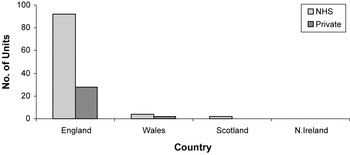
Figure 1 shows that in England there were 98 NHS and 30 private LSUs. Scotland had 2 NHS but no private LSUs and Wales had 4 NHS and 2 private LSUs, whereas Northern Ireland did not have any NHS or private LSUs.
Numbers of NHS and private LSUs in UK

The private sector has a significantly higher number of overall beds (t = −2.18,df = 125, p = 0.031) compared to the NHS. There is no significant difference between the NHS and private sector regarding the number of male, female or mixed beds. See Table 1 for details.
Mean numbers of beds

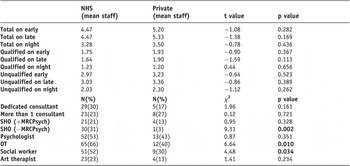
Staffing
Staffing levels are shown in Table 2. No significant difference was found between NHS and private units regarding the nursing staff. The patient:qualified staff ratio on NHS and private LSUs was 8 patients to each nursing staff member (8:1). As to non-nursing staff, NHS LSUs reported having significantly more senior house officers below the MRCPsych level (χ2 = 9.31, df = 1, p = 0.002), occupational therapists (χ2 = 6.64, df = 1, p = 0.010) and social workers (χ2 = 4.48, df = 1, p = 0.034) compared to the private LSUs.
Nursing and other staff working on units

SHO = Senior House Officer; OT = Occupational Therapist
Provision of facilities
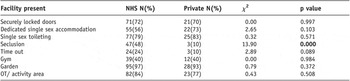
The results show that the majority of LSUs (both NHS and private) do not have adequate seclusion, time out and gym facilities. These results are shown in detail in Table 3.
Unit facilities

Interventions
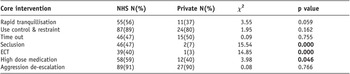
Table 4 shows the core interventions used by NHS and private LSUs. NHS units used significantly more seclusion (χ2 = 15.54, df = 1, p = 0.000), ECT (χ2 = 14.85, df = 1, p = 0.000) and high dose medication (χ2 = 3.98, df = 1, p = 0.046) compared to their private counterparts.
Core interventions

ECT = Electroconvulsive Therapy
Protocols
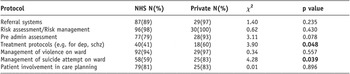
Table 5 shows the protocols that were being used on the units. It shows that private units are significantly more likely than NHS units to have treatment protocols (χ2 = 3.90, df = 1, p = 0.048) and management of suicide protocols (χ2 = 4.28, df = 1, p = 0.039).
Protocols

Care pathways – referral, admission and discharge
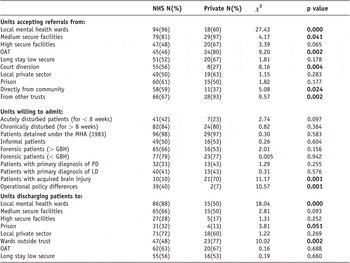
Table 6 shows that NHS units were significantly more likely to accept referrals from:
Local mental health wards (χ2 = 27.43, df = 1, p = 0.000)
Court diversion (χ2 = 8.16, df = 1, p = 0.004)
Directly from community (χ2 = 5.08, df = 1, p = 0.024)
Referral, admission and discharge

OAT = Out of Area Treatment; GBH = Grievous Bodily Harm; MHA = Mental Health Act; PD = Personality Disorder; LD = Learning Disability
Private units were significantly more likely to accept referrals from:
Medium secure facilities (χ2 = 4.17, df = 1, p = 0.041)
Out of area (χ2 = 9.20, df = 1, p = 0.002)
From other trusts (χ2 = 9.57, df = 1, p = 0.002)
Private units were significantly more willing to admit patients with acquired brain injury (χ2 = 11.17, df = 1, p = 0.001) compared to the NHS units. Significantly more NHS units reported accepting patients against their operational policy (χ2 = 10.57, df = 1, p = 0.001). Regarding the discharge behaviour of units, NHS units were more likely to discharge patients to local mental health wards (χ2 = 18.04, df = 1, p = 0.000) and prisons (χ2 = 3.81, df = 1, p = 0.051) compared to their private counterparts.
Patient characteristics
The NHS LSUs were reported to be housing 1084 patients and the private LSUs 359 patients.
Demographic characteristics
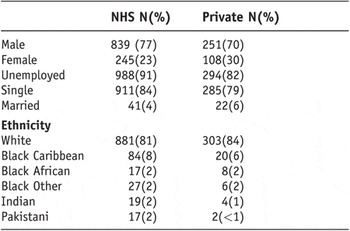
Table 7 includes the basic demographic characteristics of patients in NHS and private LSUs. It shows that a large majority of patients were white, male, unemployed and single in both NHS and private units.
Demographic characteristics

Length of stay
The length of stay was calculated for the 30 patients most recently discharged. The average length of stay for NHS LSU patients was 317 days and for private LSU patients, 514 days (t= -5.77,df = 1281, p = 0.000) indicating that NHS patients had a significantly shorter length of stay compared to the private patients.
Reasons for admission and section status
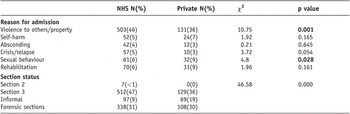
Table 8 shows that the most common reason for admission to LSUs for both NHS and private patients was violence to others / property. Significantly more NHS patients were admitted to LSUs for violence to others / property compared to private patients (χ2 = 10.75, df = 1, p = 0.001). A significantly greater number of patients were admitted to private LSUs due to sexual behaviour compared to NHS units (χ2 = 4.83, df = 1, p = 0.028). The majority of patients (both NHS and private) were involuntarily detained under Section 3.
Reason for admission and section status

Clinical issues
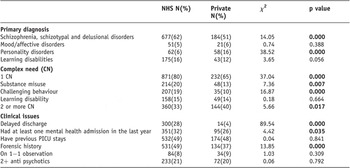
Table 9 shows that 62% NHS patients and 51% private patients had schizophrenia, schizotypal and delusional disorders as their primary diagnosis. A higher number of private patients had personality disorders as their primary diagnosis (χ2 = 38.52, df = 1, p = 0.000). A high majority of both NHS and private patients had at least one complex need. Significantly more NHS patients were defined as delayed discharged (χ2 = 89.54, df = 1, p = 0.000), had at least one mental health admission in the last year (χ2 = 4.42, df = 1, p = 0.035) and forensic history (χ2 = 13.85, df = 1, p = 0.000) compared to the private patients.
Clinical issues

1 CN = Have at least 1 complex need
DISCUSSION
This paper compares the NHS LSUs with private LSUs in terms of their unit and patient characteristics. Although the number of private LSUs is small compared to their NHS counterparts, it is more than the number of private PICUs.
Unit characteristics
Private units seem to have significantly more beds compared to the NHS, but the difference regarding the number of occupied beds in the two sectors seems to be non-significant. The patient:qualified staff ratio in NHS and private units is the same.
Although NHS LSUs reported having significantly more OT and social worker input in their units compared to the private sector, the numbers do not appear to be satisfactory when compared to the National Standards (DoH, Reference Pereira and Clinton2002), which clearly state that apart from other core services, long stay low secure units should be staffed by a dedicated social worker. Buckle (2005) also argued that social workers have an important part to play in the provision of a more holistic service to cater to the social needs of patients in low secure environments. In addition, the number of psychologists working in both sectors seems quite low, considering the fact that psychology is one of the core services offered in low secure environments and patients need psychologists to deal with their psychological, emotional and behavioural difficulties (Beer et al., Reference Beer, Pereira, Paton, Beer, Pereira and Paton2001). Both sectors may need to increase the psychology, OT, social work and art therapy input in order to display effective multi-disciplinary teamwork.
The results showed that NHS LSUs tend to use seclusion as core intervention significantly more than private units. There could various reasons for this difference, including the possibility of the NHS using more seclusion due to having access to more seclusion facilities compared to their private counterparts. Furthermore, significantly more NHS LSUs have a tendency to use electroconvulsive therapy (ECT) and high dose medication as core interventions than the private units. According to the National Standards (DoH, Reference Pereira and Clinton2002), high dose medication should be avoided as far as possible. It would be interesting to explore the type of core interventions the private sector has in place as an alternative to seclusion, ECT and high dose medication to manage patients.
Private LSUs appear to have more well-developed protocols for treatment (e.g., depression, schizophrenia) and management of suicide attempt on ward compared to the NHS LSUs. Apart from these two protocols, NHS and private LSUs had similar numbers of protocols. Well-developed protocols are important for uniformity of approach to treatment within a multi-disciplinary team and aid communication between team members.
Private LSUs reported being more willing to accept referrals from out of area and other trusts, which may be due to lack of local facilities available, contributing towards moving patients to out of area private units (Coid, Reference Coid1991a). This appears to go against the standards outlined for people with severe mental illness, which is to ensure that service users are placed as close to home as possible (DoH, 1999). Another possible explanation for high out of area referrals could be that the private LSUs have been established in areas where there is a lack of NHS LSU facilities. The private sector profited by spotting this gap in services and opening these units provided them with a lucrative business/marketing opportunity (Coid, Reference Coid1991b).
Eighteen percent of private units were willing to admit patients with acquired brain injury, which was significantly more than the NHS figure. This raises the issue of whether the private LSUs are better resourced to cater for this special patient group or is it because the complex nature of the illness these difficult to place patients end up in the private sector, a concern raised by Coid (1991b) and others. A surprising number (40%) of NHS LSUs reported accepting patients against their operational policy, which highlights bad practice. This issue needs to be further investigated; what leads the NHS units to accept patients against their operational policy? Perhaps the operational policies need to be updated or modified in view of the changing nature of patients being admitted to these units.
Patient characteristics
The basic demographic profiles of NHS and private patients were similar. Interestingly, there was a significant difference between the NHS and private units in terms of the average length of stay of patients (317 days v 514 days). This could be due to a number of reasons, possibly including the type of patients being admitted in private facilities. In our sample, a high number of patients admitted to private PICUs tended to have a diagnosis of personality disorders and had two or more complex needs. Coid (Reference Coid1991a,b) commented that ‘difficult to place’ patients displaying ‘challenging behaviour’ are passed from one service to the other and many end up in private care as local NHS services may not be able to appropriately cater for the needs of this complex and difficult patient group. It is interesting to note that in our LSU sample, significantly more NHS patients were identified as having substance misuse issues, challenging behaviour and forensic history compared to the private patients. This may point towards the fact that these patients also exhibited the type of challenging behaviour which may necessitate longer duration of stay, similar to private patients. More patients with substance misuse issues in NHS units may point towards the need for training more staff in substance misuse issues, a suggestion made by Atakan (2001).
Poole et al., (2002) also voiced their concern at the displacement of patients to the private sector due to an absence of appropriate NHS provision. Another reason for a longer duration of stay in private facilities could be due to inefficient monitoring systems in place to bring the patients back to their respective catchment area (Coid, Reference Coid1991a).
The reason for admission to NHS LSUs was mostly due to violence to others or property and accounted for 46% of all admissions, which was significantly more than private units. In addition, 62% of NHS patients had a primary diagnosis of schizophrenia, significantly greater than private patients. The association of schizophrenia and substance misuse with violence is well known. Saverimuttu & Lowe (2000) concluded from their study that patients with schizophrenia were more likely to display violence against others as compared to other diagnostic categories.
Another interesting finding was related to the number of informal admissions. A striking 19% of private patients had an informal status. It is noteworthy that admission of voluntary or informal patients to these units appears to go against the nature and principles of the low secure environment and undoubtedly raises important ethical and legal issues related to deprivation of liberty (Laidlaw & Buckle, Reference Laidlaw and Buckle2005). According to the National Standards (DoH, Reference Pereira and Clinton2002) admission criteria for PICUs/LSUs, patients have to be detained under an appropriate assessment / treatment section of the mental health act. This issue needs to be further investigated in more detail.
LIMITATIONS
More NHS and private LSUs may have become operational in the time period between the data collection and publication of this paper.
CONCLUSION
This is the first time that differences between NHS and private LSUs have been studied in detail. It has brought to the fore issues and aspects of LSU service provision related to the unit and patient characteristics in an evidence based manner. From the findings it would be safe to say that there is plenty of room for improvement in both sectors. It is important to note that at the time of the survey, not many units (NHS or private) were adhering to the National Standards (DoH, Reference Pereira and Clinton2002), quite possibly because these standards were published after this survey was done. Nevertheless, it would be interesting to see whether or not any significant changes have taken place in terms of adherence to the National Standards (DoH, Reference Pereira and Clinton2002) since publication.
DECLARATION OF INTEREST
The project was funded by the Department of Health.
Acknowledgements
The authors would like to acknowledge the assistance of Dr Farid Jabbar, Graham Hill and Alexander Smith in the development of this paper and Paul Dawson and May Sarsam for their contributions in data collection.