Introduction
The world’s population is ageing rapidly. According to the United Nations (2022), the percentage of people aged 65 and over is projected to rise from 10 per cent in 2022 to 16 per cent in 2050. In 2022, Europe and North America already have the highest share of older adults, nearly 19 per cent, and this figure is expected to reach one in four by mid-century (United Nations 2022).
Older adults are a highly heterogeneous group, shaped by diverse life trajectories that produce wide variation in cognitive outcomes (Stern et al. Reference Stern, Arenaza-Urquijo, Bartres-Faz, Belleville, Cantilon, Chetelat, Ewers, Franzmeier, Kempermann, Kremen, Okonkwo, Scarmeas, Soldan, Udeh-Momoh, Valenzuela, Vemuri and Vuoksimaa2020). Some maintain stable cognition, others decline gradually and a smaller proportion deteriorate rapidly (Wilson et al. Reference Wilson, Beckett, Barnes, Schneider, Bach, Evans and Bennett2002; Hayden et al. Reference Hayden, Reed, Manly, Tommet, Pietrzak, Chelune, Yang, Revell, Bennett and Jones2011). While some decline is expected with age (Harada et al. Reference Harada, Natelson Love and Triebel2013), severe impairments are not inevitable (Fjell and Walhovd Reference Fjell and Walhovd2010; Mattson and Arumugam Reference Mattson and Arumugam2018). Normal ageing is typically accompanied by gradual declines in cognitive abilities, including processing speed, attention, learning and memory, decision-making, sensory perception and motor coordination (Salthouse Reference Salthouse2010; Harada et al. Reference Harada, Natelson Love and Triebel2013); these changes are a normal part of ageing, whereas accelerated deterioration in memory and other higher-order cognitive functions is associated with pathological ageing, such as dementia (Albert et al. Reference Albert, DeKosky, Dickson, Dubois, Feldman, Fox, Gamst, Holtzman, Jagust, Petersen, Snyder, Carrillo, Thies and Phelps2011; Sacuiu Reference Sacuiu, Rosano, Ikram and Ganguli2016).
Cognitive decline has wide-ranging consequences, including increased co-morbidity and mortality (Lv et al. Reference Lv, Li, Ma, Chen, Zeng, Yu, Hofman and Wang2019; Duan et al. Reference Duan, Sam, Wang and Liu2022) and reduced quality of life (Stites et al. Reference Stites, Harkins, Rubright and Karlawish2018; Song et al. Reference Song, Fan and Seo2023). It is also associated with social outcomes: older adults may experience greater social isolation and loneliness (Kotwal et al. Reference Kotwal, Kim, Waite and Dale2016; Burholt et al. Reference Burholt, Windle, Morgan and Team2017). Although related concepts, social isolation reflects an objective lack of contact, while loneliness is a subjective perception of unmet social needs (de Jong Gierveld et al. Reference de Jong Gierveld, Van Tilburg, Dykstra, Perlman and Vangelisti2006). In severe cases, such as dementia, loss of independence leads to substantial health-care costs and reliance on both formal and informal care (Prince et al. Reference Prince, Comas-Herrera, Knapp, Guerchet and Karagiannidou2016; Cantarero-Prieto et al. Reference Cantarero-Prieto, Leon, Blazquez-Fernandez, Juan and Cobo2020), presenting a pressing challenge for public health systems and policy makers across Europe.
Given the heterogeneity of cognitive ageing and its serious individual and societal impacts, identifying the factors that shape cognitive function in older adults is a critical public health priority (Boyle et al. Reference Boyle, Wilson, Yu, Barr, Honer, Schneider and Bennett2013; Li et al. Reference Li, Feng, Sun, Hou, Han and Liu2022). Understanding these determinants is essential for developing strategies to preserve cognition and achieve substantial social and economic benefits.
Cognitive decline can both result from and contribute to the many forms of social exclusion experienced by older people (Burholt et al. Reference Burholt, Winter, Aartsen, Constantinou, Dahlberg and Feliciano2020). According to Walsh et al. (Reference Walsh, Scharf and Keating2017, p.93),
Old-age exclusion involves interchanges between multi-level risk factors, processes and outcomes. Varying in form and degree across the older adult life course, its complexity, impact and prevalence are amplified by old-age vulnerabilities, accumulated disadvantage for some groups, and constrained opportunities to ameliorate exclusion. Old-age exclusion leads to inequities in choice and control, resources and relationships, and power and rights in key domains of neighbourhood and community; services, amenities and mobility; material and financial resources; social relations; socio-cultural aspects of society; and civic participation.
This definition shows that older people are especially vulnerable to social exclusion, resulting from a combination of factors that often accumulate across the lifecourse and intensify in old age. As people grow older, they are more likely to experience events such as declining autonomy, the loss of a spouse, relatives or friends, and age discrimination (Cavalli et al. Reference Cavalli, Bickel and Lalive D’Épinay2007; Van Regenmortel et al. Reference Van Regenmortel, De Donder, Dury, Smetcoren, De Witte and Verté2016). These events intersect with long-term socio-economic disadvantages that may have developed throughout life, a dynamic explained by the theory of cumulative advantage/disadvantage (Dannefer Reference Dannefer2003; Walsh et al. Reference Walsh, Scharf and Keating2017).
In old age, the impact of these accumulated disadvantages becomes more pronounced, as many older adults experience physical or cognitive frailty and have fewer socio-economic resources to buffer or compensate for these effects. At the same time, opportunities to alter their circumstances tend to diminish, further reinforcing vulnerability. Social exclusion, therefore, emerges from the interplay between lifelong processes of disadvantage and the additional challenges of later life. It can manifest in multiple domains of daily living (Walsh et al. Reference Walsh, Scharf and Keating2017). In line with the multidimensional framework proposed by Walsh et al. (Reference Walsh, Scharf and Keating2017), this study focuses on three central domains: economic exclusion, social relationships and civic participation.
These domains are highlighted for their relevance to older adults, as discussed later. Numerous studies have examined the relationships between these domains and cognitive performance, both cross-sectionally and longitudinally. However, research analysing multiple domains simultaneously in relation to cognition is limited; only one longitudinal study conducted in China has been identified, and no comparable evidence exists for Western or European populations. This gap restricts the generalizability of existing findings and leaves open important questions about whether these combined influences operate similarly in different socio-cultural contexts. The present study addresses this limitation by examining these domains together in a European context.
Economic exclusion
Many older adults, especially women, experience economic difficulties due to income loss after retirement (Albuquerque et al. Reference Albuquerque, Arcanjo, Nunes and Pereirinha2010; Murphy and O’Connor Reference Murphy and O’Connor2023). This situation is dire for older adults with health problems that lead to early retirement (Johnson Reference Johnson2018). Financial troubles in older age may also arise from other circumstances, such as the loss of a partner or living alone (Kemp et al. Reference Kemp, Bradshaw, Dornan, Finch and Mayhew2004; Murphy and O’Connor Reference Murphy and O’Connor2023); the presence of co-morbidities that result in high expenses related to medical visits and exams, and medication (McInerney et al. Reference McInerney, Rutledge and King2017; Rutledge and Sanzenbacher Reference Rutledge and Sanzenbacher2019); or the need for home support and care-giving services (Jones et al. Reference Jones, De Nardi, French, McGee and Kirschner2018; Oliveira and Llena-Nozal Reference Oliveira and Llena-Nozal2020), to name just a few.
Several studies have assessed the association between economic exclusion, particularly poverty, and cognitive function in middle-aged and older adults. These investigations have consistently found that unfavourable economic conditions are linked to poorer cognitive performance (Koster et al. Reference Koster, Penninx, Bosma, Kempen, Newman, Rubin, Satterfield, Atkinson, Ayonayon, Rosano, Yaffe, Harris, Rooks, Van Eijk and Kritchevsky2005; Lee et al. Reference Lee, Buring, Cook and Grodstein2006; Zhang et al. Reference Zhang, Gale, Erickson, Brown, Woody and Hedges2015).
Social relations
The loss of social relations is particularly significant for older adults due to reduced contact following retirement, a situation that tends to be more pronounced for men (Patulny Reference Patulny2009; Kalmijn Reference Kalmijn2012), as well as the death of a spouse, close relatives or friends (Dykstra and Fokkema Reference Dykstra and Fokkema2007). With ageing, physical, mental and sensory difficulties (Karlamangla et al. Reference Karlamangla, Tinetti, Guralnik, Studenski, Wetle and Reuben2007; Salive Reference Salive2013) may further hinder interpersonal relationships and limit participation in social activities (Coyle et al. Reference Coyle, Steinman and Chen2017).
Living alone is frequently used as a structural indicator associated with the risk of social isolation or loneliness (Ward et al. Reference Ward, Layte and Kenny2019; Chen et al. Reference Chen, Cao, Wang, Zhu, Lu, Zhang and Shen2024), while environmental characteristics unfavourable to ageing – such as the absence of socialization spaces, lack of public transportation, insecurity or gentrification – can effectively reduce opportunities for interaction, contributing to isolation or loneliness (Buffel and Phillipson Reference Buffel and Phillipson2019; Torres Reference Torres2020; Astell-Burt et al. Reference Astell-Burt, Hartig, Putra, Walsan, Dendup and Feng2022).
Numerous studies have examined the association between social relations and cognitive function in middle-aged and older adults. Findings generally indicate that loneliness and social isolation are negatively associated with cognition; that is, individuals experiencing these conditions tend to show worse cognitive performance compared to their counterparts (Poey et al. Reference Poey, Burr and Roberts2017; Evans et al. Reference Evans, Llewellyn, Matthews, Woods, Brayne, Clare and Team2018; Montoliu et al. Reference Montoliu, Hidalgo and Salvador2019). Conversely, social participation and social connectedness are positively associated with better cognitive performance and slower cognitive decline in older adults (Paiva et al. Reference Paiva, Cunha, Voss and Delerue Matos2021; Cunha et al. Reference Cunha, Rodrigues, Voss, Martinez-Pecino and Delerue-Matos2024).
Civic participation
Civic participation can enable older adults to remain active, engage with their communities and address issues that concern them, such as ageism or legislation related to the protection of older people (Serrat et al. Reference Serrat, Scharf and Villar2021). Within this domain, volunteering is one example of an activity that might expand social networks and enhance social support (Low et al. Reference Low, Butt, Ellis and Davis Smith2007; Anderson et al. Reference Anderson, Damianakis, Kroger, Wagner, Dawson, Binns, Bernstein, Caspi, Cook and Team2014). Volunteering also offers other benefits, such as giving meaning to life, boosting self-confidence and increasing self-efficacy (Brown et al. Reference Brown, Hoye and Nicholson2012; Seeman et al. Reference Seeman, Merkin, Goldwater and Cole2020). Additionally, it has been associated with dementia prevention, reductions in negative feelings and loneliness, the promotion of active and healthy ageing (Müller et al. Reference Müller, Ziegelmann, Simonson, Tesch-Römer and Huxhold2014; Tabassum et al. Reference Tabassum, Mohan and Smith2016; Han et al. Reference Han, Kim and Burr2018, Reference Han, Kim and Burr2020), improvements in quality of life (Nazroo and Matthews Reference Nazroo and Matthews2012) and efforts to counteract the ageist view that older people are a burden to society (Levy and Apriceno Reference Levy and Apriceno2019; Hövermann and Messner Reference Hövermann and Messner2022).
In many ways, exclusion from civic participation reflects broader social exclusion, as it can limit participation in political institutions that make decisions affecting citizens’ lives. As a result, older adults who are excluded from civic participation may have no voice in decisions that affect them and risk losing access to rights, particularly those designed to protect minorities or underrepresented groups (Kneale Reference Kneale2012).
Despite its importance, civic participation among older adults remains low. According to Walsh et al. (Reference Walsh, Scharf and Keating2017), this domain of social exclusion has received the least attention from researchers. It is also important to note that individuals who do not engage in civic activities, whether political or voluntary, may be considered excluded by society, even when their non-participation is voluntary and they do not feel excluded or disadvantaged. Society may still regard this lack of participation, particularly abstention from voting, as harmful to social cohesion (Burchardt et al. Reference Burchardt, Le Grand and Piachaud2002; Le Grand Reference Le Grand2003). Most studies assessing the association between civic participation and cognition find a positive association: middle-aged and older adults who volunteer tend to exhibit better cognitive functioning than those who do not (Shmotkin et al. Reference Shmotkin, Blumstein and Modan2003; Schwingel et al. Reference Schwingel, Niti, Tang and Ng2009; Guiney et al. Reference Guiney, Keall and Machado2021).
Multidimensional exclusion
It is also essential to consider the intersectionality between the different areas of social exclusion. Many authors agree that social exclusion is fundamentally dynamic: individuals may move in and out of exclusion at various points in their lives. However, it is well established that the risk of social exclusion tends to increase with age, as exclusion in one domain can heighten the risk of exclusion in another, with domains often interlinked (Dahlberg Reference Dahlberg, Walsh, Scharf, Van Regenmortel and Wanka2021; Scharf et al. Reference Scharf, Walsh, Van Regenmortel, Wanka, Walsh, Scharf, Van Regenmortel and Wanka2021). For instance, the economic and social domains are closely connected, since older adults who are economically disadvantaged may find it more challenging to maintain a broad social network. Older people with low economic status often struggle to replace relationships lost over the lifecourse (Cornwell Reference Cornwell2015), as their ability to participate in community social life is limited. This, in turn, significantly reduces opportunities to expand and diversify their social interactions (Stephens et al. Reference Stephens, Alpass and Towers2010; Ellwardt et al. Reference Ellwardt, Peter, Präg and Steverink2014). According to Aartsen et al. (Reference Aartsen, Veenstra and Hansen2017), older adults with low socio-economic status also tend to have lower-quality social networks in terms of both emotional closeness and support, which may lead to more severe health problems.
Economic difficulties can also reduce older adults’ likelihood of participating in civic activities, further increasing the risk of exclusion from social relations (Kneale Reference Kneale2012). It is therefore not surprising that older adults facing financial difficulties are more likely to report loneliness than those without such challenges (Haushofer Reference Haushofer2013; Niedzwiedz et al. Reference Niedzwiedz, Richardson, Tunstall, Shortt, Mitchell and Pearce2016). Barnes et al. (Reference Barnes, Blom, Cox, Lessof and Walker2006) also found reciprocal relationships between the domains of social relations and civic participation, as well as between civic participation and the consumption of material and financial goods.
Research aim
This study aims to investigate the potential association between social exclusion and cognitive function in Europeans aged 50 and above. The study focuses on three main domains: economics, social relations and civic participation. The purpose is to assess the association between the different domains of social exclusion (separately and as a whole) and cognitive performance. This study will contribute to the existing body of literature by (i) assessing the independent association of each social exclusion domain with cognitive function in a large sample of Europeans aged 50+; (ii) determining which domain has the strongest association with cognitive function; (iii) evaluating whether multidimensional exclusion is more strongly associated with cognitive function than exclusion in a single domain; and (iv) proposing social policy recommendations to reduce social exclusion among older adults.
Methods
Study population
This study draws on data from the Survey of Health, Ageing and Retirement in Europe (SHARE), a biennial panel study conducted in 27 European countries and Israel. SHARE collects multidisciplinary data from a representative sample of individuals aged 50 and over, as well as their partners (regardless of age), covering health, socio-economic status, and social and family networks. Data are gathered through computer-assisted personal interviews (CAPI) conducted in respondents’ homes. All interviewers receive standardized training to ensure reliability, consistency and comparability across countries (Alcser and Benson Reference Alcser, Benson, Börsch-Supan and Jürges2005).
The SHARE project is coordinated by the SHARE Berlin Institute in Germany and has been approved by the Ethics Council of the Max Planck Society for the Advancement of Science. Further details on the survey’s methodology and sampling can be found in Börsch-Supan et al. (Reference Börsch-Supan, Brandt, Hunkler, Kneip, Korbmacher, Malter, Schaan, Stuck, Zuber and Team2013).
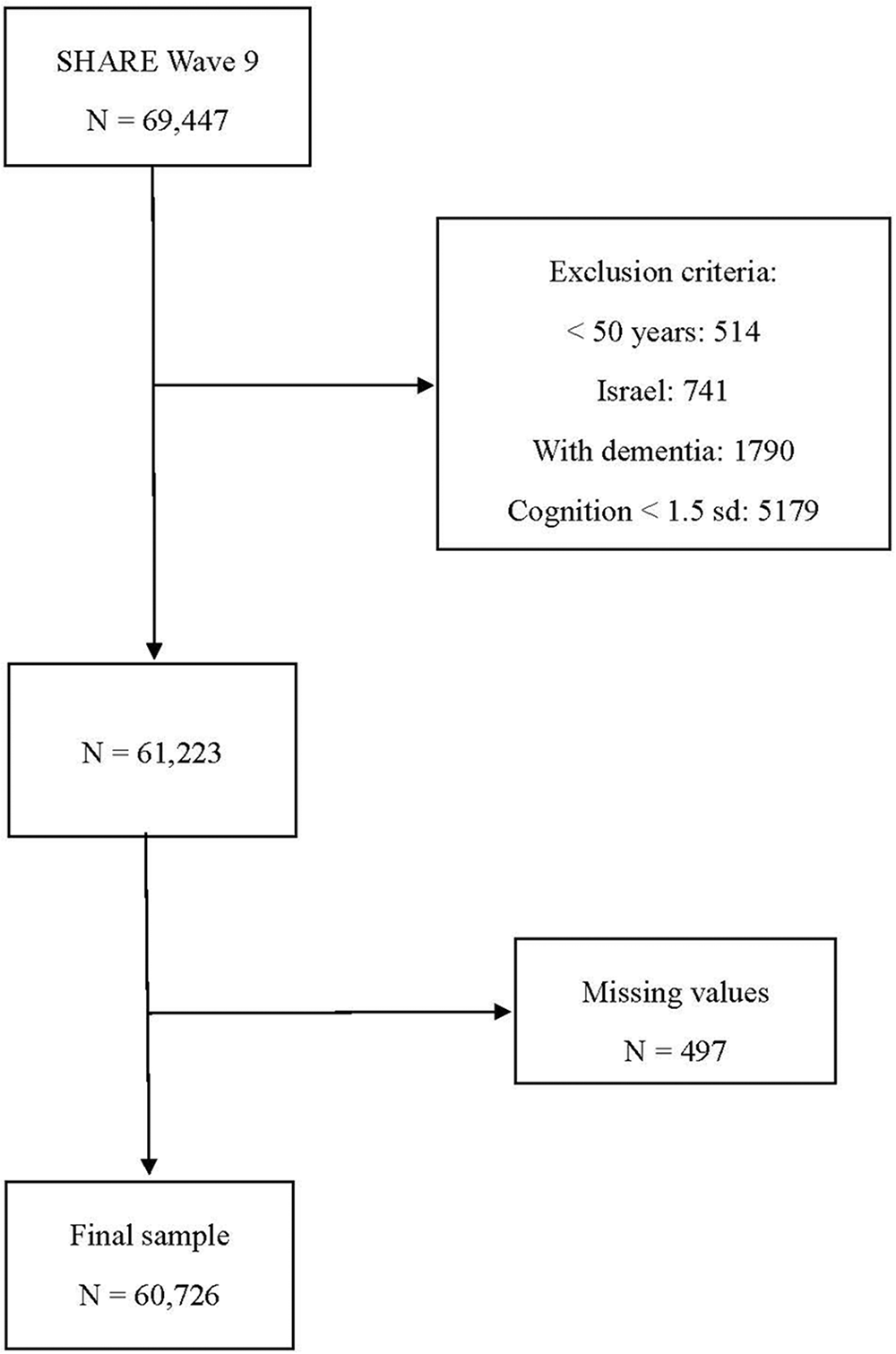
This study uses data from Wave 9, collected in 2022, as provided in release 9.0.0 (https://doi.org/10.6103/SHARE.w9.900) (Börsch-Supan et al. Reference Börsch-Supan, Brandt, Hunkler, Kneip, Korbmacher, Malter, Schaan, Stuck, Zuber and Team2013; Bergmann et al. Reference Bergmann, Wagner and Börsch-Supan2024). The analytic sample was restricted to non-institutionalized European respondents aged 50 and over. To reduce the likelihood of reverse causality, we excluded from the sample respondents with a cognitive function more than 1.5 standard deviations below the country-specific average and those who reported having Alzheimer’s disease, another form of dementia, or senility (Albert et al. Reference Albert, DeKosky, Dickson, Dubois, Feldman, Fox, Gamst, Holtzman, Jagust, Petersen, Snyder, Carrillo, Thies and Phelps2011; Visser et al. Reference Visser, Dubbelman, Verrijp, Wanders, Pelt, Zwan, Thijssen, Wouters, Sikkes, van Hout and van der Flier2021). This decision is justified by the fact that cognitive impairment may lead to a reduction in social networks and lower levels of social and civic participation (Kail and Carr Reference Kail and Carr2020; Piolatto et al. Reference Piolatto, Bianchi, Rota, Marengoni, Akbaritabar and Squazzoni2022). Finally, 497 individuals with missing data on any of the variables of interest were excluded. Thus, the sample of this study consists of 60,726 individuals (Figure 1).
Flowchart describing the population eligible for this study.

Variables
Outcome variable
The dependent variable – global cognitive function – was assessed using five distinct cognitive tests: orientation, immediate recall, verbal fluency, numeracy and delayed recall. In the orientation test, respondents were asked to report the current day of the month, the day of the week, the month and the year, with scores ranging from 0 (all answers incorrect) to 4 (all correct). In the immediate recall test, respondents were asked to recall a list of ten words immediately after it was read aloud by the interviewer (scores ranged from 0 to 10). The verbal fluency test required participants to name as many animals as possible within one minute (the score corresponds to the total number of animals named). In the numeracy test (Serial Sevens), respondents were asked to subtract 7 five times, starting from 100 (score ranged from 0 to 5). In the delayed recall test, participants were asked to recall the same list of ten words after a short delay during which the verbal fluency and numeracy tests were applied (scores ranged from 0 to 10).
Following Leist et al. (Reference Leist, Glymour, Mackenbach, van Lenthe and Avendano2013), an overall cognitive score was computed as the sum of the z-scores of the five cognitive tests. The final measure of global cognitive function ranges from −5.56 to 16.07, with higher values indicating better cognitive performance.
Variables of interest
Economic exclusion
Poverty was used as an indicator of exclusion in the economic domain of social exclusion. The total household net income was adjusted for purchasing power parity (PPP) by country and household size and then divided into tertiles. The lowest tertile was coded as 1, the middle as 2 and the highest as 3. To assess poverty risk, the income per ‘equivalent adult’ was calculated, assigning a weight of 1 to the first adult in the household and 0.5 to each additional adult. This adjusted income was again corrected for PPP by country. Individuals whose income fell below 60 per cent of the national median were considered at risk of poverty. These individuals were coded as economically excluded (1), while those not at risk of poverty were coded as not excluded (0).
Social relations exclusion
Exclusion in the domain of social relations was assessed based on two dimensions proposed by Barnes et al. (Reference Barnes, Blom, Cox, Lessof and Walker2006): frequency of contact and density of the relationship network. However, adaptations were made to account for the data available in the SHARE project.
Frequency of contact was measured using the question: ‘Please give me the first name of the person with whom you most often/often discuss things that are important to you’. Respondents could name up to seven individuals. For each person listed, the following questions were asked: ‘What is that person’s relationship to you?’; ‘During the past 12 months, how often did you have contact with that person, either in person, by phone or mail, or by email or any other electronic means?’; ‘Where does that person live?’. Only four relationship types were considered: spouse/partner, child, other relatives (excluding children) and friends. Contact was considered frequent if it occurred daily or several times a week, and only individuals not living in the same household were included. Respondents scored one point for frequent contact with each type of relationship (maximum score = 4). Unlike Barnes et al. (Reference Barnes, Blom, Cox, Lessof and Walker2006), our index did not distinguish between face-to-face and telephone contacts due to SHARE data limitations. Also, contrasting with Barnes et al. (Reference Barnes, Blom, Cox, Lessof and Walker2006), our index includes living apart together (LAT) relationships, which have acquired importance in recent decades.
Density of the relationship network was measured using some of the previously mentioned questions: ‘Please give me the first name of the person with whom you most often/often discuss things that are important to you’ and ‘What is that person’s relationship to you?’) with the same response options (spouse/partner, child, relative, friend), along with the question ‘How close do you feel to that person?’. Relationships were considered close if described as ‘very’ or ‘extremely’ close; all others were not considered close. Unlike the frequency dimension, living in the same household or not was not considered here. Following Barnes et al. (Reference Barnes, Blom, Cox, Lessof and Walker2006), scores were assigned as follows: 0.5 points for a close relationship with one child, one relative or one friend; 1 point for a close relationship with two children, two relatives or two friends; 1.5 points for close relationships with three or more children, relatives or friends; an additional 1.5 points were given for a close relationship with a spouse/partner. It is important to note that Barnes et al.’s (Reference Barnes, Blom, Cox, Lessof and Walker2006) original index had a maximum score of 6, but, due to the SHARE limit of seven nominated contacts, the maximum density score in our study is 4.5.
The final index of exclusion in social relations was calculated by summing the scores for frequency (0–4) and density (0–4.5), obtaining a total range of 0 to 8.5, where lower scores reflect greater exclusion. Based on the distribution of this index, a cut-off point of 1.5 was used to dichotomize the variable. Individuals scoring ≤ 1.5 were considered socially excluded (coded as 1); all others were coded as not excluded (coded as 0). In SHARE Wave 9, 12.4 per cent of older adults were categorized as socially excluded, a percentage similar to that found by Barnes et al. (Reference Barnes, Blom, Cox, Lessof and Walker2006) in the United Kingdom (12 per cent).
Civic participation exclusion
Civic participation was assessed using the question ‘Please look at Card 38. Which of the activities listed on this card – if any – have you done in the last 12 months?’. For this domain, only voluntary or charity work and political or community-related organizations were considered to be indicators of civic participation. Thus, individuals who reported engaging in either of these activities in the past 12 months were coded as not excluded (0). Those who did not were considered to be civically excluded (1).
Control variables
In line with the existing literature, several control variables were included in this study, such as socio-demographic characteristics, physical health and mental health. Socio-demographic characteristics include age (50+), gender (female or male) and education (classified according to the International Standard Classification of Education – ISCED-97 – into three levels: primary schooling or less, secondary education, and post-secondary education). Working was coded as ‘yes’ if the respondent was currently working and ‘no’ if currently not working, which includes individuals who are retired, unemployed, permanently sick, homemakers or others.
Financial distress was assessed based on the respondent’s perceived difficulty in making ends meet. Those who reported ‘great difficulty’ or ‘some difficulty’ were classified as experiencing financial distress, whereas those who answered ‘quite easily’ or ‘easily’ were considered not to be under financial distress.
Physical health was assessed using an index following the procedures of Ploubidis and Grundy (Reference Ploubidis and Grundy2011) and Di Gessa et al. (Reference Di Gessa, Glaser and Tinker2016). This composite measure includes one objective health indicator (maximum grip strength) and six subjective indicators (self-perceived health, long-term illness, limited activities due to poor health, having had a heart attack, stroke and chronic lung disease). The resulting physical health score ranges from −1.744 to 1.363, with higher values indicating better physical health. As noted by Ploubidis and Grundy (Reference Ploubidis and Grundy2011), this composite measure is less prone to measurement error and has greater repeatability and reliability than individual health indicators used separately. The indicator was constructed using Mplus version 7, with the WLSMV estimator, and demonstrated a good model fit (root mean square error of approximation = 0.03; Comparative Fit Index = 0.98 and Tucker-Lewis Index = 0.97).
Mental health was assessed using the EURO-D scale (Prince et al. Reference Prince, Reischies, Beekman, Fuhrer, Jonker, Kivela, Lawlor, Lobo, Magnusson, Fichter, Van Oyen, Roelands, Skoog, Turrina and Copeland1999), which measures the presence of 12 depressive symptoms experienced in the past month. Scores range from 0 to 12 and were dichotomized to indicate clinically significant depressive symptoms (scores ≥ 4) versus not clinically significant (scores < 4).
Statistical analysis
Univariate descriptive statistics were obtained using calibrated individual weights to characterize our study population, given that SHARE does not have a uniform sample design. Comparisons between socially excluded and non-excluded individuals were conducted using t-tests and chi-square (χ2) tests. Effect sizes (Cohen’s d/Phi) and their confidence intervals (CI) were also computed.
The need for multi-level modelling was assessed by calculating the intraclass correlation coefficient (ICC) from the null model to determine the extent to which variation in cognitive function was explained by differences between countries. The ICC of the null model was 10.8 per cent, exceeding the commonly recommended cut-off point of 5 per cent, thus justifying the use of multi-level models (LeBreton and Senter Reference LeBreton and Senter2007).
Multi-level regression analysis was conducted in several stages. The null model included individuals and countries as random effects and was adjusted only for the outcome variable. In Model 1 (Table 5) and Models 1.1, 1.2 and 1.3 (Supplementary material, Table S2), the independent variables (social exclusion domains) were tested together and separately, without adjusting for control variables. Model 2 included only the control variables, and Model 3 (Table 5) and Models 3.1, 3.2 and 3.3 (Supplementary material, Table S2) assessed the association between the social exclusion domains (simultaneously and separately) and cognitive function, adjusting for control variables. Model 4 evaluated the association between multidimensional exclusion (being socially excluded in one, two or all three domains) and cognitive function, also adjusting for control variables (Table 6).
Model assumptions were verified, including normality of fixed effects, linearity, homoscedasticity, absence of multicollinearity and absence of endogeneity (Supplementary materials, S3). Visual inspection of residual plots revealed no major deviations from linearity, homoscedasticity or normality of fixed effects. Although some outliers were present, the large sample size reduced their potential influence. Multicollinearity was assessed using the variance inflation factor (VIF) and tolerance. All VIF values were below 5, and tolerance values exceeded 0.20, indicating no multicollinearity concerns (Kim Reference Kim2019). There was also no evidence of endogeneity, as the covariates were not correlated with the residuals. Although random effects do not follow a normal distribution, the large sample size ensures the robustness of fixed effects estimates, in line with the Central Limit Theorem (Maas and Hox Reference Maas and Hox2004). Model fit was compared using the Akaike Information Criterion (AIC). Statistical analyses were conducted using R software, version 4.0.2, and IBM SPSS Statistics 27.
Results
Descriptive statistics
Table 1 presents the descriptive statistics for the total sample. The average age was 65.5 years (SD = 9.8), with a slight majority being women (53.6 per cent). About 70 per cent hold a low or medium level of education, 36.7 per cent were currently working and 33.2 per cent reported experiencing financial distress. The average physical health score was 0.11 (SD = 0.62), ranging from −1.74 to 1.36, and 25.8 per cent of participants reported four or more depressive symptoms. The mean cognitive function score was 0.69 (SD = 2.66), with values ranging from −5.56 to 16.07.
Descriptive statistics of the study population according to economic exclusion status

Note: Weighted data.
Tables 1 to 4 show descriptive statistics for Europeans aged 50 and older in SHARE Wave 9, categorized by the three domains of social exclusion. The data show that economic exclusion affected 19.8 per cent of the participants. Compared to those not economically excluded, individuals who were economically excluded were younger (64.9 vs 65.6 years), more likely to be women (58.7 per cent), had a lower educational level (41.8 per cent vs 27.8 per cent in the lowest category) and were less often in the labour market (28.7 per cent vs 38.9 per cent). They also reported higher financial distress (52.6 per cent vs 27.9 per cent), worse physical health (0.03 points vs 0.13 points), poorer mental health (29.8 per cent vs 24.8 per cent with ≥ 4 depressive symptoms) and worse cognitive function (−0.03 points vs 0.89 points). All differences were statistically significant, showing small effect sizes (Table 1).
Table 2 shows that social relations exclusion was reported by 12.4 per cent of Europeans. Trends in this group mirrored those seen in economic exclusion, with small effect sizes, except for gender, where no significant difference was found (p = 0.227).
Descriptive statistics of the study population according to social relations exclusion status

Note: Weighted data.
Table 3 reveals that civic participation exclusion affected most of the sample (83.1 per cent). While the excluded group differs significantly from the non-excluded across all variables, only cognitive function showed a medium effect size (d’ = 0.450), with differences in other variables remaining small.
Descriptive statistics of the study population according to civic participation exclusion status

Note: Weighted data.
Multidimensional exclusion is presented in Table 4, comparing individuals excluded in one, two or three domains with those not excluded in any domain. A total of 65.5 per cent of individuals were excluded from one domain, 21.8 per cent from two domains and 3.4 per cent from all three. Only 13.3 per cent of Europeans aged 50 and above were not excluded from any of the domains studied. Significant differences were observed across all variables when comparing groups based on the number of exclusion domains, with the worst outcomes found among those excluded from all three. Effect sizes were small for most variables, except for cognition, which has an effect size very close to medium (d’ = 0.411).
Descriptive statistics of the study population according to the number of exclusion domains status

Note: Weighted data.
In addition, the number and percentages of Europeans aged 50+ excluded in two domains simultaneously were also examined. The results showed that 17.3 per cent (n = 10,538) of middle-aged and older adults were excluded from both the economic and the civic domains, 10.9 per cent (n = 6,635) from the social relations and the civic domains, and 3.7 per cent (n = 2,259) from both the economic and the social relations domains (Supplementary material, Table S1).
Statistical analysis
Table 5 displays the results of the multi-level regression analysis. Model 3 shows that individuals excluded from any of the three social domains exhibit significantly lower cognitive function scores compared to those who are not socially excluded. Among the three domains, exclusion from civic participation is most strongly associated with poorer cognitive outcomes (β = −0.40; CI95%: −0.45; −0.35; p < 0.001), followed by social relations exclusion (β = −0.36; CI95%: −0.41; −0.30; p < 0.001) and economic exclusion (β = −0.32; CI95%: −0.36; −0.27; p < 0.001).
Association between domains of social exclusion and cognition

All control variables were statistically significant: older age (β = −0.072; CI95%: −0.074; −0.069; p < 0.001), being male (β = −0.41; CI95%: −0.44; −0.37; p < 0.001), experiencing financial distress (β = −0.28; CI95%: −0.33; −0.24; p < 0.001) and having depressive symptoms (β = −0.30; CI95%: −0.34; −0.25; p < 0.001) were all associated with lower cognitive performance. Conversely, individuals with secondary and post-secondary education scored higher than those with primary education or less (β = 0.76; CI95%: 0.71; 0.81; p < 0.001 and β = 1.56; CI95%: 1.51; 1.61; p < 0.001, respectively). Being currently employed (β = 0.18; CI95%: 0.12; 0.23; p < 0.001) and having better physical health (β = 0.42; CI95%: 0.39; 0.45; p < 0.001) were also positively associated with cognitive performance.
The association between being excluded in one, two or three domains and cognitive function was also assessed (Table 6). Cognitive function decreased progressively with the number of excluded domains. Compared to individuals not excluded in any domain, those excluded in one domain had lower scores (β = −0.36; CI95%: −0.41; −0.30; p < 0.001), as did those excluded in two domains (β = −0.68; CI95%: −0.75; −0.62; p < 0.001), and particularly those excluded in all three domains, who had the poorest cognitive function (β = −1.12; CI95%: −1.23; −1.01; p < 0.001).
Association between being excluded from one, two or three domains of social exclusion and cognition

To better understand the distinct contribution of each domain, additional models were estimated to assess their separate associations with cognitive function. These domain-specific model results, presented in the supplementary material (Table S2), are consistent with those reported in Model 3.
Discussion
The analysis showed that adults aged 50 and over who experience social exclusion perform worse on cognitive tests across all examined domains. Among the three domains evaluated, exclusion from civic participation was most strongly associated with poorer cognitive function. Specifically, individuals who did not engage in civic activities (such as volunteering or political participation) exhibited worse cognitive performance, even after controlling for socio-demographic and health variables. This was followed by those excluded from social relations, and finally by individuals experiencing economic exclusion.
These findings align with previous research that examined the association between volunteering and cognition, showing that individuals who volunteer tend to have better cognitive performance than those who do not (Shmotkin et al. Reference Shmotkin, Blumstein and Modan2003; Schwingel et al. Reference Schwingel, Niti, Tang and Ng2009; Guiney et al. Reference Guiney, Keall and Machado2021). In terms of exclusion from social relations, our findings are also consistent with several studies reporting that individuals who experience such exclusion have worse cognitive outcomes (Poey et al. Reference Poey, Burr and Roberts2017; Evans et al. Reference Evans, Llewellyn, Matthews, Woods, Brayne, Clare and Team2018; Montoliu et al. Reference Montoliu, Hidalgo and Salvador2019). Similarly, individuals experiencing economic difficulties demonstrated poorer cognitive function than those without financial hardship (Koster et al. Reference Koster, Penninx, Bosma, Kempen, Newman, Rubin, Satterfield, Atkinson, Ayonayon, Rosano, Yaffe, Harris, Rooks, Van Eijk and Kritchevsky2005; Lee et al. Reference Lee, Buring, Cook and Grodstein2006; Zhang et al. Reference Zhang, Gale, Erickson, Brown, Woody and Hedges2015).
We found no cross-sectional studies exploring whether being excluded from multiple domains simultaneously is associated with poorer cognitive performance. However, a longitudinal study of 10,923 Chinese older adults, followed for six years, found that those excluded from two or more domains experienced greater cognitive decline than those excluded from one or no domains (Yang et al. Reference Yang, Yeung and Feng2018).
Several theories have been proposed to explain the association between economic exclusion, social relations and cognition in middle-aged and older adults. The literature suggests that physiological changes can be linked to poverty and cognitive functioning. In fact, chronic poverty can limit access to quality housing, health care and nutritious food (Heisler et al. Reference Heisler, Choi, Rosen, Vijan, Kabeto, Langa and Piette2010; Desmond and Bell Reference Desmond and Bell2015; Siddiqui et al. Reference Siddiqui, Salam, Lassi and Das2020). The stress caused by economic difficulties can also lead to mental illnesses, such as depression (Cheung and Chou Reference Cheung and Chou2019), and to unhealthy behaviours, including excessive alcohol consumption, smoking and a sedentary lifestyle (Lynch et al. Reference Lynch, Kaplan and Salonen1997; Huckle et al. Reference Huckle, You and Casswell2010; Kalousova and Burgard Reference Kalousova and Burgard2014). Financial difficulties, alone or coupled with exclusion from social relations, can lead to psychological stress, which affects the hypothalamic-adrenocortical axis and may result in neurotoxicity, particularly in brain areas like the prefrontal cortex and the hippocampus (Sapolsky Reference Sapolsky2000; Tata et al. Reference Tata, Marciano and Anderson2006). Dysfunction in this axis is also a known significant predictor of chronic diseases such as hypertension, diabetes, stroke and cardiovascular disease (Esch et al. Reference Esch, Stefano, Fricchione and Benson2002; Steptoe and Kivimaki Reference Steptoe and Kivimaki2012), all of which are associated with cognitive decline (Knopman et al. Reference Knopman, Boland, Mosley, Howard, Liao, Szklo, McGovern and Folsom2001; Biessels et al. Reference Biessels, Deary and Ryan2008).
On the other hand, while the activity theory (Havighurst Reference Havighurst1961) was not originally formulated with cognitive outcomes in mind, it has been used to support the idea that continued social engagement promotes successful ageing, a notion that aligns with hypotheses such as ‘use it or lose it’ that more directly link activity with cognitive health (Almond, Reference Almond2010).
Studies have shown that engaging in mental exercise (e.g. games such as cards and chess, and reading), physical exercise and social activities (e.g. voluntary or charity work; sports, social or other kinds of club; political or community organizations) is linked to higher cognitive scores, slower cognitive decline and a reduced risk of dementia (Bielak and Gow Reference Bielak and Gow2023; Cunha et al. Reference Cunha, Rodrigues, Voss, Martinez-Pecino and Delerue-Matos2024). Similarly, the cognitive reserve theory posits that education and engagement in cognitive, social or cultural activities enhance cognitive reserve, thereby increasing resilience to brain pathology such as dementia (Stern et al. Reference Stern, Arenaza-Urquijo, Bartres-Faz, Belleville, Cantilon, Chetelat, Ewers, Franzmeier, Kempermann, Kremen, Okonkwo, Scarmeas, Soldan, Udeh-Momoh, Valenzuela, Vemuri and Vuoksimaa2020; Song et al. Reference Song, Stern and Gu2022). The cognitive enrichment hypothesis also supports the idea that behaviours such as cognitive activity, social participation, physical exercise and healthy habits can promote neuroplasticity and protect cognitive function in older age (Hertzog et al. Reference Hertzog, Kramer, Wilson and Lindenberger2008).
Theories explaining the link between civic participation and cognitive function propose several mechanisms. According to Fried et al. (Reference Fried, Carlson, Freedman, Frick, Glass, Hill, McGill, Rebok, Seeman, Tielsch, Wasik and Zeger2004) and Anderson et al. (Reference Anderson, Damianakis, Kroger, Wagner, Dawson, Binns, Bernstein, Caspi, Cook and Team2014), volunteering boosts physical, social and cognitive activity, leading to improvements in physical and mental health, and thus in cognition (Guiney and Machado Reference Guiney and Machado2018). Other research suggests that prosocial behaviour, such as helping others, may positively influence biological systems by modifying genetic regulation, improving health and ultimately enhancing cognition (Nelson-Coffey et al. Reference Nelson-Coffey, Fritz, Lyubomirsky and Cole2017; Seeman et al. Reference Seeman, Merkin, Goldwater and Cole2020). Volunteering can also increase life satisfaction, positive emotions, purpose and self-efficacy, and reduce depression and decrease reactivity to hormonal stress (Tabassum et al. Reference Tabassum, Mohan and Smith2016; Han et al. Reference Han, Kim and Burr2020). Moreover, it may reduce the risk of cardiovascular diseases (Burr et al. Reference Burr, Han, Lee, Tavares and Mutchler2018; Kim et al. Reference Kim, Halvorsen and Han2023) and inflammation (Kim and Yoon Reference Kim and Yoon2020; Bell et al. Reference Bell, Ferraro and Sauerteig-Rolston2022), both of which are known risk factors for cognitive decline and dementia (Harrison et al. Reference Harrison, Ding, Tang, Siervo, Robinson, Jagger and Stephan2014; Boots et al. Reference Boots, Castellanos, Zhan, Barnes, Tussing-Humphreys, Deoni and Lamar2020).
It is worth noting that our findings align with the existing literature, which indicates that cognitive function tends to decline with increasing age (Murman Reference Murman2015). As in other studies, our data show that men have worse cognitive function than women (Van Exel et al. Reference Van Exel, Gussekloo, De Craen, Bootsma-Van Der Wiel, Houx, Knook and Westendorp2001; McCarrey et al. Reference McCarrey, An, Kitner-Triolo, Ferrucci and Resnick2016; Yang et al. Reference Yang, Walsh, Shartle, Stebbins, Aiello, Belsky, Harris, Chanti-Ketterl and Plassman2024). We also found that middle-aged and older adults who are still employed show higher cognitive function scores, supporting the idea that continued work might involve skill development, a broader social network and a structured routine, all of which might contribute to better cognitive and brain health (Sarabia-Cobo et al. Reference Sarabia-Cobo, Perez, Hermosilla and de Lorena2020).
Regarding physical and mental health, our results indicate that better health in both domains is associated with higher cognitive function scores, consistent with previous research showing that chronic diseases negatively affect cognition in middle-aged and older adults (Choi et al. Reference Choi, Park, Cho, Chun and Park2016; Taylor et al. Reference Taylor, Bouldin, Greenlund and McGuire2020). Likewise, depression has been linked to poorer cognitive performance in later life (Thomas and O’Brien Reference Thomas and O’Brien J2008; Kwak et al. Reference Kwak, Yang and Koo2016). However, it is educational attainment that appears to be most strongly associated with cognitive function: middle-aged and older adults with more years of schooling exhibit significantly better cognitive outcomes (Fletcher et al. Reference Fletcher, Topping, Zheng and Lu2021; Oliveira et al. Reference Oliveira, Melo, Cachioni, Falcao, Batistoni, Ordonez, Neri and Yassuda2024).
Finally, middle-aged and older adults facing financial difficulties also exhibit worse cognitive performance, consistent with findings from other studies (Butterworth et al. Reference Butterworth, Cherbuin, Sachdev and Anstey2012; Lindert et al. Reference Lindert, Paul, Lachman, Ritz and Seeman2021). This suggests that economic stress might have a detrimental effect on cognition in later life (Munoz et al. Reference Munoz, Sliwinski, Scott and Hofer2015; Korten et al. Reference Korten, Comijs, Penninx and Deeg2017).
Strengths and limitations
This study has several strengths. One is the use of representative data from 27 European countries, enabling a high degree of generalizability. Another is, to the best of our knowledge, its innovative focus on multiple domains of social exclusion and their combined association with cognition in Europeans. Furthermore, our use of a multi-item construct to measure exclusion from social relations represents an improvement over studies that rely on single-question assessments of social isolation or loneliness.
However, there are also limitations. First, this is a cross-sectional study so that no causality can be determined. Furthermore, despite the measures taken to lower the probability of reverse causality, because this is an observational study it remains possible that it may not only be social exclusion that is associated with cognition, but also that individuals with low cognitive function are socially excluded. Second, the data were collected in 2022, shortly after the Covid-19 pandemic. The high rates of exclusion from civic participation may partly reflect lingering fears among older adults about engaging in crowded settings or restrictions still in place. Third, the survey only includes individuals living in private households, excluding highly vulnerable groups such as the homeless, migrants, people in informal settlements or institutionalized individuals (e.g. prisoners or psychiatric inpatients), a situation that is common across the majority of large-scale surveys.
Conclusions
This research aimed to analyse the relationship between three domains of social exclusion and cognitive function, and to assess whether multidimensional exclusion, a common experience in later life (Scharf and Keating Reference Scharf, Keating and Scharf2012; Walsh et al. Reference Walsh, Scharf and Keating2017), is more strongly associated with poor cognition in middle-aged and older Europeans than the exclusion in each of the domains, examined separately. Our findings show that civic participation is the domain most negatively associated with cognition. We also found that being excluded in two or three domains simultaneously is more detrimental to cognition than being excluded in just one. This is an important finding, given older adults’ tendency to experience social exclusion across multiple domains.
Because civic participation has the strongest association with cognition, it is essential to promote civic engagement among older adults. Possible initiatives include organizing volunteer centres to utilize the skills of older adults and developing intergenerational programmes, such as tutoring, cultural exchanges or youth support activities. This not only fosters engagement but can also expand social networks and combat social exclusion.
Addressing economic exclusion is also critical. Support for basic health needs (e.g. doctor’s visits, medications), autonomy (e.g. home support services, vouchers for home heating/cooling) and social inclusion (e.g. leisure centres) can all be beneficial for cognition and, thus, quality of life in later life.
Supplementary material
The supplementary material for this article can be found at https://doi.org/10.1017/S0144686X26100695.
Acknowledgements
The authors acknowledge the important contribution of the funding partners (see the financial support section).
Author contributions
PMFR and ADM conceived and designed the study. PMFR performed the literature review and developed and led the research. PMFR and GV analysed the data. PMFR and CC discussed the results. PMFR wrote the manuscript and compiled the research results. ADM supervised the study. All authors participated in the critical review of the manuscript and read and approved the final manuscript.
Financial support
The SHARE data collection has been funded by the European Commission through the fifth framework programme (project QLK6-CT-2001–00360 in the thematic programme Quality of Life). Further support by the European Commission through the sixth framework programme (projects SHARE-I3, RII-CT-2006–062193, as an Integrated Infrastructure Initiative; COMPARE, CIT5-CT-2005–028857, as a project in Priority 7; Citizens and Governance in a Knowledge Based Society, and SHARE-LIFE (CIT4CT-2006–028812)); through the seventh framework programme (SHARE-PREP (No 211,909), SHARE-LEAP (No 227,822), M4 (No 261,982) and DASISH (No 283,646)); through Horizon 2020 (SHAREDEV3 (No 676,536), SERISS (No 654,221), SSHOC (No 823,782), SHARE-COHESION (No 870,628), SHARE-COVID19 (No 101,015,924), RItrain (No 654,156) and ERIC Forum (No 823,798)); and by DG Employment, Social Affairs and Inclusion through VS 2015/0195, VS 2016/0135, VS 2018/0285, VS 2019/0332, VS 2020/0313, SHARE-EUCOV: GA No 101,052,589 and EUCOVII: GA No 101,102,412 is gratefully acknowledged. In Portugal, this study was financially supported by the Calouste Gulbenkian Foundation and by the Portuguese Foundation for Science and Technology through national funds (PIDDAC) and co-financed by the European Regional Development Fund (ERDF), through the Operational Programme PORNorte and PORLisboa, AAC No. 01/SAICT/2016, Application No. 022209-DATALAB. This research was also supported by FCT – Fundação para a Ciência e Tecnologia (Portuguese Foundation for Science and Technology) – fellowship no. 2022.13205.BD, https://doi.org/10.54499/2022.13205.BD, subsidized by national funds from the MCTES (Ministry of Science, Technology and Higher Education) and by the European Social Fund. The funders had no role in the study design, data collection, analysis, preparation of the manuscript or decision to publish.
Competing interests
No potential conflict of interest was reported by the authors.
Ethical standards
The SHARE study is continuously subject to ethical scrutiny. SHARE-ERIC’s activities related to human research are guided by international principles of research ethics, such as the Code of Conduct for Socio-economic Research and the Declaration of Helsinki. In Waves 1 to 4, the SHARE study was reviewed and approved by the Ethics Committee of the University of Mannheim. Wave 4 of the SHARE study and subsequent waves were reviewed and approved by the Ethics Committee of the Max Planck Society and the Ethics Councils of the participating countries.