

1 Introduction
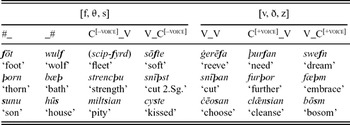
Students of Old English must learn in which phonetic environments the fricatives f, þ, s have voiceless and voiced variants, since the distinction is not expressed orthographically.Footnote 2 As a rule of thumb, they are voiceless in initial and final positions, as well as in medial position when next to a voiceless consonant, yet they are voiced between vowels and between a vowel and a voiced consonant. A summary of the rules, with illustrative examples, is presented in table 1.Footnote 3
Distribution of voiceless and voiced fricatives in Old EnglishFootnote 4
Once the rules are learned, the variation does not cause too much difficulty; however, a number of exceptions to the general rules do exist. In particular, fricatives in prefixes and suffixes at morpheme boundaries are not voiced, e.g. þrym-fæst ‘glorious’, of-āscian ‘enquire’, o þ-īewan ‘show’, lang-sum ‘tedious’. Nor are they voiced in verbal roots after unstressed prefixes, e.g. ge-findan ‘find’, a-þenċan ‘devise’, be-singan ‘sing’. The status of the feminine abstract noun suffix -þu and the ordinal suffix -þa is especially debated. Bammesberger (Reference Bammesberger, Kastovsky and Bauer1988: 124) and Fulk (Reference Fulk2001: 70; Reference Fulk2002: 95) prefer not to explain voiceless fricatives in these suffixes by morpheme juncture, but as resulting from a rule, first suggested by Luick (Reference Luick1914–40: 845), that fricative voicing did not take place after unstressed vowels, e.g. streng-þ(u) ‘strength’ (< *strangiþu), fyl-þ ‘filth’ (< *fūliþu), seofo-þa ‘seventh’, eahto-þa ‘eighth’. By contrast, Dietz (Reference Dietz1997: 168–74) maintains that these two suffixes also fall under the morpheme juncture rule. He regards the productive suffixes -þu and -þa as lexical, thus akin to -sum in lang-sum and -fæst in þrym-fæst, contrasting with inflectional suffixes which do not inhibit voicing, e.g. hūs-es ‘houses’, luf-ode ‘loved’. He also argues that his account can explain a number of apparent exceptions to Luick's rule, which states that there was no voicing after unstressed vowels, such as the (assumed historical) voiced fricatives in forms like Old English adesa ‘adze’ and Temese ‘Thames’.Footnote 5 Be that as it may, a phonemic distinction /s/ vs /z/ has also been argued for on the basis of forms such as cærse (< *cræsse) ‘watercress’, hyrse (< *hruss(i)j-) ‘mare’ and Horsa (< *hrossa = a personal name), which show simplification of -ss- following r-metathesis but, apparently, no subsequent voicing of s in accordance with the rules set out in table 1.Footnote 6 Likewise, Late West Saxon blosm ‘blossom’ (< blostm) shows syncope of t but no subsequent voicing of s either. Although it is not possible to find minimal pairs to finalise the issue of phonemicisation for all fricatives, Bammesberger (Reference Bammesberger, Kastovsky and Bauer1988: 125) calls into question the allophonic status of Old English voiced fricatives and, more forthrightly, Fulk (Reference Fulk2001: 61) concludes that ‘the distribution of voiced and voiceless varieties cannot be determined on a purely phonological basis, and thus voiced and voiceless fricatives cannot have been allophones in Old English’.Footnote 7
In terms of relative chronology, voicing must have occurred before syncope (c. sixth century, Luick Reference Luick1914–40: 321, 847–8), because the dental past-tense marker d in weak verbs should otherwise have devoiced to t, had it come into contact with a voiceless fricative, e.g. cydde ‘made known’ (< *cyþide) or rǣsde ‘rushed’ (< *rǣside), but cyste ‘kissed’ (< *kyssida) (see Campbell Reference Campbell1959: 179–80; Hogg Reference Hogg1992: 284). Hogg (Reference Hogg1992: 284) points out that medial voicing of fricatives occurred after the lenition of medial *[x] > [h], because [x] should otherwise have voiced and become [Ɣ], which would have remained as such in Old English. This inference is plausible since we can observe that when a voiced velar fricative [Ɣ], which had not been subject to palatalisation, comes to be in word-final position, it devoices to [x], e.g. burh (< *burg), especially in Late West Saxon (see Hogg Reference Hogg1992: 285). It is unclear, however, when in prehistory [x] was lenited to a glottal aspirate [h] medially; nor do we know whether [h] first became voiced [ɦ] before disappearing (see also Suzuki Reference Suzuki1994: 78–9; Fulk Reference Fulk, Rauch and Carr1997: 31–3).
2 Previous explanations for the phonemicisation of voiced fricatives
Despite arguments for a possible phonemic voice distinction among some fricatives, e.g. /s/ vs. /z/, in Old English, the situation is different from that of other Old Germanic languages, and no clear motivation for a general early phonemicisation of voice in fricatives has been provided; thus other factors have traditionally been proposed. Following suggestions by Jespersen (Reference Jespersen1928, Reference Jespersen1933a, Reference Jespersen1937), many scholars hold French responsible for the phonemicisation of a contrast in voice. According to this thesis, the distinction of voice in French was quickly understood by English speakers, who were very perceptive of the contrast, rarely putting a foot wrong when adopting French loans with either voiceless or voiced fricatives. Most significantly, French introduced a contrast of voice in initial position.Footnote 8 Northern and most Midlands dialects adopted French loans with initial voiced fricatives into their phonemic system, e.g. vine (< Old French vi(g)ne ‘vine’),Footnote 9 while southern dialects, with their voiced initial fricatives (see footnote 3), introduced initial voiceless fricatives, e.g. fine (< Old French fin ‘settlement, payment’). However, numerous cases of voicing of initial voiceless fricatives from French loans were found in modern dialects until quite recently, suggesting that such voicing was even more widespread in Middle and Early Modern English. Derek Britton, in a discussion of Nielsen's Reference Nielsen, Laing and Williamson1994 paper, offers the following remarks about this discrepancy (discussion in Nielsen Reference Nielsen, Laing and Williamson1994: 56):
In the South you have this tendency for French words with initial [f] to be anglicised to fit the phonotactic rules of English by becoming voiced. So you get [varmər] ultimately out of [farmər]. But this did not happen in all the items. Whereas, seemingly outside the South, French loanwords with initial <v> never appear to have been devoiced to fit in with the pattern word-initially.Footnote 10
While, as Britton notes, the southern voicing of initial voiceless fricatives in French loans can simply be viewed as a phonotactic change, it is curious that speakers of northern and Midlands dialects did not devoice voiced fricatives to fit their native consonantal distribution too; after all, this is what happens when French, Dutch or English words with initial voiced fricatives are borrowed into Modern Frisian (see Visser Reference Visser1997: 49–50). Apparently, at the time of borrowing, the voice contrast was better established in northern and Midlands dialects of English than in the South.
A second explanation for the phonemicisation of the voicing contrast was set out by Trnka (1934–5, Reference Trnka1936, Reference Trnka1938). Trnka accepted that French loanwords were borrowed into Middle English with contrasting voiced and voiceless fricatives, but thought that such loans remained marked non-native members of a voice correlation. He contended that the voice contrast was ‘felt as a characteristic feature of foreign words and both z and v continued to be secondary variants of the phonemes s and f in the phonological structure of Middle English’ (Reference Trnka1936: 62). According to Trnka, the loss of unstressed vowels in final syllables ultimately phonemicised voiced fricatives in Middle English. Apocope brought voiced fricatives into final position, and rather than these becoming voiceless in accordance with the phonotactics of Old English, voice was retained because English speakers – somewhat out of character – took a dislike to homonymy, e.g. leaf: leave, sooth: soothe, rice: rise, etc. (Trnka Reference Trnka, Jones and Fry1936: 63).Footnote 11 Trnka concludes that phonemicisation of voiced fricatives proceeded from north to south, following loss of final -e in early Northumbrian Middle English and its later apocope in central and southern dialects, such as in London at the turn of the fifteenth century (1934–5 [1982]: 213). Only then, according to Trnka, were French loans which contained contrasting voiced and voiceless fricatives assimilated to the native stock.
A third explanation for the phonemicisation of the voice contrast in fricatives – usually attributed to Hans Kurath (Reference Kurath1956) – is the argument that simplification of intervocalic geminate fricatives, which remained voiceless, brought about a phonemic distinction of voice in fricatives in medial positions.Footnote 12 Consequently, contrasting voiced and voiceless singleton fricatives arose in intervocalic position. However, there are several problems with this analysis. As James Sledd pointed out in Reference Sledd1958, the long voiceless fricatives occurred only after short vowels, while, after lengthening of short vowels in open syllables, the voiced fricatives occurred only after long vowels. Since the distribution of voiceless and voiced fricatives can be predicted according to their alternate phonetic environments, it is doubtful whether this explanation could accurately be described as phonemicisation.
Finally, it has been argued that the three explanations for the phonemicisation of the voicing contrast outlined above need not be mutually exclusive. For instance, Lass (Reference Lass and Blake1992: 57–61; Reference Lass, Hogg and Denison2006: 62) thinks that all three factors contributed to the characteristically stable voicing contrast of English fricatives in initial, medial, and final positions of words. Thus, a voice contrast was established in initial position through French loanwords, in medial position by degemination, and in final position as a result of apocope of unstressed vowels. In spite of this, it would be fair to say that French influence is usually considered the earliest and most decisive phonemicising factor among scholars. Even Trnka acknowledged that French loans were generally adopted without reversion to the Old English phonotactic rules set out in the introduction to this article. Other scholars have criticised the degemination theory, such as Nielsen, who concluded that ‘the influx of French loanwords into Middle English played a much greater role than anticipated by Kurath’, such that ‘the phonemic opposition between voiceless and voiced fricatives could simply have been imported along with the numerous loans’ (Reference Nielsen, Laing and Williamson1994: 24–5). Indeed, the notion that French gave rise to the voicing contrast in English fricatives is now so well established that it is sometimes given as an illustrative example of phonological borrowing in works on language contact; see Thomason & Kaufman (Reference Thomason and Kaufman1988: 124, 308), Thomason (Reference Thomason2001: 79), and Winford (Reference Winford2003: 54).
3 An explanation based on language contact and language shift
In this section, I shall explain how language contact and subsequent language shift of native Brittonic-speaking populations in many parts of Britain from about the mid fifth century onwards could have led directly to the phonemicisation of voiced fricative allophones at an early stage in the development of English.Footnote 13 However, before outlining the linguistic facts which would support such a thesis, it is necessary to say a few words about possible early Anglo-Saxon–British language contact and language shift, since most handbook accounts talk variously about native Romano-British populations being wiped out or, more often, driven into present-day Wales, Cornwall, and Scotland by Anglo-Saxons (see van Kemenade Reference Kemenade, König and van der Auwera1994: 110; Baugh & Cable Reference Baugh and Cable2002: 50; Crystal Reference Crystal2003: 8).
As far as I can gather, the view that Romano-British populations were exterminated or expelled seems to be founded on two inferences. First, Celtic languages are only attested in the western Celtic fringe of Britain in later medieval times. Second, there is a dearth of British loans in English. The first argument equates ethnicity with language alone, a very precarious approach, as should be clear from more recent cases of large-scale language shift, such as in Ireland in recent centuries. The second loanword-based argument equates lexical borrowing with intensity of contact; this is now considered a misguided notion by experts of language contact, since it is widely believed that ‘lexical interference may be negligible in cases of interference through shift’ (Thomason & Kaufman Reference Thomason and Kaufman1988: 60 and passim). In situations of language shift one expects to find signs of structural influence, such as morphosyntactical and phonological/phonetic influences. In the present study, we shall assume that the intensity of linguistic contact and the amount of language shifting varied throughout Britain, but that some degree of population continuity at least stands for many areas of Britain, and especially those areas of Britain which were anglicised late, e.g. much of the north and west of present-day England was not anglicised until the seventh century (Jackson Reference Jackson1953: 208–9). It may turn out, however, that there was indeed more native survival in many other areas than has previously been thought (see Filppula et al. Reference Filppula, Klemola and Paulasto2008 and Laker Reference Laker, Aertsen and Veldhoen2008 for surveys of recent cross-disciplinary research into Anglo-Saxon–British contacts, including lengthy discussion of various examples of possible Brittonic influence on English).
Now, based on the assumption that native speakers of Brittonic, more specifically Late British (i.e. the Brittonic language spoken around the fifth–sixth centuries AD) as well as later attested Brittonic languages, learned what must have been an early, prehistoric form of Old English as a second language, an interesting process of second language acquisition must have ensued. Celticists are in agreement that [f, θ, s, v, ð] were all phonemes in Late British, just as in Old Welsh, Middle Welsh, and today in Modern Welsh. Accordingly, Britons learning early Old English would interpret the allophonic voiced fricative variants of early Old English as phonemes, thus imposing a phonemic split on English, at least in their own varieties of the language.Footnote 14 The development suggested here is well known from situations of second language acquisition. Weinreich (Reference Weinreich1953: 18–19) in his pioneering study Languages in Contact refers to this kind of external phonemicisation as ‘over-differentiation of phonemes’ and lists it as one of four basic types of possible phonological/phonetic interference to be expected in situations of second language acquisition and language shift. In Weinreich's own words, the process ‘involves the imposition of phonemic distinctions from the primary system on the sounds of the secondary system, where they are not required’ (Reference Weinreich1953: 18). A well-known modern parallel is that of English speakers who, when learning Spanish, typically identify [ð] – an allophone of [d] in Spanish – with the English phoneme /ð/; see Whitley (Reference Whitley1986: 14):
Consider the English minimal pairs den/then, day/they, ride/writhe. These show the distinction between the two phonemes /d/ and /ð/ in English, and it can be predicted that English speakers will be alert to the difference between She's riding and She's writhing. Spanish speakers, however, will not readily sense the difference since their language organizes [d] and [ð] as allophones of the same phoneme. There are no minimal pairs such as /rajd/ (ride) vs. /rajð/ (writhe) in Spanish, and in fact, the same word can be pronounced with either phone, depending on its environment: dónde is [dónde] in ¿Dónde está? but [ðónde] in ¿De dónde es?, and native speakers are unaware of the change in pronunciation unless they have received phonetic training.
Thus, the same type of acquisition process which takes place when English native speakers learn Spanish could, indeed must, have applied when speakers of Late British (and later Old British dialects such as Old Welsh) learned early Old English as a foreign language: the voiced fricative allophones of early Old English had the status of phonemes in Late BritishFootnote 15 and so would have been understood as such during the acquisition process. The distribution of the fricatives /f, θ, s, v, ð, z/ in Late British (c. fifth–sixth century) and Middle Welsh (c. 1150–1450) is outlined in table 2 (note that in Late British, as well as in later Medieval Welsh, fricatives contrast for voice initially,Footnote 16 medially, and finally).
Voiceless and voiced fricative phonemes in Late British and Middle WelshFootnote 17
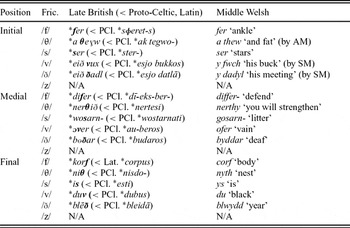
One argument which can be raised against the proposal suggested here is the fact that there are no grounds for assuming that Late British had a voiced sibilant [z] either phonetically or phonemically (see table 2), such that phonemicisation of the Old English variants [s(:)] vs. [z], which only occurred in medial positions, cannot be directly explained by this analysis. Rather, one would expect to find some evidence for substitution of [z] with [s]. There is indeed some evidence that the /s/ vs /z/ contrast is the least stable in Modern English. Especially varieties of northern English and Scots show a tendency for Standard English [z] to be realised as [s] (see Jones Reference Jones and Jones1997: 324);Footnote 18 but /s/ and /z/ are rarely differentiated in the orthography at earlier periods except initially, hence it is difficult to gain much historical insight into this matter.
Importantly, it is known from more recent contact situations that if a phonetic feature is already utilised in a language contrastively, then it can be more readily transferred to other speech segments too. Illustration of this point is provided by the language shift of Irish to (Irish) English, which took place mainly in the eighteenth and nineteenth centuries. In brief, speakers of Irish had a larger consonantal inventory than English and often found equivalents or near-equivalents for Modern English consonants from their native Irish language, yet Irish possessed neither the voiced alveolar /z/ nor the voiced postalveolar fricative /ʒ/. Nevertheless, these voiced sibilants were generally acquired by Irish speakers on account of the fact that a voicing contrast was already well established for other fricatives in Irish, such that speakers effectively learned to voice native /s, ʃ/ in line with other fricatives. As Bliss (Reference Bliss and Trudgill1984: 137) explains: ‘No sounds corresponding to English /z, ʒ/ existed in Irish, but since these are merely the voiced equivalents of /s, ʃ/ they were easily articulated.’ Thus, the lack of a voiced sibilant /z/ in Late British and Medieval Welsh need not constitute as significant a problem as might first be presumed, given that voice was well established as a distinctive feature within the Late British consonantal system.
4 Five points in support of the proposed explanation
It should now be apparent that the proposed thesis of early phonemicisation of a voice contrast in fricatives through early language shift offers several advantages over previous accounts. First, it is evident that early phonemicisation of a voice contrast in fricatives provides an explanation for the early indications of phonemicisation even in Old English (Fulk Reference Fulk2001, Reference Fulk2002). It can explain, for instance, why already in Old English some voiceless fricatives came to stand in voiced environments through metathesis and simplification of geminate fricatives without apparently reverting to voiced fricatives in line with the inherited rules of free variation, e.g. cærse (< *cræsse) ‘watercress’, hyrse (< *hruss(i)j-) ‘mare’, compare also blosm ‘blossom’ (< blostm).
Secondly, phonemicisation of allophonic contrasts – especially at so rapid a rate and across all dialects – is more likely to occur as a result of language shift than through lexical borrowing and diffusion. To assume, as Thomason & Kaufman (Reference Thomason and Kaufman1988: 308) do, that English has ‘phonologized certain allophonic pairs though French influence’, even though ‘not a single foreign sound (phone) has been introduced from French’ requires special pleading. Rather, early phonemicisation of a voicing contrast in fricatives through British language shift accounts for why the English were so adept at adopting French voiceless and voiced fricatives in loanwords without any large-scale sound substitution. The introduction of numerous French loanwords certainly enhanced the number of voice oppositions in English, notably in the highly salient initial position; but the phonemic contrast of voice in fricatives was already in place long before any large-scale French borrowing.
Thirdly, it is now clear that preservation of voice in final consonants after apocope of unstressed syllables has little to do with avoidance of homonyms, pace Trnka (Reference Trnka1936: 63), but is due to the fact that phonemicisation of voice was already instituted before apocope occurred, e.g. bathe /beið/, house /haʊz/ (< Old English baþian, hūsian) vs bath /bɑːθ/, house /haʊs/ (< Old English bæþ, hūs). Indeed, there has been a tendency for English speakers to extend this contrastive feature analogically by creating new verbal forms from nouns, e.g. ModE mouth and grease, i.e. pronounced /maʊθ/ and /griːs/ as nouns, but /maʊð/ and /griːz/ as verbs (see Oxford English Dictionary: s.vv. for the derivation of these forms). Such a productive extension of the voice contrast in fricatives to morphology illustrates how crucial the distinction in voice has become in English, unlike its closest relatives Frisian, Dutch, and German.
Fourthly, although a voice contrast in some fricatives arose to varying degrees in other Germanic languages and dialects, in none was it established to such a degree and so early as in English. In particular, a contrast already arose to some extent in varieties of Middle Dutch and now in Standard Dutch, but it has to be agreed, with Nielsen (Reference Nielsen, Laing and Williamson1994: 23), that ‘the opposition between voiceless and voiced fricatives did not become nearly as well integrated into the Dutch phonemic system as it did in English’. In fact, even southern Netherlandic and Belgian Dutch varieties, with their characteristic initial voiced fricatives (unlike varieties of northern Dutch), display a great deal of internal and dialectal allophonic variation owing to external sandhi and other phenomena (see Schönfeld Reference Schönfeld and van Loey1970: 56; Collins & Mees Reference Collins and Mees1981: 120ff., 159ff.; Nielsen Reference Nielsen, Laing and Williamson1994: 54). In English, however, the voicing contrast in fricatives (often referred to as a fortis vs lenis contrast; see note 8) is steadfast, as in Late British and today in Modern Welsh.
Fifthly, it may be noteworthy that even the phonetics of Modern English and Modern Welsh fricatives in initial, medial, and final positions are largely analogous. In English and Welsh voiced fricatives are usually fully voiced between voiced sounds but only partially voiced or unvoiced in initial and final positions. Consequently, some phoneticians talk about English and Welsh employing a fortis vs lenis contrast, as this can be viewed as the primary distinguishing feature in fricatives as it also is for the plosives in these languages; see Cruttenden (Reference Cruttenden2001: 178 cited in note 8) and Ball & Williams (Reference Ball and Williams2001: 103–4).Footnote 19 Of course, it is difficult to ascertain whether such similarities in phonation result exclusively from early contacts, especially as it is likely that dialectal variation pertaining to the laryngeal features of the plosives in Brittonic and English did exist at earlier periods and still does exist to some extent today (see Schrijver Reference Schrijver, Filppula, Klemola and Pitkänen2002: 97–8 and Wells Reference Wells1982: 370, 409 respectively). Still, it is curious that now in most varieties of English and Welsh the laryngeal settings of fricatives are remarkably similar. In brief, the inventories of fricativesFootnote 20 in English and Welsh, their three positions of contrast, and their respective phonation types are strikingly similar from an areal linguistic perspective. If the tenor of this article is correct, this parallelism need not merely be viewed as coincidental.
5 Conclusion
Late British to early Old English language shift would lead directly to the phonemicisation of a previously allophonic alternation of early Old English voiceless and voiced fricatives. Such early phonemicisation can better account for early evidence for contrasting voiceless and voiced fricatives resulting especially from various reductive processes in Old English and Middle English. Furthermore, phonemicisation of an allophonic contrast, such as here between voiceless and voiced fricatives, is more likely to occur as a result of language shift than through superficial borrowing from French. Contrary to the generally held belief that French lexical influence introduced an awareness of voiced fricatives which promoted them to phonemic status in Middle English, the thesis outlined in this article explains why the English were so skilful at adopting French voiceless and voiced fricatives in loanwords without any large-scale sound substitution, namely by the very fact that an awareness of contrasting voice in fricatives had already been established in English well before the introduction of French loanwords. French lexical influence greatly enhanced the number of voice oppositions in English, notably in the highly salient initial position, but it was not as fundamental as Brittonic language contact and language shift were at setting in place a distinction of voice in English fricatives.



