Introduction
The genus Pestivirus, family Flaviviridae, comprises important animal viruses, including the cattle pathogens bovine viral diarrhea virus 1 (BVDV-1) and 2 (BVDV-2), and the recently classified HoBi-like pestivirus (HoBiPeV) (ICTV, 2017; Simmonds et al., Reference Simmonds, Becher, Bukh, Gould, Meyers, Monath and Ictv Report Consortium2017). Pestiviruses are small (40–50 nm), enveloped viruses, containing a single-stranded, positive sense RNA genome of approximately 12.3 kb in length. The viral genome contains a long open reading frame (ORF) flanked by two untranslated regions (5′ and 3′ UTRs), respectively. The ORF encodes a long polyprotein which is co- and post-translationally cleaved by viral and host proteases in 11–12 mature viral polypeptides: Npro, C, E0/Erns, E1, E2, p7, NS23 (NS2-3), NS4A, NS4B, NS5A, and NS5B (Tautz et al., Reference Tautz, Tews and Meyers2015).
Historically, pestivirus species were defined by several criteria including the origin host species, comparisons of the complete coding nucleotide sequences, and cross-neutralization titers (Becher et al., Reference Becher, Avalos Ramirez, Orlich, Cedillo Rosales, König, Schweizer and Thiel2003; Simmonds et al., Reference Simmonds, Becher, Bukh, Gould, Meyers, Monath and Ictv Report Consortium2017). Nucleotide sequencing and comparison of the highly conserved 5′ UTR, in addition to Npro and E2 sequences – or even the complete coding sequence – have been employed for pestivirus phylogeny and genotyping (Pellerin et al., Reference Pellerin, Van Den Hurk, Lecomte and Tijssen1994; Ridpath et al., Reference Ridpath, Bolin and Dubovi1994; König et al., Reference König, Shannon, Orlich, Thiel, Becher and Horner1997; Becher et al., Reference Becher, Avalos Ramirez, Orlich, Cedillo Rosales, König, Schweizer and Thiel2003; Liu et al., Reference Liu, Kampa, Belák and Baule2009a, Reference Liu, Xia, Wahlberg, Belák and Baule2009b). According to these criteria, BVDV-1 isolates have been allocated into at least 21 subgenotypes (named −1a to −1u), whereas four BVDV-2 subgenotypes (−2a to −2d) have been described to date (Giangaspero et al., Reference Giangaspero, Harasawa, Weber and Belloli2008; Yeşilbağ et al., Reference Yeşilbağ, Alpay and Becher2017). Based on a limited number of isolates/genomes already genotyped, the newly classified HoBiPeV may be allocated into, at least, four subgenotypes or subgroups (Giammarioli et al., Reference Giammarioli, Ridpath, Rossi, Bazzucchi, Casciari and De Mia2015).
BVDV-1 and BVDV-2 have the broadest global distribution and have been associated with a variety of clinical manifestations in cattle (Houe, Reference Houe2003) and a wide range of ruminant species, both domestic and free ranging. HoBiPeV were initially identified as contaminants of fetal bovine serum (FBS) of Brazilian origin (Schirrmeier et al., Reference Schirrmeier, Strebelow, Depner, Hoffmann and Beer2004) and subsequently associated with a variety of clinical manifestations in cattle in South America (Cortez et al., Reference Cortez, Heinemann, de Castro, Soares, Pinto, Alfieri and Richtzenhain2006; Decaro et al., Reference Decaro, Lucente, Mari, Cirone, Cordioli, Camero and Buonavoglia2011; Bauermann et al., Reference Bauermann, Ridpath, Weiblen and Flores2013; Marques et al., Reference Marques, Maia, Aguiar, Weber, Simões and Azevedo2016; Weber et al., Reference Weber, Mósena, Simões, Almeida, Pessoa, Budaszewski and Canal2016a, Reference Weber, Pino, Souza, Mósena, Sato, Barcellos and Canal2016b; Mósena et al., Reference Mósena, Cibulski, Weber, Silveira, Silva, Mayer and Canal2017a, Reference Mósena, Weber, Cibulski, Silveira, Silva, Mayer and Canal2017b; Silveira et al., Reference Silveira, Weber, Mósena, da Silva, Streck, Pescador and Canal2017), Italy (Decaro et al., Reference Decaro, Lucente, Mari, Cirone, Cordioli, Camero and Buonavoglia2011), Thailand (Liu et al., Reference Liu, Kampa, Belák and Baule2009a, Reference Liu, Xia, Wahlberg, Belák and Baule2009b), India (Mishra et al., Reference Mishra, Rajukumar, Pateriya, Kumar, Dubey, Behera and Reddy2014), and Bangladesh (Haider et al., Reference Haider, Rahman, Khan, Mikolon, Gurley, Osmani and Rahman2014). It has also been isolated from water buffalo. The origin, distribution, and relevance of this novel bovine pestivirus is still unclear (Bauermann et al., Reference Bauermann, Ridpath, Weiblen and Flores2013).
Brazil has the world's largest commercial bovine herd with estimates exceeding 211 million cattle (BRASIL, 2014). Several studies have demonstrated a widespread distribution of BVDV among Brazilian cattle (Canal et al., Reference Canal, Strasser, Hertig, Masudab and Peterhans1998; Gil et al., Reference Gil, Flores and Botton1998; Flores et al., Reference Flores, Ridpath, Weiblen, Vogel and Gil2002; Cortez et al., Reference Cortez, Heinemann, de Castro, Soares, Pinto, Alfieri and Richtzenhain2006; Lunardi et al., Reference Lunardi, Headley, Lisbôa, Amude and Alfieri2008; Bianchi et al., Reference Bianchi, Martins, Weiblen and Flores2011, Reference Bianchi, Konradt, de Souza, Bassuino, Silveira, Mósena and Driemeier2017; Otonel et al., Reference Otonel, Alfieri, Dezen, Lunardi, Headley and Alfieri2014; Weber et al., Reference Weber, Silveira, Machado, Groff, Mósena, Budaszewski and Canal2014; Mósena et al., Reference Mósena, Cibulski, Weber, Silveira, Silva, Mayer and Canal2017a, Reference Mósena, Weber, Cibulski, Silveira, Silva, Mayer and Canal2017b; Silveira et al., Reference Silveira, Weber, Mósena, da Silva, Streck, Pescador and Canal2017; Monteiro et al., Reference Monteiro, Cargnelutti, Braunig, Folgueras-Flatschart, Santos, Pituco and Flores2018a, Reference Monteiro, Cargnelutti, Martins, Noll, Weiblen and Flores2018b). A few inactivated vaccines are available in Brazil, most containing both BVDV-1 and BVDV-2, but some containing only BVDV-1 (Anziliero et al., Reference Anziliero, Martins, Weiss, Monteiro, Ataide, Weiblen and Flores2015). Recently, an attenuated vaccine containing genetically modified BVDV-1 and BVDV-2 strains was licensed in the country. Regardless, vaccination against BVDV-associated diseases is not a widespread practice in Brazil and only 5 million doses of BVDV-containing vaccines were sold in 2016. HoBiPeV antigens have not been introduced in commercial vaccines yet in spite of a crescendo identification of these viruses in Brazilian cattle (Monteiro et al., Reference Monteiro, Cargnelutti, Braunig, Folgueras-Flatschart, Santos, Pituco and Flores2018a, Reference Monteiro, Cargnelutti, Martins, Noll, Weiblen and Flores2018b).
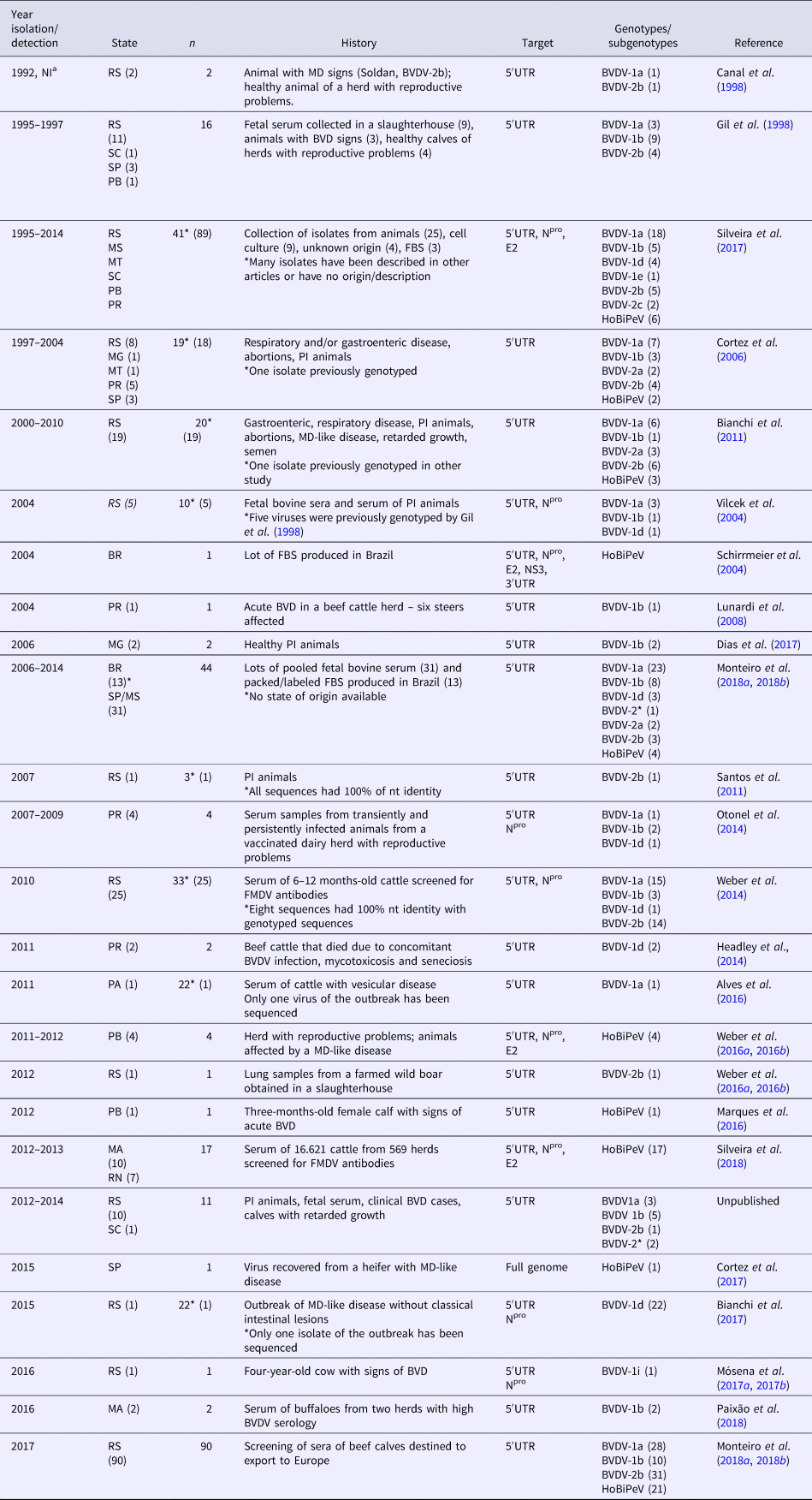
In the last two decades (1998–2018), selected BVDV-1 and BVDV-2 subgenotypes have been shown to circulate among Brazilian cattle and other related species (Canal et al., Reference Canal, Strasser, Hertig, Masudab and Peterhans1998; Gil et al., Reference Gil, Flores and Botton1998; Flores et al., Reference Flores, Ridpath, Weiblen, Vogel and Gil2002; Cortez et al., Reference Cortez, Heinemann, de Castro, Soares, Pinto, Alfieri and Richtzenhain2006; Lunardi et al., Reference Lunardi, Headley, Lisbôa, Amude and Alfieri2008; Bianchi et al., Reference Bianchi, Martins, Weiblen and Flores2011, Reference Bianchi, Konradt, de Souza, Bassuino, Silveira, Mósena and Driemeier2017; Otonel et al., Reference Otonel, Alfieri, Dezen, Lunardi, Headley and Alfieri2014; Weber et al., Reference Weber, Silveira, Machado, Groff, Mósena, Budaszewski and Canal2014; Mósena et al., Reference Mósena, Cibulski, Weber, Silveira, Silva, Mayer and Canal2017a, Reference Mósena, Weber, Cibulski, Silveira, Silva, Mayer and Canal2017b; Silveira et al., Reference Silveira, Weber, Mósena, da Silva, Streck, Pescador and Canal2017; Monteiro et al., Reference Monteiro, Cargnelutti, Braunig, Folgueras-Flatschart, Santos, Pituco and Flores2018a, Reference Monteiro, Cargnelutti, Martins, Noll, Weiblen and Flores2018b). Likewise, atypical pestiviruses (subsequently identified as HoBiPeV) have been isolated from animals since the early 2000s and a number of studies indicate that these viruses are endemic in Brazil (Cortez et al., Reference Cortez, Heinemann, de Castro, Soares, Pinto, Alfieri and Richtzenhain2006; Bianchi et al., Reference Bianchi, Martins, Weiblen and Flores2011; Marques et al., Reference Marques, Maia, Aguiar, Weber, Simões and Azevedo2016; Weber et al., Reference Weber, Mósena, Simões, Almeida, Pessoa, Budaszewski and Canal2016a, Reference Weber, Pino, Souza, Mósena, Sato, Barcellos and Canal2016b; Mósena et al., Reference Mósena, Cibulski, Weber, Silveira, Silva, Mayer and Canal2017a, Reference Mósena, Weber, Cibulski, Silveira, Silva, Mayer and Canal2017b; Silveira et al., Reference Silveira, Weber, Mósena, da Silva, Streck, Pescador and Canal2017, Reference Silveira, Baumbach, Weber, Mósena, da Silva, Cibulski and Canal2018; Monteiro et al., Reference Monteiro, Cargnelutti, Braunig, Folgueras-Flatschart, Santos, Pituco and Flores2018a, Reference Monteiro, Cargnelutti, Martins, Noll, Weiblen and Flores2018b). This article provides a critical review of the published work concerning the genetic identification and genotyping of bovine pestiviruses, with the goal of generating an approximate genetic profile of Brazilian bovine pestiviruses. A chronological history of the genetic identification, clinic-pathological, and geographical origin of these viruses is presented in Table 1. The Supplementary file contains more details and sequence information on these viruses.
Identification, typing, and subgenotyping of bovine pestiviruses from Brazil (1998–2018)

a No information available.
Early studies
The earliest article of genetic identification of bovine pestiviruses in Brazil dates from the late 1990s and reports the genotypic identification and phylogeny of two non-cytopathic BVDV isolates (Soldan and BR275) based on a 247 nt sequence within the 5′UTR (Canal et al., Reference Canal, Strasser, Hertig, Masudab and Peterhans1998). The Soldan strain – identified as BVDV-2 – had been isolated from an animal with mucosal-like disease (MD) six years earlier (1992) in Rio Grande do Sul (RS), the southernmost Brazilian state. Thus, the isolation of Soldan strain preceded the first reports of the identification of BVDV-2 in North America (Pellerin et al., Reference Pellerin, Van Den Hurk, Lecomte and Tijssen1994; Ridpath et al., Reference Ridpath, Bolin and Dubovi1994). Strain BR275 was isolated from the serum of an antibody-negative heifer in RS and identified as BVDV-1a. The study by Canal et al. paved the way for a number of reports of genetic identification of bovine pestiviruses in Brazil (Table 1).
Next, Gil et al. (Reference Gil, Flores and Botton1998) performed the genetic analysis of 16 BVDV isolates from various sources, including ten viruses obtained from fetuses in a slaughterhouse in RS (1997–1998), two isolated from animals with BVD signs (Santa Catarina state, SC, southern Brazil) and four isolated from the sera of calves from herds with reproductive problems in Sao Paulo state (SP), southeastern country (Table 1, Supplementary file). Genetic analysis based on the 5′ UTR sequences identified 11 BVDV-1 (three BVDV-1a and nine BVDV-1b) and four BVDV-2 (no genetic subtyping of BVDV-2 was conducted at that time). Two of these BVDV-2s had been isolated from clinical cases resembling the acute BVD described in North America a few years earlier (Pellerin et al., Reference Pellerin, Van Den Hurk, Lecomte and Tijssen1994; Ridpath et al., Reference Ridpath, Bolin and Dubovi1994).
A subsequent study by Flores et al. (Reference Flores, Ridpath, Weiblen, Vogel and Gil2002) provided the first evidence of the existence of subgenotypes within the BVDV-2 species. Comparison of BVDV-2 sequences available to that date demonstrated the existence of two genetically distinct BVDV-2 subgroups. Subgenotype BVDV-2a included most North American, European, and Asian isolates while subgenotype BVDV-2b comprised South American isolates. Currently, comprehensive genetic analysis including a high number of isolates from different locations based on the 5′UTR, Npro, and E2 indicates the existence of four BVDV-2 subgenotypes (−2a to −2d) (Giangaspero et al., Reference Giangaspero, Harasawa, Weber and Belloli2008; Yeşilbağ et al., Reference Yeşilbağ, Alpay and Becher2017). It should be noted that only one isolate was identified as BVDV2d in the analysis by Giangaspero et al. (Reference Giangaspero, Harasawa, Weber and Belloli2008).
A new player comes into play
An article by Schirrmeier et al. (Reference Schirrmeier, Strebelow, Depner, Hoffmann and Beer2004) represented a hallmark on the recent history of bovine pestiviruses. A quality control routine of FBS conducted in Germany led to the identification of a novel pestivirus – named D32/00_‘HoBi’ – in a batch of Brazilian serum. Sequence analysis of the entire Npro and E2-coding sequences, complemented by cross-neutralization and monoclonal antibody-binding assays indicated that the isolate D32/00_‘HoBi’ was distinctly different from the known pestiviruses (Schirrmeier et al., Reference Schirrmeier, Strebelow, Depner, Hoffmann and Beer2004; Bauermann et al., Reference Bauermann, Flores and Ridpath2012). Thus, isolate D32/00_‘HoBi’ was proposed as the prototype of a novel pestivirus genetic group, variously referred to as HoBi-like, atypical pestiviruses or, simply, BVDV-3 (Liu et al., Reference Liu, Kampa, Belák and Baule2009a, Reference Liu, Xia, Wahlberg, Belák and Baule2009b; Decaro et al., Reference Decaro, Lucente, Mari, Cirone, Cordioli, Camero and Buonavoglia2011; Bauermann et al., Reference Bauermann, Ridpath, Weiblen and Flores2013). Viruses belonging to this genetic group were subsequently found in FBS from different geographical origins and in clinical specimens obtained from cattle with a variety of clinical manifestations, in South America (Cortez et al., Reference Cortez, Heinemann, de Castro, Soares, Pinto, Alfieri and Richtzenhain2006; Marques et al., Reference Marques, Maia, Aguiar, Weber, Simões and Azevedo2016; Weber et al., Reference Weber, Mósena, Simões, Almeida, Pessoa, Budaszewski and Canal2016a, Reference Weber, Pino, Souza, Mósena, Sato, Barcellos and Canal2016b; Mósena et al., Reference Mósena, Cibulski, Weber, Silveira, Silva, Mayer and Canal2017a; Monteiro et al., Reference Monteiro, Cargnelutti, Braunig, Folgueras-Flatschart, Santos, Pituco and Flores2018a; Silveira et al., Reference Silveira, Baumbach, Weber, Mósena, da Silva, Cibulski and Canal2018), Italy (Decaro et al., Reference Decaro, Lucente, Mari, Cirone, Cordioli, Camero and Buonavoglia2011), Thailand (Liu et al., Reference Liu, Kampa, Belák and Baule2009a, Reference Liu, Xia, Wahlberg, Belák and Baule2009b), India (Mishra et al., Reference Mishra, Rajukumar, Pateriya, Kumar, Dubey, Behera and Reddy2014), and Bangladesh (Haider et al., Reference Haider, Rahman, Khan, Mikolon, Gurley, Osmani and Rahman2014). Recently, this group of viruses has been recognized as a new pestivirus species, named Pestivirus H (ICTV, 2017) (proposed abbreviation, HoBiPeV). The origin, distribution, and relevance of HoBiPeV are still unclear, yet a number of studies demonstrated that these viruses are endemic in Brazil (Cortez et al., Reference Cortez, Heinemann, de Castro, Soares, Pinto, Alfieri and Richtzenhain2006; Weber et al., Reference Weber, Mósena, Simões, Almeida, Pessoa, Budaszewski and Canal2016a, Reference Weber, Pino, Souza, Mósena, Sato, Barcellos and Canal2016b; Silveira et al., Reference Silveira, Weber, Mósena, da Silva, Streck, Pescador and Canal2017, Reference Silveira, Baumbach, Weber, Mósena, da Silva, Cibulski and Canal2018; Monteiro et al., Reference Monteiro, Cargnelutti, Braunig, Folgueras-Flatschart, Santos, Pituco and Flores2018a, Reference Monteiro, Cargnelutti, Martins, Noll, Weiblen and Flores2018b).
Subsequently, Cortez et al. (Reference Cortez, Heinemann, de Castro, Soares, Pinto, Alfieri and Richtzenhain2006) performed the phylogenetic analysis of 18 BVDV isolates obtained from laboratories in five Brazilian states, between 1997 and 2004, and isolated from cattle with varied clinical backgrounds, including persistently infected (PI) animals and aborted fetuses. Based on comparison of the 5′UTR, 10 were identified as BVDV-1 (seven as BVDV-1a and three as BVDV-1b) and six were identified as BVDV-2 (two as BVDV-2a and four as BVDV-2b). Two viruses grouped with the prototype D32/00_ HoBi (Schirrmeier et al., Reference Schirrmeier, Strebelow, Depner, Hoffmann and Beer2004) and were classified as ‘atypical pestiviruses’ at the moment. The clinical history of these two viruses dates back to 2000 and 2002, respectively, when they were isolated from aborted fetuses in SP state (Table 1). This was apparently the first published isolation of ‘atypical pestiviruses’ from cattle in Brazil, as opposed to FBS, and indicated the circulation of HoBiPeV in Brazil as early as by 2000. However, HoBiPeV may have been present even earlier in Brazil based on the isolation of strain BrazBuf930 in the late 1990′s, in an outbreak of disease in water buffaloes (Canal, unpublished data; Bauermann et al., Reference Bauermann, Ridpath, Weiblen and Flores2013).
Bianchi et al. (Reference Bianchi, Martins, Weiblen and Flores2011) performed a genetic and antigenic characterization of 20 pestivirus isolates obtained from PI animals, calves with retarded growth, clinical cases of BVD, aborted fetuses and semen collected between 2000 and 2010 in RS. Phylogenetic analysis based on the 5′UTR identified nine BVDV-2 (three BVDV-2a and six BVDV-2b), seven BVDV-1 (six BVDV-1a and one BVDV-1b) and three isolates were classified as ‘atypical pestiviruses’ (Table 1). These viruses, subsequently classified as HoBiPeV, were isolated from commercial bull semen associated with the birth of blind calves (SV713/00), from a calf of a herd with reproductive problems (SV241/10) and from an aborted fetus (SV311/10).
Genetic typing of viruses associated with clinical cases/outbreaks
A number of studies reported the genetic identification of pestiviruses associated with clinical cases, disease outbreaks or, simply, of viruses detected in the sera of cattle – or water buffaloes – from herds with positive BVDV serology and/or with reproductive problems (Table 1). Lunardi et al. (Reference Lunardi, Headley, Lisbôa, Amude and Alfieri2008) performed the genetic identification of a pestivirus involved in an outbreak of gastroenteric disease in Parana state (PR), southern Brazil, in which six steers developed signs of acute BVD (depression, anorexia, watery diarrhea, sialorrhea, and weakness) and died 24 h to 15 days after observation of the first clinical signs. Samples of different organs obtained from a necropsied steer were positive in a 5′UTR-based RT-PCR and genetic analysis identified a BVDV-1b genome.
Dias et al. (Reference Dias, Médici, de Sousa, Alfieri and Samara2013) identified two BVDV isolates obtained from the serum of PI calves from a crossbred herd in Southeastern Brazil (state of Minas Gerais, MG) as BVDV-1b, based on phylogenetic analysis of the 5′UTR. The herd had no reports of clinical signs or reproductive failure suggestive of BVDV infection.
Otonel et al. (Reference Otonel, Alfieri, Dezen, Lunardi, Headley and Alfieri2014) performed a RT-PCR screening in sera from vaccinated cattle of a dairy herd with reproductive problems in PR state, detecting the BVDV genome in 27 cows and two PI calves. Sequencing of 5′UTR and/or Npro amplicons obtained from four animals revealed three different BVDV subgenotypes (BVDV-1a, BVDV-1b, and BVDV-1d), calling attention for the possible infection of open herds with multiple BVDV subgenotypes.
A HoBiPeV strain – identified by analysis of the 5′UTR – was associated with a case of acute, fatal gastroenteric disease in the semi-arid region of Paraiba state (PB), northeastern Brazil (Marques et al., Reference Marques, Maia, Aguiar, Weber, Simões and Azevedo2016). A HoBiPeV was also identified in a spleen sample from a dead calf presenting signs of acute BVDV in a beef cattle herd in Mato Grosso (MT). In this study, phylogenetic analysis was based on comparison of both 5′UTR and Npro gene sequences (Rodrigues et al., Reference Rodrigues, Otonel, Fritzen, Gardinali, Colodel, Alfieri and Alfieri2011).
Paixão et al. (Reference Paixão, Fritzen, Crespo, de Moraes Pereira, Alfieri and Alfieri2018) reported the genetic identification of BVDV isolated from the serum of water buffalo calves from two herds with high levels of BVDV antibodies in Maranhão state, northeastern Brazil. Phylogenetic analysis based on the 5′UTR revealed two BVDV-1b isolates circulating in each herd. Apparently, this was the first identification of active BVDV infection in water buffaloes in Brazil.
Bianchi et al. (Reference Bianchi, Konradt, de Souza, Bassuino, Silveira, Mósena and Driemeier2017) reported the isolation of a noncytopathic BVDV from 22 affected animals in an outbreak of MD in RS state. This outbreak was unusual in that there were no intestinal lesions. Phylogenetic analysis based on 5′UTR and Npro sequences revealed that all 22 animals were infected with the same BVDV-1d virus. Headley et al. (Reference Headley, Alfieri, Fritzen, Queiroz, Lisbôa, Netto and Alfieri2014) identified a BVDV-1d in specimens from two cows that died after clinical manifestations of uncoordinated gait, fever, transient bloody diarrhea, dyspnea, and lateral decumbency, probably concomitantly intoxicated by mycotoxins and Senecio brasiliensis.
In RS state, five calves PI with BVDV were submitted to necropsy after developing clinical signs characterized by growth impairment, nasal and ocular discharge, and congenital cataract. Amplification of the 5′UTR followed by phylogenetic analysis revealed that all five calves were infected with a BVDV-2b strain (Santos et al., Reference Santos, Antoniassi, Boabaid, Bitencourt, Almeida, Canal and Driemeier2011). A BVDV-2b isolate was also detected in lung samples of a wild boar collected in a commercial slaughterhouse in RS in 2012 (Weber et al., Reference Weber, Mósena, Simões, Almeida, Pessoa, Budaszewski and Canal2016a, Reference Weber, Pino, Souza, Mósena, Sato, Barcellos and Canal2016b). Alves et al. (Reference Alves, Figueiredo, de Oliveira, Barbosa, Lima, Bomjardim and de Souza Trindade2016) detected a BVDV-1a genome in the sera of cattle during an outbreak of vesicular disease by pseudocowpox virus in Pará (PA), northern Brazil. Nucleotide sequencing and phylogeny based on the 5′UTR demonstrated a high similarity with Oregon C24V BVDV strain.
Genotyping of laboratory pestivirus collections
A few studies reported the genetic identification of laboratory collections of pestiviruses (Table 1). Silveira et al. (Reference Silveira, Weber, Mósena, da Silva, Streck, Pescador and Canal2017) genetically characterized a collection of 89 pestiviruses obtained from different sources in Brazil, between 1995 and 2014. The 5′UTR, Npro and E2 regions were used for genotyping isolates/sequences from cattle (25), contaminated cell cultures (9), FBS (3), or from unknown origin (4). Forty-eight of these isolates had been genotyped in previous studies (Cortez et al., Reference Cortez, Heinemann, de Castro, Soares, Pinto, Alfieri and Richtzenhain2006; Bianchi et al., Reference Bianchi, Martins, Weiblen and Flores2011; Weber et al., Reference Weber, Silveira, Machado, Groff, Mósena, Budaszewski and Canal2014). Out of the 41 viruses not been previously genotyped (Supplementary file), 28 (68.3%) were identified as BVDV-1, seven as BVDV-2 (17%), and six as HoBiPeV (14.6%). Eighteen viruses were identified as BVDV-1a (43.9%), five as BVDV-2b (12.2%), five as BVDV-1b (12.2%), four BVDV-1d (9.75%), one BVDV-1e (2.4%), and two BVDV-2c (4.9%). Among all 89 sequences, 48 (53.9%) were classified as BVDV-1, 30 as BVDV-2 (33.7%), and 11 (12.4%) as HoBiPeV (HoBi-like). Nineteen of the 89 isolates, mainly BVDV-1, had identical sequences, possibly reflecting laboratory contamination. This study included a considerable number (9.75%) of viruses/genomes of unknown origin (n = 4) and contaminants of cell cultures (9), including two BVDV-2c genomes. The geographical origin of these viruses is uncertain and, as such, these sequences should not be considered as part of Brazilian BVDV genotypes.
Vilcek et al. (Reference Vilcek, Durkovic, Kolesárová, Greiser-Wilke and Paton2004) characterized BVDV isolates from different countries, including ten from Southern Brazil. From these, five had been genotyped previously (Gil et al., Reference Gil, Flores and Botton1998; Cortez et al., Reference Cortez, Heinemann, de Castro, Soares, Pinto, Alfieri and Richtzenhain2006). The remaining five isolates included three BVDV-1a, one BVDV-1b, and one BVDV-1d. These viruses were originally isolated at our laboratory (Virology Section of the Federal University of Santa Maria, RS) from sera of bovine fetuses or from the blood of animals from herds with reproductive failure. The correct identification of these isolates is in the Supplementary file.
Genetic identification of pestiviruses in cattle sera
Some studies reported the genetic detection and identification of pestiviruses present in serum of cattle collected for diverse purposes (Table 1). Weber et al. (Reference Weber, Silveira, Machado, Groff, Mósena, Budaszewski and Canal2014) performed a screening and genetic identification of pestiviruses in sera of 9,078 young cattle submitted to an official serological survey for foot and mouth disease virus (FMDV) in RS (2010). Serum samples were mixed in 227 pools of up to 44 samples and submitted to RT-PCR, followed by individual testing of samples composing the positive pools. Genomes of 25 different viruses were detected and analyzed based on 5′UTR and Npro (Supplementary file). BVDV-2b was the predominant subgenotype (48%), followed by −1a (36%), −1b (12%), and −1d (4%). Similar to the previous results of Bianchi et al. (Reference Bianchi, Martins, Weiblen and Flores2011), an unexpectedly high frequency of BVDV-2 was observed in RS state.
Silveira et al. (Reference Silveira, Baumbach, Weber, Mósena, da Silva, Cibulski and Canal2018) performed a screening for pestivirus genomes in the sera of cattle, collected from 2012 to 2013, as part of an FMDV vaccination monitoring program, from two northeastern states [Maranhão (MA) and Rio Grande do Norte (RN)]. Serum samples from 16,621 cattle from 569 herds in both states were pooled in up to 45 samples/pool and tested by RT-PCR. Individual samples from positive pools were then submitted to RT-PCR followed by sequencing using 5′UTR, Npro, and E2 primers. A total of 17 pestivirus genomes (0.1%) were detected in cattle from 15 herds (2.64%). All isolates were classified as HoBiPeV based on phylogenetic analysis (5′UTR, Npro, E2). Interestingly, no BVDV-1 or BVDV-2 genomes were detected in the sampled population, in spite of several studies reporting the circulation of these viruses in the region. These results suggested that HoBiPeV viruses are the predominant pestiviruses in these northeastern Brazilian states. These findings – although potentially interesting – should be taken cautiously because RT-PCR testing of pooled samples containing mixed genomes or contamination may result in preferential detection of the most abundant genomes or the genomes with highest primer complementarity (Monteiro et al., Reference Monteiro, Cargnelutti, Braunig, Folgueras-Flatschart, Santos, Pituco and Flores2018a).
A comprehensive genetic identification of bovine pestiviruses in southern Brazil was recently conducted by Monteiro et al. (Reference Monteiro, Cargnelutti, Martins, Noll, Weiblen and Flores2018b). The authors reported the genetic detection and identification of 90 pestivirus genomes from sera of beef calves from RS state destined to export to Europe (2017). Screening of 15,684 serum samples of beef calves from hundreds of herds by an antigen capture ELISA and, subsequently, by RT-PCR revealed 135 samples containing pestivirus RNA. Genetic typing of these viruses based on the 5′UTR revealed 90 different viruses. Thirty-eight were identified as BVDV-1 (42.2%), 31 as BVDV-2 (34.4%), and 21 as HoBiPeV (23.3%). Among BVDV-1, only subtypes −1a (n = 28, 31.1%) and −1b (n = 10, 11.1%) were identified. All 31 BVDV-2 isolates belonged to BVDV-2b subtype and the 21 HoBiPeV viruses clustered to subtype 3a. Even though it focused on a single state, this study provided an approximate genetic profile of pestiviruses circulating in a geographically defined cattle population in an important Brazilian beef cattle-raising state.
Pestivirus investigation in FBS
A study by Monteiro et al. (Reference Monteiro, Cargnelutti, Braunig, Folgueras-Flatschart, Santos, Pituco and Flores2018a) reported the screening and genetic identification of pestiviruses in 73 lots of FBS produced in Brazil between 2006 and 2014. Forty-six lots consisted of pooled fetal sera collected in slaughterhouses in Southeastern and Midwestern states. Twenty-seven samples represented commercial batches of FBS produced in Brazil, whose geographic origin within the country was unavailable (Table 1). Thirty-nine lots (53.4%) were positive for pestivirus RNA by RT-PCR. Nucleotide sequencing and phylogenetic analysis of the 5′UTR revealed 34 lots (46.6%) containing BVDV-1 (23 BVDV-1a, eight BVDV-1b, and three BVDV-1d). Six batches (8.2%) contained BVDV-2 (two BVDV-2a, three BVDV-2b, and one undetermined due to short nucleotide sequence) and four FBS batches (5.5%) harbored HoBiPeV virus genomes. Five batches (6.8%) contained more than one pestivirus. The lack of the geographical origin of most FBS batches somewhat restricts the epidemiological value of some of these findings.
Complete genome sequencing
In addition to D32/00_‘HoBi’ (Schirrmeier et al., Reference Schirrmeier, Strebelow, Depner, Hoffmann and Beer2004), at least four full genomic sequences of pestiviruses isolated in Brazil have been published: three HoBiPeV and one BVDV-1i. Mósena et al. (Reference Mósena, Cibulski, Weber, Silveira, Silva, Mayer and Canal2017a, Reference Mósena, Weber, Cibulski, Silveira, Silva, Mayer and Canal2017b) performed a full genomic sequencing and characterization of a BVDV-1i isolated from cattle in RS state. BVDV-1i is an uncommon subgenotype and has been detected in few regions (Yeşilbağ et al., Reference Yeşilbağ, Alpay and Becher2017). Phylogenetic analyses based on the whole genome, 5′UTR, and Npro sequences showed that strain was closely related to previously characterized BVDV-1i (JQ920104.1, JQ920215.1, and FJ493484.1) from the UK (90.5% highest nt identity at 5′UTR) and Uruguay (KT833795.1) (90.6 high identity at Npro). Mósena et al. (Reference Mósena, Cibulski, Weber, Silveira, Silva, Mayer and Canal2017a, Reference Mósena, Weber, Cibulski, Silveira, Silva, Mayer and Canal2017b) performed the full genomic sequencing and antigenic characterization of two previously described Brazilian HoBiPeV isolates (Bianchi et al., Reference Bianchi, Martins, Weiblen and Flores2011; Weber et al., Reference Weber, Mósena, Simões, Almeida, Pessoa, Budaszewski and Canal2016a, Reference Weber, Pino, Souza, Mósena, Sato, Barcellos and Canal2016b). According to the authors, the presented data provided evidence that HoBiPeVs are members of the genus Pestivirus and should be formally recognized as a novel species. Lastly, Cortez et al. (Reference Cortez, Araújo, Flores, Ribeiro, Megid, Paes and Heinemann2017) published the complete genome sequence of a HoBiPeV (strain SV757/15) isolated from a Nelore heifer with gastroenteric disease in SP state.
In addition to the above studies, some studies by groups outside Brazil included Brazilian pestiviruses, including some already characterized (Schirrmeier et al., Reference Schirrmeier, Strebelow, Depner, Hoffmann and Beer2004; Yeşilbağ et al., Reference Yeşilbağ, Alpay and Becher2017). In addition to published studies, unpublished data from our laboratory includes the genotyping of BVDV isolates from cases of gastroenteric and respiratory disease, PI animals, and fetal serum samples from RS and SC states (2014–2014). Phylogenetic analysis revealed BVDV-1a (3), BVDV-1b (5), and BVDV-2b (1) strains. Phylogenetic analysis of two remaining BVDV-2 isolates has not been performed yet.
The genetic profile of Brazilian bovine pestiviruses
Considering the published data and a few unpublished sequences from our laboratory, some 307 distinct pestivirus isolates were genotyped in the last two decades, including four full genomic sequences (Table 1). These numbers included only viruses unequivocally isolated from or detected in Brazilian sources, e.g. obtained from clinical specimens, FBS, or cattle serum of Brazilian origin. Thus, this calculation excluded viruses from uncertain origin, e.g. viruses detected in FBS of uncertain origin and viruses contaminating cell cultures. This total number also excluded multiple results for the same virus genotyped in different studies (Cortez et al., Reference Cortez, Heinemann, de Castro, Soares, Pinto, Alfieri and Richtzenhain2006; Bianchi et al., Reference Bianchi, Martins, Weiblen and Flores2011; Silveira et al., Reference Silveira, Weber, Mósena, da Silva, Streck, Pescador and Canal2017) and multiple results for the same virus isolated from different animals during an outbreak (Otonel et al., Reference Otonel, Alfieri, Dezen, Lunardi, Headley and Alfieri2014; Bianchi et al., Reference Bianchi, Konradt, de Souza, Bassuino, Silveira, Mósena and Driemeier2017; Silveira et al., Reference Silveira, Weber, Mósena, da Silva, Streck, Pescador and Canal2017; Monteiro et al., Reference Monteiro, Cargnelutti, Braunig, Folgueras-Flatschart, Santos, Pituco and Flores2018a). The reviewed studies included genotyping of viruses involved in clinical cases and outbreaks, detected in PI animals in herds with reproductive failures, detected in pooled FBS and packed commercial FBS, detection of virus sequences in pooled or individual serum samples of cattle collected for diverse purposes, and laboratory collections of viruses from diverse clinic-pathological and epidemiological backgrounds. We also included four full genomic sequences of pestiviruses isolated in Brazil published by Brazilian researchers, excluding Brazilian isolates sequenced abroad.
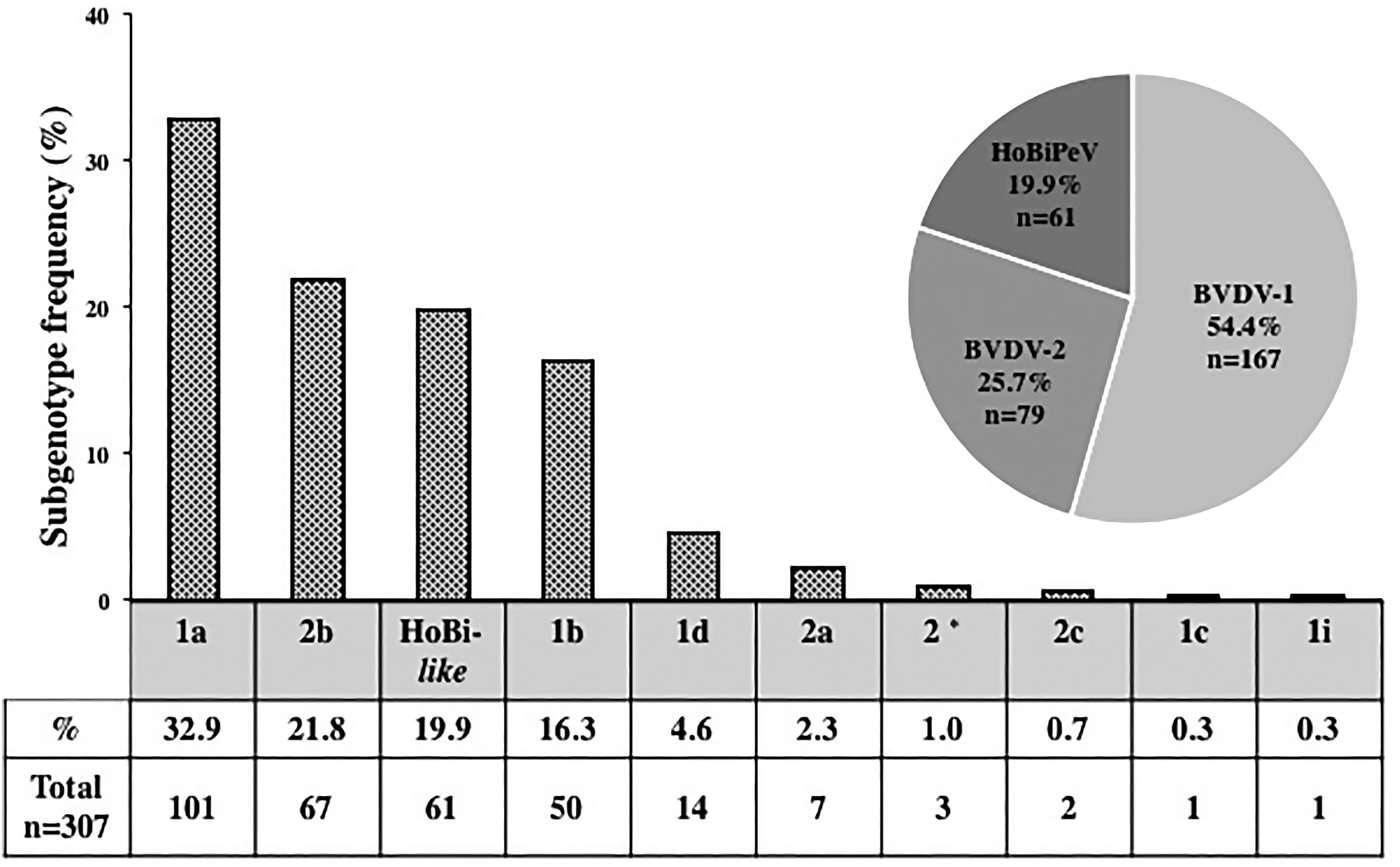
Based on this inclusion criteria, the relative frequencies of pestivirus species and subgenotypes identified in Brazil (1998–2018) are presented in Fig. 1. The profile indicates a clear predominance of BVDV-1 (54.4%), with high frequency of subgenotypes −1a (33.9%) and −1b (16.3%). BVDV-1d was detected at low frequency (4.6%) and subgenotypes −1e and 1i were identified in one sample each. A number of studies have shown that various BVDV subgenotypes predominate in different countries (Yeşilbağ et al., Reference Yeşilbağ, Alpay and Becher2017). Thus, according to published data, BVDV-1b is the predominant subgenotype in North America (53%) and worldwide (31.6%), followed by BVDV-1a (19.9% in North America and 20.8% worldwide) (Yeşilbağ et al., Reference Yeşilbağ, Alpay and Becher2017). In contrast, our data indicated a predominance of BVDV-1a among Brazilian isolates.
Frequency of bovine pestivirus species/genotypes and subgenotypes in Brazil (1998–2018).

In our review, 25.7% of the published sequences were identified as BVDV-2, with a clear predominance of BVDV-2b (85.2%) (Fig. 1). BVDV-2a were detected in low frequencies (2.2%) and BVDV-2c (n = 2) were only detected in contaminated cell cultures of unknown origin. This high BVDV-2 frequency overall is due, in part, to the unique high frequency of this genotype in Southern states, where it makes up to 48% of the genotyped viruses (Bianchi et al., Reference Bianchi, Martins, Weiblen and Flores2011; Weber et al., Reference Weber, Silveira, Machado, Groff, Mósena, Budaszewski and Canal2014). Because sequences from southern Brazil contributed approximately 50% of the analyzed sequences, the overall frequency of BVDV-2 in Brazilian cattle may be somewhat lower than that reported herein. Considering only published sequences, BVDV-2 accounts for approximately 11.8% of BVDV sequences genotyped worldwide (Yeşilbağ et al., Reference Yeşilbağ, Alpay and Becher2017). A recent review indicated that BVDV-2a is the most prevalent subgenotype of BVDV-2 on all continents (Yeşilbağ et al., Reference Yeşilbağ, Alpay and Becher2017). BVDV-2c has been detected only in Europe and the Americas and a single contaminating BVDV strain from Argentina was classified as BVDV-2d (Giangaspero et al., Reference Giangaspero, Harasawa, Weber and Belloli2008). Thus, the observed high BVDV-2 prevalence seems somehow unique to Brazil, especially to southern states, compared to overall frequencies detected in other countries and continents (Yeşilbağ et al., Reference Yeşilbağ, Alpay and Becher2017). As BVDV vaccination is not a usual practice in Brazil, and only a small part of the herd is currently vaccinated (<5%), it is very unlikely that vaccination immunity would have influenced the frequencies of different viral species and subgenotypes.
HoBiPeV accounted for 19.9% (61/307) of the genotyped viruses (Fig. 1). This number was influenced by the high frequency of these viruses detected in some northeastern states. In fact, HoBiPeV was the only pestivirus detected in pools of cattle sera submitted to an official serological survey for FMDV antibodies (Silveira et al., Reference Silveira, Baumbach, Weber, Mósena, da Silva, Cibulski and Canal2018). Thus, it is conceivable that the overall frequency of HoBiPeV circulating in Brazil may be somewhat lower than this number, as demonstrated by other studies (Cortez et al., Reference Cortez, Heinemann, de Castro, Soares, Pinto, Alfieri and Richtzenhain2006; Bianchi et al., Reference Bianchi, Martins, Weiblen and Flores2011; Silveira et al., Reference Silveira, Weber, Mósena, da Silva, Streck, Pescador and Canal2017; Monteiro et al., Reference Monteiro, Cargnelutti, Braunig, Folgueras-Flatschart, Santos, Pituco and Flores2018a, Reference Monteiro, Cargnelutti, Martins, Noll, Weiblen and Flores2018b). On the other hand, these data corroborate previous findings indicating that HoBiPeVs are endemic and contribute significantly for the pool of bovine pestiviruses circulating in Brazilian cattle.
The estimated prevalence of viral species and subgenotypes, presented herein, may be skewed. First, because more than 50% of the examined viruses were obtained in southern states and roughly 20% from southeastern and midwestern Brazil. Few sequences from northeastern and northern states were genotyped and published to date. Second, the high BVDV-2 frequency in Southern states certainly influenced its high frequency overall. Third, the high number of HoBiPeV genomes detected in some northeastern states likewise influenced their final numbers. Fourth, some studies performed genetic identification of viruses detected from pooled samples. In our experience, RT-PCR detection of viruses in pooled samples such as FBS and pooled sera frequently favors amplification of the most abundant genomes and those genomes with highest primer complementarity, missing viruses present in lower amounts or sequences with lower primer complementarity (Bauermann et al., Reference Bauermann, Flores, Falkenberg, Weiblen and Ridpath2014; Monteiro et al., Reference Monteiro, Cargnelutti, Braunig, Folgueras-Flatschart, Santos, Pituco and Flores2018a, Reference Monteiro, Cargnelutti, Martins, Noll, Weiblen and Flores2018b). In summary, the use of the published data to assemble a profile of Brazilian pestiviruses should be taken with caution because it may not represent the real frequencies and relative proportions of the viruses circulating in the field. As a consequence, the genetic profile of Brazilian bovine pestiviruses based on these studies seems to be more of a sketch than a well-finished picture, and should, therefore, be considered a provisional rather than a definitive profile.
Genetic and antigenic characterization of isolates is an ongoing process, which has proven relevant and useful for pestivirus diagnosis and control in Brazil. For instance, the initial identification of BVDV-2 in the country in the early years (Canal et al., Reference Canal, Strasser, Hertig, Masudab and Peterhans1998; Gil et al., Reference Gil, Flores and Botton1998; Flores et al., Reference Flores, Ridpath, Weiblen, Vogel and Gil2002) paved the way for the introduction of BVDV-2 strains in current vaccines. Currently, most BVDV vaccines available in the country contain both BVDV-1 and BVDV-2. The identification of BVDV-2 in Brazil also led to an appraisal and adaptation of molecular and immunodiagnostic tools of pestivirus detection (Canal et al., Reference Canal, Strasser, Hertig, Masudab and Peterhans1998; Monteiro et al., Reference Monteiro, Cargnelutti, Braunig, Folgueras-Flatschart, Santos, Pituco and Flores2018a, Reference Monteiro, Cargnelutti, Martins, Noll, Weiblen and Flores2018b). More recently, the identification of HoBiPeV among Brazilian cattle has called attention to the need for evaluation of the molecular and immunodiagnostic assays (Bauermann et al., Reference Bauermann, Ridpath, Weiblen and Flores2013; Weber et al., Reference Weber, Mósena, Simões, Almeida, Pessoa, Budaszewski and Canal2016a, Reference Weber, Pino, Souza, Mósena, Sato, Barcellos and Canal2016b; Silveira et al., Reference Silveira, Weber, Mósena, da Silva, Streck, Pescador and Canal2017; Monteiro et al., Reference Monteiro, Cargnelutti, Braunig, Folgueras-Flatschart, Santos, Pituco and Flores2018a, Reference Monteiro, Cargnelutti, Martins, Noll, Weiblen and Flores2018b). The need of inclusion of these viruses in current vaccines has also became a subject of relevant debate (Bauermann et al., Reference Bauermann, Ridpath, Weiblen and Flores2013; Silveira et al., Reference Silveira, Weber, Mósena, da Silva, Streck, Pescador and Canal2017; Monteiro et al., Reference Monteiro, Cargnelutti, Braunig, Folgueras-Flatschart, Santos, Pituco and Flores2018a, Reference Monteiro, Cargnelutti, Martins, Noll, Weiblen and Flores2018b). Thus, we expect that this review to shed more light on the epidemiology of pestiviruses in Brazil, thus contributing to diagnostics and control efforts.
Supplementary material
The supplementary material for this article can be found at https://doi.org/10.1017/S1466252318000130