Introduction
The idea that schizophrenia is, fundamentally, a disorder of neurocognitive functioning is both new (Kahn & Keefe, Reference Kahn and Keefe2013) and old (Jung, Reference Jung1907/1960). Both Kraepelin and Bleuler made clinical observations that their patients had difficulty with everyday tasks that involved attention, memory, and basic problem-solving. Kraepelin compared these impairments with dementia, leading him to christen the disorder dementia praecox, which he viewed as a progressively deteriorating brain disease (Kraepelin, Reference Kraepelin1919/1971). Later writers and researchers moved away from the concept of schizophrenia as a form of dementia, but retained the idea that there were basic neurobiological abnormalities that led to severe neurocognitive impairments, and that these changes were the primary or core features of the disorder, from which other symptoms emerged, often as compensatory reactions (Bleuler, Reference Bleuler1911/1950; Kahn & Keefe, Reference Kahn and Keefe2013).
In current parlance, impairments in basic mental functions, such as attention, memory, and executive functions are termed neurocognitive deficitsFootnote †Footnote 1 (Heinrichs & Zakzanis, Reference Heinrichs and Zakzanis1998). Appreciation of the existence of these deficits in schizophrenia has accelerated over the past 20 years, especially after reviews of the literature were published showing that: (1) the neurocognitive test score distributions of individuals with schizophrenia are markedly different from (and largely do not overlap with) those of healthy controls (Heinrichs, Reference Heinrichs2001, Reference Heinrichs2005); and (2) poor test performance is significantly correlated with scores on measures of real world functioning (Green, Reference Green1996; Green et al. Reference Green, Kern, Braff and Mintz2000; Heinrichs, Reference Heinrichs2001; Green et al. Reference Green, Kern and Heaton2004), thereby implying it should be a treatment target. Because poor performance was substantial in magnitude, predated illness onset, and appeared stable, investigators argued that the tests were indexing a core neurobiological deficit in cognitive ability (Keefe & Fenton, Reference Keefe and Fenton2007), similar to neurocognitive deficits that are observed in several neurological disorders. Given the emerging view that neurocognitive deficits are a core feature of the disorder (Green & Nuechterlein, Reference Green and Nuechterlein1999; Heinrichs, Reference Heinrichs2005; Keefe & Fenton, Reference Keefe and Fenton2007; Kahn & Keefe, Reference Kahn and Keefe2013), the development of standardized batteries to measure the impairments occurred in parallel, and research on the relationships between a widened range of neurocognitive factors and a widened range of outcomes (e.g. beyond psychiatric rehabilitation outcomes) accelerated (Green et al. Reference Green, Llerena and Kern2015). Interestingly, more recent data, while continuing to replicate largely moderate-sized correlations between neurocognitive test scores and functioning, has demonstrated that the relationships were not as simple as originally proposed. For example: (1) some aspects of neurocognition (e.g. learning potential) are only weakly related to functioning; (2) social cognition acts as a mediator between neurocognitive functioning and community functioning; (3) social motivation has been shown to be an important variable in the pathway from neurocognition to functioning (Green et al. Reference Green, Hellemann, Horan, Lee and Wynn2012) and (4) reinforcement-based behavioral interventions that promote task engagement can significantly improve neurocognitive test scores in people with chronic schizophrenia (Silverstein et al. Reference Silverstein, Roche, Khan, Carson, Malinovsky and Newbill2014).
Amongst dozens of batteries developed worldwide, two of the most influential are Gur and colleagues’ Penn Computerized Neurocognitive Battery (Penn Battery) (Gur et al. Reference Gur, Ragland, Moberg, Turner, Bilker and Kohler2001) and the Measurement and Treatment Research to Improve Cognition in Schizophrenia Consensus Cognitive Battery (MATRICS Battery) (MCCB; Kern et al. Reference Kern, Green, Nuechterlein and Deng2004).Footnote 2
While a range of neuroscience-based models of schizophrenia have been proposed (e.g. (Cohen & Servan-Schreiber, Reference Cohen and Servan-Schreiber1992; Phillips & Silverstein, Reference Phillips and Silverstein2003; Hemsley, Reference Hemsley2005; Corlett et al. Reference Corlett, Honey and Fletcher2007; Braff, Reference Braff2010; de Jong et al. Reference de Jong, de Gelder and Hodiamont2013; Corigliano et al. Reference Corigliano, De Carolis, Trovini, Dehning, Di Pietro and Curto2014; Howes & Murray, Reference Howes and Murray2014), a common feature to all of them is the assumption of a core deficit in neurocognition, as measured by neurocognitive test batteries, or by more recently developed tests that are grounded more in cognitive neuroscience (including in animal modeling studies) than in traditional clinical neuropsychology (Carter & Barch, Reference Carter and Barch2007; Carter et al. Reference Carter, Barch, Bullmore, Breiling, Buchanan and Butler2011; Gold et al. Reference Gold, Barch, Carter, Dakin, Luck and MacDonald2012). Indeed, the concept of neurocognitive deficit is central to the shared understanding of schizophrenia as evidenced in the Diagnostic and Statistical Manual of Mental Disorders Fifth Edition (DSM-5) (American Psychiatric Association, 2013, APA), which describes impairment in neurocognitive performance as an established and stable feature of the disorder ‘strongly linked to vocational and functional impairments’ (APA, 2013, 101).
Two of us (Beck & Grant) began research in this area more than 15 years ago. Our goal was to understand the disability in schizophrenia and develop better treatments. In this regard, we were strongly influenced by the work of Michael Green and his group at University of California, Los Angeles, linking test performance to poor functional outcomes. Rubin and Raquel Gur provided us access, and we employed the Penn Battery in our studies. However, over the course of our clinical work, a conundrum emerged. A number of individuals who scored two standard deviations or more below the unaffected reference sample were able to drive a car in traffic, play chess well, teach computer skills, or prepare a complex recipe – tasks that appeared to involve the same functions which appeared to be impaired when they had engaged in neurocognitive testing (attention, recall, etc.). This relatively high level of functioning occurred when the individuals were energized to engage in the meaningful, enjoyable, and social activity. In addition, others of us (Silverstein) observed that improvements in level of attentiveness in activities such as skills training groups could be independent of changes in scores on neurocognitive tests (Silverstein et al. Reference Silverstein, Hatashita-Wong, Solak, Uhlhaas, Landa and Wilkniss2005), supporting data from the traumatic brain injury literature suggesting an independence between impairment (on tests) and disability (in real-world activities). In view of these observations – in addition to literature demonstrating that scores on neurocognitive tests, and performance on real world tasks (i.e. instrumental and adaptive functioning in real, not testing, environments) could be dramatically improved by altering levels of positive reinforcement and the nature of social context in which testing occurred (Paul & Lentz, Reference Paul and Lentz1977; Glynn & Mueser, Reference Glynn and Mueser1986; Silverstein et al. Reference Silverstein, Menditto and Stuve2001; Park et al. Reference Park, Lee, Folley and Kim2003; Park et al. Reference Park, Gibson and McMichael2006) – we decided to review the literature in order to evaluate this discrepancy between test scores and performance when it is embedded in a positive socio-affective context.
During this time, we had begun to develop a cognitive model of schizophrenia based on the formulation that dysfunctional attitudes (e.g. defeatist and asocial) were key factors in negative symptoms and poor functional outcomes (Grant & Beck, Reference Grant and Beck2009a; Reference Grant and Beck2010; Perivoliotis et al. Reference Perivoliotis, Grant and Beck2009a; Beck et al. Reference Beck, Grant, Huh, Perivoliotis and Chang2013; Thomas et al. Reference Thomas, Luther, Zullo, Beck and Grant2017). In our initial view, dysfunctional beliefs occurred after neurocognitive deficits in the chain of causation (Beck et al. Reference Beck, Rector, Stolar and Grant2009). However, as noted above, our clinical experience and an emerging literature increasingly suggested that poor test performance could result from dysfunctional beliefs influencing the amount and duration of effort that is applied during laboratory-based testing.
Evaluation of neurocognitive performance in schizophrenia
Non-neurocognitive factors that influence neurocognitive performance
We turn now to a literature, which considers the influence of non-neurocognitive factors on performance on the test batteries. Our purpose is to consider the impact of these factors on the underlying assumption of the deficit model of neurocognition.
Avolition
Decreased motivation has been found to correlate with neurocognitive performance (Brebion et al. Reference Brebion, Amador, Smith, Malaspina, Sharif and Gorman2000a; Nakagami et al. Reference Nakagami, Xie, Hoe and Brekke2008; Brebion et al. Reference Brebion, Bressan, Pilowsky and David2009; Barch et al. Reference Barch, Bustillo, Gaebel, Gur, Heckers and Malaspina2013), associations that remain significant when controlling for antipsychotic treatment, medical comorbidity, and the severity of positive, depressive, and the other negative symptoms (Fervaha et al. Reference Fervaha, Zakzanis, Foussias, Graff-Guerrero, Agid and Remington2014). Greater motivation has been shown to longitudinally predict better test scores and improvement in performance over time; however, the reverse was not true, test scores did not predict improvement in motivation (Nakagami et al. Reference Nakagami, Hoe and Brekke2010). Similarly, individuals with schizophrenia who received contingent monetary reinforcement in addition to enhanced instruction with verbal and visual prompts showed significant improvements in performance compared with those receiving either intervention alone or no intervention (Kern et al. Reference Kern, Green and Goldstein1995). Choi & Medalia (Reference Choi and Medalia2010) additionally showed that individuals with schizophrenia who completed intrinsically motivating cognitive training exercises – that also involved contextualization, personalization, and choice – exhibited significantly greater improvements in arithmetic and attention test scores than a control group.
Effort
Closely related to motivation is effort (Fervaha et al. Reference Fervaha, Foussias, Agid and Remington2013). Studies consistently find that decreased effort correlates with worse neurocognitive performance for individuals diagnosed with schizophrenia (Schmand et al. Reference Schmand, Kuipers, Vandergaag, Bosveld, Bulthuis and Jellema1994; Gorissen et al. Reference Gorissen, Sanz and Schmand2005; van Beilen et al. Reference van Beilen, van Zomeren, van den Bosch, Withaar and Bouma2005; Avery et al. Reference Avery, Startup and Calabria2009; Foussias et al. Reference Foussias, Siddiqui, Fervaha, Mann, McDonald and Agid2015; Morra et al. Reference Morra, Gold, Sullivan and Strauss2015; Strauss et al. Reference Strauss, Morra, Sullivan and Gold2015; Whearty et al. Reference Whearty, Allen, Lee and Strauss2015). Additionally, the decreased effort has been identified as a mediator of the relationship between motivation and neurocognitive performance (Foussias et al. Reference Foussias, Siddiqui, Fervaha, Mann, McDonald and Agid2015). Some of these studies show that reduced effort can explain anywhere from one-quarter to one-third of the variance in neuropsychological test results (Gorissen et al. Reference Gorissen, Sanz and Schmand2005; Strauss et al. Reference Strauss, Morra, Sullivan and Gold2015). Indirect evidence for the role of effort in neurocognitive performance is also provided by the emerging literature on effort-based decision making (see Green et al. Reference Green, Llerena and Kern2015), which has shown that individuals with schizophrenia are generally willing to exert less effort than controls for the same level of reward. Thus, the differential effort is an important confound to consider in any comparative study involving tasks for which decreased effort is expected to impact performance, and perhaps more so when this effort must be sustained over the course of a prolonged period.
Dysfunctional attitudes
Dysfunctional beliefs (Beck et al. Reference Beck, Rector, Stolar and Grant2009) have been found to play a role in neurocognitive task performance. For example, defeatist beliefs have been found to correlate with poor neurocognitive performance in schizophrenia (Grant & Beck, Reference Grant and Beck2009a; Quinlan et al. Reference Quinlan, Roesch and Granholm2014). Defeatist beliefs, moreover, have been shown to moderate the relationship between negative symptoms and effort applied to a memory task, (Granholm et al. Reference Granholm, Ruiz, Gallegos-Rodriguez, Holden and Link2016), a finding that has recently been replicated (Reddy et al. Reference Reddy, Horan, Barch, Buchanan, Gold and Marder2017b). Recent work by Moritz et al. (Reference Moritz, Klein, Desler, Lill, Gallinat and Schneider2017) showed that beliefs about being judged and expecting poor outcomes were both robustly (and negatively) associated with neurocognitive performance in people with schizophrenia.
Stress
A recent study found that differences between healthy controls and people with schizophrenia in working memory, episodic memory, and long-term memory were no longer statistically significant after accounting for heart rate and subjective stress during the test taking (Krkovic et al. Reference Krkovic, Moritz and Lincoln2017). Other researchers have proposed that stress may contribute to poor memory retrieval through interactions between glucocorticoids and noradrenaline (Schwabe et al. Reference Schwabe, Joëls, Roozendaal, Wolf and Oitzl2012) and higher cortisol levels (Havelka et al. Reference Havelka, Prikrylova-Kucerova, Prikryl and Ceskova2016). In a sample of children at risk for psychosis, neurocognitive performance correlated with abnormal hypothalamic-pituitary-adrenal (HPA) axis functioning (as indicated by elevated diurnal cortisol levels and/or a blunted cortisol awakening response), while HPA axis functioning did not correlate with test results among children in the normative control group (Cullen et al. Reference Cullen, Zunszain, Dickson, Roberts, Fisher and Pariante2014). Similar effects have been observed in the first psychotic episode sample in which verbal memory and processing speed significantly correlated with dysregulated HPA-axis activity (Aas et al. Reference Aas, Dazzan, Mondelli, Toulopoulou, Reichenberg and Di Forti2011).
Negative emotion
Lysaker et al. (Reference Lysaker, Bell, Greig and Bryson2000) found that emotional distress (symptoms of depression and anxiety) correlated with worse verbal memory performance in individuals with schizophrenia and explained between 20 and 25% of the variance. Levels of depressive symptoms are associated with worse memory, attention, and executive functioning test scores in schizophrenia (Brébion et al. Reference Brebion, Amador, Smith, Malaspina, Sharif and Gorman2000b) – correlations that remain significant after controlling for positive and negative symptoms (Halari et al. Reference Halari, Mehrotra, Sharma and Kumari2006). In addition, Möser et al. (Reference Möser, Krieg, Zihl and Lautenbacher2006) reported that scores of people with schizophrenia on half of their measures of attention, and on all of their measures of memory were no longer significantly different from those of controls after accounting for depressive symptoms (Möser et al. Reference Möser, Krieg, Zihl and Lautenbacher2006). Higher levels of anxiety and tension have also been found to correlate with worse neurocognitive performance (Halari et al. Reference Halari, Mehrotra, Sharma and Kumari2006).
Asociality
People with schizophrenia, on average, have smaller social networks than others, fewer social contacts, and higher levels of reported loneliness (Trémeau et al. Reference Trémeau, Antonius, Malaspina, Goff and Javitt2016). Loneliness has been related to poorer neurocognitive functioning in the general population (Hawkley & Cacioppo, Reference Hawkley and Cacioppo2010), and in people with psychosis (Badcock et al. Reference Badcock, Shah, Mackinnon, Stain, Galletly and Jablensky2015). Importantly, feelings of social exclusion are related to poorer neurocognitive functioning and to defeatist performance beliefs (Reddy et al. Reference Reddy, Reavis, Polon, Morales and Green2017a), as well as to alterations in body perception and tactile discrimination (Michael & Park, Reference Michael and Park2016). Conversely, small changes to testing procedures, such as replacing dot stimuli with faces, giving positive feedback about performance, or having 5 min of conversation prior to the start of testing, working collaboratively significantly improve test performance in schizophrenia (Park et al. Reference Park, Gibson and McMichael2006; Grant et al. Reference Grant, Perivoliotis, Luther, Bredemeier and Beck2018).
Disorganized symptoms
More severe disorganization has been found to correlate with poorer performance on neurocognitive tests (Brekke et al. Reference Brekke, Raine and Thomson1995; Grant & Beck, Reference Grant and Beck2009a), particularly on measures of memory, verbal abilities, IQ scores, and attention (Basso et al. Reference Basso, Nasrallah, Olson and Bornstein1998). Moreover, conceptual disorganization correlates highly with impaired cognition on interview-based symptom ratings (Lindenmayer et al. Reference Lindenmayer, Grochowski and Hyman1995). These data suggest both that disorganization and some aspects of neurocognitive impairment may share a common basis (Phillips & Silverstein, Reference Phillips and Silverstein2003, Reference Phillips and Silverstein2013; Phillips et al. Reference Phillips, Clark and Silverstein2015). Additionally, the presence of conceptual disorganization may interfere with a person's ability to effectively engage with, and understand the requirements of, a task over a sustained period of time.
In summary, there is now strong evidence that several psychological and social factors can negatively affect neurocognitive task performance. To our knowledge, no one study has included all of these non-neurocognitive factors. As such, we suggest that it is far from certain how much of poor neurocognitive test performance in people with schizophrenia reflects core disease-related neurological impairments v. the attitudinal, motivational, other psychological, and symptomatic factors reviewed above.
Additional concerns
Lack of discrimination
Individuals with schizophrenia do not appear to show selective deficits. For example, Depp et al. (Reference Depp, Moore, Sitzer, Palmer, Eyler and Roesch2007) administered 17 neurocognitive tests and found that individuals with schizophrenia scored significantly worse than controls on all 17 tests. Similarly, Keefe et al. (Reference Keefe, Goldberg, Harvey, Gold, Poe and Coughenour2004) administered seven neurocognitive tests and found that individuals with schizophrenia performed significantly worse than controls on all of them. Based on studies from the past several decades and from around the world, Schaefer et al. (Reference Schaefer, Giangrande, Weinberger and Dickinson2013) similarly concluded that individuals with schizophrenia perform worse on all neurocognitive tests.
Cognitive remediation
A notable feature of the cognitive remediation literature is that impacts on real-world functioning are greater when remediation is embedded in a psychiatric rehabilitation program that directly targets improved real-world adaptation or explicitly addresses motivation and beliefs (Wykes et al. Reference Wykes, Huddy, Cellard, McGurk and Czobor2011; Medalia & Saperstein, Reference Medalia and Saperstein2013; Best & Bowie, Reference Best and Bowie2017). An interesting line of future research would be to compare cognitive remediation with interventions that target beliefs and motivation without remediation. We have already observed that significant improvement occurred on MATRICS neurocognitive battery (Kern et al. Reference Kern, Green, Nuechterlein and Deng2004) composite scores after exposure to attention shaping procedures in another context (Silverstein et al. Reference Silverstein, Roche, Khan, Carson, Malinovsky and Newbill2014), suggesting that level of generalized self-initiated persistence is a factor contributing significantly to neurocognitive test scores.
Proposal for an alternative model: the cognitive model of the negative syndrome
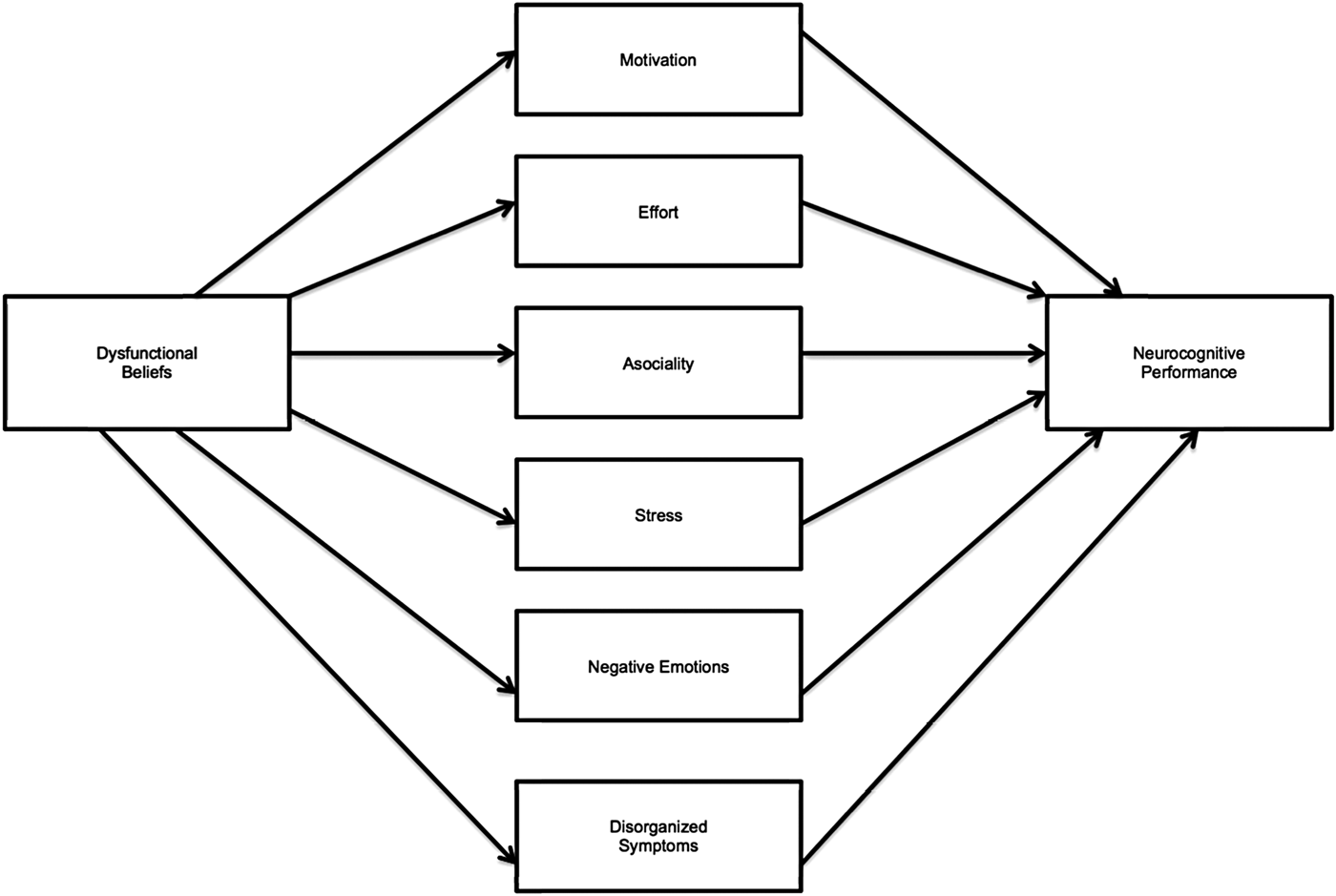
While it is not clear how much of the variance in neurocognitive performance of individuals with schizophrenia would be accounted for if all of the factors reviewed above were assessed, this influence appears to be nontrivial. In this regard, it is useful to note that a common feature of all these ‘confounding’ factors is the role of beliefs. Beliefs are linked to amotivation (Grant & Beck, Reference Grant and Beck2009a), low effort (Granholm et al. Reference Granholm, Ruiz, Gallegos-Rodriguez, Holden and Link2016; Reddy et al. Reference Reddy, Horan, Barch, Buchanan, Gold and Marder2017b) stress (Palmier-Claus et al. Reference Palmier-Claus, Dunn, Drake and Lewis2011), negative emotion (Smith et al. Reference Smith, Fowler, Freeman, Bebbington, Bashforth and Garety2006), asociality (Grant & Beck, Reference Grant and Beck2010), and disorganization (Grant & Beck, Reference Grant and Beck2009b). This observation leads us to propose an alternative hypothesis: a significant proportion of poor neurocognitive performance is a consequence of a higher, more complex level of dysfunction. Specifically, the anticipation of failure and an avoidant stance towards evaluative tasks increases perceived psychological vulnerability subjective level of stress, and arousal level, thereby reducing task engagement and increasing the likelihood of failure. As illustrated in Fig. 1, the cognitive model, which features beliefs, can be applied to these factors.Footnote 3
Alternative cognitive model leading to neurocognitive deficits.

Derivation of the cognitive model
An assumption behind this perspective is that an individual's cognitive organization – comprised beliefs, attitudes, and meanings (Beck & Haigh, Reference Beck and Haigh2014) – determines the limits of neurocognitive functioning. This model shares features of the cognitive models of other disorders such as anxiety (Beck & Emery, Reference Beck and Emery1979; Beck & Haigh, Reference Beck and Haigh2014) and depression (Beck & Haigh, Reference Beck and Haigh2014; Beck & Bredemeier, Reference Beck and Bredemeier2016), which are associated with many of the same neurocognitive features as schizophrenia. At the same time, the cognitive model of schizophrenia allows for the possibility that people with schizophrenia may perform more poorly on some neurocognitive tests than people with these other disorders (Bortolato et al. Reference Bortolato, Miskowiak, Kohler, Vieta and Carvalho2015; Scott et al. Reference Scott, Matt, Wrocklage, Crnich, Jordan and Southwick2015; Davies et al. Reference Davies, Fowler and Greenwood2017; Treen Calvo et al. Reference Treen Calvo, Gimenez-Donoso, Setien-Suero, Toll Privat, Crespo-Facorro and Ayesa Arriola2017). This is perhaps owed to factors such as the traumatizing effects of hallucinations (Lu et al. Reference Lu, Mueser, Shami, Siglag, Petrides and Schoepp2011; Bora et al. Reference Bora, Yalincetin, Akdede and Alptekin2017), fundamental phenomenological shifts in the perception of self and world and their effects on motivation for externally presented tasks (Juckel et al. Reference Juckel, Sass and Heinz2003; Bismark et al. Reference Bismark, Thomas, Tarasenko, Shiluk, Rackelmann and Young2017), medication effects (Moritz et al. Reference Moritz, Kolbeck and Andreou2016), and social isolation caused by rejection secondary to unusual behaviors (Reddy et al. Reference Reddy, Reavis, Polon, Morales and Green2017a).
Research on the model
The cognitive model of low functioning has received considerable empirical support. Grant & Beck (Reference Grant and Beck2009a, Reference Grant and Beckb) found that defeatist beliefs correlated significantly with neurocognitive performance, negative symptoms, and functional outcomes. Similarly, in a subsequent paper, they found that asocial beliefs were associated with asociality and predicted poor social functioning 12 months later (Grant & Beck, Reference Grant and Beck2010). In a third study, individuals having the most severe and persistent negative symptoms, those who met criteria for the deficit syndrome, endorsed defeatist beliefs, and asocial attitudes to a greater extent than a group having less severe negative symptoms (Beck et al. Reference Beck, Grant, Huh, Perivoliotis and Chang2013). At the other end of the spectrum, defeatist beliefs have also been found to correlate significantly with negative symptoms in ultra-high-risk adolescents and young adults (Perivoliotis et al. Reference Perivoliotis, Grant and Beck2009a), as well as in those with elevated schizotypy (Luther et al. Reference Luther, Salyers, Firmin, Marggraf, Davis and Minor2016). In a longitudinal study, baseline defeatist beliefs and asocial beliefs independently predicted community participation at follow-up 6–12 months later (Thomas et al. Reference Thomas, Luther, Zullo, Beck and Grant2017). Defeatist beliefs have been found to correlate with work outcomes (Mervis et al. Reference Mervis, Lysaker, Fiszdon, Bell, Chue and Pauls2016; Mervis et al. Reference Mervis, Fiszdon, Lysaker, Nienow, Mathews and Wardwell2017) and to moderate between negative symptoms and effort (Granholm et al. Reference Granholm, Ruiz, Gallegos-Rodriguez, Holden and Link2016). A recent meta-analysis of 10 studies found that defeatist beliefs were significantly associated with negative symptoms and functional outcomes (Campellone et al. Reference Campellone, Sanchez and Kring2016).
Question of causation
There is emerging evidence that beliefs prospectively predict neurocognitive test performance. For example, in individuals with schizophrenia, baseline defeatist beliefs predicted change in neurocognitive performance at a 6-month follow-up after controlling for task performance at baseline. Notably, baseline test performance did not predict future change in beliefs (Grant et al. Reference Grant, Bredemeier and Beck2017a). In an independent sample, change in beliefs between a baseline and 6-month assessment predicted change in neurocognitive performance between a 12- and 18-month assessment (Grant et al. Reference Grant, Bredemeier and Beck2017c).
Application to treatment
In addition to developing and supporting the cognitive model, we have observed that the low-functioning and symptoms conceal the individual assets and strengths, particularly the potential for successful adaptation. The counterpart to the system of negative beliefs is a system of latent adaptive beliefs, with a potential for constructive motivation and adaptive behaviors. This adaptive system can be activated through a variety of strategies, which correspondingly deactivate the dysfunctional negative beliefs. The formulation of the negative beliefs and the positive assets provided a framework for an active therapeutic intervention, which we labeled recovery-oriented cognitive therapy (CT-R; Beck et al. Reference Beck, Rector, Stolar and Grant2009, Beck et al. in press). The overall thrust of CT-R is to activate and strengthen the positive beliefs (adaptive mode) and inactivate and weaken the negative beliefs. Since the more global self-concept interacts with the specific situational beliefs, an intervention which affects either of these will directly or indirectly affect the other type of belief (Beck et al. in press).
Empirical support for CT-R and cognitive model for treatment
In an analog study of CT-R, individuals with significant negative symptoms and poor performance on neurocognitive tasks who experienced guided success showed improvement on a card sorting task, defeatist attitudes, self-concept, and mood, as compared with a control group; a composite variable of defeatist beliefs, self-concept, and mood predicted improved performance (Grant et al. Reference Grant, Perivoliotis, Luther, Bredemeier and Beck2018). CT-R was also tested in a randomized clinical trial that found that individuals with schizophrenia who were low functioning showed a significantly better global functioning, ameliorated negative symptoms, and reduced positive symptoms at the end of treatment (18 months) as compared with standard treatment in the community (Grant et al. Reference Grant, Huh, Perivoliotis, Stolar and Beck2012). These gains were maintained at 6-month follow-up (24 months after baseline) over which the therapy had been withdrawn, with individuals having longer course of illness also showing improvement in global functioning by the follow-up (Grant et al. Reference Grant, Bredemeier and Beck2017c). Additionally, change in a composite variable of cognitive mechanisms (defeatist beliefs, asocial beliefs, self-concept, and helplessness) correlated with a composite of the three outcome variables, while the change in neurocognitive performance did not correlate with change in outcome (Grant et al. Reference Grant, Bredemeier and Beck2017b). Similarly, Granholm and colleagues found that defeatist and asocial beliefs mediated improvement in negative symptoms in response to cognitive behavioral social skills training (Granholm et al. Reference Granholm, Holden, Link, McQuaid and Jeste2013; Granholm et al. Reference Granholm, Holden, Link and McQuaid2014; Granholm et al. Reference Granholm, Holden and Worley2017). Finally, in a study of work performance, improvement in work-specific defeatist beliefs was associated with better social functioning, self-esteem, and work behaviors, while improvement in global defeatist beliefs was associated with improvements in social functioning (Mervis et al. Reference Mervis, Lysaker, Fiszdon, Bell, Chue and Pauls2016).
Discussion
The purpose of this paper has been to challenge a key feature of prevailing theories of schizophrenia – the assumption that there is a neurologically-based neurocognitive deficit that is central to the disorder in the sense of it is independent of other psychological processes, and that it accounts for much of what is observed clinically (e.g. symptoms and poor real-world performance). A voluminous literature (not reviewed here) has accumulated supporting positive psychometric properties of neurocognitive test batteries designed explicitly to test cognitive deficits in schizophrenia. The batteries have also been shown to predict real world-functioning, the transition to psychosis, and anomalies on other biomarkers, as well as shown responsiveness to cognitive remediation. However, there are multiple non-neurocognitive factors, including motivation, effort, stress, and asociality, that have also been demonstrated to contribute to poor performance on these laboratory tasks. When considered together, it is clear that these non-neurocognitive factors account for substantial variance in the gaps between individuals with schizophrenia and non-affected comparison samples. Given that these factors are pervasive, and that they have typically been viewed as confounds rather than as meaningful sources of variance in much of the existing literature, it is not clear what the true contribution of neurocognitive issues, independent of those caused by dysfunctional beliefs and poor motivation, is to abnormal performance in laboratory and real-world settings in people with schizophrenia. Our view is that, neurocognitive performance deficits are present in some (perhaps most) individuals with schizophrenia, but that psychological and social factors that impact task performance have led to an overestimation of their magnitude as well as to misunderstanding about their nature (e.g. stability) and implications (e.g. for daily functioning).Footnote 4 More research is needed to advance our understanding of neurocognition in schizophrenia. What is clear, however, is that cognitive remediation that directly addresses motivational factors can have a significant effect on neurocognition test scores and real-world functioning. More importantly, treatments can significantly improve functioning in individuals with schizophrenia by addressing these psychological and social factors, even when neurocognition is not directly targeted.Footnote 5
Because beliefs are involved in these non-neurocognitive factors, we have proposed an alternative cognitive model that features negative attitudes towards task performance. We believe this model: (a) more broadly accounts for poor performance on laboratory and real-world tasks, (b) provides an understanding of key features of the disorder, particularly negative symptoms, and (c) motivates a treatment (CT-R) for schizophrenia. The alternative model has a burgeoning evidence-base, and treatments successfully targeting negative beliefs have shown to be efficacious for ameliorating negative symptoms and improving functioning.
CT-R, specifically, demonstrates a direct application of theoretical understanding to the treatment of individual cases, informed by basic research examining the impact of beliefs on symptoms and functioning in schizophrenia. For instance, an individual who is withdrawn may express the belief about other people that ‘No one likes me, so I am better off by myself’. Another individual who refuses to engage in activities may express the beliefs ‘I don't have energy’ or ‘I don't enjoy anything, so there is no point in trying.’ It is true in many cases that the basic dysfunctional attitude may need to be inferred or identified starting an activity (‘I have more energy than I thought,’ ‘I did feel more together with people,’ or ‘I did enjoy myself after all’). The cognitive model, importantly, emphasizes the need to enhance the positive attitudes that are activated as a result of positive experiences. These positive attitudes are not readily accessible by the individuals in the withdrawn state. As the negative attitudes are disconfirmed, the positive attitudes can begin to emerge. The understanding of the negative symptoms, thus, leads directly to the recovery-oriented treatment. The formulation may differ somewhat for each individual, but the therapeutic application of the model remains the same: engagement, setting goals, working collaboratively with the individual to achieve the goals, and drawing conclusions regarding success.
Future directions
Neurocognitive tests have been used to demonstrate performance impairments in unaffected relatives of patients, and in high-risk and schizotypal individuals, thereby refining our understanding of the genetic and other neurobiological diatheses for schizophrenia and the development of the prodromal phase of illness (Keshavan et al. Reference Keshavan, Kulkarni, Bhojraj, Francis, Diwadkar and Montrose2010; Scala et al. Reference Scala, Lasalvia, Cristofalo, Bonetto and Ruggeri2012; Juuhl-Langseth et al. Reference Juuhl-Langseth, Holmen, Thormodsen, Oie and Rund2014; Xavier et al. Reference Xavier, Best, Schorr and Bowie2015; Zarogianni et al. Reference Zarogianni, Storkey, Johnstone, Owens and Lawrie2017). Data from these studies can, of course, be used to counter the evidence for effects of the ‘confounds’ we have discussed since these non-neurocognitive functions are often assumed to be normal in unaffected individuals. However, we think there is ample evidence to the contrary. Individuals identified as having a genetic liability for schizophrenia – including unaffected identical twins (Berenbaum et al. Reference Berenbaum, Oltmanns and Gottesman1990) – have been shown to have poor child and adolescent social functioning, as well as elevated mood disturbance, personality disorders, street drug use (Faridi et al. Reference Faridi, Pawliuk, King, Joober and Malla2009; Wisner et al. Reference Wisner, Elvevåg, Gold, Weinberger and Dickinson2011), and negative symptoms (Galderisi et al. Reference Galderisi, Rossi, Rocca, Bertolino, Mucci and Bucci2016). Additionally, dysfunctional attitudes relevant to efficacy and desirability have been elicited in childhood depression and can be present in children pre-disposed to schizophrenia as well as in first degree relatives (Jacobs et al. Reference Jacobs, Reinecke, Gollan and Kane2008). Individuals at ultra-high risk for psychosis have been shown to endorse negative performance beliefs to a greater extent than controls, these beliefs are being associated with greater negative symptom severity independent of depression and positive symptoms (Perivoliotis et al. Reference Perivoliotis, Morrison, Grant, French and Beck2009b). Further, individuals with elevated levels trait schizotypy show more profound self-reported difficulties in neurocognition than is observed on performance measures (Chun et al. Reference Chun, Minor and Cohen2013), perhaps highlighting diminished self-efficacy in this population. Moreover, heightened stress reactivity is related to poorer spatial working memory in people with elevated levels of schizotypy (Smith & Lenzenweger, Reference Smith and Lenzenweger2013). A productive line of future research would be to examine the relationship between these attitudes (including defeatist beliefs, asocial beliefs, negative self-concept, and internalized stigma) and neurocognitive task performance in relatives and high-risk samples. A related focus would be examining belief measures as predictors of conversion to psychosis. Ideally, a longitudinal study testing whether the dysfunctional attitudes occur early in life and interact with traumatic experiences (as we propose) would help determine the temporal ordering of these relationships.
Another fruitful line of future research would be to systematically investigate whether individuals who score poorly on a standardized neurocognitive battery can perform much better on tasks when they are sufficiently motivated. It would also be useful for future research to focus on neurobiological correlates of the non-neurocognitive factors, such as beliefs, that are implicated in poor performance on laboratory and real-world tasks.
For clinical and research purposes – and following the example of neurocognitive test batteries – it is necessary to develop, refine, and validate new measures of the negative (dysfunctional) and positive (functional) attitudes posited by the cognitive model. In particular, the development of performance-based measures of these constructs (e.g. implicit attitude tests) would provide a valuable complement to existing questionnaire measures of beliefs, to help address methodological limitations of self-report methods. These instruments can then be utilized to test a variety of hypotheses, including in basic psychopathology studies and using experience sampling methods that capture the beliefs in everyday life. Better measures of both positive and negative beliefs will also improve studies of treatments that target cognitive mechanisms of improvement, including needed replications of the randomized controlled trial of CT-R for individuals with schizophrenia whose functioning level is on the lower end of the continuum. This research promises to contribute to a fuller understanding of the causes and contextual effects involved in impaired real-world performance (both social and non-social) and will enable clinicians to maximally empower individuals with schizophrenia to achieve their full potential for recovery.
Acknowledgements
We would like to thank Robert DeRubeis, Steffen Moritz, Scott Kauffman, Lorenzo Lorenzo-Luaces, Nina Bertolami, Marguerite Cruz, Rachel Ruger, Molly Finkel, Aelita Sadykova, Ellen Inverso, Aaron Brinen, Elizabeth Thomas, Abby Mandell, Kelly Green, and Irene Hurford for their help in the preparation of this manuscript.
Financial support
This work was supported by the Fieldstone 1793 Foundation.
Conflict of interest
The authors have no conflicts of interest to report.
Ethical standards
The authors assert that all procedures contributing to this work comply with the ethical standards of the relevant national and institutional committees on human experimentation and with the Helsinki Declaration of 1975, as revised in 2008.