Introduction
Simply defined, resilience is the ability to successfully adapt, maintain, or regain mental health when faced with stressors, traumata, or chronic adversity (“psychosocial toxicity”) or physical illness.Reference Naguy, Moodliar-Rensburg and Alamiri 1 , Reference Stein 2 A closely related concept is psychological hardiness, defined as a constellation of attitudes, beliefs, and behavioral tendencies, which consists of three components: commitment, control, and challenge.Reference Crowley, Hayslip and Hobdy 3 Psychological hardiness is considered a positive predictor of resilience.
Stress precipitates depression with a resultant toxicity to and shrinkage of the hippocampus.Reference Naguy and Sabir 4 These effects seem to be mediated/moderated by individual disposition.Reference Shrivastava, De Sousa and Lodha 5 Childhood traumatic experiences (eg, abuse/neglect) are prime examples of psychosocial toxicity and have been tied to poor outcomes in patients with depression, especially regarding pharmacotherapy.Reference Serafini, Canepa and Adavastro 6
The stress response is quite complicated. Current treatment strategies target symptom remission rather than attempting to tackle the stress response directly. Novel strategies that target the stress response might open new avenues for successful intervention. Recently, reports of the development of pharmacological agents that can attenuate the stress response itself began to gain a foothold in the literature. Although corticotropin-releasing factor is the main regulator of the stress system, there is a burgeoning body of evidence suggesting that arginine vasopressin (AVP) has an equally important role in mediating the stress response.Reference Bao and Swaab 7
Mood and anxiety disorders as well are etiologically tied to stress, with alterations of hypothalamus–pituitary–adrenal (HPA) axis function orchestrating the endocrine response to stress.Reference Moodliar and Naguy 8 AVP is a neuropeptide that is mainly expressed and/or released in the hypothalamus and the pituitary, but also in other brain areas, particularly in limbic regions. It strongly contributes to the endocrine and neural response to stress.Reference Stein 9 Several studies show an increased plasma level of AVP in patients with anxiety disorders as well as with unipolar depression. Moreover, the single nucleotide polymorphism (SNP) of the vasopressin V1b receptor has been found to protect against depression.Reference Caldwell, Aulino and Rodriguez 10 Interestingly, antagonism of the V1b receptor decreases anxiety and depressive-like behaviors in rodents, as well as the response to stress by the HPA axis. A novel V1B receptor antagonist was investigated in patients with major depressive disorder (MDD) who had an inadequate response to current antidepressant therapy. In a randomized, double-blind study, 51 patients (43 of whom completed the study) were randomly assigned to either the novel V1B receptor antagonist (10 and 50 mg) or placebo for a 6-week treatment period.Reference Kamiya, Sabia and Marella 11 Taken together, these data indicate that affective disorders may be related to excessive AVP activity; hence, treatment with AVP receptor antagonists may be an effective therapy.Reference Iijima, Yoshimizu and Shimazaki 12
Objectives
AVP levels have been repeatedly demonstrated to be elevated in patients struggling with depression. As a chief mediator of the stress response, AVP allegedly plays a central role in psychological hardiness, a proxy measure of resilience. The aim of this work was to examine the relationship between AVP and psychological hardiness and, in turn, resilience in patients with MDD, and to assess the serum level of AVP in patients with MDD.
Methodology
This was a comparative cross-sectional study. The cohort consisted of two groups: 40 patients with MDD and 40 healthy control subjects. Patients were recruited from the Kasr Al-Ainy Psychiatry and Addiction Prevention Hospital (outpatient clinic and inpatient department).
It was conducted over 6 months (from September 2012 to March 2013). Patients were diagnosed according to DSM-IV-TR criteria (as the sample was entirely recruited prior to the press release of the latest version of DSM-5). Both sexes were included, and age ranged from 20 to 50 years. The patients and controls underwent thorough physical, psychiatric, and neurologic examinations to rule out any comorbidities.
Exclusion criteria included: electroconvulsive therapy within the past 6 months, any known metabolic or endocrine disorder, a current or past substance use disorder, are on regular corticosteroids, intellectual disability, and any mental disorders due to general medical disorder.
Tools
Psychiatric assessment
A specially designed detailed semi-structured interview was used to cover demographic data, past history, family history, substance history, and illness history.
The Dispositional Resilience (Hardiness) ScaleReference Bartone, Ursano and Wright 13 by Bartone et al, in this case the Egyptian version by Mekhamer,Reference Mekhamer 14 was used to assess psychological hardiness. It consists of three subscales, that is, challenge, commitment, and control, commonly referred to as the three-facet model of hardiness. A closely related concept is the stress-hardy personality, usually defined as a personality structure comprising the three related general dispositions of commitment, control, and challenge that functions as a resistance resource in the encounter with stressful conditions. The commitment disposition was defined as a tendency to involve oneself in the activities in life and having a genuine interest in and curiosity about the surrounding world (activities, things, and other people). The control disposition was defined as a tendency to believe and act as if one can influence the events taking place around oneself through one’s own effort. Finally, the challenge disposition was defined as the belief that, change rather than stability, is the normal mode of life and constitutes motivating opportunities for personal growth rather than threats to security. The three subscales used here show good reliability, as indexed by internal consistency coefficients ranging from .62 to .82. For the overall measure, Cronbach’s alpha = .85.
The rating scale for psychological health status and quality of life (QOL), the PCASEE QuestionnaireReference Bech 15 (PCASEE: P, physical; C, cognitive; A, affective; S, social; E, economic-social; and E, ego functions), clarifies the subjective expression of the QOL of the patients. It consists of six domains to estimate the degree of impairment in QOL of the patients. These domains are physical, cognitive, affective, social, ego, and economic. Each domain includes subdimensions to specify the areas of impairment. Scoring of this scale was done for each item from 0 to 2, where 0 stands for bad response, 1 for moderate response, and 2 for good response. The results are calculated by multiplying the sum of each domain by 4 to obtain the percentage for QOL. A score of 100% means better QOL.
The Beck Depression Inventory (BDI-II),Reference Beck, Steer and Ball 16 in this case the Arabic version by Gharib Abdel Fattah,Reference Ghareeb 17 is a self-reported scale designed to assess DSM-IV-defined symptoms of depression over the previous 2 weeks. The scale is composed of 21 groups of statements corresponding to no, mild, moderate, or severe depressive symptomatology. The scores range from 0 to 63, where higher scores indicate greater depression severity: (0-1) indicates no or minimal depression, (14-19) indicates mild depression, (20-28) indicates moderate depression, and (29-63) indicates severe depression.
The Social Readjustment Rating Scale (SRRS),Reference Holmes and Rahe 18 in this case the Egyptian version by Okasha et al,Reference Okasha, Sadek and Lotaief 19 was sued. The Egyptian version of the scale was designed to quantify the degree of adaptation required by diverse life events. Some of the stressful life events identified to be major life events are death of a spouse, divorce, death of a close relative, and change in health or behavior of a family member. Each life event is given a score that indicates the relative stressful power of the event, for example, death of a spouse has the highest score of 100.
Biochemical analysis
Serum samples were collected in a chilled ethylenediaminetetraacetic acid tube by a trained nurse under standardized resting conditions between 9 and 10 am; plasma was separated and stored at −70°C until the time of assay. Plasma AVP was determined by enzyme-linked immunosorbent assay (ELISA) test device (Sunrise Basic Tecan, Tecan Austria GmbH, Austria) at the Biochemistry Research Laboratory of Cairo University Faculty of Medicine; the detection limit was 0.5 pg/mL of plasma.
Statistical analysis
IBM SPSS software package version 20.0 (IBM Corp., Armonk, NY) 20 was used for data analysis. Categorical data are described as numbers and percentages. Quantitative data are described as ranges, means ± standard deviation (SD), or medians. For comparative studies, the χ 2 test was used to analyze categorical variables, the t-test and analysis of variance were used to analyze the normally distributed numeric data, and the Mann–Whitney and Kruskal–Wallis tests were used to analyze the skewed numeric data. Pearson’s coefficient and Spearman’s coefficient were calculated for correlated variables when the data were normal. P-value < .05 was considered significant.
Results
This study included two groups: Group 1, subjects with MDD (n = 40); Group 2, the control healthy group (n = 40). With regard to the demographic data, there were no statistically significant differences between the two groups regarding age, sex, and marital status (P = .3, .82, and .563, respectively). Mean duration of illness was 5.5 years ± 5.2, and 52.5% of the patients showed a positive family history for psychiatric illness.
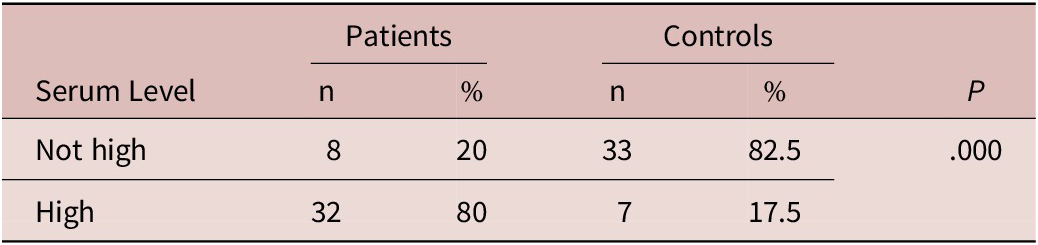
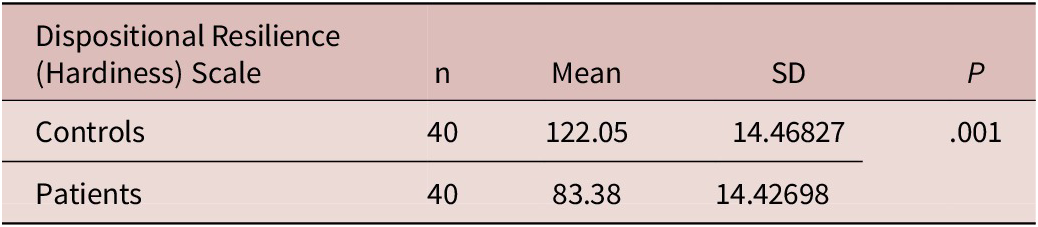
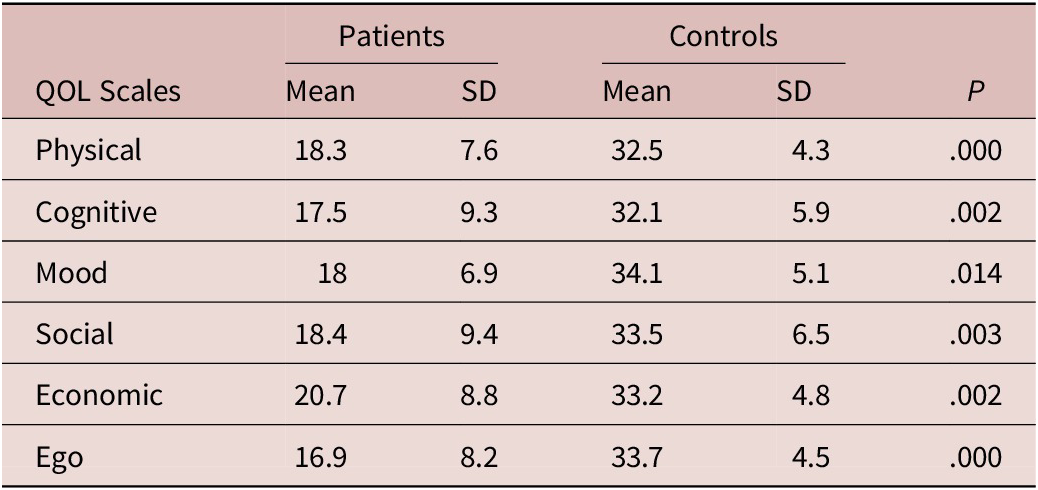
The severity of major depression was rated using the BDI-II: approximately 25% had severe depression, 42.5% had moderate depression, and only 15% had mild depression. Approximately 80% of the patients had high serum levels of AVP compared with 17.5% of the healthy controls (Table 1). The difference was statistically significant (P = .000). The reference normal level of AVP is 1 to 5 pg/mL. The psychological hardiness score was higher for healthy controls than for patients (mean = 122.05 and 83.38, respectively). This difference was statistically significant (P = .001; Table 2). According to SRRS scores, the stressors were higher in patients than in controls (mean = 238.4 and 96.9, respectively), and the difference was statistically significant (P = .002; Table 3). QOL scales were lower in patients than controls, and there were statistically significant differences in all scales (Table 4). As for correlative studies, we found that there was a statistically significant negative correlation between AVP level and psychological hardiness (r = 0.657, P = .000). Moreover, there was a statistically significant positive correlation between AVP level and severity of depression (r = 0.83, P = .000). There was a statistically significant negative correlation between depression and the cognitive and ego scales of the QOL (cognitive: r = 0.344, P = .03; ego: r = 0.345, P = .02).
Arginine Vasopressin Level in Patients and Controls

Dispositional Resilience (Hardiness) Scale Scores in Patients and Controls

Abbreviation: SD, standard deviation.
Social Readjustment Rating Scale (SRRS) Results in Patients and Controls

Abbreviation: SD, standard deviation.
Quality of Life (QOL) Scores in Patients and Controls

Abbreviation: SD, standard deviation.
Discussion
Our study showed an elevated serum level of AVP in 80% of the patients with MDD compared to 17.5% of the healthy controls, which is statistically significant. There was also a significant positive correlation between the level of AVP and the severity of depression. Moreover, a significantly negative correlation between AVP level and psychological hardiness has been demonstrated, psychological hardiness being an important dimension of resilience. Last but not least, statistically significant differences between the depressed group and the control group regarding QOL were found with more impairment in the depressed group.
The adaptive physiological response to acute stress involves a process called allostasis, as reported by Sterling and Eyer,Reference Sterling, Eyer, Fisher and Reason 21 in which the internal milieu varies to meet perceived and anticipated demand. This definition was extended to include the concept of a set point that changes because of the process of maintaining homeostasis.Reference Ganzel, Morris and Wethington 22 The responses to severe stress that promote survival in the context of a life-threatening situation may be adaptive in the short run. However, if recovery from the acute event is not accompanied by an adequate homeostatic response to terminate the acute adaptive response of stress mediators, the deleterious effects on psychological and physiological function, termed the “allostatic load,” occur.Reference Lohr, Chang and Sexton 23 The allostatic load is the burden borne by the brain and body adapting to challenges, both physiological and psychological. The concepts of allostasis and allostatic load link the protective and survival values of the acute response to stress to the adverse consequences that result if the acute response persists.Reference Morales-Medina, Witchey, Caldwell, López-Muñoz, Srinivasan, de Berardis, Álamo and Kato 24
Hyperactivity of the HPA axis is one of the key biological abnormalities described in MDD, occurring in 30% to 50% of depressed subjects. Corticotropin-releasing hormone (CRH) and AVP are the main regulators of this stress system, with the two neuropeptides acting synergistically in bringing about adrenocorticotropic hormone (ACTH) release from the anterior pituitary and cortisol from the adrenal gland.Reference Mello, Mello and Carpenter 25 In the same vein, LondenReference Londen, Kerkof and van den Berg 26 compared 48 patients with MDD and 30 healthy controls and found that mean plasma concentrations of AVP were higher in depressed patients than in healthy controls.
In addition, another study detected elevated AVP levels in patients with MDD, particularly in relation to the melancholic subtype. They determined the amount of AVP messenger ribonucleic acid (mRNA) in the paraventricular nucleus (PVN) in postmortem brain tissue of nine depressed subjects (six with the melancholic subtype) and eight control subjects. Sixty percent of patients had higher AVP mRNA expression compared with control subjects. In the melancholic subgroup, AVP mRNA expression was significantly increased in the PVN of patients compared with control subjects; this might partly explain the observed increased AVP levels in patients with depression.Reference Meynen, Unmehopa and van Heerikhuize 27
As noted earlier, Bao and SwaabReference Bao and Swaab 7 reported that AVP acts as a neuromodulator of the stress response through acting as an ACTH stimulating factor, synergistic to CRH. Furthermore, there are at least four different vasopressinergic systems intimately involved in the symptoms of depression. First, AVP is produced as a neurohormone by the magnocellular neurons of the hypothalamic supraoptic nucleus and PVN, whose axons run to the neurohypophysis where it is released into the general circulation. Circulating AVP has an influence on the anterior pituitary, and high levels of circulating AVP also affect mood. In the second place, parvocellular neurons of the PVN secrete CRH and AVP also as neurohormones from their axons in the median eminence into the portal capillaries that transport them to the anterior lobe of the pituitary. AVP strongly potentiates ACTH-releasing activity. Third, additional vasopressinergic fibers are found to project from the hypothalamus to subregions of the hippocampus, septum, amygdala, and brainstem areas, where AVP serves as a neurotransmitter/neuromodulator via AVPR1a and AVPR1b receptors that are widely distributed. AVP works through AVPR1b on pituitary corticotropes, and the AVPR1b seems to be more reactive in depression. In contrast, a major SNP haplotype of the AVPR1b has been found to protect against recurrent MDD. All the previous observations support the possibility of a direct involvement of AVP in the pathogenesis of depression.Reference Surget and Belzung 28 , Reference Merali, Hayley and Kent 29
Psychological hardiness makes a contribution to resilience, not only in the sense of persevering, but also thriving under stress.Reference Maddi 30 Put in different words, hardiness paves the way for resilience in stressful environments.Reference Maddi 31
This might be explained by Holsboer and Ising,Reference Holsboer and Ising 32 who mentioned that depression and anxiety disorders are prominent examples of stress-related disorders associated with an impaired regulation of stress hormones. The personality style of hardiness is proposed to have a moderating effect on this process by encouraging effective mental and behavioral coping, building and utilizing social support, and engagement in effective self-care and health practices.Reference Maddi 33 , Reference Hammen 34
Stressors were significantly higher in the depressive group than the control group. This is in concordance with the stress diathesis model of medical illness, including depression.Reference Monroe 35 The diathesis-stress model proposes that a latent diathesis may be activated by stress before psychopathological symptoms manifest. Some levels of diathesis to illness are present in everybody, with a threshold over which symptoms will appear. Exceeding such a threshold depends on the interaction between diathesis and the degree of adversity faced in systemic lupus erythematosus (SLE), which increases the liability to depression beyond the combined additive effects of the diathesis and stress alone.Reference Schneiderman, Ironson and Siegel 36 Furthermore, stressful life events consistently have been recognized as a determinant of depressive symptoms, with many studies reporting significant associations between SLE and MDD. In addition, different studies reported that many psychiatric disorders are a result of a disturbance in or exhaustion of the human stress response system.Reference Muscatell, Slavich and Monroe 37
Regarding QOL, in tandem with our findings, Saarijärvi et alReference Saarijärvi, Salminen and Toikka 38 compared health-related QOL in 165 patients with MDD and 165 randomly selected age- and gender-matched controls from a population sample. Overall, perceived QOL was broadly reduced among depressed outpatients, and compared with the control group, significant impairment was observed; depression per se impairs an individual’s functioning ability in a number of ways. It has a significant effect not only on mental well-being but also on perceived physical functioning and bodily pain, and even on general health perceptions. MDD seems to explain the broad decline in the QOL among patients with depression.Reference Cho, Lee and Kim 39 Indeed, the treatment of patients suffering from MDD can be highly challenging for mental health workers; intractability as well as relapse is commonly seen among these patients, leading to functional impairment and poor QOL.
Although a large variety of antidepressant drugs are available for treatment, approximately 30% of patients fail. Therefore, the search for newer or novel drug targets for the treatment of MDD continues. Some of these targets include vasopressin V1b receptor antagonists, glucocorticoid receptor antagonists, and corticotropin-releasing factor-1 receptor antagonists, with promising results.Reference Kulkarni and Dhir 40 - Reference Grady and Stahl 42 Other pathways underlying the neurobiology of depression include inflammatory, oxidative/nitrosative, mitochondrial, 1-carbon cycle, glucose metabolism, neutrophin signaling, opiate, cholinergic, and GABAergic pathways, only to mention a few. Of related interest, glutamatergic system pathways are promising potential targets, including broad high-trapping glutamatergic modulators (eg, ketamine), NMDA-receptor antagonists (eg, dextromethorphan), subunit-specific NMDAR antagonists (eg, rapastinel), and glutamate modulators (eg, riluzole).Reference Naguy 43 , Reference Serafini, Pompili and Innamorati 44
Conclusion
As demonstrated in this study, AVP levels are indeed higher in patients suffering from depression. Furthermore, AVP level and psychological hardiness are negatively correlated, reflecting lower stress resilience. Capitalizing on this premise, preclinical evidence and promising clinical trials speak to the idea that at least two V1b receptor antagonists (TS-121 and ABT-436) showed tendencies to reduce the depression scores of patients with MDD at doses that attenuate HPA axis hyperactivity or block the pituitary V1b receptor. Importantly, TS-121 showed a clearer efficacy for patients with higher basal cortisol levels than for those with lower basal cortisol levels, which was consistent with the hypothesis that V1b receptor antagonists may be more effective for patients with HPA axis hyperactivity. Therefore, V1b receptor antagonists are promising approaches for the treatment of depression involving HPA axis impairment, such as depression.Reference Chaki 45 On the other hand, enhancing resilience through therapy as an outgrowth of positive psychology has gained a foothold in clinical practice, and building up resilience should readily be integrated into routine clinical care.
Limitation of this study
The current study involved a small sample size. Replication of these findings in larger studies is needed. Given the cross-sectional nature of study, the cause–effect relationship between AVP and depression could not be established. These results do not inform whether this could represent a state-dependent vs a trait-dependent variable.
Author Contributions
Conceptualization: S.M.A.M., H.A.H., F.Z.; Data curation: S.M.A.M., H.A.H., F.Z., A.A., D.R.A.; Formal analysis: F.Z., A.A., D.R.A.; Investigation: S.M.A.M., H.A.H., A.A.; Methodology: A.A.; Resources: S.M.A.M., H.A.H., F.Z., A.A., D.R.A., A.N.; Software: D.R.A.; Supervision: H.A.H., F.Z., A.N.; Validation: S.M.A.M., H.A.H., F.Z., A.A., D.R.A., A.N.; Visualization: F.Z., A.A., D.R.A., A.N.; Writing—original draft: S.M.A.M., H.A.H., A.N.; Writing—review and editing: A.N.
Ethical Considerations
Approval of the ethical committee in Kasr Al-Ainy Psychiatry and Addiction Hospital was obtained beforehand. A written informed consent was signed by each participant before the beginning of the study.
Disclosure
The authors have no competing interests or financial affiliations.