Implications
A planned animal health approach to dairy herd fertility was demonstrated, through a controlled randomised study, to improve fertility at herd level. The programme tested (InCalf) used a management cycle approach, that is assessment of current performance against goals and objectives, identification of areas for improvement, development and implementation of a plan and review. Such an approach allowed identification of the economically important areas for improvement. Success of this approach provides industry leaders and service providers (e.g. veterinarians and other rural professionals) with confidence that, if appropriately implemented, such planned animal health services will have positive effects on herd performance.
Introduction
The concept of management cycle approaches to managing reproductive performance (Barfoot et al., Reference Barfoot, Cote, Stone and Wright1971; De Kriuf and Brand Reference de Kruif and Brand1978; Morris et al., Reference Morris, Williamson, Blood, Cannon and Cannon1978a), mastitis (Morris et al., Reference Morris, Blood, Williamson, Cannon and Cannon1978b; Green et al., Reference Green, Leach, Breen, Green and Bradley2007), lameness (Bell et al., Reference Bell, Bell, Knowles, Whay, Main and Webster2009) and other diseases in dairy herds has been advocated since the 1960s. Early herd health programmes focused on routine visits to cows with abnormalities, such as those having retained foetal membranes or vaginal discharges (Morrow, Reference Morrow1968). Recognition that risk factors such as nutrition, oestrous detection efficiency and infectious disease operated at herd as well as cow level, and that preventative strategies were important, resulted in the development of broader programmes (LeBlanc et al., Reference LeBlanc, Lissemore, Kelton, Duffield and Leslie2006). Such programmes were further extended by the inclusion of a focus on product quality and use of management tools such as hazard control critical point programmes (HACCP; Noordhuizen and Wentik, Reference Noordhuizen and Wentink2001). This approach is commonly called a herd health and production management programme and falls within a wider definition of agricultural extension. Agricultural extension has been defined by the Food and Agriculture Organisation of the United Nations as ‘… the organized exchange of information and the purposive transfer of skills’ (Nagel, Reference Nagel1997). Herd fertility programmes are an essential component of broader herd health and production management extension services (Brand and Varner, Reference Brand and Varner1996).
Current herd fertility programmes generally use a management cycle approach, that is a continuous process of establishing and updating farm objectives, assessment of current status, planning, execution and assessment (Brand and Guard, Reference Brand and Guard1996). Such programmes require reliable record-keeping, regular farm visits, consultation and record analysis, with interpretation of data resulting in actions. To allow decision-making, objectives and targets need to be established using clearly defined reproductive indices.
Many of the reproductive performance measures used as key performance indicators for year-round calving (Fetrow et al., Reference Fetrow, McClary, Harman, Butcher, Weaver, Studer, Ehrlich, Etherington, Guterbock, Klingborg, Reneau and Williamson1988) are inappropriate for seasonal calving systems (Macmillan, Reference Macmillan2002; Morton, Reference Morton2010). For example, in year-round calving systems indices such as calving to first insemination or calving to conception are commonly analysed, whereas in seasonal calving systems cows are bred upon oestrous detection after a calendar date, set as the start of the seasonal breeding programme, irrespective of the interval after calving of individual cows. This is due to the need to start breeding on a specific calendar date to ensure that subsequent calving occurs at the optimal time. Thus, the concept of a voluntary waiting period is not relevant in seasonal breeding systems. Despite these differences between systems, the important point is that the key performance indicators have been agreed upon and precise definitions are consistently monitored and used objectively to assess a herd’s performance.
Once the key performance indicators are defined, data collected at both the herd and cow level are required to allow the calculation of indices for a specific farm. A wide range of data must be collected to aid decision-making, given the complex interactions between genetics, physiology, nutrition and management. When the indicators are met, monitoring is all that may be subsequently required. However, when the indicators are not met, it is necessary to identify the deficiencies (‘gaps’ in performance) within the farm system, evaluate potential options to improve performance and implement appropriate interventions (Brand and Varner, Reference Brand and Varner1996).
The objective of this paper is to review a herd-level fertility programme (InCalf) and evaluate its performance under commercial conditions in New Zealand.
Evaluating herd fertility programmes
The primary intention of agricultural extension is to improve one or more aspects of farm performance (an ‘end result’). In turn, a change in performance usually requires change in one or more on-farm practices. Therefore, extension programmes generally aim to introduce a new behaviour or modify a current one, such as improving herd reproductive performance through facilitated and structured meetings (Britton et al., Reference Britton, Nettle and Morton2003). Before a change in management practice on farm can occur, a change in intention by the key decision maker (KDM) is required, and that intention is usually preceded by a change in the knowledge, attitudes, skills and/or aspirations (KASA) of that KDM (Coudel et al., Reference Coudel, Tonneau and Rey-Valette2011).
A model for evaluating the impact of an agricultural extension programme has been proposed on the basis of this process (Bennet, Reference Bennett1975). Bennett’s hierarchy consists of seven sequential criteria, outlining the recommended steps to plan, implement and evaluate agricultural extension programmes. At each level of the hierarchy, targets can be set and assessed using appropriate study design. The seven levels of the hierarchy of evidence are as follows: (1) inputs, (2) activities, (3) people involvement, (4) reactions, (5) KASA change, (6) practice change and (7) end results.
The hierarchy is accompanied by three guidelines:
-
1. The evidence for an extension programme’s impact becomes stronger as the hierarchy is ascended (as evidence for change is at higher levels in the hierarchy).
-
2. The difficulty and cost of obtaining evidence of accomplishments increase as the hierarchy is ascended.
-
3. Robust evidence is usually ideal but is expensive and difficult to obtain.
Ideally, herd fertility programmes should be evaluated using the highest criterion, the end result (e.g. herd-level reproductive performance). However, assessment of changes in farmer KASA, as well as practice change, as a result of the programme is essential to determine how the end result was achieved. Hence, in this study, evaluation was undertaken at the highest level (i.e. level 7 or ‘end results’), which provides the strongest evidence of the effectiveness of the programme. However, to aid in understanding of how the end result was achieved, the degree of practice change and change in KASA were also evaluated.
Simple measures could be used to assess short-term outcomes, for example, use of attendance registers at farmer meetings, but to assess farmer behaviour or practice change, on-farm measures such as heifer live weights may be required. End-result measures are also often subject to a long time lag following implementation of the programme. Typically, levels 1 to 4 of the hierarchy are used to evaluate the process of the agricultural extension programme, whereas levels 5 to 7 evaluate the impact of the programme. This review focuses on the impact of a herd reproductive management programme (InCalf) using levels 5 to 7.
Level 7: end result
End-result criteria are programme objectives and are assumed to be the product of the practice changes (Bennett, Reference Bennett1975). Definitive evaluation of the effect of extension requires that targets are set and the end results are evaluated. The most rigorous method of determining the effect of intervention are randomised controlled trials (Lavori and Kelsey, Reference Lavori and Kelsey2002; Stolberg et al., Reference Stolberg, Norman and Trop2004). Size, scope and expense are major limiting factors in their application (Dohoo et al., Reference Dohoo, Martin and Stryhn2009); however, they remain the most effective way to control potential confounders and minimise selection bias and some sources of measurement bias.
A limited number of randomised controlled trials have been undertaken to assess animal health interventions. A mastitis control programme designed, implemented and analysed by experienced researchers reduced the clinical mastitis incidence rate by 22% compared with control herds (Green et al., Reference Green, Leach, Breen, Green and Bradley2007). The reduction in clinical mastitis incidence was positively associated with the degree of compliance of the farmers to the experts’ recommendations.
Another study evaluated a heifer lameness control programme that used an HACCP approach to evaluate putative risk factors for lameness in heifers. Recommendations were given to farmers by trained, regional veterinarians who were farm specific (Bell et al., Reference Bell, Bell, Knowles, Whay, Main and Webster2009). On using a randomised controlled trial, no significant effect of the extension programme was identified on the change in risk factors between the baseline year and second year of the study. A low level of compliance was identified for both veterinarians and farmers.
There is evidence of improved herd reproductive performance following veterinary intervention in longitudinal (Morris et al., Reference Morris, Williamson, Blood, Cannon and Cannon1978a) and cross-sectional (Derks et al., Reference Derks, van de Ven, van Werven, Kremer and Hogeveen2012) study designs. However, it appears that no randomised controlled study has assessed the effect of introducing a herd health plan with a fertility focus. This is likely due to the complexity and expense of running a randomised controlled trial at herd rather than cow level.
Level 6: practice change
Level 6 quantifies changes in practices, technology and/or social structure as a result of extension (Bennett, Reference Bennett1975). Data at this level can be collected from farmer self-reports, measured through objective on-farm observations, or derived from farm records.
Traditional evaluation has treated management practice as a dichotomous variable simply describing whether a practice is undertaken without considering the intensity or commitment to the activity (Bigras-Poulin et al., Reference Bigras-Poulin, Meek, Martin and McMillan1985; Cowen et al., Reference Cowen, Schwabe, Rosenberg, Bondurant, Franti and Goodger1989).
Level 5: change in KASA
Level 5 evaluates the change in the direction and durability of KASA (intentions) of the participants as a result of an extension programme (Bennet, Reference Bennett1975). This evaluation requires data from questionnaires from participants (Radhakrishna and Rhemilyn, Reference Radhakrishna and Rhemilyn2009). It can use either cross-sectional post-exposure or pre- and post-exposure interviews to measure change in attitude. Although these are valid methods, attributing causality is normally inappropriate as causes of change in attitude other than through exposure cannot be excluded. The most valid method of attributing the correct effect of the extension would require a representative control group for comparison, that is a randomised controlled study design.
InCalf
InCalf is an extension package of resources, tools and training for both dairy farmers and their advisers. It is based on a process of identifying opportunities for improvement and then pursuing them. Conventional ‘problem solving’ or ‘best practice’ approaches, although suitable for other management issues, are not well suited to herd reproductive management because of the complexity of the systems.
InCalf was developed in the early 2000s in Australia (Britton et al., Reference Britton, Nettle and Morton2003) and was introduced in New Zealand in 2007 (Blackwell et al., Reference Blackwell, Burke and Verkerk2010). The programme aims to enable dairy farmers to achieve measured improvement in herd reproductive performance. The key technical recommendations were based on the findings of a large multicentre, multi-year observational project that aimed to identify the key risk factors for reproductive performance in Australian dairy herds (Morton, Reference Morton2010).
That project developed tools, including a one-page summary of the key reproductive performance indicators (Fertility Focus Report), a farmer-level guide to managing and optimising reproductive performance (InCalf Guidelines) and a standardised body condition scoring system (Britton et al., Reference Britton, Nettle and Morton2003). Emphasis is placed on training advisors and facilitators who then undertake training of farmers and on-farm work. The Fertility Focus Report is a key tool that allows a rapid and cost-effective assessment of the current performance of a herd and provides a standardised approach to calculating the key performance indicators (6-week in-calf rate, not-in-calf rate), as well as further information about key secondary drivers such as calving spread, oestrous detection efficiency and conception (or non-return) rates.
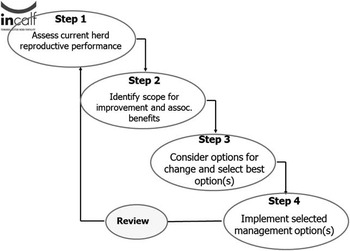
The InCalf programme is based on four steps (Figure 1):
-
1. Investigating and assessing current herd reproductive performance.
-
2. Identifying the major management areas requiring change for improved herd reproductive performance.
-
3. Prioritising management actions and building an action plan.
-
4. Implementing the selected management options and then reviewing the outcomes.
The four-step management process used in the herd fertility management programme (InCalf).

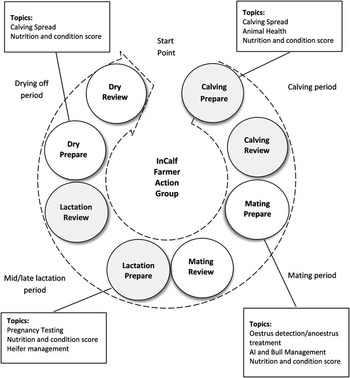
The programme stresses that change is likely to be incremental and continuous. It is structured around the annual management cycle, that is calving, mating, mid-lactation and dry periods. When used with managers of seasonal calving herds, these four key stages align with particular times of the year (Figure 2).
The seasonal approach to reproductive management used for prepare and review meetings by participants in farmer action groups as part of the InCalf programme.

Farmers may become involved in InCalf through direct approaches from their advisors suggesting that they may benefit from involvement, through attendance at marketing events or by directly seeking professional advice.
The delivery of the InCalf material is either through farmer action groups or through one-on-one meetings. Farmer action groups involve 6 to 15 farmers and relevant staff meeting on eight or nine occasions across a year to receive technical material and discuss upcoming management areas. For example, at the pre-calving prepare meeting the areas are plan calving, manage cow health and manage nutrition. The meetings are facilitated by trained rural professionals. The function of this role is facilitation, rather than technical. Although the majority of facilitators are veterinarians, the specific technical interventions for any given farm are not dealt with directly within the farmer action group; rather, farmers are encouraged to use people with the appropriate technical skills outside the farmer action group meetings. The farmers benchmark their herd’s current reproductive performance and, within groups of three peers, develop plans for the upcoming period that are documented and retained by the farmer and the facilitator. Following each prepare meeting, there is a review meeting at which farmers present the outcomes for the period and review why, or why not, changes in management were implemented and were successful, or not (Figure 2). One-on-one meetings involve a trained advisor working with one farmer. These meetings may be set up over a whole lactation period, that is following a similar schedule to the farmer action group model, or undertaken on a more ad hoc basis by the farmer and advisor.
From 2000 to 2009 the reproductive performance of dairy herds in Australia declined. Morton (Reference Morton2011) found that:
-
∙ the 6-week in-calf rate had declined from 63% to 50%;
-
∙ the final not-in-calf rate had increased from 9% to 20%;
-
∙ the 3-week submission rate had declined from 77% to 72%; and
-
∙ the first insemination conception rate had declined from 49% to 30%.
This occurred despite introduction of InCalf and indicates that any beneficial effects of the InCalf programme were outweighed by other factors causing reproductive performance to decline. Over that time many herds had converted to split calving, that is two or three blocks of calving across the year. Suggested reasons for this change included alteration of milk payment systems to encourage ‘flatter’ milk supply, drought, belief that these systems use labour more efficiently, international export of heifers and reluctance to adopt crossbreeding to improve performance (Macmillan, Reference Macmillan2012). Importantly, the impact of a herd reproductive management programme such as InCalf had not been formally assessed using a randomised controlled study in Australia or New Zealand. For this reason, a large-scale study (the National Herd Fertility Study) was undertaken to assess an extension programme designed to improve the reproductive performance of dairy herds.
Study design
Details of the study design have been previously described (Brownlie et al., Reference Brownlie, Weir, Tarbotton, Morton, Heuer and McDougall2011b and Reference Brownlie, Morton, Heuer, Hunnam and McDougall2013). In summary, herds from four regions across New Zealand (Waikato, Taranaki, North Canterbury and South Canterbury) were enrolled in May 2009. The four regions were chosen to represent a diverse cross-section of the dairy industry in New Zealand, both geographically and demographically. The herds thought likely to meet the selection criteria of the study were self-selected from those nominated by the coordinating veterinarians at each of the cooperating veterinary practices in these regions. The selection criteria were:
-
1. being a client of a participating veterinary clinic;
-
2. having >90% of the herd calving annually between 1 June and 30 November (i.e. seasonal, spring-calving herds);
-
3. the KDM was expected to remain farming on the same site for the subsequent 2 years;
-
4. was willing to (and considered likely to) follow the protocol for the study.
These criteria were imposed to try to increase herd retention in the study, as a large ongoing commitment from farms was required for on-farm monitoring.
Herds were ranked within the region on the proportion of cows estimated to have conceived in the first 6 weeks of the seasonal breeding programme (6-week in-calf rate) derived from the Fertility Focus Report for the season preceding the study, and randomly assigned within sequential blocks to one of three groups:
-
1. participation in a herd reproductive management programme (i.e. InCalf) with on-farm monitoring (treatment group);
-
2. a control group without participation in the reproductive extension programme but subject to the same on-farm monitoring (control group);
-
3. a passive control group that received neither the reproductive extension programme nor any on-farm monitoring.
The passive control group was included to test whether the active monitoring in the control group led to improvements in performance simply because of external interest in the farm (the so-called ‘Hawthorne’ effect; Holden, Reference Holden2001). No differences between the control and passive control groups were found in any reproductive outcomes (data not shown), and hence there was no evidence of the Hawthorne effect and no further reference will be made to this group in this paper.
The treatment farmers were enrolled in a farmer action group during the 2009/10 dairy season. All herds were actively monitored for the 2009/10 and 2010/11 seasons.
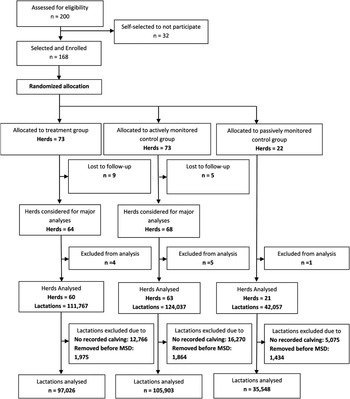
At enrolment, farmers gave permission for data to be accessed electronically from the New Zealand Dairy Core Database (LIC, Hamilton, New Zealand). The data included herd-, cow- and cow-event-level information. Numbers of herds and lactations allocated to groups and numbers of lactations used for analyses are summarised in Figure 3.
Diagrammatic representation of the number of herds and lactations of dairy cows enrolled in the treatment, actively monitored control, or passively monitored control groups and analysed for the 2009/10 and 2010/11 seasons within the New Zealand National Herd Fertility Study. MSD=start of the seasonal breeding programme.

The key reproductive outcome of interest (the end result) was the 6-week in-calf rate, as this has been shown to be an important economic driver (Beukes et al., Reference Beukes, Burke, Levy and Tiddy2010). To determine this, pregnancy diagnosis was undertaken by an experienced veterinarian at 12 weeks after the planned start of mating for herds in both years, when the pregnancy status and stage of gestation (if pregnant) were determined for each cow.
To evaluate whether involvement in the farmer action group resulted in practice changes in some of the key risk factors for reproduction, specific on-farm measurements were taken at strategic times: these included assessment of calving distribution, heifer live weight, body condition score (BCS), oestrous detection efficiency, anoestrous cow management and bull management.
In summary, calving distribution was derived from calving records in each herd for each study-year, and cows calving >42 days after the planned start of calving were identified as late-calving animals. Live weights of 70 2-year-old heifers from each herd were determined about 2 weeks before the planned start of calving in both years, and the difference between the measured live weight and the target live weight was derived. The BCS of 70 animals selected at random was also determined about 2 weeks before calving and 2 weeks before mating in both years of the study. Oestrous detection efficiency was estimated as the proportion of mature (3- to 8-year-old) cows that calved <42 days after the planned start of calving and had at least one insemination recorded in the first 21 days of the mating period. This subset of cows is analysed as the majority of them are likely to be ovulating and expressing oestrus by the start of mating, and hence if <95% of these cows are detected in oestrus in the first 21 days of mating low sensitivity of oestrous detection may be suspected. The timing of anoestrous interventions relative to the start of the seasonal breeding programme was used to assess anoestrous cow management. Anoestrous intervention date was categorised as either early or late (i.e. before or after the start of the seasonal breeding programme, respectively). Bull management was assessed in each herd-year as a ratio of the mean of discrete time hazards of conception for each week in the 3 weeks following the end of the artificial insemination period, when bulls were run with the lactating herd (the bull period), relative to that for the 3 weeks preceding the end of the artificial insemination period. The KASA of KDM were examined using detailed questionnaires covering farm-level policy, farmer and staff demographics, and KDM beliefs and attitudes at the start of the study, after the first (the year of the farmer action group) and second year of the study.
Statistical analysis
Data were analysed using Stata 12 (StataCorp, 2011).
Because of the seasonal dairy cycle and the periodic exposure over the year, the temporality of exposure, in this case the farmer action group meeting on the relevant topic, had to be considered. Use of analysis of covariance for post-exposure measurements, including the pre-exposure status as a covariate, gives the highest statistical power in randomised controlled studies (Vickers, Reference Vickers2001). Accordingly, in this analysis, post-exposure measures were evaluated with pre-exposure measures included as fixed effects where appropriate. When the first study-year measures were undertaken before any realistic chance of any management change resulting in a change in performance, only the second study-year measures were evaluated. When the technical area was addressed in the farmer action group at such a time that management change could be implemented and its effects were likely to be measurable, the measures were pooled across the 2 years of the study.
Proportional data were modelled using generalised linear regression models with logit link functions and binomial error distributions. Continuous outcome variables were analysed using ordinary linear regression models. For binary outcome variables (e.g. anoestrous intervention date and the bull management ratio) logistic regression was used.
When outcome measures were analysed at herd-year level, that is when 2 years of data for each herd were analysed, robust standard errors were used to account for the repeated measures within herds, or random effects of herd were fitted (for ordinary linear regression and logistic regression). Estimated marginal means were derived from models using Stata’s margins command where appropriate. Only associations between groups (treatment or control) and key management factors that were significant at the P=0.05 level are reported.
Results
Descriptive results
The number of herds and lactations used in analyses is presented in Figure 3.
The mean (±s.d.) herd size was 561 (±279) cows, being managed on 164 (±72) ha, by 3.3 (±1.3) staff members. There was significant regional variation with the two South Island sites having larger herds, greater area and more staff than North Island sites (Brownlie et al., Reference Brownlie, Weir, Tarbotton, Morton, Heuer and McDougall2011b).
Effect of participation in an InCalf farmer action group on reproductive performance (end result)
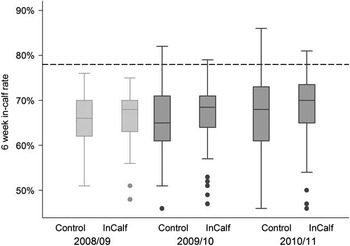
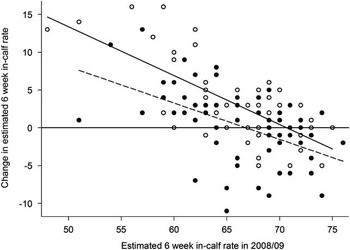
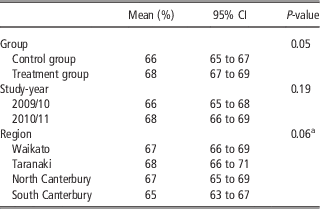
After accounting for region and study-year, the mean (95% confidence intervals) 6-week in-calf rate in the treatment group was 1.95 (0.01 to 3.89) percentage points higher than that in the control group (P=0.05; Table 1). There were large ranges in 6-week in-calf rates within both groups in both study-years (Figure 4). The change in 6-week in-calf rate (year 2 post-enrolment–pre-enrolment) increased with decreasing 6-week in-calf rate in the year preceding the study (P<0.05) (Figure 5).
Box and whisker plots of 6-week in-calf rates for three seasons for herds where the key decision maker participated (InCalf) or did not participate (control) in a fertility management programme in 2009/10. Boxes represent mid quartiles and whiskers represent outer quartiles; horizontal lines within boxes are medians; dashed line is the target 6-week in-calf rate of 78%.

Scatter plot and linear regression line of change in estimated 6-week in-calf rate (i.e. year 2 post-enrolment–pre-enrolment) by estimated 6-week in-calf rate before enrolment (2008/09) for herds where the key decision maker participated (○: solid line) or did not participate (∙: dashed line) in a fertility management programme.

Marginal mean estimates of 6-week in-calf rate from a multivariable model to assess effects of participation in a herd fertility management programme in 2009/10 (treatment) or not (control) by key decision makers from dairy herds in four regions of New Zealand, over two study-years

a Overall significance of region effect.
Effect of participation in an InCalf farmer action group on reproduction risk factors (practice change)
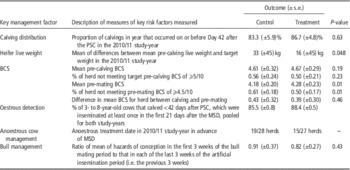
A positive effect of participation in the InCalf farmer action group was evident for three of the six managements areas measured (Brownlie, Reference Brownlie2012). These were heifer live weight, pre-mating BCS and oestrous detection efficiency. No significant difference was detected between groups in calving distribution, anoestrous cow management and bull management (Table 2).
Description of risk factors used to assess change in management factors, and outcomes, for dairy herds where the key decision maker participated (treatment) or not (control) in a reproductive management programme in 2009/10

MSD=start of the seasonal breeding programme; PSC=planned stat of calving; BCS=body condition score on a 1 to 10 scale (Roche et al., Reference Roche, Dillon, Stockdale, Baumgard and VanBaale2004).
Heifer live weight
In total, 6711 and 6118 heifer weights were collected before the planned start of calving for the 2009/10 and 2010/11 study-years, respectively. Mean (±s.d.) herd heifer live weights in the 2010/11 study-year were 428 (±46) and 436 (±47) kg in the treatment and control groups, respectively. Participation in the InCalf programme was associated with a mean (±s.e.) 17 (±8.5) kg reduction in live weight gap (relative to target weights) in the 2010/11 study-year compared with the control herds (P=0.048).
Pre-calving and pre-mating BCS
In total, 8447 and 7834 pre-calving BCS and 10 217 and 9369 pre-mating BCS were available for analysis from the 2009/10 and 2010/11 study-years, respectively. Overall, there was no difference between control and treatment herds in mean pre-calving BCS or in the percentage of the herd meeting target pre-calving condition scores (Table 2). Participation in the InCalf programme was associated with higher mean pre-mating BCS compared with control herds in the Reference Beukes, Burke, Levy and Tiddy2010/11 study-year (P=0.01) but not in the 2009/10 study-year (P=0.99). A higher proportion of cows met pre-mating BCS targets in treatment than in control herds (P=0.01; Table 2).
Oestrous detection
The mean 21-day submission rate for early-calved, mature cows among treatment herds was 3.4 percentage points higher than that of control herds in 2009/10 (P<0.01) and 2.3 percentage points higher in 2010/11 (P=0.08).
Intentions to change management practice as a consequence of participation in an InCalf farmer action group
Overall 60% of farmers attended all farmer action group meetings with the highest complete attendance in South Canterbury (13/15; 87%) and the lowest complete attendance in North Canterbury (6/12; 50%).
The vehicle for management change employed within the InCalf farmer action group was proposing relevant actions for the forthcoming management period in a supportive and facilitated environment. Participants were encouraged to develop specific, measureable, achievable, realistic and time-bound (SMART) actions (Doran, Reference Doran1981). These actions were reviewed and it was found that 97% of the proposed actions were not in the SMART format. No significant associations were found between the specific proposed actions and any on-farm management measures.
Farmers proposed actions for a mean of 8 of the 10 topics, ranging between 4 and 10 actions. There was a negative association between the number of actions proposed and the subsequent 6-week in-calf rate (P=0.01).
Discussion
Despite participation in the InCalf farmer action group being associated with an improvement in reproductive performance, no strong associations were found between the specific proposed actions and on-farm management measures. This apparent paradox suggests that the process, from proposing a management change within the farmer action group to effectively implementing it, is more complex than could be captured by the data collected in this study. The effect of participation is likely subject to a raft of other, more subtle, decision-making processes.
The inverse relationship between the number of actions proposed and the subsequent 6-week in-calf rate suggests that those farmers proposing fewer actions had a greater grasp of the priorities of management and hence more specific actions making them more achievable. Conversely, a greater number of intended actions may be over-ambitious and unrealistic to be achievable by most farmers.
The finding that almost all of the proposed actions were not structured as SMART actions was most likely due to lack of appreciation or understanding by both the farmers and the facilitators of the importance of SMART actions. Feedback from the facilitators of the farmer action groups suggested that many actions were proposed with a response bias, that is, the farmers responded the way they believed the facilitators wished them to respond. This finding suggests that the process of proposing SMART actions within small farmer groups of two to three is ineffective, partly because of poor understanding by farmers of the effectiveness of SMART actions, the lack of time allowed to undertake this planning or a need for improved facilitation training among the extension providers. It is likely that when actions were written in a SMART format these objectives were more likely to be achieved.
Economics of involvement in InCalf
The cost of sub-optimal fertility is substantial. Losses include lost production, increased replacement cost due to excessive numbers of culled animals, costs of interventions to try to improve fertility, etc. The economic benefits of being involved in herd health management programmes were demonstrated as early as the 1960s (Herschler et al., Reference Herschler, Miracle, Crowl, Dunlap and Judy1964: Barfoot et al., Reference Barfoot, Cote, Stone and Wright1971). For example, in a Canadian study comparing herds on a health programme with herds not on such a programme, herds with average to maximal compliance to the programme had returns on investment between 95% and 576%, respectively, depending on the value of milk and culls, and level of compliance (Barfoot et al., Reference Barfoot, Cote, Stone and Wright1971).
Under New Zealand management systems, losses associated with infertility are estimated to be $NZ 4 per cow for each 1 percentage point decline in 6-week in-calf rate and $NZ 10 per cow for each 1 percentage point increase in empty rate (Beukes et al., Reference Beukes, Tiddy, Burke, Levy and Lancaster2007). The annual gross return for a 400-cow herd from improving the 6-week in-calf rate from the national median of 66 to 71 percentage points was estimated to be $NZ 9000 (Brownlie et al., Reference Brownlie, Morton, Heuer and McDougall2011a). The 2 percentage point increase in 6-week in-calf rate found in the current study resulted in an estimated increase in net return to the farm of ~$NZ 3200. This is likely a conservative estimate as it makes no assumptions about the effect of the programme on the final empty rate. The costs incurred in achieving these changes depend on the farm, that is identifying the key areas of improvement and investing in those. When, for example, oestrous detection is a limiting factor, investing 1 h a day in oestrous detection during the period of artificial insemination can result in relatively low cost (say $NZ 20/h labour×1 h/day×35 days=$NZ 700); hence, the return on investment may be substantial.
Challenges in implementing herd fertility programmes
Veterinarians
Despite the likely benefits of herd health programmes for farmers, veterinarians have been slow to adopt such approaches (Mee, Reference Mee2007). Impediments such as perceived lack of demand, inability to demonstrate a cost-benefit to farmers and inability to develop a market have limited veterinary involvement. Improved likelihood of offering such services occurs when the veterinarian is secure in a more senior role within a veterinary business, has postgraduate training and is undertaking continuous professional development (Higgins et al., Reference Higgins, Huxley, Wapenaar and Green2013).
For veterinarians who derive income from sales of products (rather than just services), generating an attractive proportion of income from InCalf compared with more traditional ‘fire brigade’ veterinary medicine is a challenge. In the short term, offering InCalf may not be as profitable as offering more traditional services. However, with improvement in the technical skills of farmers and staff, deregulation of drug sales and improvements in preventative medicine, demand for reactive veterinary services is likely to decline, and hence having alternative services such as InCalf will become more important. Although all farms would potentially benefit from involvement in InCalf, in reality perhaps 20% of farmers in an area are likely to become involved in the programme. Thus, for a veterinarian or farm consultant to become involved in providing InCalf services they need to have a sufficient number of clients to justify the investment in time and money in training. What is commonly happening in the larger veterinary practices is that one or two individuals are being trained and become the InCalf leaders within that business, and their colleagues then refer potential clients to them. In this way those individuals become sufficiently competent to offer an effective service and develop a sufficient case load for it to be cost-effective.
Farmers
Achieving farmer acceptance of the value proposition of the farmer action groups has been a challenge. InCalf does not provide a recipe for improving reproductive performance; rather, it provides a structured approach. It does not provide all the technical answers either. For example, it has limited technical material on nutrition and relies on the advisor/facilitator having nutritional skills or them referring farmers to nutritionists, where nutrition is identified as a key limiting factor on a farm. Some farmers (and advisors) may be frustrated with the non-prescriptive approach; however, the programme cannot be (and does not set out to be) the full technical resource for managing reproduction.
Social science approaches to improve understanding and implementation of change
A key conclusion from the interviews with KDM undertaken at the outset of this study was that there was a high level of farmer satisfaction with reproductive performance, and this was considered a likely barrier for improvement (Brownlie et al., Reference Brownlie, Weir, Tarbotton, Morton, Heuer and McDougall2011b). Marketing principles suggest that changing attitudes and behaviour requires a consistent and enduring message (Vakratsas and Ambler, Reference Vakratsas and Ambler1999). Ensuring that herd owners are exposed to consistent national and regional targets from multiple sources is necessary. It is also imperative that the rural professionals providing this advice also believe and endorse these targets. Robust and accessible evidence should be available to all industry sectors. Furthermore, realistic expectations are needed among industry stakeholders about the length of time needed for changes in attitudes and beliefs to occur. Disconnections between farmer attitude and management practice change need to be addressed within extension programmes.
The theory of planned behaviour (Ajzen, Reference Ajzen1991) hypothesises that attitudes and knowledge, perceived social norms and perceived behavioural control influence intentions and actual behaviour. Thus, changes in perceptions, intentions and actual behaviour (i.e. farm management) are required before there can be a measureable change in herd reproductive performance. Another model, the Health Belief Model, proposes that behavioural change will only occur when a person believes a disease represents a personal threat and believes that a proposed management change is effective (Jansen and Lam, Reference Jansen and Lam2012).
Although farmers understand that preventative approaches may be better than curative approaches, and that disease is complex and multifactorial, they tend to seek simple, short-term and curative solutions (Jansen and Lam, Reference Jansen and Lam2012). Further, rational, scientific approaches to change work better for farmers who are internally motivated, but not with those who are not. Thus, to achieve actual on-farm change, changes in attitudes and behaviours are required. In the Netherlands it was shown that milk quality was associated with farmer attitude to milk quality and that a national mastitis control programme was able to change attitudes and hence outcomes (Jansen et al., Reference Jansen, van den Borne, Renes, van Schaik, Lam and Leeuwis2009, Reference Jansen, Renes and Lam2010a and Reference Jansen, Steuten, Renes, Aarts and Lam2010b). Veterinarians are important communicators around complex disease processes, but need appropriate facilitation and communication skills as well as technical skills (Jansen and Lam, Reference Jansen and Lam2012). In addition, it has been demonstrated that farmer attitudes have a bigger impact than management variables on reproductive outcomes, and hence attitudes should be understood before management changes are proposed (Bigras-Poulin et al., Reference Bigras-Poulin, Meek, Martin and McMillan1985).
Work from Scandinavia, utilising the Q methodology (Dziopa and Ahern, Reference Dziopa and Ahern2011), evaluated how dairy farmers perceived the value of involvement in health management programmes (Kristensen and Enevoldsen, Reference Kristensen and Enevoldsen2008). That study challenged the belief that farmer’s motivation was predominantly financial, as farmers identified teamwork, animal welfare and knowledge dissemination as their highest priorities. Conversely, herd health providers/extension agents reportedly believed that production and financial gain were the key drivers of the same farmers. In a review of 14 case studies of national and regional decision support systems in Australia, it was found that, if farmers perceived that extension tools were bypassing their own decision-making processes, there was considerable resistance to adoption. Conversely, when an extension tool was perceived as helping to modify farmer decision-making it had a relatively higher uptake (McCown et al., Reference McCown, Hochman and Carberry2002). At the industry level, it has been suggested that for successful on-farm change there needs to be increased coordination and communication between research projects and rural professionals (Jansen and Lam, Reference Jansen and Lam2012). Such a process needs to be proactive, supported by organisers and funders, and ongoing.
Conclusions
Planned animal health and production management programmes have a long history. They have evolved from simple monthly visits to farms examining a selected category of cows to management cycle-based approaches taking a holistic view of reproduction within the farm system. The introduction of the InCalf programme in New Zealand in 2007 provided an opportunity to test whether such programmes actually improve reproductive outcomes in commercial farms and examine the mechanism by which the programme works. On the basis of a large, herd-level randomised controlled study, we concluded that participation in an InCalf farmer action group had a small positive effect on herd reproductive performance. However, for the New Zealand dairy industry to achieve its stated goal of having half the herds nationally achieving 6-week in-calf rates of >78% by 2020, not only would the majority of herds nationally need to be enrolled in InCalf but those herds would need to achieve a substantially greater increase in 6-week in-calf rate than 2 percentage points per annum.
Clearly, improvements in the uptake and effectiveness of herd reproductive performance programmes are required, including improvements in the technical approach, substantial marketing efforts, and improved training and implementation of whole-farm assessment and facilitation skills by rural professionals. Incorporation of the new insights into on-farm change provided by social science models needs to be more generally understood by those providing services on farm and to be incorporated into the design of such programmes. Many of the same barriers to implementation of on-farm change also apply to the veterinary and extension businesses providing such services. Veterinarians are recognised as key providers of technical advice to farmers around fertility and as such are the logical providers of programmes designed to improve reproductive performance. However, because of the competing opportunities within the businesses of rural professionals, provision of herd health programmes must be as profitable as, if not more so than, other activities.
Acknowledgements
The contribution of the cooperating veterinary businesses, veterinarians and farmers to the National Herd Fertility Study is gratefully acknowledged. The National Herd Fertility Study was funded by New Zealand dairy farmers through DairyNZ Inc. (www.dairynz.co.nz; project number AN 806), the Sustainable Farming Fund (project number 08/008) and by Agmardt (Visiting Fellowship for Dr John Morton). Fiona Rhodes is thanked for her critical reading of the manuscript.