The spoils of war
On 26 September 1946 in the River Mersey in Lancashire, England, Soviet officials took possession of a former German whaling factory ship, previously in British service as Empire Venture. Three days later they renamed her Slava [Glory]. Similar events had been taking place all over Britain for several months. At the Potsdam conference in July 1945 the disposal of captured German naval and merchant shipping had not been decided easily. The British had resisted a simple division into three ‘approximately equal parts’ between themselves, the Soviet Union and the United States, on the grounds that they had suffered nearly half of all allied shipping losses. That was, however, the eventual determination, with details to be settled by Tripartite Naval and Merchant Marine Commissions (Kuznetsov no date; see also Madsen Reference Madsen1998). The bulk of the work of the Tripartite Merchant Marine Commission (TMMC) therefore fell outside the scope of formal reparations, for which no arrangements had yet been made. The process was, rather, a matter of ‘booty’, as both US President Harry Truman and British Foreign Secretary Ernest Bevin pointed out (Butler and others Reference Butler, Pelly and Yasanee1984: xxx, 421). The TMMC met in plenary session nine times at Berlin from 1 September to 7 December 1945. The last meeting of this, its first and most substantial session, ratified allocation lists which had been agreed by 1 December 1945.
Empire Venture was built as Vikingen in 1929 at the Swan, Hunter shipyard in Newcastle for the Viking Whaling Company of the same city. Five whalers or whale catchers, Vikingen I to V, were built by the Smith's Dock Company, Middlesbrough, in 1929, and two more, Vikingen VI and VII, were built by the same firm in 1935 and 1936. The enterprise was a joint venture by the Norwegian whaling entrepreneurs Torger Moe and Johan Rasmussen and the London based Norwegian financier Erling Dekke Naess. Vikingen was the world's second purpose built pelagic whaling factory, the first to be listed on the London Stock Exchange, and was designed for dual use as a whaling factory or an oil tanker according to market conditions (Basberg Reference Basberg1998). In 1931 Naess transferred her to the Viking Corporation of Panama so that Norwegian investors would no longer have to pay tax in Britain as well as Norway. The controlling company remained Johan Rasmussen and Co. of Sandefjord, and the pay and conditions of her Norwegian crew were unaffected apart from compensation for loss of pension rights.
Vikingen's first two seasons were successful and thanks to forward selling she paid good dividends despite the global recession. But because of adverse economic or fishing conditions her owners used her in support of the Vestfold and other whaling factories in the 1932–1933, 1934–1935 and 1937–1938 seasons (Naess Reference Naess1977; Walsh Reference Walsh2009). In a complex deal the Vikingen flotilla was transferred to the German Ölmühlen-Walfang-Konsortium in 1938 and renamed Wikinger, Wiking I etc., except for Vikingen VI and VII which were supplied on charter for the first season and were then transferred to the Vestfold flotilla. Although the new ownership was nominally German, the Anglo-Dutch multinational Unilever NV held a majority share (69%) in the consortium, as it did in most German whaling companies in the 1930s (Sparenberg Reference Sparenberg2009). The German government suspected Unilever of channelling British influence to its German subsidiaries, even though the holding company was Dutch and therefore under the control of German occupation authorities after May 1940 (Wubs Reference Wubs2007). (After the war any Dutch rights and interests in the Unitas and Wikinger whaling factories were unceremoniously disregarded in the Potsdam process.) Wikinger worked a single season, 1938–1939, under her new ownership with moderate success. Five new catchers, Wiking VI to X, were completed by Deutsche Schiff- und Maschinenbau, Bremen, in 1939 but those that survived did not take part in whaling until after the war.
Wikinger and her catchers were requisitioned by the German Navy in 1939. The factory, stripped of some of her whaling equipment, was used as a support ship at the naval dockyard in Kiel from 1940 to 1943 (Schmidtke Reference Schmidtke2006). From 1943 to 1944 she served as a bunker ship or ‘oiler’ at Riga (Rohwer and Hümmelchen Reference Rohwer and Hümmelchen2007). That posting happened to place her within a short distance of the Estonian island of Saaremaa, the birthplace of the great nineteenth century Antarctic explorer Fabian Gottlieb von Bellingshausen.
The wartime service of Wikinger's catchers is only partly known. Most served as guard boats (Vorpostenboote) but four were converted for a time into anti-aircraft corvettes with the 11th Guard Boat Flotilla in the Elbe-Rotterdam sector. Four served in the 15th Guard Boat Flotilla in northern France, which saw heavy losses including ten former German or Norwegian whale catchers. Wiking VII was sunk, probably off the French coast, in September 1943, and Wiking IV was sunk in the Gulf of Finland in July 1944 (Lohmann and Hildebrand 1956: 65/83, 88).
German forces evacuated Riga in September and October 1944. It is not known what part, if any, Wikinger played in that operation. But she proceeded westwards in stages. In March 1945 she evacuated 700 dockyard and factory workers from Gotenhafen (now Gdynia) to western Germany (Schmidtke Reference Schmidtke2006). In the final weeks of the war she sustained fire damage to her foredeck and bridge in an allied air raid.
By 3 May 1945 Wikinger was in the Strande Bucht outside Kiel, at the western end of the Baltic. Two weeks later she was in the nearby Ekernförder Bucht, probably because allied forces were sorting out captured ships in some form of traffic control near the eastern end of the largely undamaged Kiel Canal. In taking her home Wikinger's captain, Johannas Adermann, had joined hundreds of other German ships that were trying to surrender as far west as possible, away from invading Soviet forces (The Manchester Guardian 28 August 1945: 6). On 9 June 1945 she was formally seized in prize by the Royal Navy's HMS Princess Alice, which was based at the same location. The event was less exciting than it sounds. Princess Alice was not a ship but a shore unit, and the weapon of choice for her officers, Captain Robert Richards, RN, and Lieutenant Frederick Geddes, RNVR, was probably a loudhailer. By 5 July Wikinger's papers were in Britain (Shepherd Reference Shepherd1945). The prize court granted a warrant on 18 July and it was duly served on 31 July, after which the next phase in her life could begin.
Partly for security and convenience, partly also perhaps to emphasise that this was not a negotiable or reversible arrangement, hundreds of German vessels of all types were removed to British harbours and many were immediately brought into use as ‘Empire ships’, whether or not they were destined for permanent British ownership (Mitchell and Sawyer Reference Mitchell and Sawyer1965). In July 1945 a British official noted that ‘we already virtually hold all undamaged German war- and merchant ships’(Anon. 1945a). Wikinger, however, was moved in about August to the Howaldtswerke shipyard at Kiel for repairs and refit (Kleffel Reference Kleffel1963; Ostersehlte Reference Ostersehlte2004).
The inventory of Wikinger's contents included 6,065 tons of fuel oil and unspecified ‘whaleing plant’ (F. Geddes Reference Geddes1945). Equipment removed from the ship in 1939 might conceivably have been reshipped early in 1945 to make her more attractive to the allies. But the physical and organisational state of German shipyards at that time makes it more likely that the reference was to fixed plant retained in tanker mode. There is no evidence for the speculation that equipment seized from the Norwegian whaling fleet, after its capture by the German commerce raider Pinguin in January 1941, was used in this refit. Since Wikinger spent the first three years of the war at Kiel, her own equipment, removed and stored there, is just as likely to have been available in 1945 as any other.
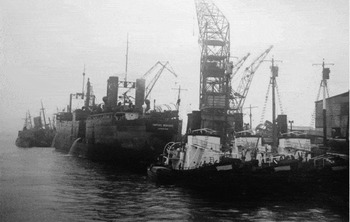
Of her catchers, Wiking I, II and III were taken (or more probably, processed) at Kiel on 18 October 1945 and Wiking VI, VIII, IX and X at Emden eleven days later. All were described as needing urgent overhaul and conversion back to their original, and for the second group still unfulfilled, economic function. Three were photographed next to a renamed Empire Venture and undergoing some sort of overhaul, but still without their harpoon guns, at the Howaldtswerke in 1945 (Fig. 1.) By 26 October the same three, presumably, had ‘recently been sailed to U. K.’ (B.N.C. in C. 1945).
The renamed Empire Venture with three catchers at the Howaldtswerke, Kiel, October 1945. (Courtesy of the Howaldtswerke archives).

Meanwhile the tankers division of the British Ministry of War Transport asked the ministry's man at the TMMC, Sir Andrew Common, to treat the whole matter as ‘top priority’ (R. Geddes Reference Geddes1945). A similar attitude was taken in the Kremlin, with Stalin becoming personally involved (Madsen Reference Madsen1998; Kuznetsov no date; Gan Reference Gan2009).
The reason for urgency was summed up by the British Minister of Food, Sir Benjamin Smith: ‘[d]uring the next twelve months both this country and the liberated countries of Europe will be in desperate need of fats’ (Smith Reference Smith1945; see also The Times (London) 23 March 1946: 4). All ten British whaling factories had been lost, and captured replacements would be deployed immediately if they were in working condition. It was also hoped that whale populations would have increased during the wartime interruption to the industry. Smith's omission of any reference to German needs was not accidental. Konrad Adenauer, the leader of the newly founded Christian Democratic Union, petitioned for part of the German whaling fleet to be retained in order to meet domestic needs. His plea fell on deaf ears (Adenauer Reference Adenauer1946).
Wikinger was renamed Empire Venture in October and sailed from Kiel on or about 5 November 1945 (Lohmann and Hildebrand 1956: 57/8). Empire Venture was reported by Lloyds List as entering British waters on 10 November. On 13 November she had reached Glasgow and by 18 November she was in the Clyde and bound ‘for Antarctic whaling grounds’. Lloyds List does not record the presence of any of her catchers, renamed Empire Viking I etc., in British waters in 1945. Some are shown by official documents to have passed through Britain; others may have sailed directly from Germany, after completing their refits, to catch up with the slower factory ship.
Empire Venture left the Clyde with only a week to go before the season opened (earlier than usual because of the food crisis). However, the British had known since at least 2 November that Wikinger (on TMMC documents) was about to be made Soviet property (Keenlyside Reference Keenlyside1945). Not surprisingly the Russians on the TMMC, many of whose fellow citizens were starving whereas the British were merely very hungry, were furious when they learned that their new whaling factory had been sent to the Antarctic on Britain's account for a minimum of five months, just three weeks before the formalities of distribution could be completed (Common Reference Common1945). They continued to protest for the first half of 1946 and the issue of captured whale catchers, in particular, remained a thorn in the side of the British government for several years.
After all the build-up, and despite the maximum extension which the British government could extract from the International Whaling Conference, Empire Venture did not enter Port Sunlight, Liverpool, at the end of May 1946 with a bumper catch. The Times had foretold ‘the coming dearth’ after ‘the failure of this winter's whaling in the Antarctic’ (The Times (London) 7 February 1946: 5). The actual figure was 62,640 barrels, or about 80% of her capacity and less than she delivered to Germany in 1939 (Norwegian Whaling Gazette (Sandefjord) October 1946: 256).
The TMMC had discussed but not resolved two difficult issues: the status of equipment ‘appertaining’ to individual ships that was found in German shipyards, and the disposal of income generated by ships in temporary use by one country before they were delivered to another. At the beginning of December 1945 there was readiness to compromise on both sides. The Soviet delegation ‘have definitely stated they do not want any fittings and that sp.[ecial] fittings must all be removed’ (‘D/A’ 1945). And British officials allowed that there ‘might be a case’ for sharing either the profits or the catch from Empire Venture's 1945–1946 season (Anon. 1945b).
But with nothing decided attitudes hardened during 1946. That summer the British removed the equipment which had been installed in Kiel or elsewhere, but which they had now earmarked for new factory ships or catchers. Then they handed Empire Venture and her catchers over to the Russians much as they had been found in 1945. Enough equipment was removed to deter British officials, at that point, from hiring the flotilla back for the 1946–1947 season (Hollyer Reference Hollyer1946c). The renamed flotilla consequently underwent a second refit at Soviet expense between the end of September and December 1946. Apart from complaints about the flotilla's generally run down condition, sources mention the removal by the British of electrical equipment, including gyrocompasses from four and sonar fish finders from five of the catchers. Pavel Rozhkov, who was there, reserved his strongest criticism for the withholding of anti-fouling paint (Bulkeley in press). According to him it was eventually donated (presumably via the proverbial ‘back of a lorry’) by shipyard workers from Newcastle (Rozhkov Reference Rozhkov1948).
The Ministry of War Transport wanted to stop the Russians obtaining new whaling equipment in Britain, on the grounds that they were not members of the International Whaling Convention of 1937, but the Board of Trade refused to go along with this (Hollyer Reference Hollyer1946b; Tannahill Reference Tannahill1948). In the event, however, much of the necessary equipment was shipped to Britain from the Soviet Union on the General Brusilov (Rozhkov Reference Rozhkov1948), which only reached Liverpool, via Szczecin, a major ship-building centre which had been in Soviet hands for 18 months, on 29 November. The eleventh hour dash by the Brusilov suggests that the extent of what the flotilla needed from home did not become known until after the handover, and is consistent with Rozhkov's claims about unofficial British obstruction. After heroic efforts by her people, Slava set sail for the second postwar season in the Antarctic on 22 December. Five of her catchers followed her from the Mersey within the next five days, but two remained in dry dock at the end of the year (Lloyds List; Solyanik Reference Solyanik1950). Repairs were completed at sea. On 28 January 1947 they killed their first whale (Voronin Reference Voronin1948).
Until recently little has been known about Slava's second refit, because most Soviet descriptions of the formation of the flotilla withheld even the basic facts presented in this section. The Soviet national press published, and foreign correspondents in Moscow relayed, the statement that the flotilla had sailed ‘from northern Russia’ (The Washington Post 26 December 1946; The New York Times, 26 December 1946). The senior flotilla director for Slava's first season was Vladimir Voronin, who captained several ships for the Arctic expeditions of Otto Schmidt between 1929 and 1934, went on to command the icebreaker J. Stalin at Murmansk during and after the war, and was seconded from that post to Slava for a single season. In 1948 he published a rather prosaic description of the voyage in which he explained the new techniques of pelagic whaling that were introduced in 1925 and even mentioned that Slava had been built in 1929, but avoided saying anything about her history or how she came to be in Soviet hands in 1946. In the same vein he described the role and skills of the harpoon gunners but omitted to mention that on this voyage the men in question were Norwegians (Voronin Reference Voronin1948). Such evasions were quite normal, in compliance with the chauvinist cultural orthodoxy that was established by Andrei Zhdanov in 1946, but it should be added that by 1948 Voronin was himself a member of the Supreme Soviet, a body chaired by Zhdanov until his sudden death in August that year.
The cosmetic approach to Slava's origins was taken to new lengths by Aleksei Solyanik, who took over as sole flotilla director and captain combined in 1947. According to Solyanik, the flotilla ‘went into construction’ after World War 2 under the auspices of the Soviet Ministry of Fisheries and the personal supervision of Stalin's close colleague Anastas Mikoyan (Solyanik Reference Solyanik1950: 3, 20). Elsewhere in his first pamphlet Solyanik mentioned that personnel and equipment were despatched from Leningrad to somewhere unstated, and that Soviet personnel had made an excellent job of equipping and preparing the factory ship at somewhere unstated. By omitting the true port of departure from his carefully constructed text Solyanik upheld what was by then, Rozhkov notwithstanding, a well established piece of misinformation (Solyanik Reference Solyanik1950: 17; see also Solyanik Reference Solyanik1952, Reference Solyanik1954). To this day some Russian sources report that Slava sailed from Leningrad in 1946, though fortunately others are better informed.
Lastly, Empire Venture had seven catchers in 1945–1946 but authoritative sources, including press reports from 1946 and Voronin (Reference Voronin1948), give Slava eight catchers in her first, 1946–1947 season. Only the seven received from the TMMC via Empire Venture appear outward bound in Lloyds List for 1946. Kuehn has stated that for the first season the seven ex-Wikinger catchers listed by the TMMC became Slava 8–10 and 2–5, but that Slava 1 was an ex-Walter Rau catcher received by the Soviet Union in February 1947 (Kuehn Reference Kuehn2002). The presence of Slava 1 at South Georgia that same month (see below) could be reconciled with this information if that catcher had perhaps been acquired (without passing through British hands) in time to be sent to join Slava at the end of 1946, but was not finally allocated by TMMC officials, with or without formal tripartite ratification, until early 1947. After all, the TMMC had previously endorsed British possession and deployment of the Unitas whaling factory after the fact, so perhaps the case of Rau ?/Slava 1 was handled in the same way. It makes this more plausible that there were several Rau (and other) catchers in the German Navy's 12th Anti-Submarine Flotilla, which operated in the eastern Baltic at the end of the war (Lohmann and Hildebrand 1956). Early acquisition of this catcher would explain its number and might also be consistent with, while not excusing, the press reports about the flotilla having sailed from Leningrad in December 1946. Rozhkov's wording also suggests that the General Brusilov was accompanied by another vessel.
The TMMC assigned further German catchers to Slava after January 1946, of which Wiking V was still laid up at Wilhelmshaven, in the British occupation zone, in 1948 (Anon. 1948). Two of the three replacement catchers which joined the flotilla for the 1947–1948 season probably came from outside the Soviet Union and one of the following season's replacements had been repaired in Britain, so that it may have been Wiking V (M. Buhl, personal communication, 28 November 2009). But due to political disagreements about the Inter-Allied Reparations Agency, which the Soviet Union decided not to join, the commission's second report was not completed until December 1947 and no further allocations were formally ratified by all three parties. After the first season Slava's catchers were sometimes renumbered or transferred to the north Pacific, so that tracing their identities becomes increasingly futile.
A hostile reception
To look at the Slava flotilla's (combined) ports of call on its first cruise, Gibraltar, Canary Islands, Ascension, Tristan, Grytviken, Port Stanley, Rio, Cape Verde Islands, Gibraltar, Malta, one might think it had been sponsored by the British government. In fact it was viewed with concern and even distrust by western officials from the outset. As one phlegmatic civil servant at the British Colonial Office put it, two days after Slava first sailed under her new flag, ‘we can, I think, expect some political results from this new trading venture’ (Barton Reference Barton1946). A colleague at the Ministry of Transport was slightly less reserved.
The fortuitous acquisition of [Wikinger] gave the Russians open access to an area in which the presence of Soviet vessels might otherwise have been regarded with more than an element of suspicion. . . . [W]e must consider the implications of an extension of Soviet activities in the Antarctic. . . .
On the political side, Foreign Office were concerned last year [1946] lest the Russians had any intentions of prospecting [for uranium? – author] or of landing in the Antarctic territories. . . . [W]ith the prospect that all-Russian crews will be employed in future years, there would be nothing to prevent their whaling expeditions being used as transports for landing parties. (Hole Reference Hole1947)
The removal of whaling equipment before Slava was handed over in 1946 reflects the British desire to restore their own whaling industry as soon as possible, together with lingering dissatisfaction with the Potsdam Agreement. But the Russians also faced a more gratuitous obstruction that year. On 21 December 1945 the Norwegian parliament had enacted a protectionist ‘crew law’ which made it illegal for Norwegian sailors, with their internationally respected and marketable whaling expertise, to work for foreign enterprises. Foreign Office concerns were allayed by an assurance from Oslo that the ban would only be used against ‘new’ whaling countries, a hypocritical notion since Norway had helped the Soviet Union to begin whaling in the north Pacific in 1933 and those operations had continued annually ever since (Anon. 1946; UK Foreign Office 1946; Berzin no date).
In August 1946 a senior Norwegian official, in the presence of his minister, further assured a British diplomat ‘that in any case Russians could not sail this season’ (Collier Reference Collier1946). Six weeks later the British Ministry of Transport still believed this (Hollyer Reference Hollyer1946a; see also The Times (London) 3 October 1946: 9). But the Soviet Union had recently helped to liberate northern Norway, and was currently exerting strong diplomatic pressure for changes to Norwegian sovereignty over Bear Island and the Svalbard Archipelago. On 29 November 1946 the Norwegian cabinet disregarded the advice of its whaling industry and allowed the Soviet Union to employ thirty Norwegian sailors on condition that it also joined the International Whaling Convention, which Soviet delegates were already in Washington to do.
The Soviet Union duly signed the new International Whaling Convention (IWC) on 2 December 1946 and placed the Slava flotilla under existing restrictions from the first season (The New York Times 3 December 1946; The Times (London) 7 May 1947). The Soviet Union then became the fifth signatory, out of fifteen, to deposit an instrument of ratification with the IWC secretariat, and the new convention duly entered into force for all its members in November 1948 (US Department of State 2009). In the end 54 Norwegians were employed in the flotilla for the 1946–1947 season as boat steerers, harpoon gunners and factory experts, out of a total complement of 433 people (Børresen Reference Børresen2004).
On the other side of the Atlantic, United States Antarctic policy was in a state of flux in 1946 and would remain so for several years thereafter. Its only constant element was the principle that, as Secretary of Defense James Forrestal expressed it in April 1948, ‘. . . it is imperative that sovereignty or active participation in control of the Antarctic . . . should be denied groups of nations which include our most probable enemies’ (US Department of State 1972 I: 972). But already, at Berlin on 7 December 1945, Admiral Robert Ghormley, USN, had put his signature to a document which gifted the Soviet Union with maritime and some political access to the Antarctic. Membership of the IWC may not have amounted to ‘participation in control’ of the entire region, but it was the first rung on the ladder.
Readers may wonder why the acquisition of Slava was so important, given that the Soviet Union's Aleut whaling factory had been operating in the north Pacific since 1933. Why had not Aleut already followed Norwegian and British whalers to the world's most abundant whaling grounds in the Southern Ocean? Aleut began life as the cargo ship Glen Ridge, built in the United States in 1919. She was sold to the Soviet government ten years later and converted into a whaling factory at Leningrad in 1931. After conversion she was about 5,000 gross registered tons (GRT) whereas Slava was 14,772 GRT and her displacement was 30,000 (Tauber Reference Tauber1949). Although she had a slipway, Aleut's smaller size meant that she could barely handle the largest prey species, the blue whale. Furthermore, the conversion had taxed Soviet shipbuilding skills and other resources to the limit, and was nearly abandoned at one point (Ivanitskii Reference Ivanitskii1990). The implication seems to be that Aleut was neither large enough nor, perhaps, sound enough to cruise some of the stormiest seas in the world for up to four months at a time, thousands of miles from the nearest friendly port. And crucially, Aleut was too small to provide a self subsistent, ocean going base for her catchers. There were Soviet ports for them in the north Pacific but none in the Antarctic. In that sense the Aleut flotilla was at best coastal or ‘semi-pelagic’. Slava, on the other hand, had been designed and built by leading experts in the industry to do everything that Aleut could not. Her destination was almost part of her specifications, so to speak.
There were two American initiatives towards Antarctica in 1946, and they were not closely coordinated. The first was the US Navy's Operation Highjump, which became one of the largest expeditions ever sent to Antarctica, with thirteen ships and 4,700 men, many of them raw recruits and few with any polar experience. As recorded at a planning meeting in August, the goals of the operation included ‘training personnel and testing material, consolidating and extending U.S. sovereignty over Antarctic areas, [and] investigating possible base sites’ (Rose Reference Rose1980: 40). The expedition was put together in some haste and sailed on 2 and 3 December 1946. Its various units returned to different American ports between February and April 1947.
The second American move in 1946 was a decision by the State Department to conduct a comprehensive review of US Antarctic policy. The review began in about November 1946 and was a response to several developments, including the renewed tension between Argentina, Britain and Chile arising from their conflicting claims to the Antarctic Peninsula, the perceived military threat from the Soviet Union, which might have to be confronted in the Arctic, and Operation Highjump itself, which raised widespread concerns among US allies in Europe and the southern hemisphere.
Although both the US Navy and the State Department also had other grounds for their actions in respect of Antarctica in 1946, the imminent arrival of a Soviet presence in Antarctic waters may have been high on their list of concerns. Significantly, it was Admiral George Dufek's flagship Pine Island itself which encountered the Russian whaling flotilla on 26 February 1947, about four weeks after the latter had first arrived in the Southern Ocean. ‘The Soviets proved unfriendly. . . . However, it may be that they were too busy to chat with the Americans. The seas roundabout the two ships “abounded” with whales . . .’ (Rose Reference Rose1980: 165).
From the second (1947–1948) season onwards, and perhaps even from the first (1946–1947), the flotilla carried a scientific team (Mikhailov and others 2002; Gan Reference Gan2009), directed at different times by meteorologist Georgii Tauber and biologist Viktor Arsen'ev among others. From the fourth season (1949–1950) the scientists were provided with a purpose built catcher, Slava 15, alias Gorbach (Humpback). At some point they began collecting mainly biological specimens for Soviet zoos and museums (Solyanik Reference Solyanik1950; Morskoi Flot (Moscow) 2 April 1952). But western officials were apprehensive about the flotilla's scientific activities from the outset, whether or not they involved the use of landing parties. Some of the Russians visited South Georgia in February 1947, and within weeks a British Foreign Office official had expressed to an American colleague his grave concern that one of the Soviet catchers was equipped for scientific research rather than for whaling (US Embassy 1947). The flotilla's practice of bunkering outward bound in the bay of Gibraltar, from Soviet tankers, also gave the Royal Navy a useful opportunity to inspect its component vessels (Rozhkov Reference Rozhkov1948).
According to Solyanik, the catcher which visited South Georgia was Slava 1 (1950; see also Voronin Reference Voronin1948; Tauber Reference Tauber1949). If unlike the rest of the flotilla she had been in Soviet hands, and perhaps at Leningrad, the home of the Arctic Research Institute, by mid–1946 (above), she would have been well placed to meet the requirements of scientists preparing to accompany the flotilla later that year.
But any inconsistency between the information conveyed by the Foreign Office and the time frame offered in Soviet accounts of the Slava science team is less significant than the rapid politicisation, or re-politicisation, of Antarctic science at the beginning of the cold war. The British had long regarded their own scientific studies of the region as enhancing their legal title to large parts of it, and this linkage immediately took on negative value when the studies in question were being carried out by the Soviet Union. Whatever international lawyers might say about mere discovery being insufficient to establish title to territory, diplomats were in practice reluctant to abandon the long held belief of governments that survey is closely connected with sovereignty. Indeed a Soviet jurist inadvertently vindicated British suspicions about Slava, a few years later, when he supported his country's right to participate in international decisions about Antarctica by mentioning, amongst other things, that ‘Soviet scientists are continually producing important scientific observations and discoveries in Antarctica, using the Slava whaling flotilla for a base’ (Molodtsov Reference Molodtsov1954: 16; see also Berg Reference Berg1949b: 137; Shvedye Reference Shvedye and Shvedye1949: 26–27; Grigor'ev and Lebedev Reference Grigor'ev and Lebedev1950: 8, 9, 15–16).
The British had carried out extensive scientific investigations in the 1920s and 1930s, the Discovery expeditions, that were closely connected with their Antarctic whale fishery (Ommanney Reference Ommanney1938; Coleman-Cooke Reference Coleman-Cooke1963). But the irony of their negative attitude towards the scientific activities of Slava is that the Discovery reports contained several positive references to research carried out by Norwegian scientists from the very same hull before World War 2, when it had sailed the selfsame waters as Vikingen. To give just one example, such a reference was even published in the same year that a British official penned the suspicious memorandum about Slava that was quoted above (Bargmann Reference Bargmann1947: 108).
Exploration, and landings in particular, by parties from the Slava flotilla were always viewed with concern by western governments. They took place at Gough Island and in the South Sandwich Islands in the fourth season, 1949–1950, in the South Sandwich Islands again in January and December 1957, and at the Balleny Islands in March 1958. One source stresses that Slava scientists never visited the mainland (A. Vvedenskii Reference Vvedenskii1972). The landings in 1957 and 1958 are thought to have been made by Slava 15, which confirms Solyanik's identification of her as (by then) the scientific catcher (Headland Reference Headland1989). The Soviet landing which caused the most alarm occurred at Zavodovski Island in the South Sandwich Islands on 16 December 1957. The reason was simple. Since 1908 the group had been claimed as British territory within the Falkland Islands Dependencies. The southern part of the group had been discovered by James Cook in 1775, but the three northernmost islands, also known as the Traversay group, had been discovered and named in December 1819 by an expedition of the Imperial Russian Navy, under the command of Bellingshausen. His flag captain, Ivan Zavodovski, led the shore party which explored the island named after him. Bellingshausen also surveyed the whole group thoroughly, which Cook had not been able to do, as the Royal Navy acknowledged (Hydrographic Department 1930). During the cold war this otherwise normal progression in the history of exploration played a part in Soviet arguments for the right to take part in any international arrangement for Antarctica.
The Bellingshausen problem
In the middle of the twentieth century several governments with territorial claims or other declared interests in Antarctica found themselves embarrassed by the fact that for some considerable time none of their citizens had actually visited the continent, whether in private or in state-backed expeditions. After 1945 some countries, including Australia, Chile, France and Norway, therefore began preparations for new expeditions and overwintering stations that, in addition to their scientific contributions, would restore the credibility of national Antarctic pretensions.
In 1819–1821 an expedition of the Imperial Russian Navy commanded by Captain Fabian von Bellingshausen, carried out extensive explorations in the Southern and Pacific Oceans and a circumnavigation of the Antarctic, in which more than thirty new islands were discovered and the mainland of Antarctica was almost certainly glimpsed, under unfavourable conditions, for the first time (Belov Reference Belov1963; Jones Reference Jones1982). As one historian long ago remarked: ‘[i]t is an exceedingly unfortunate circumstance that so little has ever been known outside Russia of Bellingshausen's great exploit. The voyage was a masterly continuation of that of Cook, supplementing it in every particular, competing with it in none’ (Mill Reference Mill1905: 129).
In January 1939 the Soviet government responded to a Norwegian order-in-council, which had placed a coastal sector of Antarctica under Norwegian sovereignty, by sending a note to Norway stating that it ‘would reserve its opinion as to the national status of territories discovered by Russian citizens’. As of 1946, however, no Russian expedition had visited the Antarctic for 125 years.
The postwar situation of the Soviet Union, vis-à-vis Antarctica, was considerably more difficult than that of other ‘absentees’, such as France or New Zealand, for two reasons. First, although the political status of Antarctica had not yet been resolved by an agreement between all interested parties, most of those parties regarded the continent as a sphere of exclusively western interest and were determined to keep it that way. Thus although the Soviet Union could simply have announced that it was sending a scientific expedition to Antarctica in the late 1940s, to do so would have sparked off a diplomatic crisis. There was no way around this obstacle until the early 1950s, when planning started for the IGY.
The second and more immediately tractable difficulty confronting Soviet Antarctic policy in 1946 was that although the Bellingshausen expedition was the only basis for the Soviet claim to participate in an Antarctic settlement, until quite recently Bellingshausen's achievement had been sadly undervalued in his own country.
Bellingshausen before 1940
Bellingshausen died in 1852; two obituaries appeared in 1853. Between that date and the establishment of the Russian Socialist Federative Soviet Republic in 1917–1918 Bellingshausen and the expedition were treated by only nine original publications in Russian, including three reports on a ceremony held in his honour at Kronshtadt in 1868. If derivative and repetitive entries in encyclopaedias are included, the number for this period goes up to 19 (Bellingshausen Reference Bellingshausen and Shvedye1949; Belov Reference Belov1963; Horensma Reference Horensma1991; Tryoshnikov Reference Tryoshnikov1963).
In the following period, between the successful struggle of Bellingshausen's native Estonia for independence, which was recognised in a peace treaty with the Soviet Union in February 1920, and its reannexation, which began in 1939 (incidentally under the direction of Andrei Zhdanov), the expedition fell into even greater obscurity. In those twenty years there was just one new publication in Russian, intended to mark the centenary of the expedition but seven years too late for it (Shokalskii Reference Shokalskii1928; but see also Sholkalsky [sic] 1924; S. Grigor'ev Reference Grigor'ev and Yakubovich1937).
In the early part of the twentieth century the Russian geographer Yulii Shokalskii had operated like a one member Bellingshausen Society. With Bellingshausen's book so rare as to be unobtainable he sent copies of the expedition's reports to the French explorer Jean-Baptiste Charcot, the Scottish explorer William Bruce, and the British historian Hugh Mill. Not surprisingly, when his study of Bellingshausen was finally published in Russian it had a lasting impact.
After comparing the expeditions of Cook and Bellingshausen in detail Shokalskii followed Mill (Reference Mill1905) in seeing them as complementary contributions to the discovery that Antarctica existed. Taken together, he thought, they had proved that no further temperate southern continent existed, besides Australia, and they had also shown that a polar continent almost certainly did (Shokalskii Reference Shokalskii1928: 193). Of the two men, Cook had the distinctions of historical priority and furthest southing, but Bellingshausen had covered more of the Southern Ocean beyond the Antarctic Circle and in the presence of pack ice. He concluded that Bellingshausen had done rather more than Cook to establish the approximate location and to demonstrate the positive reality, in the form of the Alexander I coast, of a polar continent. But Shokalskii never claimed that the expedition had discovered Antarctica, in the ‘Cortez moment’ sense of being the first people to see the continent, recognise it, and report it for what it was. Specifically, he described the expedition's two southings on 16 and 21 January 1820 (O.S.) and the sighting of land birds in February 1820, without claiming that land had been sighted, let alone a new continent discovered, on those occasions. (Julian dates are given for the expedition, to conform with Soviet practice until the early 1950s. In the late 1950s some authors began substituting Gregorian dates, thus reducing Bellingshausen's apparent lead of two weeks over Edward Bransfield to a more accurate two days.) At the time of the latter event, Shokalskii calculated, the expedition had been 150 nautical miles from the coast of Enderby Land, a distance which he rather freely described as ‘not that far away’ (Shokalskii Reference Shokalskii1928: 185). The highlights of the expedition had been the discoveries of Peter I island and the Alexander I coast in January 1821. Doubtless because of plausible prior sightings of northern parts of the Antarctic Peninsula by Edward Bransfield and Nathaniel Palmer, he described the second of the two Russian achievements simply as the first land seen ‘southward of the Antarctic Circle’ (Sholkalsky Reference Sholkalsky1924: 130).
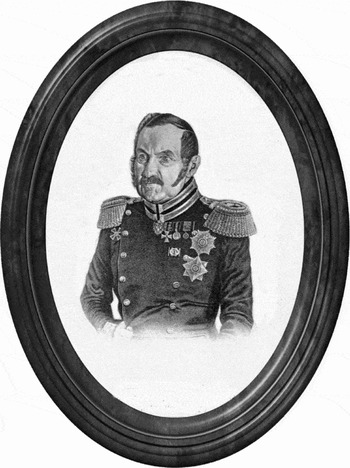
During the October Revolution, the civil war, and the factional struggles that surrounded Stalin's rise to power, some people slighted the expedition in ways that went beyond mere literary neglect. In 1867 a statue of Mikhail Lazarev, the captain of the expedition's second ship, Mirnyi, and a famous navigator in his own right, had been erected in Sevastopol with funds subscribed at his funeral in 1851. In 1928, the same year as Shokalskii's solitary article, Lazarev's statue was destroyed (with others) on the grounds that it was ‘lacking in historical significance’ (Anon. 2009). Bellingshausen's statue in Kronshtadt and bust in Irkutsk were not harmed, but his portrait, which used to hang in the Admiralty at St Petersburg, was lost without trace (Fig. 2).
Vice Admiral F. G. von Bellingshausen circa 1835. From Mill (Reference Mill1905).

Even if items published in Bellingshausen's lifetime and further editions are added to his publications tally, the bibliography for the expedition in Russian from 1821 to 1939 comes to only 36 entries. By contrast a 1928 bibliography of James Cook listed at least 1,500 (unnumbered) entries (Mitchell Library 1928). Perhaps 70% to 80% of that total should be taken out of the comparison, being unpublished manuscripts, translations, multiple editions, original but non-English material, or non-literary items such as medals, portraits etc. A further adjustment to compensate for the different time spans of the two surveys would leave Cook with a score of about 240 and Bellingshausen with, say, 40 (to allow for possible omissions) separate and original publications in English and Russian respectively. The difference is striking.
Bellingshausen's first rehabilitation, from 1940 to August 1948
Neither of the two relevant articles in the Bolshaya Sovyetskaya Entsiklopediya published in 1927 and 1940 claimed that the Bellinghausen's expedition had been the first to discover Antarctica (1st edition 5: 331–332, 46: 387–388). But from 1940 the treatment of the subject began to change. The Soviet Union had just declared its political interests in Antarctica. Added to which it had just reannexed Estonia and fought a war with Finland. Patriotism, not communism, was now the order of the day. Between 1940 and 1949 18 new items joined the Bellingshausen bibliography, almost the same number in a single decade as had appeared, by the most generous reckoning, between his death and 1939. If reprinted nineteenth century items and multiple publications of new ones are included, in strict bibliographic style, the total for the 1940s comes to at least 36 items, about equal to the number of all previous Russian publications on the expedition. Nor were all the new items merely ‘pot-boilers’ and wartime propaganda. Serious scholarship was also represented, firstly by the discovery and publication of a previously unknown report by the expedition's chief scientist, Ivan Simonov, and secondly by the preparation and publication of a long overdue second edition of Bellingshausen's book, this time complete with illustrations and scholarly apparatus, and in 20,000 compared with the original 600 copies (Bellingshausen Reference Bellingshausen and Shvedye1949). The book was quite generously priced at 14.5 roubles, compared with a 3 rouble pamphlet in 50,000 copies (Golubyev Reference Golubyev1949) or an 8 rouble book in 25,000 copies (Sementovskii Reference Sementovskii1951) on the same subject. For comparison a tertiary level textbook on dialectical materialism from this period was printed in one million copies.
The cultural rehabilitation of Bellingshausen in the 1940s was not just a matter of the quantity and quality of material produced. There was another key component. Whereas previously the word most often applied to his achievements had been ‘circumnavigation’, from 1941 onwards it became ‘discovery’, as in ‘first discovery of Antarctica’.
In the 1940s, however, two awkward facts confronted Soviet commentators seeking to upgrade the national and international status of the expedition. The first was that although the British explorer James Cook claimed to have disproved the existence of a southern continent distinct from Australia but located in temperate latitudes, he had also repeatedly asserted his belief in the existence of a (fairly useless) polar continent, which, he said, he might well have seen himself (Cook Reference Cook1777 II: 192). The second problem was that an American sealer, Nathaniel Palmer, could plausibly be said to have sighted and reported the Antarctic Peninsula in November 1820. If accepted, as it was by many western scholars, Palmer's achievement predated the expedition's incontestable discoveries of Peter I island and the Alexander I coast (so close to the ice-choked south-western shores of the Peninsula that it was only discovered to be, in fact, an island in the 1930s) in January 1821.
After Shokalskii died in March 1940 his enlightened plea for the Cook and Bellingshausen expeditions to be seen in the context of their day was largely ignored, as was the distinction between an undiscovered temperate continent, widely conjectured from the 16th to the 18th centuries, and an undiscovered polar one, about which only geographers and scientists had had much curiosity. Shokalskii mentioned the distinction, so vital to understanding both expeditions, but had not gone out of his way to underline its importance.
As far as it is possible to judge from a limited sample of the literature, the rehabilitation of Bellingshausen in the 1940s and early 1950s went through two distinct phases. The turning point came on 9 August 1948, when the United States sent an aide-mémoire to the seven countries which had made territorial claims to sectors of the Antarctic continent, Argentina, Australia, Chile, France, New Zealand, Norway and the United Kingdom, proposing that they should renounce their separate claims and join the United States in forming an exclusive eight power condominium to assume collective sovereignty over Antarctica.
An example of the presentation of the expedition before August 1948 is the article ‘On the question of Russian discoveries in the Antarctic’ by N. Vvedenskii (Reference Vvedenskii1941). Vvedenskii began by describing Cook's second expedition as having spent 1,003 days in the southern hemisphere, 75 of them beyond 60° S and 80 in the presence of ice, adding that these figures were familiar to Bellingshausen and a stimulus to his efforts. They were in fact Shokalskii's figures, and there is no evidence that Bellingshausen himself ever subjected his predecessor to such a comparison. Disregarding the normal progress of geographical knowledge, Vvedenskii proceeded to contrast Bellingshausen's thorough survey of the South Sandwich Islands with Cook's limited sighting but characteristically competent location of Sandwich Land. In doing so he made no bones about ignoring Cook's remark that ‘I concluded that what we had seen, which I named Sandwich Land, was either a group of islands, or else a point of the continent.’ (Cook Reference Cook1777 II: 205 emphasis added).
The main thrust of Vvedenskii's article was a reasonable contention that the expedition's sighting and naming of the Alexander I coast in January 1821 had amounted to an encounter with the mainland of Antarctica, coupled with the claim that this event had been the first discovery of the continent. Unfortunately the second and politically crucial part of his thesis depended on less creditable arguments. The claim by Edward Bransfield, RN, to have sighted the mainland in January 1820 was simply ignored. The claim by Nathaniel Palmer to have done so in November 1820 was disallowed, on the grounds that Palmer had not been engaged on a properly constituted voyage of exploration at the time (N. Vvedenskii Reference Vvedenskii1941: 122). And thirdly, just after hailing Bellingshausen as the first explorer to discover Antarctica, Vvedenskii removed Cook from the picture with the carefully selected quotation marked as (C) in Box 1 below (N. Vvedenskii Reference Vvedenskii1941: 121).
Box 1: Selective Soviet quotations from Cook
Phrases and sentences selectively quoted by Soviet authors in the 1940s and 1950s are in italics.
Other parts of these passages were available only in the 1948 Russian translation of Cook's Voyage (Cook Reference Cook1948).
(For the underlined phrase, see text)
(A) ‘I was now well satisfied no continent was to be found in this ocean, but what must lie so far to the south, as to be wholly inaccessible on account of ice; and that if one should be found in the southern Atlantic Ocean, it would be necessary to have the whole summer before us to explore it. . . . . . .[But] though I had proved that there was no continent but what must lie far to the south, there remained nevertheless room for very large islands in places wholly unexamined. . .’ (Cook Reference Cook1777 I: 262)
(B) ‘I had now made the circuit of the southern ocean in a high latitude, and traversed it in such a manner as to leave not the least room for the possibility of there being a continent, unless near the Pole, and out of the reach of navigation. . . . Thus I flatter myself, that the intention of the voyage has, in every respect, been fully answered; the southern hemisphere sufficiently explored, and (C)a final end put to the searching after a southern continent, which has, at times, ingrossed the attention of some of the maritime powers, for near two centuries past, and been a favourite theory amongst the geographers of all ages.
That there may be a continent, or large tract of land, near the Pole, I will not deny; on the contrary I am of opinion there is; and it is probable that we have seen a part of it.’ (Cook Reference Cook1777 II: 192)
‘For I firmly believe that there is a tract of land near the Pole which is the source of most of the ice that is spread over this vast southern ocean. I also think it probable that it extends farthest to the north opposite the southern Atlantic and Indian oceans; because ice was always found by us farther to the north in these oceans than any where else, which I judge could not be, if there were not land to the south; I mean a land of considerable extent. . . . It is true, however, that the greatest part of this southern continent (supposing there is one), must lie within the polar circle, where the sea is so pestered with ice, that the land is thereby inaccessible. (D)The risque one runs in exploring a coast, in these unknown and icy seas, is so very great, that I can be bold enough to say that no man will ever venture farther than I have done; and that the lands which may lie to the south will never be explored.’ (Cook Reference Cook1777 II: 206)
‘. . .Lands doomed by Nature to perpetual frigidness; never to feel the warmth of the sun's rays; whose horrible and savage aspect I have not words to describe. Such are the lands we have discovered; what then may we expect those to be which lie still farther to the south? For we may reasonably suppose that we have seen the best, as lying most to the north. (E)If any one should have resolution and perseverance to clear up this point by proceeding farther than I have done, I shall not envy him the honour of the discovery; but I will be bold to say, that the world will not be benefited by it.’ (Cook Reference Cook1777 II: 216).
‘. . . this, perhaps, is a circumstance from which the curious reader may infer, that the purposes for which we were sent into the Southern Hemisphere, were diligently and effectually pursued. (F)Had we found out a continent there, we might have been better enabled to gratify curiosity; but we hope our not having found it, after all our persevering researches, will leave less room for future speculation about unknown worlds remaining to be explored.
But, whatever may be the public judgment about other matters, it is with real satisfaction, and without claiming any merit but that of attention to my duty, that I can conclude this account with an observation, which facts enable me to make; that our having discovered the possibility of preserving health amongst a numerous ship's company, for such a length of time, in such varieties of climate, and amidst such continued hardships and fatigues, will make this voyage remarkable (G)in the opinion of every benevolent person, when the disputes about a Southern Continent shall have ceased to engage the attention, and to divide the judgment of philosophers.’ (Cook Reference Cook1777 II: 257–258)
Vvedenskii's dismissal of Palmer accorded with a slightly later Soviet statement about the credentials for geographical discovery.
Geographical discovery means a visit by representatives of some civilized people to a new part of the earth's surface, previously unknown to world culture, or the establishment of a spatial connection between parts of the earth's surface which were already known’ (Magidovich Reference Magidovich1949: 3).
But such a criterion did not rule out Edward Bransfield, who had explored the South Shetland Islands as an official servant of the British government in January 1820. Magidovich allowed that an authorised person could make a geographical discovery by chance, as Bransfield may have sighted the Antarctic Peninsula, but himself believed that Antarctica was discovered by Bellingshausen and through a deliberate and strenuous effort. Unfortunately for the present enquiry Magidovich only discussed the expedition in detail in 1957, by which point the Russian discovery of Antarctica had been unassailably brought forward from January 1821 (Alexander I coast) to January 1820 (future Princess Martha coast), and his interesting but risky methodological introduction was dropped. Magidovich naturally complied with the reigning orthodoxy (Magidovich Reference Magidovich1957: 510–516).
A second, shorter pre–1948 account of the expedition contrasts significantly with later work by its author. In 1946 Lyov Berg, who had succeeded Shokalskii as president of the Soviet Geographical Society, published a history of Russian geographical discoveries. It contained less than two pages, out of some 350, about the expedition, in which Berg merely cited and followed Vvedenskii in identifying Bellingshausen's discovery of the Alexander I coast in January 1821 as the first discovery of Antarctica. No words were wasted on discussing rival claims (Berg Reference Berg1946: 109–110).
The essence of what historians write is sometimes revealed in what then gets written by those who consult them. Even as late as mid–1948 both the director of the Slava whaling flotilla and a captain of one of the catchers could publish accounts of their first season which simply mentioned that Bellingshausen had visited South Georgia in 1819, or had explored the region, and said nothing at all about the expedition having discovered Antarctica (Voronin Reference Voronin1948; Rozhkov Reference Rozhkov1948). That sort of casual treatment would not recur.
Bellingshausen's second rehabilitation, after August 1948
After the American démarche of August 1948 a second, more radical rehabilitation of Bellingshausen was set in hand. The new presentation of the expedition comprised three elements: first, a stronger denigration of Cook, often signalled with the phrase ‘Cook's mistake’; second, the advancement of the Russian discovery of Antarctica from January 1821 to January 1820, which effectively disposed of Palmer and placed Bellingshausen in serious contention with Bransfield, whether or not the latter was mentioned by name; and third, the production of a substantial body of scholarly work on the expedition, including learned commentaries and the publication of several rare or previously unpublished nineteenth century texts.
The campaign opened with a lecture by Lyov Berg to a general meeting of the Soviet Geographical Society on 10 February 1949. The meeting also passed a resolution urging the nation to defend the achievements of Russian explorers, who had so brilliantly confounded the attempts of James Cook and other foreigners to deny the existence of Antarctica, and calling on the Soviet government to reaffirm its right to take part in any decisions about the political future of the region. The resolution and a summary of Berg's lecture appeared in Izvestiya the following day and the meeting was also reported in Pravda and throughout the Soviet press (Berg Reference Berg1949c). A summary in the popular magazine Nauka i Zhizn [Science and Life] in March was shorter and less political than the one in Izvestiya.
The lecture triggered a wave of support from all parts of the union. A month later Berg sent a cable to the ‘heroic . . . Soviet Antarctic Fleet’ thanking them for material supplied to the Leningrad Zoological Museum, which demonstrated ‘how remarkable are the successes which the Soviet whalers are trying to achieve, and how abundant is the technical equipment of our expeditions’, and calling for more. ‘We await your communications. The scientific public of the country must know of your voyage . . .’ etc. (Izvestiya (Moscow) 22 March 1949 in (Berg Reference Berg1949c); see also Pravda (Moscow) 20 June 1949). The society held further meetings on the subject at Leningrad in April and June, and at Moscow in April. Scientists from Slava gave speeches at the latter that were ‘greeted warmly’.
The text of the lecture was published twice in March (Berg Reference Berg1949b) and twice again that year, once as a chapter in (Berg Reference Berg1949a) that was ten times longer than his treatment of the expedition in the first edition (Berg Reference Berg1946), and once as a pamphlet. After Berg's death in December 1950 it appeared again as the keynote piece in an anthology with a similar title (Sementovskii Reference Sementovskii1951). Except for Berg's 1949a account the different versions included a positive reference to the Slava flotilla on the first page and were essentially the same. In Berg (Reference Berg1949a) the political rallying cry which ended the original lecture was dropped and the text was given a more erudite opening, about the speculations of Aristotle and Ptolemy, and a closing geographical and economic section which ended with a reference to Slava.
Berg illustrated ‘Cook's mistake’ with the selective quotations shown as (A), (B) and (E) in Box 1, citing the newly available Russian translation only for quotation (A) (Cook Reference Cook1948).
Surprisingly, perhaps because at the age of 72 he was indifferent to consequences, Berg showed little enthusiasm for the key component in the revised version of the expedition, the new timing of the discovery. Although he quite properly identified the encounters with ‘ice mountains’ on 16 January and with birds on 5 February 1820 (O.S.) as dates on which the expedition had approached the mainland, he never expressly referred to either event as the discovery of Antarctica. He commented quietly that the proximity to land of both positions was only something which was ‘now clear’ or which ‘we now know’ (1949b: 141). And in his 1949a account (Berg Reference Berg1949a: 181), but nowhere else, he even discussed whether the continent had actually been seen either by the expedition in January or February 1820, or by Palmer in November 1820. His assessment was that in the first case it probably was, as several later historians have also concluded (Jones Reference Jones1982), but that in the second case it was hard to tell whether Palmer had seen the mainland or an island.
Overall, by avoiding the harder challenge posed by Bransfield and by treating the discovery of Antarctica as something achieved by the whole expedition over two seasons, rather than by any particular sighting, Berg preserved much of Shokalskii's earlier internationalist assessment of the expedition underneath a superficially nationalist presentation. All that separated them was, first, Berg's cryptic way of putting things, so typical of intellectual practice in that time and place; second, the extraneous political rhetoric with which, perforce, he accompanied the historical substance of his text; and lastly, the disparagement, however restrained, of Cook. Berg may even have initiated the practice of placing Cook's Sandwich Land in scare-quotes, merely because Bellingshausen had shown it to be the island group that Cook himself had suspected (see also Shvedye Reference Shvedye and Shvedye1949). Needless to say, no Soviet author would have dared to administer a taste of the same medicine to Bellingshausen's equally ‘mistaken’ but equally unobjectionable Alexander I coast.
Other champions of the new orthodoxy were less restrained than Berg. The polar historian Aleksandr Andreyev simply announced that the Russian discovery of Antarctica had taken place a year earlier than was previously believed (Andreyev Reference Andreyev and Andreyev1949: 8; see also Pravda (Moscow) 1 April 1949: 4). Rear-Admiral Yevgenii Shvedye, Bellingshausen's editor, at first appeared to agree with Debenham that Bellingshausen had seen the mainland in January 1820 without realising what it was (Debenham Reference Debenham and Bellingshausen1945: xviii–xx). But Shvedye nonetheless declared that this amounted to discovering the continent of Antarctica and thereby establishing Russian priority. In support of that conclusion he quoted from a recent article about Slava's second, 1947–1948 season by the flotilla's meteorologist, Georgii Tauber, which described the excellent view of the Princess Martha coast which had been obtained on 20 March 1948 from roughly the same position that the expedition had reached on 21 January 1820 (O.S.) (Tauber Reference Tauber1949: 370). In quoting Tauber, however, Shvedye omitted his source's identification of the discovery with the expedition's second, inconveniently ‘post-Bransfield’ approach to the continent, edited out Tauber's comment that Bellingshausen had only been able to see ‘a narrow strip of the foreshore’, and then covered his tracks by leaving the actual source unstated (Shvedye Reference Shvedye and Shvedye1949: 26–28). Like Debenham, Tauber had also explained why modern steam powered ships were more likely to encounter good visibility than sailing ships had been, but Shvedye had no use for that part of his comments either.
According to Golubyev, on 16 January 1820 (O.S.) Russian sailors became the first people to approach the shores of Antarctica and that was that. What is more the governments of England and France, in particular, had been ‘annoyed and offended’ by the prowess of Russian explorers (Golubyev Reference Golubyev1949: 24, 61). However, no evidence was produced for this allegation. In Solov'ev's version, the mariners of ‘West European’ countries had been battling through the bleak, icy wastes of the Southern Hemisphere for 300 years in a vain endeavour to reach the mysterious land of Antarctica, until Cook convinced them they were wasting their time. Then along came the expedition, which approached its shores on that officially memorable day. Because ‘Russian scientific ideas were superior to the geographical thinking of the West’, its members had known at the time precisely what they were achieving (Solov'ev Reference Solov'ev and Sementovskii1951: 3). So it had been a Cortez moment after all, and a progressive one at that.
Shvedye and Golubyev both used the phrase ‘Cook's mistake’, with Shvedye adding ‘fatal’. Solov'ev hardly needed to. Shvedye used the quotations (B), (F) and (G) from Box 1, linking them with a paraphrase of (E). Golubyev referred to Sandwich Land without scare-quotes and opted for (B) plus most of (C). Solov'ev chose (B), the underlined part of (C), and (D).
Golubyev also attributed ‘Cook's mistake’ to his lack of interest in science, whereas the expedition had been scientific through and through (Golubyev Reference Golubyev1949: 22–23). It is true that one of Cook's typically imprudent remarks had been a deprecation of his own scientific abilities, and Bellingshausen's Stalinist champions were unlikely to make allowances for the subtleties of English understatement. They should however have known that Cook was a Fellow of the Royal Society and a recipient of the Copley Medal.
By including quotation (B) these post–1948 commentators did at least allow Cook his reservation ‘unless near the Pole’. Unfortunately, even after doing him that much justice, someone as knowledgeable as Shvedye could still pronounce, with no evidence, that ‘as a consequence of Cook's fatal mistake, in the late 18th and early 19th centuries the conviction reigned that no such thing as Antarctica existed’ (Shvedye Reference Shvedye and Shvedye1949: 8; see also Shvedye Reference Shvedye1958: 6). But one has only to read Weddell's book to realise that on the contrary, Cook or no Cook, mariners of that period were still quite open minded about the possibility of a polar Antarctic continent (Weddell Reference Weddell1827).
In a world supposedly bamboozled by Cook it made little sense for the enlightened expedition to have spent a month in England in order to acquire charts and instruments and to consult the Royal Society and the Royal Navy. So most writers spared their readers that information and simply moved Bellingshausen from Kronshtadt to the South Atlantic via Rio de Janeiro. There was no point in Shvedye doing this in his introduction, since his author Bellingshausen was about to describe the visit to England in his first chapter.
In January 1950 60,000 copies of a separate pamphlet on the priority question were printed at 60 kopeks apiece, almost one day's wage on a collective farm but less than the price of a 1lb loaf of rye bread. The work of the Slava flotilla was noted on four of its 14 pages, and twice before any reference was made to the expedition. The experiences of the expedition on 16 January 1820 (O.S.) were enhanced with an interpolated phrase, but the claim remained essentially the same. The only newish argument was the contention that until the 1930s Bellingshausen's priority had been accepted around the world. No examples, Russian or foreign, were produced to support this. Two years later another popular pamphlet was issued for the centenary of Bellingshausen's death (Ivanov and Golovanov Reference Ivanov and Golovanov1952).
One dissenter from the new, ‘early discovery’ version of the expedition should also be mentioned, if only in view of his contribution to the recent unmasking of Soviet whaling practices. In the early 1950s the young cetacean biologist Vyacheslav Zemskii stuck firmly to the more conservative account of events that had been given by Vvedenskii in 1941 and was tacitly endorsed by Berg in 1949 (above). Despite elevating Cook's mistakes to ‘manifold’, perhaps to gain political leeway, Zemskii bluntly stated that the expedition had not been able to discover land in January or February 1820 (Arsen'ev and Zemskii 1951: 4,5; Zemskii Reference Zemskii and Kotlyar1952: 265–266).
On 7 June 1950 the Soviet government sent a note to the United States and six of the seven governments with territorial claims in Antarctica, in which it adopted the recommendations and arguments of the Geographical Society. The claim to first discovery was repeated, but now the expedition became ‘the first people who reached’ and not merely ‘approached’ the shores of Antarctica. Soviet whaling interests in the region were also mentioned (Solov'ev Reference Solov'ev and Sementovskii1951: 5–6).
Much of the Soviet priority campaign of 1949–1952 was bluster, plausible bluster as regards the expedition, it turned out several years later (Kucherov Reference Kucherov1962; Belov Reference Belov1963; Armstrong Reference Armstrong1971), but bluster nevertheless. The reason why nothing later than 16 January 1820 (O.S.) would meet Soviet requirements after August 1948 was partly that Edward Bransfield, RN, had rather convincingly claimed to have seen the Antarctic mainland on 30 January 1820, two days later. But it was also about something larger than that. In the late 1940s and early 1950s Soviet cultural life was dominated by the insecure obsession with Russian superiority and priority in all cultural spheres that had been promulgated by Andrei Zhdanov (Counts and Lodge Reference Counts and Lodge1949; Lyons Reference Lyons1954; Anon. 1958). Accordingly, the Soviet Union proposed to inherit more than just an honourable share in the discovery of Antarctica. By all honest measures it already had that. What it demanded from history was the lion's share, priority.
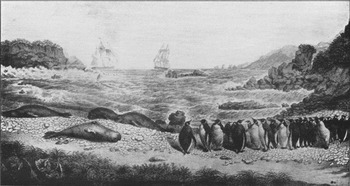
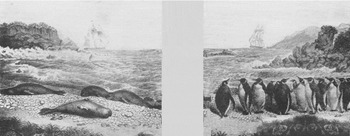
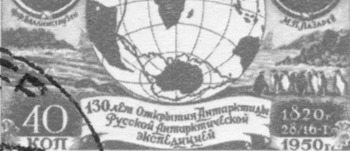
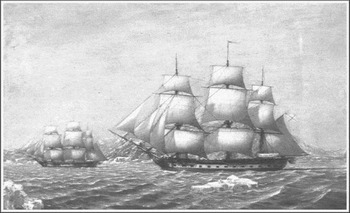
The American political move on Antarctica in 1948 was plainly anti-Soviet in its intentions, but the cultural overkill with which it was resisted from Moscow could not have been anticipated. In October 1950 the reshaping of history was epitomised in a 40 kopek stamp, issued for the 130th anniversary of the discovery of Antarctica on ‘28/16 January 1820’. The designer, V. Zav'yalov, represented the event by rearranging a sketch which had been drawn by the expedition's artist Pavel Mikhailov at Macquarie Island, which lies about 1,600 km away from Antarctica at 54°37′53″ S and was crowded with busy sealers at the time of the expedition's visit in November 1820 (Box 2). Conveniently for the subterfuge, this charming and dramatic image had been omitted from Bellingshausen (Reference Bellingshausen and Shvedye1949).
Box 2: How Macquarie Island replaced Antarctica
Pavel Mikhailov: The Vostok and Mirnyi off Macquarie Island. November 1820. From Bellingshausen's Atlas volume via Mill (Reference Mill1905).

Simulation of some of the changes to Mikhailov's sketch, including trimming, stretching, and moving one sloop and the penguins, that were made in the artwork for the 1950 stamp below.

Part of the 40-kopek stamp issued in October 1950 to mark the 130th anniversary of the expedition's discovery of Antarctica.

After 1952 the ‘Bellingshausen industry’ fell suddenly quiet. Having produced 27 items in four years, several of them substantial, it managed only six more during the rest of the 1950s. Between 1953 and 1955 there was only one. The expedition was barely mentioned any longer in the Proceedings of the Geographical Society. And in 1960 only 3,000 copies of the third edition of Bellingshausen's book were printed, a drop in the ocean by Soviet standards (Bellingshausen Reference Bellingshausen and Shvedye1960).
There were several reasons for this. The political goal of establishing and justifying a national policy had quickly been achieved, even if the Ministry of Foreign Affairs had needed to shove the geographers over the line, so to speak, with the word ‘reached’. In the process, everything that required to be said had apparently been said. There was, after all, only so much political and literary mileage to be extracted from the rather brief and vaguely described experiences of the expedition on a handful of days 130 years ago, however valiant and significant those experiences had undoubtedly been. A more positive reason was that at long last Soviet information managers had something else to talk about in the Antarctic, namely Slava.
Glory: the transfiguration of Slava
For better or worse Slava's political heyday, from 1948 to 1959, was inextricably linked with the person of flotilla director Aleksei Nikolayevich Solyanik. He was born in Primorsk, the district around Vladivostok, on 2 November 1912, as the son of an army sergeant. He went to sea at 14 and was appointed director of a Pacific fishing fleet in 1938 (during the turmoil of the great purge). Aleksandr Dudnik, the legendary director of the Aleut whaling flotilla, is said to have recognised his considerable abilities at about that time (for information on Solyanik's life see Berzin Reference Berzin2008; Chornyi Reference Chornyi2003; Clapham and Ivashenko Reference Clapham and Ivashchenko2009; Ivanitskii Reference Ivanitskii1990; Katkevich Reference Katkevich2003; Mlechin Reference Mlechin2004, see also Reference Mlechin2009; Poizner Reference Poizner2006; Sakhnin Reference Sakhnin1965; Skripnik Reference Skripnik2004).
Solyanik must have demonstrated complete political reliability and some linguistic skill, because during World War 2 he worked abroad, including three years spent supervising repairs to Soviet fishing and transport vessels, including the Aleut flotilla, at Portland, Oregon (Bollinger Reference Bollinger2003 for background). In 1945 he returned from the United States to Odessa before joining a government commission in Poland and Germany which may have been connected either with the Potsdam process and the TMMC, or else with unilateral acquisitions of captured shipping. His detractors claim that he used underhand methods to block Dudnik's appointment as Slava flotilla director in 1946 and to remove Voronin a year later. But while he was more than capable of such machinations, the case against him on those two counts has not been established. Dudnik may simply have been a respected consultant for the planning phase at Leningrad. And Voronin, one of the country's most experienced ice captains but with no fisheries experience, was almost certainly assigned as senior co-commander only to safeguard a valuable national asset for the first season.
Solyanik was made a Hero of Soviet Labour in 1950 and received the Order of Lenin three times in recognition of his economic and political achievements with the Slava (1946–1959) and Sovyetskaya Ukraina (1959–1965) whaling flotillas, which he commanded jointly as a sort of ‘whaling tsar’ for several years. The responsibility and status of that position is shown by the fact that Sovyetskaya Ukraina was the largest vessel in the Soviet merchant marine and the largest whaling factory in the world (Harbron Reference Harbron1963). He became a member of the Supreme Soviet of the Ukrainian Republic, and socialised with the national elite, for whom the Black Sea coast was a holiday playground. He married a film actor twenty-five years his junior, Svetlana Zhivankova, who sometimes sailed with him in the 1960s, on the payroll. After his disgrace in 1965 (see below) he was given command of the Aleut sized deep sea fishing vessel Van Gogh, based in the Soviet far east. In 1968 he returned both to the Southern Ocean, at the Kerguelen Islands (Kukharev and others Reference Kukharev, Piotrovskii, Timokhin and Ivanin1998), and to controversy, in the Gulf of Carpentaria (Anon. 1968). His wife left him for a marine scientist. He retired in 1984 after 58 years service.
From the late 1940s Soviet authors drew frequent parallels between the presence of Slava in the Southern Ocean and the precedent set by the expedition over 125 years earlier. In January 1951, for example, a popular magazine included a sketch of the flotilla in a routine tribute to the expedition (Adamov Reference Adamov1951). But on the basis of their main subjects, only five books or periodical articles were devoted to Soviet whaling between 1949 and 1951, as against 25 about the expedition (not counting the reprints of Berg's lecture in 1949).
From about 1951 the basis for Soviet Antarctic pretensions was altered to encompass present activities in the region as well as former ones. Although the expedition was never dropped from the argument, the spotlight shifted first to the Slava flotilla, in particular to its scientific activities, before moving on in the mid–1950s to the annual expeditions of the IGY.
At the end of 1951 two scientists who had worked on the flotilla published an extensively illustrated book called In the Land of Whales and Penguins, which remained in print for several years (Arsen'ev and Zemskii 1951). Without including its further editions there were 14 books or articles either about Antarctic whaling or by flotilla scientists between 1952 and 1959, but only nine about the expedition. Although the author has seen only five of the nine whaling items written for the general public in this period, it is reasonable to assume that all made the connection with Bellingshausen. After all, although Cook had reported seeing ‘many whales’ at the edge of the pack and/or below the Antarctic Circle, once as far south as 67° (Cook Reference Cook1777 I: 61–62), for Soviet purposes it had been the ‘attentive observer’ Bellingshausen who first described this phenomenon 54 years later (Zenkovich Reference Zenkovich1954: 339).
Four of the popular items were written by (or for) Solyanik and one was an anthology of pieces by flotilla workers (Kotlyar Reference Kotlyar1952). A Pravda correspondent, Vasya Reut, accompanied the first voyage, and over time the flotilla received so much publicity in the national press, some of which was cited in the previous section, that Solyanik's name ‘resounded throughout the country’ (Mlechin Reference Mlechin2004: 407). Together with the earlier literature about the expedition, the publicity given to Slava was a textbook example of the adage that foreign policy begins at home.
The Soviet public had a phenomenal appetite for reading matter in those days, but the political value of the flotilla went beyond the printed word. As the Soviet Union's Arctic publicity had shown for many years, live citizen-heroes could provide material with more outreach and immediacy than any history book. The first documentary film, Whaling in the Antarctic, appeared very soon after the first expedition (Katkevich Reference Katkevich2003). Another, Soviet Whalers, directed by Irina Zetkina in 1951 and with commentary by Solyanik, was mainly shot with Slava but added footage from the shore based Kurile Islands flotilla. Solyanik was also featured in at least ten Ukrainian newsreels, some devoted exclusively to his flotilla, between 1949 and 1955, and others were doubtless made elsewhere in the union. The annual welcome and farewell to the flotilla were captured by Soviet artists with all the visual rhetoric of the time, for example by V. Zaichenko in ‘Welcoming Slava in Odessa Harbour’ (1954, now in the Odessa Historical Museum) and by W. Makrozhitskii in ‘Saluting the Sailors’ (1958, now in the Kendall Whaling Museum). In 1955 the community was even celebrated in an operetta, White Acacia, created by three leading Soviet writers for the stage, lyricists Vladimir Mass and Mikhail Chervinskii and composer Isaac Dunayevskii. One of its songs became and remains the unofficial anthem of Odessa. A film version was directed by Georgii Natanson in 1958, too late to make much contribution to Soviet Antarctic policy leading up to the treaty. The opera was revived in Moscow in 2008.
The annual political jamboree for the return of the flotilla inspired not only artists but also vivid passages in the memoirs of Odessa whalers. Typically, there would be an informal dockside welcome by families and friends, followed by a full scale political rally and a parade (Rozhkov Reference Rozhkov1948). The city would also hold a public holiday for up to three days. The whalers had their own bi-weekly newspaper, their own housing estate and special shops, and successful harpoon gunners were feted ‘like astronauts’ (Katkevich Reference Katkevich2003). The flotilla came to boast several more Heroes of Socialist Labour besides Solyanik.
But although such matters were important for the civic pride of Odessa, and for that keystone of the Soviet Union, the relationship between Russia and Ukraine, they were too local to affect the evolution of the domestic foundations of Soviet Antarctic policy. Such a component of national public opinion had to be established and adjusted by giving a lead in nationwide media, which more local publications could then follow. Another key component of the Soviet information system, the workplace or neighbourhood meeting, would also have been supplied with some of its most interesting lecture material (before sputnik) by literature on whaling or items such as (Grigor'ev and Lebedev Reference Grigor'ev and Lebedev1950). One book even included a summary of whaling law and regulations, but regretted that while capitalism prevailed no effective restraint could be placed on the appetites of the monopolists. As an eye witness to the early years of Soviet state-capitalist practices under the International Whaling Convention, the author surely knew what he was talking about (Zenkovich Reference Zenkovich1952: 141).
On 14 November 1954 Soviet radio hams established their first two way contact with Slava in the Antarctic. They spoke not only to Solyanik but also to Aleksei Tryoshnikov, a geographer from the Arctic Research Institute in Leningrad (Radio (Moscow) March 1955: 8). It was another turning point, because Tryoshnikov's presence had nothing to do with whaling. He was there for reconnaissance purposes, having been chosen to lead the main Soviet overwintering party in Antarctica for the IGY. From the end of 1955, when the first Soviet Antarctic expedition set off to build Mirnyi Station in Antarctica, the Slava flotilla was reduced from a major to a marginal political asset. Even without including the Bulletin and the Proceedings of the Soviet Antarctic expeditions, both of which were published from 1958, the bibliographic evidence is clear. Between 1955 and 1960 there were seven whaling publications, some of them quite technical, as against 15 general treatments of Antarctica, most featuring the new expeditions. The Slava flotilla might also be mentioned, but now only in a brief section sandwiched between Arctic and Antarctic, or past (Bellingshausen) and future (IGY) Antarctic exploration (Burkhanov Reference Burkhanov1956; Khvat Reference Khvat1956).
The Soviet Union's participation in the Antarctic IGY secured its entrée into negotiations which resulted in the signing of the Antarctic Treaty on 1 December 1959. The anthology Soviet Expeditions of 1959 shows how far Soviet Antarctic anxieties were relaxed by that event, if only through its leisurely publication (Shcherbakov Reference Shcherbakov1962). Of its four Antarctic contributions, only one used either ‘Bellingshausen’ or ‘Lazarev’ outside Antarctic place names. The exception was an account of the first year at Lazarev Station which casually explained the name as that of a famous Russian mariner (Kruchinin Reference Kruchinin and Shcherbakov1962). One contribution even described a circumnavigation of Antarctica by the Slava flotilla in the early months of 1959, including a failed attempt to visit Peter I island by helicopter, without once mentioning their glorious predecessors at that spot (Kirillov and Rybnikov Reference Kirillov, Rybnikov and Shcherbakov1962).
The last political gesture by Soviet Antarctic whaling was the appearance, in September 1963, of Sovyetskaya Ukraina on one of four postage stamps in the series ‘Antarctica, continent of peace’. In 1967 a lavish visual celebration of Soviet achievements in the Arctic and Antarctic included 94 full plate colour or black and white images. One showed the expedition, two portrayed Voronin as a famous Arctic ice captain, and one depicted an Arctic fishing boat. There were no pictures of whaling (Ruban and Morozov Reference Ruban and Morozov1967).
The political whaling of the 1940s and 1950s was succeeded by increasingly frantic and criminal tropical whaling in the 1960s (Zemskii and others Reference Zemskii, Berzin, Mikhalyov and Tormosov1995). It is tempting to speculate that the anthropogenic decline in whale stocks together with the loss of the political limelight may have so obsessed Solyanik as to cause the excesses which brought about his downfall in 1965, while simultaneously undermining the political protection to which he was accustomed. As it was, he almost got away with it. It was not the killing of illegal categories of whales, which the Soviet state had already authorised for 17 years, but the scandalous revelation of the annual toll of dead whalers which persuaded the Brezhnev government to dispense with Solyanik's vestigial political services and downgrade his rank and economic role (Sakhnin Reference Sakhnin1965; Mlechin Reference Mlechin2004: 407–413; Berzin Reference Berzin2008).
A parting of the ways
In a quiet way, Bellingshausen's status was also affected by the Antarctic Treaty. In 1960 a third and, intellectually speaking, more impressive phase of expedition scholarship got under way with the third edition of Bellingshausen's book, the launch of a new journal, Antarctic Papers [Antarktika: doklady komissii], and the discovery and reproduction of original maps from the expedition which had been annotated by Bellingshausen himself (Bellingshausen Reference Bellingshausen and Shvedye1960; Belov Reference Belov1963). That body of work, which included the analysis of other early documents, significantly advanced the case for saying that the expedition believed itself to have glimpsed and thereby discovered a new continent, even if a rather unusual one, in January 1820. But the relevant question here is, not whether the new evidence was or was not conclusive, but who was still listening after the Antarctic Treaty. Only a library edition of the newly discovered maps and Belov's commentary appeared, in 500 finely printed copies, as compared with 600 (1831), 20,000 (1949), and 3,000 (1960) copies for editions of Bellingshausen's book.
One of Belov's discoveries was that the dates of potentially key events on the expedition were in need of adjustment, because the Imperial Navy used days running from noon to noon instead of midnight to midnight, and also because in its second Antarctic season the expedition took no cognisance of the day which it had gained through circumnavigating. The resulting change of date for the claimed first discovery, from the afternoon of 16 January (naval) to 15 January 1820 (O.S.), provides a cultural tracer for the diffusion of this new body of work through popular writers to the Soviet and later to the Russian public. The author could find no examples of the date adjustment in popular or semi-popular literature from the Soviet period, though some may exist. Examples of its absence come readily to hand (Tryoshnikov Reference Tryoshnikov1963; Sanin Reference Sanin1973; Dubrovin Reference Dubrovin1976; Firsov Reference Firsov1988). Nor did the Bolshaya Sovyetskaya Entsiklopediya [Great Soviet Encyclopaedia] (3rd edition 1969–1978) adopt the correction. Belov included the date change and its explanation in his rubric for the two sheets from Bellingshausen's chart that were reproduced in the maps volume of the Soviet Atlas of Antarctica (Bakaev and others 1966: sheet 6). But three years later he himself referred only to ‘the end of January’ (Gregorian) in the history of Antarctic exploration which he contributed to the text volume of the same work (Belov Reference Belov1969: 40). Apparently, after permanent Soviet research stations had been installed in Antarctica and the Soviet Union had joined the Antarctic Treaty, the fine detail of the Imperial Expedition had once again become a matter of indifference to all but a handful of historians.
Today, 47 years after Belov's dating discovery, both the Bolshaya Entsiklopediya Terra (2006) and the rival Bolshaya Rossiskaya Entsiklopediya (2004–) retain the misleading, because unexplained, Imperial Naval date rather than the Gregorian (or Julian) date for the afternoon of 27 (15) January 1820. So does one of the most powerful information media in the world today, The Voice of Russia. So does the website of the Arctic and Antarctic Research Institute, home of the Russian Antarctic Expeditions. Not surprisingly a Google search suggested that around 80% of Russian web pages conform to this orthodoxy. Needless to say, the oft-told tale of ‘Cook's mistake’ also continues to give general satisfaction.
By now the expedition has almost abandoned the sphere of historical fact, of what did happen, for the comfort and security of myth, the sphere of what ‘must’ have happened. In response to the Geographical Society's campaign of 1949 the naval artist M. M. Semyonov appears to have used a reverse copy of one of Mikhailov's illustrations (Bellingshausen Reference Bellingshausen and Shvedye1949: opposite 80), to produce a painting of the sloops Vostok and Mirnyi discovering Antarctica. Intentionally or not, Semyonov portrayed them in mythical terms (Fig. 4). With nearly all sail set in uncharted and ice prone waters, and identically rigged despite their different sailing characteristics, they bowl serenely past the (added) shores of Antarctica in hazy sunlight and near-perfect visibility. Fossilized by this image like flies in amber, they sail imperturbably onward today in page after page of Russian media, printed or virtual, and will do for the foreseeable future. But perhaps the expedition's long exemption from historical re-examination is drawing to a close. The first new edition of Bellingshausen's book in 48 years, nearly 1,000 pages long, was published in 2008 and reprinted at the end of 2009 (Bellingshausen Reference Bellingshausen, Karpyuk and Kharitonova2008).
M. M. Semyonov: The sloops Vostok and Mirnyi off the coast of Antarctica, discovered by them in 1820. Watercolour, 1949. (Central Naval Museum, St Petersburg).

The cultural fortunes of the Slava flotilla have been less benign. First its role in vindicating Russian rights in Antarctica was transferred to the Soviet IGY expeditions. Then Solyanik was disgraced in 1965. For the rest of the Soviet period whaling remained a respectable subject for magazines, technical journals and reference works, but after 1966 there were few if any more book length treatments of Antarctic whaling for the general public (Kirillov and Rybnikov Reference Kirillov and Rybnikov1966).
Finally, during the short period of indigenous historical revisionism which followed the downfall of the Soviet state, the full extent of Soviet overfishing of protected species, such as the pygmy blue whale, and the related falsification of catch figures submitted to the IWC, mainly during the 1960s, was exposed by a small group of courageous Russian experts (Zemskii and others Reference Zemskii, Berzin, Mikhalyov and Tormosov1995; Yvashchenko and others Reference Yvashchenko, Clapham and Brownell2007; Berzin Reference Berzin2008).
Solyanik died in Odessa and obscurity on a date known only to the city's Second Christian Cemetery. The indifference of Russian and Ukrainian historians to his fate mirrors the retrospective status of Soviet whaling in those countries today. Unlike the Bellingshausen expedition the once famous cruises of Slava are never recalled by The Voice of Russia. The Bolshaya Entsiklopediya Terra goes into some detail about Soviet whaling in the Pacific, giving the names of factories, catchers and flotilla directors. But it draws a discreet veil over Soviet whaling in the Antarctic (Bolshaya Entsiklopediya Terra 21: 491–492). In its shorter article on whaling, the Bolshaya Rossiskaya Entsiklopediya gives no details of Soviet whaling at all (Bolshaya Entsiklopediya Terra 14: 187). A handful of unofficial websites, subscribed to by the descendants of Soviet whalers, simultaneously deplore and confirm this situation.
Afterword
The world expects historians to show national bias and is seldom disappointed. This article has identified such an episode, but has scarcely explained it. Although all texts, from encyclopaedias to postage stamps, are primary sources for cultural history, the author's access to government records in the first two sections, but only to published material thereafter, obliged him to shift the perspective from an internal account of how and why events unfolded to a narrative confined to the external surface of events. It remains for future historians, using documents in Russian archives, to show just how, why and by whose particular agency nineteenth and twentieth century Russian and Soviet activities in the Antarctic region came to be deployed in successive different ways, as they undoubtedly were, in support of Soviet Antarctic policy after World War 2.
Acknowledgements
The author is grateful for information, research materials and advice received from Dag Bakka, Klaus Barthelmess, Dag Børresen, Max Buhl, Aleksandr Chekulayev, Aant Elzinga, Reinhard Krause, Detlev Machoczek, Christian Ostersehlte, Jürgen Rohweder, Yurii Solocha and Ole Sparenberg, in some cases over several years. Also for information supplied by the Naval Historical Branch of the Royal Navy, and for the truly exceptional assistance with this research that was provided by staff of the Bodleian Library, Oxford.