INTRODUCTION
Increasing movement of fishing effort into the deep-sea (Morato et al. Reference Morato, Watson, Pitcher and Pauly2006), combined with a lag in the scientific study of these systems (Haedrich et al. Reference Haedrich, Merrett and O'Dea2001), has raised concerns over the sustainability of species occupying deep-sea habitats (Roberts Reference Roberts2002). Substantial declines in stocks have already been documented for a range of deep-sea taxa (Graham et al. Reference Graham, Andrew and Hodgson2001; Devine et al. Reference Devine, Baker and Haedrich2006). It is now well known that the slow growth, late maturation and longevity of bony fishes in the deep-sea limit their ability to sustain fisheries, making precautionary management important (Koslow et al. Reference Koslow, Boehlert, Gordon, Haedrich, Lorance and Parin2000; Cailliet et al. Reference Cailliet, Andrews, Burton, Watters, Kline and Ferry-Graham2001). However, the ability of deep-sea cartilaginous fishes (the Chondrichthyes: sharks, rays and chimaeras) to sustain fisheries and recover from overfishing is relatively unknown, owing to the paucity of life history data.
Like deep-sea bony fishes, the cartilaginous fishes are generally slow growing, late maturing and long-lived (Musick Reference Musick and Musick1999). However, within the group there are a wide range of life histories along a continuum from very low productivity to relatively high productivity. For example, Australian sharpnose shark Rhizoprionodon taylori (Ogilby 1915) mature after only one year, live to seven years and have litters of up to 10 young every year after maturation (Simpfendorfer Reference Simpfendorfer1999). This species has a high intrinsic rate of population increase (the maximum rate at which a population could increase either to sustain fishing or recover from overfishing), and the population can double in size in a period of 2.55 years if it is substantially below carrying capacity (Simpfendorfer Reference Simpfendorfer1999). In contrast, spiny dogfish Squalus acanthias Linnaeus, 1758 in the Eastern North Pacific mature after 25 years, live to 70 years and have litters of approximately 22 young every three years after maturity (Jones & Geen Reference Jones and Geen1977; McFarlane & Beamish Reference McFarlane, Beamish, Summerfelt and Hall1987; Saunders & McFarlane Reference Saunders and McFarlane1993). As a result, its intrinsic rate of increase is much lower, and it has a population doubling time of around 42 years (Smith et al. Reference Smith, Au and Show1998). Most chondrichthyans studied to date fit on a continuum between these two species.
Work on the productivity of chondrichthyan species (i.e. their ability to sustain fishing pressure or recover from overfishing) has been largely restricted to those inhabiting the continental shelf or pelagic habitats (see Smith et al. Reference Smith, Au and Show1998). There are few investigations of deep-sea species, largely due to the lack of appropriate life history data. However, recent research on the life history of deep-sea species has provided sufficient data to provide the first assessment of productivity trends for the group. We aimed to determine the intrinsic rebound potential and population doubling times of deep-sea chondrichthyan fishes, compare the results to those of shallow-water continental shelf and pelagic species and consider the implications of the results for management of the deep-sea.
METHODS
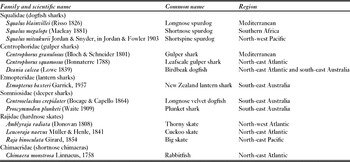
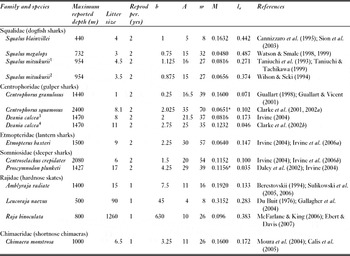
For our analysis we selected all deep-sea cartilaginous fishes (defined as those species whose distribution is predominantly at, are restricted to, or spend the majority of their life cycle at depths below 200 m; for example species occurring on the continental and insular slopes and beyond, including abyssal plains and oceanic seamounts) that had sufficient reliable age and reproductive data to allow the calculation of productivity. In all, data were available for 15 stocks from 13 species, representing six chondrichthyan families (Table 1, Table 2). This represents a very small proportion (2.5%) of the approximately 530 species of described deep-sea cartilaginous fishes (Kyne & Simpfendorfer Reference Kyne, Simpfendorfer, Carrier, Musick and Heithaus2009), but was sufficient to provide an indication of trends within the deep-sea environment.
Species of deep-sea cartilaginous fishes for which adequate life history data were available to calculate productivity in this study, and the regions from which data were obtained.

Life history data for deep-sea cartilaginous fishes used to calculate intrinsic rebound potential and population doubling time. Reprod per. = reproductive periodicity; b = annual female litter size; α = age at maturity; w = maximum reproductive age; M = natural mortality; lα = proportion of the population surviving to maturity. *Calculated using the Hoenig (Reference Hoenig1983) method; 1Japan; 2Hancock Seamount; 3Pacific Ocean; 4Atlantic Ocean.

The productivity of a species was determined using the intrinsic rebound potential method (Au & Smith Reference Au and Smith1997; Smith et al. Reference Smith, Au and Show1998). This method produces an estimate of population increase rates similar to the intrinsic rate of increase calculated in life tables (r), but differs in having simpler data requirements and allowing for density-dependent compensation. Detailed information on the method, including assumptions, can be found in Smith et al. (Reference Smith, Au and Show1998). Data required to determine the intrinsic rebound potential (r2M) were age at maturity (α), maximum reproductive age (w), annual female litter size (b, total litter size divided by the proportion female and the periodicity of breeding), natural mortality (M) and the proportion of the population surviving to maturity (lα). We assumed maximum age to be the maximum observed age and a reproductive periodicity of two years for viviparous species. Natural mortality was estimated using the relationship with growth parameters (von Bertalanffy k; M = 1.6k) (Jensen Reference Jensen1996). When k was not available, an alternative method (Hoenig Reference Hoenig1983) that calculated M from maximum age (M = 1.44 – 0.982ln w) was used. The growth parameter approach was preferred, as most of the data was collected from populations that were being fished and to use the maximum age method it is necessary to assume that there is no fishing. The proportion of individuals reaching maturity was calculated using the function lα = e−αM. Annual egg production in skates is difficult to determine due to the continuous production of eggs over an extended season. This limited the number of species from this group for which data were available. Annual fecundity estimates were not available for chimaeras, so we used ovarian fecundity as a proxy for the reproductive output of rabbitfish Chimaera monstrosa Linnaeus, 1758.
The intrinsic rebound potential method assumes that maximum productivity of a population is reached when total mortality is equal to twice the level of natural mortality (i.e. r2M). However, for some shark species, it has been suggested that maximum productivity occurs at levels below twice natural mortality (Fowler Reference Fowler1988). For this reason we also calculated r1.5M. We incorporated density-dependence by calculating r2M assuming that reproductive output was increased by a factor of 25% (i.e. 1.25b). We compared intrinsic rebound potentials of deep-sea species to values for shelf and pelagic species from Smith et al. (Reference Smith, Au and Show1998).
RESULTS
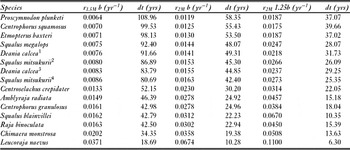
The most conservative values of intrinsic rebound potential for deep-sea chondrichthyans (r1.5M b) ranged from 0.0064 yr−1 for plunket shark Proscymnodon plunketi (Waite 1909) to 0.0371 yr−1 for cuckoo skate Leucoraja naevus Müller & Henle 1841; the most optimistic values (r2M 1.25b) ranged from 0.0187 yr−1 for P. plunketi to 0.1100 yr−1 for L. naevus (Table 3). Conservative values (r1.5M b) were mostly below 0.02 yr−1; optimistic values (r2M 1.25b) were mostly less than 0.05 yr−1. The intrinsic rebound potential of viviparous deep-sea species (dogfish, gulper, lantern and sleeper sharks) (0.0153 yr−1) was significantly lower than that of oviparous species (skates and chimaeras) (0.0330 yr−1) (Mann-Whitney rank sum test; T = 51.5; p = 0.013).
Intrinsic rebound potentials (r1.5M, r2M) and population doubling times (dt) of deep-sea cartilaginous fishes with no increase in reproductive output (b) and with a 25% increase (1.25b). 1Atlantic Ocean; 2Hancock Seamount; 3Pacific Ocean; 4Japan

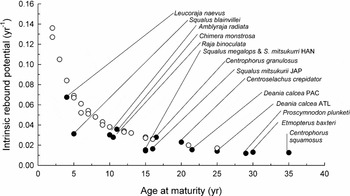
Intrinsic rebound potentials for deep-sea species fell mostly at the lower end of the range exhibited by all cartilaginous fishes (Fig. 1) and, where overlap occurred, values were normally lower than for shallow-water species with the same age at maturity. The mean rebound potential of deep-sea species (0.0233 yr−1) was significantly lower and less than half that of shelf and pelagic species (0.0525 yr−1) (t-test; t = 3.349; df = 38; p = 0.002). These rates of increase (r2M b in Table 3) result in doubling times for depleted populations from 10 to 58 years, assuming no further fishing. Recovery from depletion is therefore very slow. More pessimistic scenarios based on evidence that maximum productivity of some shark populations occurs at lower levels of depletion than those presented in Figure 1 (Fowler Reference Fowler1988) produced even slower rebound potentials (r1.5M b in Table 3) and doubling times of 19–109 years. Incorporating density-dependence and allowing for a 25% increase in reproductive output resulted in higher rates of increase (r2M 1.25b in Table 3) and more optimistic doubling times of 6–40 years. All but a few of the intrinsic rebound potentials calculated, irrespective of whether they were conservative or optimistic, fell in the range considered to be very low (<0.05 yr−1; Musick et al. Reference Musick, Harbin, Berkeley, Burgess, Eklund, Findley, Gilmore, Golden, Ha, Huntsman, McGovern, Parker, Poss, Sala, Schmidt, Sedberry, Weeks and Wright2001). The few remaining values all fell within the low category (0.05–0.15 yr−1; Musick et al. Reference Musick, Harbin, Berkeley, Burgess, Eklund, Findley, Gilmore, Golden, Ha, Huntsman, McGovern, Parker, Poss, Sala, Schmidt, Sedberry, Weeks and Wright2001).
Intrinsic rebound potentials (r2M) of deep-sea (solid circles) and shelf and pelagic (open circles) cartilaginous fishes as a function of age at maturity. Three letter abbreviations for location differentiate stocks of the same species (ATL = Atlantic Ocean; HAN = Hancock Seamount; JAP = Japan; PAC = Pacific Ocean). Data for intrinsic rebound potential of shelf and pelagic species from Smith et al. (Reference Smith, Au and Show1998).

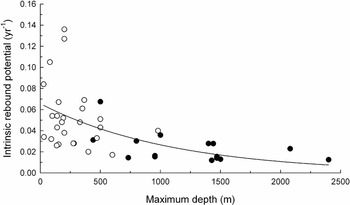
There was a significant decreasing trend in the intrinsic rebound potential with increasing reported maximum depth for the cartilaginous fishes as a whole (r2 = 0.305; F1,38 = 16.69; p = 0.0002; Fig. 2).
Intrinsic rebound potentials (r2M) of deep-sea (solid circles) and shelf and pelagic (open circles) cartilaginous fishes as a function of maximum depth of occurrence. Data for intrinsic rebound potential of shelf and pelagic species from Smith et al. (Reference Smith, Au and Show1998).

DISCUSSION
Cartilaginous fishes display a range of life histories and hence productivities (Smith et al. Reference Smith, Au and Show1998), but this study demonstrates that deep-sea chondrichthyans fall at the lower end of the productivity scale and include the lowest levels observed to date. Where the values for deep-sea species fell within the range of continental shelf and pelagic species they often had lower productivities for the same age at maturity. The values used in the comparison were moderate levels of rebound potential (i.e. r2M), and thus actual values may be even lower (i.e. r1.5M). These low levels of productivity are in part a function of the deep-sea environment, where low temperatures and limited food result in slow rates of growth and late maturity (Cailliet et al. Reference Cailliet, Andrews, Burton, Watters, Kline and Ferry-Graham2001).
Shallow-water species show higher and more variable intrinsic rebound potentials than deep-sea species, which show lower and less variable values. This relationship suggests that the vast majority of deep-sea cartilaginous fishes occurring below 1000 m will have very low intrinsic rebound potentials, and thus limited abilities to sustain fishing or take long periods to recover from overfishing. Eight of the 15 deep-sea species/stocks examined here had rates of increase (r2M) resulting in population doubling times > 40 years (as high as 58 years for P. plunketi). For shallow-water species, only a single species (the British Columbia population of S. acanthias) showed a population doubling time > 40 years (all other species/stocks were < 30 years) (Smith et al. Reference Smith, Au and Show1998). Using conservative rates of increase (r1.5M), population doubling times were as great as 109 years (for P. plunketi). Added to the risk to deep-sea species is the observation that sharks do not occur below approximately 3000 m (Priede et al. Reference Priede, Froese, Bailey, Bergstad, Collins, Dyb, Henriques, Jones and King2006) and so, as a group, they do not have the extreme deepwater refuge from fisheries that the bony fishes do. The significant decline in the intrinsic rebound potential of species with increasing maximum depth provides the ability to predict, within the bounds of confidence intervals, the rebound potentials of species for which only the maximum depth of occurrence is known. This result is consistent with the observations of Dulvy and Reynolds (Reference Dulvy and Reynolds2002) that body size was the best indicator of extinction risk in skates and that body size (and hence extinction rate) increased with depth.
For the large majority of deep-sea sharks, rays and chimaeras, life history information is limited or completely lacking; the lack of available life history data limited the scope of this productivity assessment. A review of published literature as well as unpublished sources provided sufficient data to calculate productivity for only 13 species (15 stocks). Whole orders and families of deep-sea cartilaginous fishes were unrepresented in this analysis, which required reliable reproductive and age data. For the majority of sharks examined here (all dogfishes of the order Squaliformes), age data were derived from the analysis of dorsal spine bands (i.e. Clarke et al. Reference Clarke, Connolly and Bracken2002a, Reference Clarke, Connolly and Brackenb; Irvine et al. Reference Irvine, Stevens and Laurenson2006a, Reference Irvine, Stevens and Laurensonb), as opposed to traditional ageing methods that rely on seasonal changes in calcification rates of the vertebrae or caudal thorns to produce banding patterns. These techniques are of limited use for species from the stable and uniform habitats of the deep sea. Despite being one of the major groups of deep-sea chondrichthyans, there are no age data available for the catsharks (family Scyliorhinidae), since their vertebral centra are unsuitable for ageing and they lack dorsal spines. Hence, this diverse and speciose shark family could not be included in this analysis, and will require the development of novel techniques in order to provide this important data.
The estimation of annual fecundities of egg-laying species (such as catsharks, skates, suborder Rajoidei, and chimaeras, order Chimaeriformes) is also problematic owing to the continuous production of eggs over an extended season. The number of skates (families Arhynchobatidae and Rajidae) examined here was limited by a lack of fecundity estimates, despite there being published age at maturity and maximum age data available for many species. The skates probably have the highest reproductive rates of any chondrichthyans, with some species potentially producing hundreds of eggs per year (annual fecundity has been estimated at 1260 for big skate Raja binoculata Girard, 1854, in which individual egg cases contain multiple eggs; Ebert & Davis Reference Ebert and Davis2007). Despite these high reproductive outputs, many skates appear to be reproductively active for a relatively short period of their life (Ebert Reference Ebert2005). This limitation on reproduction is likely to translate into low intrinsic rebound potentials as demonstrated by L. naevus, which despite having an annual fecundity of 90 (Du Buit Reference Du Buit1976), had an intrinsic rebound potential of 0.0371 yr−1 (under conservative estimates), owing to a short reproductive life of only six years (Ebert Reference Ebert2005). While this is the highest value amongst the deep-sea species examined, it still falls within the range of productivities considered to be very low (< 0.05 yr−1; Musick et al. Reference Musick, Harbin, Berkeley, Burgess, Eklund, Findley, Gilmore, Golden, Ha, Huntsman, McGovern, Parker, Poss, Sala, Schmidt, Sedberry, Weeks and Wright2001).
Using an approach calculating the fishing mortality necessary to drive chondrichthyans to extinction (F extinct), García et al. (Reference García, Lucifora and Myers2008) showed that extinction risk was highly associated with habitat; the average F extinct of deep-sea species was 58% of that required to drive continental shelf species to extinction. Interestingly, extinction risk was also associated with reproductive mode, being lower for oviparous species and higher in viviparous species (García et al. Reference García, Lucifora and Myers2008). A similar pattern was determined for the rebound potential of deep-sea chondrichthyans, with skates and chimaeras (oviparous species) having significantly higher r2M values than the sharks (viviparous species) analysed here. The oviparous species incorporated into this analysis generally had larger litter sizes and/or lower ages at maturity than the viviparous species.
The simple demographic method used here required a number of assumptions about the populations analysed, including age-independent levels of natural and fishing mortality, no maternal size–litter size relationship and no fishing of juveniles (see Smith et al. Reference Smith, Au and Show1998). The technique does however provide a standardized approach to obtaining productivity estimates, which allowed comparison between deep-sea taxa and amongst groups of chondrichthyan fishes (deep-sea versus continental shelf and pelagic species) (Smith et al. Reference Smith, Au and Show1998). The ongoing collection of life history and fisheries data across the taxonomic range of deep-sea chondrichthyans is required to provide improved understanding of the risks facing this group.
The results of this study demonstrate that the chondrichthyan populations inhabiting the deep-sea are especially susceptible to overfishing because of the very low intrinsic rebound potentials. Assuming that the increasing movement of fisheries into the deep-sea (Morato et al. Reference Morato, Watson, Pitcher and Pauly2006) continues, deep-sea chondrichthyans are likely to come under increasing pressure. Given the low level of productivity of these populations it is likely that any fisheries targeting them, or taking them as a significant bycatch, will quickly deplete stocks. Sustained intensive deep-sea fishing could potentially lead to species extinctions (García et al. Reference García, Lucifora and Myers2008), a loss of biodiversity and ecosystem level changes as a result of the loss of high trophic level predators. There are few data on the effects of fishing on deep-sea chondrichthyans, but those studies available typically show substantial declines (i.e. Graham et al. Reference Graham, Andrew and Hodgson2001). As fisheries move into deeper waters, the effects on chondrichthyans will increase, with those that live deeper more vulnerable. Policy makers and resource managers responsible for the deep sea must therefore take a precautionary approach considering the consequences of deep-sea fisheries, not only because of the inability of deep-sea sharks, rays and chimaeras to sustain fishing, but also the very long recovery times that are required from even short periods of fishing.
ACKNOWLEDGEMENTS
The Marine Conservation Biology Institute provided funding. We thank Lance Morgan for project assistance, Sarah Irvine for access to life history data, and Claire Bartron, Michelle Heupel and Chris Glen for comments on the manuscript.