Background
Concerts and music festivals attract hundreds of thousands of Australians every year and have a valuable economic impact.1 However, music events are also associated with deaths, high levels of recreational drug use, and increased consumption of medical services.Reference Chhabra, Gimbar, Walla and Thompson2-Reference Turris and Lund5 Australian music festivals have recently received significant media attention due to a spate of fatal ingestions of recreational party drugs. This has resulted in an extensive whole-of-government response in New South Wales, including the publication of festival health guidelines; in Victoria, moves are being made to regulate event medical providers.
The delivery of medical care at mass-gathering events (defined as more than 1,000 people in a place for an event) is the subject of a small niche of literature, with most work documenting small case series of events or longitudinal observation of single events.Reference Arbon6-Reference Milsten, Maguire, Bissell and Seaman8 There is a small body of Australian literature, but it focusses largely on community events.Reference Arbon6
Internationally, Lund, et al have established a mass-gathering registry and published around the value of physician presence and advanced on-site capabilities in the reduction of health service impact from mass gatherings.Reference Lund and Turris9 This is in keeping with broader international legislation over the last 20 years which demonstrates similar benefits.Reference Lund and Turris9-Reference Wood, Beaumont, May and Dargan13
A smaller subset of published works evaluates the medical aspects of large music festivals, concerts, and rave parties. There is little comparative literature and most works are descriptive, single-event case reports. Electronic dance music, specifically, is called out as having an association with an increased demand on medical services when compared with other mass-gathering events, as well as higher rates of recreational substance use.Reference Chhabra, Gimbar, Walla and Thompson2,Reference Lund and Turris9,Reference Munn, Lund, Golby and Turris10,Reference Turris, Camporese, Gutman and Lund12-Reference Ruest, Stephan, Masiakos, Biddinger, Camargo and Kharasch20
The authors sought to answer a number of questions from the available data. As the local literature is not comprehensive, the first was to outline the demographics and drug use patterns of patients presenting to medical services at major Australian music events. Given the degree of regulatory interest in mass-gathering medical care in the current political climate, the authors also set out to identify interventions which are performed at the event on this patient set, and what inferences can be made from that data about event resourcing. Additionally, the authors attempted to validate recently published, temperature-based triage tools issued by one jurisdiction by evaluating the relationship between vital signs at initial presentation and the need for hospitalization.
Method
This paper presents a retrospective chart audit.
As part of a not-for-profit team of volunteer health professionals who provide a specialized portable critical care capability to Australian mass gatherings, the authors attended 15 music events over 22 days from June 2018 through March 2019. The resuscitation team worked with four different commercial first aid and paramedical providers and the events occurred across three states.
Patients presenting to the medical service at these events were triaged by a health professional and were streamed to assessment and treatment by the critical care service or to care by first aid and paramedical personnel. Case report forms were completed, which included demographic details, vital signs, reported intoxicants, and interventions provided. The design of these forms varied between providers, limiting the dataset which could be captured reliably.
A research proposal was submitted to the Metro South Hospital and Health Service (Queensland, Australia) Human Research Ethics Committee and an exemption was granted for this project.
Case report forms for all patients seen by the critical care team were audited by the authors and tabulated for descriptive analysis. Additionally, the broader whole-of-event medical report for each event was sourced, as was publicly available information about crowd size and weather conditions. Team composition for each event was recorded in operational logs.
Data analysis was completed using IBM SPSS Statistics (2015; IBM Corp.; Armonk, New York USA) to prepare descriptive statistics, and one-way ANOVA analysis was used to evaluate for confounders in observation time analysis.
Results
From September 2018 through March 2019, the event critical care team assessed, managed, and dispositioned 221 patients at 13 events included in this audit.
The Events
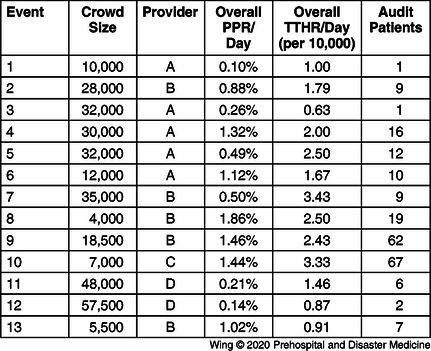
Published medical statistics for each of the events audited were obtained with consent of each data owner, and the results were tabulated below. Several multi-day events were considered as single events for the purposes of statistical analysis. Events and providers were de-identified at their request. Minor injuries and self-help presentations were not included in event patient presentation rates (PPRs).
Event PPRs (corrected for multiple-day events) varied between 0.1% and 5.8% (mean 0.83% [SD = 0.59%]) of the crowd size. Overall transport to hospital rates (TTHRs; expressed per 10,000 crowd and corrected for multiple-day events) ranged between 0.63 and 3.43 (mean 1.89 [SD = 0.92]; Table 1).
Event Characteristics

Abbreviations: PPR, patient presentation rate; TTHR, transport to hospital rate.
The Team
Team composition was subject to the perceived risk of the event and the risk assessment completed by the event’s first aid provider. The team was led by a physician with prehospital and event experience. A dual qualified registered nurse/paramedic deployed as the team’s nursing coordinator.
Additional nurses (mean three [SD = two]) and paramedics (mean two [SD = one]) were assigned to airway assistant, circulation, drugs, procedures, and scribe roles. A critical care paramedic with post-graduate qualifications and extensive airway experience was included in the team where there was a perceived risk of multiple simultaneous intubations.
All team members had at least two years of post-graduate clinical exposure to emergency or intensive care medicine and had worked under supervision at a number of previous similar events. Each team member completed an annual training workshop and an online package of eLearning.
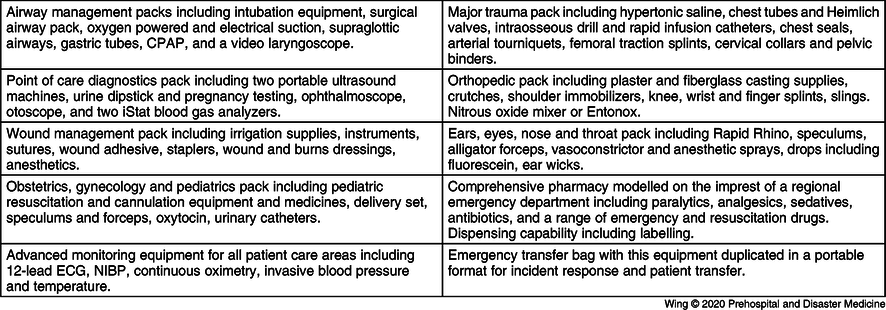
The team provided equipment to enable the delivery of complex resuscitation, as well as prolonged observation and minor procedures, which reduced the need to transport to hospital. This equipment is outlined in Table 2.
Key Equipment for Festival Medical Teams

Abbreviations: CPAP, continuous positive airway pressure; ECG, electrocardiograph; NIBP, non-invasive blood pressure monitoring.
The Patients
A total of 221 cases were audited by the authors. No cases were excluded. Patients evaluated by the critical care team were more likely to be male (55.0%), with a mean age of 25, and a range of one to 82 years of age; 18 patients (8.1%) did not have a recorded age.
Seventy-three (33.0%) patients reported, or were observed by their friends, to have used amphetamine-based pills, capsules, or powder. This rate varied across events, with Event 10 peaking at 85.0% of critical care team presentations. Gamma-hydroxybutyrate (GHB) use, previously a major issue at music festivals, accounted for 10.0% of presentations. Alcohol was a factor in 20.0% of encounters. Ketamine was reported in 14.0% of encounters and hallucinogens were reported in 13.5%. Other drugs not otherwise specified (generally cocaine and cannabis) were involved in 14.0% of cases; 45.9% of methylenedioxymethamphetamine (MDMA) users admitted or were observed to have taken another agent as well. Of these, more than one-half (52.9%) co-ingested MDMA and alcohol and another 29.4% used MDMA and ketamine. Comparable rates were reported for concurrent use of hallucinogens and other drugs.
All patients were assessed by a registered nurse, paramedic, or physician upon arrival. Eighty-five percent of patients had their first set of observations documented within five minutes of arrival in the medical tent. The mean heart rate on arrival was 104 (SD = 27) and the mean temperature 36.8°C (SD = 1.05°C) measured with an in-ear tympanic device. Patients presenting after using MDMA were more likely to have an elevated temperature (37.03°C [SD = 1.2°C] versus 36.54°C [SD = 0.8°C]; P = .007); 18 patients (8.1%) presented with temperature above 38°C. The highest temperature recorded on arrival was 42.4°C. Patients with an initial temperature of 38°C or higher were more likely to be transported to hospital (χ2 4.16; P = .041).
A 12-lead electrocardiograph (ECG) was routinely performed on patients presenting with collapse, syncope, or tachycardia on initial assessment. One-hundred eleven (50.2%) patients received at least one diagnostic ECG in their encounter. Of the patients who received an ECG, 4.5% had an ECG abnormality requiring immediate management documented in their clinical notes. The most common abnormality was hyperkalaemia. One episode of polymorphic ventricular tachycardia was recorded.
The team carried two iStat (Abbott Inc.; Princeton, New Jersey USA) portable blood gas analyzers, and a range of other point of care diagnostic tests. Blood gas analysis was generally conducted on borderline patients to support a decision for observation over transfer, and in some cases, to guide resuscitation of critically unwell patients. Twenty-two (10.0%) patients had their blood gas analyzed; 55.6% of patients analyzed had a pH of less than 7.35, with the lowest pH recorded 6.9. All but one of these cases was associated with clinical amphetamine toxicity; the exception was a patient at a rural festival who was managed for diabetic ketoacidosis (HCO3 12 BSL 32 Ketones 6) with fluids and insulin infusion before retrieval.
A small number of patients (n = 2; 1.8%) had a bedside serum pregnancy test for abdominal pain or syncope. Urinalysis was performed for 3.6% (n = 4) of patients. Neither test was required at single-day events.
Bedside ultrasound provided a flexible diagnostic tool which could also support difficult vascular access and regional anesthesia in the prehospital environment. Twelve patients (5.4%) had a bedside ultrasound performed. In most cases, this was a RUSH or FAST protocol. Lung ultrasound was performed to exclude pneumothorax on two occasions. There were no positive findings which altered management.
Patients presenting to the service had an intravenous cannula placed if they required hydration, were not tolerating oral medications, or if deterioration was anticipated. Sixty-seven patients (30.3%) were cannulated by the team. Twenty-five patients (11.3%) were given a parenteral antiemetic (ondansetron preferred or metoclopramide second line). Difficult and resuscitative vascular access options including long cannula, rapid infusion catheters, and intraosseous drivers were available, but only two patients required intraosseous access.
The team led the management of patients with agitated delirium, sometimes necessitating response into the field to support event paramedics and first aiders. Sedation was performed by a team of at least two clinicians with airway management experience and equipment, comprehensive monitoring, and specific training. Twenty-five patients (11.3%) were given parenteral sedatives; 17 (7.7%) droperidol and eight (3.6%) midazolam. Droperidol was initially dosed at 10mg and given intramuscularly as the preferred agent; 10 patients required a second 10mg dose. Patients received midazolam only after physician assessment and only one dose was required in all instances. No patients received both agents.
Patients presenting with evidence of early sympathetic toxidromes, chest pain, or substance-associated dysphoria were managed with oral diazepam. Forty-one patients (18.5%) were given interval doses to achieve normalization of vital signs and calm demeanor. Eighty-five percent of patients receiving diazepam settled with the initial dose of 10mg. Only one patient who was managed with oral diazepam subsequently required transfer.
No significant difference was found in the doses of droperidol (P = .146), midazolam (P = .546), or diazepam (P = .663) given to patients presenting after ingesting MDMA when compared with other intoxicants. No significant difference was found in sedative doses for any other single drug ingestion when compared to other patients.
Ketamine was used as a second-line sedation agent, and as rescue therapy for severe excited delirium. Six patients received ketamine intravenously or by intramuscular injection for behavioral disturbance. One-half of patients received less than 100mg (range 20-300mg). One patient had a ketamine procedural sedation for an open fracture dislocation of an ankle.
Rapid sequence intubation in the prehospital environment is a high-risk intervention which should be limited to the setting of critical illness where it is value added before or to facilitate transfer. Six patients (2.7%) had rapid sequence induction at the event. In most cases, the indication was severe clinical amphetamine toxicity (83.0%), and in one instance, airway protection for aeromedical retrieval in the setting of large GHB ingestion. A checklist approach was used in all instances. The airway operator was the physician in three cases and a critical care paramedic in the other three cases. First pass success was 100%.
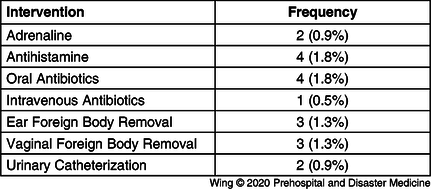
A range of other interventions were performed for patients presenting with wounds and orthopedic injuries. Fifteen patients (6.8%) received parenteral opiates (fentanyl or morphine). Ten patients (4.5%) required a procedure for wound closure, mostly with sutures. Four patients (1.8%) had a joint or fracture reduced and one patient (0.5%) had a plaster trauma slab applied (Table 3).
Low-Frequency Interventions

Prolonged observation was offered in a monitored environment with a clear plan for reassessment and criteria for discharge. Patients were observed for an average length of stay of 44 minutes (SD = 40 minutes), with a maximum observation of 4 hours 57 minutes.
Patients who had ingested lysergic acid diethylamide (LSD) or other hallucinogens were more likely to have a longer observation time than other ingestions (mean 1:07 [SD = 1:04] versus 0.40 [SD = 0:34]; t = 3.412; P = .001). Prolonged observation was also noted with MDMA (mean 0:40 [SD = 0:45] versus 0.51 [SD = 0:37]; t = 1.989; P = .048). No significant difference was found in observation times for any other single drug ingestion when compared to other patients.
More than one-half of patients sedated with droperidol (58.8%) were able to later be discharged, but required a longer period of observation (mean 1:40 [SD = 1:09] versus 0.39 [SD = 0:33]; t = 6.414; P = .001).
While both MDMA use and droperidol administration were seen to prolong observation time, no interaction effect was identified with a two-way ANOVA (F = 2.713; P = .101). This confounding effect did appear to be present with LSD use however (F = 11.219; P = .001).
The service transferred 36 patients (16.2%) for on-going care in a hospital emergency department. All transfers occurred by road or air ambulance.
Discussion
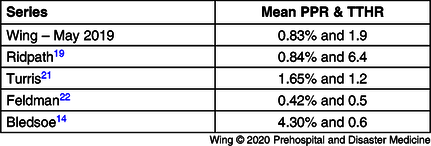
Event PPRs (mean 0.83% [SD = 0.59%]) and TTHRs (mean 1.89 [SD = 0.92]) were broadly consistent with other case series involving similar events (Table 4Reference Bledsoe, Songer, Buchanan, Westin, Hodnick and Gorosh14,Reference Ridpath, Driver and Nolan19,Reference Turris, Callaghan, Rabb, Munn and Lund21,Reference Feldman, Lukins, Verbeek, Macdonald, Burgess and Schwartz22 ). Insufficient data were available to complete an ANOVA analysis. The mean PPR and TTHR in the literature are widely variable, and this is attributable to a range of environmental factors as well as variance in data collection and case definition.Reference Arbon6,Reference Milsten, Maguire, Bissell and Seaman8 There is no currently agreed better measure of workload and acuity.
Comparison of PPR and TTHR to Other Papers

Abbreviations: PPR, patient presentation rate; TTHR, transport to hospital rate.
When evaluating demographics of this patient population, the sample population appears consistent with other events reported in the literature. The largest sample identified on review is Krul, et alReference Krul17 which demonstrates 49.9% male gender (χ2 2.229; P = .1354) and a mean age of 23 (no SD reported).
Patterns of drug use involving music event attendees have not been well-elucidated in the literature. Several survey-based retrospective studies look at proportion of drug use and agents used, but these are small samples and demonstrate wide variation in results.Reference Jenkinson, Bowring, Dietze, Hellard and Lim23,Reference Martinus, McAlaney, McLaughlin and Smith24 It would be valuable to be able to review similar data collected historically to quantify the magnitude of the difference in substance use and assess any potential relationship between substance use and PPR.
In the wake of multiple recent deaths and episodes of critical illness at music festivals over the 2019 Summer, the New South Wales Ministry of Health (New South Wales, Australia) issued a range of guidelines, including clinical guidance to support event medical providers.25 The interim guideline recommends the use of a temperature cutoff of 38°C as a criterion to escalate care and initiate immediate medical assessment. The current patient sample demonstrates that this temperature is significantly associated with an increased rate of transport, but given this test has a standalone sensitivity of 21.0%, reliance on this alone as a triage tool may not be adequate.
The presented case mix in the literature varies widely. Most presentations documented in broader mass-gathering literature are the result of trauma or exacerbation of chronic medical conditions. Some music events have demonstrated a similar distribution of presenting issues.Reference Chhabra, Gimbar, Walla and Thompson2,Reference Heiby, Barnhardt, Berry, Welcher and Brady3,Reference Arbon6-Reference Milsten, Maguire, Bissell and Seaman8,Reference Munn, Lund, Golby and Turris10,Reference Bledsoe, Songer, Buchanan, Westin, Hodnick and Gorosh14 The data from this series, however, suggest that patients requiring advanced care tend to present with effects of recreational drugs, including hyperthermia, agitated behavior, and dehydration. The rate of critical illness and intubation is also higher than seen in many published series,Reference Lund and Turris9,Reference Munn, Lund, Golby and Turris10,Reference Turris, Camporese, Gutman and Lund12,Reference Friedman, Plocki and Likourezos16,Reference Turris, Callaghan, Rabb, Munn and Lund21 although Ridpath, et alReference Ridpath, Driver and Nolan19 reports similar proportions.
Providers also need to be equipped and resourced to provide prolonged observation with appropriate monitoring for several hours. There were no comparable data in the literature to evaluate on-site length of stay or observation period other than a mean observation time of 71 minutes in one paper.Reference Lund and Turris9
There is scant literature about specific interventions and capabilities in the mass-gathering environment. Point of care ultrasound, as employed in this case series, can offer decision support to on-site clinicians and is thought to offer some benefit in reduction of off-site transfers.Reference Prager, Sedgwick and Lund26 The iStat portable blood gas analysis provides a means for the medical team to evaluate blood chemistry, oxygenation, and ventilation, and is a valuable tool in improving the quality of resuscitation, but also to risk stratify patients who are to be observed on-site.Reference Munn, Lund, Golby and Turris10,Reference Bledsoe, Songer, Buchanan, Westin, Hodnick and Gorosh14
Mass gatherings present unique challenges for health providers in ensuring adequate resources and procedures are in place to manage the medical needs of participants. Effective mass-gathering medical management can reduce the impact of events on the local community health service and improve the event experience for patients. There is a growing body of literature which supports the provision of advanced medical services with capability for physician-oversighted assessment, resuscitation, and transfer of critically ill patients, and the management, observation, and safe discharge of patients presenting with less-acute emergencies.
Significant work is already underway in exploring and validating harm minimization strategies for music events, including peer surveillance and education campaigns. The root cause of the perceived increase in recreational drug use (which is anecdotal at this time) is not well-understood and needs to form part of the literature in this space.
Tympanic temperature at the point of triage, and potentially in crowd-care spaces, may help early recognition of significant illness; an elevated temperature should trigger senior medical review. Temperature alone, however, is insensitive in detecting serious illness and while attempts have been made in the literature to develop a more reliable tool, on-going work in validation of a triage protocol for high-volume patient presentations at mass gatherings is needed.
The development of a validated decision support tool for use by non-physicians in the assessment of patients considered for on-site observation versus transfer would be a valuable area of further work. Additionally, state and territory legislative and regulatory approaches to event medical care should carefully consider not only the presence of physicians, but the overall capability of the service to provide safe management of agitated behavior, emergent airway management, comprehensive assessment of toxicology presentations, minor procedures, and safe prolonged observation.
Limitations
This paper presents a retrospective chart audit, which may introduce a range of methodological issues including bias. This paper does not present all patients seen at each event, but rather those who required intervention from the higher-level care team, and as such, may under-represent true workload and acuity.
Conclusions & Recommendations
This paper presents a contemporary case series of patients presenting requiring emergency medical care at a cross-section of major Australian musical events. It provides an opportunity for hypothesis generation, and most importantly, informs front-line clinicians and medical service planners about the acuity and workload seen at these events, and the capabilities required in this evolving space. Further work needs to be done to correlate the issues identified in this paper with event characteristics and factors.
Conflicts of interest
none