Introduction
On the evening of January 16, 1991, President George H. W. Bush, sitting by his desk in the Oval Office, made a televised statement to the nation in which he announced that the United States and its allies had initiated a military attack against Iraq. Although there was nothing surprising about the announcement, which followed months of preparations broadcast by the media, its effect on public opinion was dramatic: overnight, the president's job-approval rating increased by about 20 percentage points, to 83 percent. There is a seemingly simple explanation for this “rally-round-the-flag” (RRTF) effect: whenever the United States stands at the center of militarized conflicts, Americans feel a patriotic obligation to support the country's elected leader. However, a thorough examination of US military history does not support this interpretation. Of the dozens of major war and security crisis events in which the United States has been involved, only a few have resulted in considerable increases in presidential job-approval ratings. For example, while the Gulf War announcement led to a jump in Bush's popularity, his 1992 announcement of the invasion of Somalia did not. This article seeks to explore under what conditions and through which processes do war and security crisis events become rally points.
Past research has been guided by three perspectives: (1) the rationalist assumption according to which the public opinion processes information to determine the chances to win a war, (2) a realist perspective, which suggests that rally periods are motivated by a widespread sense of threat to national security, and (3) opinion leadership perspective according to which the public rallies if the media and the entire political establishment present a unified voice in favor of a military intervention abroad. This article introduces a more sociological approach to the RRTF phenomenon that combines elements of social psychology with the sociology of nationalism. I argue that neither rational calculation, nor the perception of a security threat, nor elite consensus cause the rally effect; rather, it emerges when events are widely perceived as an opportunity to reclaim or enhance the honor of the national group. This new approach to the RRTF phenomenon is derived from sociological understanding of individuals as members of collectivities that pursue symbolic politics of status achievement and maintenance.
My approach shares with some opinion leadership approaches the emphasis on the president and the mainstream media as the main agents of public opinion during RRTF periods. However, in contrast to previous explanations, I claim that the success of the president and the media in mobilizing public opinion in response to major security events depends not only on what these opinion leaders do, but also on whether the historical circumstances foster a widespread feeling that the national honor needs to be protected or enhanced. As we shall see, it is in this type of situation that presidents have successfully mobilized the public (through the media) to rally behind military actions, neither because they pointed to threats to national security nor because they could guarantee American victory, but because their claims that national honor was at stake resonated with the public mood.
This study also differs from previous studies with regard to methodology. Thus far, researchers studying the RRTF phenomenon have primarily used regression-based analysis to explain changes in presidential job-approval ratings. However, this approach suffers from three major limitations. First, many studies have failed to draw a qualitative distinction between minor changes of public opinion and major RRTF periods. Second, regression analysis provides only correlational evidence of causality but fails to explore the (different) mechanisms that bring about a statistical association. Third, regression-based studies usually do not explore the possibility that the RRTF effect has emerged through more than one process.
To move one step closer to such a multicausal approach, this study follows the logic of comparative historical analysis (Mahoney Reference Mahoney, Mahoney and Rueschemeyer2003; Skocpol Reference Skocpol1984; Stinchcombe Reference Stinchcombe1978). Using the technique of qualitative comparative analysis (QCA; see Ragin Reference Ragin1987; Rihoux and Ragin Reference Rihoux and Ragin2009), the study first compares rally points to detect common conditions that may cause the RRTF outcome. Rally points are then contrasted with similar events that did not produce rally effects, highlighting the configurations of conditions that were present only in rally points, and thus providing evidence of their causal role. In a final step, I discuss in more detail the processes through which major war events and security crises have transformed into rally points by discussing a historical example for each of the different pathways leading to the rally.
Why (and How) Do RRTF Periods Emerge?
The existing literature on the RRTF phenomenon offers four types of explanations. First, a rational choice argument suggests that people rally behind the sitting president when they believe his policy is likely to succeed at a tolerable cost, but (because of a lack of direct information) the public uses informational cues, either events such as winning a major battle or a war's policy objectives, for example restraining foreign aggressors (often perceived as likely to be successful) or intervening in another country's internal political affairs (often perceived as unlikely to succeed) (Eichenberg Reference Eichenberg2005; Eichenberg et al. Reference Eichenberg, Stoll and Lebo2006; Gelpi et al. Reference Gelpi, Feaver and Reifler2009: ch. 4; Jentleson Reference Jentleson1992; Jentleson and Britton Reference Jentleson and Britton1998; Voeten and Brewer Reference Voeten and Brewer2006). Second, two arguments entail the realist assumption that the general public prioritizes geopolitical considerations and national security, thus we may label them “security-concerned public” arguments: one argument proposes that individuals are more likely to support military initiatives they perceive as seeking to maintain national interests, especially national security (Kohut and Toth Reference Kohut and Toth1994; Nincic Reference Nincic1997; Rielly Reference Rielly1979; Western Reference Western2005). Another realist argument suggests that the American public also monitors the opinion of the UN Security Council to verify that presidents only go to war for genuinely defensive purposes (Chapman and Reiter Reference Chapman and Reiter2004).
The remaining two explanations shift the focus of the investigation from the public to the political elite that serve as “opinion leadership.” Several scholars highlight the role of the president as the main agent of public opinion in the United States. These scholars, who also share the realist assumptions, suggest that presidents are especially likely to garner public support for aggressive foreign policies when they frequently mention security threats to the United States (Kaufmann Reference Kaufmann2004; Willer Reference Willer2004) and when they justify a military initiative as a “protective intervention” (Nincic Reference Nincic1997). I shall use the title “manipulation of threat” in reference to these arguments.
The last, highly influential argument is often labeled the “elite consensus” argument. According to this argument, rally periods emerge when opposition-party leaders either explicitly support the president's policies or simply refrain from expressing criticism. This (tacit or explicit) approval leads to the RRTF effect because the information the public receives is biased in favor of the president and his policy (Berinsky Reference Berinsky2007; Brody Reference Brody1991; Zaller Reference Zaller1992).
Several opinion leadership arguments, it should be noted, have a more integrative character, highlighting the interaction between presidential leadership during security crises and the reactions of the media and the political elite (Baker and Oneal Reference Baker and Oneal2001; Lian and Oneal Reference Lian and Oneal1993; Oneal and Bryan Reference Oneal and Bryan1995). Nonetheless, even the most sophisticated opinion leadership arguments provide only a partial and probabilistic explanation to RRTF periods. For example, they cannot explain why (as we shall see) in some occasions, rally periods have not emerged despite coordinated actions by all main agents of public opinion. Therefore, as a few authors have recently argued, rally effects are not driven solely by the message opinion leaders send to the public, but also depend on whether the public is willing to embrace the message or not (Groeling and Baum Reference Groeling and Baum2008; Western Reference Western2005).
In response to the limitations of existing explanations of the RRTF effect, the following section presents a new explanation based on a sociological-psychological theory of national identification. Existing scholarship has overlooked the role of deeply rooted popular national sentiment that, when activated, drives people to rally behind the elected national leader and his foreign policy. Moreover, this study proposes a more historically oriented explanation, according to which RRTF periods have emerged from the interaction between events, leadership, and historical circumstances that jointly generated symbolic challenges for individuals who identify with the nation and its state.
National Sentiment and Rally Points
Membership in the nation is a subjective experience that, although not promising equal access to material and political resources, nevertheless offers all “members” a shared symbolic resource: the nation's prestige. Nationalism has historically involved a sentiment of superiority vis-à-vis other nations (Hayes Reference Hayes1926: 6; Kohn Reference Kohn1944: 5), which is nurtured, as Stephen Van Evera explained, by the “chauvinist mythmaking” of nationalist agents—schools, journalists, and the political elite (Van Evera Reference Van Evera1994: 27). Because for modern individuals the sense of self-worth is closely tied to the prestige of the nation, they carry a profound commitment to the nation and protecting its prestige (Greenfeld Reference Greenfeld2006). However, as Liah Greenfeld noted, national prestige is a precarious resource: because the amount of prestige one nation has is measured relative to that of other nations, “no matter how much prestige one may have gained at a certain moment, one can be outdone in the next” (ibid: 206). The precariousness of national prestige, I argue, is at the root of the RRTF phenomenon, which emerges when that national prestige is challenged. A study by Snyder and Borghard (Reference Snyder and Borghard2011) offered support for this argument; their findings demonstrated that, more than any other aspect of international conflicts, public opinion in the United States is concerned with national honor and the country's international reputation for political resolve.
In short, I argue that episodes of RRTF have emerged following dramatic war events and during security crises if the historical circumstances allowed the sitting US president to compellingly depict the situation as a challenge to national honor. These symbolic challenges, in turn, activated national sentiments that caused people to rally behind the commander-in-chief, whose policy was expected to restore or enhance national prestige.Footnote 1
The proposed explanation challenges previous scholarship on the RRTF phenomenon in two ways. First, previous research has overlooked the role of popular nationalist sentiment, and specifically the symbolic aspect of wars against foreign aggressors. I argue that RRTF periods emerge when the political elite successfully use extraordinary events as a symbolic resource in order to appeal to national sentiment. Second, while previous research on “opinion leadership” has recognized that the ability of presidents to mobilize public opinion is bounded by circumstances, most studies express this contingency in the form of the probabilistic or average effect of presidential rhetoric. In contrast, the explanation advocated in this article focuses on the interaction of presidential action and historical conditions, and takes a nonprobabilistic form.
Preliminary Expectations
The analysis in this article focuses on both circumstances and actions by political leaders, and investigates how they jointly caused the emergence of historical RRTF periods. With regard to “circumstances,” I emphasize the specific characteristics of events and their historical context, while for “action” I investigate the sitting president's public reaction to each event. This article proposes that two types of process lead to the creation of RRTF periods. First, a rally period occurs when the public largely perceives of a war event or security crisis as a challenge for the international prestige of the nation and sees in military reaction an opportunity to reclaim or enhance that prestige. Specifically, two conditions must be met. The political leadership must actively pursue a nationalist framing of the situation: if an American target was attacked, the event must be presented as an attack on the nation, and if the United States used its military power to invade or control a foreign country, the official rhetoric must claim that the goal was to either save the lives of Americans or protect the core values of the nation—its honor and dignity. Rhetoric that justifies wars in humanitarian terms or as a means to achieve regime change in another country or guarantee regional peace will not create a rally period. In addition, nationalist sentiment must be activated not only in favor of the nation, but also against adversaries. As Mouffe explained, collective identities are always constructed through “constitutive others,” but this differentiation takes the friend/enemy form when the other “begins to be perceived as negating our identity, as putting in question our very existence” (Mouffe Reference Mouffe1993: 3). The emergence of RRTF periods requires that the president clearly define an enemy—a foreign country or a terrorist organization—against which nationalist mobilization can emerge.
A second type of process leading to the emergence of a rally period is related to the unique status of the United States as a world superpower. As a superpower, the United States has launched several military invasions officially aimed at helping other peoples in domestic or regional conflicts (e.g., Lebanon 1958, Korea 1950, Somalia 1992, the Gulf War 1991). To be sure, some Americans tend to support this type of military intervention, either because they believe that the United States should play a central role in world politics or because they empathize with oppressed peoples. Nonetheless, I suggest that to become popular, this type of military intervention must trigger widespread nationalist sentiment associated with a sense of collective superiority. This symbolic charge is created when the United Nations appoints the United States as the guarantor of world order, because this appointment conveys a recognition of the moral authority and military supremacy of the United States. However, UN authorization must be communicated to the public by the president, who must also clearly define an enemy to be defeated. In this second type of process, nationalist rhetoric is suppressed because it would interfere with the “leader of the free world” rhetoric, which demands a different self-representation in the global arena. However, the public at large still sees this leadership role as an expression of the global supremacy of the United States.
To summarize, I hypothesize that RRTF periods will emerge if the president uses nationalist rhetoric and points to a clear adversary either when addressing a major war event (hypothesis 1) or following an attack on American targets (hypothesis 2). In addition, I expect RRTF periods to emerge during military invasions authorized by the United Nations if the president communicates the authorization to the public and points to a clear enemy (hypothesis 3).
In addition to these three primary hypotheses, the analysis explores several other hypotheses, each representing one of the leading competing explanations of the RRTF phenomenon. First, the rationalist emphasis on the influence of successful events predicts that successful military operations by US forces will be followed by RRTF periods (hypothesis 4). Second, the rationalist argument also predicts that RRTF periods will follow US military operations if the official goal is to restrain foreign aggressors acting against US national security interests or to provide humanitarian aid to suffering populations, but will not occur in response to wars of political intervention (hypothesis 5). Third, the elite consensus thesis proposes that military actions and security crises that are followed by bipartisan support for presidential policies will generate RRTF periods (hypothesis 6). Finally, the realist approach expects RRTF periods to follow events that were framed as posing security threats to the United States (hypothesis 7).
Data
Following the logic of comparative history, this study seeks to identify configurations of conditions that are sufficient for the emergence of RRTF periods (this issue is discussed in further detail in the following text). This analysis requires a variable-rich data set that contains thorough information on the characteristics of each of dozens of events, for example, the type of event, military results, number of casualties, media coverage, main themes of presidential rhetoric about the event, the reactions of the opposition party, and other factors. Prior to this study, a variable-rich data set covering dozens of events did not exist (typical data sets include relatively few variables that are used in regression-based time-series analysis). Therefore, I compiled a new data set that includes 54 major war acts and security crisis events with direct US involvement from 1950 to 2006 that have received significant attention by the mainstream media. The data set covers various aspects of events such as the type of events (e.g., military invasion, war escalation, or attack on American target), how sitting presidents reacted publicly to events, the declared goals of military actions, the reactions of the congressional elite, international reactions, media coverage in the United States, number of US troops involved, number of American casualties, economic and political conditions in the United States, and timing of event relative to electoral cycles.Footnote 2 An initial list of events was compiled from the lists previously created by three pairs of scholars: Brace and Hinckley (Reference Brace and Hinckley1992), Ostrom and Simon (Reference Ostrom and Simon1985), and Newman and Forcehimes (Reference Newman and Forcehimes2010). To these, I added a handful of events mentioned in two other prominent studies by Eichenberg (Reference Eichenberg2005) and Jentleson and Britton (Reference Jentleson and Britton1998). To create the final list, I applied two additional selection criteria. First, assuming that a preliminary condition for the emergence of RRTF effects is that mainstream media would bring it to the public's attention, I only included events that were mentioned on the front page of the New York Times.Footnote 3 Second, I limited the scope of the final list to acts of war and other security events and excluded events such as the signing of peace or ceasefire agreements. Fifty-four events met these criteria, but eight were eventually dropped from the list—five because there were not enough data to assess their effects on public opinion, and three because their effects on public opinion were ambiguous (however, these ambiguous cases were included in a second round of analysis, see note 5).
Coding RRTF Events
Past quantitative research has treated any increase in a president's job-approval rating that could be attributed to a particular event as a RRTF effect—even events that were followed by minor increases of one to four points were considered rally points. This approach is problematic because it dilutes the meaning of the term rally-round-the-flag, which distinguishes extraordinary boosts to the popularity of presidents (events that generate “a let's-get-behind-the-President” effect, as John Mueller [Reference Mueller1970: 22] originally described them) from more modest increases. In this study, a more qualitative approach to coding RRTF events was employed. After carefully inspecting changes in the presidential approval rates following each of the events on the list, the following coding categories were applied: (1) non-RRTF events: events followed by one- or two-point increases in the president's job-approval rating, declines in approval, or no change; (2) major RRTF events: events followed by sudden and sharp increases in presidential job-approval ratings and considerable declines in presidential job-disapproval ratings—in all but one major RRTF event, the difference between support for and opposition to the president increased by at least 20 points;Footnote 4 and (3) minor RRTF events: events followed by presidential job-approval rating increases that were more than a couple points, but not enough to reach the level of a major RRTF event. Typically, after minor RRTF events the difference between support and opposition increased by six to 10 points. Because small improvements in presidential popularity ratings are also caused by factors such good news about the economy, small market booms, or the passing of a popular law initiated by the president, the categories of minor RRTF and non-RRTF events were combined and jointly provided the comparison group for major RRTF events.Footnote 5
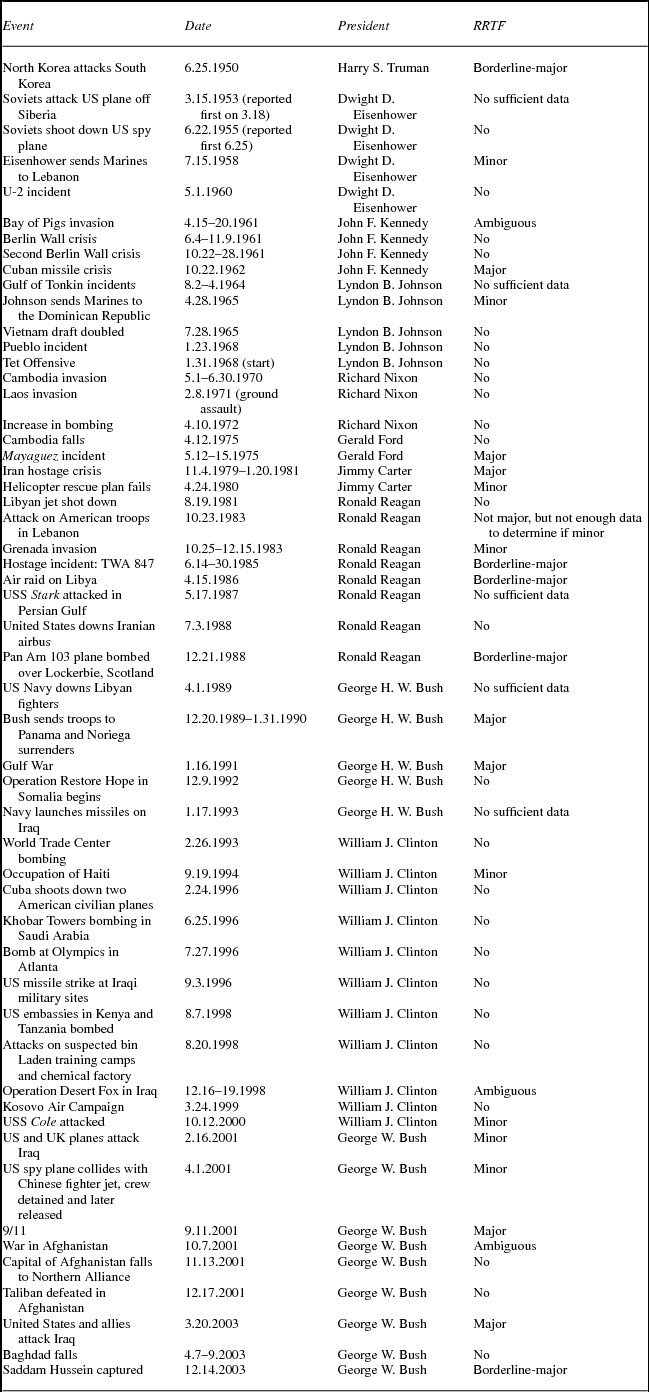
Data for the RRTF variable came from two sources: the Roper Center at the University of Connecticut and the American Presidency Project at the University of California in Santa Barbara. Data from both sources were compiled from various public opinion polls. To avoid measurement errors associated with differences in sampling designs and the wording of questions, whenever possible coding decisions were made by examining data collected by the same polling organization at different points of time.Footnote 6 Further, whenever possible, I first made coding decisions based on the data collected in Gallup polls and then looked to other polls for confirmation. (For the complete list of events and their RRTF code, see appendix table A1.)
Explanatory Variables
All independent variables have a binary format (1,0). Data for coding these variables were gathered from two types of sources: First, I used numerous secondary sources, primarily academic writing about specific events, US presidents, or particular historical periods. Second, articles from major newspapers—the New York Times, the Los Angeles Times, and the Washington Post—were used to reconstruct the official framing of events, assess the reactions of other political actors, and evaluate the intensity of media coverage.
Type of event
According to the perspectives outlined in the preceding text, three types of events have resulted in RRTF periods. First, a military invasion is defined as ground assault in the territory of another country. Second, war escalation is defined as an event that deviates from a previously more moderate conduct of conflict. Third, an attack on an American target may be either an act of a rival state or an act of a terrorist organization against an American target either in the United States or abroad.
Two variables measure aspects of the presidential framing of events. First, identification of an enemy codes whether or not the president named a country or a particular terrorist organization as the enemy confronting the United States during the event. Second, nationalist rhetoric is coded “1” if the president appealed directly to national sentiment, as defined by one of the following conditions: calling for solidarity with fellow Americans whose lives military action sought to save, describing the military conflict as a test of the United States’ capacity to maintain its supreme international status, or devoting a significant part of the speech to the “American spirit” and the core values of the nation. In many cases, a presidential address combined all three themes.
UN authorization records whether or not military action was authorized by the UN Security Council and was mentioned by the president in his national address (in all cases that include UN authorization of military action, the authorization was communicated to the public).
The three hypotheses provided the initial set of explanatory variables, but data analysis in QCA is an iterative process, in which theoretical arguments and their corresponding sets of variables are repeatedly modified in an effort to produce an explanatory model that fully (or almost fully) differentiates events that became rally points from events that were not followed by rally periods. This form of analysis follows the comparative history praxis of moving “back and forth between theory and history in many iterations of analysis as they formulate new concepts, discover novel explanations, and refine preexisting theoretical expectations in light of detailed case evidence” (Mahoney and Rueschemeyer Reference Mahoney, Rueschemeyer, Mahoney and Rueschemeyer2003: 13). As a result of applying this principle, several of the preliminary expectations were modified during data analysis (as discussed in the following text) and the following three additional variables were coded: (1) attack on an American civilian target is coded “1” if the attacked American target was not a military installation; (2) prior enemy construction is coded “1” if the other actor in the conflict had a history of public confrontation with the United States or if the White House had launched a campaign to portray the opponent as the “enemy” of the United States prior to the event; and (3) prior fiasco indicates whether, in the public conversation, the event had been directly connected to a previous event or a set of events that had caused great embarrassment to the United States on the international stage.
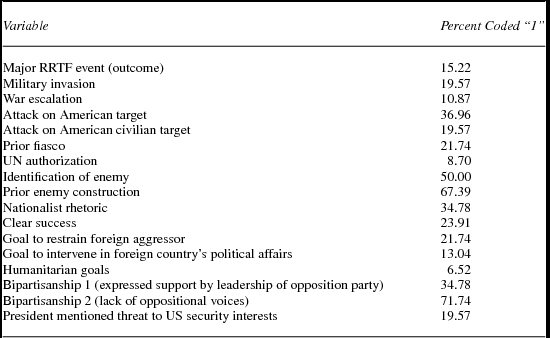
Several variables were used to test competing explanations of rally periods. First, one variable records whether an event was a clearly successful military operation (or was presented in the media as such). Three variables—humanitarian goals, restraining a foreign aggressor, and intervention in the internal political affairs of a foreign country—indicated the policy objectives of military operations. Second, a binary variable was coded “1” if the presidential address connected the event to security threats. Finally, two variables recorded “bipartisan support” if in the aftermath of events the presidential policy was supported by the leadership of both parties in the Congress and Senate: one variable indicated whether the opposition party showed a moderate level of support by refraining from explicit criticism of the president, while the other variable recorded whether the opposition leadership expressed explicit support for the president's policies.Footnote 7 Table 1 presents the distributions of variables associated with the focal argument and with competing arguments.
Distributions of binary variables (N=46).

Data Analysis and Results
To identify necessary and sufficient conditions for the rally effect, I employed the QCA (see Ragin Reference Ragin1987; Rihoux and Ragin Reference Rihoux and Ragin2009) method using the fs/QCA software. QCA is an analytical technique that uses Boolean algebra to apply the logic of qualitative comparison to small or intermediate-size data sets. The qualitative element of the investigation is achieved by the use of variable-rich data sets that thoroughly characterize each case and allow for comprehensive case comparison. Computer algorithms maximize the number of comparisons made across the cases. Ultimately, QCA detects causal processes in the form of combinations of conditions and an outcome, which QCA distinguishes from combinations of conditions that do not include the outcome. Each outcome of interest may be the product of one or several combinations of conditions.
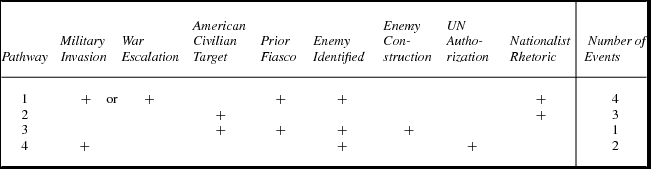
By using QCA, this study overcomes two major limitations of previous research. First, QCA effectively differentiates the configurations of conditions that were present only in major rally points from the configurations of conditions that were present in other events, and therefore the causal claims produced in this article do not have a probabilistic form. Second, QCA allows a given outcome to be the result of multiple trajectories—that is, different empirical processes or “pathways”—that are expressed by different configurations of conditions. The results (shown in table 2) contain four mutually exclusive pathways. These four configurations effectively explain all seven major RRTF events in the list (coverage score = 1). Further, a consistency score of “1” means that there were no cases in which all elements of any of the four pathways in table 2 were present and a rally effect failed to materialize.
Pathways to RRTF periods in the United States.

Notes: Coverage and consistency scores are 1.0000.
Pathway 1: Cuban missile crisis (Oct. 1962), invasion of Panama (Dec. 1989), Iraq War (Mar. 2003)
Pathway 2: Iran hostage crisis (Nov. 1979), September 11 attacks (Sep. 2001)
Pathway 3: Mayaguez incident (May 1975)
Pathway 4: Persian Gulf War (Jan.–Feb. 1991)
Overall, the findings support the three primary hypotheses, but also suggest some revisions. Two conditions—the president defining a clear opponent in a conflict, and the prior construction of the opponent as enemy of the United States—are present in all four pathways. The second, which was not included in the preliminary hypotheses, leads to a modification one of the main arguments: naming the enemy in a conflict is indeed a necessary condition for mobilizing public opinion, as expected, but for a major rally effect to emerge, this “enemy” must have been constituted prior to the event (i.e., either because the enemy had already established history of confrontation with the United States, or because the administration had convinced the American people that a foreign country, its leadership, or a terrorist organization is an enemy worth fighting).
In line with hypothesis 1, major war events resulted in RRTF periods if presidents used nationalist rhetoric when publically discussing the events and their implications. However, the results of the data analysis indicated that the effect of nationalist rhetoric on public opinion depended on the historical context. Therefore, an additional variable was coded and added to the model: the presence of a prior international fiasco that provided a context in which public sentiment focused on the desire to reclaim national honor. Major war events turned into rally points if they were viewed as an opportunity for the United States to demonstrate its supreme power and reclaim international prestige after suffering a major setback.
As predicted by hypothesis 2, foreign attacks against American targets transformed into rally points if the president used nationalist rhetoric in his response to the attacks. Once again, however, data analysis resulted in a modification of the initial argument: only attacks on American civilian targets facilitated the emergence of major RRTF periods.
In line with hypothesis 3, military invasions generated RRTF periods if the UN Security Council had appointed the United States as the leader of a coalition force seeking to restore world order, and if the sitting US president referred to a clear and well-established enemy.
A final pathway emerged inductively during data analysis. Because of historical circumstances that will be discussed later, an attack on an American civilian target—the 1975 Mayaguez incident—led to a major rally point despite presidential rhetoric that lacked a clear nationalist tone. This series of events suggested a fourth pathway to the RRTF effect.
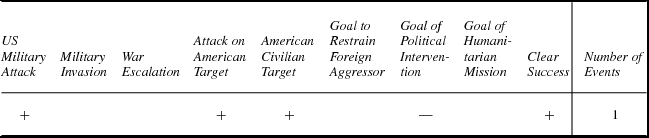
Data analysis also included testing hypotheses 4 through 7, which represent alternative theoretical explanations (see appendix tables A3-1 through A3-4). The findings suggest that none of the alternative arguments sufficiently explains rally effects. For a theoretical argument to be considered a valid general explanation of the RRTF phenomenon, the conditions it specifies must be present in all (or nearly all) the RRTF events (and not present in events that did not become rally points). However, the findings show that the conditions specified by each of the alternative arguments (rational public, communication of threat, and elite consensus) were absent from some rally periods or were not unique to rally period. For example, in two of the rally periods, none of the conditions associated with the rational public argument—communicated military success and a policy objective of fighting a foreign aggressor or providing humanitarian aid—was present. Further, whereas in the other five rally periods, at least one of these conditions was present, the same condition was also present in events that did not become rally points. These findings weaken the rational public argument.
Finally, I further examined the robustness of the findings by adding a set of control variables that previous research has found to be associated with the size of RRTF effects (Baker and Oneal Reference Baker and Oneal2001; Baum Reference Baum2002; Edwards and Swenson Reference Edwards and Swenson1997): unemployment and inflation rates, level of economic optimism/pessimism, the popularity of presidents on the eve of events, the presidents’ political party affiliations, whether government was divided or undivided, and whether or not another war was ongoing. While some of these economic and political conditions certainly help explain differences in the magnitude of RRTF periods, they did not change the basic configurations of variables on which the currently proposed explanation rests, and thus do not seem to be a necessary component of understanding the emergence of the RRTF phenomenon.
Discussion
The four configurations of conditions that emerged from the data analysis share a common theme: they represent processes through which events have been charged with the symbolic meaning of testing the international prestige of the United States, and thereby inciting popular nationalist sentiment. Table 2 divides rally processes into two categories. The first category includes pathways 1 through 3, in which the RRTF effect emerges from a desire to reclaim national honor, and the second category contains pathway 4, in which the rally effect is the product of the United States assuming the role of “leader of the free world,” which increases the prestige of the nation in the global arena.
The following discussion grounds the insights that emerged from the QCA results in a deeper understanding of concrete historical cases. To demonstrate the importance of key elements in each pathway, major rally points are contrasted with similar events that did not become major rally points. The analysis relies on the secondary literature as well as a close reading of newspapers. Due to space constraints, only one rally event in each pathway will be discussed in detail. A significant limitation of the current investigation is the lack of a direct measure of popular nationalist sentiment, one of the elements of my theoretical argument. Unfortunately, no surveys have systematically monitored this aspect of public attitudes. To address this limitation, parts of the discussion combine supplemental information from case studies with qualitative information to jointly show that the desire to restore or enhance national prestige was a central mechanism of public opinion during RRTF periods. It is important to clarify that letters to the press and other qualitative materials are not included in the materials analyzed through QCA in this study. However, the supplemental data are included in the text in order to demonstrate the plausibility of my retrospective reading of historical situations by showing that the meanings I attribute to historical events were shared by laypeople experiencing the events in real historical time.
Reclaiming National Honor (Pathways 1–3)
Five of the seven major RRTF events followed pathways 1 and 2, in which public opinion was mobilized by presidents who directly appealed to nationalist sentiment and placed the blame for the conflict on a well-established enemy. However, this nationalist rhetoric was successful only when prior events led to a widespread belief that the national honor of America was compromised and must be reclaimed. The importance of this belief is further supported by pathway 3, which shows that under certain circumstances, popular desire to restore national prestige can mobilize a RRTF period even without nationalist rhetoric on the part of the president.
Pathway 1
Three dramatic war events became major rally points when presidents used nationalist rhetoric and defined enemies against which the public could unite: the 1962 Cuban missile crisis, the 1989 invasion of Panama, and the 2003 invasion of Iraq. In none of these three cases, however, did the public rally behind the president solely because of the nationalist rhetoric. In fact, presidential appeals to popular nationalist sentiment resulted in RRTF periods only for these three major war events; for other major war events—the invasions of the Dominican Republic (1965), Cambodia (1970), and Grenada (1983)—nationalist presidential rhetoric was ineffective (I discuss the Cambodian incursion as an example of ineffective nationalist rhetoric later in the text). The common factor shared by the three events that did become rally points through pathway 1 is that they each offered the United States an opportunity to reclaim national honor after being greatly embarrassed by prior events. The Cuban missile crisis is a particularly helpful illustration. On the eve of the crisis, in October 1962, President John F. Kennedy's job-approval rating stood at about 60 percent; following Kennedy's address to the nation on October 22 and his decision to impose a marine blockade on Cuba, his job-approval rating rose to about 75 percent. Over the same period, Kennedy's disapproval rating declined from 25 percent to about 15 percent.
Although many Americans experienced a sense of threat during the missile crisis, the “security threat” argument is not satisfactory for at least three reasons. First, evidence from multiple surveys led Tom Smith to conclude that “[w]hile the Cuban missile crisis was on most people's minds, the public was not overwhelmed by worries and did not dwell on concerns about death and nuclear survival” (Smith Reference Smith2003: 274). Second, while Kennedy described the security threats imposed by the stationing of Soviet strategic missiles in Cuba in his address to the nation, data analysis did not point to security threat as a necessary condition for the emergence of RRTF period through pathway 1. Third, Kennedy specifically stressed that the threat to the security of the United States imposed by missiles in Cuba was not new: “American citizens,” he emphasized, “have become adjusted to living daily on the bull's-eye of Soviet missiles located inside the U.S.S.R. or in submarines. In that sense, missiles in Cuba add to an already clear and present danger” (New York Times 1962a).
While describing the stationing of Soviet missiles in Cuba as an addition to an existing threat, Kennedy's speech also portrayed the act as a provocative breach of the status quo in the Western Hemisphere, as a “flagrant and deliberate defiance” of international pacts and treaties, and, most importantly, his own previous warnings to the Soviet Union (ibid.). He then appealed to national sentiment by referring to the American spirit and the obligations of the United States as a world superpower; specifically, he described the need to take firm action in response to Soviet provocation as “most consistent with our character and courage as a nation and our commitment around the world” (ibid.). In his concluding sentences, Kennedy did not justify his response to the Soviets’ actions as an act of self-defense against imminent threat, but rather reiterated the United States’ commitment to promoting peace and freedom in the Western Hemisphere and around the world (ibid.).
Kennedy's call for self-determination and self-respect succeeded because the public interpreted it in light of preceding events. For months prior to the missile crisis, Republican politicians who were involved in the congressional election campaign had kept the embarrassing memories of the Bay of Pigs fiasco fresh in the mind of the public by criticizing Kennedy for being indecisive with regard to his foreign policy. In early 1962, Cuba was the only foreign policy issue on which Kennedy received a negative public opinion rating due to the public's high levels of frustration and anger at Castro's durability and the expanding Soviet influence as shown in public opinion polls (Lebow Reference Lebow1983: 443). In fact, most Americans wanted the United States to take a tougher stance on Cuba even before the Soviet missiles were revealed (Snyder and Borghard Reference Snyder and Borghard2011: 453). The criticism from Republicans intensified as the congressional elections approached.Footnote 8 Therefore, when the missile crisis was made public many Americans felt that the time had come to settle the bill with the Communist government in Cuba (New York Times 1962b), a feeling that was encouraged by the press (George Reference George2003; Phillips Reference Phillips1962). Therefore, the public perceived Kennedy's reaction to the Cuban missile crisis not as emphasizing a security threat, but rather as sending a firm message to both Cuba and the Soviet Union that the United States was again ready to use force to stop any attempt to challenge its dominance in the Western Hemisphere. Indeed, many professional columnists as well as ordinary citizens who sent letters to the press asserted that Kennedy's decision to impose a marine blockade on Cuba showed that the United States was once again determined to act as a world superpower in the spirit of the Monroe Doctrine (Nacos Reference Nacos1990: 28).
Similar processes generated major RRTF periods following two other events: the invasions of Panama in 1989 and Iraq in 2003. A close investigation (which due to space limitation cannot be discussed in detail) revealed that the RRTF that followed the invasion of Panama was related to a widespread perception that drug trafficking from Latin America had ceased to be only a health and crime problem and became also a matter of national dignity, a perception that has evolved following the Iran-Contra scandal. Similarly, the RRTF that followed the invasion of Iraq was related to the widespread feeling of national humiliation by the terrorists who attacked the United States in September 11 and to the success of the White House in depicting the invasion of Iraq as a test case for the recovery of the United States and its capacity to fight its enemies.
In contrast, in three other major war events the sitting president tried to emphasize nationalism, but the absence of a previous episode of national embarrassment or the lack of an established enemy prevented these events from becoming major rally points. The 1970 invasion of Cambodia provides a revealing illustration. President Richard Nixon's televised statement about his decision to invade Cambodia was especially challenging because the decision was made only 10 days after Nixon announced that 150,000 American soldiers would be withdrawn from Vietnam within one year. In effort to convince the public that his decision to invade Cambodia was the right one, Nixon referred to a large map of Cambodia, pointing to areas that had become military sanctuaries for North Vietnamese guerilla forces; further, he claimed that increasingly hostile activity originating in North Vietnamese sanctuaries in Cambodia left the United States no choice but to launch a joint military operation with South Vietnam. Nixon described the invasion of Cambodia as “indispensable for the continuing success of that withdrawal [from Vietnam] program” and as essential for keeping the casualties of “our brave men” as low as possible.
Nixon chose to appeal to nationalist sentiment—his address included some of the most nationalist and confrontational statements I came across in this study, including the following quotes:
The action I have announced tonight puts the leaders of North Vietnam on notice that we will be patient in working for peace, we will be conciliatory at the conference table, but we will not be humiliated. We will not be defeated. . .. The question all American people are asked and answered tonight is this: does the richest and strongest nation in history of the world have the character to meet a direct challenge of a group which rejects every effort to win a just peace, ignores our warnings, tramples on solemn agreements, violates the neutrality of an unarmed people and uses our prisoners as hostages? (New York Times 1970)
The invasion of Cambodia seemingly met all the required conditions for becoming a major rally point: it was a large-scale military invasion and a war escalation; there was a well-established and clearly defined enemy; and it was announced by the president using nationalist rhetoric that portrayed the event as a test of the capacity of the United States to maintain its national honor and international prestige. However, in 1970 the anti–Vietnam War sentiment was already widespread and a mistrust of Nixon's declared intention to end the war was prevalent in the public. Nixon's announcement of the invasion of Cambodia thus did not generate a RRTF effect, because the public did not perceive the invasion as an opportunity to restore some of the prestige the United States had lost in the prolonged war in Vietnam, but rather viewed it as yet another phase of the same messy conflict.Footnote 9 As a result, less than half of the public (48 to 49 percent) supported the operation,Footnote 10 and Nixon's job-approval rating stayed at modest levels similar to those recorded before the incursion started (54 to 59 percent).Footnote 11
In sum, all three events that followed pathway 1—the Cuban missile crisis, the invasion of Panama, and the Iraq War—were perceived as opportunities to restore tarnished national honor by standing up against defiant enemies, which turned them into major rally points. In other major war events such as the invasion of Cambodia (or the invasions of the Dominican Republic in 1965 and Grenada in 1983, which were not discussed), presidents who employed nationalist rhetoric failed to mobilize significant RRTF effects because the public did not view these events as opportunities to reclaim national honor.
Pathway 2
The desire to reclaim national honor has emerged in response to not only international fiascos, but also foreign attacks against American civilian targets that were perceived as an “attack on the nation.” Two major rally points fit this pattern: the Iran hostage crisis and the 9/11 attacks. In both cases, US civilian targets were attacked and the public rallied behind a president who used nationalist language to glorify the American spirit, sent a message of national unity and solidarity with the victims, pointed to a clear enemy who was to be blamed for the attack, and promised a military response. These rally effects did not emerge simply because of the nationalist rhetoric, however, but also because the president's message matched a widespread sentiment that the nation's honor had been violated and must be restored. The Iran hostage crisis is an especially important example of this pattern.
From the beginning of the hostage crisis (November 4, 1979), a sense of outrage dominated both the media coverage and the public conversation. A study that analyzed the content of all print news coverage of the crisis (including news stories, editorials, letters to the editor, and editorial cartoons) by two magazines and two newspapers—the New York Times, Time, Newsweek, and the Denver Post—found that throughout the crisis the theme of “national humiliation” was prevalent (Dowling Reference Dowling1989). In addition, clear expressions of a popular feeling of national humiliation due to the loss of international prestige can be found in a series of interviews conducted with residents of Cumberland, Maryland, for the New York Times on November 11, 1979 (New York Times 1979a). As an additional illustration, the following excerpts from letters sent to the press further demonstrate the public mood during the hostage crisis. “The development in Iran, and this country's response thereto,” wrote Samuel Intrater of Bethesda, Maryland, “have brought into focus a bitter historical reality: the end of our role as a world power. For if a pipsqueak country like Iran can with impunity invade the territory of our embassy, take American citizens prisoner, and thumb its nose at us, then clearly we have become a paper tiger, incapable of protecting our property, our interests and our citizenry.” Similarly, Michael C. Smith of Washington, DC, wrote: “I am sick and tired of every other country spitting in our face. How long will Americans endure this sort of treatment?. . . The time has come for us to stand up and be proud to be Americans” (Washington Post Reference Post1979), and Raymond Queein of Washington, DC, wrote: “The handling of the crisis in Iran by the Carter administration is cowardly and disgraceful. . .. This is the United States, not some two-bit country that has to beg for peace. Dammit, we can demand peace and we can back the demand with force” (ibid). Notably, the public was outraged not only because of the seizure of the American embassy in Tehran and the hostage situation, but also because President Carter's reaction—using restrained language and attempting to solve the crisis behind closed doors through diplomacy—was widely seen as an additional violation of national pride. In this emotional climate, Carter's job-approval rating remained low, around 30 percent.
Harold Saunders, the assistant secretary of state for Near East affairs at the time of the crisis, recalled that the administration felt strong pressure from the public to pursue national honor even at the cost of putting the safety of the hostages at risk (Saunders Reference Saunders, Christopher, Saunders, Sick, Carswell, Davis, Hoffman and Owen1985). According to Snyder and Borghard (Reference Snyder and Borghard2011), this public pressure pushed Carter to shift the tone of his rhetoric about Iran from diplomatic to more belligerent. As a result, a few weeks into the crisis, the tone of Carter's rhetoric became more nationalist and confrontational—Carter characterized the Iranian regime as the enemy of the United States; referenced American pride, courage, and honor; and stressed the United States’ commitment to the lives of its citizens (New York Times 1979b, 1979c). Due to this change in rhetoric, the public began to rally behind the president. Carter's job-approval rating peaked at 61 percent in early December 1979 (Snyder and Borghard Reference Snyder and Borghard2011: 448). Although this rating is modest in absolute terms, Carter's job-approval rating had never been this high, with the exception of the “honeymoon” period during his first few months in office.Footnote 12
The importance of the president's reaction is revealed by a comparison of these two rally points with the bombing of the World Trade Center on February 26, 1993 and the bombing of the US embassies in Kenya and Tanzania on August 7, 1998. In the case of the 1993 World Trade Center bombing, in which six adults and one unborn child were killed and more than 1,000 people were injured, President Bill Clinton treated the event as a matter best handled by law enforcement. In a radio address, Clinton promised to use “the full measure of federal law-enforcement resources to hunt for those responsible for the blast” (McFadden Reference McFadden1993). Due to this framing of the event, and because there was no clear enemy responsible for the attack, no RRTF period emerged. A similar pattern occurred when Clinton addressed the bombing of the US embassies in Africa, in which almost 300 people were killed (including 12 Americans) and about 5,000 were wounded. Once again, the president avoided nationalist language and could not initially point to a clear enemy, but rather defined the attacks as abhorrent acts of terrorist violence, and promised to bring the people responsible to justice (New York Times 1998); consequently, no RRTF period followed this event either.
In stark contrast to the Iran hostage crisis and the 9/11 attacks, none of the ten major attacks on American military targets were followed by a RRTF period. For example, no rally periods emerged after the seizure of the USS Pueblo by the Democratic People's Republic of Korea in January 1968; China's detention of 24 US aircrew members on April 1, 2001; or any of the attacks on American military installations that claimed the lives of many servicemen such as the 1968 Tet Offensive in Vietnam, the 1983 Beirut barracks bombing, and the 1996 Khobar Towers bombing in Saudi Arabia. In a country with a sharp institutional separation between military and civilians, attacks on service members may not stimulate the popular outrage generated by attacks on American civilians. However, the current data do not allow a conclusive test of this argument because in only one instance did the president respond to an attack on an American military target (the Beirut barracks attack on October 23, 1983) with explicit nationalist language that might have triggered a RRTF effect.Footnote 13
Pathway 3
The “reclaiming national honor” category contains one additional pathway; only one event, the Mayaguez incident of May 1975, became a rally point through this pathway. The case of the Mayaguez is particularly interesting because it illustrates that under specific historical circumstances, a popular desire to reclaim national honor generated a RRTF effect even though presidential rhetoric was not explicitly nationalistic. The incident began on May 12, 1975, when the Khmer Rouge seized the American merchant ship SS Mayaguez in an international sea lane that Cambodia claimed as its territorial waters. President Gerald Ford secretly ordered a military rescue operation in response, but the Mayaguez crew was no longer in the targeted locations. On May 15, the Khmer Rouge released the US crew; in a shrewd public relations maneuver, Ford announced the operation on national television and reported that “the vessel has been recovered intact and the entire crew has been rescued” (Woolley and Peters Reference Woolley and Peters1999). Ford never mentioned that 18 American servicemen had been killed and 41 wounded during the failed rescue attempt, or that the captured servicemen were actually released by the Khmer Rouge rather than rescued by the US military.
Ford's announcement was embraced by the public—there was a surge of support for the rescue operation and a dramatic increase in his job-approval rating.Footnote 14 From a realist point of view, one may suspect that concerns for national security in the post-Vietnam era motivated the public to support the president. However, the realist perspective, while making a reasonable case for other cases such as the Cuban missile crisis, does not seem to fit the Mayaguez rally, because this relatively minor incident could not change the military results of the Vietnam War or alter the international standing of the United States.
As an alternative explanation, proponents of the rational choice perspective may suggest that the Mayaguez incident was popular because it was a “cheap success.” However, other short and successful military operations that cost few or no American lives—the 1958 operation in Lebanon, the 1994 occupation of Haiti, and the September 1996 missile strike on Iraqi forces in Kurdistan—did not produce major RRTF effects.
Although it was crucial that Ford portrayed the rescue operation as successful,Footnote 15 it was not “success” per se that transformed the incident into a rally point, but rather the historical context in which that success was achieved: the attack occurred only a month after the US military was forced to pull out of Cambodia, and a few weeks after the withdrawal from South Vietnam that marked US defeat in the war in Southeast Asia. In the context of this series of events, the Mayaguez incident added an element of humiliation, and therefore Ford's decisive reaction provided the public with a moment of reassurance and pride, a sentiment expressed in many “letters to the editor.” For example, Jeffery Windle of Santa Monica, California, wrote “our actions were [a] symbol of our continuing strength and solidarity in spite of Vietnam, strength that should not be underrated” (Los Angeles Times 1975). Vance B. Gay of Washington, DC, wrote “‘Hail to the chief.’ Congratulations for President Ford for his swift and forthcoming action in the recovery of our ship and its crew from Cambodia. He reassured the world that the U.S.A. still carry [sic] the ‘big stick’ and the ‘giant’ is not asleep” (Washington Post Reference Post1975). Expressing this feeling of reassurance most concisely, Bob Nolthenius of Hacienda Heights, California, wrote: “Thanks Mr. President—we needed that!” (Los Angeles Times 1975).
The Mayaguez incident is unique because although Ford's response did not include nationalist rhetoric, it aroused popular nationalist sentiment precisely because Southeast Asian nations had compromised US national honor. Therefore, as with other events in the “reclaiming national honor” category, in the Mayaguez incident, the sitting president enjoyed a RRTF period because the general public saw an opportunity to reclaim national honor and international prestige.
Assuming the Role of “Leader of the Free World”
Pathway 4
The relationship between popular nationalist sentiment and the perceived international status of the United States is also crucial for the second group of major RRTF events. These rally points were triggered by an effort on the part of the United States to demonstrate its role as leader of the free world, which reinforces its global prestige and honor. In the period covered by this study, the Persian Gulf War was the only event that developed into a major RRTF point using pathway 4; however, it is likely that other events, most notably World War II, would be included in this pathway if the database could be extended to the years before 1950. In this section, I contrast the Gulf War rally with the other major military intervention by US-led coalition forces: the Korean War, which did not become a major RRTF point.
Both the Korean War and the first Gulf War were legitimized by UN mandates to overturn the annexation of one country's territories by the neighboring country: in Korea, the official mission was to compel North Korean forces to withdraw back to the 38th Parallel, while in the Gulf War the mandate was to force the Iraqi military to pull out of Kuwait. Interestingly, presidential rhetoric did not strike a nationalist tone in either event, probably because the presidents were commanding coalition forces in UN-authorized operations. Nevertheless, by actively demonstrating that the United States was willing to take on the role of “leader of the free world,” and fight evil forces on the world stage, the policies of both presidents Harry Truman and George H. W. Bush successfully mobilized public support. However, the Gulf War became a major RRTF point, while the rally effect of the Korean War was quite modest.
Truman's decision to intervene in Korea was initially received with praise and was supported by about 8 of every 10 Americans (Casey Reference Casey2008: 35). Despite the high levels of public support for the military intervention in Korea, however, its effect on Truman's popularity was modest: Truman's job-approval rating increased by only 9 points and peaked at 46 percent, while his disapproval rating, though declining by 7 points, remained fairly high (40 percent). Why did Truman, whose job-approval rating skyrocketed to about 90 percent following World War II,Footnote 16 not enjoy a similar boost of popularity after announcing the intervention in Korea despite general public approval of the decision?
The reason, I argue, is twofold. First, in June 1950, North Korea had not yet established a history of confrontations with the United States. Although the North Korean leader Kim Il Sung often used anti-American rhetoric, no military confrontations had occurred. Moreover, because the Soviet Union—an ally during World War II and only a potential “enemy”—initially refused to support North Korea's invasion of South Korea, and China was not yet publicly recognized as an enemy, the invasion seemed more like a local territorial dispute than part of the Cold War, which would have made North Korea a legitimate enemy of the United States. Second, at the onset of the Korean War, the Truman administration actually downplayed the events in the Korean peninsula and the scale of US involvement because the administration did not want to add to widespread concerns about a third, atomic world war (Casey Reference Casey2008: ch.1). Thus, at a news conference on June 29, 1950, when asked whether the United States was at war, Truman replied decisively: “We are not at war.” When reporters subsequently asked whether it would be correct “to call [the international act in Korea] a police action under the United Nations,” he responded: “Yes. That is exactly what it amounts to” (Woolley and Peters Reference Woolley and Peters1999).
The combination of these two factors prevented the Korean War from becoming a major RRTF point. Although the large death toll and traumatic memories of World War II surely led Americans to respond with less enthusiasm to the new war (Young Reference Young, Osgood and Frank2010), the case of the Gulf War illustrates that with the “right” enemy in sight, war enthusiasm can supersede war traumas.
The Persian Gulf War began with Iraq's invasion of Kuwait on August 2, 1990. Although the end of the Cold War and the traumatic memories of Vietnam meant that most Americans no longer embraced the belief that the United States had a duty to serve as the world's policeman, the onset of the Persian Gulf War led to one of the most dramatic rally effects in the history of the United States: the president's approval rating skyrocketed from less than 60 percent to nearly 90 percent. In contrast to the Korean War, the Gulf War produced the type of war enthusiasm and admiration of leadership that are typical of major RRTF events. The widespread mobilization of the American public was expressed in the kinds of patriotic displays typical of popular wars, such as flag waving, community-based rallies, and long waiting lines outside blood donation centers (Radway Reference Radway, Bose and Perotti2002: 479). This popular mobilization emerged—despite the trauma of Vietnam—precisely because the two conditions that were missing in the Korean War were present in the Gulf War: a president who explicitly assumed the role of “leader of the free world” and an already established enemy.
As the crisis in the Persian Gulf unfolded, President Bush expressed a growing commitment to using American power—first diplomatic and economic, and then military if needed—to force the government of Iraq to withdraw its forces from Kuwait, as required by the UN Security Council. Determined as he was to intervene, Bush needed to sell his decision to a political elite and general public that, in the post-Vietnam era, seemed reluctant to support large military adventures overseas.
To persuade the public, the administration initiated an information campaign using a loyal mainstream media. Arguably, the most important effect generated by the official propaganda was the portrayal of Saddam Hussein as a Satan who must be defeated. Prior to the crisis in the Gulf, Saddam Hussein rarely made the headlines in the American press (Lang and Lang Reference Lang, Lang, Bennett and Paletz1994). This situation changed dramatically following the annexation of Kuwait. Official speakers—including the president—and news reports reminded Americans that the Iraqi military had used chemical gas against Iraqi Kurds and Iranian forces (but did not mention that the United States chose not to impose sanctions on Iraq for these atrocities) (MacArthur Reference MacArthur1992). The president and the media described atrocities committed by Iraqi soldiers in Kuwait, and demonized Saddam Hussein by referring to him as a “madman,” “barbarous,” a “beast,” a “monster,” and ultimately, the contemporary “Hitler” (Kellner Reference Kellner1992); these portrayals implied that postponing intervention in the Gulf would have consequences similar to those due to the delayed intervention in World War II (Winkler Reference Winkler2006: 114).
In addition to official speakers and the media, private US-based firms hired by the government of Kuwait to mobilize US support for military intervention also played a major, although not widely acknowledged, role (Gardner Reference Gardner, Osgood and Frank2010; Kellner Reference Kellner1992; MacArthur Reference MacArthur1992). According to a report by the Center for Media and Democracy's PRWatch, the government of Kuwait hired a few dozen public relations, law, and lobbying firms, including the largest (at the time) PR firm in the world, Hill and Knowlton, which launched “the largest foreign-funded campaign ever aimed at manipulating American public opinion” (PRWatch 2011). The campaign culminated on October 10, 1990 with the testimony of a teary-eyed 15-year-old girl, Nayirah, in front of the House Human Rights Caucus; she testified that she witnessed Iraqi soldiers removing infants from their incubators, stealing the incubators, and leaving the babies to die on the floor. According to the PRWatch report, Nayirah was actually the daughter of the Kuwaiti ambassador to the United States and a member of the Kuwaiti Royal Family, and her testimony had been fabricated by Hill and Knowlton's PR experts. The “baby killing” theme was immediately picked up and recycled by Bush, as well as other politicians and the media, who combined it with stories of other atrocities such as Iraqi soldiers shooting civilians on the streets of Kuwait City and raping Kuwaiti women (Gardner Reference Gardner, Osgood and Frank2010; Kellner Reference Kellner1992; Winkler Reference Winkler2006).
As a result of the massive information campaign, public attitudes in the United States gradually shifted toward greater animosity against Saddam Hussein and more support for using military force to intervene in the Persian Gulf. Perhaps the event that brought the crisis closer to home for Americans was the hostage crisis at the US embassy in Kuwait, which aroused bad memories of the Iran hostage crisis in 1979–80 and incited a desire to respond forcefully in order to avoid another humiliation (Gardner Reference Gardner, Osgood and Frank2010: 233). In late October 1990, the administration began disseminating detailed accounts of the hostages’ plight (Winkler Reference Winkler2006: 104, 110).
The Gulf War became popular, therefore, because official rhetoric, assisted by the media and private companies, successfully presented the war as the fulfillment of the United States’ duty as leader of the free world, portrayed Saddam Hussein as the epitome of evil, and depicted Bush and the US forces as knights fighting evil forces on behalf of the oppressed. An expression of this mood can be found in the following excerpts from two letters sent to the press. Jo Ann R. Paddock of Montgomery, Alabama, wrote: “History should record it as ‘the war that united 28 nations against Iraq's madman Suddam Hussein [sic]; restored calm and confidence within the Persian Gulf; and demonstrated American military superiority and bravery under the courageous leadership of President George Herbert Walker Bush’” (Wall Street Journal Reference Journal1991a). Mike Greece of New York wrote: “History will judge that the U.S. fulfilled its destiny in thwarting the dark side with orchestrated precision, humanity, technology, diplomacy, perseverance, morality and intelligence” (Wall Street Journal Reference Journal1991b; emphasis added).
Opinion poll data also illustrate that support for Bush and the Gulf War was related to enthusiasm about the possibility of claiming the “leader of the free world” status: since Vietnam, rates of public support for an “interventionist” policy had been about 65 percent, and support rates for a more “isolationist” policy had been about 30 percent; however, during the Gulf crisis, support for an interventionist position jumped to about 80 percent, while the popularity of the isolationist position declined to less than 15 percent (Holsti Reference Holsti and Scott1998: 142).
To summarize, in sharp contrast to the rhetoric and events surrounding the Korean War, in which Truman only reluctantly took on the “leader of the free world” role, and did not clearly present North Korea as an enemy, Bush made an explicit commitment to an international leadership role in the Gulf crisis and launched a successful campaign to characterize Saddam Hussein as an evil force, which made the goal of “taking down Saddam” a test of the United States’ capacity to perform its international leadership role and prove its might and honor in the global arena. These developments, in turn, triggered widespread nationalist sentiment and transformed the war into a major RRTF event.
The Gulf War also highlights the central role of the political elite who manipulate public opinion, which is emphasized in the “opinion leadership” approach. However, these manipulation efforts do not always succeed; rather, presidents are able to mobilize the public behind their leadership when circumstances allow their rhetoric to stimulate popular nationalist sentiment. In the Gulf War, the UN authorization of the war and overwhelming international condemnation of the Iraqi invasion of Kuwait provided a context in which President Bush could mobilize public opinion in support of the leadership role of the United States.
Conclusion
This study proposed a new understanding of the processes through which crisis events transform into RRTF periods in the United States. In contrast to the existing literature, I argued that the desire to increase or restore the prestige of the nation vis-à-vis the international community is the driving force behind the RRTF phenomenon. This argument is based on the sociological principle of analyzing individuals as members of collectivities that pursue a symbolic politics of status achievement and maintenance. QCA of data on war and security crises in the United States between 1950 and 2006 revealed four configurations of conditions that transformed events into major rally points. Although these four configurations vary in the precise combinations of conditions, all four represent international conflicts that offer the opportunity to restore or enhance the prestige of the nation. The findings also emphasize the role of sitting presidents who are able to manipulate public opinion during rally periods, in line with “opinion leadership” explanations. Further, while presidential rhetoric may have only a limited general effect on public opinion (Edwards Reference Edwards2006), this study shows that occasionally presidential rhetoric becomes a powerful mechanism of public opinion formation. However, the study also shows that presidents cannot manipulate public opinion at will; instead, rally periods have emerged when the event, presidential action, and supporting historical circumstances align in a way that stimulates popular nationalist sentiment.
The present study is not without limitations. First, although QCA is designed for the analysis of small and intermediate sized (but variable-rich) data sets, and only a few relevant events are omitted from the data set (due to insufficient information), the total number of cases is not large and thus some caution should be used in the interpretation of the results. Second, the explanation developed in this study does not account for variations in the magnitude and duration of RRTF effects in the United States. Future work might offer a more nuanced explanation of why some RRTF effects have been stronger or lasted longer than others.
Third, while this study provided evidence to support its central theoretical claims, it did not explore the scope conditions for these empirical patterns. For example, for several decades the average American has not been directly involved in military activity, and the military supremacy of the United States has made potential threats to ordinary citizens very unlikely. Therefore, Americans’ mobilization behind these wars may resemble the behavior of sports fans who cheer their favorite team while seated comfortably and safely far away from the actual conflict (Mann Reference Mann1987). A study of rally periods in times of vast mandatory conscription would add an important layer to the understanding of the RRTF phenomenon in the United States. This task could not be conducted in the present research because the data set contains information from 1950 onward, a period in which no major rally periods emerged during mandatory conscription. A study of RRTF periods that included mandatory conscription would need to revisit public reactions to events that occurred prior to the development of reliable public opinion polls, and thus would have to rely on qualitative indicators.
Fourth, subsequent investigations should expand this research beyond the US case. While the bulk of research on the RRTF phenomenon has focused on the United States, there is evidence of RRTF periods in other countries as well, for example in Britain during the Falkland War and the Gulf War (Lai and Reiter Reference Lai and Reiter2005; Lanoue and Headrick Reference Lanoue and Headrick1998; Norpoth Reference Norpoth1987), and in Israel during wars with neighboring states (Russett Reference Russett1990: 35; Stone et al. Reference Stone, Guttman and Levy1982). The fundamental mechanism discussed in this article—rallies emerging in response to a symbolic challenge to national honor—might operate in other countries as well. At the same time, the precise conditions that create such challenges to national honor may vary by location and time. Future research will benefit from systematic examination of such variation across countries for longer periods of time.
Appendix
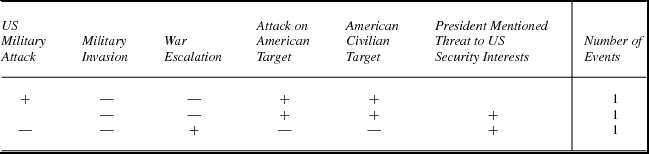
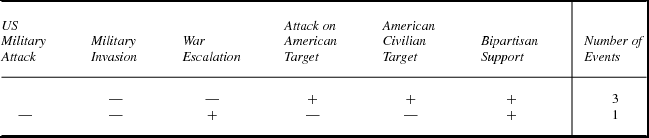
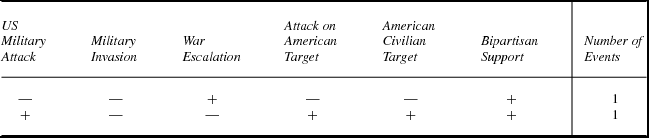
Table A2 contains all variables used to test my explanation of major RRTF periods. However, in addition to the seven major RRTF events, in this analysis five "borderline" cases were recoded as major rally events: the Korean War, the 1986 air raid on Libya, the hijacking of TWA Flight 847, the bombing of Pan Am Flight 103, and the capture of Saddam Hussein in Iraq in December 2003. Of the 12 rally events, this model explains 10.
List of events and RRTF coding.

Results of QCA with borderline cases coded “major RRTF event” (N=46).

The model integrates the 1986 air raid on Libya into pathway 1, which also includes the Cuban missile crisis and the invasions of Panama and Iraq. A detailed investigation of this event reveals that it included all the necessary conditions for becoming a major rally point, but the relatively small size of the operation prevented the development of a significant RRTF effect. The hijacking of TWA Flight 847 is integrated into pathway 2, which also contains the Iran hostage crisis and 9/11. However, in contrast to the model presented in table 2, here the definition of an enemy is not a necessary condition for the emergence of the RRTF effect (by “not necessary,” I mean that a condition was present in at least one of the rally periods included in a pathway, but was absent from at least one of the other rally periods in the same pathway). This model thus suggests that nationalist rhetoric in response to an attack on American civilians is sufficient for generating a considerable increase in presidential job-approval ratings. However, the additional definition of an enemy is required to generate a major rally period. The Korean War joins the Gulf War in pathway 4, but having a preestablished enemy is dropped from the list of necessary conditions. Once again, the presence of a well-defined enemy makes the difference between major rally points and borderline events. Pathway 3 remains unchanged.
Two borderline events remain unexplained by this model (none of the four configurations of conditions that the table specifies is fully present in these cases; the coverage score of 0.833 means that the model does not account for 2 of the 12 major or borderline rally periods). The bombing of Pan Am Flight 103 on November 21, 1988, was followed by a small increase in Reagan's approval rating; however, this increase may not have been a response to the Lockerbie bombing, but rather reflected a general tendency of the American public to be generous when assessing presidents in their last weeks in office. Indeed, similar increases in popularity have occurred in the last weeks of the terms of all presidents since Lyndon Johnson, with the exceptions of Jimmy Carter and George W. Bush, who were also the most unpopular presidents when leaving office. Insufficient data make it impossible to conclude which explanation is more accurate. The fact that Reagan's job-approval ratings had already started to increase in November 1988 (before the Lockerbie bombing) offers partial support to the “end of presidency” explanation.
The capture of the former Iraqi president, Saddam Hussein, on December 14, 2003, generated a modest increase (4–6 points) in President Bush's job-approval rating. In this case, the rally effect most likely emerged because, for many Americans, the event marked the defeat of a hated enemy, a perception that was encouraged by Bush's “We got him” speech. However, the capture of Hussein did not produce a major RRTF effect because it occurred at a time when opposition to the war in Iraq was already at about 40 percent, double the level at the onset of the war (Gallup/CNN/USA Today Poll 2003a, 2003b).
Using QCA to Test Rationalist, Realist, and Elite Consensus Arguments
The data in table A3-1 test the two rationalist arguments; the first argument attributes popular support for military operations to their stated policy objectives, while the second argument attributes support to the success of military operations. The solution produced by QCA covers only one of the seven major RRTF events (the Mayaguez incident).
Testing rationalist arguments.

The data in table A3-2 examine whether the communication of threats to national security can explain the emergence of major RRTF periods. The solution produced by QCA has poor coverage. According to this solution, the “communication of threat” argument explains only two major RRTF periods: the Cuban missile crisis and 9/11.
Testing the communication of threat argument.

The data in tables A3-3 and A3-4 test the elite consensus argument. Both tables show that whether a narrow definition of bipartisanship (that counts only active support for the president's foreign policy by the leadership of the opposition party) is used or a broader definition (that also considers passive support) is applied, most of the RRTF periods remain unexplained. The Gulf and Iraq wars are two examples of events that led to major rally periods despite the media's presentation of a significant opposition to the presidents’ foreign policy.
Testing the elite consensus argument (passive support by the leadership of the opposition party).

Testing the elite consensus argument (active support by the leadership of the opposition party)