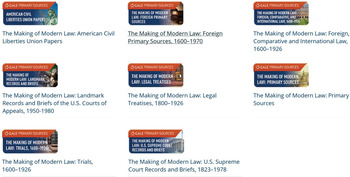
In 2003, Gale launched the first of eight databases that currently comprise The Making of Modern Law. Although each database opens a unique window onto a vital aspect of legal history, the series bespeaks Gale's broader mission of serving academic, public, school, and corporate library patrons around the world. Functioning as the library reference publishing division of the global higher education publisher Cengage, Gale has operated since its founding nearly 60 years ago to provide information resources—from authoritative encyclopedic works and critical directories to interactive learning tools—to millions of users across the world. Unlike traditional legal publishers, Gale provides information resources from a broad array of fields, with products representing nearly all disciplines in the humanities and social sciences, as well as key selected areas in science, technology, and medicine. Within this broader product palette, Gale's foray into legal scholarship reflects its specialization in, among other areas, the delivery of large collections of critical historical primary sources for scholarly research.
Badges for each project currently part of Gale's Making of Modern Law series of digital historical collections.

SURVEYING THE LANDSCAPE
At present, the Making of Modern Law series comprises some 34 million pages of content. These includes legal treatises, published trial transcripts, court briefs, and a slew of other types of works that legal historians and scholars from other areas of historical study use in their research.
THE LAUNCH OF THE MAKING OF MODERN LAW
Behind each project lies a unique story of its evolution. Consider the first title launched in the series, Legal Treatises, 1800–1926. This collection first emerged as a microfilming collaboration between the publisher Research Publications and, in order of the size of their contribution to the project, the law libraries of Harvard University, Yale University, York University, and Columbia University. Moreover, as the original project sought to reproduce as complete a collection as possible of treatises on the American and English legal traditions, hard-to-access titles—including titles from France, Germany and elsewhere—were also gathered from the law libraries of or rare book collections housed at the University of Georgia, the University of Minnesota, Southern Illinois University, St. Louis University, Northern Kentucky University, the University of Virginia, Wesleyan University, Fordham University, Florida State University, Northwestern University, and numerous others. Because the original project concentrated exclusively on Anglo-American law, Research Publications and its partners decided to forego the reproduction of treatises prior to 1800 owing to their inclusion in other comprehensive microfilm collections, now available in digital form, from Gale (ECCO or Eighteenth Century Collections Online), ProQuest (EEBO or Early English Books Online), and Readex (Early American Imprints).
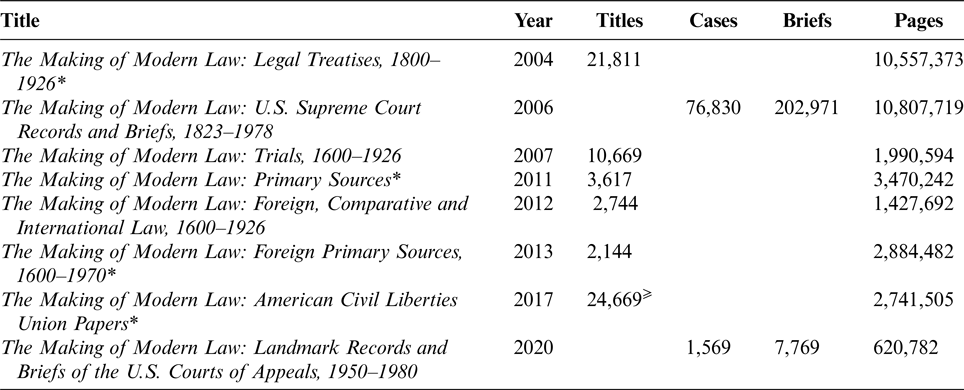
Totals in terms of titles, cases, and briefs among databases within Gale's Making of Modern Law series.

*Originally published in two parts.
⩾Manuscript objects, primarily folders.
Legal Treatises, 1800–1926 illustrates a standard approach among publishers of making longstanding microfilm series digitally available for research. However, the default notion that mere possession of a microfilm collection lowers barriers of access and cost enough to justify immediate conversion into a digital product is simply not borne out by the reality of how markets operate. While cost and ready access are sometimes necessary criteria, they are not necessarily sufficient ones. While they can play important roles in any product development decision, they are only factors and not fully determinative. As a result, each project in Gale's Making of Modern Law series has its own origin story, if you will.
SERVING MORE THAN LEGAL HISTORIANS
One factor shaping those origin stories is Gale's nature, since Gale is, unlike, say, Hein Online or LLMC, not just a legal history publisher. As a consequence, Gale editors must often consider how future products fit within the vast array of historical products on offer. Alongside the Making of Modern Law, Gale also is the publisher of digital collections that serve a broader range of types of historical scholarship, from literary history to LGBTQ Studies. User expectations, particularly across multiple products, oblige Gale to take into consideration how well collections in legal history will thus “play” with projects focused on other disciplines, from American Fiction, 1774–1920 to the multipart Archives of Sexuality and Gender.
Legal Treatises, 1800–1926 meets these expectations in some notable ways, in part because it assembles content that fundamentally comments on the law rather than instantiates the law in the form of regional, national, or international statutes, treaties, regulations, and even court opinions intended to guide (or bind) future legislation or legal rulings. Note that although various Making of Modern Law databases do not forego the latter kind of content altogether, such content is not necessarily the series’ focus because of Gale's broader mandate as a publisher of many types of historical content. Making of Modern Law databases lean more towards the assembly of legal materials from categories that might otherwise fall outside of the pale of what legal publishers (including such heavyweights as LexisNexis or Westlaw) commonly pursue.
The Making of Modern Law: Trials, 1600–1926 exemplifies this principle. The nearly 2 million pages of content for this database come from the law libraries of Harvard University and Yale University and the remarkable holdings of the Library of the Bar Association of New York City. With input from legal scholars and librarians, this project filled a critical gap in digitally available historical legal literature not only for legal historians but those scholars working in other spheres. For users, the collection brings together published trial transcripts; popular printed accounts of sensational trials, “unofficial” published accounts of trials, briefs and arguments that appeared as standalone publications, records of administrative proceedings, published arbitration sessions, monographs on multiple trials, and rare pamphlets devoted to a single trial.
How might Trials, 1600–1926, serve scholars working in social, political, religious, economic, cultural and popular history? In this collection students and scholars of history can digitally leaf through trial materials on major figures in British history (the deposed and executed Charles I, the Tory firebrand Henry Sacheverell, impeached Governor-General of India Warren Hastings, exiled Danish Queen Caroline Matilda, great Irish reformer Daniel O'Connell, and controversial literary bon vivant Oscar Wilde), American history (accused Revolutionary War spy John André, political figure Aaron Burr, abolitionist radical John Brown, controversial classroom teacher of evolution John Scopes, and captured slave Dred Scott). There are even materials on a number of French legal causes célèbres (religious warrior Joan of Arc, peasant impostor Martin Guerre, French Revolutionary supporter-turned-critic François-Noël Babeuf, and falsely accused spy and victim of French anti-Semitism Alfred Dreyfus). So for the early American historian, transcripts of Major General Benedict Arnold's court martial are reprinted; the modern comparative historian can read through the impeachment of Andrew Johnson; the social and political historian can review the trial transcripts of the Sacco and Vanzetti murder case; the religious historian will find treatments of the Popish Plot to assassinate Charles II in the late 1670s; the historian of slavery will find materials on the trial of missionary John Smith for his assistance with the 1823 Demerara slave rebellion in Guyana; the literary historian can review treatments of the abduction trial of Andrew Robinson Stoney-Bowes, who served as the inspiration for William Makepeace Thackeray's classic novel The Luck of Barry Lyndon; and the medical historian will discover materials on the prosecution of William Burke and William Hare for their body snatching-inspired spate of murders.
FILLING GAPS IN THE DIGITAL UNIVERSE
Because Gale differs from other legal publishers in serving a potentially wider market of historical research, some of its databases illustrate well the model of assembling “off-the-beaten-path” materials. Foreign, Comparative and International Law, 1600–1926 performs this function by making available critical works in four such areas with respect to writing about the law. The first is that of published legal treatises on jurisdictions outside the Anglo-American tradition, already effectively represented in Gale's Legal Treatises, 1800–1926. The second covers published assessments of the ancient and medieval—specifically the Roman and “canonical”—legal systems, which heavily influenced modern Western legal thought and codes. The third gathers examinations of various religious legal traditions, notably the Jewish and Islamic legal systems. The fourth compiles the many published works in the field of comparative law, featuring titles that expressly compare legal systems to one another. In assembling works for this collection from the special collections at the Yale Law Library, the George Washington University Law Library, and the Columbia Law Library, Gale availed itself of critical subject indexing assignments to help navigate materials by these designations.
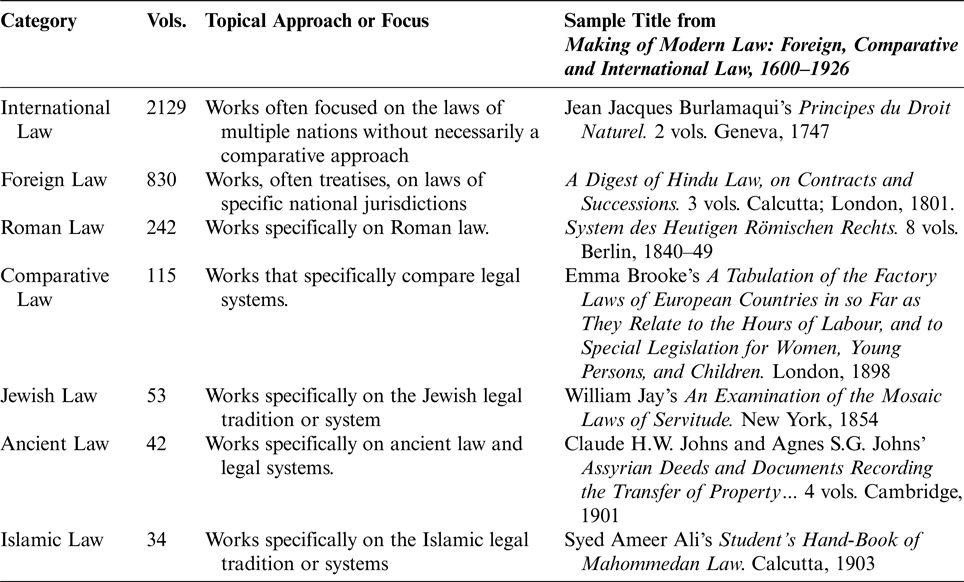
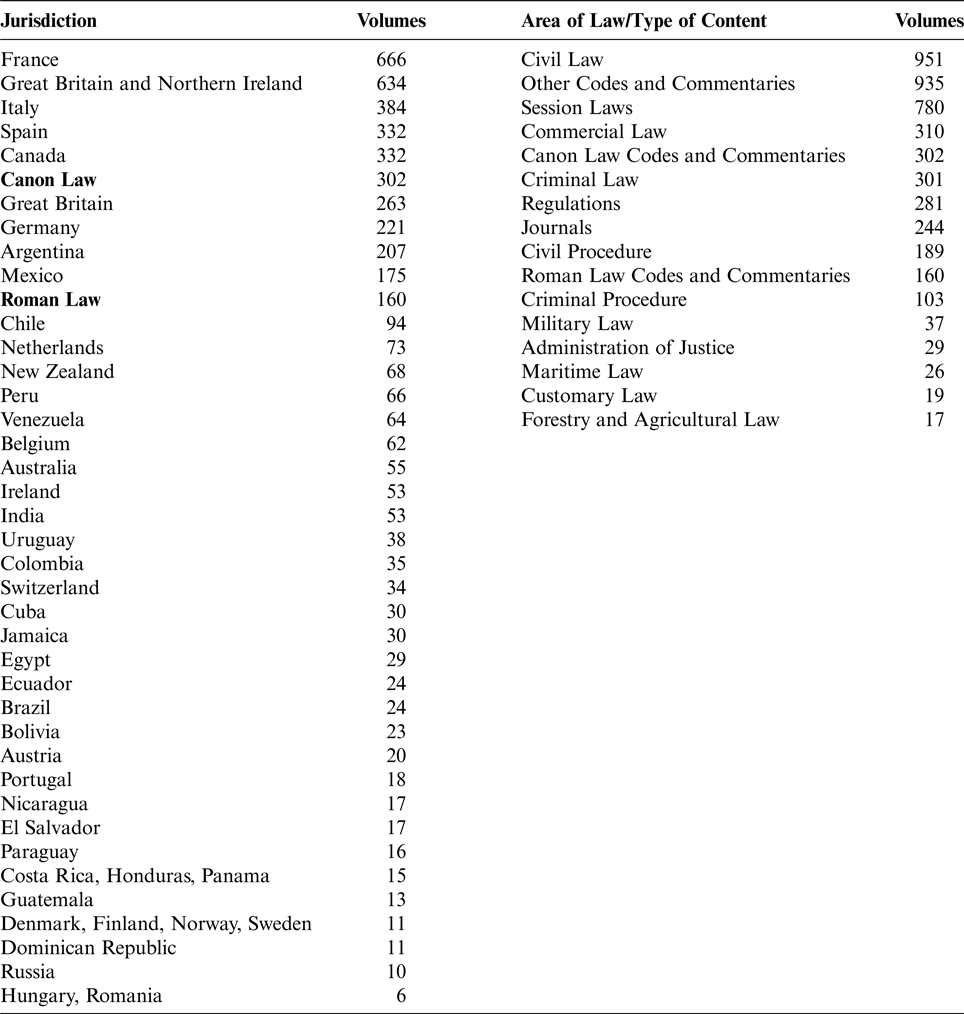
Volume counts by topical focus of works in Making of Modern Law: Foreign, Comparative and International Law, 1600–1926.

Other collections within the Making of Modern Law, such as its exclusively American-focused Primary Sources collection and the largely European Foreign Primary Sources collection, sought to fill critical holes in the digital availability of certain kinds of more traditional legal historical content. With a more pronounced focus on legal codes, both collections together comprise over 5,000 titles, nearly 10,000 volumes, and some 6.3 million pages of acts, charters, laws, ordinances, statutes, and other types of content, all sourced from the Massachusetts Historical Society, the Law Library of the Library of Congress, the National Archives of the United Kingdom in Kew, and the George Washington University, Harvard University and Yale University Law Libraries. Example titles from the specifically the Primary Sources collection illustrate the nature and variety of content, which range from law digests and dictionaries to published minutes and records of state and municipal bodies.
In Foreign Primary Sources, 1600–1970, similar types of works appear but are drawn from the broader palette of the Western legal tradition, including a number of transnational works devoted to Roman and canon law. In this collection of 2,143 titles and 4,685 volumes, categories and jurisdictions are both specially indexed to assist scholars seeking to narrow their focus by region and/or content type.
A BRIEF VIEW OF THE WORLD OF BRIEFS.
Of the current eight databases that comprise the Making of Modern Law, two are notable for the very different set of research needs they seek to address through the panoply of documentation, primarily legal briefs, that underlie American court rulings. The original inspiration for U.S. Supreme Court Records and Briefs, 1823–1978 had been a long available microfilm set from the publisher Scholarly Resources, which had been acquired by Gale in 2003. However, Gale's editorial team soon realized that the microfilm set in question was little more than the tip of the proverbial iceberg as a new partner stepped in with a collection of Supreme Court records nearly ten times the size (at 10 million pages), providing one of the largest collections of historical content associated with Supreme Court case filings to be placed online. Published in 2006, this online collection comprises amicus, appellant's, appellee's, intervenor's, petitioner's, relator's, reply, respondent's, supplemental, defendant-in-error and plaintiff-in-error briefs, briefs on petition, and appendixes; briefs and briefs on petition for the United States and for the opposition respectively; applications for writ or review; docket sheets, jurisdictional statements, motions, oral transcripts, memoranda and memoranda on petition, petitions for rehearing or review, record excerpts or extracts or on appeal, reproduced records, statements, and transcripts of record.
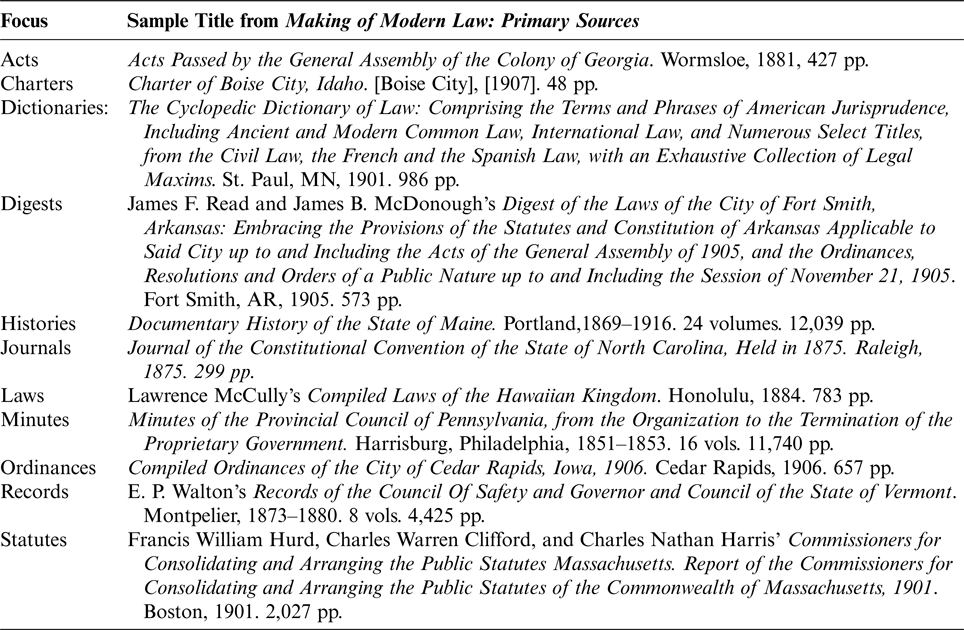
Sample titles by types of content Making of Modern Law: Primary Sources.

U.S. Supreme Court Records and Briefs, 1823–1978 proved an immediately successful project for Gale, but it would be nearly a decade and a half before Gale could successfully engage with what seemed its complement: selected records and briefs from the federal appeals courts of the United States. The key challenge represented was the ability to make a useful selection for digitization. Gale editorial staff were long aware that the estimated number of pages for all associated briefs and records from the various circuits from the appeals court system's inception in 1891 until the early1980s numbered some 75 million pages. This figure was recorded by Margaret Leary in her seminal study on the matter in the 1993 Law Library Journal article “The Case of the Disappearing Briefs: A Study in Preservation Strategy.” As she would write, after a study conducted by the LLMC on the viability of a microfilm project to preserve as much of this content as possible: “The study showed a market not quite strong enough to support the project, which would have filmed seventy-five million pages at a cost of nearly three million dollars. Again, the irony appears: the very unavailability of the material contributes to the lack of demand.”
Despite her prediction, much of this content would, in fact, come to be microfilmed at the Library of the Bar Association of the City of New York under a preservation grant. (The fact that a preservation grant had financed the project also affirmed Leary's assertion that there was no market demand for a collection this large.) Yet even this microfilm set would have to lie dormant since lack of any market demand for the entire collection did extend to the digital arena. An artful selection, however, was another matter. The challenge was how to separate appellate court wheat from chaff.
Volume counts from Making of Modern Law: Foreign Primary Sources, 1600–1970 by jurisdiction and by area of law.

The solution would not emerge until over a decade after the release of U.S. Supreme Court Records and Briefs, 1823–1978, with the arrival of databases that allowed the sorting of federal appellate case opinions by the number of citations received in law review articles for each circuit. The result was the 2020 release of The Making of Modern Law: Landmark Records and Briefs of the U.S. Courts of Appeals, 1950–1980, which reproduces over 7,500 court-related documents for some 1,500 cases from all circuits, cases that were among the most heavily cited in legal research. This collection will be complemented by the imminent release in late 2021 of the preceding 60 years’ worth of cases, again most heavily cited in legal research, in Gale's forthcoming Landmark Records and Briefs of the U.S. Courts of Appeals, 1891–1950.
BEFORE GETTING TO COURT: THE CASE OF THE ACLU
The last of the Making of Modern Law databases requiring mention looks beyond the world of published legal documentation. Again, inspiration and source were a microfilm project created in the 1990s by Scholarly Resources, which had collaborated with Princeton University to film part of the records of the American Civil Liberties Union, stored at Princeton's Seeley G. Mudd Manuscript Library, which serves as the organization's archival repository. The initial release, which first appeared in 2017, made digitally available the records of the organization's New York office, which functioned as the central clearing house for many of its major cases. This initial release comprised over 17,000 manuscript objects (specifically folders) and some 2,000,000 pages of files, covering the period of 1912 to 1990. In 2019, Gale followed up after close discussion with both the ACLU and Princeton University staff the release of the records of the Southern Regional Office in recognition of the critical importance of the ACLU's work in the South, particularly during the civil rights era. This offering included nearly 7,000 manuscripts and over 647,000 pages.
The value of a collection of this nature is how well it represents the background work of a key participant in many of the most important court cases that moved through the American legal system. In order to capture a sense of the “back room” operations of an organization so heavily vested in the American court system, users can review the organization's legal case files (1933–1990), project files for the Amnesty Project (1964–1980) and Lawyers Constitutional Defense Committee (1964–1976); extensive subject files in such categories as due process of law (1938–1988), equality before the law (1941–1987), freedom of belief, expression, and association (1939–1988), international civil liberties (1942–1982); the southern regional office's legal department subject files (1950–1980); correspondence related to academic freedom (1917–1950), censorship (1917–1950), conscientious objectors (1917–1950), federal departments (1921–1951), federal legislation (1919–1950), injunctions (1931–1939), labor and liberal organizations (1921–1950), and state legislation (1928–1950); and clippings files on academic freedom (1912–1950), censorship (1928–1950), federal departments (1920–1950), legislation (1917–1950), and states (1919–1950).
FROM THE TOP DOWN
The last critical point worth noting in the Making of Modern Law series does not concern so much this family of products but the platform on which it lives alongside the rest of Gale's historical digital collections. Gale has recently engaged in the coordinated process of both moving all of its legacy products (U.S. Supreme Court Records and Briefs, 1823–1978 was one of these) to its current “Omni” platform while initiating a series of updates to optimize the user experience.
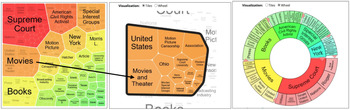
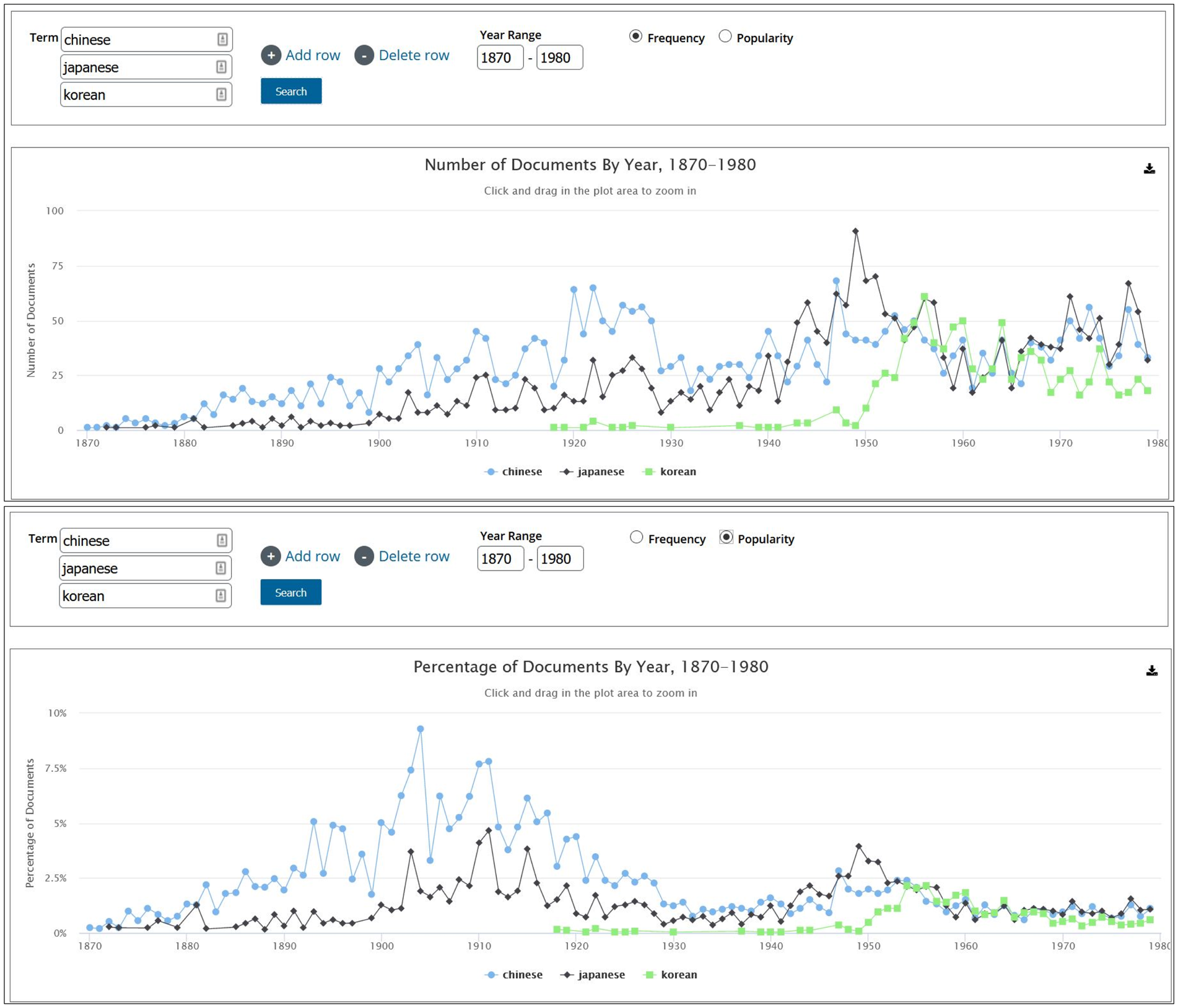
This is a delicate balancing act since the platform for all of Gale's digital historical collections must support nearly 200 million pages of digitized historical content, from single and multi-title newspaper collections to book, periodical, and manuscript collections that comprise some 400 large and small individual archive products. To that end, Gale continuously tests the user experience and prioritizes the integration of enhancements to that experience. No listing of these enhancements can do proper justice to either their significance or frequency. Whether we are talking about advanced search features or powerful visual tools such as our tile-and-wheel topic finder and word frequency graphs (see figures 2 and 3), all such improvements serve but one purpose: to unlock the treasure chest of hard-to-access historical information that so often serves as the source of pedagogical and publishing success in the field of history.
A first- and second-level topic finder tile and the first-level topic finder wheel, based on the term “censorship” in The Making of Modern Law: U.S. Supreme Court Records and Briefs, 1823–1978.

Word frequency reviews by total mentions by year (top) and percentage of documents that include the term by year (bottom) in The Making of Modern Law: U.S. Supreme Court Records and Briefs, 1823–1978.