The focus in this study was on interrelations among two sets of adjustment indicators, personal maladjustment and academic performance, among affluent high school students, followed from 10th through 12th grades. Two critical issues were addressed. The first concerned examination of bidirectional antecedent-consequent associations, for example, whether problem behaviors in sophomore year portend declines in academic functioning over time (Part 1 of the study) or is the converse more likely (examined in Part 2). The second issue pertained to continuity of problem behaviors and academic competence, for example, whether 10th graders high on personal distress or low on achievement remained so by the completion of high school.
The bioecological model of human development (Bronfenbrenner & Morris, Reference Bronfenbrenner, Morris, Lerner and Damon2006) posits that inherent qualities of the individual dynamically interact with varied environments, both proximal and distal, to shape development. This is particularly salient in the framework of this study given the contextual influences, namely, that of relatively affluent parents and the larger cultural milieu, placing high expectations for academic achievement on these adolescents. Additionally, qualities of such environments, parents and schools equipped with resources to assist adolescents in myriad ways, may work in concert with achievement pressures to dampen the likelihood of poor academic outcomes in this population.
Despite the environmental factors that may effectively promote academic competence, there may very well be unintended negative consequences for personal adjustment, such that certain adolescents may become distressed in response to these stressful and ubiquitous cues to achieve. In a similar vein, lower achieving students, aware that their performance falls short of the high parental and societal expectations present in privileged social contexts, may reactively engage in externalizing and internalizing problem behaviors. Therefore, although achievement pressures may act as a protective factor in one domain, that is to say encouraging academic accomplishment, they may exert a negative influence in another, namely, personal adjustment. This dynamic relationship among intraindividual characteristics, family, as well as social–contextual factors, necessitates longitudinal data that can begin the task of exploring the reciprocal relationship between academic performance and internalizing and externalizing indicators of distress (Rutter, Champion, Quinton, Maughan, & Pickles, Reference Rutter, Champion, Quinton, Maughan, Pickles, Moen, Elder and Luscher1995).
Part 1: Distress Among Affluent Youth
There is now growing empirical evidence of maladjustment among adolescents of affluence (Luthar, Reference Luthar, Cicchetti and Cohen2006; Luthar & Goldstein, Reference Luthar and Goldstein2008; Luthar & Latendresse, Reference Luthar and Latendresse2005); however, to date, the long-term ramifications are not clear. In an early study, Luthar and D'Avanzo (Reference Luthar and D'Avanzo1999) reported significantly higher substance use levels among affluent suburban 10th graders compared to their low-income urban counterparts. Subsequent cross-sectional analyses of these high school sophomores (Luthar & Ansary, Reference Luthar and Ansary2005) showed significantly compromised academic outcomes among multiproblem (MP) teens, or those who engaged in diverse problem behaviors including substance use, delinquency, and school disengagement. Additionally, the findings revealed poor academic achievement among the drug user cluster (these individuals were not significantly different than MP youth on academic indicators) suggesting that overall drug use for this population may have as serious ramifications for academic adjustment as does engagement in multiple deviant behaviors (Luthar & Ansary, Reference Luthar and Ansary2005). Given the lack of longitudinal data examining whether substance use and other deviant behaviors might harbinger long-term academic problems among affluent youth, in the current investigation, we sought to examine, whether the coalescing of problem behaviors would have any ramifications for future academic functioning from sophomore year through the end of high school.
In the only prospective work on adolescents from this population, McMahon and Luthar (Reference McMahon and Luthar2006) focused specifically on trajectories of substance use over time among the Luthar and D'Avanzo (Reference Luthar and D'Avanzo1999) cohort, using a composite indicator of cigarette, alcohol, and marijuana use. Five clusters based on use patterns over time emerged: minimal use, declining use, late escalating use (escalations in 12th grade), early escalating use (escalations in 11th grade), and persistently high use. When compared with the minimal use cluster, escalating, declining, and persistently high use groups consistently showed poorer adjustment across internalizing and externalizing dimensions as well as academic outcomes, across all three time points. Importantly, the adjustment trajectory slopes for these groups did not differ across time, the highly using adolescents began and ended the three waves reporting poorer outcomes on myriad adjustment indicators.
Although substantial evidence suggesting a high toll exacted by overall drug use on adjustment for this population exists, it is important to explore if the ramifications of drug use on personal adjustment are equivalent across drug type. Regarding nicotine, Luthar and Ansary (Reference Luthar and Ansary2005) and others (Andrews & Duncan, Reference Andrews and Duncan1997; Ellickson, Bui, Bell, & McGuigan, Reference Ellickson, Bui, Bell and McGuigan1998; Newcomb & Bentler, 1988; Newcomb et al., Reference Newcomb, Abbott, Catalano, Hawkins, Battin-Pearson and Hill2002) have shown that cigarette use has unique negative links with academic achievement. Findings regarding academic consequences of other substances are less clear, with some reporting little or no such association for alcohol use (Bryant & Zimmerman, Reference Bryant and Zimmerman2002; Ellickson et al., Reference Ellickson, Bui, Bell and McGuigan1998) and no unique effects for cannabis use on high school drop out (Ellickson et al., Reference Ellickson, Bui, Bell and McGuigan1998).
Importantly, it is presently unknown whether deviant behaviors other than substance use, notably delinquent behaviors, have any ramifications for long-term academic functioning among high socioeconomic status (SES) adolescents. Again, cross-sectional comparisons of the Luthar and D'Avanzo (Reference Luthar and D'Avanzo1999) sophomores revealed overall delinquency levels commensurate with that of their inner-city counterparts (Luthar & Ansary, Reference Luthar and Ansary2005). At the same time, occasional forays into rule-breaking behavior may have fewer long-term negative effects for wealthy youth in general, unlike inner-city teens, as a result of the support systems ostensibly available to them (Luthar & Burack, Reference Luthar, Burack, Cicchetti, Rappaport, Sandler and Weissberg2000); thus, delinquency may not be as strong a precursor and consequence of academic problems as it is among other adolescent samples.
Aside from links between deviant behaviors of an externalizing nature and academic competence, cross-domain prospective links between internalizing problems such as depression and anxiety among high SES youth and their academic underachievement warrant examination. This is an area of vital importance given the high rates of depression levels documented in the Luthar and D'Avanzo (Reference Luthar and D'Avanzo1999) study: one in five affluent adolescent girls reported clinically significant depression levels, nearly two to three times as high as national norms. Of importance, extant evidence on the associations between internalizing distress and academic problems in other samples are somewhat equivocal. Whereas some contend that depression may be a consequence of academic failure (Lewinsohn et al., Reference Lewinsohn, Roberts, Seeley, Rohde, Gotlib and Hops1994; Pelkonen, Marttunen, & Aro, Reference Pelkonen, Marttunen and Aro2003), others have suggested that internalizing distress may be positively associated with academic adjustment, that some heightened level of anxiety may enhance academic performance (Svanum & Zody, Reference Svanum and Zody2001). In their prospective longitudinal study, Masten and colleagues (2005) concluded that internalizing distress was not causally linked with later academic achievement, whereas earlier academic incompetence significantly predicted later internalizing distress. Accordingly, given the alarmingly high rates of depression found among wealthy adolescent females in the Luthar and D'Avanzo (Reference Luthar and D'Avanzo1999) study, as well as the inconsistency in the literature regarding links between depression and achievement, we examined links between internalizing distress and academic adjustment across sophomore year through the end of high school.
Because we were interested in exploring the association between achievement and externalizing and internalizing dimensions examined separately, as well as any overlap between these two domains (i.e., individuals exhibiting both externalizing and internalizing behavior problems), person-based analyses were deemed most appropriate. As was done in our earlier cross-sectional analyses of deviant behavior patterns and academic achievement (Luthar & Ansary, Reference Luthar and Ansary2005) cluster analyses were chosen for two broad reasons: (a) interaction effects are unstable and often fail to capture the relationship between multiple underlying constructs (see Luthar, Reference Luthar1993; Luthar, Cicchetti, & Becker, Reference Luthar, Cicchetti and Becker2000), and (b) we felt it more informative to examine profiles of individuals rather than data in aggregate form as is done in variable-based techniques. Specifically, in Part 1 of the study, we derived clusters of 10th graders based on self-reported levels on externalizing (use of cigarettes, alcohol, and marijuana, as well as engagement in delinquent activities) and internalizing indices, namely, depression and anxiety. These problem behavior clusters were first replicated and then validated against peers' ratings on conceptually related dimensions. Clusters were then examined for (a) disparities in academic outcomes over time, considering both grades and teacher ratings of adaptive classroom behaviors and (b) continuity over time on these maladjustment dimensions.
Part 2: Academic Disengagement Portends Problem Behaviors
Links in the opposite direction, with earlier academic problems foreshadowing maladjustment to come have been found for substance use (Bryant, Schulenberg, Bachman, O'Malley, & Johnston, Reference Bryant, Schulenberg, Bachman, O'Malley and Johnston2000), delinquency (see Hawkins et al., Reference Hawkins, Herrenkohl, Farrington, Brewer, Catalano, Harachi, Loeber and Farrington1998; Lipsey & Derzon, Reference Lipsey, Derzon, Loeber and Farrington1998), and internalizing distress (Lewinsohn et al., Reference Lewinsohn, Roberts, Seeley, Rohde, Gotlib and Hops1994; Pelkonen et al., Reference Pelkonen, Marttunen and Aro2003). Although obtaining poor grades is plausibly a “less serious” transgression than smoking marijuana or breaking the law, for instance, it may pave the way to more serious deviant behaviors. From a developmental perspective, it makes intuitive sense that adolescents would progress from less to more serious offenses, and in fact, the literature supports this (Kandel, Reference Kandel and Kandel2002; Luthar & Cushing, Reference Luthar and Cushing1997).
Furthermore, poor academic functioning occurring in adolescents from affluent environments may be particularly indicative of deviance and maladjustment (more so than for adolescents from other socioeconomic backgrounds). Endemic to this context are pressures to perform and gain entrance to prestigious universities (Luthar & Sexton, Reference Luthar, Sexton and Kail2004); potentially, those who perform poorly in the face of such widespread pressure may be more apt to engage in a variety of deviant activities.
Consequently, in Part 2 of the study, our aim was to derive clusters of 10th graders based on academic functioning, as indexed by baseline levels of both academic grades across four major subjects and teacher ratings of classroom adjustment behaviors. Cluster analyses were again utilized because grades obtained from four different academic subjects were considered conceptually different than teacher ratings, from one instructor, primarily focusing on adaptive classroom behaviors (e.g., disruptiveness in the classroom, remaining on task, motivation to learn, etc.). Because this sample is a relatively unexplored group, it was certainly plausible that we might find students moderately high on grades but not necessarily concurrently high on positive classroom behaviors. Hence, cluster analyses were deemed most appropriate to explore these associations. Therefore, analogous to our first aim, we then examined these clusters over time to track (a) changes in externalizing and internalizing dimensions as a function of earlier achievement cluster membership and (b) continuity in academic adjustment (addressing the question of whether teens with compromised academic functioning at 10th grade were still performing poorly by senior year).
Gender Differences
Gender differences were considered in all analyses, given prior evidence indicating disparities in the incidence of problem activity, with females demonstrating more socially acceptable conduct (Broidy et al., Reference Broidy, Nagin, Tremblay, Bates, Brame and Dodge2003; Newcomb et al., Reference Newcomb, Abbott, Catalano, Hawkins, Battin-Pearson and Hill2002), as well as superior levels of academic performance (Luthar & Ansary, Reference Luthar and Ansary2005; Newcomb et al., Reference Newcomb, Abbott, Catalano, Hawkins, Battin-Pearson and Hill2002). Whereas some studies suggest largely similar associations between problem behavior and academic performance among males and females (Luthar & Ansary, Reference Luthar and Ansary2005; Moffitt, Caspi, Rutter, & Silva, Reference Moffitt, Caspi, Rutter and Silva2001), others suggest variations by gender (see Hawkins et al., Reference Hawkins, Herrenkohl, Farrington, Brewer, Catalano, Harachi, Loeber and Farrington1998). Gender disparities are perhaps most evident when examining associations between internalizing distress and academic achievement, with links being substantially more robust for females than males (Pomerantz, Altermatt, & Saxon, Reference Pomerantz, Altermatt and Saxon2002; Reinherz, Giaconia, Carmola Hauf, Wasserman, & Silverman, Reference Reinherz, Giaconia, Carmola Hauf, Wasserman and Silverman1999).
Summary
In sum, the central objectives of this study were to prospectively examine among affluent suburban adolescents: (a) bidirectional antecedent-consequent links between problem behaviors and academic achievement, (b) continuity in problem behavior activity as well as stability of academic functioning across three waves of data, and (c) gender differences in both parts.
Specific a priori hypotheses were limited because of the fact that results of cluster analyses would be required to make predictions about these subgroups. However, given prior cross-sectional work using clusters generated from similar dimensions (Luthar & Ansary, Reference Luthar and Ansary2005), as well as evidence from the extant literature, a priori hypotheses were as follows:
Part 1: Clusters generated based on 10th grade problem behaviors
1. Drug-using youth, especially so for cigarette users, would show lower concurrent and long-term academic performance as compared to their “asymptomatic” counterparts.
2. Multiproblem youth would exhibit the lowest academic competence, both at baseline and at the end of high school, as compared to their “asymptomatic” counterparts, as well as less maladjusted groups.
3. Regarding prospective links of depression with academic achievement, depression was not expected to precede poor academic outcomes, given the findings of Masten and colleagues (2005).
Part 2: Clusters created from baseline grades and teacher-rated academic competence
4. Low academic achievers, exhibiting low grades and low teacher-rated academic competence, would report the worst outcomes on personal adjustment both concurrently and longitudinally (compared to those obtaining high grades and teacher ratings) in the form of (a) high levels of substance use and delinquency and (b) moderate to high levels of internalizing distress (given findings from Masten et al., Reference Masten, Roisman, Long, Burt, Obradovic and Riley2005).
Method
Participants
The data used in this investigation was collected as part of a larger study on resilience conducted at Yale University (see Luthar & Ansary, Reference Luthar and Ansary2005; Luthar & D'Avanzo, Reference Luthar and D'Avanzo1999). Participants were drawn from an entering class of 289 10th grade students from one high school servicing three demographically similar towns in the Northeast. The average age of the students at initial evaluation was 16.14 years (SD = 0.49). From the original cohort, 89% of subjects (n = 256) completed at least two waves of data collection and were thus included in the final sample. Seven individuals entering the school during 11th grade were not included in the final sample as the majority of analyses relied on Time 1 data to generate cluster membership. Thus, 256 (137 female, 119 male) were included in the final sample. The ethnic composition of the participants in this final sample was mostly White with 78.7% Caucasian, 1.1% African American, 2.3% Latino, 7.2% Asian, 5.3% other, and 5.3% failed to report their ethnicity.
By several accounts, household incomes for the three towns were substantially above national averages, with median household incomes ranging from $74,898 to $102,121 (the national median income was $41,994; US Census Bureau, 2004). The percentage of families below the poverty level was 2.1% or less and in this sample, 1% of students were eligible for free school lunch. Furthermore, in a statewide survey of public schools implemented around the time of initial data collection, this school was placed in the second highest of nine categories of school districts grouped by family socioeconomic status (Beuhring, Saewyc, Stern, & Resnick, Reference Beuhring, Saewyc, Stern and Resnick1996).
Measures: Self-report
Substance use
Drug use was measured using a grid adapted from the Monitoring the Future Study (Johnston, O'Malley, & Bachman, Reference Johnston, O'Malley and Bachman1984). Students were asked to indicate the number of times from “never” to “40+” they used specific substances during the preceding year. The substances included in the measure were cigarettes, alcohol, marijuana, inhalants, LSD, crack, as well as cocaine and at Time 3 heroin, ecstacy, and Ritalin were also added. The psychometric properties of this measure have been sufficiently documented (Johnston, Bachman, & O'Malley, Reference Johnston, Bachman and O'Malley1989; Luthar & D'Avanzo, Reference Luthar and D'Avanzo1999). In this study, we were most concerned with cigarette, alcohol, and marijuana use, and these were tested separately to explore unique links with academic achievement. Alpha levels were based on the three drugs evaluated together at each time. For females, α measures of internal consistency ranged from .82 to .86 and for males .81 to .86 across the three measurements.
Delinquency
The Self-Report Delinquency Checklist (SRD; Elliot, Dunford, & Huizinga, Reference Elliot, Dunford, Huizinga, Burchard and Burchard1987) was administered to gauge delinquent behaviors within the contexts of home, school, and community. The SRD assesses the seriousness of delinquent acts via a 4-point scale anchored by never (1) and very often: five or more times per year (4). To avoid overlap with measures of substance use, 6 of the 38 items that pertained to drug-related behaviors were omitted in the summing of items to arrive at the overall delinquency score (e.g., used alcohol, been drunk in a public place, sold marijuana). Acceptable reliability and validity have been reported (Huizinga & Elliot, Reference Huizinga and Elliot1986). Across each time point, internal consistency coefficients, evaluating the stability of the 32 items were .85 to .89 for females and .90 to .91 for males.
Depression
The Children's Depression Inventory (Kovacs, Reference Kovacs1992) is a self-report measure that consists of 27 items. Participants are asked to endorse the statement that best characterizes their feelings within the past 2 weeks (e.g., “I feel like crying everyday”). Items are then summed to create an overall composite of depressive symptomatology. This inventory has demonstrated acceptable reliability and validity (Kovacs, Reference Kovacs1992; Luthar & D'Avanzo, Reference Luthar and D'Avanzo1999). Within this sample, α coefficients ranged from .87 to .90 for girls and .81 to .86 for boys across the 3 years.
Anxiety
Two subscales of the Revised Child Manifest Anxiety Scale (Reynolds & Richmond, Reference Reynolds and Richmond1985) were used to gauge two dimensions: worry and physiological anxiety. Participants circle “yes” or “no” to 37 statements about feelings and symptoms of anxiety (e.g., “I worry about what my parents will say to me” and “my hands are sweaty”). Acceptable reliability and validity have been demonstrated for this measure (Reynolds & Richmond, Reference Reynolds and Richmond1985). Among students in this sample, the worry subscale α coefficient ranged from .82 to .86 for females and .79 to .82 for males, whereas αs spanned .65 to .66 for girls and .57 to .63 for boys for the physiological anxiety subscale.
Demographics
At each time point, students reported their demographic information such as age, gender, and ethnicity.
Measures: School records and teacher reports
Academic grades
School records were used to obtain final semester grades for four core subjects: English, math, social studies, and science. As in prior reports on this cohort (Luthar & D'Avanzo, Reference Luthar and D'Avanzo1999; Luthar & McMahon, Reference Luthar and McMahon1996; McMahon & Luthar, Reference McMahon and Luthar2006) we applied a standard grade conversion matrix, routinely used by the school to make comparisons of grades across classes of different difficulty levels. For instance, a grade of “A” obtained in a remedial class was assigned a lower numerical value than an “A” obtained in an advanced placement class. Thus, the school administration categorized their courses in terms of difficulty level and converted the letter grade, either to a higher or lower numerical value, based on the academic rigor of the course. During the 10th and 11th grades, all four class subjects were required, whereas not all were required during the 12th grade, resulting in some students not having grades for all four subjects at Time 3. However, internal consistency levels indicate that the grades used for the Time 3 assessment is consistent with the levels found for the previous two time points in that α across composite grades from Time 1 to Time 3 was .91. For Time 1 and 2, α values for the four semesters across four subjects were .92 and .97, respectively. The internal consistency for Time 3 across two semesters and four subjects was .87. Thus, the average of the grades variable for Time 3 was calculated based on all available data and this assumption is supported given the strong alphas.
Composite grade levels were taken such that for 10th and 11th grades, across the four semesters, and across two semesters for 12th grade, and four subjects, grades weighted based on difficulty level were averaged and a raw composite created. Thus, a weighted average for each class subject across semester was calculated and these were then averaged together for one final composite grades variable. The internal consistency of this composite grades variable across the four core subjects and three waves ranged from .83 to .92 for females and .76 and .92 for males.
Teacher report
The Teacher-Child Rating Scale (T-CRS; Hightower et al., Reference Hightower, Work, Cowen, Lotyczewski, Spinell and Guare1986) consists of 36 items, based on a 5-point scale, on which teachers rate their students' classroom behavior. In this study, four subscales of the T-CRS, two of a negative valence and two positive, were used to create the classroom adjustment variable. Of the negative scales, the actout subscale gauges students' disruptiveness in the classroom as indicated by items such as “is disruptive in class” and the learning problems subscale measures behaviors indicative of low academic motivation such as “is underachieving.” Alphas ranged from .91 to .93 for girls and .85 to .91 for boys across the 3 years for the actout subscale, and for learning problems internal consistency levels ranged from .88 to .92 for females and .91 to .92 for males.
The two positive dimensions were the frustration tolerance and task orientation subscales; frustration tolerance gauges students' capacity to negotiate difficult situations in the classroom (e.g., “accepts things not going his/her way”) and task orientation measures how well a child follows through on an assignment or other undertaking in class (e.g., “carries out requests responsibly”). Alphas for frustration tolerance ranged from .72 to .90 for females and .78 to .87 for males. Reliabilities were also high for task orientation with αs ranging from .94 to .96 for females and .95 and .96 for males across the three waves.
The classroom adjustment behaviors variable was created based on factor analysis of these four subscales. All four loaded strongly on only one factor with an eigenvalue of >1. At 10th grade, loadings ranged from .75 to .93, loadings fell between .61 and .91 at 11th grade, and loadings ranged from .70 to .90 at 12th grade.
Measures: Peer report used to validate clusters
Peer ratings, acquired at the baseline assessment only, were utilized in cluster validation. These ratings were obtained via an adapted version (Luthar & Feldman, Reference Luthar and Feldman1998) of the Revised Class Play (Masten, Morison, & Pellegrini, Reference Masten, Morison and Pellegrini1985), a measure in which students are asked to nominate their classmates into roles reflecting specific behaviors. Participants were provided a list of student names with corresponding fake identification numbers in their respective English classes and were asked to pick up to three names per role. For each student, the total number of nominations received per item was summed and then divided by the number of students within the classroom to account for classes of differing sizes. The reliability and validity of such peer nominations have been well documented (Becker & Luthar, Reference Becker and Luthar2007; Luthar & McMahon, Reference Luthar and McMahon1996).
Each set of cluster analyses was validated with the use of peer ratings on characteristics related to the grouping variables. To examine cluster validity for groupings generated based on the externalizing and internalizing areas, five items all conceptually related to the problem behaviors being examined were used. Two of these items address a deviant nature (“gets into trouble with the law” and “breaks school rules”), one of an internalizing, depressed (“is usually sad”), and the last two items are of a social dimension to be used as a point of reference upon which to assess substance use (“likes to party” and “likes to hang out with other kids rather than alone”).
As for clusters created based on grades and classroom adjustment, nominations on one robust and highly specific item was used to differentiate the clusters based on achievement: good student status (“someone who is a good student”). Because this item pointedly addresses the targeted construct, including other more tangential peer nomination items was considered unnecessary.
Procedure
Measures were group administered to students over the span of two 45-min class meetings. All questions were read aloud to minimize participant differences in reading ability. As incentive for participation, at Times 1 and 2, a $3 gift was given to students for their involvement. At Time 3, students were given $5 for participation as well as the opportunity to win three monetary prizes in the sum of $50, $100, and $150 through a drawing. English teachers who completed the T-CRS were reimbursed $1 for each student rated.
Missing data
Varying amounts of data were missing at each time point. Similar patterns of data were missing at Times 1 and 2 such that the maximum amount of missing data on any variable did not exceed 4.9% (n = 13) of the data. With respect to Time 3, the maximum amount of data missing on any variable did not exceed 16.7% (n = 44). Missing data was imputed with maximum likelihood (ML) estimation in the form of the expectation maximum algorithm using SPSS 14.0 and all variables included in the study across all time points were utilized to impute missing information. The ML estimation method of imputation has been found to be superior to mean substitution, regression imputation, and listwise deletion in terms of creating less biased estimates (Gold & Bentler, Reference Gold and Bentler2000; Schafer & Graham, Reference Schafer and Graham2002), and has been recommended as one of the best ways to address missing data (Croy & Novins, Reference Croy and Novins2005; Schafer & Graham, Reference Schafer and Graham2002). Thus, ML estimation was the method of choice to address missing data values.
Attrition
One-way analyses of variance (ANOVAs) were used to ascertain whether individuals completing the study were different than those who did not; dependent variables included all nine adjustment/academic indicators measured at the beginning of the study. Of the nine variables assessed at baseline, subjects completing the study were different than those not completing the study on three dimensions with those completing the study having higher grades F (1, 270) = 9.83, p < .01, and classroom adjustment F (1, 265) = 6.20, p < .05; and lower physiological anxiety F (1, 266) = 3.99, p < .05. Therefore, those completing the study were likely to be slightly more conventional than those not completing the study.
Results
Cluster analyses
For cluster analyses, raw variables were scaled by gender first and then mean centered by gender next, thereby placing all variables on a −1 to 1 scale. Scaling, accomplished by dividing each variable by its range, has been found to be the most robust manner in which to place variables on the same scale for purposes of cluster analyses (Milligan, Reference Milligan, Arabie, Hubert and DeSoete1996). K-means cluster analyses were conducted on these variables and were run separately for males and females. For Part 1 (10th grade problem behaviors predicting to achievement outcomes over time), clusters were created from seven 10th grade problem behavior variables: cigarette, alcohol, and marijuana use (all three considered separately), delinquency, depression, physiological, and worry-based anxiety. In Part 2 (10th grade achievement groups predicting to problem outcomes over time), clusters were derived from 10th grade academic grades and teacher-rated classroom adjustment behaviors.
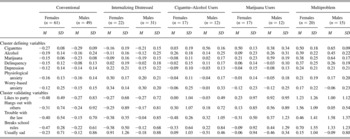
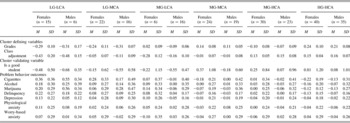
Because nearly identical groupings were obtained for males and females across both Parts 1 and 2 of the study, they were combined. Four to 10 clusters were requested with five problem clusters emerging in Part 1 and six achievement clusters in Part 2. Cluster validation was carried out in two forms. First, clusters were validated with peer-nomination items related to the cluster defining variables; group differences on these validation items, are presented in Table 1 for Part 1 problem behavior clusters and descriptive information for the validation item for the achievement clusters in Part 2 are located in Table 2. For problem behavior clusters, all five peer-rated items significantly differentiated groupings for girls (p < .001). For boys, all items with the exception of “is usually sad” also differentiated groups significantly (p < .05). Likewise, the peer-rated item “is a good student” differentiated achievement clusters significantly (p < .001 for females, p < .05 for males).
Problem behavior groups: Descriptive statistics for 10th grade clustering and validation variables

Note: Cluster validating variables are in z score form because peer ratings were standardized by class size to adjust for classes of varying sizes affecting the frequency of nominations. All other variables are scaled and mean centered separately by gender.
Descriptive statistics for all variables assessed during the 10th grade presented separately by achievement cluster
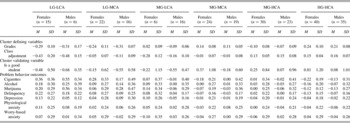
Note: All variables are scaled and mean centered separately by gender. The cluster validating item is in z score form as peer ratings were standardized by class size to adjust for classes of varying sizes affecting the frequency of nominations. LG, MG, HG, low, medium, high grades, respectively; LCA, MCA, HCA, low, medium, high class adjustment, respectively.
The reliability of the cluster structure was examined by creating two sets of identical clusters; each set was generated from a different 50% random sample from the dataset and then the level of correspondence between the two was examined. For Part 1, the two problem clusters were highly related, with kappa indicating 80% overlap for females and 90% for males (p < .001 for both). Comparably, the achievement groups were also alike with kappa reflecting an 86% correspondence rate for girl achievement clusters and 80% for boys (p < .001 for both).
Cross-domain associations
Part 1: Problem behavior clusters predicting achievement outcomes
Descriptive data for clusters and outcomes
Group means, presented separately for males and females, on the problem behaviors used to generate clusters as well as cluster validating variables are located in Table 1.
Two clarifications regarding cluster names are important to note. For the cigarette–alcohol problem behavior clusters in Part 1, females reported high alcohol levels, whereas males reported both high cigarette and alcohol levels. Literature on the gateway hypothesis suggests that use of licit drugs (legal for adults), such as cigarettes and alcohol, may be viewed as a precursor to use at more serious levels, namely, marijuana and other illicit drugs (Kandel, Reference Kandel and Kandel2002). Thus, these early stage drugs have been viewed together within the gateway hypothesis framework, and therefore, although the cigarette–alcohol females in this study did not use cigarettes to a high degree (their reported use levels were higher than conventional (C) and internalized distressed (ID) girls but not as much as marijuana users and MP females) they were combined with cigarette and alcohol using males as both drugs are considered to be gateways to use of more serious drug forms.
The classification of “legal” versus “illegal” drugs was used in naming the next two clusters. With regard to the marijuana users cluster, although their cigarette and alcohol use levels were also high, this cluster was named as such because of the illegal categorization of cannabis. Because individuals at a more severe stage of use have a greater tendency toward use of both legal and illegal substances, it has been suggested that usage be identified in terms of the most severe substance being used (Labouvie & White, Reference Labouvie, White and Kandel2002).
Regarding cluster definitions, C adolescents scored low on all problem dimensions, whereas MP teens reported high engagement in both externalizing and internalizing domains. ID individuals indicated higher levels of depression, physiological, and worry-based anxiety relative to other groups. In fact, females in the ID group averaged in the 95th percentile for depression, the 97th percentile for physiological anxiety and the 86th percentile for worry-based anxiety. Similarly, ID males averaged depression levels in the 76th percentile and 87th percentile for both physiological and worry-based anxiety. Thus, especially so for females, it appears that these individuals displayed relatively high levels of internalizing distress as opposed to slight elevations relative to the rest of the sample.
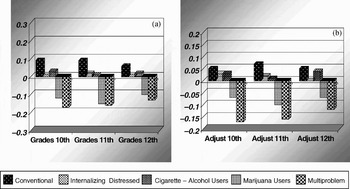
Cluster differences are displayed graphically for the two academic functioning outcomes over time. Figure 1a depicts problem behavior cluster performance levels on grades and Figure 1b shows group differences on the teacher-rated classroom adjustment variable.
A comparison of problem behavior clusters on (a) academic grades and (b) teacher-rated classroom adjustment over time. All variables are scaled and mean centered for ease of comparison among clusters.

General linear model (GLM) results
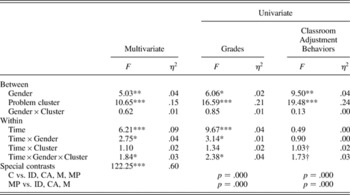
A doubly multivariate repeated measures GLM, with achievement outcomes at each time point entered together as the dependent variables and between-subjects factors being gender and problem behavior cluster was used to examine our central questions. When possible, quadratic trends were explored in an effort to glean a more comprehensive understanding of change over time in all GLMs.
As can be seen in Table 3, significant main effects for problem behavior cluster were obtained on both achievement outcomes: grades and teacher ratings. A priori special contrasts examining group differences between C and all others, in addition to MP and all others, yielded seven unique comparisons. Thus, α was set at .007 (α = .05/seven comparisons). Significant between group differences on grades (see Figure 1a) and classroom adjustment (see Figure 1b) were (a) C teens scored substantially higher than marijuana users and MP adolescents and (b) MP teens also performed significantly worse than ID and cigarette–alcohol users.
Problem behavior groups predicting achievement outcomes over time: Doubly multivariate repeated measures general linear model

Note: Reported multivariate F ratios are Wilk's lambda because this is the most widely used multivariate statistic and it is robust to Type I errors (Stevens, Reference Stevens1996). C, conventional; ID, internalizing distressed; CA, cigarette–alcohol users; M, marijuana users; MP, multiproblem.
† p < .10. *p < .05. **p < .01. ***p < .001.
With respect to overall gender differences, girls scored higher than boys on both grades and teacher-rated classroom adjustment, and with respect to grades only, males decreased at a faster rate than females across time; linear effect, F (1, 246) = 4.63, p < .05, η2 = .02. Regarding main effects and interactions for time, there was a significant general decrease in grades with a sharp decline occurring between 11th and 12th grades. This was indicated by a significant quadratic trend, F (1, 246) = 14.07, p < .001, η2 = .05. Furthermore, interaction effects revealed that clusters performed similarly on achievement indicators across the three time points. In other words, no significant Time × Cluster interaction was obtained, and thus clusters did not traverse achievement trajectories that differed from 10th to 12th grades.
One more interaction is important to note. The Time × Gender × Cluster interaction was significant for grades, F (7.69, 472.77)Footnote 1 = 2.38, p < .05, η2 = .04, and marginally so for teacher rated classroom competence, F (8, 492) = 1.73, p < .10, η2 = .03. For grades across all clusters, females performed at a higher level than males; however, this was not the case for female marijuana users whose performance at 10th and 11th grades were substantially lower than males.
Part 2: Achievement clusters predicting problem behavior outcomes
Descriptive data for clusters and outcomes
Table 2 presents means and standard deviations, separately by group and gender, for the two achievement variables used to define clusters for each time point, cluster validation item, as well as problem behavior outcomes assessed during the 10th grade.
GLM results
Because of theoretical differences between externalizing and internalizing outcomes, two separate doubly multivariate repeated measures GLMs were conducted. Thus, externalizing dependent variables for each time point were entered together: cigarette, alcohol, marijuana use, as well as delinquency. Likewise, internalizing outcomes across the three waves were entered simultaneously for depression, physiological, and worry-based anxiety. For both externalizing and internalizing GLMs, the between subjects factors were gender and achievement cluster and again, quadratic trends were examined to ascertain more fine-grained information about change over time. As was done earlier, two special contrasts were created to test a priori hypotheses. These comparisons were made first between the lowest achieving cluster and all others, in addition to, the juxtaposition of the highest achieving group compared to all others.
Externalizing outcomes
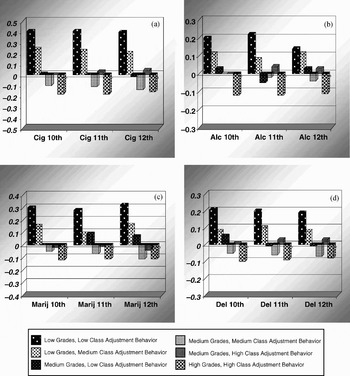
Table 4 contains the GLM results for achievement clusters predicting to externalizing outcomes over time. The a priori special contrasts comparing the lowest achievement group (low grades, low classroom adjustment [LG-LCA]) to all others, as well as a comparison between the highest achieving group (high grades, high classroom adjustment [HG-HCA]) and all other groups (except LG-LCA) were significant for each outcome. Alpha levels for these group comparisons were fixed at .006 (α = .05/nine comparisons). Cluster disparities on each of the four externalizing outcomes are displayed graphically in Figure 2a–d. Significant differences were found for all three substances and delinquency; the two lowest achievement groups (LG-LCA and low grades, medium classroom adjustment [LG-MCA]) reported significantly greater levels then the highest achievement group (HG-HCA). Moreover, for all externalizing variables with the exception of alcohol use, the LG-LCA group was also significantly higher than the most average achievement group (medium grades, medium classroom adjustment [MG-MCA]) and for cigarette and marijuana use only, the lowest achievement group (LG-LCA) also reported significantly higher levels than the second highest achievement group (medium grades, high classroom adjustment [MG-HCA]). Of interest, regarding the MG-HCA group, these individuals reported significantly greater levels of cigarette and alcohol use as well as delinquency compared to the highest achievement group (HG-HCA).
A comparison of achievement clusters on (a) cigarette use, (b) alcohol use, (c) marijuana use, and (d) delinquency over time. All variables are scaled and mean centered for ease of comparison across clusters.

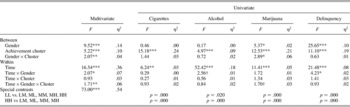
Achievement groups predicting externalizing problem behavior outcomes over time: Doubly multivariate repeated measures general linear model

Note: Reported multivariate F ratios are Wilk's lambda because this is the most widely used multivariate statistic and it is robust to Type I errors (Stevens, Reference Stevens1996). LL, low grades, low class adjustment behavior; LM, low grades, medium class adjustment behavior; ML, medium grades, low class adjustment behavior; MM, medium grades, medium class adjustment behavior; MH, medium grades, high class adjustment behavior; HH, high grades, high class adjustment behavior.
† p < .10. *p < .05. **p < .01. ***p < .001.
Of the externalizing outcomes, main effects for gender were found for delinquency and marijuana use only, with males reporting significantly higher levels than females. Regarding main effects for time on these externalizing dimensions, there was an overall increase in use of all three substances from sophomore to senior year, with the greatest effect seen for alcohol use (see Table 4; cigarettes, η2 = .03; alcohol, η2 = .18; marijuana, η2 = .05). To illustrate, a steep increase in reported alcohol consumption occurred between 11th and 12th grade, and this was indicated by a significant quadratic trend for time F (1, 240) = 11.79, p < .01, η2 = .05). With respect to delinquency, a decline was found across time with a moderate effect size (η2 = .08). Two interactions revealed further differences among these groups. Gender × Achievement Cluster interactions were significant for marijuana use, F (5, 240) = 2.89, p < .05, η2 = .06. Plots reveal that overall, males reported higher cannabis use than females, with the exception of one group: medium grades, low classroom adjustment (MG-LCA) females reported greater marijuana use than males.
An additional interaction among the externalizing outcomes is also worthy of note. For delinquency, a Time × Gender interaction was found, F (1.80, 431.75) = 4.23, p < .05, η2 = .02, and indicated that males reported a steeper decline in delinquency over time than females.
Internalizing outcomes
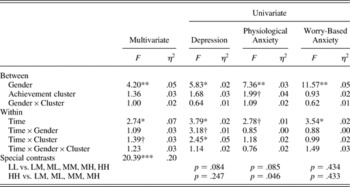
The GLM results for internalizing outcomes are presented in Table 5. No achievement cluster differences were significant. Gender differences were found with females scoring higher than males on all three internalizing indicators. With respect to main effects for time, declines of a modest effect size (η2 ≤ .02) were found for depression, physiological, and worry-based anxiety from 10th to 12th grades. A Time × Cluster interaction was marginally significant at a multivariate level and was significant for depression at the univariate level, F (8.74, 419.42) = 2.45, p < .05, η2 = 05. Plots indicate a steep decline in depression levels for the two low classroom adjustment groups (LG-LCA and MG-LCA) and of interest, the MG-HCA group was the only cluster to increase in depression over time, whereas the remaining groups reported relatively steady levels by 12th grade.
Achievement groups predicting internalizing problem behavior outcomes over time: Doubly multivariate repeated measures general linear model

Note: Reported multivariate F ratios are Wilk's lambda because this is the most widely used multivariate statistic and it is robust to Type I errors (Stevens, Reference Stevens1996). LL, low grades, low class adjustment behavior; LM, low grades, medium class adjustment behavior; ML, medium grades, low class adjustment behavior; MM, medium grades, medium class adjustment behavior; MH, medium grades, high class adjustment behavior; HH, high grades, high class adjustment behavior.
† p < .10. *p < .05. **p < .01. ***p < .001.
Continuity over time
Part 1: Problem behavior clusters
To ascertain whether groups continued on the same maladjustment trajectories over the course of the study, a doubly multivariate repeated measures GLM was used with gender and problem behavior cluster as the between-subjects factors and all seven variables at each time point were entered simultaneously as the dependent variables. The multivariate Time × Cluster interaction was significant with Wilks' Λ = 3.98, p < .001, η2 = .19; all univariate problem behavior variables achieved significance with levels less than .01 for each. The Time × Gender × Cluster interaction was marginally significant.
Despite considerable stability, it appears that all groups reported moderate decreases in each of the problem behavior areas they were initially high on. In other words, groups tended to “mature out” of their problematic activities at a modest level by 12th grade. However, despite this general trend toward decreasing incidence of problem behaviors by senior year, all groups were still higher than the sample average in the realms they were named for. For instance, although ID individuals showed decreases on depression and anxiety over time, their scores on these dimensions were still much greater than the sample mean within each gender.
Thus, the Time × Cluster interaction revealed generally consistent trends with regression toward the mean as a recurring pattern across the majority of groups on each of the dimensions assessed over the three waves. Over time, C adolescents increased slightly on both externalizing and internalizing domains, whereas decreases across the three internalizing indices were seen for the ID group. Similarly, a leveling off of externalizing dimensions among cigarette–alcohol users was also reported. Only marijuana users and MP individuals reported generally steady drug use levels, although marijuana users did show increases in alcohol use by 12th grade. Also worthy of note is a decline in self-reported delinquency and internalizing distress among MP teens by 12th grade.
Part 2: Achievement clusters
To ascertain whether individuals performing poorly on both indicators of achievement at 10th grade maintained their levels of academic maladjustment by 12th grade, a doubly multivariate repeated measures GLM was used with gender and achievement cluster as the between subjects factors and grades and teacher-rated classroom adjustment at each time point entered simultaneously as the dependent variables.
In general, again, all groups regressed toward the mean over time, with three lowest groups improving and the three highest groups declining on grades; this significant Time × Cluster interaction yielded for grades, univariate F (9.67, 464.17) = 3.62, p < .001, η2 = .07, and on classroom adjustment, F (10, 480) = 11.46, p < .001, η2 = .19. Additionally, a significant Time × Gender × Cluster interaction revealed further differences among the clusters over time on academic grades only, univariate, F (9.67, 464.17) = 2.71, p < .01, η2 = .05. Gender differences in the trajectory of achievement was found in three groups: although females were higher than males across all groups, male trajectories in the two low grade groups (LG-LCA and LG-MCA) and the MG-HCA group fluctuated a good deal more than their female counterparts with peaks and dips in grades evident over the course of the 3 years.
Despite slight changes in performance, with all achievement groups demonstrating regression toward the mean by senior year, each still maintained their relative rank to each other. Stated otherwise, the lowest achievement groups at 10th grade were also the lowest at 12th just as the highest performers ranked superior to the remaining groups. This parallels what was seen in continuity over time in problem behavior activity; despite slight fluctuations in conduct occurring over the 3 years, individuals high on a problem dimension at 10th grade reported much higher levels compared to their peers on those same problem dimensions at 12th grade.
Discussion
Based on youth tracked from sophomore year through the end of high school, findings of this study indicate strong associations between problem behavior activity and academic underachievement among relatively affluent suburban youth. Individuals using marijuana, represented by the marijuana users and MP groups in this investigation, exhibited academic deficits as great as a full letter grade below conventional students and this effect lasted across the three annual high school assessments. Of interest, cigarette and alcohol use single-handedly were not related to academic underachievement. Consequently, these results suggest that marijuana use alone is associated with poorer academic outcomes within this population.
Concomitantly, findings imply that low achievement may be associated with later levels of personal maladjustment. First and most generally, across externalizing outcomes, the two lowest achievement groups reported considerably more maladjustment than the uppermost achievement group and this effect occurred from 10th to 12th grade. Second, the MG-HCA group, those exhibiting medium grades and high classroom adjustment, reported higher levels than the highest achieving cluster, on cigarette and alcohol use as well as delinquency. Furthermore, this group was the only cluster to increase in depression levels over time, whereas all others either declined or remained steady. Third, these cluster differences also revealed that females exhibiting average grades and low classroom adjustment (MG-LCA) were also likely to report higher marijuana use. Each of these findings will be discussed further, as well as their implications for intervention efforts.
Cross-domain associations
Part 1: Problem behaviors predicting achievement outcomes
The commonality between the two problem behavior clusters manifesting the poorest academic outcomes was engagement in use of cigarettes, alcohol, and marijuana. However, nicotine and ethanol use alone was not associated with poorer school performance at baseline nor was it by senior year; in fact, cigarette-alcohol users scored significantly higher on grades than did MP teens (one of the two marijuana using groups) and they were not statistically different from C youth on both achievement outcomes. Thus, our first two hypotheses, that drug using and MP teens would have worse academic outcomes than others were supported. However, our assertion that cigarette users would be worse off academically was only partially supported as cigarette–alcohol users were no different than conventional teens in academic performance.
As the current study spanned three annual waves, prospective links suggest that for adolescents from affluent backgrounds, marijuana use, over and above cigarette and alcohol use, may confer risk for concurrent and future academic underachievement. These results parallel those found in another longitudinal study following one cohort for 25 years: marijuana users were 3.7 times more likely to dropout of high school even after controlling for social, family and childhood factors (Fergusson, Horwood, & Beautrais, Reference Fergusson, Horwood and Beautrais2003). This study further found that after controlling for these confounding factors, there was no support for the temporal sequence of poor school performance predicting subsequent marijuana use (Fergusson et al., Reference Fergusson, Horwood and Beautrais2003).
Findings from the current study run counter to others, which indicate that it is cigarette, and not marijuana use, that is the more potent force for academic risk (Ellickson et al., Reference Ellickson, Bui, Bell and McGuigan1998; Newcomb & Bentler, Reference Newcomb and Bentler1988). In a prior cross-sectional study using the same affluent high school sample used in the current investigation, it was found that cigarette and not marijuana use significantly predicted to concurrent grades (Luthar & Ansary, Reference Luthar and Ansary2005). It is important to note two points: (a) variables in that cross-sectional study included a low academic motivation variable that accounted for a considerable 9% of the variance in grades, and (b) in all likelihood the majority of those who engaged in tobacco smoking also engaged in a multitude of other problem behaviors (e.g., in the current study three problem groups engaged in cigarette use, cigarette–alcohol users, marijuana users, and MP youth, two groups having the worst academic outcomes). The explanation for this inconsistency probably lies in the overlap between deviance, marijuana use, and low academic motivation. In a prospective longitudinal study, deviance was found to fully explain the relationship between marijuana use and low academic motivation (Andrews & Duncan, Reference Andrews and Duncan1997) but did not mediate the relationship between cigarette use and low academic motivation. Thus, in the Luthar and Ansary (Reference Luthar and Ansary2005) study, it is likely that low academic motivation accounted for the variance in grades that may have been explained by marijuana use given the overlap between these two variables. Clearly, these findings illuminate the necessity for further research examining mediators, especially deviance, of the relationship of each drug's effect on academic outcomes.
Internalizing distress
The finding that high self-reported depression and anxiety at baseline did not, to a large extent, hinder academic performance over time is an interesting one. Although marginally significant, those reporting high internalizing distress at baseline performed only slightly below conventional youth while performing substantially better than MP teens on academic grades. It is important to note, at the same time, that overall both C and ID youth scored in the “B” range of grades across all 3 years. Taken together, these findings suggest that internalizing distress may not be associated with poor academic competence to the same degree as engagement in other problem behaviors might, and therefore, we find relative support for our third hypothesis, which asserts that internalizing distress does not substantively precede poor academic outcomes. These results resonate with the findings from Masten and colleagues' (2005) prospective longitudinal study in that earlier internalizing distress did not significantly predict to later academic outcomes; discussing these findings, the authors suggested that academics may not be a domain where the impact of internalizing distress is proximal enough to compromise functioning.
Aside from the general links between internalizing distress and academic competence, we wanted to further explore possible gender differences in these associations given the higher levels of depression reported by girls in the ID group compared to boys (95th percentile vs. 76th, respectively). Surprisingly, post hoc analyses revealed that males and females in this group did not perform differently on the two achievement indices over time. It is plausible that despite such high depression levels that these girls are able to adhere to the general trend of females placing more effort and emphasis on academics than males (Newcomb et al., Reference Newcomb, Abbott, Catalano, Hawkins, Battin-Pearson and Hill2002).
Part 2: Academic achievement predicting problem behavior activity
On a broad basis, the finding that the two lowest achieving groups exhibited substantially greater distress is consistent with the literature on externalizing outcomes (Bryant et al., Reference Bryant, Schulenberg, Bachman, O'Malley and Johnston2000; Griffin, Botvin, Doyle, Diaz, & Epstein, Reference Griffin, Botvin, Doyle, Diaz and Epstein1999; Hawkins et al., Reference Hawkins, Herrenkohl, Farrington, Brewer, Catalano, Harachi, Loeber and Farrington1998; Lipsey & Derzon, Reference Lipsey, Derzon, Loeber and Farrington1998; Schulenberg, Bachman, O'Malley, & Johnston, Reference Schulenberg, Bachman, O'Malley and Johnston1994). This finding provides support for our fourth hypothesis (subset “a”), which contended that relative to peers, those with low academic performance would also have concurrent and long-term increases in substance use and delinquency. However, regarding internalizing outcomes, our fourth hypothesis (subset “b”) reflecting the expectation that the lowest achievement group would be highest on internalizing outcomes was not supported. Despite high rates of depression, particularly among females found in this cohort of adolescents (Luthar & D'Avanzo, Reference Luthar and D'Avanzo1999), in the current investigation internalizing distress was not substantively linked with poor academic outcomes when considered both as a predictor or consequence of academic achievement. Future work is needed to explore the robustness of this finding in subsequent studies on internalizing distress and achievement within a different sample of privileged adolescents.
Returning to the externalizing outcomes, it is not surprising that the lowest achieving group also scored significantly higher than students obtaining average grades (MG-MCA and MG-HCA) on a variety of the externalizing dimensions used in this investigation. What is surprising is that MG-HCA individuals, those in the second highest achievement group, reported substantially greater engagement in cigarette and ethanol use, delinquency, as well as increases in depression over time, compared to the highest achievers (HG-HCA).
The considerably greater distress exhibited by these individuals, compared to the highest achievers, is likely to emerge from the dissonance between one's actual and desired level of academic accomplishment. In this investigation, classroom adjustment behaviors may be viewed as a proxy for achievement motivation; in other words, those motivated to achieve will put forth the effort and required responsibility necessary for high classroom adjustment and superior performance. Thus, MG-HCA adolescents may be exhibiting “good student” behaviors while not “making the grade” commensurate with those behaviors, thereby causing elevations in externalizing and internalizing distress. This result is corroborated by findings that suggest that adolescents displeased by their grades were at greater risk for subsequent depression (Lewinsohn et al., Reference Lewinsohn, Roberts, Seeley, Rohde, Gotlib and Hops1994). Considering that the sample from the current investigation is from a relatively privileged background with pressures to achieve from parents and teachers at extremely high levels, this is likely to be the temporal sequence of events.
Another finding regarding marijuana use is important: elevated cannabis use was found for females compared to males in the MG-LCA cluster. This is striking given the fact that gender differences in marijuana use, with males reporting higher levels than females, were found in this study, and this is consistent with general trends in illicit drug use (Johnston, O'Malley, Bachman, & Schulenberg, Reference Johnston, O'Malley, Bachman and Schulenberg2005). A possible explanation for the elevated marijuana use of females in this particular cluster may be that the low classroom adjustment behaviors they are exhibiting may be indicative of general deviance. Given pressures to achieve evident in these environments (Luthar & Sexton, Reference Luthar, Sexton and Kail2004), as well as the general propensity for girls to outperform boys in school (Dryfoos, Reference Dryfoos1990), girls exhibiting these low classroom adjustment behaviors may be more deviant to begin with in order to display “bad student” behaviors within this affluent high school setting. In contrast, this rationale does not explain the relatively low marijuana use levels of girls in the other low classroom adjustment group (LG-LCA). Replication of this investigation with another sample of wealthy adolescents may explain if this finding is in fact unique to this group of females or if it is an artifact of the sample used in this investigation.
Establishing a temporal sequence
The results from this investigation speak to the difficulty in concluding a robust temporal sequence regarding the complex relationship shared between distress domains and academic achievement. In all likelihood, once the cycle has started, it may be nearly impossible to tease apart which came first. Because the adolescents studied here were 16 years old at initial assessment, the cycle of deficits in achievement and increased maladjustment were likely to have begun much earlier. Further longitudinal studies on other, younger, affluent samples would be necessary for replication, as well as to examine the proposed reasons underlying these findings (i.e., the role of potential confounding factors, achievement pressures, etc.). At the very least, with respect to achievement motivations, the findings discussed here support those of Andrews & Duncan (Reference Andrews and Duncan1997) in that it is likely that low academic motivation and substance use affect each other in a reciprocal fashion. Findings from this investigation support both ordering of events in that results suggest that achievement factors precede elevations in problem behaviors as is consistent with several longitudinal studies (Bryant, Schulenberg, O'Malley, Bachman, & Johnston, Reference Bryant, Schulenberg, O'Malley, Bachman and Johnston2003; Lipsey & Derzon, Reference Lipsey, Derzon, Loeber and Farrington1998), as well as that maladjustment predicts subsequent deficits in achievement (Ellickson et al., Reference Ellickson, Bui, Bell and McGuigan1998; Fergusson et al., Reference Fergusson, Horwood and Beautrais2003; Newcomb & Bentler, Reference Newcomb and Bentler1988). In sum, as seems to be the case within youth from other socioeconomic backgrounds, it appears that for adolescents from relatively privileged environments, maladjustment, and poor school performance reciprocally affect one another.
Continuity over time
Two basic questions are on the minds of parents, educators, and researchers: (a) does engagement in problem behaviors at an earlier time point necessarily place teens at risk for poor achievement by senior year and (b) should one worry about substandard academic performance as an indicator of current maladjustment and future problems to come by the end of high school? Findings from this study suggest yes. Despite overall maturing out of problem behaviors by 12th grade, all clusters still remained high on the dimensions on which they were named; for instance, although MP teens reported declines in all maladjustment domains by 12th grade, they were still considerably higher than all other groups on those dimensions and their achievement levels were still well below others.
In parallel, adolescents demonstrating low levels of academic competence at 10th grade were likely to remain low on achievement indicators by 12th grade. Thus, across the three waves of this study, considerable stability in both personal and academic adjustment was found; marijuana users were likely to continue using at high levels just as poor students tended to obtain substandard grades over time. What is more intriguing than stability in problematic conduct across the three waves, is that the relationships across personal and academic domains were relatively steady; for example, MP youth were likely to be poor students at 10th grade just as they were at 12th grade, and this was also the case for low achievers engaging in problematic conduct similarly at baseline and at senior year. Accordingly, parents and educators should not view youth engagement in problem behaviors and poor school performance blithely as “teens being teens;” findings from this investigation suggest that maladjustment in one area is likely to remain over time as well as to have long-term negative ramifications for other domains of adjustment.
Implications for intervention
In particular, the findings of this study point to the need for school-based interventions focusing on marijuana use, as well as academic problems, as both are related, if not bidirectionally influencing one another. From an applied perspective, certainly prevention would be the easiest and most direct of interventions with a focus on stopping marijuana use before it begins, as well as stemming overall low academic performance. In light of evidence suggesting greater isolation from parents, as well as lower levels of adult supervision after school in high socioeconomic environments (see Luthar, Reference Luthar2003), interventions should largely focus on promoting after school supervision as well as parental education about the potential deleterious consequences marijuana use may pose. Furthermore, an open dialogue between parents, teachers, and school counselors must be emphasized to identify teens at risk for use (i.e., adolescents who may already be using cigarettes and alcohol and might not have graduated to cannabis use) as well as those who may already be using marijuana.
Moreover, the findings regarding low academic achievement and elevated engagement in externalizing problem behaviors also indicate a direct need for intervention. These easily identifiable adolescents—those with substandard grades and exhibiting poor classroom behaviors—can be targeted by parents, teachers, and school counselors for intervention that could be simultaneously directed toward academic performance and acceptable classroom behavior.
A third group potentially warranting attention, and one less overtly “at risk” but shown to be so by their trends over time in this study, were students exhibiting high classroom motivation but only average grades. If this is, in fact, a case of academic perseverance higher than one's academic potential or ability, students might be helped to set more realistic goals (e.g., by taking fewer of the most rigorous academic elective courses). Finally, it might be useful to explore in more depth, the processes within a puzzling group: girls whose grades were reasonably good but whose behaviors in class were disruptive and unruly. Again, this seems to be a subgroup of particularly high vulnerability, and the reasons for their rebelliousness could be better understood through qualitative data and focus groups.
Limitations
Although this study has many strong features, the prospective longitudinal design, use of person- and variable-centered analyses, as well as multiple informants, several caveats are noteworthy. First, lack of a comparison group is a considerable limitation confining generalizability of these findings. It is unclear whether findings from this study are restricted to this unique sample under investigation or is representative of wealthy adolescents as a whole.
Second, although the sample in its entirety was categorized at the high end of the socioeconomic continuum based on several characteristics of the towns students lived in, we did not have data that explored within group differences on income level. It would have been informative to explore the association between problem behaviors and achievement as a function of SES at the subject level. In other words, exploring whether those at the lower end of the socioeconomic continuum within the sample were overly represented in more problematic clusters or low achieving groups would have allowed us to tease apart these contextual influences further.
Third, it would also have been useful to explore the links between use of each individual drug type and academic achievement (e.g., examining the achievement levels of cigarette or alcohol users separately rather than together as was done here). Future work would be well served to examine profiles of individuals engaging in use of each drug type, when isolated use occurs, and their levels of academic achievement.
Fourth and finally, attrition over the 3 years led to missing data, and this may have occurred selectively for the most distressed individuals. Post hoc ANOVAs revealed mean differences at baseline on academic grades and classroom adjustment behaviors with those dropping the study performing lower than those remaining (minimal differences were found between groups on the distress domains across time). However, it should be emphasized that loss of these more academically compromised individuals would have served to weaken the associations that were found (i.e., had these individuals remained in the sample, the relationships between these problem groups and achievement outcomes, for instance, may have been still stronger than those detected). Where possible, this limitation was addressed by the use of ML estimation to impute missing values for these individuals.
Although it is important to consider these limitations, they should not detract from the value of this work. No studies to date have prospectively examined cross-domain associations among “privileged” adolescents, and the present findings provide important beginning insights into links between their problem behaviors and academic underperformance. Overall, our findings indicate that affluent students do show some overall reduction in various deviant behaviors between the ages of 16 and 18 years. On the other hand, there do appear to be some bidirectional, long-term ramifications between psychopathology on the one hand and academic problems on the other, with those most troubled as sophomores, for example, showing the poorest academic performance as graduating high school seniors (with levels a whole letter grade below average). These findings add to a growing body of evidence suggesting the need for parents and educators to be concerned about adolescent behaviors such as “smoking weed” or chronic academic underachievement in high SES communities: these behaviors should not be too readily dismissed as benign rites of passage of adolescence that carry no untoward repercussions for future adjustment.