

INTRODUCTION
Immigration is arguably the most controversial and politically charged facet of globalization. Repeatedly, polls have shown that while the public is open to considering greater international trade and financial integration, there is skepticism about increasing immigration inflow. Extant research on attitudes toward immigrants has focused on the role of cultural and economic threat to understand these negative attitudes (see Online appendix A for a review of previous literature). But what predicts positive reactions to immigrants and more open immigration policy attitudes? What might attenuate anti-immigrant sentiment such that immigration becomes a less contentious issue area?
Past literature dismisses two potential ways in which immigration attitudes may become more positive (see Online appendix A for more details): (1) intergroup contact; and (2) interventions designed to foster empathy (Batson and Ahmad, Reference Batson and Ahmad2009). Here, we consider another avenue through which attitudes toward immigration might become more positive: using a bridging frame between immigration and another issue area. Perhaps a widely accepted issue position could be used to persuade individuals to become more receptive to other issues they would otherwise be more hostile toward (Snow et al., Reference Snow, Rochford, Worden and Benford1986).
Human trafficking has promise as a bridging issue area with respect to immigration for three reasons. First, human trafficking is closely connected with immigration (U.S. Immigration and Customs Enforcement, 2013). Second, addressing human trafficking requires more open immigration policies (Feingold, Reference Feingold2005). Finally, and crucially, there is nearly universal opposition to trafficking. In forcing individuals to reconcile the fact that a more widely accepted issue position of combating trafficking also requires a reassessment of immigration policies, anti-immigration attitudes may soften (see Online appendix A for a definition of human trafficking). By introducing strict immigration policies as a contributor to human trafficking, individuals opposed to immigration may be forced to reconcile a cognitive inconsistency, and become more favorable to relaxing exclusionary immigration policies. Here, we present two survey experiments that demonstrate how human trafficking can act as a bridging frame to induce more positive attitudes toward immigrants and immigration policy.
CAN BRIDGING FRAMES ALTER IMMIGRATION ATTITUDES?
The bulk of extant research on immigration attitudes has attempted to explain the causes of anti-immigration sentiment. Research examining what might foster more positive immigration attitudes is relatively scant. Triggering empathy has been suggested as one strategy (Batson and Ahmad, Reference Batson and Ahmad2009). Similarly, fostering humanitarian values that emphasize perspective-taking, which predict support for more permissive immigration policies (Newman et al., Reference Newman, Hartman, Lown and Feldman2014), has been raised as another potential strategy. However, humanitarianism is difficult to shift (Findley et al., Reference Findley, Nielson and Sharman2014); humanizing appeals that aim to foster empathy for immigrants have little effect on immigration attitudes. Moreover, those who are anti-immigrant may actually exhibit a backlash to this type of empathy appeal, increasing their support for more punitive and restrictive immigration policies (Gubler et al., Reference Gubler, Karpowitz, Monson and Romney2014).
We consider an alternative strategy, examining how antipathy toward immigrants may be softened by bridging immigration to another issue. Frame bridging is a mechanism to link two related, but unconnected aspects of an issue to trigger attitude change (Benford and Snow, Reference Benford and Snow2000, p. 624). Bridging frames have been used to align distinct groups on a particular issue (Gerhards and Rucht, Reference Gerhards and Rucht1992), and to bolster more support for movements (McCallion and Maines, Reference McCallion and Maines1999).Footnote 1 In the context of immigration, we anticipate that bridging frames could also induce attitude change if an open immigration policy is intertwined with a policy position on another issue that universally elicits support.
Human trafficking has potential to act as an effective policy domain to bridge with immigration for three reasons. First, human trafficking is intimately linked to immigrant smuggling (Smith, Reference Smith1997), and impacted by the level of rights and protections afforded to temporary workers (Garrison et al., Reference Garrison, Bensinger and Singer-Vine2015).Footnote 2 A non-trivial number of trafficking victims are asylum seekers or immigrants deceived by third party agents, and many forms of trafficking are inextricably part of the migration process (Thomas, Reference Thomas2002). Second, trafficking experts unanimously agree that more restrictive immigration policies aggravate human trafficking prevalence (Feingold, Reference Feingold2005). Third, whereas immigration issues tend to be controversial and highly partisan, human trafficking is a bipartisan issue. The cornerstone anti-trafficking legislation, the Trafficking Victims Protection Act (TVPA), was enacted in 2000 with broad bipartisan support, passing by a vote of 371-1 in the House and 95-0 in the Senate.Footnote 3 Although there are some differences in how Republicans and Democrats legislate against trafficking, “in the end, they come together as a non-partisan force” (Bouche and Wittmer, Reference Bouche and Wittmer2009, p. 7).
Bridging frames “creat[e] a connection between the specific issue and the previously defined issue” to successfully mobilize processes; thus, opinions on one issue help sway opinions on a second (Gerhards and Rucht, Reference Gerhards and Rucht1992, p. 587). If individuals learn that human trafficking levels increase with strict immigration policies, tension can form between opinions on human trafficking and immigration for individuals who have negative attitudes toward immigrants. Highlighting this dissonance between anti-trafficking perspectives and anti-immigration attitudes should induce opinion change for individuals with negative opinions toward immigration for two reasons. First, the linkage highlights inconsistencies in the two policy positions, and we expect individuals to reconcile these inconsistencies by changing one position (Harmon-Jones et al., Reference Harmon-Jones, Amodio and Harmon-Jones2009). Since anti-trafficking efforts are almost universally supported, it is possible that attitudes toward immigration become more positive. However, it is also possible that the bridge could cause individuals who have more negative attitudes toward immigrants and open immigration policies to become less supportive of efforts to combat human trafficking. Second, linking the policy issues allows individuals to learn more about immigration. Increased knowledge about immigrants might induce a more positive opinion toward immigrants, particularly, if individuals are learning about how immigrants may by victimized (Schneider and Ingram, Reference Schneider and Ingram1993). Alternatively, we anticipate that individuals that have positive attitudes toward immigrants will not have a significant motivation to alter a previously defined position because the linkage of the immigration issue to the human trafficking issue does not create a tension that needs to be reconciled among individuals with more positive attitudes toward immigrants.
RESEARCH DESIGN
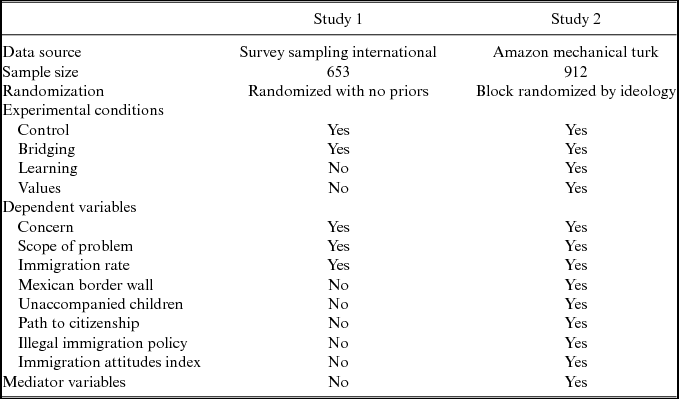
To test our hypotheses, we conducted two experimental studies: one on a nationally representative sample (Study 1), and the other on a convenience sample (Study 2). The two studies are not exact replicas. The core differences between them are summarized in Table 1, and additional details regarding each study’s data collection procedure, experimental design, and measures are in Online appendix B.
Experiment Contents
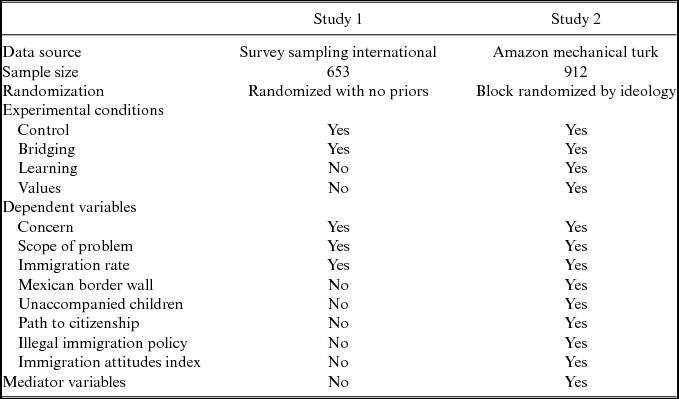
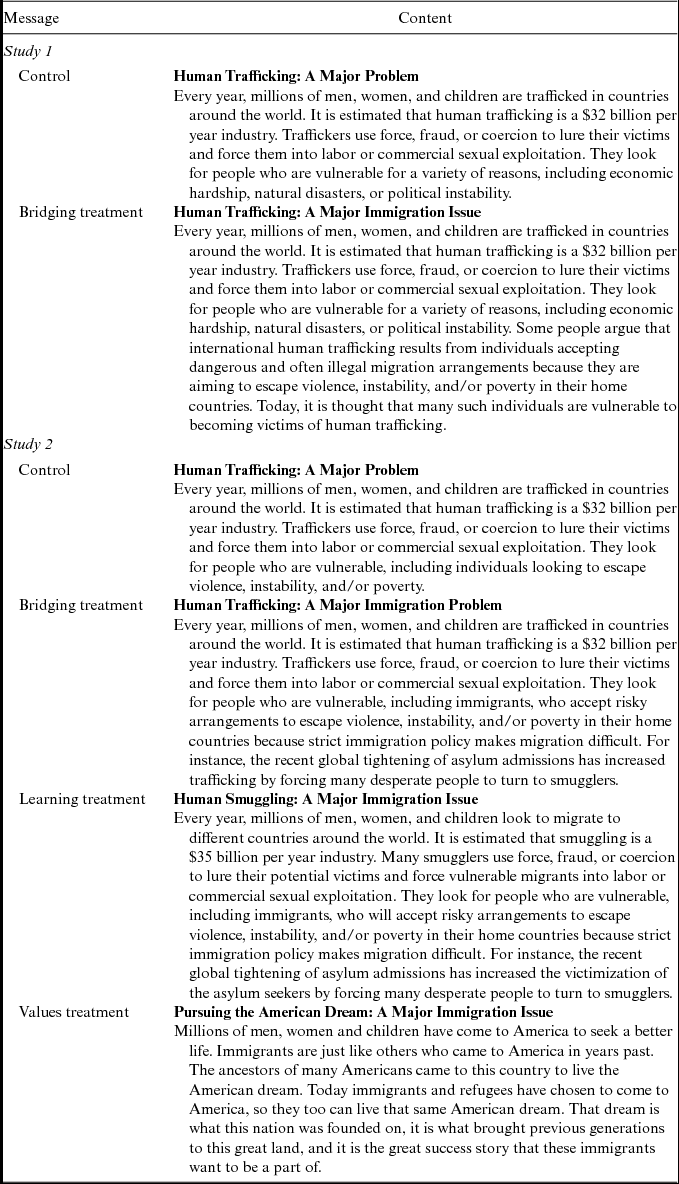
In both experiments, participants were randomly assigned to an experimental condition, which took the form of a newspaper article (see Table 2). The control condition in both studies described human trafficking in general, without adding any explicit note about how solving the human trafficking issue requires more open immigration policies. The “bridging treatment” included the basic human trafficking description featured in the control condition and one additional statement about how human trafficking often results from “individuals accepting dangerous and often illegal migration arrangements because they are aiming to escape violence, instability, and/or poverty in their home countries.” The title of the article in the treatment condition also made the connection between human trafficking and immigration salient.
Experimental Conditions
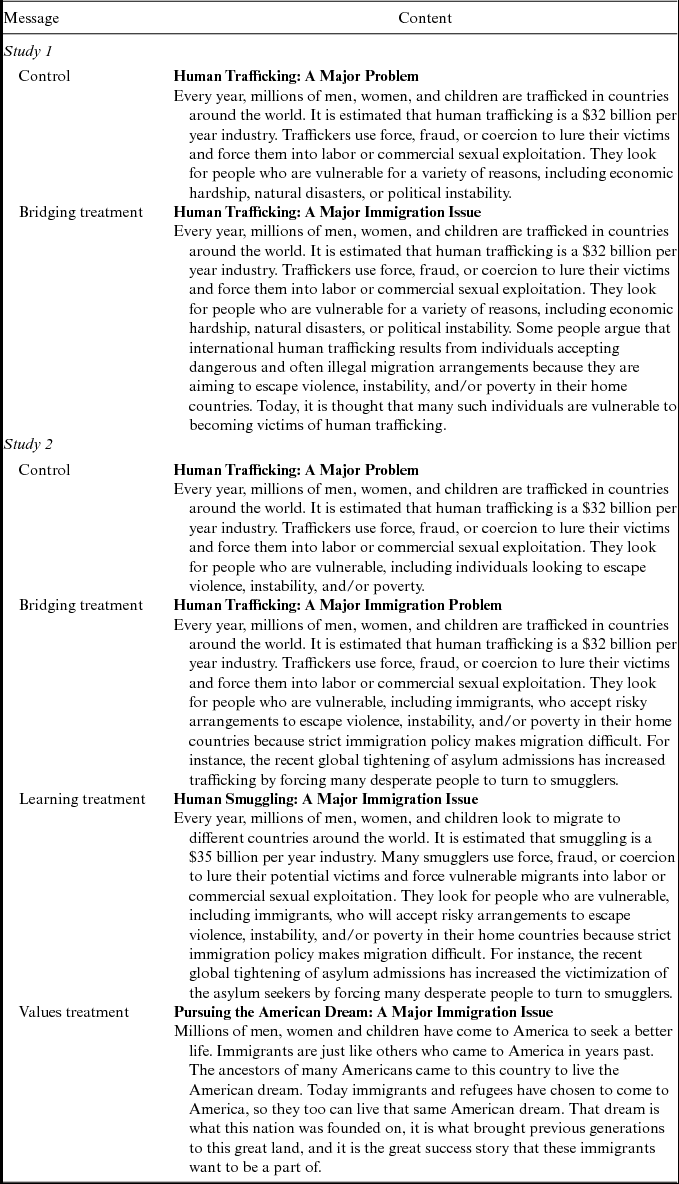
Note. In each study, each subject was randomly assigned one of the newspaper articles. Each article also contained a by-line for S. Johnson after the title in bold above.
Since it is possible that noting human trafficking in a message about immigration could also provide individuals with new information and/or elicit more empathy toward immigrants, we introduced two additional treatment conditions in Study 2. In addition to providing information that inexplicably bridges immigration with human trafficking (the “bridging treatment”), we consider the effects of providing (1) the same information about immigrants without bridging immigration with human trafficking (the “learning treatment”); and (2) information that fosters empathy without linking immigration with human trafficking and providing the new information in the other two conditions (the “values treatment”).
After receipt of one of the newspaper articles, respondents were presented with questions about human trafficking and immigration. First, respondents were asked how much of a concern the human trafficking issue was to them and how big of a problem they believed human trafficking to be. These questions were included to verify that human trafficking is a bipartisan issue that engenders high levels of concern, and to assess whether enmity toward immigrants leads to greater antipathy toward human trafficking victims when immigration and human trafficking are presented as inter-related issues. Second, we evaluated support for immigration. In both studies, we asked whether the number of immigrants permitted in the United States should increase or decrease. In Study 2, we included four additional measures of attitudes: opinions about a border wall, unaccompanied minors (Nazario, Reference Nazario2007), and paths to citizenship. Finally, in addition to measuring attitudes on immigration policy, in Study 2, we included measures to clarify the mechanism by which the treatments affect support for immigration. We explored the following well-known predictors of immigration opposition: (1) economic threat and cultural threat; and (2) ingroup-centric beliefs.Footnote 4
We used party identification as a proxy for pretreatment attitudes on immigrants, employing a binary party measure for the two major parties to moderate the sample. Immigration has increasingly become a polarizing issue area central to party conflict (Hetherington and Rudolph, Reference Hetherington and Rudolph2015). A partisan gap with regard to immigration has emerged where none was evident 20 years ago, where Republicans are more exclusionary with respect to immigrants than Democrats. Today, only 1% of liberals compared to 41% of those who are conservative support deportation of all unauthorized immigrants (Pew Research Center, 2014). Nudging Republicans to reconcile the role that immigration policies play in human trafficking prevalence may shift their ultimate policy preference to be closer to that of Democrats. Alternatively, it may negatively affect attitudes toward human trafficking. In contrast, we expect to see less change on either issue for Democrats because they generally are less opposed to policies that restrict immigration at the outset.
Summary statistics of demographic characteristics and each outcome measure are provided in Table C.1 in Online appendix C and Table E.1 in Online appendix E. We also conduct manipulation checks (see Online appendix B) and balance tests (see Tables C.2 and E.2), and find that the experimental design worked as intended. Finally, we recoded all outcome measures to be between 0 and 1 for our analyses so we can interpret effect sizes in percentage point terms.
RESULTS
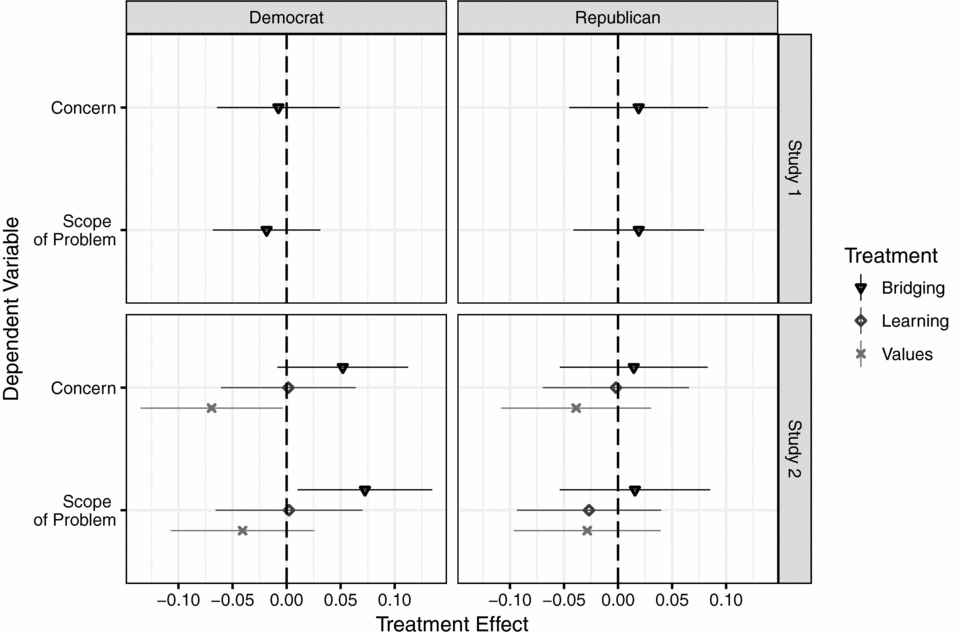
Human trafficking is a strong bipartisan issue (see Kolmogorov–Smirnov tests in Online appendices C and E); general concern for human trafficking is high among members of both parties. The average respondent, regardless of party identification, conveyed “a lot of concern” for human trafficking and a sense that human trafficking is a “big problem.” We find that linking a polarizing issue like immigration to a bipartisan issue like human trafficking has no negative effect on people’s opinions on the importance of the human trafficking problem as measured by levels of concern and perceptions of the scope of the human trafficking problem (see Figure 1). Across both studies, there are no meaningful changes in both measures due to the bridging treatment among Republican participants. There are modest shifts in human trafficking attitudes among Democrats due to the bridging frame in Study 2; however, the shifts are positive (βConcern, Democrat = 0.07, p = 0.02; βScope, Democrat = 0.05, p = 0.09).Footnote 5 These results assuage concerns that attitudes on immigration have a negative spillover effect on attitudes toward human trafficking when the two issue areas are bridged.
Average Treatment Effect: Human Trafficking Attitudes by Party Identification.

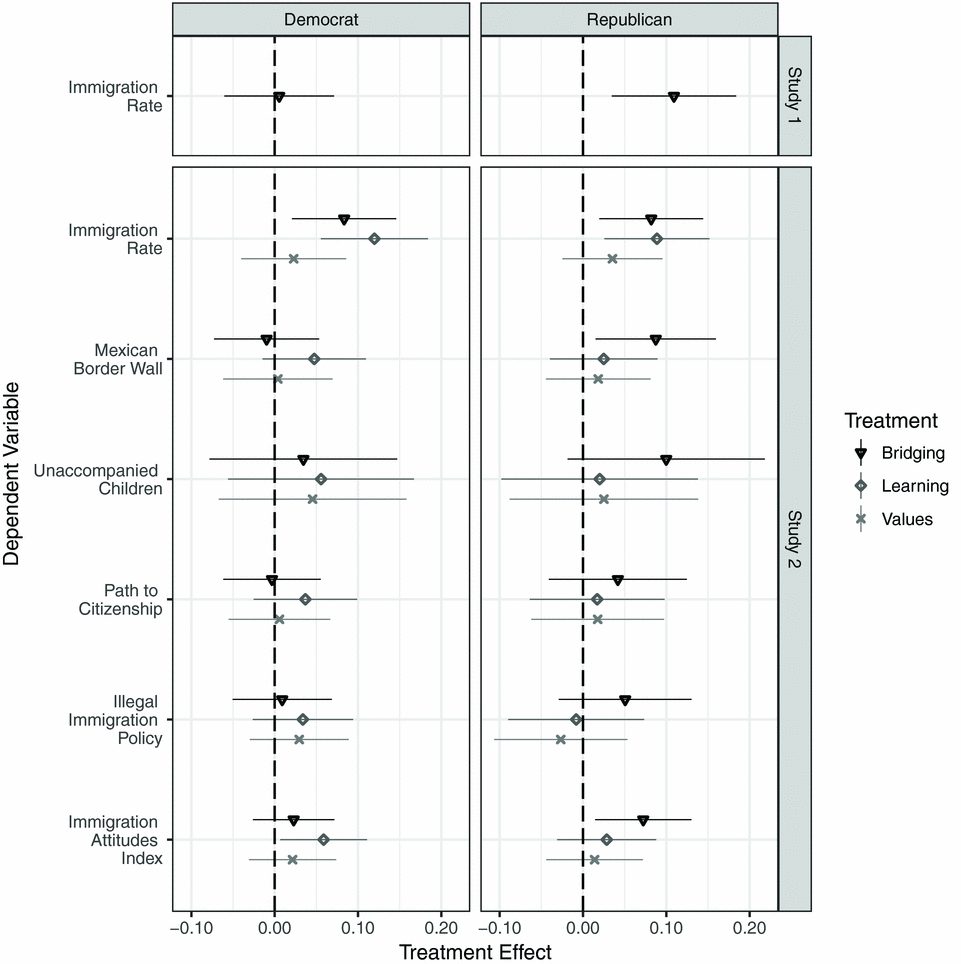
Results look quite different when we consider the effects of the treatment on immigration attitudes, and the effects are moderated by party identification (see Figure 2). In Study 1, as expected, average support for an increase in the immigration rate is 16 percentage points lower among Republicans than Democrats in both conditions (p < 0.001). However, among Republicans, treated respondents are 11 percentage points more likely to be favorable to increasing the number of immigrants permitted to enter the United States than untreated respondents (p = 0.005). Meanwhile, there is no significant difference between the control and treatment group among Democrats (βImmigrationRate, Democrat = 0.01; p = 0.87). When we conduct difference-in-difference analyses (see columns (5) and (6) of Table D.3 in Online appendix D), we see that the treatment effect is driven primarily by Republicans becoming more open to immigration. The interaction between the treatment and party identification is statistically robust (β = 0.10; p = 0.04).
Average Treatment Effect: Immigration Attitudes by Party Identification.
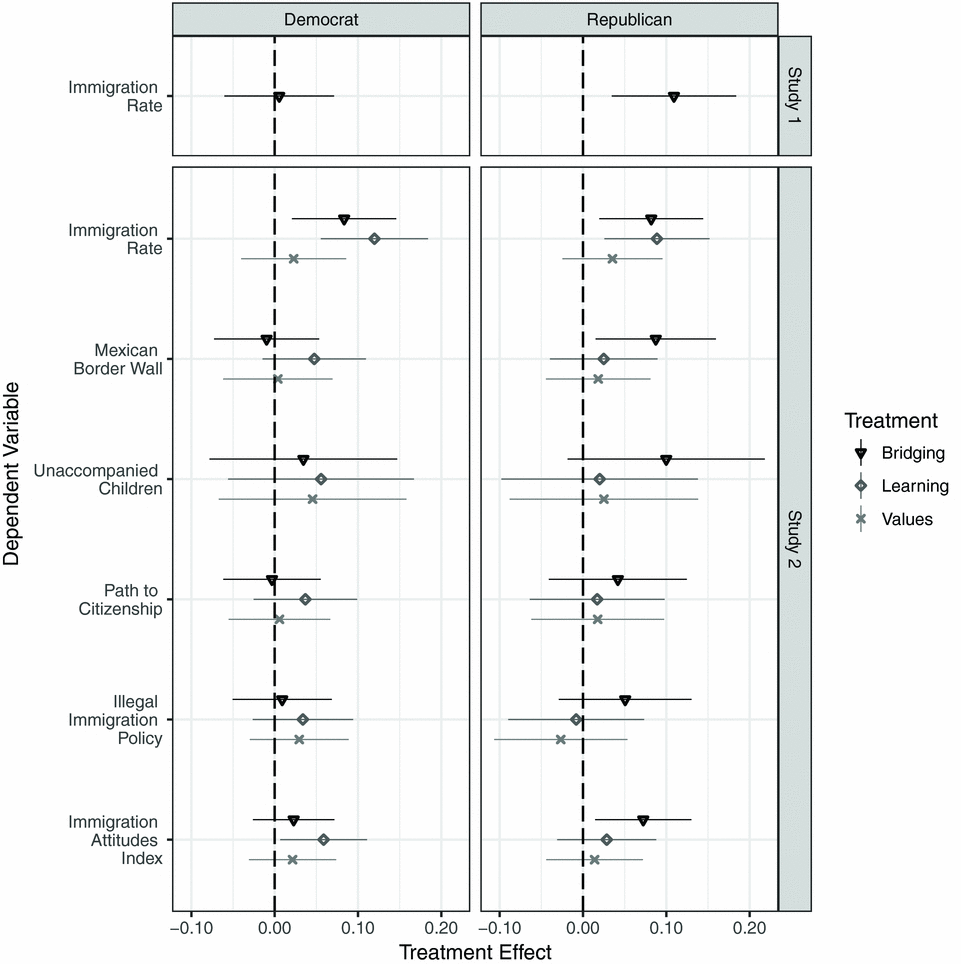
As in Study 1, immigration is highly partisan and party identification moderates treatment effects in Study 2 (see Figure 2).Footnote 6 While we analyze each of the five measures separately in Study 2 (see Table F.2 in Online appendix F for the full regression results), we focus on an index we call the immigrations attitude index (IAI) constructed by averaging across all of the measures in order to reduce any error associated with any single measure (Ansolabehere et al., Reference Ansolabehere, Rodden and Snyder2008). This index has a Cronbach’s alpha of 0.86, well above the recommended level of internal consistency. Republican attitudes are positively and significantly impacted by the bridging treatment (βBridging, Republican, IAI = 0.07, p = 0.02). The learning and values treatments make very little difference (βLearning, Republican, IAI = 0.03, p = 0.35; and βValues, Republican, IAI = 0.01, p = 0.64).Footnote 7 As in Study 1, when we conduct a difference-in-difference analyses (see Table F.4), we see that the treatment effect is driven primarily by Republicans becoming more open to immigration. However, as Democrats also become marginally more open to immigration due to the bridging frame, the interaction between the treatment and party identification is not statistically robust (β = 0.05, p = 0.23). On the whole, we see very little effect of the bridging treatment on Democrats’ attitudes toward immigration policy. However, there is one exception. When we look at the immigration rate question, which was the outcome of interest in Study 1, Democrats, like Republicans, are more supportive of expanding immigration (βBridging, Democrats, ImmigrationRate = 0.08, p = 0.01)
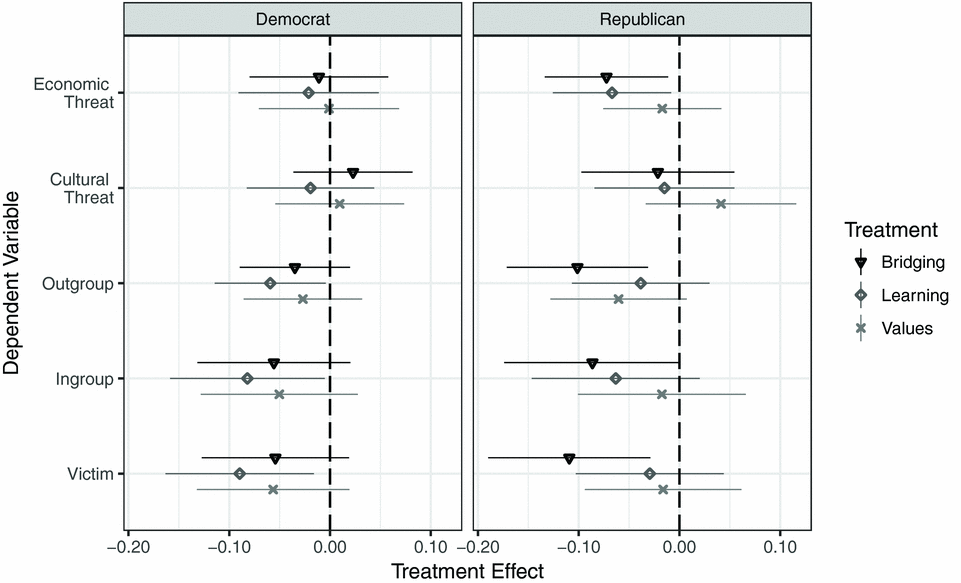
Finally, we examine potential explanations for how the bridging frame influences Republicans’ attitudes.Footnote 8 The average treatment effects for threat and ingroup-centric belief measures among Republicans are visualized in the right panel of Figure 3 (see Tables F.5 and F.6 for the full regression tables). We find that both economic threat and each ingroup-centric beliefs significantly decrease upon receipt of the bridging frame. Moreover, when we conduct mediation analyses following Imai et al. (Reference Imai, Keele, Tingley and Yamamoto2011), we find that economic threat and ingroup-centric beliefs partially mediate the effect of the bridging frame (see Table F.7).
Average Treatment Effect: Explanations of Immigration Attitudes by Party Identification.
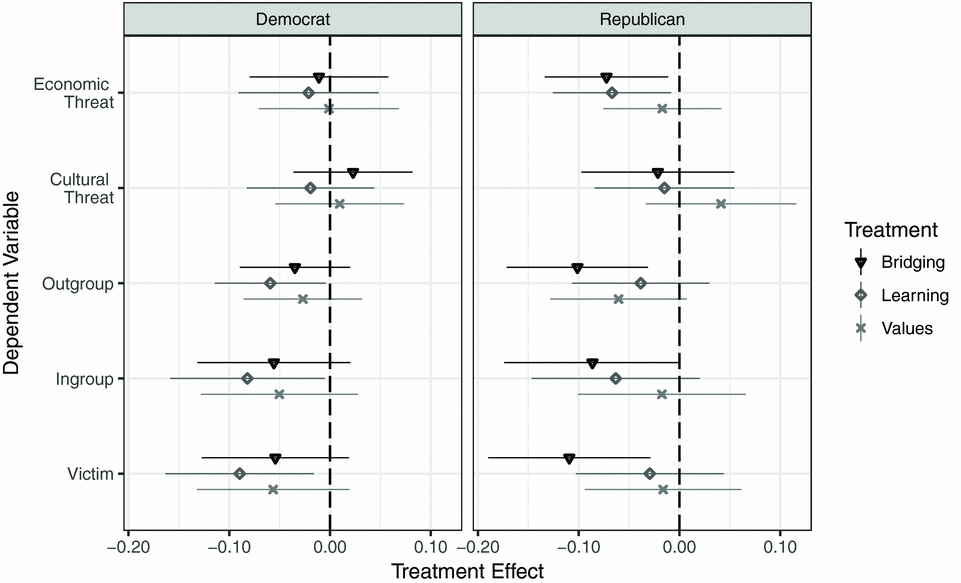
We also conduct a test of whether any effects we see are due to a “rational” reassessment of the number of immigrants that are trafficked. Respondents were asked to guess the percentage of U.S. immigrants who are victims and asylum seekers. There is no change in people’s understanding of the number of immigrants that are victims or asylum seekers due to any of the treatment conditions. This suggests that the bridging effects we find are due to a sense that some immigrants are victims, as opposed to a sense that more immigrants are victims than previously thought (see Table F.8).
Overall, this data provides initial evidence that by pairing the bipartisan issue area of human trafficking with the partisan issue area of immigration, opposition to immigration among Republicans is softened without having any consequences on attitudes toward human trafficking. The learning frame also alters attitudes for Republicans, but does so less consistently, and effects are weaker than that of the bridging frame. This suggests that while bridging human trafficking with immigration changes attitudes because bridging, in part, allows individuals to learn more about immigration, an important driver of attitude change stems from the specific mention of a bipartisan issue that garners strong levels of concern. Finally, we find that the bridging treatment has an effect on immigration attitudes for Republicans largely because the bridging frame decreases a sense of economic threat and ingroup-centric beliefs, and not due to any shifts in cultural threat.
DISCUSSION
How can anti-immigrant attitudes be nudged in a positive direction? Perhaps antagonism toward immigration could be countered when immigration is placed in the context of a less contentious issue area. We find that when human trafficking is linked to immigration, anti-immigrant sentiment softens among Republicans, the party most vehemently against open immigration policies. Additionally, we find that the bridging effect alters attitudes about immigration without inducing a change to human trafficking attitudes. With very few studies finding methods to foster more positive sentiment toward immigration and immigration being so controversial, this is a particularly interesting finding.Footnote 9
The study results also suggest several fruitful avenues for future research. First, we concentrate on how dissonance produces attitude change, but perhaps voters could use other strategies to deal with dissonance, including decreasing the importance of the issues or downplaying how the issues are related (Valkenburg et al., Reference Valkenburg, Peter and Walther2016; Hart et al., Reference Hart, Albarracín, Eagly, Brechan, Lindberg and Merrill2009; Smith et al., Reference Smith, Fabrigar, Powell and Estrada2007; Donsbach, Reference Donsbach and Hartmann2009). Second, while we show that Democrats have not reached a ceiling in terms of immigration support, we are unable to explain why Democrats’ attitudes toward immigrants and trafficking become slightly more positive in one study and not the other.Footnote 10 Third, future work should explore how bridging frame effects may be heterogeneous across individuals. For instance, bridging effects should be stronger among those who follow the logic of the linkage.Footnote 11 Fourth, additional research is necessary to determine the conditions under which human trafficking attitudes remain stable and immigration attitudes move, and conditions under which immigration attitudes remain stable and human trafficking attitudes move. Finally, the strength and durability of our effects should be assessed, including the strength of the effect in presence of a counter-frame (Druckman, Reference Druckman2004). These assessments should also consider that human trafficking is a complex issue involving various forms of exploitation. Victims might be children or adults, men or women, native or foreign-born (UNODC, 2006), and these variations may alter the magnitude of the bridging effect. Nonetheless, the data presented here progresses inquiry into how public opposition to immigration may be countered.
SUPPLEMENTARY MATERIALS
For supplementary material for this article, please visit Cambridge Journals Online: https://doi.org/10.1017/XPS.2018.3