Implications
Information is still scarce regarding the impacts of chromium (Cr) chloride and chromium picolinate (CrPic) on the immune responses of broilers vaccinated with Avian Influenza (AI) virus vaccine. The results obtained herein demonstrated that the addition of the two Cr sources improved immune responses of broilers vaccinated with AI virus vaccine, though they displayed different efficacies. These results suggest dietary supplemental Cr from Cr chloride or CrPic as a useful nutritional strategy for enhancing the immune function of broilers vaccinated with AI virus vaccine.
Introduction
Trivalent Cr was once regarded as an essential element for animals (Schwarz and Mertz, Reference Schwarz and Mertz1959) and humans (Jeejeebhoy et al., Reference Jeejeebhoy, Chu, Marliss, Greenberg and Bruce-Robertson1977), and involved in the normal metabolism of carbohydrates, proteins, lipids and nucleic acids (Anderson, Reference Anderson1997). The primary role of Cr in metabolism is to potentiate the action of insulin (Lloyd et al., Reference Lloyd, Fellner, Mcleod, Fry, Krafka, Lamptey and Spers2010). However, more and more scientists have recommended that Cr should be regarded as a nutritionally or pharmacologically beneficial element, but not an indispensable element (Wongseelashote et al., Reference Wongseelashote, Daly and Frankel2004; Nielsen, Reference Nielsen2007; Zhang et al., Reference Zhang, Sun, Liao, Lu, Zhang, Ma and Luo2018). The European Food Safety Authority (EFSA) NDA Panel (EFSA Panel on Dietetic Products, Nutrition and Allergies) (2009 and 2014) has concluded that Cr is not a required trace element for animals or humans.
Some studies indicated that dietary Cr supplementation improved the growth rate and feed efficiency of broilers (Lien et al., Reference Lien, Horng and Yang1999; Luo et al., Reference Luo, Guo, Liu, Hao, Chen, Gao and Yu1999). Improvements in the immune responses have been observed when Cr3+ was added to poultry diets (Guo et al., Reference Guo, Luo, Hao, Liu, Chen, Gao and Yu1999; Luo et al., Reference Luo, Guo, Liu, Hao, Chen, Gao and Yu1999; Zhang et al., Reference Zhang, Luo, Wang, Lu and Liu2006), and its effects seem more pronounced during stresses (Li et al., Reference Li, Luo, Liu, Shao, Guo and Yu2001; Luo et al., Reference Luo, Wang, Liu, Liang, Li and Yu2002a; Luo et al., Reference Luo, Li, Liu, Shao, Guo and Yu2002b). Studies on animals have confirmed that the organic Cr was absorbed more efficiently (about 25% to 30%) than the inorganic Cr (about 1% to 3%) (Piva et al., Reference Piva, Meola, Gatta, Biagi, Castellani, Mordenti, Luchansky, Silva and Mordenti2003). However, few studies have been carried out to compare the effectiveness of CrPic and Cr chloride in modulating the immune functions of broiler chicks vaccinated with AI virus vaccine.
Therefore, the present study was conducted to determine the effects of dietary supplemental Cr sources (Cr chloride and CrPic) and levels on the growth performance and immune responses of broilers vaccinated with AI virus vaccine.
Material and methods
Animals, diets and experimental design
All experimental procedures were approved by the Animal Management Committee (in charge of animal welfare issues) of the Institute of Animal Sciences, Chinese Academy of Agricultural Sciences (IAS-CAAS, Beijing, China) and performed in accordance with the guidelines. A total of 432 1-day (d)-old Arbor Acres commercial male broilers (Huadu Broiler Breeding Corp., Beijing, P. R. China) were randomly allotted by BW to one of nine treatments (six replicate cages of eight chicks per cage for each treatment) in a completely randomized design involving a 2 (Cr source)×4 (added Cr level) factorial arrangement of treatments plus one control with no supplemental Cr. Birds were housed in an electrically heated, thermostatically controlled room with fiberglass feeders and stainless steel cages coated with plastic, and were maintained on a 24-h constant light schedule for 42 d. The birds were allowed ad libitum access to the experimental diets and tap water that contained no detectable Cr (< 5.0 μg/l of water by analysis). Birds were vaccinated with Newcastle disease (ND) virus vaccine at 7 and 21 d of age, and with AI virus vaccine (H5N1, Re-1 strain) at 10 and 25 d of age, and with infectious bursal disease virus vaccine at 14 d of age, respectively. Body weight and feed consumption were recorded at the end of each week.
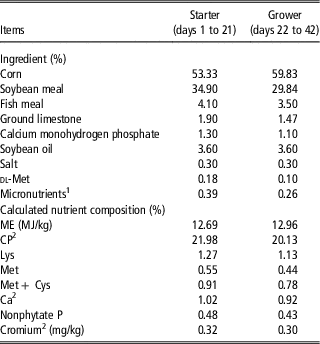
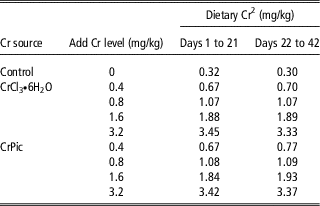
The corn–soybean meal basal diets (Table 1) contained 0.32 mg Cr/kg and 0.30 mg Cr/kg by analysis for the starter and grower diets, respectively. Diets were formulated so that all other nutrients met or exceeded the nutrient requirements of broilers (National Research Council, 1994). The dietary treatments included a Cr-unsupplemented corn–soybean meal basal diet (the control) and the basal diet supplemented with 0.4, 0.8, 1.6 or 3.2 mg Cr/kg as either reagent-grade Cr chloride (CrCl3∙6H2O, 18.82% Cr by analysis) or feed grade CrPic (11.43% Cr by analysis). Analyzed Cr concentrations are presented in Table 2.
The composition of basal diets for broilers (as-fed basis)

ME=metabolizable energy; Lys=Lysine; Met=Methionine; Cys=cysteine.
1 Provided per kilogram of diet (days 1 to 21): vitamin A (all-transretinol acetate), 15 000 IU; cholecalciferol, 5100 IU; vitamin E (all-rac-α-tocopherol acetate), 19.2 IU; vitamin K (menadione sodium bisulfate), 2.4 mg; thiamin (thiamin mononitrate), 1.2 mg; riboflavin, 10.2 mg; vitamin B6, 2.4 mg, vitamin B12, 12.0 µg; pantothenic acid, 12.0 mg; niacin, 39.0 mg; biotin, 189 µg; folic acid, 1.2 mg; choline (choline chloride), 700 mg; Cu (CuSO4∙5H2O), 8 mg; Fe (FeSO4∙7H2O), 40 mg; Zn (ZnSO4∙7H2O), 60 mg; Mn (MnSO4∙7H2O), 110 mg, I (KI), 0.35 mg, Se (Na2SeO3), 0.15 mg. Provided per kilogram of diet (days 22 to 42): vitamin A (all-trans retinol acetate), 12 500 IU; cholecalciferol, 4250 IU; vitamin E (all-rac-α-tocopherol acetate), 16 IU; vitamin K (menadione sodium bisulfate), 2.0 mg; thiamin (thiamin mononitrate), 1.0 mg; riboflavin, 8.5 mg; vitamin B6, 2.0 mg; vitamin B12, 0.01 mg; calcium pantothenate, 10 mg; niacin, 32.5 mg; folic acid, 1.0 mg; biotin, 0.158 mg; choline (choline chloride), 500 mg; Cu (CuSO4∙5H2O), 8 mg; Fe (FeSO4∙7H2O), 30 mg; Zn (ZnSO4∙7H2O), 40 mg; Mn (MnSO4∙H2O), 80 mg; I (KI), 0.35 mg; Se (Na2SeO3), 0.15 mg.
2 Analyzed values. Each value based on triplicate determinations.
Analyzed chromium concentrations in diets for broilersFootnote 1

CrPic = Cr picolinate.
1 See Table 1 for the composition of the basal diets.
2 Values based on chemical analysis of triplicate samples of diets, and reported on an as-fed basis.
Sample collections and preparations
The feed ingredients and diet samples from the treatments were collected for CP, Ca, P and Cr analyses before the initiation of the experiment. The Cr source and tap water samples were collected for Cr content analysis. At 21, 28, 35 or 42 d of age, two broilers from each cage were randomly selected according to average BW within the cage after a 12-h fast. Blood samples were taken from a heart puncture of each bird, and then centrifuged at 2000×g for 10 min at 25°C to isolate serum. The serum was then stored at −20°C for the determination of antibody titer against AI virus and concentrations of interleukin-1 (IL-1) and interleukin-2 (IL-2). At 28 or 42 d of age, the whole blood samples were also collected from the heart puncture with heparinized tubes for the analyses of T lymphocyte transformation rate and T lymphocyte percentage. At 21 or 42 d of age, after the blood samples were collected, the two birds were slaughtered and the lymphoid organs (i.e. bursa of Fabricius, thymus and spleen) were collected, weighed and expressed as a percentage of live BW.
Sample analyses
The concentrations of Cr in diets, Cr sources and tap water were determined by inductively coupled plasma emission spectroscopy (Thermo Fisher Scientific, Waltham, MA, USA) after wet digestions with HNO3 and HCIO4 as described by Huang et al. (Reference Huang, Lu, Li, Luo and Liu2009). The concentrations of Ca and CP in the feed ingredient or diet samples were determined as described by the Association of Official Analytical Chemists (1990; 927.02, 988.05). The antibody titer against AI virus was determined by the hemagglutination inhibition test (Meulemans et al., Reference Meulemans, Carlier, Gonze and Petit1987), and was expressed as the highest dilution of serum that completely inhibited viral hemagglutination. The T lymphocyte percentage was measured by the E-rosette test (Howard et al., Reference Howard, Ledbetter, Wong, Bieber, Stinson and Herzenberg1981). The T lymphocyte transformation rate was determined by the methylthiazolyldiphenyl-tetrazolium bromide colorimetric method (Mosmann, Reference Mosmann1983). The mean optical density (OD) was determined for triplicate samples, and the proliferation response was expressed as a mean stimulation index obtained by dividing the mean OD of stimulated cells by the OD of unstimulated cells. The concentrations of IL-1 and IL-2 in the serum were analyzed by the radioimmunoassay kits (catalog number: 200705251 (IL-1) and 200705252 (IL-2); Beijing Puer Weiye Biological Technology Company, Beijing, P. R. China).
Statistical analyses
To test the effect of Cr supplementation, data were analyzed using a single degree of freedom contrast to compare all supplemental Cr treatments with the control (Li et al., Reference Li, Lu, Hao, Wang, Zhang, Liu, Liu, Li and Luo2011). Data excluding the control were further analyzed by two-way ANOVA using the GLM procedure (SAS Institute Inc., Cary, NC, USA). The model included the effects of Cr source, supplemental Cr level, and their interaction. The cage served as the experimental unit. Orthogonal comparisons were used to assess linear and quadratic responses to added Cr levels. Differences among means were tested by the LSD method, and P⩽0.05 was considered to be statistically significant.
Results
Growth performance
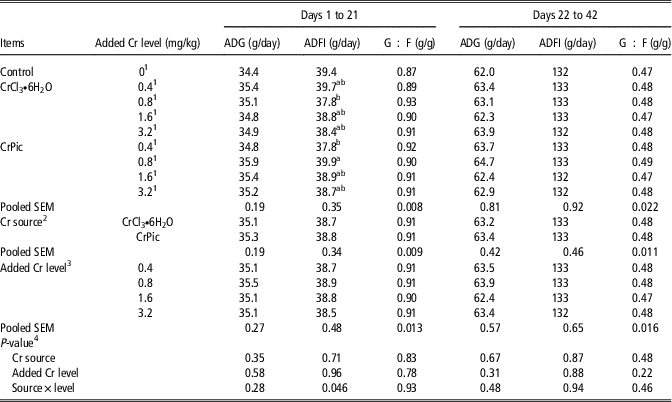
No differences (P>0.05) were detected in the average daily gain (ADG), average daily feed intake (ADFI) and gain : feed (G : F) during the starter or grower phase between the control and all Cr-supplemented treatments (Table 3). The ADFI during the starter phase was affected (P<0.05) by the interaction between the Cr source and the added Cr level. When the Cr source was CrPic, the chicks fed the diet supplemented with 0.8 mg Cr/kg had higher (P<0.03) ADFI than those fed the diet supplemented with 0.4 mg Cr/kg. In addition, the chicks fed the diets supplemented with the Cr chloride had lower (P<0.03) ADFI than those fed the diets supplemented with the CrPic when the added Cr level was 0.8 mg/kg. No differences (P>0.05) in this parameter were observed among other treatments.
Effects of dietary supplemental chromium source and level on the growth performance of broilers

ADG =average daily gain; ADFI =average daily feed intake; G : F=gain : feed; CrPic =Cr picolinate.
a,bMeans within a column without a common superscript letter differ (P<0.05).
1 Data represent the means of six replicate cages (n=6).
2 Data represent the means of 24 replicate cages (n=24).
3 Data represent the means of 12 replicate cages (n=12).
4 Probability values for main effects.
Weights of lymphoid organs
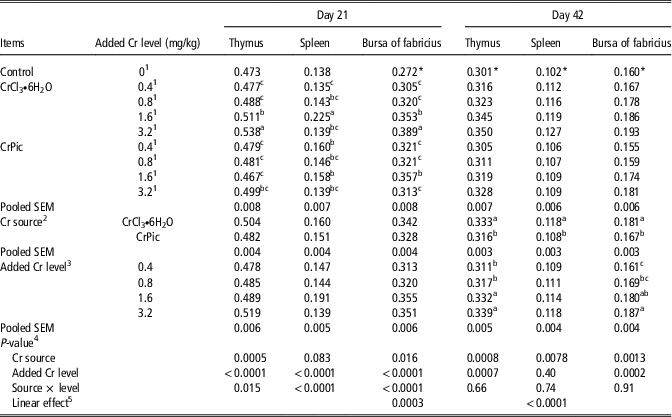
Compared with the control chicks, the chicks fed the diets supplemented with Cr had higher (P<0.05) weights of the bursa of fabricius on d 21, and of the thymus, spleen or bursa of fabricius on d 42 (Table 4). However, no differences (P>0.08) were detected in the weights of the thymus or spleen on d 21 between the control and all Cr-supplemented treatments.
Effects of dietary supplemental chromium source and level on the weights of lymphoid organs (percentages of live BWs) of broilers (%)

CrPic=Cr picolinate.
a,b,cMeans within a column without a common superscript letter differ (P<0.05).
1 Data represent the means of six replicate cages (n=6).
2 Data represent the means of 24 replicate cages (n=24).
3 Data represent the means of 12 replicate cages (n=12).
4 Probability values for main effects.
5 Linear effect of added Cr levels.
*Different (P<0.05) from all Cr supplemental groups.
The Cr source, added Cr level and their interaction affected (P<0.02) the weight of the thymus or bursa of fabricius on d 21. When the Cr source was Cr chloride, the chicks fed the diet supplemented with 1.6 or 3.2 mg Cr/kg had a higher (P<0.03) weight of thymus or bursa of fabricius than those fed the diet supplemented with 0.4 or 0.8 mg Cr/kg, and the chicks fed the diet supplemented with 3.2 mg Cr/kg had the highest (P<0.01) weight of thymus or bursa of fabricius. However, when the Cr source was CrPic, the chicks fed the diet supplemented with 1.6 mg Cr/kg had a higher (P<0.006) weight of bursa of fabricius than those fed the other CrPic-supplemented diets. In addition, the weight of the thymus from the birds fed the Cr chloride diet was higher (P<0.006) than that from those fed the CrPic diet when the added Cr level was 1.6 or 3.2 mg/kg. The chicks fed the Cr chloride diet also had a higher (P<0.0001) weight of the bursa of fabricius than those fed the CrPic diet when the added Cr level was 3.2 mg/kg.
The added Cr level and an interaction between the Cr source and added Cr level affected (P<0.0001) the weight of the spleen on d 21. When the Cr source was Cr chloride, the chicks fed the diet supplemented with 1.6 mg Cr/kg had a higher (P<0.0001) weight of the spleen than those fed the other Cr chloride diets. In addition, the weight of the spleen from the birds fed the Cr chloride diet was lower (P<0.03) than that from those fed the CrPic diet when the added Cr level was 0.4 mg/kg, but higher (P<0.0001) when the added Cr level was 1.6 mg/kg. No differences (P>0.40) were observed among other treatments.
The Cr source and added Cr level had effects (P<0.002) on the weight of the thymus or bursa of fabricius on d 42, and the weight of the spleen on d 42 was affected (P<0.008) by the Cr source. The chicks fed the diets supplemented with Cr chloride had higher (P<0.008) weights of the thymus, spleen or bursa of fabricius than those fed the diets supplemented with CrPic. As added Cr levels increased, the weight of the thymus or bursa of fabricius increased linearly (P<0.0004).
Antibody titer against Avian Influenza virus
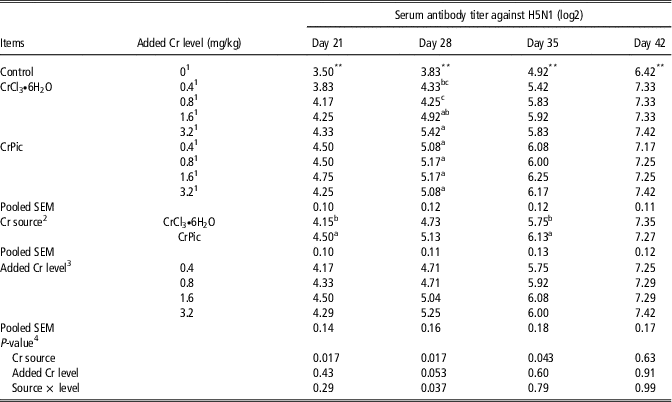
Compared with the control chicks, the chicks fed the diets supplemented with Cr had higher (P<0.01) serum antibody titer against AI virus on d 21, 28, 35 or 42 (Table 5). The serum antibody titer against AI virus on either d 21 or 35 was affected (P<0.05) by the Cr source. The chicks fed the diets supplemented with the CrPic had a higher (P<0.04) antibody titer against AI virus on d 21 or 35 than those fed the diets supplemented with the Cr chloride. The Cr source or an interaction between the Cr source and added Cr level affected (P<0.04) serum antibody titer against AI virus on d 28. When the Cr source was Cr chloride, the chicks fed the diet supplemented with 1.6 or 3.2 mg Cr/kg had a higher (P<0.04) serum antibody titer against AI virus than those fed the diet supplemented with 0.8 mg Cr/kg, and the chicks fed the diet supplemented with 3.2 mg Cr/kg had a higher (P<0.04) serum antibody titer against AI virus than those fed the diet supplemented with 0.4 mg Cr/kg. In addition, the chicks fed the diet supplemented with the Cr chloride had a lower (P<0.05) antibody titer against AI virus on d 28 than those fed the diet supplemented with CrPic when the added Cr level was 0.4 or 0.8 mg/kg. The Cr source, added Cr level and their interaction did not affect (P>0.62) serum antibody titer against AI virus at 42 d of age.
Effects of dietary supplemental chromium source and level on the antibody titer against Avian Influenza virus (H5N1, Re-1 strain) in the serum of broilers

CrPic = Cr picolinate.
a,b,cMeans within a column without a common superscript letter differ (P<0.05).
1 Data represent the means of six replicate cages (n=6).
2 Data represent the means of 24 replicate cages (n=24).
3 Data represent the means of 12 replicate cages (n=12).
4 Probability values for main effects.
**Different (P<0.01) from all Cr supplemental groups.
T lymphocyte transformation rate and T lymphocyte percentage in the blood
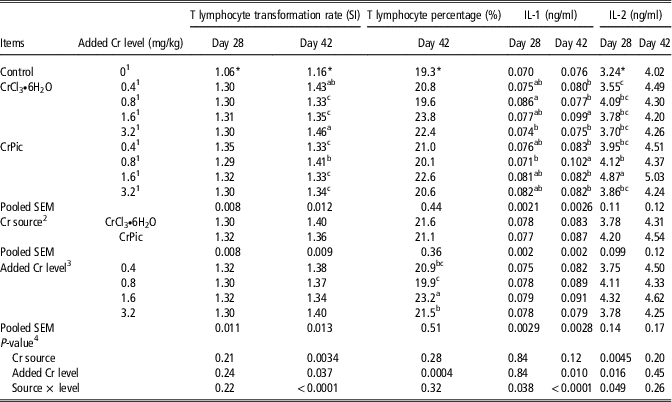
Compared with the control chicks, the chicks fed the diets supplemented with Cr had a higher (P<0.04) blood T lymphocyte transformation rate on either d 28 or 42, and T Lymphocyte percentage on d 42 (Table 6). The Cr source, added Cr level, and their interaction affected (P<0.04) the T lymphocyte transformation rate in the blood at 42 d of age. When the Cr source was Cr chloride, the chicks fed the diet supplemented with 3.2 mg Cr/kg had a higher (P<0.0001) T lymphocyte transformation rate on d 42 than those fed the diet supplemented with 0.8 or 1.6 mg Cr/kg. When the Cr source was CrPic, the chicks fed the diet supplemented with 0.8 mg Cr/kg had a higher (P<0.004) T lymphocyte transformation rate than those fed the other three Cr-supplemented diets. In addition, the chicks fed the diet supplemented with the Cr chloride had a higher (P<0.0004) T lymphocyte transformation rate than those fed the diet supplemented with the CrPic when the added Cr level was 0.4 or 3.2 mg/kg. However, the chicks fed the diet supplemented with the Cr chloride had a lower (P<0.0002) T lymphocyte transformation rate than those fed the diet supplemented with the CrPic when the added Cr level was 0.8 mg/kg. The T lymphocyte percentage in the blood on d 42 was influenced (P<0.001) by the added Cr level. The chicks fed the diet supplemented with 1.6 mg Cr/kg had a higher (P<0.02) T lymphocyte percentage than those fed the diets supplemented with 0.4, 0.8 or 3.2 mg Cr/kg, and the chicks fed the diet supplemented with 3.2 mg Cr/kg had a higher (P<0.02) T lymphocyte percentage than those fed the diet supplemented with 0.8 mg Cr/kg.
Effects of dietary supplemental chromium source and level on the T lymphocyte transformation rate and T lymphocyte percentage in the blood, and interleukin-1 (IL-1) and interleukin-2 (IL-2) concentrations in the serum of broilers

SI=stimulation index; CrPic =Cr picolinate.
a,b,cMeans within a column without a common superscript letter differ (P<0.05).
1 Data represent the means of six replicate cages (n=6).
2 Data represent the means of 24 replicate cages (n=24).
3 Data represent the means of 12 replicate cages (n=12).
4 Probability values for main effects.
*Different (P<0.05) from all Cr supplemental groups.
Serum interleukin-1 and interleukin-2 concentrations
Compared with the control chicks, the chicks fed the diets supplemented with Cr had a higher (P<0.01) serum IL-2 concentration on d 28 (Table 6). The serum IL-1 concentration on d 28 was affected (P<0.04) by the interaction between the Cr source and added Cr level. When the Cr source was Cr chloride, the chicks fed the diet supplemented with 0.8 mg Cr/kg had a higher (P<0.04) serum IL-1 concentration than those fed the diet supplemented with 3.2 mg Cr/kg. In addition, the chicks fed the diet supplemented with the Cr chloride had a higher (P<0.01) serum IL-1 concentration than those fed the diet supplemented with the CrPic when the added Cr level was 0.8 mg/kg.
The serum IL-1 concentration on d 42 was influenced (P<0.02) by the added Cr level and an interaction between the Cr source and added Cr level. When the Cr source was Cr chloride, the chicks fed the diet supplemented with 1.6 mg Cr/kg had a higher (P<0.001) serum IL-1 concentration than those fed the diets supplemented with 0.4, 0.8 or 3.2 mg Cr/kg. When the Cr source was CrPic, the chicks fed the diet supplemented with 0.8 mg Cr/kg had a higher (P<0.002) serum IL-1 concentration than those fed other Cr-supplemented diets. In addition, the chicks fed the diet supplemented with the Cr chloride had a lower (P<0.0001) serum IL-1 concentration than those fed the diet supplemented with the CrPic when the added Cr level was 0.8 mg/kg, but had a higher (P<0.003) serum IL-1 concentration than those fed the diet supplemented with the CrPic at 1.6 mg Cr/kg.
The Cr source, added Cr level, and their interaction affected (P<0.05) serum IL-2 concentration on d 28, but had no effect (P>0.19) on it on d 42. When the Cr source was CrPic, the chicks fed the diet supplemented with 1.6 mg Cr/kg had a higher (P<0.01) serum IL-2 concentration than those fed the other three Cr-supplemented diets. In addition, the chicks fed the diet supplemented with the CrCl3 had a lower (P<0.0003) serum IL-2 concentration than those fed the diet supplemented with the CrPic when the added Cr level was 1.6 mg/kg.
Discussion
Broilers grow fast and have exuberant metabolism, and thus, they may have higher requirements for Cr. Two previous experiments from our laboratory were conducted to investigate the effects of the dietary supplemental Cr source (either Cr chloride or Cr-yeast) and Cr level (0.0, 0.4, 2.0, 10.0 or 20.0 mg/kg) on the growth performance, serum biochemical parameters, immune functions and carcass traits of broilers from 1 to 21 d or 22 to 42 d of age. The results demonstrated that regardless of Cr source, 2.0 mg Cr/kg might be an optimal added level for fast-growing broilers to improve the growth performance and immune functions (Guo et al., Reference Guo, Luo, Hao, Liu, Chen, Gao and Yu1999; Luo et al., Reference Luo, Guo, Liu, Hao, Chen, Gao and Yu1999). Therefore, in the present study, supplemental Cr levels (0.4, 0.8, 1.6 and 3.2 mg Cr/kg) were higher than the level of 0.2 mg Cr/kg diet used in the United States.
The results from the present study showed that, compared with the control with no added Cr, Cr supplementation did not influence the ADG, ADFI and G : F of broilers during the starter or grower phase. A previous study from our laboratory demonstrated that the additions of 2.0 to 14.0 mg Cr/kg as Cr chloride had no effect on the ADG, ADFI and F : G of broilers (Zhang et al., Reference Zhang, Luo, Wang, Lu and Liu2006). Zheng et al. (Reference Zheng, Huang, Xiao, Lin and Lloyd2016) obtained the same results on the inclusion of 0.4 or 2.0 mg Cr/kg as either Cr chloride or CrPic in broiler diets. However, our previous study also indicated that dietary Cr supplementation (0.4, 2.0 or 10.0 mg/kg as either Cr chloride or Cr-yeast) increased ADG of broilers from 0 to 3 weeks of age (Luo et al., Reference Luo, Guo, Liu, Hao, Chen, Gao and Yu1999). Up to now, the beneficial effect of Cr on the growth performance has been observed mostly in stressed broiler chicks (Toghyani et al., Reference Toghyani, Shivazad, Gheisari and Bahadoran2012; Huang et al., Reference Huang, Yang, Xiao, Lloyd and Lin2016). Therefore, the enhanced growth performance resulting from dietary Cr supplementation is dependent on the farm environmental conditions and physiological status of the broilers. The Cr requirement for broiler chicks might be higher under environmentally stressed conditions than under normal conditions.
Thymus, spleen and bursa of fabricius are important immune organs in animals, and their weights can be used to evaluate the immune status of animals to some extents. Greater weights of immune organs usually represent stronger cellular and humoral immune functions in the body (Ravis et al., Reference Ravis, Parsons and Wang1988). Our results illustrated that the additions of 0.4 to 3.2 mg Cr/kg as either Cr chloride or CrPic to the broiler diets improved the weights of thymus, spleen or bursa of fabricius at 42 d of age, and Cr chloride was more effective than CrPic. Similar results were observed by Naghieh et al. (Reference Naghieh, Toghyani, Gheisari, Saeed and Miranzadeh2010) who reported that broilers fed the diet supplemented with 0.6 mg Cr/kg as Cr chloride had a higher weight of spleen than those fed the control diet without added Cr or the diet supplemented with the same level of Cr as Cr-yeast. However, Toghyani et al. (Reference Toghyani, Zarkesh, Shivazad and Gheisari2007) found that dietary Cr supplementation (0.5, 1.0 or 1.5 mg/kg) as CrPic had no effect on the weights of thymus, spleen and bursa of fabricius in broilers at 42 d of age, which is inconsistent with our results. The above disparities might be caused by different added Cr levels in the two studies.
The enhancement of antibody titers may be related to the role of Cr in insulin and cortisol actions (Naghieh et al., Reference Naghieh, Toghyani, Gheisari, Saeed and Miranzadeh2010). Toghyani et al. (Reference Toghyani, Zarkesh, Shivazad and Gheisari2007) observed an improvement in antibody titers against ND and AI viruses in heat-stressed broilers fed the diet supplemented with 1.5 mg Cr/kg as CrPic at 30 d of age. In the study of Naghieh et al. (Reference Naghieh, Toghyani, Gheisari, Saeed and Miranzadeh2010), the chicks fed the diet supplemented with 1.2 mg Cr/kg as Cr nicotinate had greater antibody titers against ND and AI viruses than those fed the control diet and the diet supplemented with 0.6 or 1.2 mg Cr/kg as Cr chloride. The results from our current study are in line with the above results, indicating that dietary supplementation of Cr as either Cr chloride or CrPic increased serum antibody titer against AI (H5N1) virus, and the CrPic was more effective than the Cr chloride. However, a previous study from our laboratory showed that the additions of 2.0 to 12.0 mg Cr/kg as Cr chloride to diets did not affect the antibody titers against AI and ND viruses in broilers (Zhang et al., Reference Zhang, Luo, Wang, Lu and Liu2006). The different added Cr levels to the diets might partially explain the inconsistency in the results of Zhang et al. (Reference Zhang, Luo, Wang, Lu and Liu2006) and the current study.
The normal T lymphocytes in in vitro culture conditions will transform into lymphoblasts when they are stimulated by mitogen (such as concanavilin, etc.), but this transformation will be reduced when cellular immunity is in dysfunction. A previous study from our laboratory (Zhang et al., Reference Zhang, Luo, Wang, Lu and Liu2006) showed that dietary Cr supplementation significantly increased T lymphocyte transformation rate in the blood of broilers vaccinated with AI virus. It has been demonstrated that dietary Cr addition could enhance the cellular immunity of animals (Rao et al., Reference Rao, Raju, Panda, Poonam, Murthy and Sunder2012). In an in vitro study on lymphocyte blastogenesis of dairy cows, Cr addition increased the proliferation of peripheral blood lymphocytes, and inorganic Cr chloride was more effective than organic chelated Cr (Chang et al., Reference Chang, Mallard and Mowat1996). These results are consistent with the results from the present study, indicating that dietary Cr supplementation could indeed enhance the cellular immunity of animals, and the inorganic Cr was more effective than the organic Cr. It might be explained by the fact that the inorganic Cr has more free binding sites, therefore, it is easier to transport through the membrane of lymphocytes than the organic Cr.
Interleukin-1 and IL-2 are both inflammatory cytokines. Interleukin-1 can activate the B cell and trigger its proliferation and humoral immune response (Li et al., Reference Li, Zhang, Shi, Su, Yue, Tong and Yan2017). Interleukin-2 is secreted by activated T cells, and there is a close relationship between IL-2 and maturity or proliferation of T cells (Bonham et al., Reference Bonham, O’Connor and Hannigan2002). Up to now, there has been no report about the effect of Cr on the IL-1 and IL-2 contents in the serum of broilers. Horowitz et al. (Reference Horowitz, Luchetti, Gonzales and Ritchie1998) reported that incubation of macrophages with Cr did not influence the release of IL-1, which is consistent with our current results. Myers et al. (Reference Myers, Farrell, Evock-Clover, Cope, Henderson and Steele1995) found that peripheral blood mononuclear cells from the gilts fed the diet supplemented with 0.3 mg Cr/kg as CrPic produced more IL-2 than those from the gilts fed the Cr-unsupplemented control diet. Similarly, the present study showed that the addition of Cr as CrPic or Cr chloride could increase the serum IL-2 contents of broilers on d 28. These results from the current study suggest that the elevations of lymphocyte transformation rate and T lymphocyte percentage in the blood by Cr addition might result from the increase of serum IL-2 contents.
In conclusion, dietary supplementation of Cr, in the form of either CrPic or Cr chloride, did not affect the growth performance, but improved immune functions of broilers vaccinated with AI virus. Both the CrPic and the inorganic Cr chloride displayed different efficacies. The inorganic Cr chloride was more effective than the CrPic in increasing the relative weights of lymphoid organs, however, the CrPic was more effective than the inorganic Cr chloride in enhancing the serum antibody titer against AI virus. In general, with regard to the improvement of immune functions, the optimal added Cr level was 1.6 or 3.2 mg/kg for the inorganic Cr chloride, and 0.8 or 1.6 mg/kg for the CrPic, respectively.
Acknowledgments
This study was supported by the Special Funds of CAAS for Distinguished Scientists (Beijing, P. R. China), Agricultural Science and Technology Innovation Program (ASTIP-IAS08; Beijing, P. R. China), China Agriculture Research System (project no. CARS-41; Beijing, P. R. China), and the program of Beijing Natural Science Foundation of China (project no. 6062022; Beijing, P. R. China).
Declaration of interest
The authors declare that there is no conflicts of interest.
Ethics statement
Ethical approval on animal survival was given by the animal ethics committee of IAS-CAAS.
Software and data repository resources
None of the data were deposited in an official repository.