Career choice is a very important life goal for adolescents. They build their own life choosing educational steps starting in primary education, through secondary education and in higher education.
In Japan, the percentage of students enrolling in high school exceeds ninety percent since 1970s (Ministry of Education, Science and Culture, 2012). Most adolescents spend three years in high school (from 15 to 18 years old) after the nine-year compulsory education (elementary school and junior high school). High school students must carefully consider their future life after graduation in these three years. They have two choices for their future; higher education or a job.
In modern Japan, the percentage of students enrolling in universities exceeds fifty percent. This percentage is especially higher in Tokyo and other large cities (Ministry of Education, Science and Culture, 2012). The majority of adolescents select the higher education route, known as the “school to school transition”. A minority of adolescents make the choice of working after graduating from high school, known as the “school to work transition”. Concerning the latter transition, recently the turnover rate of high school graduates after graduation in three years was higher than fifty percent.
High school students’ career paths after graduation are categorized into the following three choices: (a) going on to higher education (university, junior college, vocational school), (b) working (full time job, part-time job), and (c) university rōnin (Japanese expression for the person who failed university entrance examination and must take the examination again the following year).
This study set out to examine how high school students decide their future life course, including two different transitions; the school to school transition, or the school to work transition. This study is part of a four-year longitudinal study concerning high school graduation transition (Tsuzuki, Reference Tsuzuki2014). The participants consisted of three different grade cohorts, who were third graders in high school in the 2008, 2009 and 2010 academic years. The follow-up study was conducted with high school graduates from 2009 to 2011. The information about adolescents’ future career choice was obtained through a high school survey, and their actual career was collected in the follow-up survey after their graduation. Career choice can be seen as the future goal content which adolescents would like to attain in the future. Actual career can be seen as their attained goal after graduation. Analyzing the information about adolescents’ careers, can help examine the process from goal setting to goal keeping.
This study addresses the following question. First, do boys and girls have different types of career choice and actual careers? The educational statistics concerning the route after leaving high school by the Ministry of Education, Science and Culture (2012) indicated that the percentages of those going on to university and junior college were different for boys and girls.
Secondly, do high school students who have no idea about their career choice indicate different features of time perspective? Time perspective consists of cognitive, motivational, and affective aspects, and a basic cognitive ability (Tsuzuki, Reference Tsuzuki1999). Career choice in high school means future goal content after graduation, therefore indecision concerning career choice can be identified as the student who does not have any goal in the future. Comparing time perspectives in concrete career choices (e.g., university) and indecision may lead to some findings concerning the effect of goal content on time perspective.
Thirdly, do two types of high school graduation transitions have different effect on time perspective? “School to school transition” and “School to work transition” are considered as ecological transitions (Bronfenbrenner, Reference Bronfenbrenner1979), which include a change in one’s role or environment setting. Analyzing longitudinal data during school transition, Tsuzuki (Reference Tsuzuki2007, Reference Tsuzuki2008, Reference Tsuzuki2009) found that subscales of time perspective were changed and fluctuated during the transition. It is highly possible to find some differences relating time perspective among some distinct career paths after high school graduation.
Method
Participants and procedure
The data for this study were drawn from a 4-year longitudinal study of youth attending nine public high schools in the Tokyo (Tsuzuki, Reference Tsuzuki2014). In the autumn semester of the 2008, 2009 and 2010 academic years, the third grade students in high school (17 to 18 years old) answered a questionnaire sheet provided by their teachers in their daily classroom setting at school. In the 2008 academic year, 805 boys and 912 girls took part in the study, in 2009, 745 boys and 878 girls, and in 2010, 654 boys and 762 girls participated. The total number of participants was 4,756 (2,204 boys and 2,552 girls).
All participants were asked whether they agreed to cooperate with the survey after graduating from high school. If the participants agreed to join the follow-up survey, they were asked to write their name and home address in the questionnaire sheet. In the 2008 academic year, 386 boys and 456 girls, in 2009, 282 boys and 418 girls, and in 2010, 297 boys and 394 girls applied for the follow-up study. The total number of applicants in the follow-up study were 2,213 (945 boys and 1,268 girls).
In the fall of 2009, 2010, and 2011, the follow-up study was carried out using a postal survey. A questionnaire sheet was sent to the participants’ home by post. In the 2009 academic year, 150 boys and 242 girls, in 2010, 93 boys and 210 girls and in 2011, 101 boys and 166 girls completed the questionnaire. The total number of participants in the follow-up study was 962 (344 boys and 618 girls).
Measures
Career choice
In the high school survey, the participants were asked to choose their desired career path from within the following six options; (a) continuing on to university, (b) continuing on to junior college, (c) continuing on to vocational school, (d) working in a full time job, (e) working in a part-time job, and (f) indecision.
Actual career
In the follow-up survey, the participants were asked to choose their actual career path they have followed after graduating from high school from within these six options; (a) continued on to university, (b) continued on to junior college, (c) continued on to vocational school, (d) working in a full time job, (e) working in a part-time job, and (f) university rōnin (Japanese expression for a person who has failed the university entrance examination and must take the examination again in the following year).
Time perspective
Time perspective was assessed using the 22-item scale of the Time Perspective Scale for Adolescents (Tsuzuki, Reference Tsuzuki2009). Factor analysis revealed five subscales: (a) Hope for the future (five items, e.g., “I have already decided what I want to become in the future.”); (b) Future orientation (five items, e.g., “ I don’t consider my remote future.” reverse item); (c) Emptiness (four items, e.g., “ I feel as if every day has passed away.”); (d) Planning (five items, e.g., “ I don’t make a plan in advance and have an attitude of passivity.” reverse item); (e) Desire for having a future goal (three items, e.g., “ I want to have my own life goal.”).
Hope for the future and Future orientation refer to the cognitive aspect of time perspective, Desire for having a future goal refers to the motivational aspect, Emptiness refers to the affective aspect, and, finally, Planning refers to the basic cognitive ability of time perspective.
All items were scored on a five-point scale. The Cronbach alpha for the subscales in this study was: Hope for the future, .79; Future orientation, .74; Emptiness, .75; Planning, .69; and Desire for having a future goal, .56.
Results
Career choice in high school students
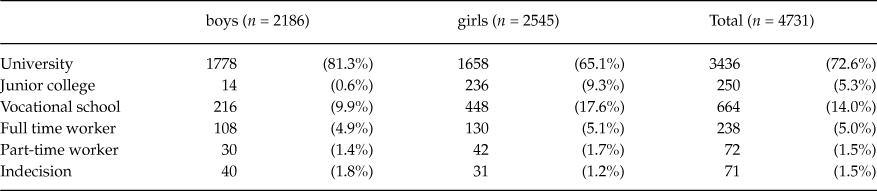
Table 1 shows the frequency of career choice in the autumn semester of third grade high school students by gender. The Chi-square test revealed a significant difference concerning career choice by gender χ2(5) = 261, 83, p < .001. A residual analysis found that the frequency of Junior college and Vocational school career choices for girls were significantly higher than those for boys (p < .01). On the contrary, the frequency of the University career choice for boys was higher than that for girls (p < .01).
Frequency of career choice in high school students

Relation between career choice and time perspective
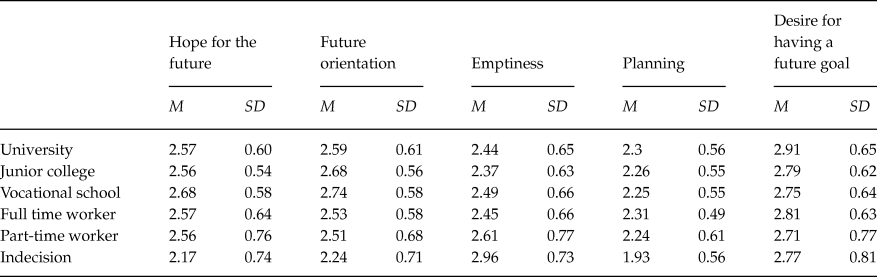
Table 2 shows means and standard deviations for the five subscales of time perspective according to the six different career choices for high school students. A one way ANOVA on career choice revealed significant main effects; Hope for the future F(5, 4641) = 9.95, p < .001; Future orientation F(5, 4669) = 13.63, p < .001; Emptiness F(5, 4688) = 10.62, p < .001; Planning F(5, 4668) = 6.67, p < .001; and Desire for having a future goal F(5, 4679) = 8.93, p < .001. Multiple comparisons using the Bonferroni method concerning the five subscales of time perspective revealed the following significant differences; (a) the score on Hope for the future showed that the Indecision group was significantly lower than the other five groups (p < .05), and the Vocational school group was significantly higher than the University group (p < .05), (b) the score on Future orientation showed that the Indecision group was significantly lower than the University, Junior college, Vocational school and Full-time worker groups (p < .05), and the Vocational school group was higher than the University, Full-time worker and Part-time worker groups (p < .05), (c) the score on Emptiness showed that the Indecision group was significantly higher than the other five groups (p < .05), (d) the score on Planning showed that the Indecision group was significantly lower than the other five groups (p < .05), and (e) the score on Desire for having a future goal showed that the University group was significantly higher than the Vocational school group (p < .05).
Means and standard deviations for the five subscales of time perspective according to career choice

Actual career after graduating from high school
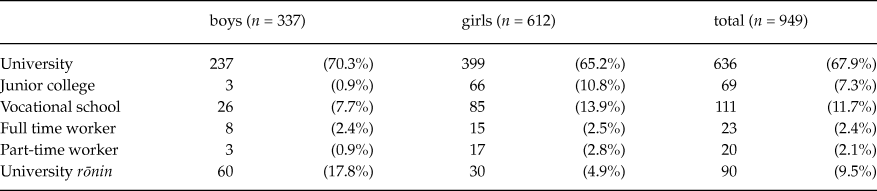
Table 3 indicates the frequency of actual career choice after graduating from high school according to gender. A Chi-square test revealed a significant difference concerning actual career choice by gender (χ2 (5) = 79.02, p < .001). Residual analyses found that the frequency of Junior college and Vocational school career choices for girls was significantly higher than those for boys (p < .01). On the contrary, the frequency of University rōnin for boys was higher than that for girls (p < .01).
Frequency of actual career choice after graduating from high school

Relation between actual career and time perspective
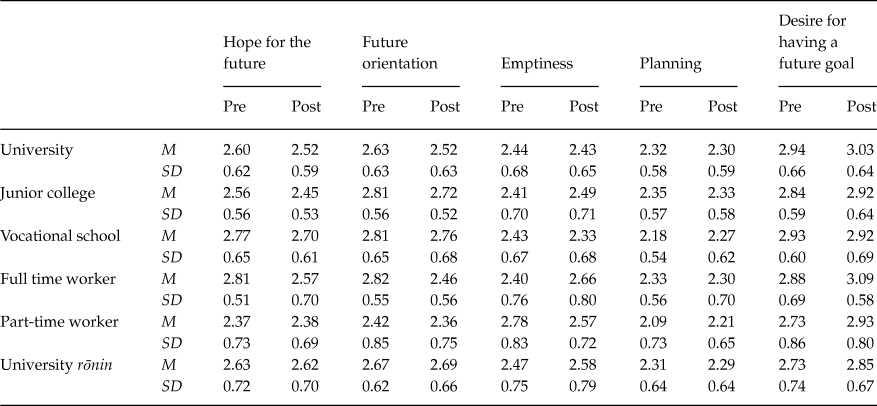
Table 4 shows the means and standard deviations for the five subscales of time perspective according to the six different actual careers after graduating from high school. Mixed-design analysis of variance revealed significant main effects; (a) for Hope for the future, time F(1, 917) = 5.74, p < .05, and career F(5, 917) = 2.99, p < .05, (b) for Future orientation, time F(1, 922) = 9.16, p < .05, and career F(5, 922) = 4.34, p < .01, and (c) for Desire for having a future goal, time F(1, 924) = 5.62, p < .05, and career F(5, 924) = 2.40, p < .05. Interaction between time and career was not significant for the above three subscales. For Emptiness and Planning, no main effect or interaction was found to be significant. Multiple comparisons using the Bonferroni method yielded that for University and Full time worker groups, the score of Hope for the future and Future orientation declined after graduating from high school (p < .05), and for the University group, the score of Desire for having a future goal increased after graduating from high school. The score of Hope for the future and Future orientation in the University group were lower than those for the Vocational school group. The score of Desire for having a future goal in the University group was higher than that for University rōnin.
Means and standard deviations for the five subscales of time perspective according to actual career by transitional year

Note: Pre = pre-transition, third grade in high school; Post = post-transition, after graduating from high school.
Discussion
Firstly, the results indicated a gender difference on career choice and actual career. The results showed that 72.6% of students would choose going to university in the future (81.3 % for boys and 65.1% for girls). The choice of going to junior college and vocational school after graduating from high school was higher for girls (9.3% and 17.6%) than for boys (0.6% and 9.9%). These results indicated that adolescents had slightly different future career plans after graduating from high school according to gender. Usually, student life in university is four years, and two years in junior college. Students in vocational school may spend two or three years learning to attain a job certification. Some junior colleges may offer qualification courses to become a nursery school teacher or other practical technical qualifications. The above gender differences might be related to how they plan their life, as girls would like to study a branch of learning which is directly related to their possible future job after graduating from junior college. That is, girls prefer to choose shorter and more concrete ways to achieve their own future within the society.
On the contrary, boys chose longer paths, such as going to university. After graduating from high school, some adolescents who failed to pass the university entrance examination continued their studies to retake their entrance examination. The results found that the percentage of University rōnin in boys was higher than for girls. The above findings may suggest similar gender differences obtained in studies with undergraduate students. Tsuzuki (Reference Tsuzuki2007) showed these gender differences concerning extension and content of future goals in undergraduate students. Girls set nearer goals in the future than boys, and more goals relating to home matters.
Secondly, the results indicated that the Indecision group obtained the lowest score in Hope for the future, Future orientation and Planning, and the highest score in the Emptiness scale among the six career choice groups. The vocational school group obtained the highest scores in Hope for the future and Future orientation. The university group yielded the highest score in Desire for having a future goal. The indecision group, who do not have any concrete plans after graduating from high school and cannot choose one career out of the possible options, had a negative time perspective. They might see their future pessimistically. The percentage of this type of adolescent is very low (1.5%). They could not decide which is the best path to follow in the future. According to the structural mode of time perspective (Tsuzuki, Reference Tsuzuki1999), it is suggested that this career indecision comes from their weakness concerning a basic cognitive ability to set a future plan.
Thirdly, the results showed that the fluctuation patterns of time perspective during the transition were slightly different among the actual career paths. For Full-time worker group, the score of Hope for the future and Future orientation decreased from third grade of high school to after graduating from high school. For the other five groups, these scores were rather stable during the transition. Getting a job was a very important goal for the Full-time worker group. During the “school to work transition”, their own goal concerning a job was already attained so that they would not need to have new hope in the future. It was suggested that they might be well adjusted to a new circumstance.
Among the “School to school transitions”, the score of Desire for having a future goal in the university group increased during the transition. The university group yielded a lower score than the vocational school group in the Hope for the future and Future orientation subscales. These results may relate to the difference of the learning curriculum in universities and vocational schools. University students generally study liberal arts in their first grade so that it is not easy for them to connect their learning with future life after graduating from university. On the other hand, vocational school prepares a specific curriculum for a certain future job such as cosmetician, mechanic, childcare worker, and so on. Vocational students can easily connect their learning to a future job.
The university group obtained a higher score than the university rōnin group in the Desire for having a future goal. This result may be explained by the following reason. University rōnins have already set an important future goal, which is passing their university entrance examination, and they do not need a further goal.
For the university group, the score of Hope for the future and Future orientation decreased during the transition from high school to university. These results may be explained by the fact that university students have already attained their most important goal (passing their university entrance examination) and are satisfied with their ongoing college life. Therefore, their time perspective is more present-oriented and not future-oriented.
In summary, a distinguishing gender difference on career paths, including career choice in high school students and actual career in high school graduates was found. Moreover, career indecision among high school students has negative effects on the development of time perspective. A longitudinal analysis yielded that the two types of transition, “school to school” and “school to work” have different effects on the fluctuation of time perspective during the transition. These results suggest that the goal content in careers may promote or inhibit the formation of time perspective during the graduation transition.