Introduction
Incentive decision making is a pervasive and fundamental mental operation. Incentive decision making occurs whenever a choice needs to be made between competing alternatives based on the value ascribed to this choice. Current theoretical models (Busemeyer & Johnson, Reference Busemeyer, Johnson, Koehler and Harvey2004; Berridge & Kringelbach, Reference Berridge and Kringelbach2008) propose that incentive decision making encompasses the following processes: (a) forming associations between stimuli and their outcomes, (b) assigning them a value, (c) extracting general principles from contingencies to predict the outcome, (d) implementing perceptual and response biases based on the assigned value, and (e) evaluating outcome and adjusting performance.
The Iowa Gambling Task (IGT; Bechara et al. Reference Bechara, Damasio, Damasio and Anderson1994), a simulated gambling task, is a prototypical tool for investigating the processes underpinning incentive decision making. The IGT requires participants to select cards arranged in four decks. Each card has a monetary value that is revealed only after it has been selected, and can either be a gain or a loss. The participants' aim is to optimize their net gains across trials. Two of the decks have high rewards (gains) but also higher punishments (losses), resulting in monetary loss over time and they are therefore disadvantageous. The other two decks have lower rewards but also lower punishments, making them advantageous in the long term. Participants are not told about the distribution of gains and losses associated with each deck but must deduce this from experience during the task. Over several trials, healthy individuals learn to favour the advantageous cards.
It has long been recognized that poor performance in the IGT may arise from markedly different deficits in the processes that underpin incentive decision making. Busemeyer & Stout (Reference Busemeyer and Stout2002) proposed a mathematical model based on the concepts of expectancy (anticipated outcome based on previous experience) and valence (value ascribed to the outcome) to analyse trial-by-trial behaviour during the IGT. This model (detailed in the online supplementary material) yields three parameters that map on the basic component processes of incentive decision making: (a) attention to gains or losses (motivational parameter), representing the relative influence of wins and losses on the pattern of responding; (b) expectancy learning (learning parameter), a measure of the ability to use associative learning over several trials to anticipate the outcome of future trials; and (c) response consistency, a measure of consistency of the pattern of responding. Based on this model, greater attention to gains would increase the tendency to choose from high gain disadvantageous decks. Individuals with poor expectancy learning would be more influenced by the most recent outcome of a trial and less by associative memories of more distant outcomes. Inconsistent or erratic choices suggest difficulties in applying learned expectancies about outcome during card selection.
The focus of the present study was to examine whether these component processes of decision making are differentially affected in schizophrenia (SZ) and bipolar disorder (BD).
There is renewed interest in incentive- or reward-based processing in the major psychoses that reflects, in part, recent insights into the effect of dopamine on the cognitive and motivational aspects of incentive decision making (Bellani et al. Reference Bellani, Tomelleri and Brambilla2009; Ziauddeen & Murray, Reference Ziauddeen and Murray2010). There is a great deal of evidence that dopaminergic input may be segregated into two complementary and interactive networks; striatal-dorsal prefrontal cortical circuits are implicated in the associative learning that underlies representation of expectancies whereas ventral prefrontal networks are involved in representing the motivational value of reward (Schultz Reference Schultz1998, Reference Schultz2002; Ursu & Carter, Reference Ursu and Carter2005; Frank & Claus, Reference Frank and Claus2006). In SZ there is evidence of disruption in associative learning (Barch, Reference Barch2005) whereas both disorders may have abnormalities in the representation of motivational value (Gold et al. Reference Gold, Waltz, Prentice, Morris and Heerey2008; Chandler et al. Reference Chandler, Wakeley, Goodwin and Rogers2009; Bermpohl et al. Reference Bermpohl, Kahnt, Dalanay, Hägele, Sajonz, Wegner, Stoy, Adli, Krüger, Wrase, Ströhle, Bauer and Heinz2010). Examination of the cognitive and motivational processes during the IGT in SZ and BD would therefore contribute to the ongoing debate about the shared and unique features of the major psychoses (Lawrie et al. Reference Lawrie, Hall, McIntosh, Owens and Johnstone2010).
Our study builds upon evidence that overall performance in the IGT is abnormal in both disorders (Clark et al. Reference Clark, Iversen and Goodwin2001; Beninger et al. Reference Beninger, Wasserman, Zanibbi, Charbonneau, Mangels and Beninger2003; Ritter et al. Reference Ritter, Meador-Woodruff and Dalack2004; Shurman et al. Reference Shurman, Horan and Nuechterlein2005; Christodoulou et al. Reference Christodoulou, Lewis, Ploubidis and Frangou2006; Sevy et al. Reference Sevy, Burdick, Visweswaraiah, Abdelmessih, Lukin, Yechiam and Bechara2007; Bellani et al. Reference Bellani, Tomelleri and Brambilla2009;Premkumar et al. Reference Premkumar, Fannon, Kuipers, Simmons, Frangou and Kumari2008; Lee et al. 2009; Adida et al. Reference Adida, Jollant, Clark, Besnier, Guillaume, Kaladjian, Mazzola-Pomietto, Jeanningros, Goodwin, Azorin and Courtet2011), although there have been negative studies (e.g. Cavallaro et al. Reference Cavallaro, Cavedini, Mistretta, Bassi, Angelone, Ubbiali and Bellodi2003; Martino et al. Reference Martino, Strejilevich, Torralva and Manes2011). Three studies to date, one in BD (Yechiam et al. Reference Yechiam, Hayden, Bodkins, O'Donnell and Hetrick2008) and two in SZ (Sevy et al. Reference Sevy, Burdick, Visweswaraiah, Abdelmessih, Lukin, Yechiam and Bechara2007; Premkumar et al. Reference Premkumar, Fannon, Kuipers, Simmons, Frangou and Kumari2008), have examined IGT performance in terms of Expectancy–Valence (E–V) parameters. Two of these studies were inconclusive (Sevy et al. Reference Sevy, Burdick, Visweswaraiah, Abdelmessih, Lukin, Yechiam and Bechara2007; Yechiam et al. Reference Yechiam, Hayden, Bodkins, O'Donnell and Hetrick2008) whereas Premkumar et al. (Reference Premkumar, Fannon, Kuipers, Simmons, Frangou and Kumari2008) found that patients with SZ showed reduced expectancy learning but were comparable to controls in terms of attention to gains or losses.
Thus our tentative predictions were that, during the IGT, SZ would be associated with reduced expectancy learning, the cognitive component of the task, whereas BD would be associated with increased attention to gains or losses, the motivational component of the task. To test these hypotheses we compared 70 patients with SZ to 70 patients with BD and 140 healthy individuals. We enrolled patients who were in remission to reduce the potential confounding effects of symptoms (Clark et al. Reference Clark, Iversen and Goodwin2001; Sevy et al. Reference Sevy, Burdick, Visweswaraiah, Abdelmessih, Lukin, Yechiam and Bechara2007; Yechiam et al. Reference Yechiam, Hayden, Bodkins, O'Donnell and Hetrick2008; Adida et al. Reference Adida, Jollant, Clark, Besnier, Guillaume, Kaladjian, Mazzola-Pomietto, Jeanningros, Goodwin, Azorin and Courtet2011). Patients were matched to healthy individuals on age, sex and general intellectual ability (IQ) to minimize the influence of demographic and non-specific cognitive factors on task performance (Toplak et al. Reference Toplak, Sorge, Benoit, West and Stanovich2010).
Method
Sample
Participants were recruited at two sites at the University of Verona (UoV), Italy and at the Institute of Psychiatry (IoP), King's College London, UK, as part of an ongoing collaboration (Tomelleri et al. Reference Tomelleri, Jogia, Perlini, Bellani, Ferro, Rambaldelli, Tansella, Frangou and Brambilla2009). This enabled us to enrol sufficient numbers of remitted patients. Based on our previous work (Christodoulou et al. Reference Christodoulou, Lewis, Ploubidis and Frangou2006; Premkumar et al. Reference Premkumar, Fannon, Kuipers, Simmons, Frangou and Kumari2008), we estimated a sample size of 70 patients in each diagnostic group for a power of 0.80 and an α level of <0.05. At both sites, patients were recruited by clinicians' referrals if they (a) were aged 18–65 years and (b) fulfilled DSM-IV-R (APA, 1994) criteria for SZ or BD type I. Age-, sex- and IQ-matched healthy individuals without a personal history of any Axis I disorder or a family history of SZ or BD (up to second-degree relatives) were recruited from the respective local communities through advertisement. Exclusion criteria for the entire sample (patients and controls) included (a) head trauma resulting in loss of consciousness, (b) personal history of neurological or medical disorders, (c) family history of hereditary neurological disorders, and (d) fulfilling DSM-IV criteria for lifetime drug or alcohol dependence and drug or alcohol abuse in the preceding 6 months. The study was approved by the joint South London and Maudsley and IoP National Health Service (NHS) Research Ethics Committee and the Biomedical Ethics Committee of the Azienda Ospedaliera of Verona. Written informed consent was obtained from all participants.
Clinical assessment
At both sites clinical assessment of all participants was conducted by trained psychiatrists using structured diagnostic interviews. Diagnostic reliability (0.958) between sites was confirmed by bilingual psychiatrists on a random selection of 14 patients (10% of the sample). At the UoV, diagnoses were obtained using the Italian version of the Item Group Checklist of the Schedule for Clinical Assessment in Neuropsychiatry (IGC-SCAN) because the group had extensive experience with this instrument and had contributed to its standardization in Italy (Peruzzo et al. Reference Peruzzo, Rambaldelli, Bertoldo, Bellani, Cerini, Silvia, Pozzi Mucelli, Tansella and Brambilla2011). At the IoP, diagnostic assessments were performed using the SCID, patient and non-patient editions (SCID-I/P and SCID-I/NP; First et al. Reference First, Spitzer, Gibbon and Williams2002a, Reference First, Spitzer, Gibbon and Williamsb). At both sites, psychopathology was assessed using the 24-item Brief Psychiatric Rating Scale (BPRS; Luckoff et al. Reference Lukoff, Nuechterlien and Ventura1986) in addition to more disorder-specific instruments: the Hamilton Depression Rating Scale (HAMD; Hamilton, Reference Hamilton1960) and the Young Mania Rating Scale (YMRS; Young et al. Reference Young, Biggs, Zieglar and Meyer1978) for patients with BD and the Positive and Negative Syndrome Scale (PANSS; Kay et al. Reference Kay, Fiszbein and Opler1987) for patients with SZ. The BPRS was chosen as the primary measure of psychopathology as it is applicable to both patient groups and to non-psychiatric populations.
Information about current type and dose of medication was collected for all patients. The comparable daily dose in chlorpromazine equivalents (CPZE) was calculated for current antipsychotic use when relevant (Bezchlibnyk-Butler & Jeffries Reference Bezchlibnyk-Butler and Jeffries2000).
Cognitive assessment
Both sites used the same cognitive battery. Evaluations were conducted by trained psychologists when patients were in remission, which was defined as scoring ⩽3 on the positive and negative BPRS items on the day of the assessment (Nuechterlein et al. Reference Nuechterlein, Miklowitz, Ventura, Gitlin, Stoddard and Lukoff2006). In the BPRS, symptoms are rated from 1 (absent) to 7 (extremely severe). Item scores of 2 and 3 correspond to very mild and mild symptoms.
An estimate of IQ was obtained using the language-appropriate version of the Wechsler Adult Intelligence Scale – Revised (WAIS-R; Wechsler, Reference Wechsler1981; Orsini & Laicardi, Reference Orsini and Laicardi1997). Assessment of incentive decision making was based on the IGT and the Wisconsin Card Sorting test (WCST; Nelson, Reference Nelson1976) was used to examine non-incentive executive function. The computerized versions of the WCST and the IGT used here were previously validated in studies of BD and SZ (Donaldson et al. Reference Donaldson, Goldstein, Landau, Raymont and Frangou2003; Frangou et al. Reference Frangou, Donaldson, Hadjulis, Landau and Goldstein2005, Reference Frangou, Dakhil, Landau and Kumari2006; Christodoulou et al. Reference Christodoulou, Lewis, Ploubidis and Frangou2006; Premkumar et al. Reference Premkumar, Fannon, Kuipers, Simmons, Frangou and Kumari2008; Ruberto et al. Reference Ruberto, Vassos, Lewis, Tatarelli, Girardi, Collier and Frangou2011). These tests were administered at both sites in a fixed order as reported here.
The performance of patients with SZ or BD on the WCST has been examined extensively (Stefanopoulou et al. Reference Stefanopoulou, Manoharan, Landau, Geddes, Goodwin and Frangou2009). The sole purpose of including the WCST here is to serve as a non-incentive decision-making task to aid in interpreting potential group differences between motivational and associative learning dimensions of decision making. The WCST version used consists of four stimulus cards [displaying different shapes (crosses, circles, triangles or stars) in different colours and different numbers] and a single deck of 36 response cards with displays similar to the stimulus cards. Participants were asked to match each response card to one of the stimulus cards on the basis of a series of categories (shape, colour or number) about which they had no a priori knowledge. After each selection, feedback was given and a different response card was displayed. The card-sorting category changed after a number of correct responses. The WCST requires participants to use outcome–feedback to form abstract notions of ‘categories’ for matching stimuli. In this respect the processes of decision making during the WCST closely approximate those involved in the IGT except that the incentive value of the WCST stimuli is very low. At the initial stages of both tasks, participants chose cards randomly as they are not given any information about stimulus–outcome associations. Following feedback, participants gradually learn the stimulus–outcome associations and adapt their responses accordingly. We therefore expected that categories achieved in the WCST would correlate with expectancy learning in the IGT.
During the IGT participants were instructed to choose a card from four decks (A, B, C, D). Each deck had different reward/punishment profiles about which participants had no a priori knowledge. At the beginning of the task, participants received a loan of pretend money and were asked to optimize their gains through their card choices. Each deck had 60 cards and participants were given 100 trials. Decks A and B were ‘disadvantageous’ as deck A had frequent, small-magnitude punishments and deck B had infrequent, but higher, punishments. By contrast, decks C and D were ‘advantageous’ as deck C had frequent, small rewards, and deck D had infrequent, higher rewards. Dividing card selections into five blocks of 20 allowed us to monitor progress over the course of the task. Performance was evaluated using (a) the net score, calculated for each block by subtracting the total number of disadvantageous decks chosen from the total number of advantageous decks [(C + D) – (A + B)], (b) the global net score, which is the sum of the net scores per block, and (c) parameters based on the E–V model. Trial number, card selected in each trial and the associated monetary loss or gain were imported into a text file and analysed in Matlab 6.1 (MathWorks, USA), as described previously (Premkumar et al. Reference Premkumar, Fannon, Kuipers, Simmons, Frangou and Kumari2008) and detailed in the online supplementary material, to calculate the model's three components, as follows. (a) Attention to gains or losses (motivational parameter): this parameter ranges from 0 to 1. Smaller values reflect attention to losses and higher values denote attention to gains, which may lead to a preference for the high-risk disadvantageous decks. (b) Expectancy learning (learning parameter): the expectancy of each deck is adjusted based on the outcome of previous experience of choosing this deck and on the payoff of the most recent choice. This parameter ranges from 0 to 1. Small values indicate small adjustments and larger values reflect greater adjustments influenced by the outcome of the most recent choice rather than past experience. (c) Response consistency (response–sensitivity parameter): this parameter ranges from −5 (random choices) to +5 (consistent choices that are highly dependent on expectancy).
Statistical analysis
We used analyses of variance (ANOVAs) and χ2 tests to examine group differences in age, sex, IQ and BPRS total score. Performance in the IGT was first examined using a block-by-group (SZ patients, BD patients, healthy individuals) mixed factorial analysis of covariance (ANCOVA) of the net score. Additionally, separate ANCOVAs were performed to test for group differences in each of the E–V parameters and in the WCST outcome variables. In all analyses, BPRS and IQ were retained as covariates to remove any variance attributable to non-specific effects of symptoms or IQ. For the IGT analyses, sex was included as an additional factor based on previous reports of sex differences on this task (Reavis & Overman, Reference Reavis and Overman2001). Correlations between performance variables from the IGT and WCST were examined in addition to correlations between performance variables and antipsychotic medication dose at the time of testing, age of onset and duration of illness. The results of these analyses were considered significant at p < 0.005 following Bonferroni correction for multiple testing. We also report effect sizes of selected group differences based on Cohen's d (Cohen, Reference Cohen1998).
The effect of site was investigated in two ways. First, within each diagnostic group we compared the UoV to the IoP sample on each performance variable. All comparisons were non-significant (p < 0.7) and of negligible effect size (d < 0.06). Second, we repeated all analyses using site as an additional independent factor but no main or interactive effects of site were detected. For simplicity we report the results without including site as a factor as it had no effect on the findings. In addition to the primary analyses, we examined the influence of differences in rates of psychosis between the two diagnostic groups and in the prevalence of smoking.
Results
Sample
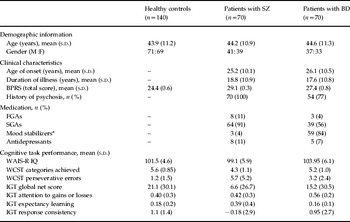
Details of the demographic and clinical characteristics of the sample are presented in Table 1. Twenty-nine patients with SZ, 34 patients with BD and 61 healthy individuals were recruited at the UoV and the remainder at the IoP. There were no group differences in age (F 2,237 = 2.10, p = 0.13), sex distribution (χ2 = 2.39, p = 0.30) or IQ (F 2,237 = 1.17, p = 0.18). The mean total scores (s.d.) for the HAMD and YMRS of the patients with BD were 1.54 (1.73) and 0.81 (0.87) respectively. The PANSS mean total score (s.d.) of patients with SZ was 42 (5.04). The scores on these scales were highly correlated with the total BPRS score (r > 0.7), which was the primary measure of psychopathology. Despite the low levels of psychopathology, there was a significant group difference in BPRS total score (F 2,237 = 51.42, p < 0.0001); patients with BD were less symptomatic than patients with SZ (p = 0.04) but both patient groups had higher scores than healthy individuals (p < 0.0001). The two patient groups did not differ in age of onset (p = 0.38) or duration of illness (p = 0.76). All patients were medicated with a variety of psychotropics. The majority received second-generation antipsychotics (SGAs; olanzapine = 51, risperidone = 29, quetiapine = 23); those on first-generation antipsychotics (FGAs) received injectable formulations. The two patient groups did not differ in mean antipsychotic dose (p = 0.7) [mean CPZE (s.d.): patients with SZ = 497.9 (384.4); patients with BD= 495.4 (299.1)]. Patients prescribed antidepressants were on a variety of selective serotonin reuptake inhibitors (SSRIs; citalopram = 7, sertraline = 4, fluoxetine = 2). Three patients with SZ were prescribed sodium valproate for arousal according to their notes. The mood stabilizers prescribed in the BD group were lithium (n = 31), sodium valproate (n = 23), carbamazepine (n = 1) and lamotrigine (n = 4). None of the patients were on regular benzodiazepines or anticholinergics or had taken any in the preceding 2 weeks. There was a significant difference in the proportion of participants who reported regular cigarette smoking (healthy individuals: 7%; SZ patients: 89%; BD patients: 65%).
Demographic, clinical and cognitive characteristics of the sample

SZ, Schizophrenia; BD, bipolar disorder; M, male; F, female; s.d., standard deviation; BPRS, Brief Psychiatric Rating Scale; FGA, first-generation antipsychotic; SGA, second-generation antipsychotic; WAIS-R, Wechsler Adult Intelligence Scale – Revised; WCST, Wisconsin Card Sorting Test; IGT, Iowa Gambling Task.
a Mood stabilizers include lithium and anticonvulsants.
WCST
Details of participants' performance in the WCST are shown in Table 1. There was a significant effect of group for categories achieved (F 2,276 = 8.89, p = 0.004) and for perseverative errors (F 2,276 = 4.17, p = 0.008). The effects of BPRS score and IQ were not significant (p > 0.25) for either analysis. Patients with SZ achieved fewer categories and made more perseverative errors than the other groups. We repeated the analysis with smoking status (smoking versus non-smoking) as an additional factor; the results remained unchanged and no significant main effect of smoking status was detected (F 2,276 = 0.86, p = 0.42).
IGT
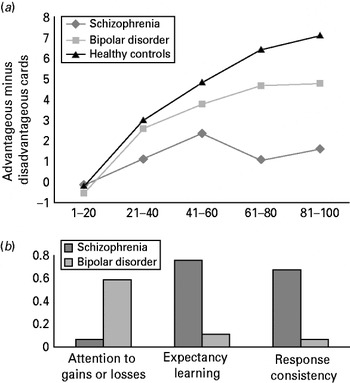
Details of participants' performance in the IGT are shown in Table 1 and Fig. 1. We found a significant effect of group (F 2,276 = 3.93, p = 0.02) and group-by-block interaction (F 2,276 = 8.06, p < 0.0001) on net score. Both patient groups underperformed compared to healthy individuals, with SZ patients performing worse than the other groups. There was a significant effect of group on attention to gain or losses (F 2,276 = 10.89, p = 0.001), expectancy learning (F 2,276= 6.11, p = 0.01) and response consistency (F 2,276 = 12.16, p < 0.0001). There were no main or interactive effects of BRPS score, sex or IQ in any of the analyses (p > 0.1). Patients with BD scored higher on the attention to gains or losses parameter compared to all other groups (p < 0.04) but were comparable to controls in terms of expectancy learning and response consistency. By contrast, patients with SZ were comparable to controls in terms of attention to gains or losses but underperformed in terms of expectancy learning and response consistency compared to both other groups (p < 0.001). We repeated the analysis adding smoking status (smoking versus non-smoking) as a factor; the results remained unchanged and no significant main effect of smoking status was detected (F 2,276 = 0.30, p = 0.58). Within the BD group we also investigated the effect of psychosis on the E–V parameters. First, a multivariate analysis of variance (MANOVA) with the E–V parameters as dependent variables and history of psychosis as an independent factor did not reveal a significant effect of psychosis (F 1,68 = 0.16, p = 0.69). Second, the effect size of the difference between patients with BD with and without a history of psychosis was small for all parameters (d ⩽ 0.26).
(a) Performance in the Iowa Gambling Task. Net score per 20-card block; values represent group means for each block. (b) Effect size of case–control difference in Expectancy–Valence parameters for each patient group.

Correlations between clinical and cognitive data
For the entire sample, the global IGT net score correlated positively with categories achieved in the WCST (r = 0.35, p < 0.0001) and inversely with the number of perseverative errors (r = − 0.24, p = 0.003). Furthermore, categories achieved in the WCST were negatively correlated with expectancy learning (r = − 0.18, p = 0.003). This pattern was also seen when correlations were examined within each diagnostic category separately, with absolute r values of ranging from 0.24 to 0.28 and p < 0.03. No other correlations between performance measures or with clinical measures were significant (p > 0.22). This also applied to correlations between the dose of current antipsychotics and the WCST and IGT outcome variables (absolute r < 0.08, p > 0.24).
Discussion
Our results indicate that, during the IGT, SZ and BD are associated with diagnosis-specific abnormalities in the motivational, cognitive and response selection components of the task. Patients with BD showed increased attention to gains or losses compared to both other groups. Patients with SZ had poor expectancy learning and response consistency compared to patients with BD and healthy individuals. These results were not attributable to non-specific effects of sex, IQ, psychopathology or medication.
Increased incentive salience of gains in BD
Our study confirms previous reports of abnormal incentive decision making in remitted BD patients (Christodoulou et al. Reference Christodoulou, Lewis, Ploubidis and Frangou2006; Adida et al. Reference Adida, Jollant, Clark, Besnier, Guillaume, Kaladjian, Mazzola-Pomietto, Jeanningros, Goodwin, Azorin and Courtet2011). Adida et al. (Reference Adida, Jollant, Clark, Besnier, Guillaume, Kaladjian, Mazzola-Pomietto, Jeanningros, Goodwin, Azorin and Courtet2011) reported that BD patients do not show aberrant responses to penalties during the IGT. Our results extend these findings to demonstrate that patients with BD are more motivated by gains. Our study is also comparable to that of Yechiam et al. (Reference Yechiam, Hayden, Bodkins, O'Donnell and Hetrick2008), who also applied the E–V model when comparing IGT performance between remitted BD patients (n = 14) and healthy controls (n = 14). Although their reported mean of the attention to gains or losses parameter (0.59) was identical to ours, the study was negative because it was underpowered. However, it is important to note that BD patients performed similarly to controls in terms of expectancy learning and response consistency, indicating that their ability to extract and apply expectancies representing the anticipated consequences of choosing a card from each deck was not impaired. We therefore infer that BD patients seem to ‘override’ these cognitive biases because of the higher ‘incentive salience’ placed on gains (Berridge & Kringelbach, Reference Berridge and Kringelbach2008). Our results are also in agreement with Chandler et al. (Reference Chandler, Wakeley, Goodwin and Rogers2009), who found that BD patients displayed a normal understanding of the context in which they were asked to make choices relating to gains or losses; this contextual information, however, had diminished impact on their behaviour. It is worth noting that their BD sample consisted of high-functioning (mean IQ = 122), unmedicated, euthymic university students with minimal duration of illness. This implies that the decision-making strategies identified in this study are also relevant to the earlier stages of the illness and are independent of general intellectual ability. We suggest that the concept of increased incentive salience of gains provides an apt description of the behaviour of BD patients during the IGT as it reflects motivational attitudes that are largely separable from contextual information and planning (Berridge & Kringelbach, Reference Berridge and Kringelbach2008). Although our findings capture trait strategies in incentive decision making in BD, mood state at the time of testing seems to have a significant impact on these strategies. The presence of depression may increase the salience of negative outcomes (Roiser et al. Reference Roiser, Cannon, Gandhi, Taylor Tavares, Erickson, Wood, Klaver, Clark, Zarate, Sahakian and Drevets2009; Adida et al. Reference Adida, Jollant, Clark, Besnier, Guillaume, Kaladjian, Mazzola-Pomietto, Jeanningros, Goodwin, Azorin and Courtet2011) whereas mania has been associated with increasingly erratic and random choices (Minassian et al. Reference Minassian, Paulus and Perry2004; Adida et al. Reference Adida, Clark, Pomietto, Kaladjian, Besnier, Azorin, Jeanningros and Goodwin2008; Yechiam et al. Reference Yechiam, Hayden, Bodkins, O'Donnell and Hetrick2008).
Decreased expectancy learning in SZ
SZ patients had reduced overall performance in the IGT compared to controls, which adds to the existing literature on abnormal incentive decision making in this disorder (Beninger et al. Reference Beninger, Wasserman, Zanibbi, Charbonneau, Mangels and Beninger2003; Ritter et al. Reference Ritter, Meador-Woodruff and Dalack2004; Shurman et al. Reference Shurman, Horan and Nuechterlein2005; Sevy et al. Reference Sevy, Burdick, Visweswaraiah, Abdelmessih, Lukin, Yechiam and Bechara2007; Bellani et al. Reference Bellani, Tomelleri and Brambilla2009;Premkumar et al. Reference Premkumar, Fannon, Kuipers, Simmons, Frangou and Kumari2008; Lee et al. 2009). Confirming our previous report (Premkumar et al. Reference Premkumar, Fannon, Kuipers, Simmons, Frangou and Kumari2008), we found that patients with SZ, in this independent sample, had reduced expectancy learning. This cognitive parameter of the E–V model reflects the influence of associative learning on behaviour; larger values, such as were seen in SZ patients, suggest that choices are guided by the more recent outcomes whereas past outcomes are discounted. Expectancy learning relies on monitoring the distribution of gains and losses for each deck on a trial-by-trial basis and on using this information to extract general rules (expectancies) to predict the likely outcome of card choices. As Bechara et al. (Reference Bechara, Damasio, Tranel and Anderson1998) have shown, the ability to form and maintain online representations of various options during incentive decision making is dependent on executive function mechanisms. The negative correlation observed between expectancy learning and categories achieved in the WCST lends further support to this notion. Our results therefore suggest that incentive decision-making deficits in SZ are linked to impairment in executive functions associated with rule discovery. This may also explain the lack of consistency in their choices. In contrast to BD patients, patients with SZ were comparable to controls on the attention to gains or losses parameter. We infer that SZ patients experienced similar reactions to gains and losses as controls and that underperformance in the IGT in SZ is not attributable to motivational processes. Taken together, these findings can be best understood within the framework proposed by Gold et al. (Reference Gold, Waltz, Prentice, Morris and Heerey2008). According to this model, patients with SZ have deficits in incentive decision making, despite normal motivational influences, because of their reduced ability to process ‘representational complexity’, which refers to the process of simultaneous representation of the multiple motivational and cognitive aspects of decision making. The model further proposes that this deficit represents another facet of executive dysfunction associated with SZ.
Implications for the relationship between BD and SZ
Decomposing the performance of patients with SZ or BD during the IGT using motivational, cognitive and response choice parameters derived from the E–V model yielded significant diagnostic differences. Associative learning underlying the representation of expectancies was disrupted in SZ, which reinforces reports of abnormalities in reward-based learning in this disorder (Gold et al. Reference Gold, Waltz, Prentice, Morris and Heerey2008), and implicates circuits linking the associative striatum with the dorsal prefrontal cortex (Corlett et al. Reference Corlett, Murray, Honey, Aitken, Shanks, Robbins, Bullmore, Dickinson and Fletcher2007). By contrast, BD was associated with increased incentive salience of gains. This is the first study to demonstrate this in remitted BD patients. Bermpohl et al. (Reference Bermpohl, Kahnt, Dalanay, Hägele, Sajonz, Wegner, Stoy, Adli, Krüger, Wrase, Ströhle, Bauer and Heinz2010) have shown that similarly altered attention to rewards in manic BD patients was associated with enhanced activity within the ventral prefrontal cortex, a finding replicated during incentive decision making in remitted BD patients (Frangou et al. Reference Frangou, Kington, Raymont and Shergill2008; Jogia et al. Reference Jogia, Dima, Kumari and Frangou2011). Our results therefore point to dissociable abnormalities in incentive decision making in BD and SZ that could potentially be mapped to different neural circuits.
Methodological considerations
All patients were medicated at the time of testing with a variety of psychotropics. Antipsychotic medication, particularly with FGAs, is known to affect motivational and reward-based processes (Beninger et al. Reference Beninger, Wasserman, Zanibbi, Charbonneau, Mangels and Beninger2003; Juckel et al. Reference Juckel, Schlagenhauf, Koslowski, Filonov, Wüstenberg, Villringer, Knutson, Kienast, Gallinat, Wrase and Heinz2006; Sevy et al. Reference Sevy, Hassoun, Bechara, Yechiam, Napolitano, Burdick, Delman and Malhotra2006; Schlagenhauf et al. Reference Schlagenhauf, Juckel, Koslowski, Kahnt, Knutson, Dembler, Kienast, Gallinat, Wrase and Heinz2008). At the same time, consistent with other colleagues (e.g. Cavallaro et al. Reference Cavallaro, Cavedini, Mistretta, Bassi, Angelone, Ubbiali and Bellodi2003; Premkumar et al. Reference Premkumar, Fannon, Kuipers, Simmons, Frangou and Kumari2008), we did not find significant correlations between IGT performance and antipsychotic dose. It was not possible to conduct subanalyses based on medication type alone as the size of the corresponding groups was small and therefore comparisons would not have been meaningful. There was a significant difference in the proportion of regular cigarette smokers between the diagnostic groups. However, the inclusion of smoking status as an independent factor did not alter our findings and the effect of smoking status was not statistically significant.
To summarize, we have presented data showing that trait incentive decision-making abnormalities in SZ and BD can be attributed to dissociable processes respectively relating to expectancy learning and attention to gains or losses. Further studies are required to examine the relevance of these behavioural observations to the biological correlates of these two disorders.
Supplementary material
For supplementary material accompanying this paper visit http://dx.doi.org/10.1017/S0033291712001304.
Acknowledgements
This work was partly supported by grants from the American Psychiatric Institute for Research and Education (APIRE Young Minds in Psychiatry Award), the Italian Ministry for University and Research and the Italian Ministry of Health (IRCCS ‘E. Medea’) to P. Brambilla.
Declaration of Interest
None.