I. INTRODUCTION
In the last 15 years, ionic liquids (ILs) have received an increasing interest Reference Plechkova and Seddon1 in a myriad of different fields. ILs are defined as salts that form stable liquids near room temperature (T R) Reference Rogers and Seddon2,Reference Weingärtner3 and over a large temperature range. Reference Seddon4 Such salts are composed of cations and anions; the former is usually an organic while the latter may be either organic or inorganic. Initially, the interest in ILs was mainly driven by the possibility to use them as custom-made green solvents. Reference Plechkova and Seddon1,Reference Seddon4,Reference Wasserscheid and Keim5 However, ILs have been used in different applications that go well beyond the initial interest in pure chemical application, due to their unique chemical and physical properties Reference Torimoto, Tsuda, Okazaki and Kuwabata6 such as high electrical conductivity (up to 100 mS cm−1), negligible vapor pressure, null volatility in vacuum, low melting point, no flammability, good thermal stability, and intrinsically smooth surface topography. Reference Borra, Seddiki, Angel, Eisenstein, Hickson, Seddon and Worden7 For instance, ILs have been applied in solar cells, Reference Grätzel8,Reference Trang Pham, Bessho, Mathews, Zakeeruddin, Lam, Mhaisalkar and Grätzel9 in super-smooth mirrors in vacuum and low pressure environments, Reference Borra, Seddiki, Angel, Eisenstein, Hickson, Seddon and Worden7 in high-density data storage, Reference Rutten, Tadesse and Licence10 as lubricants, Reference Bermúdez, Jiménez, Sanes and Carrión11 in batteries, Reference Kim, Jeong, Xue, Balducci, Winter, Passerini, Alessandrini and Appetecchi12 in nanocomposites for immunosensors, Reference Liu, Chen and Ma13 in light sources, Reference Tordera, Meier, Lenes, Costa, Ortí, Sarfert and Bolink14 and for chemical propulsion. Reference Tsuchitani, Takagi, Kikuchi and Miki15
In some applications, it is needed to work with small volumes of ILs, e.g., as imaging fluids for submicrometer-scale monolayer patterns, Reference Hozumi, Bien and McCarthy16 in microreactors, Reference Dubois, Marchand, Fouillet, Berthier, Douki, Hassine, Gmouh and Vaultier17,Reference Perera-Núñez, Méndez-Vilas, Labajos-Broncano and González-Martín18 as contact angle probe fluids, Reference Gao and McCarthy19 in micro- and nano-electromechanical systems (MEMS/NEMS), Reference Palacio and Bhushan20,Reference Pu, Wan, Zhao, Mo, Zhang, Wang and Xue21 in micro-optical applications, Reference Perera-Núñez, Méndez-Vilas, Labajos-Broncano and González-Martín18 or in a variety of sensors. Reference Inaba, Yoo, Takei, Matsumoto and Shimoyama22–Reference Ohsawa, Takahashi, Noda, Kan, Matsumoto and Shimoyama25 However, generally the use of ILs in such applications is limited by the difficulty to obtain reproducible volumes below 0.4–0.2 µL. Reference Dubois, Marchand, Fouillet, Berthier, Douki, Hassine, Gmouh and Vaultier17,Reference Mu, Wang, Zeng and Mason24 This issue is mainly due to the exceptionally high viscosity of the ILs, ranging from 22 mPas up to 40,000 mPas at T R. Reference Plechkova and Seddon1 Some attempts have been made to overcome the challenge to obtain small volumes by using electric fields to generate drops from atomic force microscope cantilever tips Reference Kaisei, Kobayashi, Matsushige and Yamada26 or by using diluted ionogels, instead of pure ILs, to obtain microdrops by inkjet printing (IJP). Reference Delaney, Liberski, Perelaer and Schubert27,Reference Löffelmann, Wang, Mager, Smith and Korvink28 Both approaches have proven to be successful. However, the former is limited to small areas on conductive substrates, whereas the latter has not been fully studied, since only liquids with viscosities below 17 mPas at T R have been tested. Although IJP is well known to be a cost-effective and flexible method for the structuring of functional materials, such as polymers, Reference Cadarso, Perera-Núñez, Jacot-Descombes, Pfeiffer, Ostrzinski, Voigt, Llobera, Grützer and Brugger29,Reference Cadarso, Smolik, Auzelyte, Jacot-Descombes and Brugger30 no detailed study of its application for the formation of IL microdrops has been found in the open literature up to date. IJP has several key advantages such as rapid prototyping capability, high precision dispensing, non-contact multi-material deposition, low material waste, and 3D patterning. Reference De Gans, Duineveld and Schubert31 It is thus relevant to study ILs in relation to IJP for many potential applications.
In this work, microdrop formation of ILs using IJP is studied in detail and experimentally demonstrated. Different ILs with viscosities between 47.4 mPas and >500 mPas have been used. A dimensionless analysis of three of the tested ILs allowed us to determine the range of temperatures at which it is possible to achieve microdrop formation even for very high viscosity ILs. The IJP process is tested in the predicted temperature (T) range using piezo-electric IJP head with a heated nozzle tip (aperture of 50 µm). The process is optimized to obtain stable and reproducible microdrops with the smallest possible volumes. Drop-on-demand (DoD) IJP, defined in this work as the formation of a single or a precise number of stable and reproducible microdrops, is also performed to demonstrate the possibility to deposit controlled volumes onto a substrate in precise positions. Finally, concave optical microlenses are fabricated replicating the deposited IL microdrops in poly(dimethylsiloxane) (PDMS) as a proof-of-concept application.
II. EXPERIMENTAL
A. Materials
All the ILs used in this work were purchased from Sigma-Aldrich and used as received: 1-ethyl-3-methylimidazoliumtetrafluoroborate ([EMIN][BF4]), 1-butyl-3-methylimidazolium tetrafluoroborate ([BMIM][BF4]), 1-hexyl-3-methylimidazoliumtetrafluoroborate ([HMIM][BF4]), 1-decyl-3-methylimidazolium tetrafluoroborate [DMIM][BF4], 1-ethyl-3-methylimidazolium chloride ([EMIM][Cl]), 1-hexyl-3-methylimidazolium chloride ([HMIM][Cl]), 1-butyl-3-methylimidazolium hexafluorophosphate ([BMIM][PF6]), and 1-butyl-3-methylimidazolium methyl sulfate ([BMIM][CH3SO4]).
The substrates onto which we deposited the IL microdrops were polystyrene (PS) (Goodfellow Cambridge Ltd., Huntingdon, England) and silicon (Si) wafers 525 µm thick. PS was used as received, while Si was used either as received or modified by a self-assembly monolayer (SAM) process performed by the evaporation of a trichloro (1H, 1H, 2H, 2H-perfluorooctyl)silane 97% (Sigma-Aldrich) at 110 °C for 30 min.
PDMS (Sylgard 184, DOW Corning Co., Midland, MI) was prepared by mixing the base pre-polymer with the curing agent (10:1, w/w). The mixture was introduced in vacuum for 20 min prior to be used to remove air bubbles. Then the liquid PDMS pre-polymer was poured over a substrate with liquid IL microdrops and cured for 1 h at 80 °C. Afterward, the PDMS was mechanically released from the substrate. The residues of ILs were removed by immersing the PDMS replicas into acetone and using an ultrasound bath for 5 min.
B. IJP technique: Microdrop generation
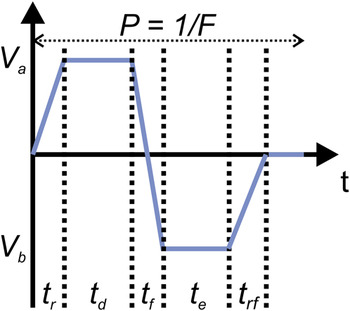
The microdrop generation of the studied ILs is performed using a heated print-head assembly (PH-46H, MicroFab Technologies, Inc., Plano, TX) with a DoD single jet dispensing nozzle (MJ-AT-01-50, MicroFab Technologies, Inc., Plano, TX) with an orifice diameter of 50 µm. The nozzle can be heated up to 130 °C. The formation of the microdrops is observed at the tip of the nozzle using a stroboscopic camera. An image analysis software (JetLab®, MicroFab Technologies) is used to determine the diameter and volume of the generated microdrops that is created by means of a periodic electrical signal sent to the piezo actuator in the nozzle. The parameters of this signal have a significant effect in the generation of the microdrops Reference Wijshoff32 and have been characterized for the studied ILs in this work. Figure 1 shows the shape of the signal used in all the experiments presented in this work. Such signal can be parameterized by positive (V a) and negative (V b) voltages, rise (t r), dwell (t d), fall (t f), echo (t e) and final rise (t rf) times and the frequency (F). To simplify the ulterior characterization some of these parameters have been fixed; pulse amplitude (PA) and pulse length (PL) are defined as follows:
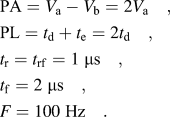 $$\eqalign{ & {\rm{PA}} = {V_{\rm{a}}} - {V_{\rm{b}}} = 2{V_{\rm{a}}}\quad {\rm{,}} \cr & {\rm{PL}} = {t_{\rm{d}}} + {t_{\rm{e}}} = 2{t_{\rm{d}}}\quad {\rm{,}} \cr & {t_{\rm{r}}} = {t_{{\rm{rf}}}} = 1\;{\rm{\mu s}}\quad {\rm{,}} \cr & {t_{\rm{f}}} = 2\;{\rm{\mu s}}\quad {\rm{,}} \cr & F = 100\;{\rm{Hz}}\quad {\rm{.}} \cr}$$
Shape of the periodic signal used to generate the microdrops.

This signal was used for continuous generation of microdrops, to characterize the microdrops in flight, and also in DoD, to prove the capacity to deposit small volumes corresponding to one single microdrop of ILs in precise positions. The positioning of the substrate was done using an X-Y motorized stage (M-ILS100CC, Newport, Irvine, CA).
C. Dimensionless analysis of IL IJP capability
To determine if a liquid, and in particular an ionic liquid, can be printed from a meniscus formed in a nozzle, following two conditions need to be fulfilled: The kinetic energy of the microdrop must be higher than both (i) the surface energy of the meniscus and (ii) the viscous dissipation. Reference Thomas33 The first one is characterized by the Weber number (We), whereas the second one is represented by the Reynolds number (Re). Being d the diameter and ν the relative velocity of the microdrop; and ρ the density, σ the surface tension, and µ the dynamic viscosity of the liquid, both dimensionless numbers can be expressed as
 $$We = {{(d{\nu ^2}\rho )} \mathord{\left/ {\vphantom {{(d{\nu ^2}\rho )} \sigma }} \right. \kern-\nulldelimiterspace} \sigma }\quad {\rm{.}}$$
 $$Re = {{(\rho d\nu )} \mathord{\left/ {\vphantom {{(\rho d\nu )} {\rm{\mu }}}} \right. \kern-\nulldelimiterspace} {\rm{\mu }}}\quad .$$
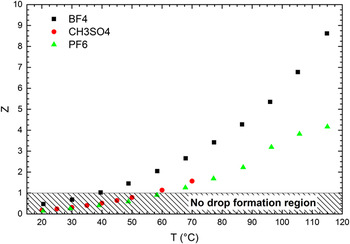
Both conditions can be combined in the dimensionless Ohnesorge number (Oh), which it has been previously demonstrated that its inverse, known as the Z-number (Z), Reference Liu, Tsai, Pai and Hwang34,Reference Derby35 can be used to determine the conditions for microdrop generation Reference Fromm36,Reference Reis, Ainsley and Derby37 since the approximate condition 1 < Z < 10 must be fulfilled. For 1 > Z, break up and microdrop generation will not occur, while for Z > 10 microdrops will be ejected but their formation will be instable, preventing their practical use.
 $$Z = {1 \mathord{\left/ {\vphantom {1 {Oh}}} \right. \kern-\nulldelimiterspace} {Oh}} = {{{Re} \mathord{\left/ {\vphantom {{Re} {(We)}}} \right. \kern-\nulldelimiterspace} {(We)}}^{{1 \mathord{\left/ {\vphantom {1 2}} \right. \kern-\nulldelimiterspace} 2}}} = {{{{(\rho d\nu )}^{{1 \mathord{\left/ {\vphantom {1 2}} \right. \kern-\nulldelimiterspace} 2}}}} \mathord{\left/ {\vphantom {{{{(\rho d\nu )}^{{1 \mathord{\left/ {\vphantom {1 2}} \right. \kern-\nulldelimiterspace} 2}}}} {\rm{\mu }}}} \right. \kern-\nulldelimiterspace} {\rm{\mu }}}\quad {\rm{.}}$$
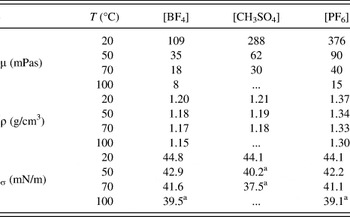
In this work, we have chosen three different ILs as model materials to characterize their inkjet ability and their volume control. The three ILs contain the same cation (1-butyl-3-methylimidazolium) [BMIM] but different anions, namely tetrafluoroborate [BF4], methyl sulfate [CH3SO4], and hexafluorophosphate [PF6]. It is possible to obtain most of their physical properties for a wide range of temperatures from the literature. Reference Jacquemin, Husson, Padua and Majer38–Reference Pereiro, Verdía, Tojo and Rodríguez40 The values for some temperatures are presented in Table I, labeling each IL by its anion. The selected ILs cover a range of viscosities from 109 to 376 mPas at T R.
Dynamic viscosity, density, and surface tension for different temperatures of the three studied ILs. Sources: for [BF4] and [PF6] µ and ρ, Reference Jacquemin, Husson, Padua and Majer38 σ Reference Freire, Carvalho, Fernandes, Marrucho, Queimada and Coutinho39 and for [CH3SO4]. Reference Pereiro, Verdía, Tojo and Rodríguez40

a Extrapolated values assuming a linear behavior.
Using these experimental values and considering d equal to the nozzle diameter (50 µm), it is possible to calculate the Z-number of the three ILs versus T and determine the minimum temperature required to achieve microdrop generation. As shown in Fig. 2, the minimum temperature to achieve microdrop generation is above 40 °C for [BF4] and close to 60 °C for [CH3SO4] and [PF6]. For [BF4], it is also possible to extrapolate the maximum temperature that will allow the generation of stable microdrops, corresponding to approximately 122 °C. Furthermore, it is possible to anticipate that the generation of the microdrops behavior versus temperature changes will be mainly dominated by the viscosity change, since both density and surface tension exhibit marginal variation in the working temperature range.
Z-number of [BMIM][BF4], [BMIM][CH3SO4], and [BMIM][PF6] versus temperature for a nozzle size of 50 µm. No microdrops can be formed for temperatures with Z < 1.

III. RESULTS AND DISCUSSION
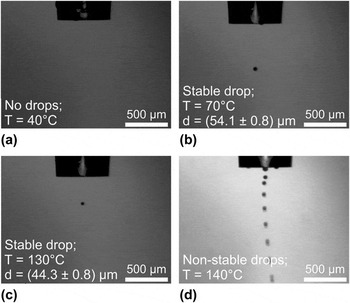
Microdrop generation was tested for [BF4] for temperatures ranging between 40 °C and 140 °C. Figure 3 shows stroboscopic pictures of the tip of the IJP nozzle taken 300 µs after sending the signal represented in Fig. 1 for different nozzle temperatures. As expected, for a temperature of 40 °C [Fig. 3(a)], no microdrops were formed. For temperatures ranging between 50 °C and 130 °C, stable microdrops were formed. However, the diameter of the microdrop changes with the temperature being 64.6 ± 0.1 µm for 50 °C [Fig. 3(b)] and 44.3 ± 0.8 µm for 130 °C [Fig. 3(c)]. The IJP parameters were optimized for each temperature to obtain the smallest possible volume. Finally, for temperatures higher than 130 °C, it was not possible to achieve stable microdrops and multiple microdrops with variable ejection conditions were formed in a single IJP cycle, as can be seen in Fig. 3(d) for a temperature of 140 °C. These results agree with the behavior expected in the theory and the calculated values for the Z-number.
Stroboscopic images of the IJP nozzle tip 300 µs after the pulse signal is sent at different temperatures of the nozzle.

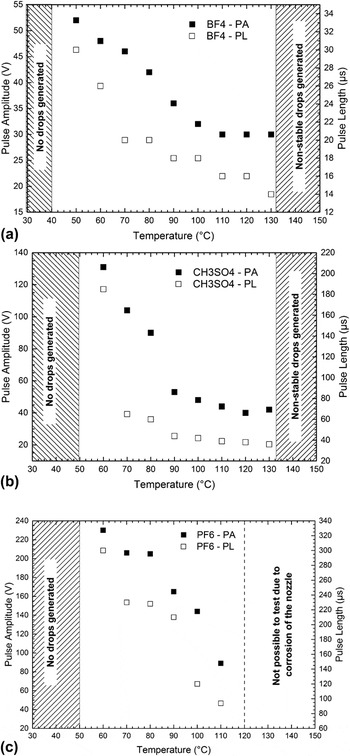
The microdrop generation was also tested for [CH3SO4] and [PF6], with similar results. For both ILs, the IJP parameters were also optimized at each temperature to obtain the microdrops with the minimum possible volume. Figure 4 shows the values of PA and PL at each temperature for [BF4] [Fig. 4(a)], [CH3SO4] [Fig. 4(b)], [PF6] [Fig. 4(c)]. The minimum temperature required to achieve microdrop generation for [CH3SO4] and [PF6] was around 60 °C, as expected from the calculated values of the Z-number. The generation of nonstable microdrops for [CH3SO4] at temperatures above 130 °C was also observed. Conversely, for [PF6], it was not possible to obtain microdrops at temperatures above 110 °C because it started to corrode the nozzle, preventing its use at higher temperatures. As it can be seen in Fig. 4 for the three ILs, the required PA and PL decreased with the temperature. This is consistent with the expected behavior, since an increased temperature is translated into a reduced viscosity and thus less energy is required to achieve the formation of the microdrops.
Optimal IJP parameters (PA: left axis, PL: right axis) at different temperatures for (a) [BF4], (b) [CH3SO4], and (c) [PF6].

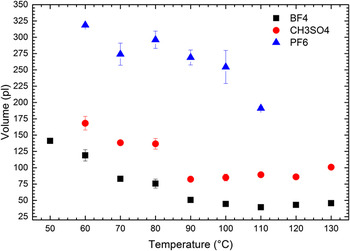
This behavior is also consistent with the reduction of diameter of the ejected microdrops observed in Fig. 3. Figure 5 shows the evolution of the volume of the microdrops for each of the studied ILs. The volume is ranging between 141.1 ± 0.5 pL at 50 °C and 43 ± 3 pL at 120 °C for [BF4], between 168 ± 10 pL at 60 °C and 86 ± 3 pL at 120 °C for [CH3SO4], and between 319 ± 1 pL at 60 °C and 191 ± 3 pL at 110 °C for [PF6]. Hence, for the three materials, the volume decreases with the temperature as it was expected. For both [BF4] and [CH3SO4], the volume tends to stabilize at temperatures above 90 °C before reaching the nonstable microdrops region. The evolution of the volume is analogous to the one of the viscosity for these materials, Reference Jacquemin, Husson, Padua and Majer38,Reference Pereiro, Verdía, Tojo and Rodríguez40 indicating that the viscosity is driving the behavior of the volume in front of temperature. Although the surface tension is very similar for the three studied ILs, the density of [PF6] is larger. This can explain the bigger volume measured for the microdrops of this liquid.
Volume of the ejected microdrops versus temperature for [BF4], [CH3SO4], and [PF6].

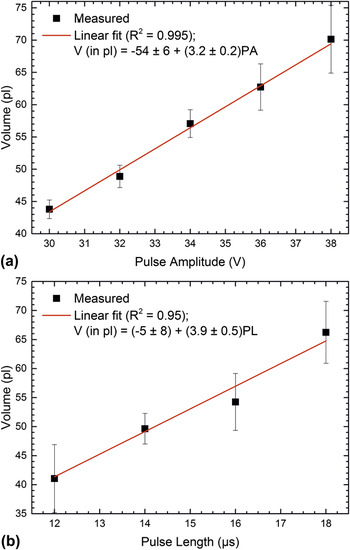
Although the results presented in Fig. 5 demonstrate that it is possible to control the deposited volume of the ILs by controlling the temperature, it will be difficult to control the volume at the picoliter range using this method. Nevertheless, it is possible to modify the volume of the formed microdrops at a fixed temperature controlling the IJP parameters, namely PA and PL. Figure 6 shows the volume of [BF4] microdrops generated at a temperature of 110 °C for (a) a fixed PL of 16 µs and (b) a fixed PA of 34 V. Both PA and PL were fixed at these values because it was experimentally observed that they were the ones allowing a larger range of possible volumes.
Volume of [BF4] ejected microdrops at a temperature of 110 °C versus (a) PA for a fixed PL of 16 µs and (b) PL for a fixed PA of 34 V.

It was not possible to obtain microdrops for PAs smaller than 30 V and PLs below 12 µs, since the liquid did not have enough kinetic energy to overcome the surface energy of the meniscus and the viscous dissipation. On the other hand, nonstable microdrops were formed for PAs above 38 V and PLs larger than 18 µs. In both cases, the volume increases linearly with PA or PL, respectively, in the working range. For PA, the slope was 3.2 ± 0.2 pL/V and the total range was 8 V, resulting in a maximum variation of 26 ± 5 pL. For PL, the slope was slightly larger, 3.9 ± 0.5 pL/µs, while the range was shorter, 6 µs, resulting in a maximum variation of 25 ± 8 pL. Hence, it is possible to conclude that changes on PA and PL have equivalent effect in controlling the volume of the generated microdrop. However, PA exhibits a reduced deviation. So to achieve the highest precision, it would be recommended to optimize PL to generate the microdrops with the minimum deviation and then modify PA to obtain the desired volume. These results prove the capability of IJP not only to obtain very small volumes of ILs but also to control the exact amount of volume with high precision.
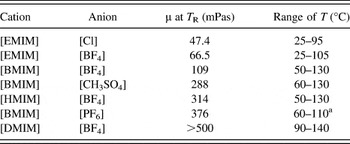
In addition to the detailed study performed for [BMIN][BF4], [CH3SO4], and [PF6], the capacity to obtain microdrops using IJP has been tested for additional ILs with different cations and/or anions. Table II summarizes all the different ILs that have been tested. As can be seen in Table II, it was possible to generate microdrops of ILs with viscosities above 500 mPas at T R. These results validate the capability and versatility of IJP to generate volumes of ILs in the picoliter range.
Summary of the microdrop generation study for different ILs.

a Not possible to test higher temperature.
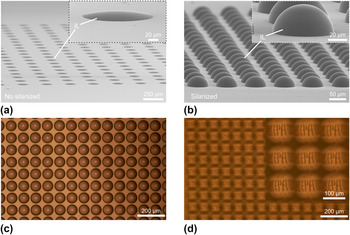
Additionally to the possibility to generate and control small volumes of ILs, IJP also provides the capability to deposit such small volumes at precise positions on a substrate, via DoD deposition. A silicon wafer has been used as the substrate for the deposition because it can be directly used to perform scanning electron microscope (SEM) images without any metallization. Figure 7 shows SEM images of two arrays of [BMIM][BF4] single microdrops deposited onto (a) bare Si and (b) Si with a SAM layer. The position of the microdrops was controlled by moving the substrates using an X-Y motorized stage. In both cases, each microdrop contains the same target volume (43 ± 3 pL) but the distribution of the ILs in the surface is drastically different. The ILs spread on the bare Si tending to form thin films. The microdrops deposited on the Si covered with a SAM layer tend to confine into high aspect ratio microdrops. This difference is due to the difference in the surface energy of both substrates and agrees with the expected behavior, as it has been observed and studied in a previous work. Reference Perera-Núñez, Méndez-Vilas, Labajos-Broncano and González-Martín18 Since no solvent is involved in the process, the IL microdrops are deposited on the substrate with their final size and it is possible to place them with a high density. Using PS as the substrate for the deposition, it was possible to reach a measured minimum distance between two microdrops of only 5 µm, equivalent to the precision in the experimental setup. Such dense microdrops array has subsequently been replicated into PDMS. This replication process has been previously demonstrated Reference Perera-Núñez, Méndez-Vilas, Labajos-Broncano and González-Martín18 but in this work we extend this work toward ordered arrays with a well-controlled volume on each microdrop. The replicated array can be seen in Fig. 7(c). The replicated structures can be directly used as concave lenses, as shown in Fig. 7(d) by superimposing the microlens array onto the printed EPFL logo, magnifying it, or as a mold for the fabrication of convex microlenses into polymeric materials. The capability to obtain and reproduce distributed IL arrays with controlled volume is of capital relevance for the use of this technique in future applications.
SEM pictures of [BF4] deposited over (a) a bare silicon substrate and (b) a silicon substrate with SAM layer. Optical microscope images of (c) a PDMS replica of an array of [BF4] microdrops and (d) the same array acting as a lens, while superimposed to the printed EPFL logo.

IV. CONCLUSIONS
In this paper, the generation of IL microdrops using IJP has been studied for materials with viscosities at room temperature (T R) up to 500 mPas, with a total of 7 different ILs tested. A dimensionless analysis done on 3 different ILs with viscosities above 100 mPas shows that, although such materials are not printable at T R, it is possible to determine the minimum temperature necessary to achieve stable microdrop generation. The experimental results have validated this study showing that microdrop generation is only possible for temperatures above 50 °C or 60 °C, and that nonstable drops start appearing for temperatures above 130 °C. IJP parameters, namely pulse amplitude (PA) and pulse length (PL), have been optimized to obtain the smallest possible volume per microdrop at each temperature, ranging between 43 ± 3 pL for [BMIM][BF4] at 120 °C and 319 ± 1 pL for [BMIM][PF6] at 60 °C. Furthermore, we showed that it is possible to control the volume of a microdrop with a variation of 3.2 pL by tuning the IJP parameters at a fixed temperature. We also demonstrated the deposition of the IL microdrops onto a substrate with high position control in the order of 5 µm. As a proof of concept, an array of IL microdrops has been replicated into PDMS to be used as a concave microlens array. These results demonstrate that it is possible to generate and precisely place small volumes of ILs, which is of great relevance for a large number of applications, as for example in micro-chemical devices, MEMS/NEMS, microreactors, sensing, solar energy microsystems, and so forth.
ACKNOWLEDGMENTS
This work has been partially funded by the IAPP Marie Curie action ACAPOLY (no PIAP-GA-2008-218075) of the 7th Framework Program of the EU, the Spanish Ministry for Science and Technology (MAT2009-14695-C04-01), the Junta of Extremadura (GRU10149), and FEDER. Julia Perera-Nuñez acknowledges Junta de Extremadura for a predoctoral grant. The authors are pleased to acknowledge the EPFL Center of MicroNano Technology (CMI) for their valuable discussions and help.